Tag Archives: Tom Wolf

Birthing a Legacy: Ceremonial bill signing celebrates Hershey woman’s 7-year quest to improve Pennsylvania’s newborn screening laws

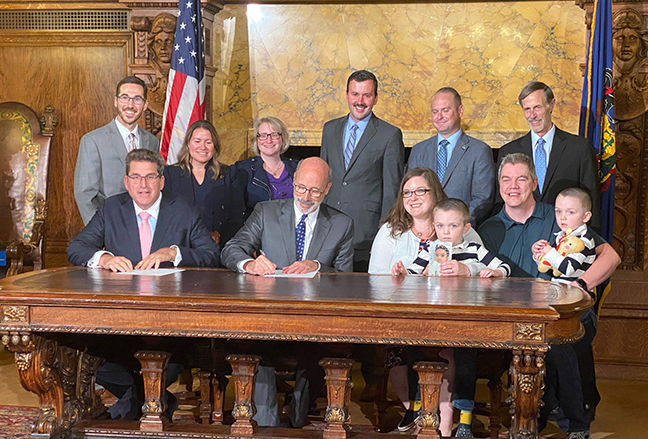
Pennsylvania Gov. Tom Wolf ceremonially signs a bill to expand medical screening for newborns, flanked by state Sen. John DiSanto and Lesa and Brennan Brackbill and their twin sons.

Lesa Brackbill experienced a full-circle moment earlier this week—closing the loop on seven years of advocacy dedicated to Pennsylvania’s newborn screening procedures.

On Tuesday, Gov. Tom Wolf held a ceremonial bill signing, flanked by the Brackbill family, of Hershey, and state Sen. John DiSanto (R-15) representing part of Dauphin, as well as Perry County.

“It was definitely a redemptive moment,” said Brackbill, who also noted the significance of the timing.

Almost exactly two years ago, on Sept. 21, 2020, Senate Bill 983 went to committee. Sponsored by DiSanto, the bill proposed to widely expand the medical screening panel given to newborn babies—and to make that panel the standard of care—across all Pennsylvania hospitals. Those proceedings, held during the pandemic, were closed to the public.

Lesa and her husband Brennan watched lawmakers vote via livestream, in the fall of 2020, from their home.

“I will never forget the day we watched the final floor vote—seeing it pass unanimously. We both cried,” Brackbill said. “Because it happened during the pandemic, we never expected to have the chance to meet the governor and have the ceremonial signing.”

But about a week ago, the governor’s office called the Brackbills, asking if they’d like to attend a ceremonial event, celebrating the bill’s original signing into law as part of Act 133 in November of 2020 by Gov. Wolf.

“It meant a lot [to have this week’s ceremonial signing] because we got to show the governor Tori’s picture—it made it all worthwhile,” Brackbill said.

The Brackbills’ daughter, Victoria (“Tori”), was born in July 2014, and passed away on Easter Sunday 2016, 14 months after her diagnosis of Krabbe (pronounced “crab-ay”) disease, a severe neurological condition that can be corrected when diagnosed at birth. The Pennsylvania hospital where Tori was born did not regularly screen for Krabbe, and she wasn’t diagnosed until 5 months of age. That’s when Brackbill’s research and advocacy began.

Today, the Brackbill family includes 4-year-old identical twin boys, who attended this week’s ceremonial signing at the capitol. And Lesa Brackbill had the opportunity to tell the governor about the law’s impact. Since the state’s new screening policies went into effect, four babies with Krabbe have been diagnosed.

“It’s stunning, for a rare disease that has a 1 in 100,000 incidence rate,” Brackbill said. “You could tell the governor was happy to hear that. And he asked how close we were to a cure for Krabbe, and I had the chance to tell him that we’re close—there are currently two gene therapy clinical trials right here in Pennsylvania.”

Babies born in Pennsylvania hospitals are now screened for 63 medical conditions, making it the state with the seventh-highest number of newborn medical tests. Prior to the new law—and Brackbill’s advocacy—Pennsylvania ranked second-to-last because only 10 newborn screening tests were mandated statewide, although some hospitals such as the Penn State Health Milton S. Hershey Medical Center screened for additional conditions.

In addition to expanding newborn screening panels, the new law empowers the Pennsylvania Newborn Screening Technical Advisory Board to make any future changes needed to newborn medical tests. Brackbill, who now serves as a parent advocate member of one of that board’s subcommittees, said “experts should be deciding these things—not legislators.” However, Brackbill is thankful to all legislators who agreed to champion her cause, especially DiSanto.

“It meant a lot to us, that Senator DiSanto was willing to embrace our family and fight with us,” she said.

DiSanto’s sponsorship marked Brackbill’s third attempt to have legislation passed.

“Lesa’s passion and purpose quickly inspires everyone she meets, convincing me that she would ultimately succeed in turning personal tragedy into triumph,” said DiSanto. “I readily agreed to join this important cause to help avoid other young families and newborns enduring such unthinkable loss. This legislation was an opportunity to make a lasting impact of saving young lives, and it has been a privilege to honor Lesa and Tori in this special way.”

But Brackbill isn’t done fighting for Pennsylvania’s babies and families. Earlier this year, she applied her advocacy skills to help other mothers grieving the loss of their children and pursuing a similar legislative journey. It resulted in legislation that screens babies for a virus, cCMV, if they fail newborn hearing tests.

Empowering other parents through advocacy skills is now Brackbill’s personal and career goal. She serves on the boards of numerous national organizations dedicated to Krabbe and newborn screening, and she has a full slate of upcoming speaking engagements around the country. On the heels of this week’s ceremonial bill signing, Brackbill addressed the Pennsylvania Rare Disease Advisory Council Stakeholder Summit in Harrisburg. She notes the disparity between all 50 states’ newborn screening procedures, as well as the disparity among European countries.

“I think I will be involved in newborn screening the rest of my life—or until every treatable condition is addressed,” said Brackbill. “Although I wish I had my 8-year-old daughter, I know without a doubt this was meant to be my journey. My ultimate goal is to give innocent babies a chance at life that my Tori didn’t get—and if I can save other parents that pain, it’s worth it.”

TheBurg first covered Lesa Brackbill’s advocacy journey in 2018, which you can read here.

If you like what we do, please support our work. Become a Friend of TheBurg!

Continue Reading

The Bridge receives $4 million state grant to spur renovation of former Bishop McDevitt building

A rendering of the The Bridge Ecovillage, once completed

A proposal to renovate and repurpose the former Bishop McDevitt High School has new energy, as the state has announced a $4 million grant for the project.

On Friday, Gov. Tom Wolf announced grants through the state’s Redevelopment Assistance Capital Program (RACP), including funds for The Bridge Ecovillage project at 2200 Market St. in Harrisburg.

According to the state, the grant would help fund the renovation of the first floor of the former high school into a facility called the JEDI (justice, quality, diversity and inclusion) Innovation Center.

Once completed, the center will include a community concert/lecture hall, library, co-working space, rooftop garden, community kitchen, fresh foods cafe and a full-service medical clinic, according to a release from state Rep. Patty Kim (D-103).

“This funding will allow for this unique building to once again house teaching, education and recreational opportunities for Harrisburg’s young people,” Kim said. “The creation of the JEDI Innovation Center is an opportunity to enrich the lives of our residents and make our city a better place to call home.”

The Bridge Ecovillage’s main building, the former Bishop McDevitt High School

Garry Gilliam, a Harrisburg native and former professional football player, heads up the Bridge as founder and CEO. He and several partners announced the project in late 2019 and ceremoniously broke ground on it in November 2020.

The grant would help finance the first phase of the build-out of the planned mixed-use project that includes numerous components, including housing, retail, urban agriculture, education and entertainment.

The 115,000-square-foot building served as Bishop McDevitt High School for about eight decades before the school relocated to a new campus in Lower Paxton Township in early 2012.

A representative for The Bridge could not immediately be reached for comment.

Click here for a related story on other projects that received RACP grants on Friday.

If you like what we do, please support our work. Become a Friend of TheBurg!
Continue Reading

Local places of worship, nonprofits receive funding for security, safety enhancements

Chisuk Emuna Congregation, a recipient of the Nonprofit Security Grant Program funding

Friday starts off a holiday weekend celebrated by many local religious communities.

The day before, state officials announced funding to support the safety of places of worship and local nonprofits.

Through the commonwealth’s Nonprofit Security Grant Program, a handful of Harrisburg-area nonprofits will receive a combined $132,201 in funds.

“This program exists in order to provide the necessary funds to update security, training and safety procedures to protect nonprofit organizations from violent attacks, hate crimes and acts of terrorism,” said Rep. Patty Kim (D-103). “I’m pleased to see funding will be provided to organizations in order to protect local residents and preserve their right to worship and gather in our community safely.”

According to Kim, this state program was created following the 2018 shooting at a synagogue in Pittsburgh’s Squirrel Hill neighborhood, a tragedy that resulted in the deaths of 11 people.

The following nonprofits in the 103rd legislative district, which covers all of Harrisburg and several adjacent east shore communities, have been approved for the listed amount:

  • YWCA Greater Harrisburg, $6,895
  • Metropolitan Community Church of the Spirit, $15,439
  • Islamic Center Masjid Al-Sabereen, $74,436
  • Chisuk Emuna Congregation, $10,503
  • Bochasanwasi Shri Akshar Purushottam Swaminarayan Sanstha, $24,928

The grant program is administered by the Pennsylvania Commission on Crime and Delinquency.

Awardees can use the funds for safety and security planning, security equipment and technology, training, building upgrades, vulnerability and threat assessments and other security enhancements.

Eligible organizations are chosen based on substantiated prior threats or attacks they have faced because of ideology, beliefs or mission; buildings of symbolic historic or regional value that they operate in; and/or based on findings from previous threats or vulnerability assessments, according to the PA House of Representatives.

These organizations may be at risk for single bias hate crime incidents as identified by the FBI’s Hate Crime Statistics publication, according to the state. The categories include race/ethnicity/ancestry, religion, sexual orientation, disability, gender and gender identity.

Gov. Tom Wolf also announced on Thursday that, in total, over $5.23 million in the security grant program funding will go to 120 churches, synagogues, mosques, temples and other nonprofit organizations across the commonwealth.

“This is an investment in the safety and security of the diverse communities that are the tapestry of Pennsylvania,” Wolf said. “It’s unfortunate that hate continues to surface here, hurting Pennsylvanians and tearing apart our communities. I will continue to stand with and support these communities in any way I can.”

For more information on the Nonprofit Security Grant Program and for a full list of Pennsylvania awardees, visit their website.

If you like what we do, please support our work. Become a Friend of TheBurg!

 

Continue Reading

New program offers grants to area’s devastated hospitality industry

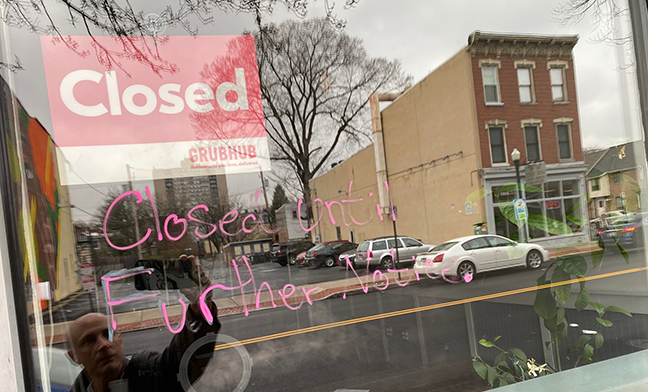
In March 2020, most area restaurants closed for extended periods and many still have not fully recovered.

A new grant program is targeting one of the hardest-hit sectors of the local economy—our area’s large hospitality industry.

Starting on March 15, hospitality-related businesses can apply for the statewide COVID-19 Hospitality Industry Recovery Program (CHIRP), which offers financial help for hotels, restaurants and bars.

The program offers grants of up to $50,000. To be eligible, businesses must have fewer than 300 employees and a tangible net worth less than $15 million.

“There are so many Dauphin County businesses that have endured closures, capacity crunches, and staff lay-offs during this unprecedented pandemic,” Commission Chair Jeff Haste said. “These funds will serve as much-needed lifelines.”

Recently, Gov. Tom Wolf announced the $145 million program throughout Pennsylvania’s 67 counties. Dauphin County’s portion is $3.1 million, and Perry County has been allotted just over $500,000.

A business is eligible if it:

  • Has a North American Industry Classification System (NAICS) designation within the Accommodation subsector (721) or Food Services and Drinking Places subsector (722) and where accommodations, food or drink is served to or provided for the public, with or without charge.
  • Has fewer than 300 full-time equivalent employees.
  • Has a maximum tangible net worth of not more than $15 million.
  • Was in operation on Feb. 15, 2020 and remains in operation and does not intend to permanently cease operations within one year of the date of application.
  • COVID-19 has had an adverse economic impact on the eligible applicant that makes the grant request necessary to support the ongoing operations of the eligible applicant.

Grants are being administered through Certified Economic Development Organizations, which, in our area, includes the Capital Region Economic Development Organization (CREDC).

Joe Massaro, general manager of the Hilton Harrisburg, emphasized the need for this program, saying that hotels have experienced a 78% drop in business since the COVID-19 pandemic began almost a year ago.

“The CHIRP program will provide much-needed relief to devastated hospitality industry businesses in Dauphin County,” Massaro said.

CREDC plans to hold a webinar on March 11 to offer details about the program and how to apply. To register, visit https://web.harrisburgregionalchamber.org/events/COVID19Hospitality%20Industry%20Recovery%20Program%20Guidance%20Webinar-3551/details

For more information for Dauphin County businesses: www.harrisburgregionalchamber.org/chirp/dauphin  

For more information for Perry County businesses:
www.harrisburgregionalchamber.org/chirp/perry


Support quality local journalism. Become a Friend of TheBurg!

Continue Reading

Enhanced coronavirus restrictions to expire on Jan. 4; vaccine “dashboard” announced

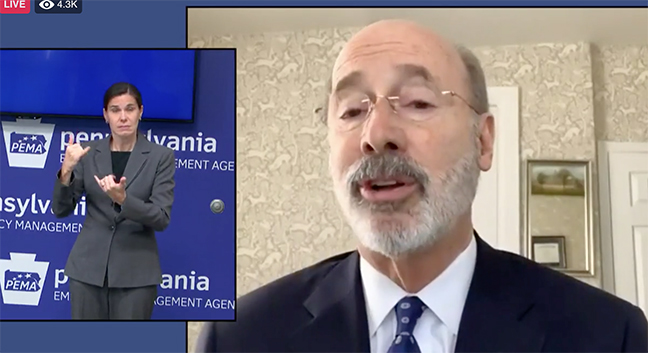
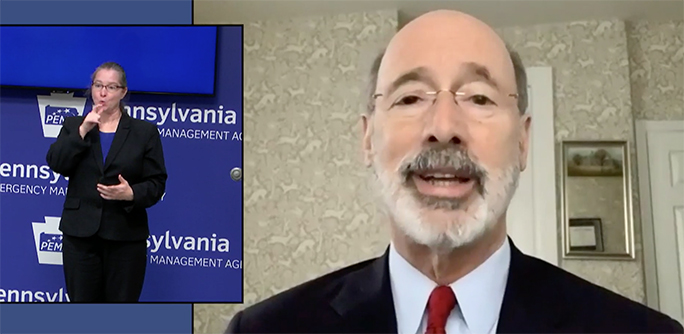
A screen shot of PA Gov. Tom Wolf today

Extra coronavirus restrictions imposed three weeks ago in PA will expire as planned on Jan. 4.

In a virtual press briefing, Gov. Tom Wolf today made that announcement, ending speculation that he might extend them further into the winter.

Wolf said that he’s been encouraged by what he called a “plateauing” of new COVID-19 cases in the commonwealth, as well as the direction of the statewide positivity rate, which stands at 15.1%. It’s fallen for two straight weeks after reaching a high of 16.2%.

Today, the state Department of Health reported 8,545 newly diagnosed cases of coronavirus. Earlier in December, average daily new case rates exceeded 10,000 for about two weeks.

Disease death rates continue to be high, and today, the department reported 267 new disease fatalities over the past 24 hours.

Despite the recent reduction in cases, Wolf said, “This does not mean that we’re out of the woods, not by any means.”

On Dec. 10, Wolf announced the enhanced restrictions, which included a ban on indoor dining, the closure of gyms and entertainment venues and a ceiling on indoor gatherings to 10 people and outdoor gatherings to 50 people.

At 8 a.m. on Jan. 4, those limitations will be lifted, but the prior, less severe restrictions will remain, which allow for indoor dining at reduced capacity and for the reopening of closed businesses, such as gyms and theaters. The mask mandate will remain.

In addition, health Secretary Rachel Levine today said that her department has debuted a new “COVID-19 vaccine dashboard,” which she described as a “great new tool for people to follow the administration of the vaccine in Pennsylvania.”

The dashboard includes data such as vaccination by county and by demographic categories. Health care workers are the first to receive vaccines in PA, Levine said.

Wolf today counseled patience, saying that, while distribution has begun, it will be some time before most of the general public has access to the vaccine.

“We anticipate it will be months, not weeks,” he said.

Support quality local journalism. Become a Friend of TheBurg!
Continue Reading

Italian Lake tree lighting goes virtual due to new coronavirus restrictions

Italian Lake in Harrisburg

An outdoor tree lighting planned for this weekend has become a virtual event, according to organizers.

The Italian Lake event on Saturday now will take place virtually, given Gov. Tom Wolf’s order yesterday limiting outdoor gatherings, said event sponsor Bethesda Mission.

“We ask everyone to please stay home and watch the live stream of the ceremony on our Facebook page,” Scott Dunwoody, executive director. “We appreciate your cooperation in this, and we apologize for inconveniences and disappointments.”

According to Bethesda Mission, Tom Russell, chief meteorologist from CBS21, will host the ceremony, and Cindy Mallow, Bethesda’s director of development, “will share the meaning of Christmas.” Shelley Brooks, director of Bethesda Women’s Mission, will share what’s happening at the shelter, and there will be a special appearance by Women’s Shelter guests as they light the tree, according to Bethesda.

On Thursday, Wolf issued an order that re-imposed certain restrictions due to the surge in COVID-19 cases. These include limits on outdoor gatherings to fewer than 50 people, leading to the change in plans for the event.

The tree lighting ceremony begins at 5 p.m. on Saturday on Bethesda Mission’s Facebook page.

For more information, please visit ChristmasItalianLake.com. Donations can be given at BethesdaMission.org/Donate.

Support quality local journalism. Become a Friend of TheBurg!
Continue Reading

Restrictions re-imposed on restaurants, gyms, gatherings through the holiday season

Gov. Tom Wolf during the virtual press conference on Thursday

Gov. Tom Wolf on Thursday tightened restrictions once again on certain businesses and on indoor gatherings as we head into the height of the holiday season.

In a virtual press conference, Wolf said that an unrelenting surge of COVID-19 cases and deaths in PA forced him to re-impose restrictions not seen since the initial statewide lockdown in March and April.

“The work we do now to slow the spread of COVID-19 is not only crucial to keeping our fellow Pennsylvanians safe and healthy,” said Wolf, who recently tested positive for the virus. “It will help all of us get back to normal, and back to all of the things we’ve missed, faster.”

The new restrictions begin at midnight on Saturday and are slated to last more than three weeks, through Jan. 4.

The newly imposed restrictions include a ban on indoor restaurant dining and the closure of gyms and entertainment venues, such as theaters, museums and casinos. Outdoor and takeout dining and takeout alcohol sales will still be allowed.

Most other businesses may remain open at 50% of maximum capacity.

In addition, indoor gatherings and events of more than 10 people are prohibited. Religious observances are an exception, though religious groups are “strongly encouraged” to find alternatives to indoor worship. Outdoor gatherings and events are limited to a maximum of 50 people.

All K-12 and youth sports will be suspended, though collegiate sports can continue according to CDC and health department guidelines.

“With these measures in place, we hope to accomplish three goals: First, stop the devastating spread of COVID-19 in the commonwealth. Second, keep our hospitals and health care workers from becoming overwhelmed. And third, help Pennsylvanians get through the holiday season—and closer to a widely available vaccine—as safely as possible,” Wolf said. “This is a bridge to a better future in Pennsylvania.”

Coronavirus cases have been growing steadily since late September and now are at their highest levels since the pandemic began in PA in March.

Just today, the commonwealth announced 11,972 new cases and 248 newly reported fatalities from the disease. This brings total diagnoses to 457,289 and deaths to 12,010 in PA.

“Each of the last two days we have reported the highest number of deaths since the beginning of the pandemic,” Dr. Rachel Levine said.

The testing positivity rate has also surged over the past two months and now stands at 14.4% over the past week. It was below 5% through much of the summer, but has risen steadily since. COVID-19 hospitalizations have also soared and now stand at 5,852 patients.

“We know that COVID-19 thrives in places where people gather together,” Wolf said. “Therefore, these mitigation measures target high-risk environments and activities and aim to reduce the spread of this devastating virus.”

Continue Reading

Burg View: Debt of Gratitude

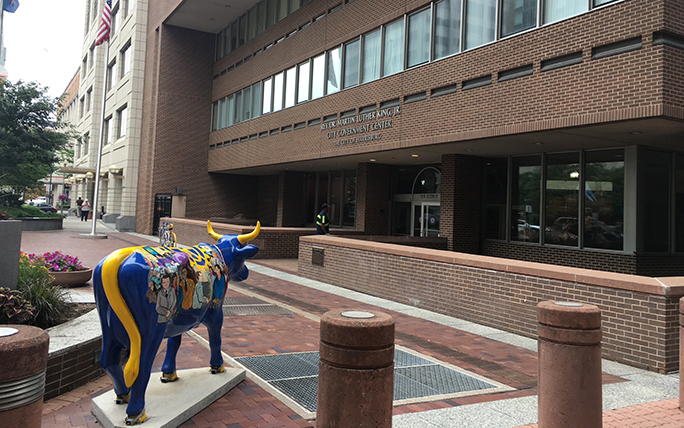
Harrisburg’s MLK Jr. City Government Center

I invariably get mail from some upset readers when TheBurg writes on two issues.

The first is when we mention “Vision Zero,” Harrisburg’s plan to make its streets more walkable and eliminate pedestrian fatalities.

The second is when we report on the city’s “extraordinary” taxing ability. That’s the subject of this editorial, so, I suppose, let ‘er rip.

Recently, the state legislature passed, and Gov. Tom Wolf signed, a fiscal code bill that allows Harrisburg to retain its current earned income and local services tax rates, which are above those typically permitted for a third-class city in Pennsylvania.

Combined, these taxes give the city $12.4 million more in annual revenue than it would have otherwise, money that city officials regard as essential to paying down debt while continuing to provide basic services to residents, workers and visitors.

Without these funds, Harrisburg faced the prospect of falling off the “fiscal cliff” in a few years, when this extraordinary taxing ability would have expired. The city now has extra time and extra money to exit Act 47 and build from there.

For this, many people deserve credit, starting with the mayor and City Council, continuing to the city’s lobbying firm, Maverick Strategies, and ending with the governor and legislature. Kudos to all involved—it was an outcome that I regarded as highly unlikely until it happened.

Having said this—I actually sympathize with commuters who may feel that they shouldn’t have to pay extra to help the city balance its books.

Harrisburg’s fiscal calamity originated decades ago with the profligate Reed administration, which never met borrowed money it didn’t like. And then, instead of repairing the city’s obsolete sewer system, it bought museum artifacts. Instead of fixing roads, it built a stadium.

Ultimately, however, I’m a pragmatist, and I realize that there were no good options outside of extending the city’s taxing authority. Most of the extra tax actually hits Harrisburg residents, especially those like me who both live and work in the city. But, yes, commuters will have to continue to pay an extra $104 a year for the next decade and another $52 a year for five years after that.

I’ve asked myself how I’d feel if the shoe were on the other foot. What if I worked in, say, Camp Hill, and had to fork over an extra $2 a week to that borough? For me, the answer is easy—I’d be fine with it. A total of $156 a year to support the services I consume or might need—roads, police, fire, health inspections, etc.—over some 2,000 annual working hours seems like a fair price to pay.

But, in Harrisburg, the situation is much more pressing. First, there’s the fact that the city’s main employer, the state government, pays no property tax. That leaves a small, poor city in the bizarre position of needing to support its humongous, well-resourced occupant.

The larger issue, though, is that the extra taxing authority truly is essential. It’s the difference between a reviving capital city and a suffering one, a promising future and a bleak one. The city now can feel confident that, at the very least, it can retain its current service levels as it continues to pay down debt. At the best, it can refinance its debt, pay it off quicker and spend more money on today’s needs, not those from 1997.

I was actually floored that a majority of the Republican-controlled legislature voted in favor of helping Harrisburg, but it did. As someone who cares deeply about the city’s future, I am grateful to those who engineered and passed this vital financial resolution.

Lawrance Binda is co-publisher and editor-in-chief of TheBurg.

Support quality local journalism.
Become a Friend of TheBurg!

Continue Reading

Gov. Wolf signs bill that allows Harrisburg to retain elevated tax rates

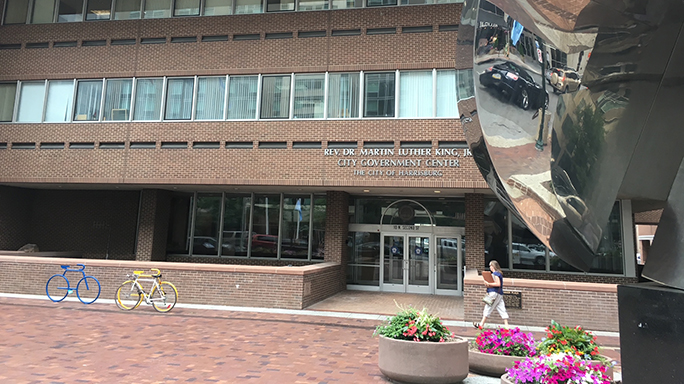
Harrisburg’s MLK Jr. Government Center

It’s official—Harrisburg will be able to retain its current, elevated levels of taxation for years to come.

On Monday, Gov. Tom Wolf signed the fiscal code bill that was approved on Friday by the state legislature.

Under the legislation, Harrisburg is able to keep both its current earned income tax (EIT) and local services tax (LST) at rates higher than typically allowed for third-class cities in Pennsylvania.

Harrisburg now can retain a 2% EIT, its local income tax, indefinitely. That’s double the typical statewide rate of 1%.

In addition, the city can retain an LST of $156 a year ($3 per week), triple the normal, statewide rate of $52 a year ($1 per week), for 10 years. The city then can assess double the statewide rate ($2 per week) for another five years, through 2035.

The LST, a tax to support city services, is charged to wage earners with jobs located in Harrisburg.

Before the legislation passed, city officials worried about an impending “fiscal cliff,” when the city’s extraordinary taxing authority would expire.

Harrisburg was allowed to tax above the normal statutory rate due to being in Act 47, the state’s program for distressed municipalities, and then from an extension that runs out in 2025. If the extra taxing ability had expired, Harrisburg would have lost about $12.4 million in annual revenue, or nearly 20% of its general fund.

According to Mayor Eric Papenfuse, Harrisburg should now be able to exit Act 47 after a decade in the program. Papenfuse is due to make his budget presentation for the city’s proposed 2021 spending plan during Tuesday’s City Council meeting.

On Monday, the city’s state-appointed financial oversight board, the Intergovernmental Cooperation Authority (ICA), also expressed support for the state legislation.

“The ICA thanks the General Assembly for its extraordinary support of the City of Harrisburg’s fiscal recovery,” said Chair Audry Carter, in a statement. “In fulfillment of our mandate, we look forward to continuing to work with all stakeholders on initiatives to strengthen the city’s finances, pursue operational excellence and promote economic development.”

Support quality local journalism. Become a Friend of TheBurg!
Continue Reading

PA legislature allows Harrisburg to extend extra taxing authority; mayor praises move as fiscal solution

The view up State Street in Harrisburg towards the PA Capitol.

Harrisburg appears to have a long-term solution to its structural financial problems at hand, as the state legislature on Friday agreed to allow the city to extend its extra taxing authority.

Today, the state Senate, then the House, passed a fiscal code bill that will enable the capital city to retain an elevated local services tax (LST) for 15 years and permanently extend its 2% earned income tax (EIT) rate.

“Today, the legislature helped to secure a sustainable financial future for its capital,” said Mayor Eric Papenfuse. “With bipartisan support, it extended Harrisburg’s taxing authority, which will now continue even after the city exits Act 47.”

The fiscal code bill passed the Senate on Friday afternoon by a 33-16 vote, later passing the House by a vote of 108-92. It now goes to Gov. Tom Wolf for his signature.

Under the legislation, Harrisburg can retain an elevated LST rate until 2035 and its elevated EIT rate indefinitely. The LST applies to all workers who have a job located in Harrisburg, including non-residents. The EIT is a local income tax that applies just to city residents.

The city now will be able to retain the current LST of $156 a year ($3 a week), triple the regular statewide rate, for 10 more years, until 2030. It then can levy double the regular rate, $104 a year ($2 a week), for five additional years, until 2035. Afterwards, the rate would revert back to the regular rate of $52 a year, or $1 a week.

In late 2018, the legislature agreed to let Harrisburg continue to levy an LST of $156 a year, as well as a 2% EIT, double the regular rate, continuing taxation rates it had under Act 47, the state’s program for financially distressed municipalities. After five years, in 2023, the city was due to lose this extra taxing authority.

Without the extra tax, the city stood to sacrifice $12.4 million a year in revenue, which constitutes nearly 20% of its general fund.

The city called this its “financial cliff,” which, Papenfuse said tonight, is now no longer a concern.

“This is a monumental achievement that will positively impact the city and the region for generations to come,” he said.

Sen. John DiSanto (R-15), who supported the bill, said the measure eliminates the risk of a possible commuter tax, while allowing the city the opportunity to refinance existing debt and, after a decade, to finally exit Act 47.

“A financially stable Harrisburg is good not only for city residents, but the entire region,” he said. “I’ll continue to support policies that support this objective.”

Papenfuse praised both DiSanto and state Rep. Patty Kim (D-103), who, he said, understood the importance of extending the city’s extra taxing authority to achieve long-term fiscal stability.

“By working together, we accomplished what was once thought to be impossible,” he said. “We have paved the way for a fiscally sound and bright future for our residents and taxpayers.”

Continue Reading