

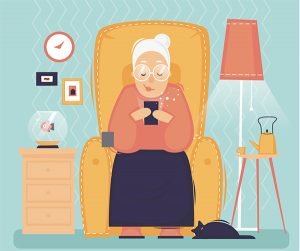
Mavis McCollam looks forward to the Country Meadows lifelong learning broadcasts, including a new series on world cultures. Shows delve into people and architecture. A monthly meal ties into the featured country.
“Roast duck,” she said of the previous night’s Denmark-inspired dinner. “Some kind of potatoes. And then a Danish rice pudding, which was different from ours but was very, very good. It has almonds in it.”
There’s a lot of living going on inside the midstate’s retirement communities and group homes. When COVID-19 restrictions shut the doors for most non-residents except employees, it set off a constant churn to ward off isolation and keep residents engaged, connected and active.
“They cannot hug anymore,” says Teri Gotti Szubinski, psychotherapist with PinnacleHealth Psychological Associates of Pennsylvania at UPMC in York. “They cannot even hug their loved ones. They cannot even hug nurses or caregivers. They are completely tossed to the side. That’s a hard thing to comprehend when you wake up in the morning and all this is going on, and there seems to be no end.”
The solution, as facility officials figure so far, is multi-dimensional. FaceTime family visits. Hallway happy hours. Closed-circuit exercise sessions. Hardee’s takeout. Quiet prayer. Spiders and lizards.
More on the creepy-crawlers later.
Connections
No family visits. No entertainers. No volunteers spreading cheer. At the midstate’s residential facilities, the creativity caps are worn 24/7 to fill the activities void.
At Paxton Street Home, two “dear, dear ladies” host monthly tea times. Residents sip tea and nibble treats served on donated china—under normal circumstances. Pandemic-era, the china still comes out, but the ladies appear via Zoom.
“They can talk to the folks they’ve gotten to know over the last couple of years,” said Jodie Smiley, executive director of Paxton Ministries, administrator of the Harrisburg-licensed personal care home. “There can still be that communication. It’s not the same, but we can still stay connected. It takes a lot of creativity. It takes a lot of staff time, but we can still stay connected to many people.”
Isolation is a real danger when residents in group settings are cut off from the things and people they love, said Gotti Szubinski. Those who can’t comprehend the why behind the sudden break from loved ones can feel abandoned. It’s the employees who step in to relieve their “unforgettable grief and sadness.”
At Paxton Street Home, where residents once walked up the road for their mushroom-and-Swiss “Thickburgers,” staffers take orders for Hardee’s takeout. Country Meadows Retirement Communities, which includes campuses in Mechanicsburg and Hershey, commandeered its in-house television circuit to broadcast in-room wellness sessions, high school students performing their numbers from canceled musicals and do-what-you-will programming from staff.
“At one campus, an associate’s daughter rescues reptiles and all those creepy-crawly things,” says Executive Director of Dynamic Living Kim Eichinger. “She did a program on rescuing these lizards and spiders. She took residents into her room and had the spiders out.”
At the Middletown Home, even residents’ outdoor visits with family on the 100-acre campus have been curtailed at times. There, staff “in some way have become their surrogate family.”
“We want to keep people safe, but we also believe that separation from family and friends is as, if not sometimes more, devastating than COVID itself,” said CEO Louis Vogel. “Obviously, we want to keep people safe. How do we keep people connected? Because we believe it’s all about relationships.”
People-to-People
McCollam and her husband, Ron, moved from West Virginia to Country Meadows Mechanicsburg in May 2019. Today, she laughs about the timing.
Louis Vogel
“Let’s move to Pennsylvania,’ she recalled saying. ‘We’ll be close to the grandchildren and great-grandchildren.’”
At residential facilities nationwide, an army of staffers is wielding iPads as weapons in the fight against loneliness. FaceTime and Zoom sessions, all agree, are no substitute for family visits, and people with dementia can struggle to understand what’s happening.
But, they help.
“The wonderful thing about these caregivers, I cannot say enough about them,” said Gotti Szubinski. “The very same people who used to run activities like bingo and dancercise—they are the same people now who are dressing up in the gowns and whatever they need in order to walk into the rooms with an iPad or an iPhone so they can help these residents talk to their relatives, sometimes for the last time.”
Country Meadows found other ways to sneak in hellos from family members. For Mother’s Day and Father’s Day, family members selected special appetizers or desserts and sent personalized notes to be shared on the meal trays—delivered, of course, individually to rooms.
“We’re just trying to make the simplest things fun and surprising for the residents,” said Eichinger.
Easy? Not at all. Actually, wrenching sometimes.
“The hardest thing are the residents who are somewhat confused,” added Eichinger. “The whole mask concept is difficult for them to wrap their head around. They need the ability to be aware of where their body is in space. For some of them, cognitively, it’s a challenge. It’s hard for them not to snuggle up with their friend on the sofa, elbow to elbow, because that’s what gives them comfort.”
Unable to hold congregant worship services, the Middletown Home is deploying pastoral care staff for one-on-ones. Personal, in-room performances by musically talented staff and visits from Carolina and Blanche, the home’s golden retriever and black lab, also provide a lift.
“It doesn’t sound like an awful lot, but something that’s really, really important is for folks to be physically present and just to listen,” said Vogel. “It’s about being physically present and sitting there, even if you have to wear gloves to hold somebody’s hand. Whether it’s praying with them, singing with them, being a liaison and getting their family on a Zoom call. It’s any of those wonderful things.”
Spiritual support helps ward off the worry that worsens depression and anxiety in the elderly, said Gotti Szubinski. “When you have spirituality in your life, faith in your life, it makes the future a lot less fearful.”
At Paxton Street Home, volunteers were able to come in and decorate a “Christmas corner” in holiday style. Residents came for photo shoots, posing for pictures sent to family and friends.
“What do you do?” said Smiley. “This is a year when you make a plan and adjust. That’s the reality for all of us. You just adjust.”
Takes a Team
As 2020 neared its end and a vaccine loomed, Smiley reminded residents, “You’re doing a great job.”
“We understand that it’s bad out there,” she told them. “You’re doing a great job. There is a light at the end of this very, very long tunnel. You’re three quarters of the way there. Hang in there.”
Country Meadows resident McCollam believes that the crush of revised activities—socially distanced happy hour, Bible studies on TV, craft kits to make Christmas decorations for a school—are “most definitely” keeping residents engaged and purposeful.
“It gives us something to do,” she said. “We can meet with a few people at a time and enjoy something and talk with other residents. You’re not just sitting in your apartment, vegetating. It keeps you active. It keeps you engaged. They’ve done a good job.”
For the duration, those creativity caps are secured firmly on heads. At Country Meadows, in-house-produced exercise broadcasts target the motor skills that diminish when people are confined to their rooms, walking only from bed to bathroom to lounge chair. For the holidays, Eichinger and the Country Meadows fitness director developed a “12 Days of Fitness” program.
“One breath of energy, two head turns, three shoulder rolls, four leg extensions, and five sit-to-stands,” said Eichinger. “It truly takes a team. It truly takes a team.”
Support quality local journalism. Become a Friend of TheBurg!








 Writer and Harrisburg University professor, Robert E. Furey, writes in his story titled “Ouroboros” that “… a monster slouched into the awareness of our lives. They told us it was coming.”



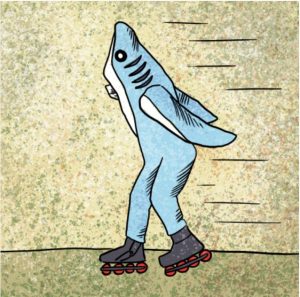 10. Land Shark. In this annus horribilis, let’s begin on an upbeat note—perhaps the one unalloyed, unexpected joy to come out of 2020. Naturally, I’m talking about Harrisburg’s one-and-only skating fish, Sharkman. Back in May, he glided into our lives, a vision in blue-and-white felt, offering fleeting comic relief for a pandemic-weary city. Before long, Sharkman sightings abounded, the costumed critter becoming a social media celebrity and even making a Burg cover. A few months later, a young musician named Jordan Dandy took up the inspirational cause in Harrisburg, holding up signs with messages like, “I value you” and “You’re so important.” When I look back on the chaotic, divisive, dark year of 2020, I hope that these two selfless people come first to mind.
 9. Crime & COVID. Now that I’ve built you up, let me bring you back down. Like in many U.S. cities, Harrisburg experienced a surge of gang activity, which, inevitably, led to turf battles, disputes and violence, especially in certain city neighborhoods. The pandemic seemed to play a big role, with jobs lost, schools closed and youth idle. The city and county responded by gearing up its anti-gang task force, but not before numerous young people took a wrong turn or even lost their lives.
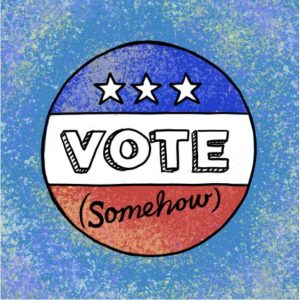 8. Vote, Somehow. In my annual list, I typically keep to stories exclusive to the Harrisburg area. The presidential election was not that, but the changes to our long-established ways of voting affected people in this political town tremendously. In Dauphin County, cautious voters cast more than one-third of their votes through the mail, while many others anxiously masked up and headed to their polling places. Kudos to our election officials for pivoting quickly to what amounted to an entirely new way of holding an election, doing so with speed and accuracy. In just months, they built a hybrid voting system, a legacy that is certain to stay with us, changing our voting habits, perhaps permanently.
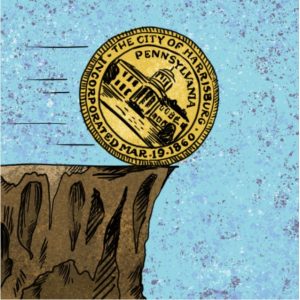 7. Off the Cliff. A late-year story squeezed into my Top 10 this year—the state legislature’s rather surprising decision in November to let Harrisburg retain its elevated earned income and local services tax rates. The average city resident may give this a shrug, as their tax bill will not change at all. But it’s a huge relief for city officials who feared falling off the “fiscal cliff” in a few years, when their extra taxing authority would have expired, forcing them to somehow make up $12.4 million in annual revenue. With this matter settled, the city now feels it can move beyond its decade-long fiscal nightmare, finally putting the profligate Reed years and resulting financial crisis behind it.
 6. Major Developments? The announcements began early in the year at the former Bishop McDevitt building, headed down to South Allison Hill, took a turn onto N. 6th Street and then bolted over to the red-hot Reily Street corridor. Italian Lake, downtown and the Shipoke area even got caught up in the frenzy. I’m referring to major building proposals in the city. From pro athletes to ambitious developers to several nonprofits, everyone, it seemed, wanted to build something—often something very large—in Harrisburg. While there was no lack of plans, there was a definite lack of hammers, nails, bricks and mortar. Will 2021 see anything more, um, concrete? I’ve been around this town long enough simply to wish everyone the best and then sit back and see what, if anything, develops.
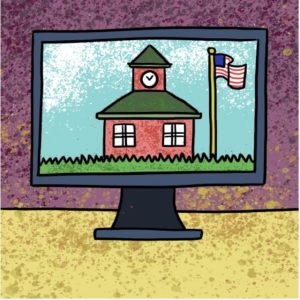 5. Home Work. The Harrisburg School District has been through the ringer in recent years: a discredited administration, a bitter school board race, state receivership and a whole new leadership team. Just as the dust began to settle, the pandemic hit, sending kids packing for home instruction. Nearly a year later, they still haven’t returned to the classroom. Credit the administration for quickly cobbling together a virtual program and the teachers for implementing it. However, all-Zoom, all the time has been a poor substitute for classroom learning, so much that even the kids yearn to return to school. If you look up the term “no-win situation,” you just might find a picture of the district’s stressed teachers, students and parents.
 4. Committee Compromise. Every year, Harrisburg has at least one policy issue that makes it onto my annual list. For 2020, that initiative was the Citizen’s Law Enforcement Advisory Committee. The city first proposed the legislation in June after weeks of Black Lives Matter protests, though the ordinance didn’t pass until November, following several public meetings, hundreds of public comments and numerous changes. For some residents, the legislation went too far; for others, it didn’t go far enough. We’ll now see how this compromise plays out as the committee is populated and begins its work in 2021.
 3. Year of Protest. I’ve long considered Harrisburg to be a sleepy capital city. Each morning, state workers zip in and, each evening, they zip right back out. Most of the time, that’s about the extent of the state’s impact on the city. Not in 2020, when Harrisburg became a magnet for protests. The year of outrage began in April, with noisy anti-lockdown protesters gridlocking city streets, then continued in May and June with demonstrations and marches in support of Black Lives Matter, before wrapping up in November with election-related protests and counter-protests. Along the way, there were some tense moments, especially in the neighborhoods near the Capitol. However, as they say, all’s well that ends well. Violent incidents were remarkably few given the thousands of people who participated in dozens of protest actions, even if police sometimes literally had to stand between opposing sides to keep the peace.
 2. Small Business Battered. The pandemic has wrought tremendous collateral damage (see several items above), but the impact on the small business community has been especially profound. Harrisburg is a unique place. Snubbed by major chains, local people have stepped in to fill the gap, with each restaurant, bar and shop its own individual, often quirky, creation. As of this writing, most have survived, though some have not, and many are teetering still. As I have before, I renew a call to support our wonderful small businesses and arts groups, which add so much life and character to this weird little city on the Susquehanna River.
 1. COVID Is Everything. In my three decades in journalism, I have never before seen a single story so dominate the news cycle and our lives, affecting everything from our health to our economy to our schools to our social lives to our housing. In fact, you can overlay the pandemic atop of each of the prior nine stories on this list. Since March, it’s been the stormy sea we’ve all been forced to swim in, and, here at TheBurg, we’ve slapped on our masks and tried to cover it from every possible angle. I hope we’ve been of service to our community during this time of trial, though I pray we’ll never have to endure anything like it again.