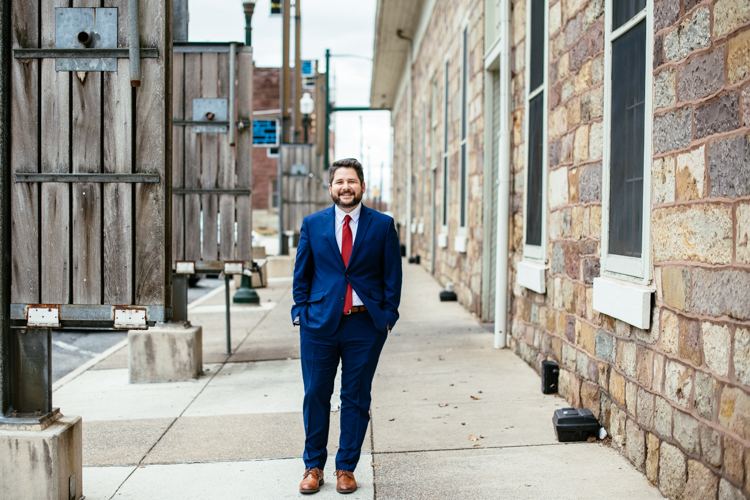
Eric Hagarty
In a charmless, cramped tent where the floor wobbles underfoot, hungry lunchtime customers formed long lines for deli sandwiches and barbecue at the Broad Street Market.
“Their club sandwich is amazing,” a Fisher’s Delights patron told his companion.
The Broad Street Market, constituting the stone building and a hard-sided tent, is open and supplying fresh, healthy and scrumptious food. As the market perseveres, its future preoccupies the minds of countless stakeholders—city officials, board members, vendors, residents—hoping to see its shattered half rise from the ashes of a devastating fire.
Brick Building
On July 10, 2023, fire tore through Broad Street Market’s brick building, the circa-1870s companion to the Civil War-era stone building.
City, county and state officials vowed to rebuild. Over 20 months later, the building looks almost like it did the day after the fire. Chain link fencing warns away the public. On brisk days, torn sheeting covering the clerestory windows flaps in the wind. By anyone’s account, progress has been slow.
The city owns both buildings and the market land. David Baker, city facilities and special projects director, confirmed a restoration timeline—which extends two years from now, or nearly four years after the early-morning fire.
Construction drawings are complete, and bidding begins June 2025. Construction starts Sept. 1. Construction is done May 1, 2027. The city will continue sharing renderings via media, social media and market-related groups, said Mischelle Moyer, the city’s communications director.
Before a standing-room-only crowd at a February town hall, city officials promised to prioritize brick building reconstruction above all market-related plans.
Plans drawn by Murphy & Dittenhafer Architects showed a building restored to its historic look on the exterior.
Note the operative word, “look.” Exterior renovations of buildings in Harrisburg’s Midtown Municipal Historic District require review by the Harrisburg Architectural Review Board and City Council approval. HARB’s standards are strict but allow some modern materials that uphold historic integrity.
The National Register of Historic Places, which lists the market, does not require historically accurate exterior renovations unless U.S. Department of the Interior funding is involved, according to Frank Grumbine, community preservation coordinator of the central region, State Historic Preservation Office, Pennsylvania Historical and Museum Commission.
The fire offered “a big opportunity to blend old with new,” Grumbine said. “With such a tragedy and such a loss, there’s always a silver lining on how to address the market in the future and the role of the market in Harrisburg.”
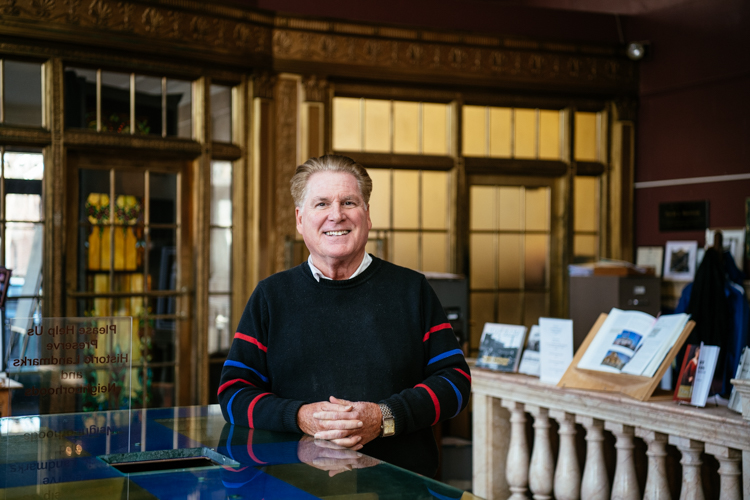
David Morrison
Historic Harrisburg Association hopes to see preservation best practices campus-wide, said Executive Director David Morrison. He recalled the 1990-era restoration of the brick building’s 42 enormous windows, which used rock maple—not “squishy” new-growth lumber—for the frames.
“That was a major expense, and it was done right,” Morrison said. “I’m hoping that that same attention to detail and authenticity and durability will be incorporated into the restoration. There are wood windows, and there are ‘wood windows.’”
Plans call for a new mezzanine augmenting ground-level seating. Small, medium and large modular units would maximize space by accommodating vendors of different sizes as they come and go. And hallelujah, the sometimes sweltering, sometimes freezing building would be equipped with air conditioning and heating.
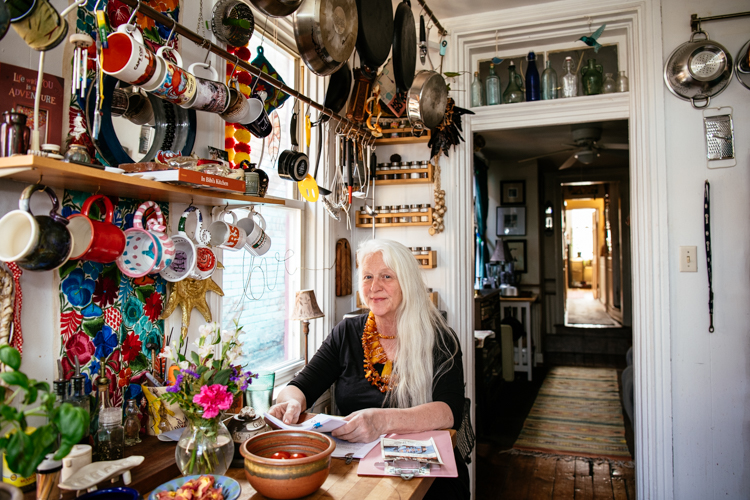
Vivi Sterste Brandler
The Courtyard
In January, Harrisburg Mayor Wanda Williams threw a boulder into a still pond by releasing a proposal to erect a two-story, glass-walled enclosure in the courtyard linking the market’s two buildings.
Stressing that plans are preliminary, city officials have touted the possibilities. Shelter from the elements. Room for more vendors. Revenue generation through rentals.
The city will “need to establish funding before any further steps will be taken with the middle building,” Moyer said. In other words, a new building constructed in the current courtyard is, as of right now, little more than an idea.
Vivi Sterste Brandler, owner of nearby Vivi’s on Verbeke, doesn’t like that “idea”—at all. She is circulating a petition to retain the courtyard’s free, open-air tradition that dovetails with today’s “third space” trends.
“People have come to me and told me how some of those enclosed spaces just don’t work for the community,” she said while collecting signatures in the stone building. “We want to maintain the sun and the community space because people like to come just spontaneously.”
Some proponents of a new structure cite precedent, as a building long stood in the courtyard, from the 1860s until around the 1960s. Morrison countered that the market’s then-private owners erected the wood building hastily, before acquiring land and constructing the permanent brick building, to accommodate the pressing need for vendors.
Covering the courtyard could obscure the market buildings’ historic facades and erase a beloved third space “that’s available to the public 24/7,” Morrison said. “It makes the market more than just a shopping center. It makes the market more of a destination.”
Before the fire, Jennifer Adams and her children would hang out in the courtyard on Fridays, listening to local musicians and buying veggies from outdoor vendors. The East Pennsboro Township resident, who works at nearby Radish & Rye Food Hub, includes the market in her “little walkabouts at lunch.”
“I love any space where people can gather in the city of Harrisburg,” she said. “It was a space where we could just go. I don’t want to see that go away.”
If the city decides to build a third structure, the Broad Street Market Alliance—responsible for market operations—would request details on its business viability, vendor demand and assignment of responsibilities for operations and utilities, said alliance Chair Eric Hagarty.
“The opinion that matters is not mine but the public’s,” he said.
Stone Building
Untouched by the fire, the stone building doesn’t qualify for any of the $10 million in insurance funds going toward the brick building, but like its brick sibling, it needs air conditioning and ventilation upgrades, plus a new roof.
The city has established funding for preliminary stone building upgrades and will request funding from the Pennsylvania governor’s office toward additional renovations, Baker said. Any construction must wait for renegotiation of the agreement between the city and the market alliance delineating their responsibilities, he added.
And although city officials continue to emphasize that any stone building upgrades must wait until the brick building is complete, Hagarty could envision efficiencies gained by simultaneous upgrades, if funding materializes.
“We hope to raise money as the alliance to help contribute to the city’s efforts,” he said. “Figuring out the financing is a little complicated, but my aspirational hope is that we can leverage the activity that’s happening at the brick building.”
After the fire, market revenue plummeted, and the market alliance was facing a projected $160,000 structural deficit.
Revenue losses were just one worry. In the shockwave following the departure of market Executive Director Tanis Monroy, later charged with felony theft from market accounts, the board discovered about $50,000 in unpaid bills, plus a lack of business-loss insurance that would have covered lost revenue—“a huge mistake,” Hagarty said.
Today, with a $350,000 Pennsylvania Department of Community and Economic Development grant plus donations, operating efficiencies, and a voluntary rate hike accepted by vendors, the market expects to close out 2026 with “well over” $100,000 in the bank, Hagarty said.
To solidify procedural reforms, the board is taking steps to adopt financial management plans, retain proper insurance coverage, create leadership succession plans, and post financial transactions on its website.
“It’s going to require the public to continue to hold the market alliance accountable,” Hagarty said. “We are setting a precedent of transparency, so that any member of the public should, in theory, be able to go to our website and ask questions. You should not need to be a board member in order to understand the health of the organization.”
Brighter Days
So, to recap. Fire. Fraud. Fiscal woes.
And still, the market abides.
“The Broad Street Market is so much more than just architecture, and it certainly matters to the community,” Morrison said.
Hagarty thanked “everyone in the community who has stepped up over the last year and a half to help save the market.” Alliance members Venus Hawbaker and Tashia James helped him manage the market as the alliance has been seeking a new executive director. The city’s Baker and his colleagues “are working every day to try to make this project move as quickly as possible.”
“It’s all a great example of the cliché that it takes a village,” Hagarty said. “I’m extremely confident that the market’s brightest days are ahead after a very dark year. Every week, I feel more and more encouraged, and it’s all because of everyone who lives here, who’s been volunteering and donating and showing up to work to help keep things going.”
The Broad Street Market is located at N. 3rd and Verbeke streets, Harrisburg. The full market is open for business. The stone building’s hours are 7 a.m. to 6 p.m., Thursday through Saturday. The tent’s hours are 7 a.m. to 5 p.m. Thursday and Friday, 7 a.m. to 4 p.m. on Saturday.
Photos by Dani Fresh.
If you like what we do, please support our work. Become a Friend of TheBurg!