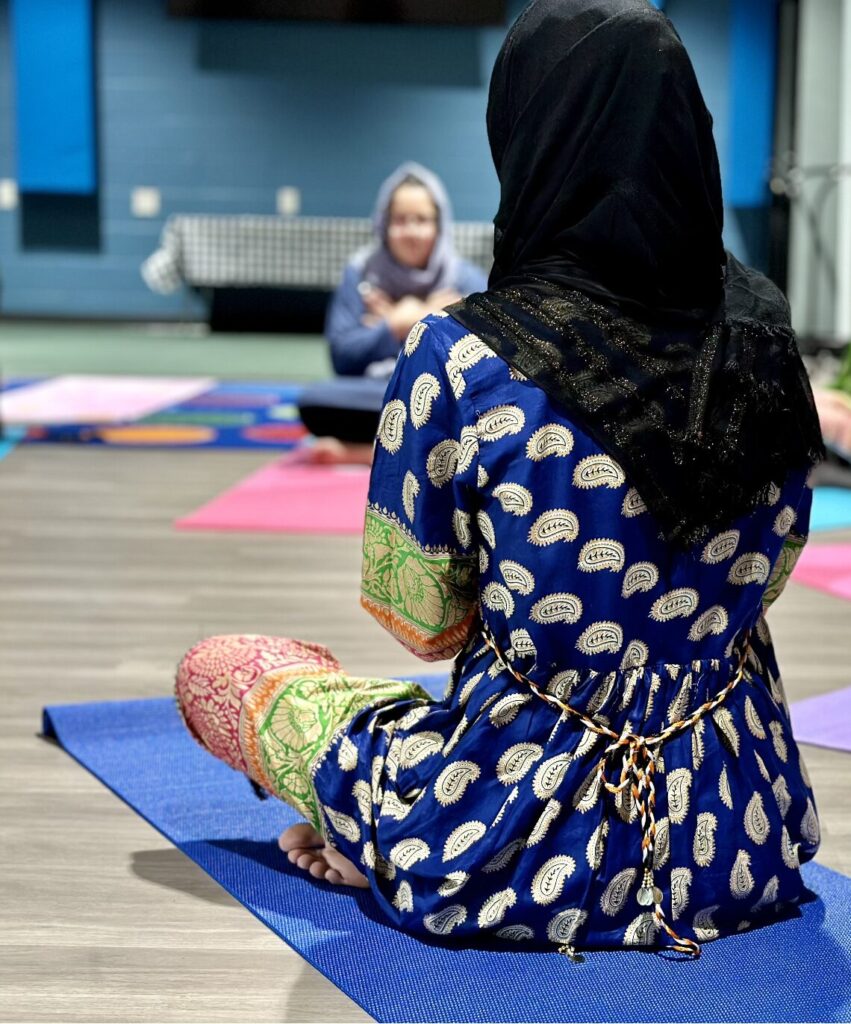
The Partnership for Better Health-funded “Circle of Care for Carlisle’s Afghans” offered trauma-informed yoga to women.
Earlier this year, one of the area’s largest refugee resettlement agencies suddenly lost most of its funding.
Church World Service (CWS), which has offices across the country, just opened its Harrisburg office in 2022, but was already facing a crisis situation, following a federal stop-work order this past January.
Just weeks after his swearing in, President Donald Trump suspended federal funding for refugee resettlement programming and stopped resettlement, crippling agencies that rely on this funding to operate and leaving refugees vulnerable.
CWS Harrisburg Site Director Alex Swan, in a statement, shared that the office, as well as all other CWS offices, has significantly reduced operational capacity. In February, they furloughed 70% of employees and by mid-March, were still only operating with about 60% of their staff.
“We have legal and moral obligations to refugees, including people living in the U.S. seeking reunification with their spouses and children and Afghan and Iraqi allies who the U.S. promised to protect,” Swan said. “They went through an intensive, often years-long process of screening, vetting and medical checks. The executive actions have not changed our focus on our clients’ well-being. We are doing everything possible to continue to provide permitted services even as these huge sources of funding have been blocked.”
Other local organizations are also feeling the impacts of recent orders, policies and statements concerning refugees and immigrants.
Harrisburg-based International Service Center doesn’t directly resettle refugees but specializes in providing resources to refugees and asylum seekers who have recently arrived in the United States. Due to funding cuts, they’ve had to eliminate half of their programs.
The status of resettlement in the country is a moving target.
Following the federal orders, the International Refugee Assistance Project, on behalf of CWS and other agencies, sued the Trump administration for stopping resettlement and blocking funding. In February, a judge in the U.S. District court in Seattle filed a preliminary injunction blocking Trump’s stop work order for at least three months. The next day, the administration terminated contracts with most resettlement agencies. However, the Trump administration said in March that it could take months to resume resettlement operations.
“The current administration and the State Department have attempted to end the U.S. resettlement program as we know it,” Swan said. “No refugees are being resettled, and the State Department terminated its agreements with the resettlement agencies and nonprofits, including faith groups, that welcome and serve refugees in the U.S. and abroad.”
Only one thing is for certain—everything is uncertain. And despite fluctuations on the federal level, the need for community assistance locally, will likely remain, no matter what happens.
In the midst of the upheaval, volunteers, churches and community groups are rising to meet the need and fill gaps in assistance.
Do Our Best
Rebekah Teuscher took a job at CWS Harrisburg less than a year ago, finding a position where she could fulfill a longtime passion of assisting refugees.
When she started in 2024, CWS was in the middle of one of its busiest years of resettlement, she said. Teuscher served as the resettlement wellness coordinator, assisting the most medically fragile clients, coordinating vaccine clinics and connecting people to physical and mental health resources.
Teuscher said that, for the last few months of 2024, CWS pushed to resettle as many people as they could, knowing that things would likely change come the presidential inauguration in January.
Following months of extremely busy workdays, everything came to an abrupt halt in February, when she was furloughed, along with most of her colleagues.
“It was historically really busy and for that to drop so suddenly was like whiplash,” Teuscher said.
Now, she fears that people may “fall through the cracks,” as CWS works its hardest, but ultimately doesn’t have the same resources as before.
“My heart has felt very heavy and broken,” she said. “It just makes me really sad that people are afraid of these individuals and haven’t chosen to engage in relationships to see how incredible they are and what a benefit they are to our country.”
At the International Service Center, the team has reduced staff and programming due to cuts to its state funding and uncertainty around future funding.
The center provides translation services, employment help, transportation and more. Often, they assist refugees after they phase out of programs, like CWS, or help those who aren’t being helped by resettlement agencies.
“We don’t know how long funding will continue, but we are determined to help the most at risk refugees,” said Dr. Truong Phuong, director of the center. “If we abandon them, they have nowhere to go, so we will do our best.”
Both CWS and the International Service Center have turned to volunteers.
One of these local volunteer groups is Muddy Waters Anabaptist Community in Mechanicsburg, which, at the end of 2024, expected changes on the horizon and made the decision to take action.
“Knowing that our current administration had campaigned on anti-immigration, one of our members said, ‘let’s get more involved,” said Linda Mininger, who attends the church.
Resilient, Resourceful
Teuscher is now doing similar work to what she was doing at CWS, just in a different way. Shortly after she was furloughed, her church, The Meeting House-Dillsburg Campus, hired her part-time to coordinate volunteers to help CWS’s clients. The church, which had partnered with CWS for several years, was asked to help, she said.
Now, Teuscher works with around 100 volunteers from the area who help families with rides to medical appointments, among other needs.
“It’s encouraging that so many people have stepped up to want to help,” she said. “As much as I wish this hadn’t happened the way it has, it really is cool to see the community take ownership of this.”
The International Service Center is working on a smaller scale than it’s used to, but they remain hopeful. The center needs volunteers now more than ever to keep them afloat.
“We always remind people working with us that we are based on the belief that hope, faith and love will keep us alive,” Phuong said. “We can’t do this alone.”
Mininger and other church members have provided meals and transportation to refugee families, have taken them grocery shopping and helped them enroll their children in school. She has also helped with some English language lessons.
“I feel called to help,” she shared. “The situation with the refugee resettlement program makes me angry that the U.S. is not meeting its obligations.”
Harrisburg Brethren in Christ Church on Derry Street has helped with groceries and gift cards for families in need of food.
Many other organizations and volunteers have stepped up, and yet, the reality remains the same. Refugees and immigrants in the U.S. face an uncertain future.
At the Latino Hispanic American Community Center in Harrisburg, director Gloria Vazquez Merrick is seeing the fear that many immigrants in her community are facing. The center isn’t engaged in refugee resettlement or assistance specifically and isn’t affected by funding cuts. However, they offer a perspective on feelings at-large, as they provide resources to a population with fears about their future in the country.
“I think everybody’s worried,” she said. “They’re thinking worst-case scenario, ‘what are we going to do?’ I think that’s where a lot of families are at.”
She acknowledged that that is a common feeling among both immigrants and refugees right now, even though the two groups are distinct.
“It’s a very tenuous situation,” she said.
Teuscher explained that, at this point, much of refugee families’ welfare relies on relationships with community members.
“There’s a lot of fear,” Teuscher said. “The lines between refugee and immigrant or asylum seeker are very blurry now, and I think that makes everyone a little less certain of their safety in the country.”
At the same time, Teuscher said that she’s not seeing or hearing of people who are sitting around waiting or worrying for the next shoe to drop.
“They are very resourceful, very innovative, very resilient,” she said. “I don’t want to downplay the desperation that there is […] it’s a really dire situation, but these are not helpless people who are passive recipients of whatever fate comes to them. With help, I hope they will find a pathway to flourishing.”
For further reading, check out our recently published article, which tells the stories of three Harrisburg area refugees and families.
For more information about Church World Service, visit www.cwsharrisburg.org.
To assist with medical transportation for refugees, contact Rebekah Teuscher at [email protected].
For more information about the International Service Center, visit www.isc76.org.
To learn more about the Latino Hispanic American Community Center, visit www.lhacc.org.
If you like what we do, please support our work. Become a Friend of TheBurg!