Illustration by Rich Hauck
What makes for a “pillar” of the Harrisburg community?
Individuals, churches, even government officials might spring to mind. Personally, I can think of many people and organizations that contribute in big and small ways to the quality of life here.
But I’d like to make a case for Harrisburg’s small businesses—and here’s why.
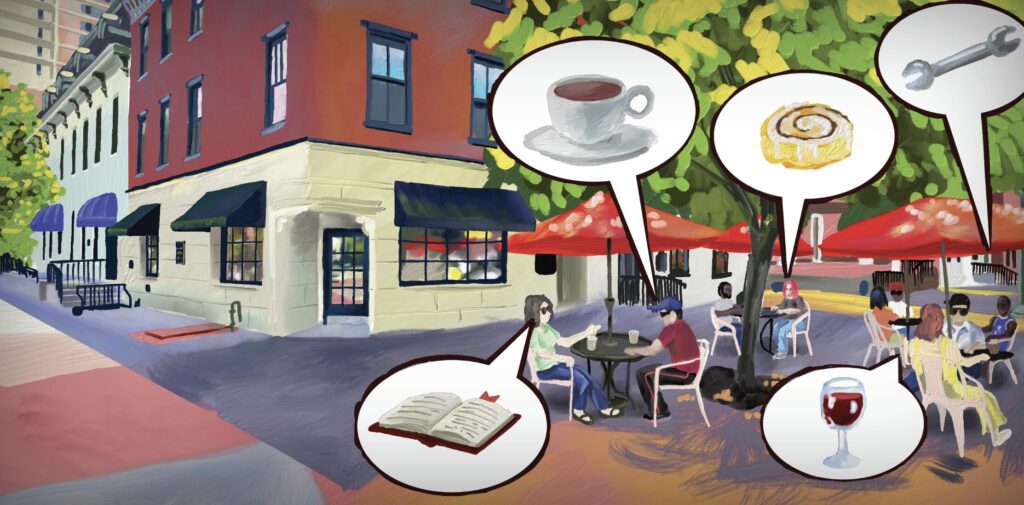
Stores, shops, restaurants, bars, venues, etc., constitute a central part of the urban fabric and, in fact, are a key amenity of city life. They make living here special, as opposed to (no offense) the strip malls and asphalt sprawl that dominate commerce in the car-centered suburbs.
In Harrisburg, I live within a 10-minute stroll of several dozen restaurants, bakeries, cafés, pubs and clubs. There’s a hardware store, a fabulous grocery, an amazing florist, one of the country’s best bookstores and so many barbers and salons that I’ve lost count (not that this guy requires that particular service).
When I think about quality of life in Harrisburg, do I noodle over whatever City Council is up to? No, but the Broad Street Market immediately comes to mind. It’s a community hub, a gathering space and, thanks to its collection of independent, hard-working vendors, a place that serves up delicious grub. It’s a big reason why I like living here.
Harrisburg’s small businesses, though, never seem to get the recognition they deserve as the important players that they are, for their critical role in our community. To me, this is a glaring and indefensible omission.
Over the years, I’ve heard many small business owners complain that they receive scant support from the city. I don’t think they want much—a little acknowledgement, an ear for their concerns, some promotion maybe. But, as they’ve told me, they hear from the city exactly twice a year: once with a bill for their business privilege tax and once with a bill for their gross receipts tax.
I can sympathize. Last year, TheBurg won a prestigious honor: the Harrisburg Regional Chamber’s “Small Business of the Year” award. This award usually goes to a suburban business, but we accepted it as a proud, Harrisburg-based company that has created a valuable product, full- and part-time jobs and municipal tax revenue. The official response from the city? Well, there was no response.
My personal gripes aside, there’s actually quite a bit the city can do to assist its incredibly important small business community and, in the process, help ensure they don’t decamp for the suburbs, as so many have done before.
Value them. Currently, most small businesses don’t feel valued; they feel unseen. City leaders should tout them, advocate for them and patronize them (very important!). As it stands, business owners don’t feel that city hall has their backs. Nor do they feel that officials appreciate their crucial role in the life of the city. Instead, they feel that the city has an extractive attitude—that they’re valued mostly for their coin.
Engage with them. As I write this, the city’s top business positions are vacant. These jobs need to be filled quickly by competent, energetic people. These new leaders then need to raise their profiles within the business community, as recent economic/business managers have been disengaged and invisible. One simple idea: occasionally stroll down the city’s main business corridors (2nd Street, 3rd Street, Derry Street, etc.). Pop your head in, introduce yourself. Ask them about their businesses; ask them what you can do to help. A little engagement would go a long way.
Ease their burden. Many business owners feel that the city is difficult to deal with, whether that’s getting a question answered, resolving an issue or helping a new business get up and running. The city needs to have a point person for small business owners to contact and who will advocate for them inside city hall.
Prioritize public image. When city leaders squabble over power and prerogatives, when they sue each other, when they deride one another in the press, they damage the image of the city. This makes people less likely to want to be here—as a resident, as a visitor, as a consumer. In Harrisburg, these fights happen regularly, with little evident concern for the broader impact on the city. Simply put, bad headlines are bad for business.
Stress business development. Most cities have a detailed economic development plan—not Harrisburg. For eight years, the state-appointed Intergovernmental Cooperation Authority has urged city leaders to do more to attract business and invigorate the local economy. In particular, the ICA has emphasized the need for a structured economic development plan, which would set priorities and policies.
Focus on services. In my view, Harrisburg does a decent job delivering basic services, such as sanitation and parks maintenance. However, the city needs to go beyond that. People want to visit business districts that are clean, safe, well-maintained and visually appealing. Harrisburg has work to do on all these fronts. Build it—or fix it and clean it—and they will come.
Most Harrisburg small businesses are low-margin, struggling enterprises. In recent years, remote work and the state-managed parking disaster have only made conditions worse, leading to many closures. Now, more than ever, the city’s small businesses need an extra dose of understanding, appreciation and support.
Lawrance Binda is publisher and editor of TheBurg.
If you like what we do, please support our work. Become a Friend of TheBurg!