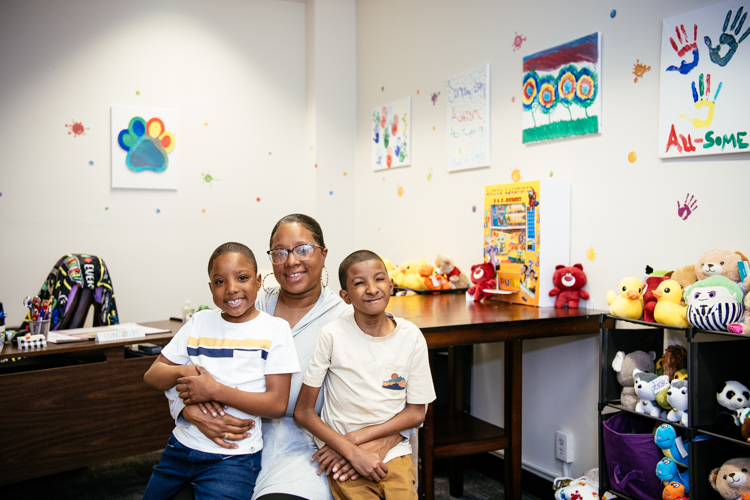
Shimera Dennis with her sons
The Neurodiverse Network’s facility in New Cumberland is stocked with all the toys, books and play equipment that a kid could want.
However, the organization selects its toys and education tools with a specific audience in mind—those with autism spectrum disorder, as well as other neurodiverse diagnoses.
This means that the toys are sensory-conscious, calming and beneficial for these families.
The connection they make with others may be even more helpful. Forming relationships is something that owner Leann Firestone herself has had to work on as she and her 8-year-old daughter both have autism.
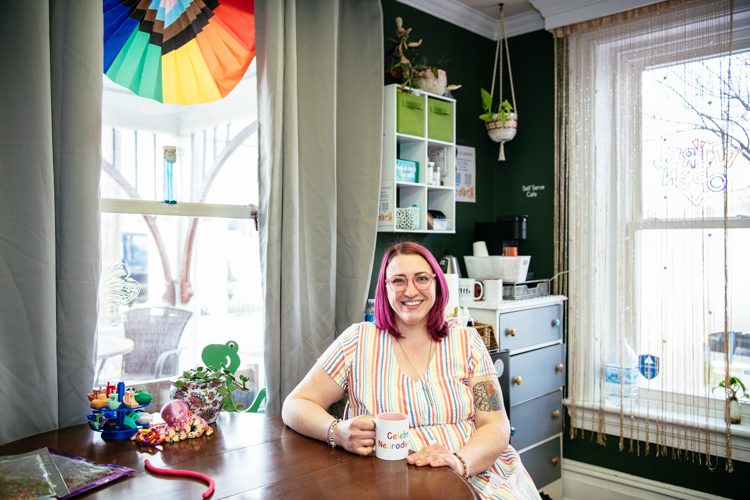
Leann Firestone
“We have trouble with social skills and relationships, for sure,” Firestone said. “I feel like since she [her daughter] was little, I’ve been trying to create social opportunities for her and myself, because it’s so hard for us to find it naturally.”
However, help and community are out there. Firestone’s Neurodiverse Network is a place where people with neurodiversity, not just autism, can come and be with others who share similar experiences, in a safe environment. They have support and social groups for adults, kids and families, as well as skill classes and a yoga-type class to help with self-regulation.
April is national Autism Acceptance Month, recognizing a reality that affects one in 36 children in the United States, according to the National Autism Association. Over 5 million adults are also affected, according to the Centers for Disease Control and Prevention. Despite the sweeping presence of neurodiversity, lack of knowledge, misconceptions and non-acceptance still exist. With that in mind, Harrisburg area organizations are working to raise awareness and improve support for local families.
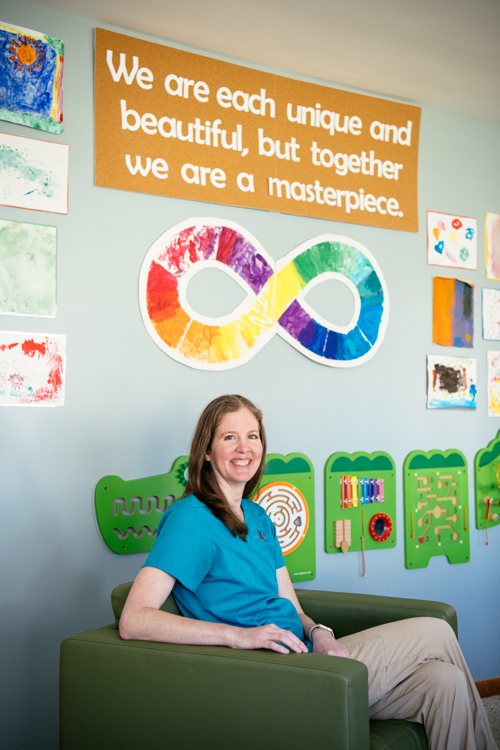
Andrea Gibson
Powerful Tool
So, what is autism? According to occupational therapist and owner of TCS Therapy and Counseling Services in Camp Hill, Andrea Gibson, much of it is defined by information processing.
“Our neurotypical society runs on Windows and how they interact with the world, how their thoughts process, how they process new information, how they learn, how they interact socially. And then comes autism, and we’re running on Mac,” she said. “So, the wires are crossing. We process information differently.”
She said “we” because Gibson herself was diagnosed as autistic in her 30s. The diagnosis was a watershed moment for her.
“It’s life changing from the standpoint that my mental health is better now, personally than it has ever been. Things that were hard, I just sort of internalized as a personal failing,” she said. “Why do I get overwhelmed and nobody else gets overwhelmed? Why am I always the sensitive one because it’s too bright or it’s too loud?”
Getting a diagnosis rather than running away from their reality can allow children and adults with autism to get the help they need and allow for a brighter future.
“There’s a lot of answers, and there’s a lot of advocacy that comes with understanding it,” Firestone said.
She explained that, when a person has a diagnosis, they have something to work with.
“For children, it’s really powerful because they’re given this tool and this language to explain their brain,” she said.
Shimera Dennis, founder of D&D Journey, a local autism support group, is raising two autistic sons. She is concerned that children who aren’t diagnosed face an uphill battle. In the Black community specifically, seeking a diagnosis can sometimes have an increased stigma, Dennis shared.
“I hear our African American community say, ‘There’s nothing wrong with my kid,’” Dennis said. “But when they grow up and they’re out there having behaviors […] because you don’t understand what’s going on with his body.”
Autism can present in many different behaviors, which is why it’s called autism spectrum disorder. These include repetitive behaviors like pacing or moving (called “stimming”), done to regulate emotions. People also have differences with sensory, sound, touch or movement and often can be oversensitive to or hyper seeking sensory input. Others face social challenges, such as communicating effectively with peers.
Connection, Inclusion
D&D Journey, named after Dennis’ two sons, offers support groups and training. They talk about, “How do they feel when they first found out that their child was autistic? What do they do when their child is having a meltdown? What do they think they could do better? As parents, what do you do for downtime for yourself?” Dennis said.
One example of the events that the group offers is its upcoming Easter egg hunt and dance for kids on the spectrum called “Autism in Bloom, Rocking the Spectrum,” on April 12.
Autism community events allow people to participate in social events without judgment. Neurodiverse Network holds Halloween, Easter and New Year’s Eve inclusive events.
“Families told us that they’ve never been able to do anything like that,” Firestone said. “Family events can be super powerful because they are not only getting an experience in a safe place, they’re seeing other families and they’re like, ‘Oh, your child screams too.’”
Firestone will hold the May Mile and Disability Resource Fair on City Island in May. This provides another opportunity for families to gather, learn and have fun.
Society in general can provide help, as well, by dispelling stereotypes and being inclusive.
“I think there’s an assumption that we’re a homogenous group—that we are either universally geniuses or we’re universally incapable of anything,” said Gibson.
She reminds people of the saying, “When you’ve met one autistic person, you’ve met one autistic person.”
It often takes more time and patience to communicate with people with autism, but including kids on the spectrum goes a long way to making their lives better.
“You don’t want them to feel like they aren’t worthy,” Dennis said.
People with autism are a diverse group, and recognition and acceptance of that diversity provides a path for understanding.
“I think that it’s important that we believe people,” Gibson said. “If somebody is saying that something is really uncomfortable for them, and there’s some loud noise that’s bothering them or that there’s a light [that’s too bright], believe them.”
Learn more about D&D Journey and the “Autism in Bloom, Rocking the Spectrum” event at www.dndjourney.org or on Facebook at D&D Journey.
Learn more about the Neurodiverse Network at www.ndnet.org.
Learn about the services provided by TCS Therapy and Counseling at www.patcs.com.
If you like what we do, please support our work. Become a Friend of TheBurg!