
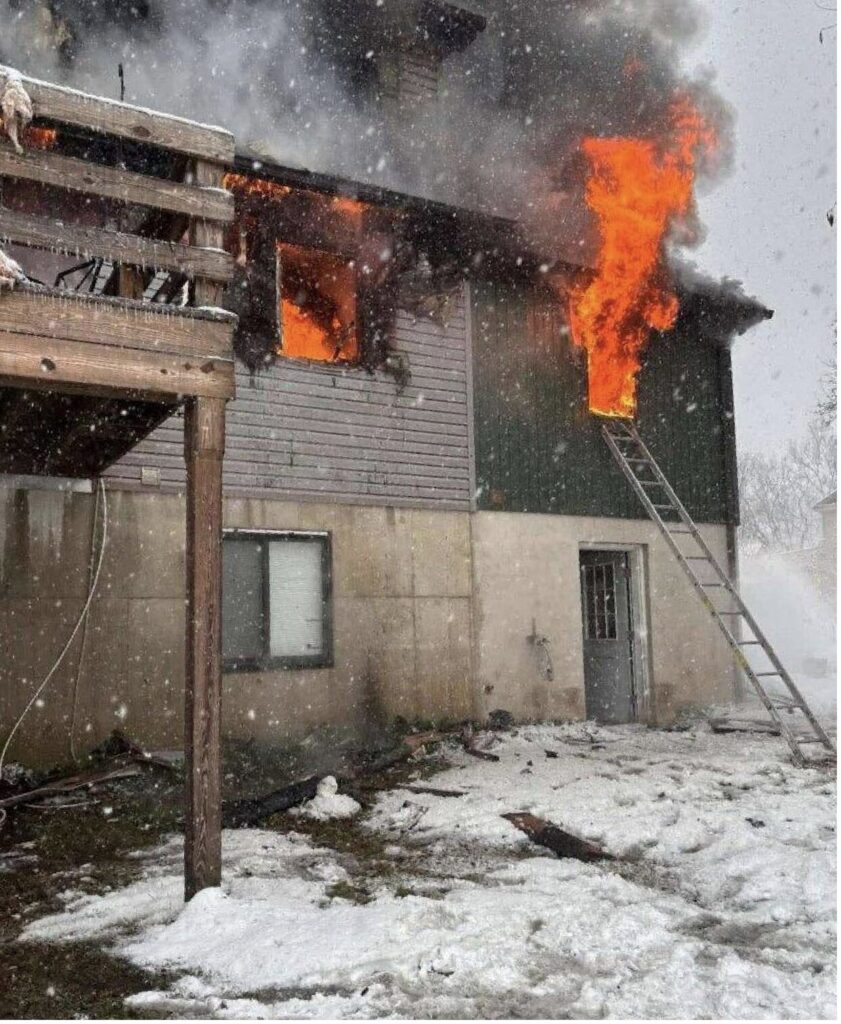
Derek Sandstrom’s home during and after the fire
“I’m not sure how to tell you this, but your house is on fire.”
Those are the words that Derek Sandstrom heard by cell phone as he and his family reveled in the stands after the Philadelphia Eagles’ Jalen Hurts ran 40 yards for a touchdown on Jan. 19.
Nationwide, there were an estimated 344,600 residential fires in the United States in 2023, according to the U.S. Fire Administration. What’s it like to pick up the pieces after a house fire?
First, there’s the realization then the shock.
“It’s just one of those surreal, out-of-body feelings,” Sandstrom said. “And I just looked past Carter [his son] to Sheri [his wife] and said, ‘Our house in on fire.’”
The family traveled home at a snail’s pace in a snowstorm to begin to face their reality.
When they arrived at the scene of their smoldering home in Etters, they were surrounded by firetruck lights and noise. Sandstrom said that the firefighters treated them very well and “told us in plain words what was happening and what we needed to do,” he said.
Surprisingly, then came the barrage of phone calls from independent insurance adjusters wanting their business. Sandstrom learned that adjusters listen to scanners and call or arrive at fires to offer their services.
“It’s like dude, oh my gosh, what—can you send me something?” he responded. “I’m here reeling in shock. If you don’t mind, I’m not gonna answer you right now.”
Also there, the American Red Cross. Emergency dispatchers inform the local Red Cross chapter when there is a fire.
“The Red Cross called and said, “We want to come over and talk to you and bring you some supplies,’” Sandstrom said.
They did come and brought bags for immediate needs like toiletries and offered cash, which could be sent to the bank or provided in any way that was most convenient. Cash allows people to make decisions about their most pressing needs, which they would know best.
“We connect with the families to provide support, including emergency lodging, financial assistance and emotional support,” said Laura Burke, executive director of the American Red Cross, Central Pennsylvania Chapter. “So, when the first responders are focused on the scene and what may be unfolding, we’re really working with individuals who were displaced.”
The Red Cross also can help with life-sustaining medical equipment and prescription medications. Bev Cullen, who experienced a fire in 2008, said that they provided vouchers so she and her husband could replace glasses lost in the fire.
Back on Their Feet
Both Sandstrom and Cullen had fire insurance. So, the next step was retrieving what they could from the scene and beginning the long process of cataloging what they had lost.
“What Bill [her husband] and I did every night for two weeks, we took one room at a time, and we sat there and closed our eyes and visualized the room,” said Cullen, also of Etters.
Sandstrom’s wife prioritized the scrapbooks. So, friends lent a hand retrieving them from the less damaged part of the house.
“We made a little assembly line, moving scrapbooks,” Sandstrom said. “The smell of a house fire is much different than a campfire. It’s like a heavy, oily, waxy, plasticky.”
He said that they were warned not to take items from the house into their new housing because the smell would permeate the space.
For those without insurance, the process is even more fraught. The Red Cross offers case managers who help folks navigate the resources available to them.
“In the days and weeks after the fire, we have volunteers that work with each family individually to create recovery plans and provide resources with local community organizations to help them get back on their feet,” Burke said.
There are ways to mitigate the stress in case of a house fire. Both Cullen and Sandstrom recommend taking pictures of your belongings.
“We’ve heard this advice before and ignored it, like everybody else,” Sandstrom said. “Take an inventory of your house, pictures or video. Whatever would jog your memory.”
And both used a public insurance adjuster, someone independent of your own insurance company. Sandstrom had a good experience with his insurance provider, Cullen not so good. Cullen recommends getting second opinions on what your insurance company advises.
Storing salvaged belongings can pose a problem.
“I wish I had known how expensive it was to store your stuff,” Cullen said. “That wasn’t really disclosed.”
In the whirlwind, she didn’t think to ask the restoration company about the cost of storing their possessions.
Friends, neighbors and family can support families going through the trauma of a fire. Cullen had a friend offer their Airbnb until they were able to rebuild.
“I was coaching tennis at Hershey, and the kids put together a GoFundMe and raised so much money,” Cullen said. “It was unbelievable.”
The night of the fire, she said that all she had was the leopard print pajamas she was wearing and had to borrow a friend’s shoes to go to the store. Friends kept their pets until they found a place to stay.
Fire victims are stunned by the situation. So, the best help is when folks just “do” rather than ask. Sandstrom said friends told them they were taking a particular day off, and they would help them that day with whatever they were doing. Sandstrom said that he was overwhelmed by the offers of help.
“I would advise anybody to have enough humility, swallow your pride enough to ask for the help that you need,” Sandstrom said. “Nobody is supposed to be able to do this themselves.”
For more information on the American Red Cross Central Pennsylvania Chapter, visit www.redcross.org and search under “Your Local Red Cross.”
If you like what we do, please support our work. Become a Friend of TheBurg!