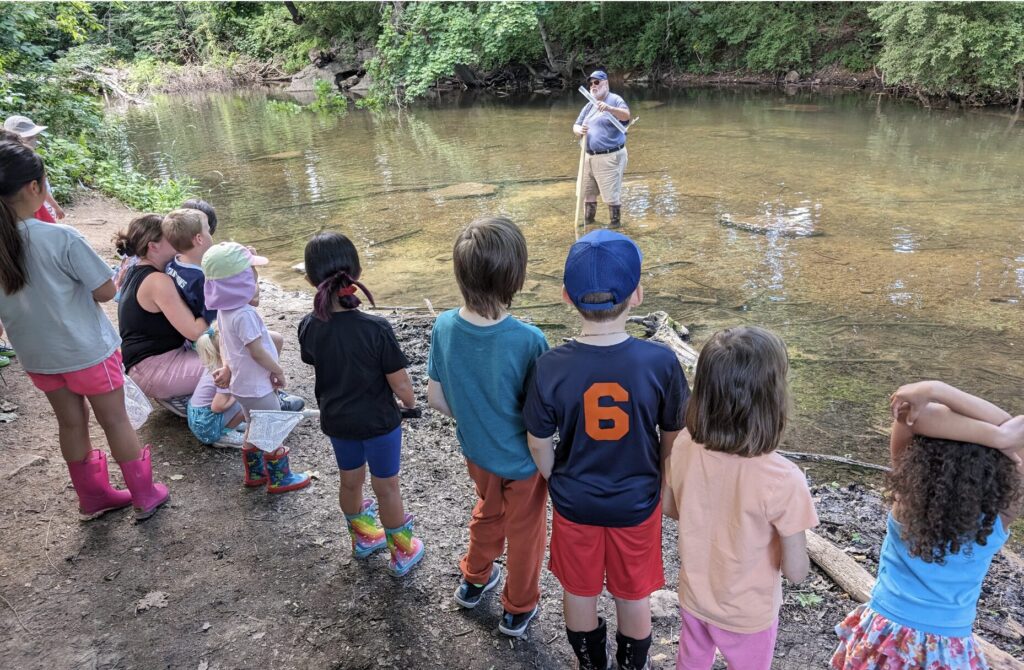
MWS volunteer Don Horn teaches Montessori Academy of Chambersburg students about stream health.
Around the state of Pennsylvania, more than 1,000 volunteers and volunteers-in-training have one thing on their minds: the health and wellbeing of our natural waterways.
As part of the Master Watershed Steward (MWS) program with Penn State Extension, which spans 42 counties across 16 programs, these volunteers and their full-time program coordinators run educational events, organize stream cleanups, monitor water quality and so much more.
In the Cumberland Valley program (which includes Cumberland and Franklin counties), Natalie Marioni leads the charge as program coordinator.
“We were established to strengthen the local capacity for management and protection of watersheds by educating and empowering these volunteers,” Marioni said.
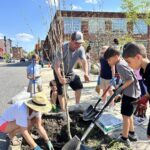
This includes supporting the work that conservation districts are doing (for example, sending out volunteers to help with a large tree planting) and answering requests from businesses, schools and other local organizations to add a pollinator habitat or rain garden, perform lawn conversions or even take students on educational creek walk field trips.
“Each of our programs is very different depending on where we are in the state,” Marioni said. “Our volunteers spend a lot of time training with the program, so they’re very invested in these topics. We foster that. They might have an idea to work with their local municipality because they see an issue that affects them and their neighbors, and that will launch into a program.”
This year, the Cumberland Valley MWS program will lead a three-part presentation series for Bosler Library in Carlisle. They also partner with Dickinson College, which runs a program called Alliance for Aquatic Resources Monitoring (ALLARM), where students and community members combine forces to investigate stream health by generating data for aquatic protection and restoration efforts. Through the Alliance for the Chesapeake Bay, a group of MWS volunteers dubbed “Riparian Rangers” ensure that riparian buffer (or stream side tree and shrub) plantings are as successful as possible. With the Department of Conservation and Natural Resources (DCNR), a new Invasive Replace-ive program helps people replace destructive invasive species with much more beneficial native trees.
These partnerships are pivotal for the state’s MWS programs.
“Not only do they help identify projects or needs in the community, but all of these different organizations bring something different to the table, and I think that’s what helps us do more in our communities,” Marioni said.
The Cumberland Valley MWS program is in the midst of its spring training session, but they generally train new volunteers on an annual basis (and other regions have their own volunteer training schedule). Volunteers are asked to commit a minimum of 20 hours per year.
“Each of those volunteers, we value whatever contribution they can provide to these efforts,” Marioni said.
Education & Outreach
Don Horn is a volunteer in the Cumberland Valley program. Horn became involved in 2020 and has since committed anywhere from 100 to 250 hours per year as a Master Watershed Steward and 10 to 20 hours per year in the Master Well Owner Network, which trains existing MWS volunteers in the management and education of private water systems like wells. His favorite activities include trout-release events and stream monitoring.
Horn is a great example that volunteers don’t need a scientific background to get involved.
“I serve on the board for the Friends of Michaux State Forest and during meetings, items came up I didn’t understand,” he said. “This was my opportunity to broaden my knowledge.”
At the start, Horn recommends that new volunteers team up with seasoned stewards until they learn their niche.
Many volunteer opportunities require boots on the ground, but the program seeks to maximize accessibility. For example, volunteers may staff tables at education booths or even write articles from the comfort of their own home.
“If I hear that a program isn’t yet accessible, or there aren’t enough accessible volunteer opportunities for whatever reason, I do really try to work hard to see how we can add new programming or adapt current programming to fit those needs,” Marioni said.
Penn State Extension’s MWS program started a dozen years ago in Lehigh County and extended to the Cumberland Valley in 2019. While Marioni has been working as a program coordinator for about five years, first in Berks and Schuylkill counties and now on the other side of the Susquehanna River, this wasn’t always her path.
For the first half of her career, Marioni was a wildlife biologist, focusing on reptiles and amphibians in aquatic habitats.
“Several years ago, when I ran out of grant funding to do some of the aquatic turtle research I was doing, I was looking for other opportunities, and I was very interested in educating our communities about protecting our water, both for our own use and for wildlife,” she said.
Eventually, she made her way to Penn State Extension’s MWS program.
“This is the 10th state that I’ve lived in, and this is the only state that I’ve lived in that has a watershed steward volunteer program,” she said.
While there are a few other states that have the program, it’s not common.
“One of my big interests, just being a former researcher and biologist, is community science, getting people involved in data collection that can be used by science communities to help study what’s going on around us,” Marioni said. “This program allows me to get volunteers involved in some of that, blending the research with the education and outreach.”
For more information on the Cumberland Valley MWS program, visit their Facebook page. The statewide program is on Instagram @PennStateWatershedSteward. Find more on all county programs at www.extension.psu.edu/programs/watershed-stewards.
Stories on environmental topics are proudly sponsored by LCSWMA.
If you like what we do, please support our work. Become a Friend of TheBurg!