Bob’s Art Blog: A Prelude to the Year in Art–“I’m Fine”

The gingko leaf, a symbol of resilience and longevity, held personal meaning for Patrick Joyce. He loved to collect them and, as a young environmentalist; they were a perfect match.

The gingko tree utilizes outside resources to survive, and its extracts are linked to mental health wellbeing. Perhaps that was one of the reasons Patrick felt an affinity for them as he struggled with mental illness, surrendering to it in 2018.

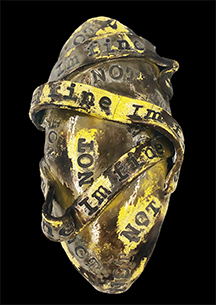
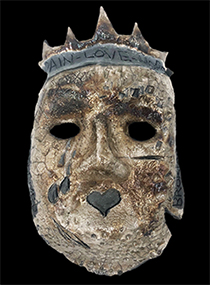
A mask from the “I’m Fine” exhibit

As a parent, the devastating effects of losing a child is life-altering and can take its toll on the most fervent believer. In a manner of working through that loss and grief, Maureen Joyce dedicated the “I’m Fine” project to the memory and life of her son. Enlisting the help of close friend and arts activist, Carrie Breschi, the women developed this project through community workshops over the course of two years, addressing the ever-growing crisis of mental health. The pandemic has further pushed mental health boundaries to the tipping point, crippling a disproportionate number of society’s population.

What started as a six-week installation at the Carlisle Arts Learning Center (CALC) this past spring, the project has taken on a life of its own through grant-writing spearheaded by Breschi and Joyce. The exhibit itself is groundbreaking in its multiverse format. It takes a page from Marshall McLuhan, the Canadian communications theorist, as “the method used to communicate information has a significant impact on the message it delivers.” Powerful in its scope and presentation with a tour-de-force wall of painted ceramic masks, it leaves an enormous impact on the viewer as it presents the ravages of mental illness.

A mask from the “I’m Fine” exhibit

The duo has fostered rabid interest in mounting “I’m Fine” in cities and towns throughout Pennsylvania. Already, it has run in Carlisle, with the next stop taking place this month at the Capital Area Intermediate Unit (CAIU) in Enola. Headed to Creative York in March 2022, “I’m Fine” will reach out to the entire community in the White Rose City. Already booked are additional events in Perry County and in Pittsburgh. Word is it will come to Harrisburg by 2024. Recently, the team addressed the PA Legislative Arts and Culture Caucus in Harrisburg, well received by this august body of legislators. In addition, the Cultural Alliance of York was on board with the project.

For Joyce and Breschi, “The mental health conversations that ‘I’m Fine’ has started, pave the road ahead to take its message across the state” and to destinations elsewhere. Who knows? This may serve as a pilot program for workshops on a national level. “I’m Fine” originated out of a parent’s grief, perhaps the most unbearable thing to face in life. And yet, out of that, a life-saving force was born, growing from a grassroots seedling like the gingko tree represents, into a body of believers who embrace “I’m Fine,” that “talking, caring and sharing can make a difference,” and, for Maureen Joyce and Carrie Breschi, that someday “I’m Fine” will come to mean exactly that.


Art News for the New Year

A quilt by Tom Ward

Arts on the Square Gallery at Market Square Presbyterian Church presents fabric artist, Tom Ward, in his one-man quilting show opening Jan. 9 through Feb. 27. Creativity has no limitation when it comes to age. At 85 years young, Mr. Ward is still at his craft, specializing in Bargello quilts where the fabric is cut into long strips and sewn together in graduated color groups. Bargello needlework is believed to have originated in the 17th century in Eastern Europe. Ward states, “I start a quilt or wall hanging in the center to see how it evolves outward.” In addition, Roger and Debbie Olson will display examples of his woodworking and her stained glass, paper-cutting and knitting.

Opening day for the exhibit is Sunday, Jan. 9, in the upstairs gallery from 12 to 1:30 p.m. on the fourth floor of the church building, with a reception. The gallery will also be open for 3rd in the Burg on Friday, Jan. 21, from 6 to 9 p.m., and on Saturday, Jan. 22, from 10 a.m. to noon. Parking will be provided for all three events in the adjacent, city-owned Market Square Garage. Visitors should enter the church through a door on the first level of the garage and continue straight ahead to the elevator lobby. For more information, contact Arts on the Square artistic director Tyler Canonico at 717-257-1270.


Also Around Town

The Nyeusi Gallery Artist Series features in-person events at the gallery at 1224 N. 3rd St., Harrisburg. January dates to note:

  • Saturday, Jan. 8, Donny Lyons, abstract artist, 1 to 5 p.m.
  • Saturday, Jan. 22, Larry Washington Jr, photographer, 1 to 5 p.m.

Metropolis Collective at 17 W. Main St., Mechanicsburg, announces “A Wintry Mix VI: Tangled Up In Blue” art exhibit on Friday, Jan. 21, from 7 to 11 p.m., with live music, featuring Donna Jean Foster. For more information, call 717-458-8245.

If you like what we do, please support our work. Become a Friend of TheBurg!

Continue Reading

Unity, Cooperation: Celebrating Kwanzaa with Harrisburg’s Black-owned businesses

Bryan Majors of Majors Prep

Just because Christmas ended does not mean that the holidays are over quite yet. Kwanzaa, the eight-day celebration recognizing African American and Pan-African principles and culture, began on Sunday.

Two of Harrisburg’s Black-owned businesses offer a way both to practice Ujamaa (cooperative economics), the fourth principle that is represented on the fourth day of Kwanzaa, and Umoja (unity), the first principle, which is represented on the first day of Kwanzaa.

Major Prep, owned by Bryan Majors, is more than fashion. The goal of Major Prep is to help the community mentally, physically, emotionally and spiritually reach its goals. This is represented through the mission of “Power, Wealth and Excellence,” not only in the apparel, but through motivational speaking, fitness training and other forms of empowerment.

“The brand conceived on the best and worse day of my life,” Majors said.

Major Prep was launched in 2012 after overcoming adversity following Majors’ father’s death in 2008.

Majors now is preparing for more projects in the coming year. He will launch the Martin Luther King “I Have a Dream” tour beginning in January. The goal is to speak at Harrisburg area schools, universities, churches and motivational workshops.

“The aim is to give participants the mindset and leadership tools that I believe Martin Luther King would’ve had in 2022,” Majors said.

Also in Harrisburg, Bre’Ale Martin-Darden created an additional holistic space for the community.

Launched right before the COVID-19 pandemic began in early 2020, The Lotus Pot was created to inspire people “to connect back to their roots with the natural healing properties that was left from our ancestors,” Martin-Darden said.

Using crystals, natural medicine, yoga and other alternate healing methods, Martin-Darden aims to help others heal—mind, body and soul on their own.

She was inspired to take action due to her parents’ illnesses and the concern of COVID-19 in the United States. She said that community support has helped The Lotus Pot become successful.

“I started participating in all these pop-up shops that they had around the city,” she said, “That’s what gave me the push I needed for my business–the support from the community.”

Martin-Darden also thanks her supporters for her success with the business so far.

“I just want to say thank you for everyone who has came and purchased anything from any of my events or even if you just came and talked to me and helped me,” she said. “That really does give me a lot of motivation to keep going.”

Martin-Darden noted that, as she is not the only holistic care business in the area, she appreciates her loyal supporters, knowing that they have chosen her to fulfill their holistic health needs.

While The Lotus Pot’s products are available to purchase through Instagram, including custom orders, the business is actually going through a rebrand for the upcoming year.

These are just two of many Harrisburg-area Black-owned businesses. For many others, view the digital edition of The Central PA Black Business Directory.

To purchase from The Lotus Pot, visit them on Instagram @TheLotusPot.

To book Majors’ to present at your organization, visit bryanmajors.com.

To learn more about Major Prep Apparel, visit majorprepapparel.com.

If you like what we do, please support our work. Become a Friend of TheBurg!

Continue Reading

Weekend Roundup with Sara Bozich

Plan your weekend with my weekly list of things to do around Harrisburg and central PA! Scroll down or use the menu links to find ideas for your weekend.

End-of-year update: I’m taking off tomorrow through Jan. 9. No Weekend Roundup next week or the following (I’ve never done that — even when I had a baby), but I have included some limited NYE and New Year’s Day events below. Thank you all for hanging around, replying to my emails, and sharing info and chats via IG (and I’ll prob still be posting on Instagram during these two weeks). I appreciate you all! Wishing you a warm and healthy holiday. See ya in 2022.

(Still) Worth noting: Check out my private Facebook community, Cheers Harrisburg. You can join the convo here.

Things on my agenda this weekend: Christmas celebrations; time with family; and extended time off.

Don’t forget to support your local brewery! Click here to find one near you.

For your weekend planning:

Below are options for your weekend.

Things to Do in Harrisburg + Central PA | Weekend Roundup | Sara Bozich

Be in the know.
Sign up to receive news and updates from Sara Bozich.
Nicely done. ??
 

Top Weekend Recs

  1. For last-min gifts, local is the answer
  2. You can get this stocking stuffer at the grocery store
  3. How to gift a brewery tour (spoiler: digital gift cards!)
  4. Scrap the whole thing and book your holiday party for 2022 instead
  5. Totally stumped? Find (the best) practical gifts here

COVID-19 Disclaimer: Masking and social distancing policies may vary per business, venue, and event. All events are subject to change. Please be considerate, follow the rules, and be nice. And tip extra!

Thursday

Friday | Christmas Eve

Saturday | Christmas Day

Sunday


Friday | New Year’s Eve

Saturday | New Year’s Day


What are you doing this weekend around Harrisburg? Let us know on Facebook, Twitter, or Instagram.

Like this content?

If you like what we do, please support our work. Become a Friend of TheBurg!

Continue Reading

Community Comment: What to Do with Dauphin?

As a result of the 2020 Census, Pennsylvania has lost one congressional seat in Washington. Legislators in the House and Senate State Government Committees of our PA General Assembly are in the process of drawing preliminary, 17-seat congressional maps now. Whatever map is chosen must pass each house of the General Assembly and be approved by the governor. It will be in effect until 2031.

On Dec. 15, the House State Government Committee passed their version of a preliminary map out of committee and on to the full House for amendments and a vote in January. So what should be done with Dauphin County and the adjacent capital region? As a resident of the county for over 44 years, I believe the General Assembly and the governor should consider the following when drawing and approving the final congressional map. In addition, a public comment period ensuring there is adequate time (preferably 30 days) for public review before approving any final map should be required.


COMPACTNESS and COMMON INTERESTS

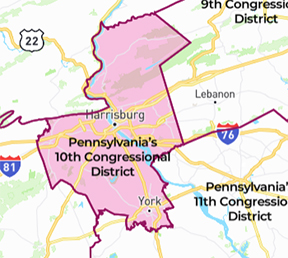
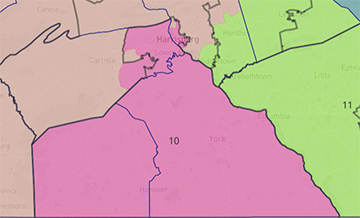
The current 10th congressional district

In its 2018 decision, the Pennsylvania Supreme Court applied essentially the same standards that our state Constitution requires for legislative redistricting. The court said congressional districts should be:

“… composed of compact and contiguous territory; as nearly equal in population as practicable; and which do not divide any county, city, incorporated town, borough, township or ward, except where necessary to ensure equality of population.”

The population of each of the 17 new congressional districts created in Pennsylvania for this redistricting cycle is 764,865. Dauphin County has a population of 286,401 according to the 2020 census. Based on population, it is possible to keep the county whole within one congressional district. It should be combined with other counties or areas with similar demographics, concerns, priorities, issues and, if at all possible, should remain whole.

The new district should not include parts of multiple counties such as was done in 2011. It should not be part of a district that stretches far to western, northern or eastern Pennsylvania. How can a legislator effectively focus on and represent two or more areas of the commonwealth containing constituents with very different issues, concerns, priorities, values and cultures? In addition, the county that is home to the PA General Assembly should not be divided. However, if a division is considered absolutely necessary, it should not be divided more than once, it should not be done to favor a party or candidate and an attempt to achieve a reasonably competitive district should be made.

The proposed 10th congressional district (labeled “10”)

With this in mind, the aforementioned House State Government Committee map has divided Dauphin County among three districts. District 10 is comprised of the city of Harrisburg, the eastern one-third portion of Cumberland and all of York and Adams counties. District 11 comprises the lower one-third of Dauphin and all of Lebanon and Lancaster counties. District 13 consists of parts or all of 11 different counties: upper two-thirds of Dauphin (minus Harrisburg); parts of Union and Snyder to the north; all of Mifflin, Juniata, Perry, Blair and Huntingdon, the western two-thirds of Cumberland to the west; and Franklin and Fulton on the Maryland border. This would seem to violate the requirement for compactness.   


BUSINESS AND INFRASTRUCTURE

The tri-county capital region has become one of the largest warehouse and distribution centers in the country and is the crossroads for the northeast in commerce, rail, trucking, air passenger and freight and general public travel. The major supporting roadways are I-81, I-83, I-78, PA-322, and I-283/ PA-283. The Pennsylvania Turnpike also traverses this area. Harrisburg International Airport is located in Middletown (south of Harrisburg). A common interest in infrastructure, business, commerce, commercial and private development, and environmental concerns exist within this region.


MINORITIES AND VRA REQUIREMENTS

Voting Act Rights requirements dictate that mapmakers strive to retain the voices of racial and ethnic minorities. The urban and suburban voters, along with significant communities of Black, Hispanic and Asian voters in Harrisburg and the surrounding area, are marginalized by combining them with overwhelmingly more conservative and rural areas. Dauphin County has the fourth-highest percentage of African Americans (19.2%) in Pennsylvania after Philadelphia (43.7%), Delaware (22.4%) and Forest (20.8%) counties. In south-central Pennsylvania, the most populous area of people of color is in Harrisburg (over half its residents). As was stated previously, there are significant and growing populations of Hispanic and Asian residents in the area and this trend will continue into the future.


CONCLUSIONS

The current congressional District 10 serves as a good example for the new congressional district. It is compact, encompassing the tri-county capital region of Dauphin, eastern Cumberland and northern York counties with similar issues, shared commerce, infrastructure and economic concerns. It has a mix of rural, suburban and urban populations and similar numbers of registered voters of both major parties, independents and other non-affiliated categories. It is also a district with one of the very few “competitive races” in both 2018 and 2020, with both results within 5%. The House preliminary map would create three safe seats for Republicans.

The citizens of Pennsylvania are calling for a map that has compact and contiguous districts. They are calling for more competitive elections that allow their voices to be heard and representatives that truly represent their interests. The new congressional map will influence policy and legislation affecting all Pennsylvanians for the next decade. What to do with Dauphin? The county that is home to the Capitol of Pennsylvania should not be divided. Keep the county whole within one district and keep the district compact and contiguous by including the tri-county capital region. It is imperative that we have the best map possible to represent Dauphin County, the tri-county capital region and our commonwealth in Washington.

Jean Handley
Resident of Dauphin County
Dauphin County Coordinator – Fair Districts PA

If you like what we do, please support our work. Become a Friend of TheBurg!

Continue Reading

Inauguration set for new Harrisburg mayor, council at Whitaker Center on Jan. 3

Mayor-Elect Wanda Williams

With the new year will come new executive leadership in Harrisburg, as Wanda Williams will be sworn in as mayor on Jan. 3.

The inaugural ceremony will take place at Whitaker Center, 222 Market St., Harrisburg, at 10 a.m. The event is free to the public.

Williams will replace incumbent Mayor Eric Papenfuse, who served for the last eight years in office. In November, Williams claimed victory overwhelmingly in the general election, despite Papenfuse’s attempt to win re-election through a write-in campaign.

Williams, the current Harrisburg City Council president, will be the 39th mayor of Harrisburg.

Harrisburg City Council members will also be sworn into office. They include Ausha Green and Shamaine Daniels, who were re-elected, as well as newcomers Ralph Rodriguez and Jocelyn Rawls. Council will reorganize, vote on a new council president and assign committee members at a Jan. 3 meeting at 12:30 p.m.

City Controller Charlie DeBrunner, who ran unopposed during the election, also will be sworn in for another term.

The following weekend, Williams will revive the tradition of holding a mayor’s inaugural ball. It will be held on Jan. 8 at the Sheraton Hotel, 4650 Lindle Rd., Harrisburg, at 5 p.m. Tickets can be purchased for $75.

For more information on the inauguration of Wanda Williams, visit her website.

If you like what we do, please support our work. Become a Friend of TheBurg!

Continue Reading

Community Comment: A tribute to Harrisburg attorney Joseph Gordon Skelly, who argued landmark religious liberty case before U.S. Supreme Court

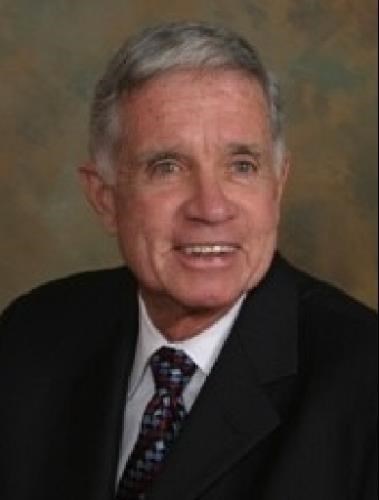
Joseph G. Skelly

One of the many wonderful things about living in Harrisburg is being a part of a diverse community.

On Saturday, Dec. 11, 2021, Harrisburg lost a local attorney, an expert in mediation and professional ethics, who worked across cultural, political, racial, religious, and geographic boundaries ensuring sound law and policy. Particularly in central Pennsylvania and all across the United States, Old Order Amish and Mennonite communities owe a debt of gratitude to Joseph Skelly for his role as a litigator in the historic landmark U.S. Supreme Court decision Wisconsin v. Yoder, 406 U.S. 205 (1972).

This U.S. Supreme Court decision exempts Old Order Amish and Mennonite children from compulsory education laws, thus preserving Amish and Mennonite culture. Joseph Skelly, a Roman Catholic, advocated for religious freedom speaking out in defense of Evangelical Christians, Orthodox Jews, Old Order Mennonites and Amish, Native Americans, and many others. He worked with diverse individuals in a very effective and practical way. Joseph Skelly’s legal career focused on the preservation of parental liberty, alternative education and free religious exercise.

Born in 1935, Joseph Gordon Skelly grew up in Oil City, Pa. His father Daniel Skelly was the district attorney for Venango County. After graduating from the University of Notre Dame, Indiana, Skelly earned his law degree at the Villanova University School of Law. Attorney William Ball was Skelly’s constitutional law professor. William Ball left Villanova Law School, moving to Harrisburg and taking the position of general counsel and executive director of the Pennsylvania Catholic Conference.

Skelly’s law partner and mentor, William Bentley Ball (1916-1999), from Rochester, N.Y., graduated from Western Reserve University in 1940. While a college student, he served in a 107th Cavalry Unit of the Ohio National Guard. Ball served in combat with the U. S. Navy during World War II and eventually retired as a lieutenant commander in the U.S. Naval Reserve. In 1948, Ball earned his law degree from Notre Dame. Ball practiced corporate law in New York first as an in-house attorney for W. R. Grace & Company and eventually for Pfizer, Inc. Beginning in 1955, Ball devoted his career to constitutional issues, particularly related to religious freedom.

After graduating from Villanova Law School, Skelly returned to Oil City, engaging in private practice as an associate in a small firm. Three years later, Ball invited Skelly to join him at the Pennsylvania Catholic Conference as assistant counsel, focusing on educational matters. In 1968, Ball and Skelly left the PCC, forming their own private practice: Ball & Skelly (later to become known as Ball, Skelly, Murren & Connell). Ball and Skelly concentrated in litigation for religious freedom. As managing partner of the firm, Skelly concentrated on general civil practice. When Ball died in 1999, Skelly undertook extensive mediation skills training and set up his own practice for alternative dispute resolution, the Skelly Dispute Resolution Center.

Skelly was interested in the ethics and professionalism of lawyers and the perception by many, both inside and outside of the legal profession, of the breakdown in civility among lawyers. Skelly lectured extensively on the subject, including presentations at continuing legal education courses. Skelly was an adjunct professor at the Harrisburg campus of Widener University School of Law, where he taught alternative dispute resolution as well as law practice management.

Skelly’s work concentrated as a mediator for special education disputes involving controversies between parents and school districts relating to special education services to children. In addition, Skelly served as a hearing officer in special education cases.

From a legal standpoint, the modern era of home education and alternative education, particularly for issues of religious freedom, began with the landmark U. S. Supreme Court decision Wisconsin v. Yoder (1972). After a string of unsuccessful battles in state courts, the 60-year struggle of the Old Order Mennonites and Amish against compulsory education culminated in Wisconsin v. Yoder (1972) argued by Ball and Skelly.

Mennonites and Amish are pacifists and, as conscientious objectors, they perform alternative service during times of military conscription. Some Americans disapproved of the Mennonites and Amish refusal to enlist or be drafted into the military during the WWI. In retaliation, in Ohio, in 1914, Mennonite and Amish fathers were fined, arrested, and convicted for refusing to send their children to Ohio public schools. Custody of Mennonite and Amish children was taken away from Mennonite and Amish parents. Farm equipment, livestock and farms were confiscated from Mennonite and Amish parents. Some Mennonite and Amish children were forced to attend state boarding schools, where Mennonite and Amish plain clothing was not permitted.

Starting in 1925, Mennonites and Amish in hostile jurisdictions began forming their own private religious schools. Some Mennonites switched from “unaccredited” home education to the use of “accredited” home-correspondence curriculum. Public educators were not placated. Public educators obtained the State v. Hoyt, 146 A. 170 (N.H. 1929), decision and implemented the precedent aggressively. Two Mennonite defeats were particularly devastating: State v. Hershberger, 144 N.E.2d 693 (Ohio App. Ct. 1955), and State v. Garber, 419 P.2d 896 (Kan. 1966), cert denied, 389 U.S. 51 (1967).

In an effort to reduce unemployment during the Great Depression, Roosevelt’s New Deal cooperated with the states in raising compulsory school attendance ages and enacting labor laws prohibiting youth apprenticeships. This became a problem for Mennonite and Amish communities where students attended schools until the eighth grade and then engaged in youth apprenticeships, learning necessary skills for operating in the local Mennonite and Amish agricultural and cottage industry economies. In 1948, in the case McCollum v. Board of Education, 333 U.S. 203, the U. S. Supreme Court eliminated public school prayer and public school Bible study. After a protracted and unsuccessful legal battle to reverse the court’s decision, many Protestants, and especially Evangelicals, turned to alternative education.

In 1965 in Olwein, Iowa, public school officials physically herded terrified Mennonite and Amish children onto school buses, forcing them into state-prescribed public education. The Rev. Dr. William C. Lindholm, a Lutheran pastor in Iowa, was horrified when he saw photographs of terrified Amish children running from truant officers in cornfields. Dr. Lindholm founded the National Committee for Amish Religious Freedom and became aware of the plight of Jonas Yoder of Wisconsin.

The Yoder family’s troubles began when the local Old Order Amish opened their own elementary school, resulting in the transfer of 37 children out of the Wisconsin government-grade schools. Kenneth J. Glewen, the local school district administrator, decided to stop his school district’s loss of $18,000 in tax revenue by filing a truancy complaint. The complaint included 15-year-old Frieda Yoder and presented the threat of criminal prosecution and other measures if her father Jonas Yoder refused to cooperate. Glewen spoke to the local newspapers about the danger of “dirty, barefoot Amish kids,” and told both the press and legal authorities how the teenagers would become “delinquent” dangers to the community unless public education intervened to prevent this growing menace to society.

On Christmas Eve 1968, Dr. Lindholm contacted Harrisburg’s law firm of Ball & Skelly, asking them to represent Jonas Yoder of Wisconsin. Ball and Skelly were contacted because they were in the forefront of the Roman Catholic Church’s efforts blocking the Kennedy and Johnson administrations from denying federal funding to parochial schools. Ball was admitted to practice before the U. S. Supreme Court in 1969 and argued nine cases relating to civil rights. He assisted in 25 other cases and practiced on the federal district and appeals levels, as well as in state courts. U. S. Supreme Court Justice Harry Blackmun told a group of law students who had just observed Ball present an oral argument at the U. S. Supreme Court how they were “privileged to see one of the finest oralists this court has ever had, Mr. Ball of Harrisburg, Pennsylvania.”

Ball & Skelly agreed to take the case, sending a formal letter dated January 20, 1969, to Dr. William C. Kahl, Wisconsin superintendent of public instruction, requesting that the threats against Jonas Yoder be discontinued on the grounds of how Yoder’s “home vocational school” qualified for the “legal excuse” exception in Wisconsin’s compulsory attendance statute. The prosecution of Jonas Yoder was handled by the Wisconsin State Deputy Attorney General Robert D. Martinson, who was assisted by local District Attorney L. A. Koenig. A bench trial was held before Judge Roger L. Elmer.

Ball & Skelly’s tactics are now a familiar part of the playbook for any knowledgeable attorney who has been involved in legally defending alternative education or parental liberty. Ball pointed out how the truancy complaint appeared to be motivated by concerns about tax revenue, not about serving the best interests of the Old Order Mennonite and Amish children. Ball and Skelly’s examination of various local government leaders proved not one Mennonite or Amish person in Green County, Wisc., was unemployed, or accepting public assistance, or involved in an illegitimate birth, or suffering from alcoholism. Thus, the evidence showed how Wisconsin’s defamations against Yoder and his community were unsubstantiated, as was the professed concern about the possible tax burdens inflicted upon Wisconsin taxpayers by the allegedly backward Mennonite and Amish communities.

Ball & Skelly also utilized a respected expert witness, Dr. John A. Hostetler, a sociologist and anthropologist professor from Temple University in Philadelphia. Hostetler ably explained why public education would destroy Amish culture. A former member of the Amish community, Hostetler was key to Ball’s strategy of placing critical facts in the record for later use on appeal. Similarly, Dr. Donald A. Erickson, associate professor of education at the University of Chicago, testified how “the current education system is detached from the real world” and Wisconsin’s government education would not help the Mennonites and Amish.

Jonas Yoder was found guilty by the trial judge and fined, but he refused to pay the fine as a matter of conscience. Ball and Skelly appealed the Yoder case, eventually all the way to the U.S. Supreme Court. An interfaith coalition, attorneys from Jewish, Seventh-Day Adventist and Church of Christ organizations rallied behind the cause, filing friend-of-the-court briefs supporting the two Catholics from Harrisburg, representing Mennonites and Amish at the request of a Lutheran pastor. But despite all of the effort and laudable ecumenical cooperation, a dejected Ball wrote Skelly a note at counsel table immediately after oral arguments had concluded: “We have LOST.”

Fortunately, Ball’s darkest fears were not realized. The U.S. Supreme Court held, 6 to 1, arguing how requiring Mennonite and Amish children to attend public school violated their constitutional right to freedom of religion. The court held that an individual’s interests in the free exercise of religion under the First Amendment outweighed the state’s interests in compelling school attendance beyond the eighth grade. In the majority opinion by Chief Justice Warren E. Burger, the court found the values and programs of secondary school were “in sharp conflict with the fundamental mode of life mandated by the Amish religion,” and argued how an additional one or two years of high school would not produce the benefits of public education cited by Wisconsin to justify the law.

Wisconsin v. Yoder (1972) proved to be one of the most important U. S. Supreme Court decisions in the history of the United States. In a decisive victory for alternative education, parental liberty, and religious freedom, the Court reaffirmed Meyer v. Nebraska (1923) and Pierce v. Society of Sisters (1925). Yoder (1972) curtailed the campaign waged against the Mennonites and Amish and other similar demographic minorities. Ball became vice chairman of the National Committee for Amish Religious Freedom.

Thanks to Ball and Skelly, Wisconsin v. Yoder (1972) also ushered in the “modern” era of alternative education and home education for non-Mennonites and Amish. But the battle was just beginning. Just as they had in the 1920s, public educators resisted implementation of the U.S. Supreme Court’s decisions. Public educators and some state courts argued how Yoder (1972) merely created a narrow “Amish exception” that did not apply to Native Americans, Mormons, African-Americans or anyone else. This legal strategy did not succeed in stopping families outside the Mennonite and Amish communities from joining the home education movement.

In 1986, U.S. Secretary of Education William Bennett suggested that private and home schools were guilty of “educational abuse” of children if compliance with government education standards did not occur (Bennett has subsequently become an advocate of home education). At the forefront of the opposition from the judicial bench were Judge Robert H. Bork, Justice John Paul Stevens, and Justice Antonin Scalia. In Troxel v. Granville, 530 U.S. 57 (2000), Justices Stevens and Scalia teamed up once again to advocate for the total elimination of constitutional protection for parental liberty, including the practical reversal of Meyers, Pierce, and Yoder. The attempt by four justices to eliminate or severely curtail parental liberty was narrowly turned back by a five-justice majority consisting of Chief Justice William Rehnquist, Justice Sandra Day O’Connor, Justice Clarence Thomas, Justice Ruth Bader Ginsberg and Justice Stephen Breyer.

At the present time, the perilous battle for the future of parental liberty and alternative education continues unabated. For over three decades, Ball and Skelly were preeminent litigators in the fight for parental liberty, alternative education and free religious exercise. Ball’s argument before the court, with Skelly’s assistance, made the case how the government must prove a compelling public need for actions affecting religious groups. Subsequent court decisions weakened this doctrine, causing Congress to pass the Religious Freedom Restoration Act of 1993 to enshrine the “compelling reason” doctrine.

Since Wisconsin v. Yoder (1972), all states must grant the Old Order Mennonites and Amish the right to establish their own schools (should they choose) or to withdraw from public institutions after completing the eighth grade. This landmark U.S. Supreme Court decision has significantly contributed to the preservation of Old Order Mennonite and Amish communities in Pennsylvania and across the nation. This was made possible because of the legal expertise of the Harrisburg law firm of Ball and Skelly. Recently, we lost Joseph Gordon Skelly, Esq., and we should pay tribute to his vocation and calling for preservation of parental liberty, alternative education, and free religious exercise. We should recognize Joe Skelly’s working across cultural, political, racial, religious, and geographic boundaries, ensuring sound law and policy. Joe Skelly represented everything that is great about our community in Harrisburg.


Jean-Paul Benowitz
is the Director of Prestigious Scholarships and Fellowships at Elizabethtown College, where, for 28 years, he has been teaching courses about local Pennsylvania Dutch history and culture. He was a scholar in residence at the college’s Young Center for Anabaptist and Pietist Studies. He has lived in Harrisburg for two decades and has served with the Historic Harrisburg Association.

If you like what we do, please support our work. Become a Friend of TheBurg!

Continue Reading

Burg Blog: There’s a Catch, 2022

Photo by Cristian Escobar on Unsplash

It feels like a case of December déjà vu.

The holiday season is once again a backdrop for COVID-19 complications. A new variant is here, adding a new wrinkle to our lives, less than two weeks from “Auld Lang Syne.” It’s a pandemic-weary wonderland.

How do we handle holiday gatherings and hoopla? What are the latest protocols, and are all of our friends and family members adhering to them? How safe are restaurants, flights, etc.? It’s a Christmas conundrum, all over again.

I’ve always been fascinated by déjà vu. It’s a sensation that’s somehow both creepy yet cool, haunting yet familiar. Kinda like Scrooge and his ghost of Christmas past. As déjà vu chills run down my spine, I usually enjoy the challenge of trying to figure out why the situation feels familiar.

But this season’s déjà vu is one I could do without. I don’t want to slide backwards, revisiting restrictions and lockdowns, but I fear that’s where we’re headed. I hope I’m wrong.

Every new year feels a little déjà vu-ish. A time of new beginnings, fresh starts, a clean new calendar. Dream a new dream, set a new goal, make a New Year’s resolution. But dare we dream about 2022? Dare we dream about an end to the pandemic?

It feels like some dreams and goals are on hold, amid the pandemic. On the flip side, other dreams have actually been inspired by the pandemic—innovative new businesses, creative WFH opportunities, brave relocations as some of us redefine “home.” How great is it, to focus on these positive stories, glimmers of hope and the resilient human spirit?

Living life “on hold” is no way to live—it’s like holding your breath for a really long time.

What I really want to do in 2022 is exhale. When will it be safe to let out our collective breath, and turn the page on the pandemic? Will that day ever come?

I’m tired of focusing on the dangers associated with inhaling a potentially deadly virus. Aside from the obvious health threat, it’s inciting fights over vaccines and masks, in political circles, within cities and towns, on school boards, among families and neighbors—as our very lives hang in the balance. Cancel culture kicks in when leaders or businesses come down on one side or the other.

As we careen toward the New Year, 2022, there’s one more complication. A catch.

Part of our society is facing the music, attuned to reality, truths and facts. And another segment of society seems to be living in an alternate reality, choosing to believe conspiracies and lies. Differences of opinion are normal and natural, but the division we’re experiencing now feels more and more hateful. We have forgotten how to respect one another. We have forgotten how to listen to one another. We have forgotten how to love one another.

That’s the creepy aspect of this year’s December déjà vu. December—and its holiday seasons—is a time when we’re especially supposed to be focused on peace on earth, joy, and love for our neighbors. I don’t pretend to have all the answers. Personally, I’m still trying to erase the memories of hate-filled signs on neighborhood lawns. Maybe you are too. Peace, love and joy can be challenging amid a politicized pandemic.

How ironic (or appropriate) that we’re approaching 2022, because these challenges—at times—feel like a catch-22. An impossible situation, like its namesake novel. It’s also ironic that Joseph Heller chose the number 22 for his novel’s title because the repeating digits have an uncanny similarity to the phrase, “déjà vu.”

Here’s another ironic twist: As we enter January 2022, it will be the 22nd month of our pandemic era. You just can’t make this stuff up. The truth is always stranger than fiction. Oh, wait—different segments of our population currently have different ideas of what is truth and what is fiction. Yikes.

How can we shake ourselves free of this nightmarish déjà vu?

Don’t worry—as a realist who’s also an eternal optimist—I’m going to end on a somewhat positive, hopeful tone. Just as the characters in the novel Catch-22 try to maintain their sanity within a war, I feel as though we too need to dig deep and do the same. We are waging war against a pandemic, but we are also engaged in wars for the truth and, some say, for our very democracy.

How can we maintain our sanity? Dare to dream into 2022 and beyond?

During this pandemic era of journalism, there are several common themes—pieces of advice—I’ve heard from sources, as I’ve interviewed all kinds of people, from all walks of life, during the past nearly two years:

  • We need to listen more and talk less.
  • Have open, rather than closed, minds.
  • Adhere to our weary medical experts’ advice.
  • Seek facts and truth.

Déjà vu is French for “already seen.” We have already seen enough of the alternatives.

I, for one, will strive to live by these seemingly simple, yet vital, “catch phrases” in 2022. I want out of the catch-22. That’s the truth. 

Karen Hendricks is a regular contributor to TheBurg and host of TheBurg Podcast.

If you like what we do, please support our work. Become a Friend of TheBurg!

Continue Reading

The Week that Was: News and features around Harrisburg

Harrisburg City Council approved a 2022 budget on Tuesday.

Only one more week until Christmas, Harrisburg! Finish wrapping those gifts and icing the cookies. While you wait on Santa’s arrival, catch up on this week’s local news.

Bob’s Art Blog previewed the last 3rd in the Burg event of the year. Two of the longest-standing civic institutions in Harrisburg will participate and offer two different looks at identity.

“C’mon C’mon” is a black and white film that takes you on a journey through the allure of introspection and vulnerability, our magazine story reported. The film debuted this month at Midtown Cinema in Harrisburg.

Dauphin County commissioners passed a $278.5 million budget, which is 2.5% less than the 2021 budget, our online story reported. The county will hold the line on property taxes once again.

Harrisburg City Council approved a 2022 budget that will serve as a placeholder until Mayor-Elect Wanda Williams takes office and likely reopens the spending plan, our reporting found. Council also approved two substantial development projects in Midtown and Uptown.

The Harrisburg School District announced its plans to use federal COVID relief money, our online story reported. Superintendent Eric Turman said that they hope to reopen William Penn School and Steele Elementary.

Harrisburg University Professor Steven Jasinski has participated in naming and describing two newly discovered dinosaurs within the past year, our magazine story reported. The Sierraceratops turneri is the seventh dinosaur species he has named, on his own or as part of a team.

Holiday events are on display this weekend as we round the corner to Christmas. Sara Bozich has all the festivities, here.

Home prices were strong even as sales overall were flat in the Harrisburg area in November, according to the latest report from the Greater Harrisburg Association of Realtors. Find data specific to your county in our online story.

The Lancaster Symphony Orchestra has a lot on its plate as it recovers from the pandemic, our magazine story reported. This season marks the orchestra’s 75th anniversary and it is in the search process to identify a new conductor.

Mifflinburg’s Christkindl Market just finished its 32nd year as a staple holiday tradition. In our magazine story, read about the history behind the popular outdoor market that draws crowds of up to 10,000 people.

MLK Day will be full of ways to serve the community this year, our online story reported. The Central Pennsylvania MLK Day of Service committee will spotlight the need for affordable housing and accessible healthcare through its volunteer opportunities.

The U.S. Marine Corps Reserve Toys for Tots program serves underprivileged children in many areas within Dauphin County, as well as Camp Hill and Mechanicsburg in Cumberland County, our magazine story reported. The program is based in Uptown Harrisburg at the Echo Co., 2nd Battalion Marine Reserve unit headquarters on N. 2nd Street.

Do you receive TheBurg Daily, our daily digest of news and events delivered right to your email inbox? If not, sign up here! 

Support quality local journalism. Join Friends of TheBurg today!


Continue Reading

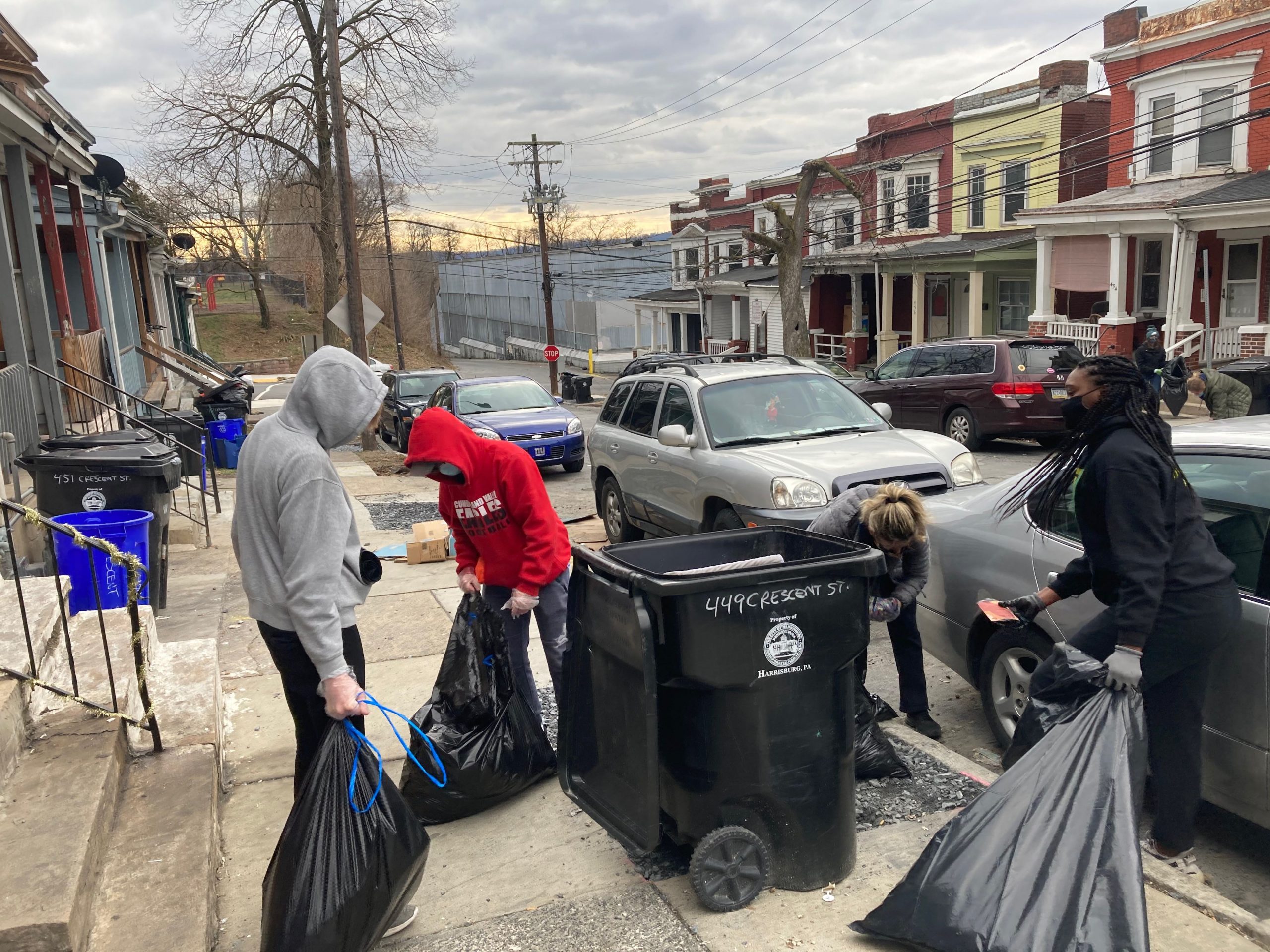
Service Spotlight: Local group will provide volunteer opportunities on MLK Day

Volunteers at a previous MLK Day of Service.

As you wrap gifts for family and friends this holiday, a local organization hopes you will consider giving back to your community, as well, in the coming year.

The annual Central Pennsylvania MLK Day of Service will commence on Jan. 17, providing those with the holiday off from work a chance to volunteer locally.

“The legacy of MLK is so big,” said Heather MacDonald, a board member for the day of service committee. “You can show up and be a part of something bigger.”

Every year, on Martin Luther King Jr. Day, the committee encourages people to spend the holiday serving. Last year, the event was largely virtually due to the pandemic.

This year, their theme is “The Beloved Community: Ensuring Affordable Housing and Accessible Health Care.” Activities will be in-person and virtual.

“Housing and health is the perfect theme,” MacDonald said. “After COVID, that is what we are all thinking about. Shining a spotlight on it is going to be really important.”

The day will kick off with an opening ceremony at 9 a.m. at Hamilton Health Center at 110 S. 17th St. in Harrisburg, which will also be live-streamed on Facebook. Then, groups will split off to volunteer around the central PA region in various capacities related to housing and healthcare needs.

Volunteer projects include tasks like creating packs of essential items for the unhoused, creating care packages for children in the hospital and working to prepare people’s homes for the winter weather.

Organizations can also sign up to have volunteers assist them with a project.

Throughout the day, the Day of Service committee will hold virtual and in-person workshops and webinars on topics such as first-time home buying and aging in place.

A vaccine clinic and blood drive will take place, as well.

Giant is a sponsor for the event, and MacDonald said that they are still looking for more sponsors and donors.

“It’s going to be a really good use of your time,” MacDonald said. “It amplifies and grows every year.”

To view volunteer opportunities or for more information about the Central Pennsylvania MLK Day of Service, visit their website.


If you like what we do, please support our work. Become a Friend of TheBurg!
Continue Reading

Burg Blog: To Publish or Not to Publish?

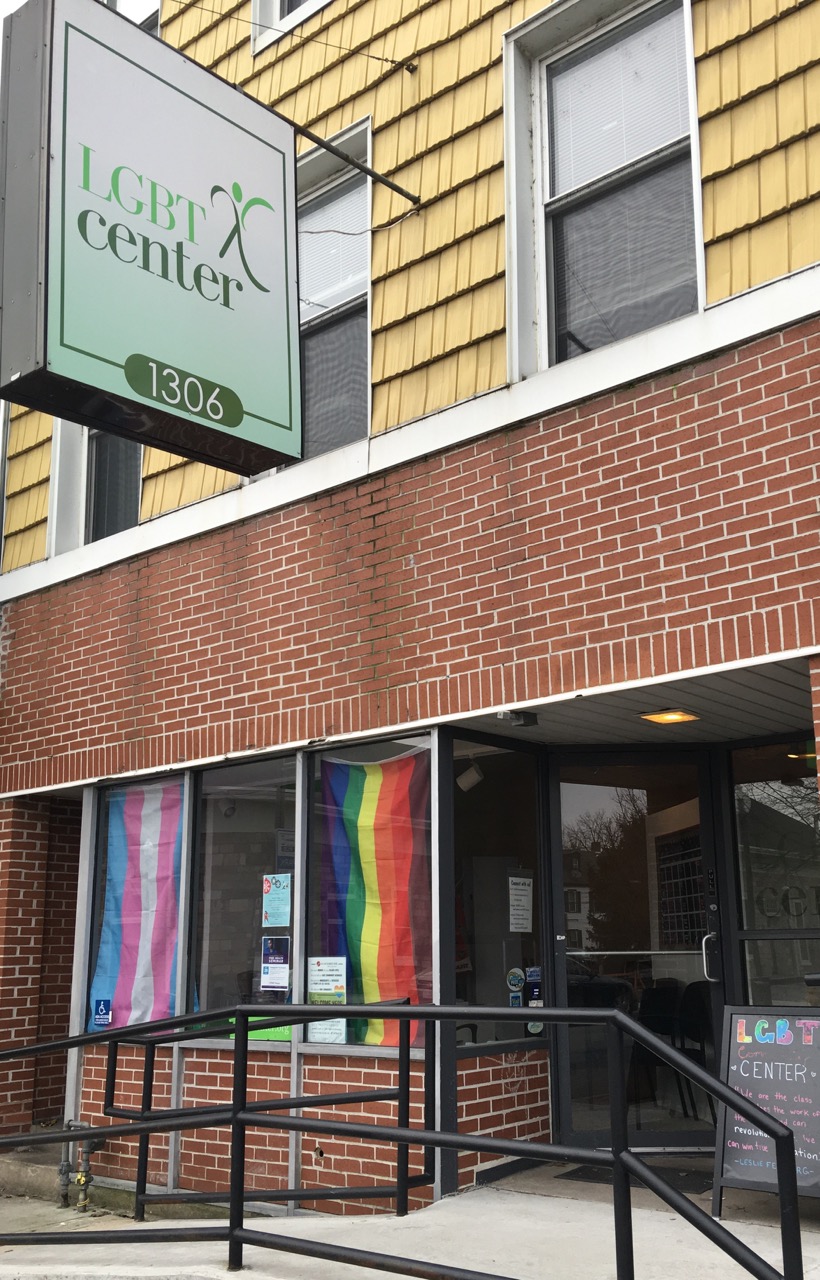
The former LGBT Center of Central PA

In journalism, some stories are much tougher to judge than others.

Most stories are obvious in terms of news importance. But some aren’t.

Take, as a good example, our story on Thursday about a dispute between the LGBT Center of Central PA and Harrisburg Mayor Eric Papenfuse.

In that story, Amanda Arbour, the center’s executive director, in a widely circulated press release and social media post, leveled certain charges about a building the mayor owns, where the center used to be located.

It was a follow up to a story from October, when we reported that the center had left its long-time home. Thursday’s story offered a lot more detail over what had allegedly happened.

Now, this is a landlord/tenant dispute at its core, so it’s something we typically would not consider newsworthy, unless perhaps there was a broader community concern or issue involved.

However, to me, this story’s importance was elevated by the prominence of the two parties involved: the city’s mayor and one of our area’s foremost nonprofits—as well as what the LBGT Center was claiming.

So, in the end, I decided it was newsworthy and should be published.

It wasn’t an easy call, and, after it was published, some people disagreed with my decision, emphatically starting with the mayor, who believed that we targeted him because of his position.

I might add that, for the story, we contacted Papenfuse for comment, which he provided and we incorporated. So, he knew we intended to publish a story based on what the LGBT Center said had occurred.

Now, the story doesn’t reach a definitive conclusion over who’s right. How could it? We weren’t there, but the two disputing parties were—and they’re saying very different things about what happened. So, we presented the center’s claims and Papenfuse’s response to them.

Many news stories are like that, of course. A reporter asks one side for their view, then the other side for theirs. It’s an imperfect method of discerning a “truth,” but it’s sometimes the best tool we have, especially when that “truth” is in dispute.

Papenfuse now believes that what we published was so egregious as to constitute irresponsible journalism at best, defamation at worst.

I continue to believe that we made the correct call.

So, what would you have done? Would you have published the story?

Lawrance Binda is the co-publisher and editor-in-chief of TheBurg.

Continue Reading