Tag Archives: William Penn High School

Burg Blog: A few Harrisburg-themed resolutions for the New Year

Harrisburg City Council

It’s nearly the New Year, and, for many of us, that means making resolutions that, we hope, will survive past January. In this spirit, I’ve put together a few resolutions for Harrisburg, things I’d like to see us, as a city, achieve over the course of 2026.

Mayor/Council peace. Ideally, I’d like our elected officials to band together and work collaboratively for the good of our shared city. However, based upon recent events, I now realize this may be too much to ask. So, my more modest request is for some type of peaceful coexistence between the two warring bodies—think a 1970s-era U.S./Soviet détente, in which the antagonists cooperate on their most pressing issues. As to who’s to blame for the current Cold War between mayor and council . . . don’t know, don’t care. We elect our public officials to work for us, and for the betterment of our troubled city, not to focus their time and energy battling one another.

William Penn decision. How long can a single can get kicked down a single road? The Harrisburg School District is testing the distance limits with its decade-long indecision over what to do with the former William Penn school and campus. Over the years, the district has weighed everything from re-use to sale to re-development to demolition, only to back down and/or reverse course every time. The result is a boarded-up building that gets more dilapidated with each passing year. For 2026, be it resolved that the school district will make a final decision on the fate of William Penn—and stick to it.

Broad Street wishes. In recent years, the Broad Street Market has come to embody the deflating sense that, in Harrisburg, if something can go wrong, it will go wrong. Therefore, for 2026, my hope is that the curse will lift, at long last. No more fires, no more delays, no more collapsed walls, no more infighting, no more design distractions—and, importantly, a competent, caring and stable board of directors. Is it possible that, 365 days hence, the market reconstruction will be progressing, the budget will be balanced, and we can look forward to a 2027 building completion? Or am I just Charlie Brown, once again, charging like a blockhead towards the football?

Blueprint beginnings. Harrisburg is a city in transition. The downtown, especially, is undergoing a painful transformation from government town to—well, something else, something not yet defined. Therefore, it’s vital that, in 2026, an economic development plan for the downtown is finalized and that implementation is started. Fortunately, there’s reason for hope, thanks to entities like the Harrisburg Regional Chamber/CREDC, area legislators and the Intergovernmental Cooperation Authority, which have taken first steps. I’m reasonably confident that, a year from now, we’ll see positive momentum on this resolution.

Hope for housing. In recent years, numerous affordable housing projects have been started or completed in Harrisburg. Fortunately, I expect that to continue in 2026, as developers take advantage of subsidies and other assistance that make affordable projects possible. In contrast, lacking these incentives, market-rate projects have lagged—many proposed, few built. So, for 2026, I hope to see some of those projects finally get off the ground. Harrisburg needs all types of housing—and it needs people who will patronize our small businesses, who will pay taxes, who will add life to our sidewalks and streets. It also needs public officials who realize that adding residents is the solution to many of our city’s woes.

Ounce of kindness. Finally, I hope that we, as a people, can resolve to treat each other with respect and kindness in 2026. Yes, this city of ours can be frustrating, sometimes making compassion challenging, whether in person or online. But, personally, I’m going to do my best to fulfill this resolution.

Happy New Year, everyone!

Lawrance Binda is publisher and editor of TheBurg.

If you like what we do, please support our work.
Continue Reading

A Doctor’s Life: Dr. Charles Crampton was one of Harrisburg’s most prominent Black citizens, until the system turned against him

Illustration by Ryan Spahr.

“He enters the Esquire Bar. All the big muck-a-muck politicians go there. It surprises me that they let a colored man enter. He’s certainly the only one.”
– “The Blue Orchard,” Jackson Taylor

In early 20th century Harrisburg, then called “a Northern city that still practices Southern ways,” Dr. Charles Crampton broke racial barriers.

He was vice chairman of the Dauphin County Republican Committee. State deputy secretary of health. Vote-getter for power-broker M. Harvey Taylor. Popular emcee for the era’s countless testimonial dinners and confabs. Wartime patriot and tireless civic fundraiser. Beloved high school athletic trainer. Physician whose wealth purportedly derived, at least in part, from providing the “illegal operation” sought by women of all classes and races.

And a man whose reach and influence didn’t protect him, in the end, from arrest for allegedly providing the very abortion procedures that likely had been an open secret for decades. To this day, his legacy lingers in the youth he inspired to pursue their dreams—and in the tale that his story tells of racism’s power to hem in Black Americans of accomplishment.


Inspiration to Youth

“Have you thought about college?” One question from Charles Crampton changed the trajectory of Calobe Jackson Jr.’s life. Like many other young people, he was inspired to reach higher by Crampton’s example and guidance.

As a child, Jackson, now 93 years old, lived around the corner from Crampton. Jackson’s father, whose barbershop still stands at 6th and Boas streets, would go to Crampton’s home every day to give the doctor a shave and weekly haircut.

Young Calobe sometimes stepped in for Crampton’s chauffeur—Crampton was known for his grand autos driven by white chauffeurs—to perform the daily task of hosing down the sidewalk and polishing the brass doorknobs. Crampton would give Jackon $5 or $10 for the job, “which was a lot of money then,” recalled Jackson, now a leading historian of Harrisburg history.

In August 1948, Jackson graduated from William Penn High School. Though he enjoyed academics, he figured he would follow in his father’s footsteps until Crampton offered the prospect of a senatorial scholarship to Lincoln University. Harvey Taylor, then a state senator representing the city and Dauphin County, had already awarded his allotment.

“But don’t worry,” Crampton told Jackson. “I’ll get you one from Cumberland County.” Which he did, through state Sen. George Wade.


Road to Leadership

Charles Hoyt Crampton was born in Harrisburg in 1879, probably to Benjamin and Susan Crampton. “Probably,” because he was adopted at age 7 or 8 by Col. L.F. Copeland.

A white progressive, Copeland, a lawyer and Chautauqua-circuit lecturer, “maybe did this as an experiment, to adopt a Black child and see what would happen,” Jackson said. “He gave him a chance at all possible education.”

Elected class orator for the Harrisburg High School class of 1899, Crampton was the first Black student to give an address at graduation ceremonies. Skipping undergraduate studies, he went directly to Howard University Medical School.

Returning to practice medicine in Harrisburg, Crampton “immediately leaped into popularity,” reported the Pennsylvania Negro Business Directory–1910.

He led or joined everything. Masons. Elks. Harrisburg Kappa Omega. He chaired wartime Red Cross drives. He helped desegregate city movie theaters, according to Jackson. He brought renowned Black personalities to speak in Harrisburg: contralto Marian Anderson, boxer Joe Louis, track star Jesse Owens.

“He seemed to know everybody,” Jackson said. “I understand Booker T. Washington came here at his request at one time.”


Sports Icon

Crampton’s unflagging devotion to building the Forster Street YMCA was driven by a passion for giving the city’s Black youth, barred from the all-white YMCA, an outlet for sports and team play. For 40 years, he served as athletic trainer for Harrisburg Technical High School and one of its successors, William Penn High School.

Every Thanksgiving, Crampton wound up the crowd at pre-game rallies for the annual William Penn-John Harris high school football matchup. He kept William Penn players “in tip top shape,” reported the Harrisburg Telegraph. Injured students never got a greenlight to play, no matter their star power.

When students visited his office, they might leave with a bit of life advice and maybe “treats, money to buy this and that.”

“The Blacks (working) in the schools were probably janitors, and here we had Dr. Crampton, who was this outstanding man who came out and made speeches before football games,” Jackson said. “He was a great person to be around.”

His work with youth exemplified “staunch adherence to the philosophy of true sportsmanship in play as a character building essential,” said a 1947 news report of a tribute dinner attended by Pennsylvania Gov. James H. Duff and other luminaries. “‘Dr. Charley,’ as he is known to his countless friends, is a living example of leadership in the Colored Race,” stated the Harrisburg Telegraph.


Unraveling

From the early 1930s to late ‘60s, state Sen. M. Harvey Taylor ran the city and, as Senate President pro tem, much of Pennsylvania.

Crampton hitched his star to Taylor’s political wagon, earning appointment as Pennsylvania deputy secretary of health. As county Republican Committee vice chair, he represented the Black vote. Leading the “Colored Voters for Shannon League of Pennsylvania,” he endorsed Edward Shannon’s 1934 gubernatorial campaign with, “The response among members of my race has been whole-heartedly for General Shannon. We are for him 100 per cent.”

But even as early as 1928, columnist George S. Schuyler berated what he saw as well-heeled Black leaders in Harrisburg loathe to jeopardize their lucrative political connections by fighting to desegregate the city’s Jim Crow elementary schools or open doors to better jobs for Black citizens. Crampton was one of them, Schuyler wrote in the Pittsburgh Courier, a Black newspaper. They were “sheep in the Republican fold.”

After World War II, Crampton’s fate spiraled downward. Reformers sounded the “dirge against Taylorism” in their “fight against local bossism,” in the words of the Harrisburg Evening News. Joseph A. Randall, a physician and boxing manager, rallied the Black Democratic vote. He charged that Taylor’s machine siphoned money from scholarship funds meant for the city’s Black students.

In those post-war years, Taylor was pushing a breathtakingly audacious plan to expand the Capitol grounds by razing swaths of the city’s largely African American 7th Ward, repeating history from the 8th Ward’s fall in the 1920s. Properties in the way included Crampton’s own fine home and his beloved YMCA on Forster Street.

Crampton’s attempt to straddle the gap by offering $5,000 toward public housing for the displaced embarrassed and angered Taylor, as described in “The Blue Orchard,” Jackson Taylor’s meticulously researched novelization of the story of his grandmother, Crampton’s white nurse. The rift would not heal.

In May 1953, Crampton received notice from the IRS demanding $95,791 in back taxes. That November, he was demoted from his Health Department post. Three weeks later, he suffered a heart attack.

In the days before Roe v. Wade, women in every family and every beauty parlor knew where to find abortion procedures. Those with means chose physicians for an assurance of safety and hygiene.

Was Crampton one of those physicians?

“I suspect that he was, but they couldn’t really prove it,” Calobe Jackson said.

In 1951, a new Dauphin County district attorney succeeded a friend of Crampton’s. This DA did not turn a blind eye when a Hazleton woman, in a tiff with her boyfriend, told police they had gone to Harrisburg for an abortion performed by Dr. Charles Crampton.

In November 1954, police arrived to arrest Crampton and his nurse. “That’s what you get for doing favors for people,” Crampton told them.

At trial, he would explain. “I was vice chairman of the Dauphin County Republican Committee, and I should have been treated more justly.”

Crampton denied the charge. The first jury he faced couldn’t reach a verdict. In a second trial, 42 character witnesses included his student athletes, now grown into solid citizens. The judge asked the jury whether such a respected man “could have done the things of which he is accused.”

That jury also deadlocked, and the judge ordered acquittal.

“Charles H. Crampton is a free man today!” cheered the Pittsburgh Courier.

In March 1955, 400 friends gathered at First Baptist Church in Steelton to celebrate Crampton’s 76th birthday. On Nov. 16, 1955, Crampton died at Harrisburg Hospital. He was buried not in the city he devoted his life to, but in Tyrone, Pa., home of his parents.

In April 1956, his belongings were auctioned to pay the back taxes. His home was then razed to make way for the Pennsylvania Department of Labor and Industry building.

Crampton once welcomed the 22nd meeting of the District Grand Lodge Number One, Grand United Order of Odd Fellows, a Black division, to Harrisburg.

“Honor men as you expect to be honored, be good and law-abiding citizens and treat your fellow men as you expect to be treated,” he told them, “and there will be no dividing line between the white and colored races.”

If you like what we do, please support our work. Become a Friend of TheBurg!

Continue Reading

William Penn building heavily damaged by arson fire; school district vows to continue work of task force

Harrisburg Fire Chief Brian Enterline and school district Superintendent Eric Turman spoke to the press on Monday at city hall.

A serious early-morning arson fire at the former William Penn High School has not lessened the school district’s hope of formulating a long-term plan for the future of the building.

On Monday morning, district Superintendent Eric Turman said that the William Penn task force will continue to meet as scheduled, with the expectation that it will release a report next year on future plans for the long-shuttered building.

“We have another task force meeting in January,” he said. “During that time, the administration and the task force will come up with a possible way to move forward.”

The 26-member task force began meeting in October. District Receiver Dr. Lori Suski appointed the temporary body following community uproar to a previous plan to raze the 98-year-old building.

At about 6:15 a.m. on Monday, the Harrisburg Fire Bureau responded to a call of a fire on the north side of the sprawling building, near the former football field. According to Fire Chief Brian Enterline, the fire was purposely set. It took the bureau about 2½ hours to bring the blaze under control, and firefighters still were extinguishing hot spots throughout the day.

In addition, the district cancelled classes at the nearby Camp Curtin campus due to heavy smoke from the fire, which infiltrated those school buildings. Turman said that he hoped classes there would resume tomorrow.

The fire broke out in the former auto mechanics repair shop portion of William Penn. The school, originally built as a high school, was used a vocational school for years before its permanent closure in 2011.

Since then, the school has been the site of many break-ins, acts of vandalism and arson fires. Most of the fires have been minor, but Enterline said that this fire was serious due to all the debris that had never been removed from the building after it closed.

He said that he was considering issuing an emergency decree to have the building cleaned out. He added that, seven or eight years ago, he asked the district to remove everything from the building, but that was never done.

“There are literally tons, thousands of tons, of debris inside that building that need to be taken out,” he said. “If we get that done through an emergency order, we eliminate the potential for any death or injury from a fire at the William Penn campus.”

Enterline said that the district had taken measures to seal up the building, but that there are limitations to how effective any barriers could be.

“The school district has done everything that they can to keep people out,” he said. “The problem is that nefarious residents want to keep going into this building and wreaking havoc on the fire department and the neighbors.”

Enterline implored residents to contact the city police if they know who was responsible for the fire.

“If you know these kids who are going in there, please call down to the Harrisburg police department, so we can bring them in and talk to them,” he said. “We don’t want anyone to be killed. I don’t want to pull anybody out of that building in a body bag.”

Turman said that the fire did not dent his optimism that the administration and the task force can agree on a plan to bring William Penn back as a usable facility.

“We all really want to see something at William Penn, which will have a great impact on the students,” he said.

If you like what we do, please support our work. Become a Friend of TheBurg!

Continue Reading

Harrisburg School District to demolish long-vacant William Penn building, approves 2023-24 budget

Harrisburg School Board meeting on Tuesday

The Harrisburg School District on Tuesday took action on two significant agenda items—the district’s budget and the future of one of its most storied buildings.

District Receiver Dr. Lori Suski approved the demolition of the long-vacant and blighted William Penn School building, citing the financial burden that it has caused the district.

“We have gone through extensive dialogue about this property,” Suski said. “The building was improperly shuttered years ago, and I agree with the residents that it’s a travesty. But we need to look at how best to use our resources. It doesn’t really appear that there is any other direction to go than to proceed with the demolition.”

Suski approved a $6.8 million proposal from the Gordian Group to demolish the building, built in 1926.

According to district officials at a previous board meeting, William Penn has increasingly suffered structural damage, fires and break-ins. Over the years, the school district weighed options such as selling the building and renovating it for use as a magnet middle school. However, Suski explained that the district wasn’t interested in any sales offers it got and received quotes estimating renovations could be as high as $90 million.

Several William Penn graduates and community members attended Tuesday’s meeting to express frustration with the plan to demolish the building.

“I’m upset that they allowed the building to deteriorate,” said Elle Richard, of the William Penn class of 1966. “It shouldn’t have gone this far. It’s sad because it seemed so much like home.”

David Morrison, executive director of the Historic Harrisburg Association, said that while he wished the building could have been adaptively reused, “that moment, sadly, appears to be long gone,” he said.

“To lose that majestic façade that looms over Italian Lake will indeed be an enduring loss,” he added. “But we know that you can’t save everything.”

Some school board members expressed support for the decision to demolish the building, agreeing with district officials that maintaining the building had become too costly.

“It does hurt that this decision had to be made,” said school board director Danielle Robinson. “We’ve done everything to try to figure out how to save this building but realistically it just can’t be done.”

The school district will likely begin demolition in August or September, which would take around a year to complete, said John Reedy, chief of operations for the district.

According to Superintendent Eric Turman, the district plans to host community meetings in the fall to hear input from residents on how they’d like to see the property used after William Penn is demolished.

Also on Tuesday, Suski approved the final 2023-24 budget of $218.5 million, which does not include a property tax increase.

Taxes will remain at a millage rate of 30.78.

In an earlier form of the preliminary budget, the district proposed raising taxes by 3.25%, however, officials removed the tax hike from the proposal at a previous meeting.

The 2023-24 budget is lower than the 2022-23 budget of $223.8 million, due to the end of some of the district’s Elementary and Secondary School Emergency Relief (ESSER) money, COVID relief funding, officials stated.

In other news, Suski also approved the termination of a license agreement of the district’s Joshua Farm with Harrisburg-based Wildheart Ministries, effective June 30. According to Suski, since the district began the partnership with the nonprofit about a month ago, the district has had concerns with the way the organization has used the property, located at 213 S. 18th St.

Suski said that district officials will create a new plan later this summer for the use of the property.

If you like what we do, please support our work. Become a Friend of TheBurg!  


Continue Reading

Historic Harrisburg outlines “preservation priorities” for 2023; Market Street Bridge tops list

The Market Street Bridge in Harrisburg (file photo)

A Harrisburg-based historic preservation group has released its annual list of endangered and threatened area landmarks, and, this year, a century-old bridge tops the list.

Earlier this week, Historic Harrisburg Association (HHA) officials announced that its top “preservation priority” for 2023 is the Market Street Bridge, a 95-year-old stone arch structure that spans the Susquehanna River.

Last year, the Pennsylvania Department of Transportation unveiled a multi-year plan to restore the bridge, which includes constructing a separate utility bridge along the bridge’s southern façade.

Sara Sweeney, chair of HHA’s preservation committee, said that the organization has been in discussions with PennDOT regarding this proposal.

“We continue to applaud PennDOT for its plan to restore the bridge and hope that, in the process, the original design and features are maintained,” said Sweeney, during a Facebook Live presentation outlining HHA’s 2023 “preservation priorities.” “We will continue to monitor progress as the design progresses.”

A PennDOT rendering of the south facade of the Market Street Bridge, showing the proposed utility bridge addition

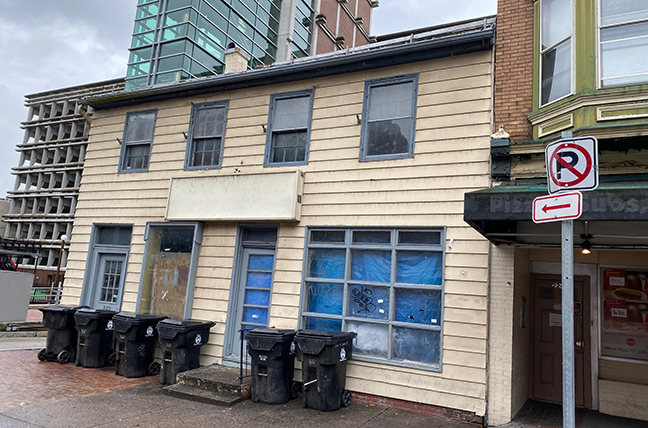
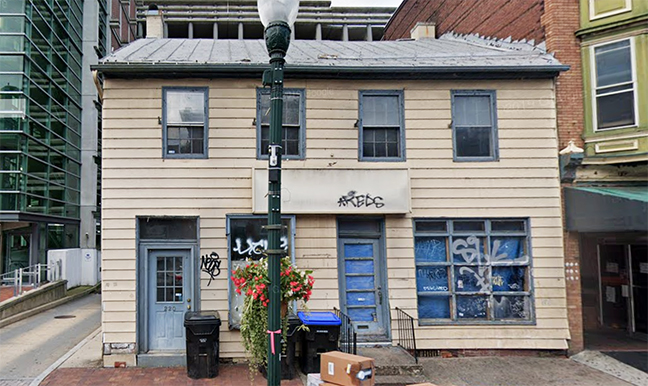
This is the first year that the Market Street Bridge has been a top priority for HHA. In 2022, the list was headed by Balsley House, a 2,590-square-foot building located at 220 N. 2nd St. According to HHA, the Federal-style building, one of the oldest structures in Harrisburg, continues to be threatened and, this year, is ranked second on the list.

However, according to HHA, there may be hope for the long-vacant, blighted structure in the heart of downtown.

“We have heard that there is actually some interest in the property by a private party, and we are hopeful for movement in 2023,” Sweeney said.

Balsley House in downtown Harrisburg

The remaining three “preservation priorities” also made last year’s top-five list. They are:

  • The former William Penn High School at Italian Lake
  • The former Harrisburg State Hospital complex
  • Prospect Hill Cemetery Gatehouse near the city line

Balsley House has been on the list since 2018, William Penn since 2017, and the former state hospital since 2014. The Prospect Hill Cemetery Gatehouse went on the list in 2021 after a car hit the structure, severely damaging it.

In the presentation, Sweeney also noted several recent preservation “successes” and two preservation “losses.”

The successes include:

  • The former Lemoyne Middle School, which has been renovated and converted into an apartment building
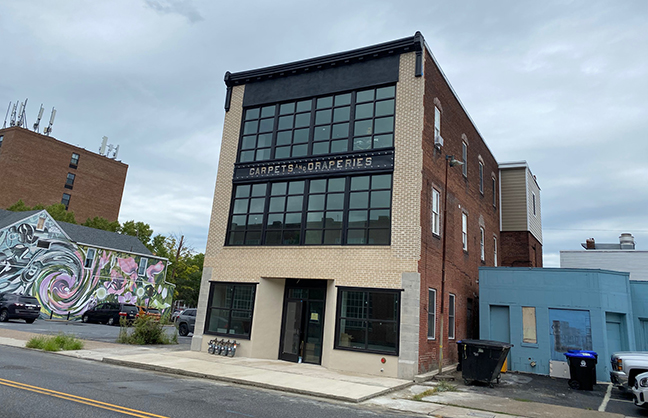
  • The former Gerber’s Department Store, also known as the “Carpets and Draperies building,” which was renovated into a mixed-used structure in Midtown Harrisburg
  • The former Milestone Inn, which now serves as headquarters for Dilks Properties in Uptown Harrisburg
  • The Harrisburg History Project, a series of historical markers in Harrisburg that needed replacement and updating

A win: The restored Carpets and Draperies building in Harrisburg

Sweeney also noted two recent “preservation losses”:

  • Beidleman House, an Allison Hill structure on Market Street that was razed last year
  • The Jackson Hotel on N. 6th Street in Harrisburg, which collapsed in early 2021

Moreover, HHA put about 30 structures in and around Harrisburg on its “watch list,” meaning that they’re historic properties of concern. These range widely, but include such landmark buildings as the Broad Street Market, the former Coca-Cola bottling works on Allison Hill, the Riverside firehouse and even HHA’s own Historic Harrisburg Resource Center.

Two new properties were added to the watch list this year.

The first, Myers House, at 213 N. Front St. in Harrisburg, made the watch list as the owner, the Dauphin County Bar Association, may no longer need such a large space, said David Morrison, HHA’s executive director. The second “watch list” addition this year is Buck’s Tavern, a nearly three-century-old structure located in West Hanover Township, which is threatened by blight and possible demolition.

HHA’s board is expected to approve the preservation priority list at its February meeting.

Historic Harrisburg Association is located at 1230 N. 3rd St., Harrisburg. To view the entire presentation, visit https://www.facebook.com/HistoricHarrisburgAssociation. For more information on Historic Harrisburg Association, which celebrates its 50th anniversary this year, visit www.historicharrisburg.org.

If you like what we do, please support our work. Become a Friend of TheBurg!

Continue Reading

Historic Harrisburg announces 2022 “Preservation Priorities,” focused on threatened, blighted properties

Balsley House in downtown Harrisburg

For a second straight year, Balsley House tops the list of threatened historic properties in Harrisburg, according to the city’s principal preservation organization.

On Monday, Historic Harrisburg Association released its proposed “2022 Preservation Priorities.”

Balsley House, a pre-Civil War double building, is on the list as it’s in danger of “demolition by neglect,” according to HHA.

The 2,590-square-foot building, located downtown at 220 N. 2nd St., also was HHA’s top preservation priority last year. Despite the designation, little seems to have been done to stabilize or restore the deteriorating structure.

David Morrison, HHA’s executive director, expressed encouragement on Monday, saying that, since last year, he has been in contact with the building’s owner, Dusan Bratic of Mechanicsburg.

“Since it went on the list last year, we’ve had a couple of conversations with the owner,” Morrison said. “I think we might be able to take this in a positive direction.”

Balsley House has housed many different businesses over its long lifetime, but has sat empty and increasingly blighted for many years.

The other priorities on HHA’s 2022 list are:

  • Beidleman House at 1225 Market St.
  • The former William Penn High School at Italian Lake
  • The former Harrisburg State Hospital
  • Prospect Hill Cemetery Gatehouse near the city line

Balsley House has actually been on the list since 2018. Beidleman House has been on since 2011, William Penn since 2017, and the former state hospital since 2014. The Prospect Hill Cemetery Gatehouse went on the list last year after a car hit the structure, severely damaging it.

William Penn has been on the sales market for many years. However, the owner, the Harrisburg School District, recently indicated that it may decide to retain and renovate the building.

HHA also listed two “preservation successes” of the past year: Grace United Methodist Church, a downtown church that has revived its congregation, and Derry Street United Methodist, an Allison Hill church that was sold and now houses the Anglican Church of the Pentecost.

HHA listed no “preservation losses” since last year’s report.

Moreover, HHA put about 30 structures in and around Harrisburg on its “watch list,” meaning that they’re historic properties of concern. These range widely, but include such landmark buildings as the Broad Street Market, the former Coca-Cola bottling works on Allison Hill, the Riverside firehouse and even HHA’s own Historic Harrisburg Resource Center.

“We want to keep these on our radar screen,” Morrison said. “This way, people can help us keep track of them.”

Morrison noted one pending success. The commonwealth-owned Dixon University Center in Uptown Harrisburg is on HHA’s 2022 “watch list.” The Jewish Federation of Greater Harrisburg recently put the site under contract for purchase, with plans eventually to move its operations to the sprawling property.

“That will be to us the great success of the decade, if not the millennium,” Morrison said.

HHA’s board is expected to approve the Preservation Priority list at its February meeting.

On Monday, Jan. 24, HHA’s Preservation Committee will hold a virtual presentation of its 2022 Preservation Priorities at 6 p.m. Tune in here. For more information about the Preservation Priorities, visit HHA’s website.

If you like what we do, please support our work. Become a Friend of TheBurg!

Continue Reading

Safe & Sounds: Harrisburg Symphony opens its live music season, in a new space, with safety in mind.

The symphonic hall is again alive.

This month, the Harrisburg Symphony Orchestra opens its 2021-22 season, having shared with many arts organizations the need to go virtual last year due to the coronavirus pandemic.

But, as it geared up for its first live concerts since February 2020, HSO faced an additional challenge. Renovations to the 90-year-old Forum in the Capitol Complex, its long-time home, forced it to seek another, temporary performance space for the season.

Right from the beginning, HSO has endured substantial challenges. When a group of music lovers decided to establish a symphony in Harrisburg, the country was in the throes of the Great Depression. Nevertheless, the founders moved ahead, with the first concert at Harrisburg’s William Penn High School on March 19, 1931, with a move to the Forum soon after.

Luckily, the search for a new, temporary home to resume live concerts was not as daunting as some expected.

“Even as it became possible to perform live again, HSO had to find a performance space large enough and attractive enough to substitute for the awe-inspiring Forum space,” said Matthew Herren, the symphony’s executive director. “Fortunately, we found a replacement in the Scottish Rite Theatre, which is a hidden gem near Italian Lake in Uptown Harrisburg.”

Built in 1954, the Scottish Rite Cathedral, at 2701 N. 3rd St., offers an entertainment venue that seats nearly 1,200 people, with 800 convenient parking spaces.

“It has a welcoming atmosphere, a large stage for our orchestra, and plenty of comfortable seating for our patrons,” Herren said.

The Pennsylvania Department of General Services, which operates the Forum, is “looking forward to the return of the HSO and its patrons to its historic auditorium after renovations are completed,” said Curt Topper, secretary of the department. “For nearly a century, the Harrisburg Symphony Orchestra has called the Forum auditorium home.’

Of course, the heart of the symphony’s new season is the live music, noted Stuart Malina, music director and maestro.

“I’m very excited to be returning to live performances for a live audience,” he said.

For the season, HSO will present two series—Masterworks and the Capital Blue Pops.

Masterworks begins the weekend of Oct. 2-3 with the theme of “Picture Perfect.” The pieces to be performed include “Three Latin-American Dances” by Gabriela Lena Frank, a lush new piano concerto by HSO composer-in- residence Jonathan Leshnoff, and Mussorgsky’s “Pictures at an Exhibition.”

The opening Pops concert, the weekend of Oct. 23-24, is a tribute to John Williams, one of the leading film composers.

The Masterworks series continues Nov. 13-14 with a theme of “Sweeping Landscapes.” Pieces to be performed include “Sinfonietta No. 1” by Mieczyslaw Weinberg, David Ludwig’s “Pictures from the Floating World,” with bassoonist Joseph Grimmer, and Jean Sibelius’s “Symphony No. 1.”

For the season, HSO tried hard—and succeeded—to maintain much of the programming that had been planned for 2020-21.

“Some changes had to be made, mostly due to ongoing COVID concerns,” Malina said. “For example, we are delaying any choral work and scheduling. But we kept the bulk of the existing programming.”

As of now, HSO is planning to keep to the announced program, “barring any major downturn,” he added.

Another point of excitement is that several composers represented in the symphony’s Masterworks series are not heard often in the concert hall, Herren said. These include Valerie Coleman, Carlos Simon and Gabriela Lena Frank.

Along with the renewed live concerts, HSO is emphasizing the development of its youth orchestra programs and its increased efforts toward diversity, inclusivity and equality, according to Pat Ferris, the new chair of the board.

In addition, the HSO Symphony Society, the fundraising arm, will sponsor a gala at Ashcombe Mansion in Mechanicsburg in April.

Of course, there is likely one more thing on concert attendees’ minds, aside from enthusiasm over the return of live music.

On its website, HSO states that it “strongly recommends” vaccinations for audience members and “masks for those at risk.” It also states that they will “continue to monitor CDC and state/local government guidelines.”

“We’re trying to ensure a safe environment for everyone,” Herren said. “Some people may have reservations about being in a large environment, and we understand. This is a deeply personal choice.”

For more information on the Harrisburg Symphony Orchestra, including tickets, visit www.harrisburgsymphony.org or call the box office at 717-545-5598.

If you like what we do, please support our work. Become a Friend of TheBurg!

Continue Reading

Five buildings deemed “preservation priorities” by Historic Harrisburg

Balsley House in downtown Harrisburg

One of Harrisburg’s oldest structures is a top preservation priority for 2021, the city’s principal historic preservation organization has announced.

At a virtual presentation on Monday, Historic Harrisburg Association unveiled its top five proposed preservation priorities for the year.

The list includes Balsley House, a dilapidated, double building located downtown at 220 N. 2nd St. Dating back almost two centuries, Balsley House is one of the few remaining federal-period buildings in Harrisburg.

“It’s one of the oldest structures still standing in Harrisburg,” said Sara Sweeney, chair of HHA’s preservation committee. “It’s deteriorating. It’s in very bad shape, especially if you go around to the back.”

The 2,590-square-foot building, owned since 2006 by Dusan Bratic of Mechanicsburg, has housed many different businesses over its lifetime, but has sat empty and increasingly blighted for a number of years.

“We’re hoping to really raise awareness of this property over the next year,” Sweeney said. “With the revitalization that Harrisburg is really primed for, hopefully, we can make some strides to bringing this building back to life before we lose it.”

The other properties on the 2021 list are:

  • William Penn High School, Uptown Harrisburg
  • Camp Curtin Memorial Mitchell UMC, Uptown Harrisburg
  • Harrisburg State Hospital campus, Harrisburg/Susquehanna Township
  • Prospect Hill Cemetery Gate House, Allison Hill/city line

William Penn, Camp Curtin UMC and the Harrisburg State Hospital campus are all on the market for sale. Prospect Hill Cemetery Gate House was severely damaged last year when it was struck by a car.

Balsley House, William Penn, Camp Curtin UMC and Harrisburg State Hospital all appeared on the 2019 list, as well.

This year, the committee changed its ranking structure, reducing its preservation priorities to just five “key” properties then adding more buildings on a “watch list.” The proposed watch list properties are:

  • Dixon University Center
  • Donald Cameron Mansion
  • Riverside Firehouse
  • Cumberland Valley Railroad Bridge
  • Milestone Inn
  • Coca-Cola Bottling Works
  • Brinser Mansion
  • Grace United Methodist Church
  • Derry Street United Methodist Church
  • Christ Lutheran Church
  • Paul’s Methodist Church
  • Zembo Shrine Center
  • Paxton Firehouse
  • Beidleman House
  • Walnut Street Bridge
  • Historic Peace Church (Hampden Township)
  • Elks Theater (Middletown)
  • Bishop Bridge (near Bowmansdale)

The HHA board now must approve the list at an upcoming meeting.

Sweeney also offered updates for several properties that have been on HHA’s preservation priority list in the past:

  • Gerber’s Department Store, Midtown Harrisburg—proposed for conversion to an apartment building.
  • Sheepford Road Bridge, Lower Allen Township—transfer of ownership proposed
  • Brotherhood Relief & Compensation Fund Building, Uptown Harrisburg—new owner, proposed conversion to a mixed-use building
  • First United Methodist Church, Midtown Harrisburg—new owner, proposed conversion to an apartment building
  • Lemoyne Middle School—currently being converted to an apartment building
  • Bishop McDevitt High School—proposed redevelopment as an eco-village called The Bridge
  • Jackson Hotel, Midtown Harrisburg—recently collapsed and razed, now with plans to rebuild the structure
  • Ridge Avenue Methodist Church Parsonage (Swallow Mansion), Midtown Harrisburg—conversion to an apartment building nearly complete
  • Broad Street Market, Midtown Harrisburg—upgrades and restoration continue
  • Historic Harrisburg Resource Center—restoration continues
  • Harrisburg History Project—ongoing rehabilitation to historical markers around Harrisburg

Sweeney also noted several Harrisburg buildings that have been restored in recent years, calling them “wins.” These include the former Mary K mansions on Front Street, the former Fox Hotel in Shipoke, Locust Street Houses downtown and the former Moose Lodge in Midtown.

David Morrison, HHA’s executive director, said that he believes that the annual list has raised awareness of the need for historic preservation and has been essential in the rehabilitation of numerous structures in Harrisburg.

“As a result of this exercise each year, I can say that quite a few properties that were listed as priorities in the past have become ‘alumni’ of the list,” Morrison said. “In other words, they’ve been restored.”

For more information on Historic Harrisburg Association, visit their website.

Support quality local journalism. Become a Friend of TheBurg!

Continue Reading

School’s Out: The century-old William Penn High has long sat vacant. Will it ever turn the page?

Capital Rebirth team at the William Penn High School

Mae Sobczak was a relatively quiet student back in her high school days at William Penn High School. She had lots of friends and participated in the orchestra, her high school’s sorority and intramural sports after school. But she wouldn’t have labeled herself “Miss School Spirit.”

Sixty-four years later, however, things are different.

After graduation, Sobczak started organizing class reunions. Every five years, William Penn alumni get together, and, each six months, the class of ’56 catches up. On top of that, Sobczak and a group of women meet for lunch every Friday to reminisce on the old days and chat about the new.

In 2006, the class celebrated its 50th reunion. Sobczak, along with a committee, organized the event, which included a tour of the old William Penn building. The group went there excited to relive old memories, but left feeling like the building they toured was nothing like their beloved alma mater.

“When we came out to get on our bus, we were saying how it was so sad,” Sobczak said.

Over a decade later, it’s even sadder, as William Penn has sat, deteriorating, since. The classrooms, once full of students, are full of old rubble and garbage, and the halls display crude graffiti. Do a quick Google search of the old school, and you’ll find videos posted by thrill seekers, trespassers on the hunt for ghosts or just curious residents.

Over the years, many fires have been set in the building, requiring the Harrisburg Bureau of Fire’s attention.

“Structurally, that building is in phenomenal shape,” Fire Chief Brian Enterline said. “It’s more that the contents inside are burning, not the building itself. The problem is it’s a large, vacant school building. It’s very difficult to secure.”

All the while, William Penn has sat in the hands of the Harrisburg school district—too damaged to hold on to, too big and costly to give up easily.

People have wondered what will come of the grand old campus overlooking Italian Lake, the school that was once Harrisburg’s pride.

In the Day

It’s the early 1920s in Harrisburg. The city isn’t just growing; it’s thriving. Suburbanization hasn’t led to flight out of the city yet. There’s even a trolley car system. But one of the hottest topics in the city is education. People are looking for modern, quality schools.

David Morrison, president of Historic Harrisburg Association, paints the picture.

People were ready to send their kids to school in the city, but the city wasn’t ready for them, he said. Many city schools were built in the post-Civil War years—the 1870s and 1880s. Once the 1920s came roaring around, the school district needed to play catch up.

“By the ‘20s, the educational infrastructure of Harrisburg was pretty obsolete,” Morrison said.

In the early 1900s, Harrisburg Technical High School, located in the building now known as Old City Hall, was built on Walnut Street and served students for many years. But with people hungry for top-notch education, Harrisburg Tech became a government center and a new, larger high school was proposed.

“In those days, the public school systems were so advanced,” Morrison said. “In some cases, people who lived in the suburbs paid to have their children attend Harrisburg schools.”

Urban architect Charles Howard Lloyd, who would later claim fame for the Zembo Shrine, was busy designing schools. Harrisburg Tech and Simon Cameron School (1896) were formed in his signature gothic style. It was only fitting that the district called upon him for the new school they would call Hoffman’s Woods School (later William Penn), Morrison explained.

But Allison Hill families wanted a school of their own that their kids could walk to. So, the district decided on two separate schools—John Harris and William Penn.

William Penn building plans were scaled back to save funds for the second school on the Hill, but the new blueprints were hardly modest.

“They had huge halls,” local historian and William Penn alum Calobe Jackson recalled. “We would start track right after Christmas, and we would run through the halls for practice.”

Jackson graduated from the class of 1948. He remembers an indoor courtyard and a grandiose auditorium with a balcony. It was beautiful and well designed, he said.

In addition, there was a kitchen, cafeteria, housekeeping suite, science and lab rooms and shop spaces for tech courses, amongst other classrooms, according to “Building Harrisburg,” a book by historian Ken Frew.

“Years ago, they used to say William Penn was the largest high school campus in the U.S.,” Jackson said. “It was really a beautiful school.”

Jackson’s class had a little over 300 students, while the full school had about 1,200. Back then, high school lasted three years instead of four.

When William Penn was constructed in 1926, high school enrollment was swelling. Between 1900 and 1920, student enrollment in the United States quadrupled and then nearly quadrupled again by 1940, according to the public policy magazine, City Journal. But it was in that same decade that the school movement ended. City Journal ties that to segregation and racial discrimination, which had Blacks enrolling at lower numbers than whites.

By the mid-1950s, enrollment at William Penn had only declined slightly. Sobczak remembers that her class of ‘56 had about 264 students. Pride for their school was still strong among students, she recalls.

“We were proud to be city school graduates,” she said.

But the 1950s represented the high mark for William Penn. That decade, the city’s industrial companies began closing, and people started leaving Harrisburg for the suburbs. In 1972, John Harris absorbed William Penn students, the building morphing into a technical school before closing entirely.

Moving Forward

For most William Penn graduates, it’s been a long time since they danced at a sock hop or scored a goal in intramural sports. Most are parents, grandparents and even great-grandparents. Many have passed away. Sobczak’s alumni mailing list gets shorter by the year.

Just like many of the students that once walked its halls, William Penn is old. But that doesn’t mean it’s any less grand. The interior may be decrepit, but the building is still the columned mammoth that it was in the 1920s.

For some, that’s enough to see it ripe with potential.

Superintendent Chris Celmer said the school district is currently taking letters of interest and offers for the William Penn building.

“We want them to have local interest in the community, and they’re going to have to have experience,” he said. “It has to come with the ability to finance.”

Local nonprofit Capital Rebirth put in a $2.5 million bid in March and garnered over 7,500 signatures from the community on a petition of support for the plan they’re calling “The Rebirth Project.” The group wants to create a community center, including space for education, entertainment and wellness, explained founder Mikell Simpson.

“William Penn has always been a historic landmark,” he said. “We know what the needs of the community are and how everyone can benefit.”

Included in the building would be an indoor stadium, classrooms, an enclosed track and offices. Simpson estimates that the work would take three to four years and cost up to $175 million.

But others envision the building as something else entirely.

Jackson could see it as a retirement home with outdoor space for rehabilitation services. Morrison thought turning it into condos or apartments would be nice or even having it join forces with Zembo Shrine across the street for a national organization.

“It has the possibility to really enhance that whole part of Uptown Harrisburg if it’s done right, and that’s why we care,” he said.

There have been other successful school building conversion projects in the city, such as the old Simon Cameron School in Olde Uptown and the former Boas Street School at Green and Forster streets, which both are now apartment buildings.

At the beginning of the year, the redevelopment group, The Bridge, started renting the old Bishop McDevitt school with plans to build an eco-friendly community center. It also has put in a bid for William Penn, according to the developers.

So, builders have big plans for other big school properties in the city.

But William Penn isn’t just big—it’s enormous—including a 222,000-square-foot building and 25 surrounding acres of land.

As Superintendent Celmer said, taking on a project like this requires not only a heart for the community, but strong resources backing it.

The district, he said, continues to weigh all viable offers.

The William Penn building is located on the 2000-block of N. 4th St., Harrisburg.

For more information on The Rebirth Project, visit their Facebook page. To learn more about The Bridge, visit www.thebridgeecovillage.com.


 

Continue Reading

Burg Blog: Historic Credits

The long-shuttered Swallow Mansion in Harrisburg is currently under restoration.

As it does each year, Historic Harrisburg Association this past week presented its “Preservation Priority” list.

This is a summary of some of the Harrisburg area’s most threatened structures, and many of the buildings on the 2020 list should come as no surprise to anyone who cares about historic preservation locally.

On it, you’ll find such notable structures as the J. Donald Cameron Mansion (up for sale), the Riverside Firehouse (slated to be sold), several abandoned churches and a few structures, victims of negligent owners, that may be lost forever if not shored up soon (among them, the pre-Civil War Balsley House downtown and the former Gerber’s Department Store—aka the “Carpets and Draperies” building—in Midtown).

The old Harrisburg Moose Lodge, now the home of StartUp Harrisburg and Union Lofts

Each year, HHA uses this list to make the public aware of the area’s historic heritage crumbling around them—and maybe even hold owners’ collective feet to the fire.

But I’d like to use this blog post to highlight something else. In its presentation, further down, following the bad news, there is this—hope.

HHA lists a section called “prior listings,” which consists mostly of buildings that have been preserved or are otherwise no longer threatened.

The fully restored North Street building, which now houses Elementary Coffee Co. and apartments

I think it’s important to highlight the buildings that have been saved and the people who have done the expensive, hard work, often against the odds and against financial logic, to preserve them. It wasn’t long ago that these buildings were endangered.

So, an enormous thanks to:

  • Mike and Sally Wilson, who transformed the decrepit Mary Sachs and Hull mansions into the stunning Manor on Front Bed & Breakfast
  • Chris and Erica Bryce, who restored the General Henry and Elizabeth Gross Mansion next door to Manor on Front
  • Harristown Development, which saved the old Fox Hotel/Santanna’s Restaurant, turning it into a boutique apartment building
  • Vice Capital/LeRon and LeSean McCoy, who are finishing up a total restoration of the Swallow Mansion on N. 6th Street
  • WCI Partners, which restored the boarded up former Moose Lodge and several commercial buildings on the 900-block of N. 3rd Street
  • Matt Krupp and Harrisburg Commercial Interiors for saving and rebuilding two North Street buildings that now house Elementary Coffee Co. with apartments upstairs.

The Bridge, the former Bishop McDevitt High School

And, as they say, the best is yet to come.

This year, The Bridge plans to begin to transform the old Bishop McDevitt High School into co-working space and an “eco village,” Matt Long/Harrisburg Commercial Interiors has received permission to begin work restoring the Jackson Rooming House, and andCulture is completing a restoration of the Old Waterworks on Front Street.

There’s also hope that, this year, the Harrisburg school district may finally sell the William Penn building and property and that the Zembo Shrine building will change hands and find a new use.

Lastly, a million thanks to David Morrison, Jeb Stuart, Calobe Jackson and everyone at HHA for reminding this community of its historic heritage—and how important it is to preserve it.

To learn more about Historic Harrisburg Association, visit their website.

Continue Reading