Tag Archives: William Penn High School

Building The Bridge: Four friends have big plans to transform the old Bishop McDevitt building into an “eco-village.” How did this all get started?

Former Bishop McDevitt High School.

Right now, if you walked into the old Bishop McDevitt building, you might feel like you were stepping into a set piece from a Stephen King novel—cracked walls, boarded-up windows, peeling paint and numerous messages stating that so-and-so was here or “RIP.”

But, starting this year, the almost 100-year-old building will begin to transform into an eco-friendly, multi-use property—that is, according to four old friends who collectively call themselves “The Bridge.”

This development company is headed by four guys who have known each other for many years, most since childhood: former NFL player Garry Gilliam Jr., Corey Dupree, DeZwaan “Dez” Dubois and Jordan Hill, another former pro football player.

The goal of the team is to create a complex where community members can eat, work and play, and what better place to start than in their hometown of Harrisburg?

“In a broad sense, we’re trying to create an environment of systematic empowerment, if you will,” said Gilliam. “It’s an environment of learning, fresh food. You can live here, work here, play here. Everything is here in one place.”

The first phase of the proposed “eco-village” is comprised of co-working spaces, which will be on the main floor of the building. According to Dupree, these spaces will keep the classroom-like feel that already exists, including things like chalkboards and whiteboards. The vision is eventually to include sustainable housing, indoor agriculture, an auditorium, a food court and more.

In a sense, the eco-village is almost like an adult version of Milton Hershey School, where Dupree, Gilliam and Dubois all attended. The school had such a tremendous impact on them that they wanted to recreate it and help their hometown community in the process.


Us Together

Gilliam was only 7 years old when his mother drove him up to Milton Hershey School. They had been living below the poverty line, and he spent his childhood skipping between his mother’s house in Edison Villiage and his grandmother’s house on Susquehanna Street in Harrisburg. He and his mother knew about the school because his cousin went there.

When they arrived, his mother sent Gilliam off to the playground while she signed paperwork. He didn’t know that, soon, Milton Hershey would become his home.

The first few months, he cried every night because he missed his family. Fortunately, Milton Hershey was filled with activities to help distract and support him. Over time, Gilliam got involved in arts, academics and, of course, sports. Eventually, when his mother was more financially stable and ready for him to come home, he didn’t want to leave.

“I didn’t want to leave not just because I had friends, but I knew this was what was best for the family,” he said. “I was a growing boy. I needed a lot of food and an environment that is conducive to success.”

Dupree joined Milton Hershey School around the 9th grade. Though born in Boston, he attended the school thanks to his big brother from the Big Brothers, Big Sisters program. Quickly, central Pennsylvania became his home, too.

It took a while for the two to become friends (Dupree swears Gilliam was after his girlfriend), but they started to click and even became roommates during their last year at the school.

Dubois came to Milton Hershey in the fourth grade and joined the football team years later, where he met Gilliam.

Hill grew up seeing Gilliam, Dupree, Dubois and everyone on the Milton Hershey football team as rivals. Unlike the other three, Hill attended Steelton High School, which had an intense rivalry with Milton Hershey.

In fact, the only time Hill said anything positive to Gilliam was during their senior year, after he found out Gilliam was going to Penn State.

“I remember that,” Gilliam said with a smile. “I think he was committed to Rutgers, and he came up to me and said ‘You going to Penn State, huh?’ I was like ‘Yeah,’ and he goes ‘All right.’”

Fast forward a couple of months, and Hill also received an offer to Penn State. He committed and ended up in the same recruitment class as Gilliam. Fast forward a few more years, and they were both on the same NFL team, the Seattle Seahawks.

“Life has kind of brought us together,” Hill said. “We grew up within a five- to 10-mile radius, went to college together and ended up playing professional football on the same team. It’s very rare.”


Bridge We Need

According to Hill, he and Gilliam had a similar mindset. They knew they needed to prepare for life after relatively brief football careers and, concurrently, they wanted to use their fame and money from football to help give back to their community. For them, the eco-village was the perfect starting point.

It didn’t take much for the friends to all agree on creating The Bridge. Dupree, a self-proclaimed comic book nerd, calls his team the Avengers and says each person brings a different specialty to the table. But they also understand that they have one common goal—to help the community.

Instead of deciding what was best to put in the eco-village, they used the hashtag #TheBridgeWeNeed to see what people wanted in their community. Some of the responses were things like community gardens, grocery stores, mental health spaces and even a room for therapy dogs.

The team took in the responses and, around April of last year, began to nail down their plans for the eco-village. Originally, they had their sights set on the old William Penn High School, but the owner, the Harrisburg school district, has not yet responded to their offer. They still hope to secure that building.

The Bridge plans to start renovation of the Bishop McDevitt building this summer. According to Gilliam, Harrisburg is only the pilot model. They plan to expand and create more eco-villages in Philadelphia, Atlanta, Detroit and elsewhere. They already caught the attention of Philadelphia-born rapper Meek Mills via Twitter.

“We’re from here, so I said we have to do it in Harrisburg first,” Gilliam said. “We have to take care of our hometown before we go anywhere else.”

For more information on The Bridge, visit www.thebridgeecovillage.com.
Continue Reading

Institutions for Sale: Your childhood school, your family church–going once, going twice.

William Penn High School

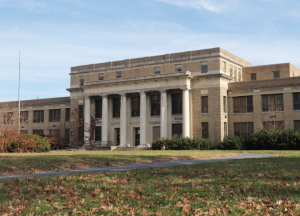
The neoclassical lintel carved “INDVSTRY” guards a door covered in peeling plywood. Inside, “AMOS” spray-painted his name on an unbroken windowpane. Outside, “L,” “D” and “M” painted their initials on the columns. The fire extinguisher lying in the grass adds a touch of irony, given the Harrisburg Fire Bureau’s growing familiarity with the vacant hulk once known as William Penn High School.

Harrisburg isn’t the only city struggling with obsolete institutional properties for sale, but a sudden flood of churches has further saturated the market. Can outdated people-gathering places be revived? Proponents hope the right alignment of creative ideas and hefty funding brings new life to old icons.


History Spared

Once, they anchored neighborhoods and hummed with activity. Now, William Penn High School is covered in vines. Choirs aren’t singing at Camp Curtin Memorial-Mitchell United Methodist Church and others closed by the Susquehanna United Methodist Conference. Zembo Shrine is active but back on the market after a sale fell through. Bishop McDevitt High School has a new owner, but its status is unclear. [Ed. note: after this story went to press, a development group announced a proposal for the Bishop McDevitt site.]

Bill Gladstone of the Bill Gladstone Group of NAI CIR is marketing six of the Methodist churches, among the many faith-based buildings crowding the real estate listings. Smaller churches tend to sell quickly, he said.

“Everybody’s starting new congregations,” Gladstone said. “They want to move out of the Holiday Inn.”

But not selling are “the bigger churches with no parking.” Many suffer from long-deferred maintenance. Inquiries trickle in, only to confront zoning and parking issues. One woman wanted to paint a church white and “attract thousands of people to come to arts events.”

Some ideas “will work,” said Gladstone, “and some won’t.”

The vast, ornate, non-ADA compliant Zembo Shrine attracted investors who saw an ideal entertainment venue—until they uncovered challenges in booking shows, Gladstone said.

“We’ve had activity,” he said. “We haven’t found quite the right buyer for it yet.”

Historic Harrisburg Association helped keep the doors open at historic Grace Church on State Street and is “trying to help find sympathetic buyers, at least for the churches that have history and architectural attributes,” says Executive Director David Morrison.

Gamut Theatre in the former First Church of God and State Street Academy of Music in the former St. Lawrence Chapel demonstrate that repurposing historic churches “becomes such a win-win, because it’s good for the building,” Morrison said. “It’s good for the organization that’s going to inhabit the building. A lot of expenses were spared, and history was spared.”

Success starts with a realistic—translation, “low”—selling price, to make up for the buyer’s upgrades, Morrison said. With institutional landmarks, “their economic value is one thing, and their community value is another thing. If you make the numbers work, there are investors and developers interested.”

Also required: time and creativity. Midtown Harrisburg’s COBA apartments sat empty for three decades before a developer acquired the building for $1, assembled the financing, reconfigured the layout and built a new elevator shaft. The result: 27 apartments in walkable Midtown.

“Thirty years went by before anybody figured that out,” Morrison said.


Offers of Interest

An old school—all those classrooms panting for conversion into lofts. What could be better? Just pay no attention to the 1,200-seat auditorium. And the gymnasium. And the cafeteria.

Philadelphia-based, multi-state developer Pennrose has made it work at Steelton’s Felton Lofts, converted from the historic Steelton High School (albeit after stepping in when the original developer backed out).

Nearly half of Pennrose’s 250 communities are the products of adaptive reuse—buildings that had “become rundown, dilapidated, an eyesore and deterrent to the values of the community,” said President Mark Dambly. “You want to make sure you have community support, because you’re going to have challenges and obstacles to overcome in order to be successful.”

Collaboration opens doors to resources and such municipal considerations as free property acquisition, waived fees, access to state and federal grants and financing, or relief from zoning and parking restrictions, Dambly said.

As for those spaces that held generations of kids staging “Oklahoma” or eating tater tots, “you want to make them generate something economically if you can, and if not, socially,” Dambly said. The Felton Lofts auditorium leans toward social, hosting community events and support services as amenities for residents.

On the revenue-generating side, look to Scranton, where the state-of-the-art Theater at North hosts such shows as an Elton John tribute tour and Judy Collins live in concert—all in a jazz-era junior high school converted in 2015 to senior-living apartments. Remarkably, the developer was Goodwill Industries of Northeastern Pennsylvania.

As for William Penn High School, now about 10 years on the market, owner Harrisburg School District “renegotiated” the listing with Landmark Commercial Realty in October, said Assistant Superintendent Christopher Celmer. Agent Seymour Barget is accepting and vetting offers.

By early 2020, the district hopes to “have a few serious offers of interest on the property that we’ll be able to sit down and evaluate,” said Celmer. “It could be a sale. It could be someone that would want to do a lease to purchase. There could be a multitude of options.”

With an active school, Camp Curtin Academy, adjoining the site, the district must also “make sure there’s a clear understanding” of boundary lines on the 25-acre property.

“If there’s an ability (for the buyer) to keep some of that history of the building, we would love to see that memorialized—what that building meant for generations that came through,” he said.


Mixed Uses

Re-imagination is hard, but it can zero in on filling community needs, said Harrisburg Economic Development Director Amma Johnson.

“Number one is mixed-use,” she said—those fashionable combos of retail and residential. Farther from the downtown-Midtown core, though, conversions could be “way more residential” until vendors dream up creative approaches to doing business.

The appetite for large institutions is primarily among “developers who have deep pockets and are creative in utilizing mixed-use space for residents—live-work, live-work-play,” added Harrisburg Historic Preservation Specialist and Archivist Frank Grumbine.

He knows, though, that those visions stumble at the sight of Gothic churches. Pittsburgh’s awesome Church Brew Works showcases potential, but “a really cool use for a big space like that is really difficult.”

“Their long-term preservation and maintenance are concerns for anybody who would purchase them,” he said.

Methodist Conference Harrisburg Superintendent Rev. Barry Robinson agrees with the primary challenges of selling large churches—“selling the buildings at a fair price over the cost of keeping them,” plus barriers due to size and condition.

“We would like for the buildings to continue to be used for houses of worship or faith-based ministries,” he said. “However, we would not deter anyone from buying the buildings for other uses.”

The city is “very flexible” about changing permitted uses while being “sensitive to the neighborhoods in which these properties reside,” Grumbine said.

Talks with developers are happening, but specifics are “still being formulated.”

“The most I can say is that the uses are mixed,” he said. “We’d like to see those buildings used as residential, commercial, even urban agriculture—a self-sustaining community within the city.”

Harrisburg Redevelopment Authority Executive Director Bryan Davis notes that developers are accustomed to relatively straightforward warehouse conversions, but repurposing unique spaces demands closer attention to the bottom line.

“It’s always nice if you’re able to find a buyer that also has a passion for historic preservation, so they have an appetite for this kind of investment,” he said. “They acknowledge the value. What that does is narrow the field of candidate buyers, which is not insurmountable.”

Neighborhoods “shudder” when beloved institutions close their doors, but Harrisburg’s monumental icons have potential, said Grumbine. William Penn is “so pretty.” And Zembo Shrine could “have a whole city within just that building.”

“There’s tons of opportunity,” he said. “It’s just who has the creativity and the money to figure it out.”

Continue Reading

Harrisburg district to launch new after-school program for 3rd-, 4th-graders

Susan Sneath, the Harrisburg school district’s chief academic officer, gave a presentation on charter school costs during Monday night’s business meeting.

The Harrisburg school district plans to launch a new after-school program meant to give an academic boost to third- and fourth-grade students.

Near the end of Monday night’s school board/business meeting, officials announced that the district will leverage a $470,000 federal grant to start a multi-faceted program that will include after-school learning, educational and support services and a free dinner, Monday through Thursday, to qualified students in those grades, said Susan Sneath, the district’s chief academic officer.

“We will be serving eligible third- and fourth-grade students based on data, based on what they need, following a very specific daily schedule to ensure that not only are we targeting their academic needs in the afternoon, but we’re also including some emotional and social skills training,” Sneath said.

The U.S. Department of Education’s “21st Century Community Learning Center Program” is meant to offer extra assistance to students in high-poverty and low-performing school districts.

Sneath said that 545 third- and fourth-grade students in the district qualify for the program, which will begin at the end of November. Enrollment, which is optional, will be on a first-come, first-served basis as the funding level can accommodate only 420 to 450 students, she said.

At the meeting, Sneath said that the district chose to target those two grade levels because of their importance in the educational and social development of children.

“The research is very clear that, if we can get our children up to grade level, by the time they’re at the end of their 3rd-grade year, their chances for a successful graduation from high school increase significantly,” she said.

Chris Celmer, the district’s acting assistant superintendent, said district staff analyzed how best to leverage the grant in a way that met federal mandates and responded to the needs of the community.

“There are very stringent guidelines for the 21st Century Program, and we will follow them 100-percent to the tee,” he said. “That’s really what led to the change in the program, as well as targeting the program for the betterment of certain students that need that extra assistance.”

Sneath said that this program, while limited, represents a return to all-day academic and support programming for Harrisburg students.

“There used to be in this district quite a comprehensive after-school program,” she said. “However, the funding for that has diminished significantly. So, we have to rethink the way that we target that school intervention.”

In other meeting news:

  • Sneath gave a presentation saying that the cost of tuition paid by the district to charter schools has increased significantly in recent years, rising from $11.1 million in the 2016-17 school year to $14.8 million in the 2018-19 school year. Most of the increase was attributable to greater payments to cyber charter schools.
  • Celmer provided a treasurer’s report that stated that the district had a general fund balance of $41.5 million as of Sept. 30. He also said that the district will kick off budget planning for the 2020-21 school year with a workshop on Nov. 12 at 6 p.m. at the Lincoln Administration Building.
  • Receiver Janet Samuels approved an updated contract with Lemoyne-based realtor Landmark Commercial Realty for the sale of the former William Penn High School campus. The district has the property, which includes the large, blighted school building and about five acres of land at Italian Lake, on the market for $2.5 million.
Continue Reading

Zembo Shrine sold to out-of-state buyer with entertainment plans.

Zembo Shrine.

The historic Zembo Mosque and Shrine is set to sell after almost one year on the market, according to a city spokesperson.

The 65,000-square-foot property at Division and N. 3rd streets will be sold to Arkansas-based TempleLive LLC, which plans to operate the building as a meeting, gathering and performing arts venue, city communications director Joyce Davis confirmed on Monday.

“The goal is to make it a more culturally active space,” Davis said on Monday.

TempleLive currently owns two Masonic temples similar to Zembo, one in Cleveland and one in Fort Smith, Ark. They run both properties as a multi-purpose event spaces, according to the venues’ websites.

Mike Brown, vice president of acquisitions for Beaty Capital Group, TempleLive’s parent company, expects the sale to close at the end of March or beginning of April. He hopes the site will be operational by the fall.

“The sooner, the better,” Brown said.

Brown said it was too early to tell if the building would require extensive renovations, but he did say that the shrine’s main auditorium would need air conditioning. He claimed that TempleLive representatives visited the site three or four times before entering the sale agreement.

Brown declined to disclose the final sale price and did not know if the buyers would take advantage of a tax abatement.

The Zembo shrine went on the market in February 2017 with a $950,000 asking price. Davis could not confirm the property’s final sale price, which was reportedly reached at a special meeting on Jan. 11.

The deal was brokered by the Bill Gladstone Group of NAI CIR, a commercial real estate agency in Lemoyne, and includes 396 parking spaces adjacent to the building.

Since its opening, Zembo has been home to the Shriners, a fraternal organization affiliated with the Free Masons. The Shriners continue to meet there today, but the group’s declining membership, coupled with the building’s high operating costs, forced them to sell the historic property.

Zembo was constructed in 1930 in a Moorish Revival architectural style. The building features interior arches, hand-painted motifs, and ornate stone detailing. It houses large meeting rooms and a theater with a 2,500-seat capacity.

The building faces Italian Lake and former William Penn High School. That vacant campus is also currently for sale.

In a statement issued on Monday, Mayor Eric Papenfuse praised the sale of the historic Zembo building and the plans to make it a touristic attraction within the city.

“This is a truly wonderful development for our city,” Papenfuse said.

This article was updated to include comments from Mike Brown.

Continue Reading

Dog Gone? City aims to toughen leash enforcement following complaints

Illustration by Rich Hauck

Citations for off-leash dogs are on the rise in Harrisburg, but some residents want the city to do more to enforce leash laws.

Animal control officers working for the Harrisburg Police Bureau have cited 22 dog owners so far in 2017 for letting their animals run off-leash. That figure is up from 14 in 2016, 15 in 2015, and zero in 2014, according to data from the Harrisburg Police Bureau.

But many dog owners say that off-leash dogs remain a problem in certain neighborhoods of the city, particularly Italian Lake and the former William Penn High School. Dogs must be restrained on a leash in all public places, including parks, according to Harrisburg City Ordinance 33.

The issue surfaced at an Oct. 10 City Council meeting. One resident said her service dog was attacked by unrestrained dogs at the State Hospital Grounds in Susquehanna Township, where she started going to avoid off-leash dogs in Harrisburg.

“I don’t think this problem is being taken seriously,” she said, adding that an attack like the one her service dog suffered could ruin its training.

Randall Gooding, a Wormleysburg resident who walks his dog on City Island and in Riverfront Park, said that he encounters many more off-leash dogs in Harrisburg than in his home borough. He wants stricter leash enforcement to keep people and animals safe.

“I get so frustrated when unattended, off-leash dogs come running up to me and my dog while the owner [says] that the dog is friendly,” Gooding said. “I can’t protect their dog while handling my own.”

Unsupervised dogs appear to be a problem in residential areas as well as parks. Naomi Reyes used to walk from her home on 3rd street to her workplace on 7th street, until too many neighbors started letting their dogs outside unsupervised.

“I had to stop doing my walks because of loose dogs that didn’t look friendly,” Reyes said.

City Councilman Cornelius Johnson, chair of the Public Safety Committee, said he spoke about the issue with animal enforcement officers this week. The city currently employs two animal enforcement officers.

Johnson said that one possible solution is increased cooperation between animal enforcement officers and the city park rangers, who are responsible for patrolling Harrisburg’s 26 parks.

Mayor Eric Papenfuse said on Friday that the city hopes to budget for another park ranger in 2018, bringing the total rank to three.

Park rangers cannot write tickets, but they make ticket referrals to the police or report stray dogs, Papenfuse said. Animal enforcement officers are also responsible for collecting stray animals, and have picked up 78 this year.

Above all, Johnson said, communication is key. He asks residents to report off-leash dog violations when they see them.

“The best thing a resident can do when they come across an issue is call it in,” Johnson said on Thursday. “When we get calls, there’s accountability.”

Continue Reading

Up by the Riverside: A close-knit community celebrates 100 years as part of Harrisburg.

Riverside Fire House, 1923.

You know the neighborhoods of Harrisburg. South Allison Hill. Midtown. Olde Uptown. Bellevue Park. Downtown. Riverside.

Back up there. What the heck is Riverside?

For those of us who live here, Riverside is our little secret. But since September marks the centennial of Riverside’s annexation into the city of Harrisburg, maybe it’s time to stake our claim as a distinct neighborhood with a unique quality of life. No, it’s not “walkable” to coffee shops and cinemas, but there are trees and backyards, parking and birdsong, quick commutes to downtown and quick getaways to highways.

First, to answer your question, Riverside is the last chunk of city land along the 2nd Street corridor. Imagine holding a Hershey chocolate bar in your hand and breaking off the far left squares. That’s Riverside, from Division Street to just north of Vaughn Street (call it Italian Lake to the Jewish Community Center) and from Front Street to 7th Street (Susquehanna River to the railroad tracks).  

“Riverside, before it was annexed, was known as a hamlet,” Howard Parker told me. “I’ve always wanted to live in a hamlet.”

New Age

We were meeting at the Olde Uptown Little Amps (like I said, we got no coffee shops). Parker, a New Jersey native who moved east and has lived in Riverside since 1980, is a history buff and president of the Riverside United Neighbors community group.

Archival records of that 1917 annexation, the year America entered the “Great War,” show that change never happens in Harrisburg without controversy and the occasional threat of fisticuffs. Riverside was still its hamlet self, home to 500 or 600 people who’d been attracted to the Susquehanna Township development since its launch in 1905 with promises of “sewer, water, light and river view.”

“One car-fare takes you from Riverside to any part of city, Steelton, Paxtang, Reservoir, Progress, Penbrook and Rockville,” pledged an ad from developer Lewis M. Neiffer.

Harrisburg had “briefly flirted with an industrial period in the 1890s,” said Historical Society of Dauphin County Librarian Ken Frew, but the ornate Beaux Arts Capitol built in 1906 ushered in a new age.

“Once the (original) Capitol burned down, and they built a new one, the whole tenor of Harrisburg changed,” said Frew. “It became a white-collar city.”

Those government workers found a bucolic escape in their Riverside homes.

“They were people who didn’t want to be down in the city,” said Frew. “They were a little more independent. They liked living up there, but they missed the city services.”

Parker confirmed that Riverside’s street paving was “not really fantastic,” and some residents were dissatisfied with schools that one resident of the day called “miserable.”

In September 1916, about 60 percent of Riverside homeowners petitioned for annexation by Harrisburg. This would be the city’s 12th annexation of adjoining lands, but money concerns intervened. Would annexation mean that “outlay on the part of the city will be far greater than the revenues derived from the Riverside section,” as the Harrisburg Daily Independent speculated? Sewer, lighting and fire hydrant upgrades would all cost money.

Despite the costs, the Harrisburg Telegraph considered the deal’s apparent collapse ill-advised.

“It was assumed that at no distant day the suburb would be taken over by the city and now, when it comes knocking at our doors, having fulfilled the requirements of the municipality and being one of the most desirable residential districts in all the country roundabout, we turn our neighbor away,” the Telegraph editorialized.

“One of the most desirable residential districts in all the country roundabout”? My Riverside? Sweet.

Wordy Battle

Back to 1917.

The Telegraph accurately predicted eventual annexation. This being Harrisburg, a backroom deal or two might have given this creature life. The plan’s sudden revival prompted a letter to the Telegraph editor signed “ONE OF THE EXPLOITED,” insisting that the so-called majority clamoring for annexation was actually a minority poised to gain, possibly through the city’s purchase of the hamlet’s sewers.

“There always has been, and never so violently as at present, a strongly voiced antagonism to annexation . . .,” complained “Exploited.” “It is a question of searching for the individuals who aim to profit at the community’s expense.”

By now, annexation was big news. City Council’s 3-1 vote to approve annexation shared banner headline space with news from the Great War in the Aug. 27, 1917, Evening News: “Riverside is Added to Harrisburg; Italians Capture 90 Square Miles.”

But then a Sept. 1 banner headline proclaimed “Riverside Citizens Oppose Annexation” (above a photo captioned “Uncle Sam Cocks His Big Guns for the Boches”). The fight to block codification of a City Council vote seen as “railroaded” seemed to be on, until the city solicitor announced that the ordinance had been signed into law, making it irreversible. With the painful news, some argued for withdrawing their opposition. Others wanted to keep up the fight.

And then things got heated. Professor George Hill, a teacher and annexation supporter, argued that “bugaboos” like the higher taxes feared by opponents might never materialize. A certain W.H. Bishop seemed to think that Professor Hill was calling Mr. Bishop and his fellow opponents “bugaboos.” A “wordy battle” ensued.

“Come out here in the hall and settle it,” Professor Hill suggested to Mr. Bishop. Mr. Bishop declined the offer but “politely went on with his criticism.”

Howard Parker shook his head as he shared news accounts of the near-altercation. “This is so frickin’ Harrisburg,” he said. “It just is.”

Wild Waste

In September 1917, the hamlet of Riverside joined the city of Harrisburg, and life went on.

A school that started as a one-room schoolhouse in 1905 grew into a modern school “heated by a furnace in the basement!” recalled one student. A fire company formed in 1915 and built its firehouse, long a community center, in 1923.

“It is situated in a northern part of the city in a district in which there are fine homes, hence they are always willing to do all they can for the welfare of the community,” the company boasted.

Corner drug stores served cherry cokes. There were barbershops and salons, churches and markets. The Riverside Baseball Team gathered for a team picture in 1921.

The “wild, wild waste” known as Italian Park, where gypsies encamped every year, became Italian Lake in 1919, beginning a string of up-and-down years for a park where residents today walk their dogs, admire azalea blooms in the spring, and jog up and down the hillside. By 2013, Riverside School had come down, making way for Chisuk Emuna’s beautiful synagogue, now a polling place and R.U.N. meeting spot.

The city’s northward march culminated in completion of the imposing, now vacant William Penn High School in 1926. The last anyone heard of plans for the school, a developer was considering its use for senior-living apartments. In the eyes of developers, classrooms make perfect apartments, said Harrisburg School Board Vice President James Thompson. But they found no uses for the auditorium, gym and the campus’ separate career school building.

“People will come in and look at it and try to make the numbers work,” Thompson said. “I’m always the optimist. Somebody will find the right use for it, but the building needs work.”

Plus, developers hungrily eye the acreage and sports fields on the William Penn campus, but the district “would like to preserve the land,” Thompson said. “I think we owe it to the community and to the neighborhood to preserve the land for current and future recreational needs.”

Life Changes

Keeping pace with the rest of the city, Riverside’s 2017 home sales have been brisk, said RE/MAX realtor Ray Davis. “Riverside” isn’t a name that prospective homebuyers instantly recognize, but just as in 1905, the neighborhood offers “a natural progression” in city dwelling, he said.

“You have buyers in Midtown who eventually want a yard, want the parking,” said Davis. “That causes them to move up because their needs change. The parking and the yard for the dog or the kids become a little more important than the walkability of downtown. Life changes.”

Another thought struck Davis, a realtor for 20-plus years. In many other city neighborhoods, houses are similar, and so, for instance, a young adult or middle-ager with durable knees can manage Midtown’s three-story rowhomes. Riverside, though, is “one of the few neighborhoods where you have some single-level homes. You have Cape Cods. You have two stories and three stories. You have some large homes. You have smaller homes.”

Diversity is a hallmark of all city neighborhoods, he continued, but Riverside’s is “a different kind of diversity.”

“The housing inventory there is really diverse, which I think adds to the diversity of the people who live there,” he said. “You have price, size, style. It’s as assorted as the people.”

That’s my Riverside. Curious? Cross Division Street and come explore for yourself. Just be sure to bring your own coffee.

To learn more about the Riverside neighborhood, visit the Riverside United Neighbors website at www.riversideunitedneighbors.com.

Author: M. Diane McCormick 

Continue Reading

History for Sale: Harrisburg’s Zembo Shrine Put on the Market

ZemboWeb

The stunning Zembo Shrine

One of Harrisburg’s most unique historic buildings is up for sale, as the Zembo Shriners have placed their iconic temple on the market.

A few weeks ago, the Lemoyne-based Bill Gladstone Group listed the 62,621-square-foot building for sale for $950,000.

The building, at N. 3rd and Division streets, long has been home to the Shriners, the Harrisburg affiliate of the international fraternity that follows Masonic principles. In addition to serving as meeting space for the society, the building may be best known throughout central PA for hosting the annual Zembo Shrine circus, in addition to many other large-scale events.

“It’s been a kick in the gut,” said Michael T. Govora Jr., a past potentate of the Zembo Shriners. “But we simply can’t afford to do it anymore. It’s a matter of manpower and money.”

Govora said that aging and declining membership, as well as increasing costs for such expenses as property taxes and utilities, are forcing the sale. Moreover, the Shriners want to make certain that they’re able to continue with their principal mission—raising money for 22 children’s hospitals.

“We’re looking at this as a positive,” Govora said. “We’re looking for our fraternity to be fruitful for years to come and not run out of money keeping something we can’t afford.”

The local organization currently has about 2,200 members, he said, down from about 10,000 four decades ago.

Built in 1928-29, Zembo was designed in the Moorish Revival style, with flourishes of Art Deco, by noted local architect Charles Howard Lloyd. The Shriners selected Lloyd’s design following a heated competition involving some of Harrisburg’s best-known architects, according to “Building Harrisburg,” Ken Frew’s history of the city’s architecture. Zembo cost about $1 million to build.

Both Govora and Gladstone said that it may take awhile to sell the cavernous stone-and-masonry building, given its unique design and features, which include rooms full of dazzling, imported tiles, a large auditorium, a 120-foot minaret and 300 parking spaces.

“So much history is attached to it, so many events have been held there,” Gladstone said. “To their credit, they realized that the time had come to sell.”

David Morrison, executive director of Historic Harrisburg Association, described Zembo as “the second-most iconic building in Harrisburg after the Capitol.”

“It’s played a huge role in the community,” he said. “A lot of events have taken place there over so many years–presidential candidates, important performers. So, its history is unique.”

Morrison said he expects another institutional user would be most interested in the property.

“Across the street, you have the William Penn campus,” he said. “That makes it a unique district, and the centerpiece is the Zembo center.”

As for the Shriners, Govora said that sale of the property will help them survive as a group and continue their mission. They may ask the buyer to lease back meeting space to them or they might find another, smaller location in the Harrisburg area.

“There’s no need for people to get too nervous because we’re not going anywhere as a fraternity,” he said.

To learn more about sale of the Zembo Shrine, visit https://billgladstone.com/Listings/Commercial/Sale/2801_North_Third_Street/2801_North_Third_Street.html.

Author: Lawrance Binda

Continue Reading

A Student Story: Class of ’51 revisits William Penn HS, with memories, regrets.

Members of the class of ‘51 sing their alma mater.

Members of the class of ‘51 sing their alma mater.

Just across from the lush, green, life-filled Italian Lake is a contrasting site.

William Penn High School closed its doors permanently in 2010 and now sits gray, lifeless, crumbling. Its empty halls, once bustling with the sounds of students, lay silent.

Recently, though, a bus stopped at the entrance, its cargo not teenagers of 2016, but students of a past era.

Alumni from the William Penn High School class of 1951, 35 of them, gathered at the school in May to visit their alma mater.

After taking a bus tour of Uptown Harrisburg, the eclectic group, who hailed from as far away as Arizona, mingled and waited for a Harrisburg district representative to let them into the school.

When asked how it felt to be here again, Edgar Alston—“Eggie” as he was affectionately known way back when—chirped an enthusiastic “Great!” When asked about his fondest memories from William Penn, he replied, “Sports.” Fred Dougherty, another alumnus, piped in over Alston’s shoulder, “The best,” referring to Alston.

Alston, who participated in football, baseball and track, proudly recalled that the football team was undefeated in 1951. He received scholarships to attend college, but, after about a year, he left to join the Air Force and head overseas.

“I didn’t wait to go,” he said.

It had been 65 years since many folks had been to the school, and their faces showed them sorting through the tickler file of memories. Some had an easier time than others. The nametags, dotted orange identifying the alumni, helped. Alston said he only remembered one face—that of class President Jim Smith.

Smith recalled with zeal the things he’d done since leaving William Penn. He graduated from Lehigh University and worked as a geophysicist. After retiring from the Office of Naval Research, he bicycled across Cuba in 2000. Classmate Carl Nurick, who traveled from Texas, chimed in about Smith.

“He has retained a position of respect from all of us,” he said.

It was apparent that this class exudes admiration for their school and one another.


Kinder, Gentler

Mara (Layton) Moore lives in the Philadelphia area and hadn’t been to William Penn since she graduated. She recalled that, on nice days, she ate her brown-bag lunch at Italian Lake, riding the bus one way for 7 cents (walking the other) and paying 3 cents for a school milk.

Boyd Strain recollected that it was a kinder and gentler time.

“I don’t even relate to what’s going on in the schools today,” he said.

While times were good, they weren’t perfect.

“We were poor,” Strain said.

He noted that black folks worked mainly janitorial or housekeeping jobs, and white folks had better paying manufacturing and railroad work. He added that school was mainly equal—aside from the segregated sock hops—but life outside of school was not.

“The opportunities weren’t there because our parents didn’t have good jobs,” he added.


Sweat and Tears

John Gallagher, director of facilities for the school district, arrived and unlocked the doors for the eager octogenarians.

As they entered the school, the first thing they noticed was the dark. The electricity was out. Just inside the entrance, to the right, stood a large trophy case—empty.

Smith inquired about the trophies before entering the school and, upon seeing them gone, said, “A lot of people had sweat and tears in those.”

Likewise, a number of his classmates expressed concern about the trophies’ whereabouts.

Next came the auditorium. On the wall, hidden in the inky blackness, rests the school’s life motto. Edna (Heck) Baker didn’t need the light to recall it. She pronounced it aloud: “So teach us to number our days so that we may apply our hearts to wisdom” (Psalm 90:12).

As the group continued to the right, sunlight illuminated the hallways of their youth. The peeling paint and fallen plaster served as a reminder of the school’s age—it opened in September 1926.

For some, it was hard to see the school in such disrepair. Alston, with nostalgia across his face, described the 43-acre campus he remembered.

“That hall goes a quarter-mile that way.”

He pointed left.

“There’s the football field and two tennis courts,” he said. “It was a beautiful school.”

He added that it was a shame that no one could find a way to keep it up.

Kenneth Markley, a member of the reunion committee, joked that he didn’t have a note from his mother.

“It’s been 65 years since I’ve been here,” he said. “I might get detention!”

Some alumni wanted to venture further into the school, but safety wouldn’t allow it. The friendly banter and memory-sharing continued as they meandered outside. Their visit was over.

As the Class of 1951 made their way to the bus, much slower than the last time they boarded here, some walked with assistance from canes or companions. It was impossible not to see the similarities between these people and the building. Both still stand proud, even as age has affected them, and both remain filled with wonderful memories of William Penn High School.

Author: Susan Ryder

Save

Continue Reading

Master of Words: Nathaniel Gadsden builds his legacy one poem, one person, at a time.

Screenshot 2016-01-26 21.08.49Nathaniel Gadsden’s Writers Wordshop attendance is small this night. It’s the first Friday after the holidays. Three people have come out in the cold to join Nate Gadsden at Midtown Scholar Bookstore.

When it’s time to share thoughts and readings, Wordshop veteran Diana Carel-Diaz produces a creased, browned sheet that may have once been legal paper. “We love dogs, but we have cats,” she says in introduction. “I just pulled this out after I don’t know how many years.”

She begins to read amid book-lined shelves of contemporary fiction, the works of Terry McMillan and Walter Mosley behind her. Her voice twinkles with mischief. Her words sparkle, capturing centuries of feline mystery. “Slippery, skittish, fawnish thing, incarnate king with wit and sting/slender, impertinent little slip, impervious, quicksilver wit,” she reads.

“Obstinate, obstreperous and loud/cruel, treacherous and proud, the disappearance causing grief was, like yourself, beyond belief,” she continues. “What mercurial unjust thief could turn your substance into air, transfer you to an unseen lair? Your presence still is everywhere.”

Since 1977, Writers Wordshop has hosted words expressed in poetry, prose, song and stories about family, friends and whatever may have happened that day. Gadsden is the founder and driving force who has turned the power of the written and spoken word into a means for change and self-fulfillment.


Power and Impact

Gadsden is a Harrisburg native—a William Penn High School Tiger, he notes proudly. He discovered poetry in 1968, when his basketball coach ordered the players to stay away from racial unrest roiling the city. The coach brought in the Rev. Belgium Baxter, who talked of peace and broke out in poetry.

“I was so impressed with the power and the impact that I started writing myself,” says Gadsden.

Though he believed in the “quote-unquote revolution,” he chose the peaceful path of Martin Luther King Jr. and “was never a person that would get out there and throw Molotov cocktails.”

“I wanted to be a person who spoke about the issues,” says Gadsden.

At what was then West Chester State College, Gadsden delved into the poetry scene. Coming home to Harrisburg after graduation, he got involved with Mim Warden and The People Place, now the arts facilitator Jump Street. They got a national grant to bring giant names in poetry to little, ole Harrisburg—Amiri Baraka, E. Ethelbert Miller, Gwendolyn Brooks.

They also embarked on something homegrown to encourage the aspirations of writers. A typo by Warden turned “workshop” into “wordshop.” They added Nate’s name to distinguish it from other “wordshops” in the United States, and Nathaniel Gadsden’s Writers Wordshop was born.

The wordshop has been in different spaces citywide over the years. Its current home, every Friday of the month except 3rd in the Burg day, is Midtown Scholar. Five special programs are held at the Pennsylvania State Museum yearly.

Gadsden also takes wordshop variations to other venues—a Harrisburg School District after-school program, county departments, state prisons. He shares poetry as therapy, because, in his life, amid the disappointment and rage of “discriminations, segregation, shootings, marches,” he has found solace in poetry.

“The poets allowed me to say it and feel it and at the same time not go to jail over it or kill anybody,” he says. “It gave release. It’s not just about bees and trees and the birds. It’s about real people.”


It’s Their Words

Gadsden is the kind of person likely, at any moment, to run into someone whose life he has touched.

During this interview, sitting in The Little Scholar section of Midtown Scholar, urban planner Tashya Dalen was at the next table with her children. She remembered Gadsden from a workshop for Harrisburg fifth-graders, when he took them walking along the river and encouraged them to share their stories.

“He has a presence with the children that they instantly wanted to hear him speak,” says Dalen. “There’s a profoundness in his words that they are eager to listen to more than, perhaps, other voices in their life.”

She turned to Gadsden. “I think they know you, know who you are,” she said. “You’re such a presence in the community.” Gadsden protests that he’s “the old guy now.” But Dalen insists that he’s respected.

“Because it’s poetry, you’re not lecturing them,” she says. “You’re not teaching in a linear way but engaging them through an art form.”

Gadsden concedes to that. “When you get them involved and engaged, it’s their words.”

Former York Poet Laureate Carla Christopher would agree. “Nate makes eye contact with everyone. Nate will reach out and touch everyone,” she says. “I don’t know how he’s still alive. The places he goes, he has put himself at risk so many times.”

At wordshop meetings, Gadsden “likes to welcome everybody,” says Christopher. “He takes the time to personally call each person out by name.” Under Gadsden’s guidance, Christopher transformed her own writing from issue-based to personal, sharing even the difficult experiences.

“Those are the ones I read with people with tears in my eyes,” she says. “I have had perfect strangers come up and hug me, and put their heads on my shoulder.”


Magic, Wonderment

A former poet laureate of Harrisburg, Gadsden has written poems for the opening of Whitaker Center and two Steve Reed mayoral inaugurations. He remembers driving while hearing Maya Angelou read her “On the Pulse of Morning” at Bill Clinton’s first inaugural and having to pull the car over. Poems commemorate occasions because “they capture our emotions, our fears, our moments of joy.”

“They are able to take us into our humanity as well as our imagination, just by crafting our conversation in a different way,” says Gadsden. “Poetry is nothing more than a thought, a conversation, a story, but said in a way that brings magic and wonderment to it.”

At the post-holidays Writers Wordshop, a newcomer named Billy asks if the wordshop is only for poets. Absolutely not, says Gadsden. Because, adds Billy, he writes about “what’s happening now.” Excellent, says Gadsden. “Stay in your lane, man, if you need to, and just do your thing.”

Gadsden is also pastor of Imani African Christian Church, co-host with his wife of the CBS21 public affairs show “Life Esteem,” and community impact manager at United Way of the Capital Region (yes, through all this, he has a day job).

Patricia Gadsden, Nate’s wife, is the founder of Life Esteem, a life skills consulting firm that employs Gadsden as a coach. The two, married for 21 years, complement each other with “the same kind of energy,” says Gadsden. “Pat’s a creator and a builder.”

Gadsden likes to look at issues from different perspectives, and he is contemplating a book that anthologizes his life’s poems, but rewritten and updated.

“You mature and grow,” he says. “I could leave those poems alone, but I think I’ll go back and rework them and see if I have the energy to make them better or make them different or more insightful.”

As the conversation ends, Gadsden mentions that he serves on the World Affairs Council of Harrisburg board, and you realize that, for a man who’s juggling so many positions, he exudes an aura of peace. People have marveled that he has kept the Writers Wordshop thriving for 38 years. He responds, “Yeah, but it didn’t feel like labor.”

“It’s felt like love,” he says. “It’s been a labor of love.”


To learn more about Nathaniel Gadsden, visit www.nathanielgadsden.com.


Continue Reading