Carrie Wissler-Thomas
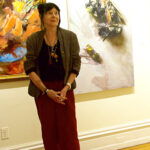
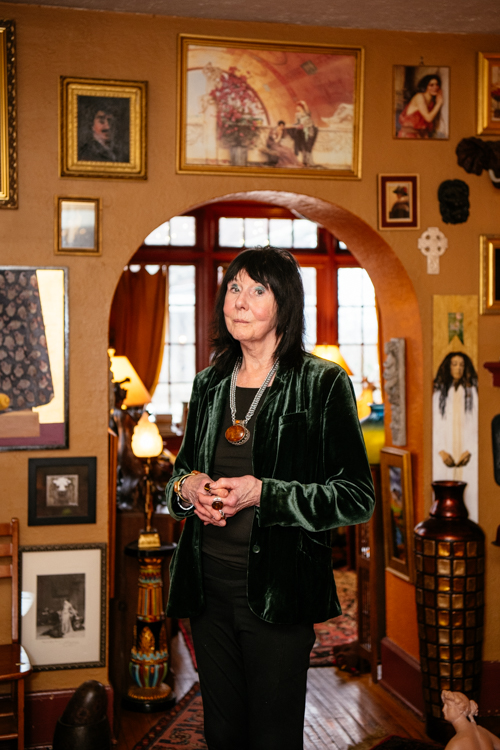
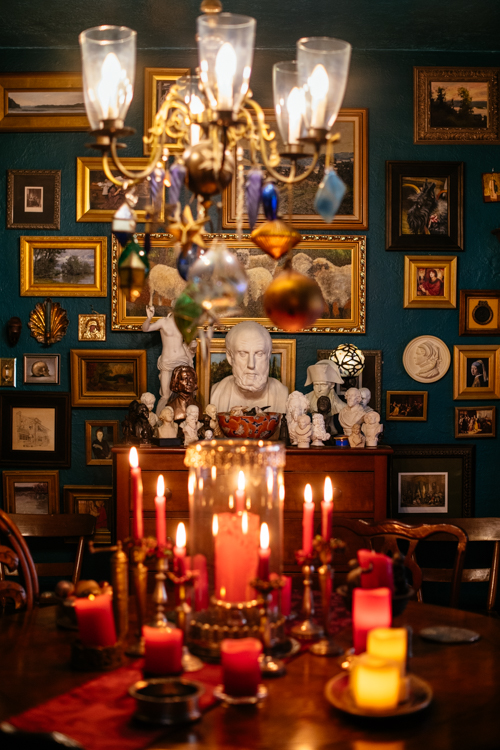
Walking into Carrie Wissler-Thomas’ home is like walking into her mind.
I guess many people’s homes could be described that way, as an expression of who they are. Not all are so unique, as many turn to big box stores for furnishings. But, as you might expect, artists are apt to collect and create one-of-a-kind pieces.
Every recess of space in Wissler-Thomas’ Harrisburg home is filled with art, art, art, history, family memorabilia, more art. She can’t tell you how many works adorn the walls, shelves and every nook and cranny. Taking inventory would be a feat.
However, for Wissler-Thomas, the long-time executive director of the Art Association of Harrisburg, collecting has never just been about amassing a great quantity. Each piece has meaning to her, whether it’s a self-portrait, a framed gift from a friend, a bronze bust from an overseas trip, or her many, many Scottie dog figurines. She’ll gladly tell you the story of each.
Unlike many professions, artists want to be surrounded by their work at home. There’s virtually no line between work and home life. This is especially true for Wissler-Thomas and two other Harrisburg artists, Michelle Green and Charlie Feathers, who all use their homes as studios as well.
Of the three, I’d call Wissler-Thomas “The Collector,” Green “The Heart” and Feathers “The Expressionist.” Welcome to their cribs.
The Collector
In addition to being an art collector, Wissler-Thomas is the family archivist, displaying her grandmother’s tea sets, her family photos, her grandchildren’s old picture books and toys, as well as memorabilia from high on the family tree.
“I read a biography of Sir Richard Burton, who was the explorer,” she said. “One of the photos was of him and his wife sitting in their dining room, and the caption said, ‘A photo of Sir Richard Burton and his wife in their typically cluttered Victorian dining room.’ I said, ‘It looks just like ours!’”
Wissler-Thomas and husband Scott moved into their N. 2nd Street home in 1991. Before hauling in furniture, anything, Wissler-Thomas painted and hung a work inspired by Victorian writer H. Rider Haggard’s book, “She: A History of Adventure,” above the fireplace, setting the centerpiece of their home.
“This is what I’ve always done,” she said. “In our first apartment, we moved the paintings in first, and I hung them and [my husband] said, ‘How can you hang paintings without furniture?’ I said, ‘I know where they should go.’ And they were fine.”
Wissler-Thomas said that first painting, and that late 1800s author, inspired the rest of her home. She’s drawn to the time period during which artists all knew each other, held elaborate parties, and were highly regarded in society.
The family has tried their best to channel the energy of that time with Wissler-Thomas hosting AAH parties in her home, opening it for Historic Harrisburg Association’s Candlelight House Tour and displaying numerous works by other local artists.
And while the house has an extensive showcase of other artists’ work, Wissler-Thomas’ own pieces, landscapes of her travels to Scotland, Spain, France and nude portraits she painted in classes taught by the late Charles “Li” Hidley, take the spotlight.
“The ones that I really love are my portraits. And I don’t take these out. These are our collection,” she said. “I’ll take you up to the studio and that has a huge inventory. I’ve been running the Art Association for 40-some years, so I’m always showcasing other artists’ work, so I don’t get my own work out there that often.”
Her home is her gallery, she said.
As the years ticked by, the collection has grown to the behemoth that it is now. There is something of an order to it. Portraits are in the living room, landscapes in the dining room, and some walls have themes, like the “hero wall,” which includes historical figures and a portrait of close friend, the late Charles Schulz dressed as a Renaissance man. The library in the front of the house is full of books, mostly English history, of which Wissler-Thomas has read every single one.
“Recently, when she brings something home, it’s mostly a matter of finding a place for it, finding a vacant or empty spot,” Scott said.
Scott, a retired IT guy who volunteers as AAH’s bookkeeper, headed up several renovations in the house and is Mr. Fix It. His office on the second floor has slightly less art and more bowling and birding, two of his passions. But the paintings that did make the cut are very meaningful pieces, including several by his wife.
And if you thought that this place—full of precious art, delicate pottery and too many taper candles to count—would make a great place for a bunch of kids and adults to run around hunting Easter eggs, you’d be right. Easter egg hunting, and even other holiday-themed hunts, have become a tradition in the household. The one rule, eggs must not be completely hidden from view.
“Our son hides them, and he’ll hide them in just one room, and it takes hours to find them,” she said, laughing. “Everybody crawls around and looks, and he sometimes puts them on top of paintings. I hate it when they hide things up on the mantel. That head of Laocoön is very unstable. An egg usually ends up on his head and that’s very scary.”
It may look like a gallery, but it doesn’t have the same rules. It’s lived in.
In the back “garden” room that was added onto the house, the couple plays their nightly board game of “Wingspan” and works on puzzles. The dressing room is full of Wissler-Thomas’ clothes, although one visitor once asked what the room with all the “vintage clothing” was for. The children’s bedroom is where her granddaughter slept for some time.
“We love coming home,” Wissler-Thomas said. “There are lots of things that remind me of my family […] there are things that family members have given me, and that Scott and I have collected on our trips and they’re all meaningful. It’s like living in history.”
The Heart
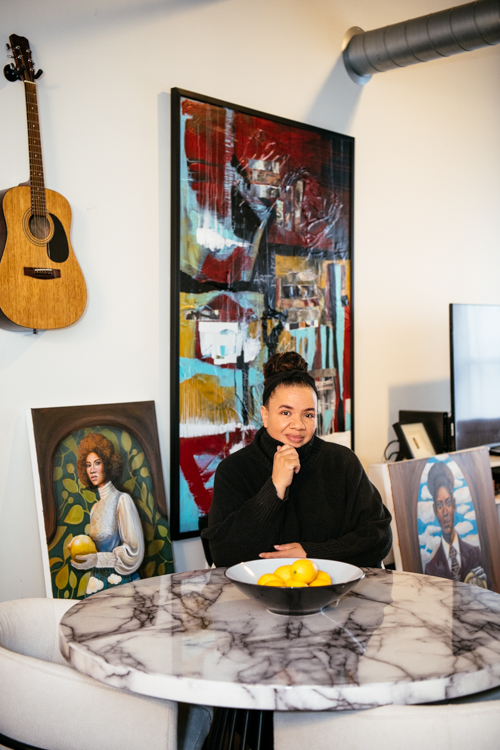
Like Wissler-Thomas, when artist Michelle Green moved into her Midtown apartment, she knew she needed to create some new art for the space.
What followed were three paintings for behind the couch, two black-and-whites of beautifully dressed women with afros, one with the word “Black” written above her head, and an abstract with primary colors red, yellow and blue.
“I do surround myself with my art because everywhere I sit in my apartment, whether it’s here or over here, I need to feel inspired,” Green said. “I just feel like, everywhere you look in your house, why aren’t you looking at something that’s enjoyable?”
Much of Green’s work is Afrocentric and Black art, depicting Black women clad in ornate dress. Since she was a child, Green has had a special interest in fashion design. She also specializes in photography and videography.
It wasn’t until she moved to Philadelphia to go to school and work at an art gallery that Green was introduced to Black art, which, she said, “changed the direction” of her craft.
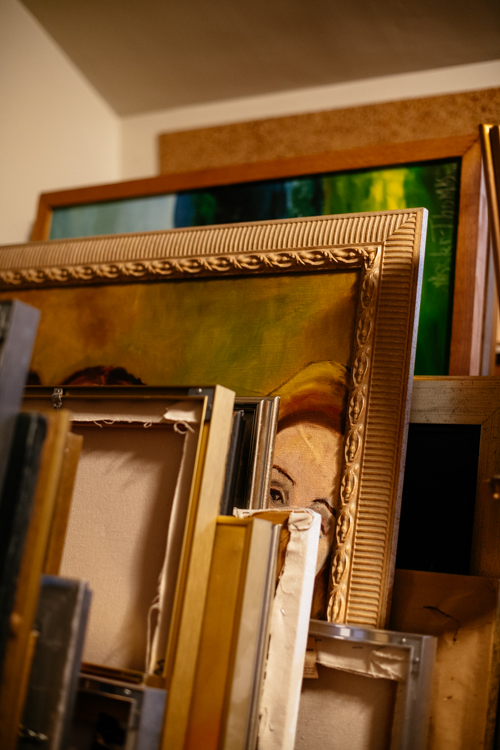
Her newest painting, “Just Dandy,” sat propped against the wall, ready to be delivered to Coda Rouge, a Harrisburg restaurant that displays Black art. The image shows a young woman dressed in a suit inspired by the Harlem Renaissance, holding a clock to represent history and legacy.
Another piece, “Bayou Beauty II,” shows a Creole woman from New Orleans, her dress paying homage to both her French and African ancestry. The woman holds a lemon, referencing the saying, “when life gives you lemons, make lemonade,” symbolizing resilience.
“I love being Black. I love being a Black woman. I love being different; I love that my personality is different. I love being a woman, and that’s what my art represents,” Green said. “I sometimes used to think, ‘I’m getting older, is it too late to…no […] maybe this is the intent, and this is the time to do it.”
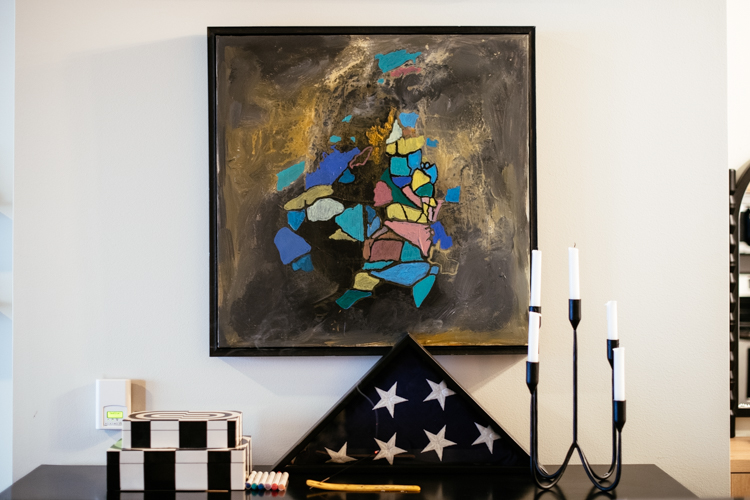
Unity, and joining different inspirations, cultures and people groups, is important to Green. In her entryway hangs an interactive painting she’s entitled, “All Who Gather.” Each time a meaningful guest visits her home, Green invites them to fill in a portion of the painting with a paint marker.
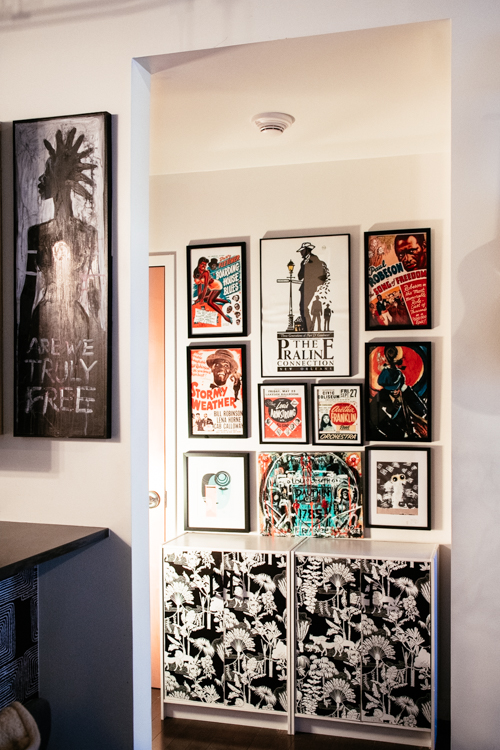
“There is so much unity in art if we allow it to be,” she said.
While working on another project, heartbreak struck Green when her mother passed away in 2024.
Art was put on pause.
Emerging from the grief, Green put all her emotion onto a large canvas. The first painting she created after the loss, while still mourning, now hangs on her living room wall.
“I took all that pain, and I threw it into that,” Green said. “I said I need this piece; I need it to be big; I need to see it every single day. It’s called ‘Art Is Life,’ because it saved my life.”
Within the painting, Green incorporated tributes to both classical artists who served as inspiration to her and more modern artists, like the late Andrew Turner, a Philly-based artist who Green said was the first Black artist who she met.
This phase of Green’s art life has been a sort of renaissance for her, as she paints a new path forward and embraces who she is.
“I’m just now, these past couple of years, trying to find myself as an artist,” Green said. “I used to paint for money. I don’t have to paint for money anymore. That’s what’s changed. When you paint for money, your passion and your love is not in your piece.”
Green’s art will be on display, along with work from other local artists, all over 50 years old, at her showcase on May 16 called “Strength, Courage & Wisdom: The Power of the Seasoned Creative.”
Attendees will be able to view many of the paintings currently hung in Green’s home, each holding personal meaning.
And though you’d never know it, Green’s pristine home is also where she creates her art. Her art cart was tucked away beside the couch ready for her next project.
For Michelle, her home is a place of comfort, joy and creativity.
“I love coming home. I love being home. It takes a lot for someone to get me to leave the house.”
Charlie Feathers
The Expressionist
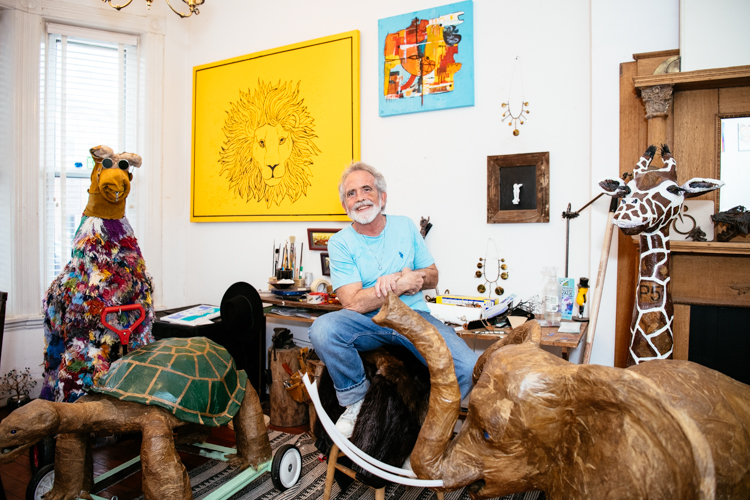
When you enter artist Charlie Feathers’ Midtown townhouse, you’re greeted by several larger-than-life animals. There’s the funky llama covered in yarn and wearing sunglasses. There’s a papier mâché elephant, a tortoise on wheels and a giraffe made of a tossed chair and broom.
Each was sculpted with recycled materials, as most of Feathers’ art is. He pointed to one, explaining that he made it from discarded Planet Fitness paper towels he found while dumpster diving.
“I’ve dug in worse,” he said. “Believe me, that’s nothing.”
Feathers is one-of-a-kind, as is his home.
Where Green and Wissler-Thomas’ homes are decorated with paint, wallpaper, aesthetic rugs and furniture, Feathers’ is much more bare bones, gritty. It’d be fitting to describe it as a blank canvas that’s constantly showing off new and evolving work. But that certainly doesn’t mean the home is minimalistic. Every wall, corner and even the floors and closets are art displays.
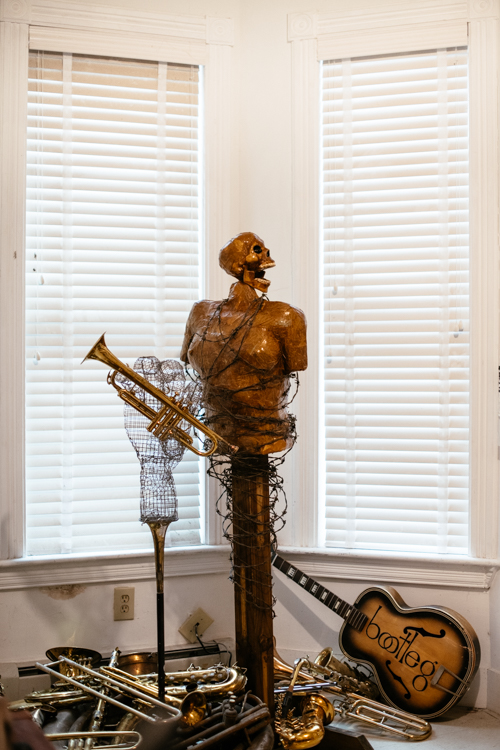
His bedroom closet has been retrofitted into his “blue chair” art display, and on the floor of a nook in his upstairs hallway sits a jumble of donated and found brass instruments.
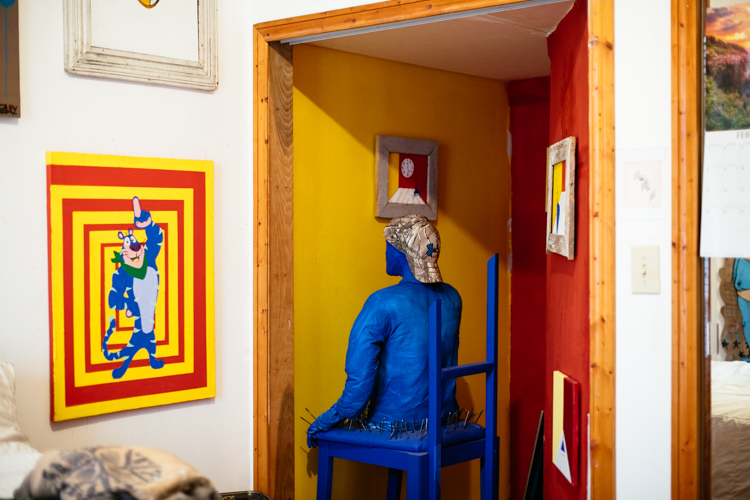
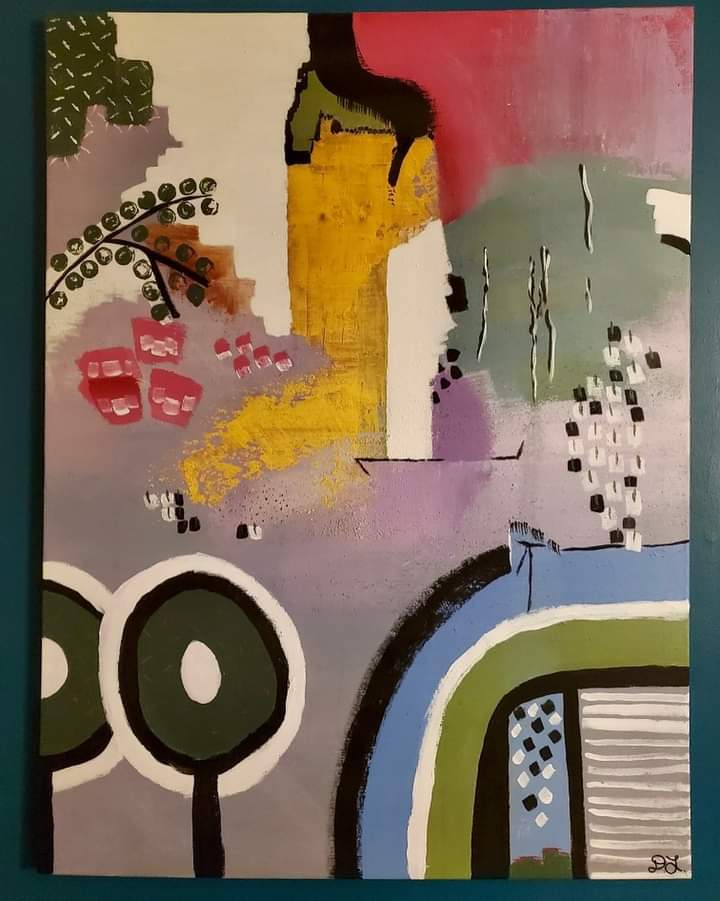
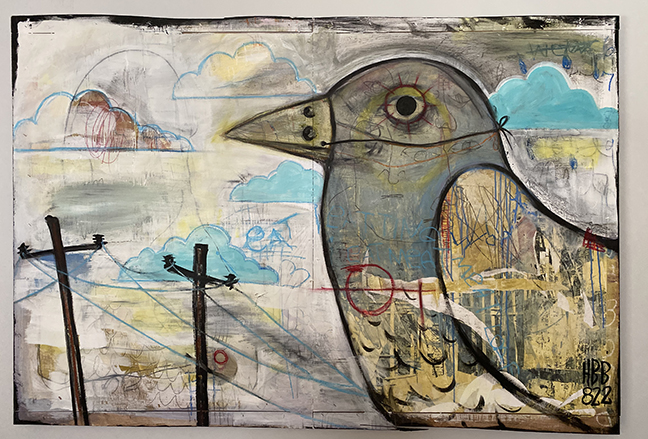
Feathers tends to work in series. He gets “buzzing” on an idea and won’t stop pulling the thread until he’s satisfied. There’s his rattle head doll series, “black balloon” series, collection of sculpted hands, and many others.
“I seem to run on series,” he said. “Just repetitive, repetitive things until I get it out.”
Feathers found art later in life, in 2012, when he enrolled at HACC in search of a purpose and something to help curb his substance addiction. In school, he found art and was drawn to the “dynamic” group of artists he met.
“This filled a good niche. All previous euphoria was chemicals,” he said. “And then I found a different outlet, which hit like the same sensor, and I was like, wow, this is euphoric.”
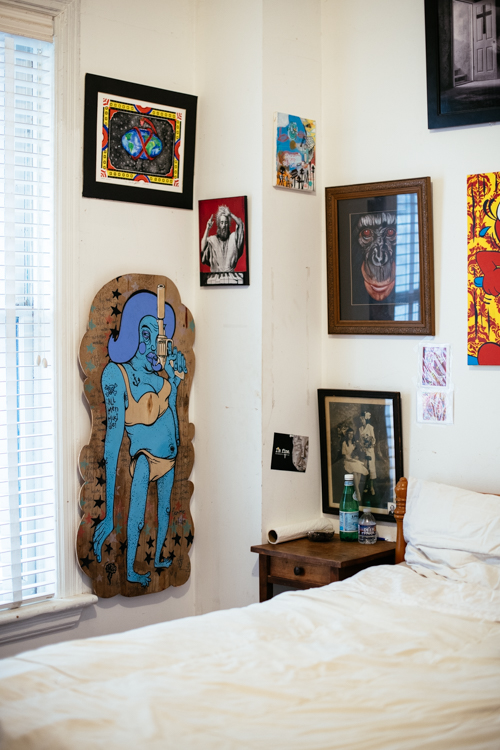
Feathers’ work runs the gamut of mediums. He paints, sculpts, quilts and works with metal, fabric, wood, paint, clay and more. His best work is born when he is simply “freestyling” without a plan, he said.
Feathers uses found objects, mostly because it’s the most affordable way to make art, breaking the mold of art requiring costly materials.
“They’re most accessible to me,” he said.
That’s why, if you dissected Feathers’ work, you’d find scrap metal in sculptures, his old hoodie balled inside an animal head wall hanging, a tarp in a painting on canvas and wool sweaters stitched into a quilt.
While some of his work is inspired by random colors, objects or themes, some is also born from his real-life experiences and relationships. One piece depicts “the one that got away.” Another represents the time he found religion as a boy. A literal ball-and-chain piece was made at the end of a relationship. There’s also plenty of references to his artist tags—“Speedee,” a symbol of a guy on a motorcycle, and “Bootleg,” which represents his tendency to pull from other artists’ work and give it his own “lick.”
Much of Feathers’ art also speaks to mental health, an important and personal topic to him. He’s not shy about sharing how art keeps him on track day-to-day and in a healthy head space. For that reason, he’s always creating.
“If I don’t, it’s not a good sign,” he said.
Feathers’ spacious basement is his workshop, and his art-filled home is his sanctuary.
That’s a sentiment that all three of the artists shared. There’s both something comforting and inspiring about being emerged in art—a feeling that maybe only an artist can truly understand.
“It’s a safe place,” Feathers said.
To view Carrie Wissler-Thomas’ work, visit www.wisslerthomas.com.
For Michelle Green’s work, visit her Instagram page @filmzbymichelleg.
To see art by Charlie Feathers, visit his Facebook page.
Photos by Dani Fresh.
If you like what we do, please support our work. Become a Friend of TheBurg!