Capital City Music Hall
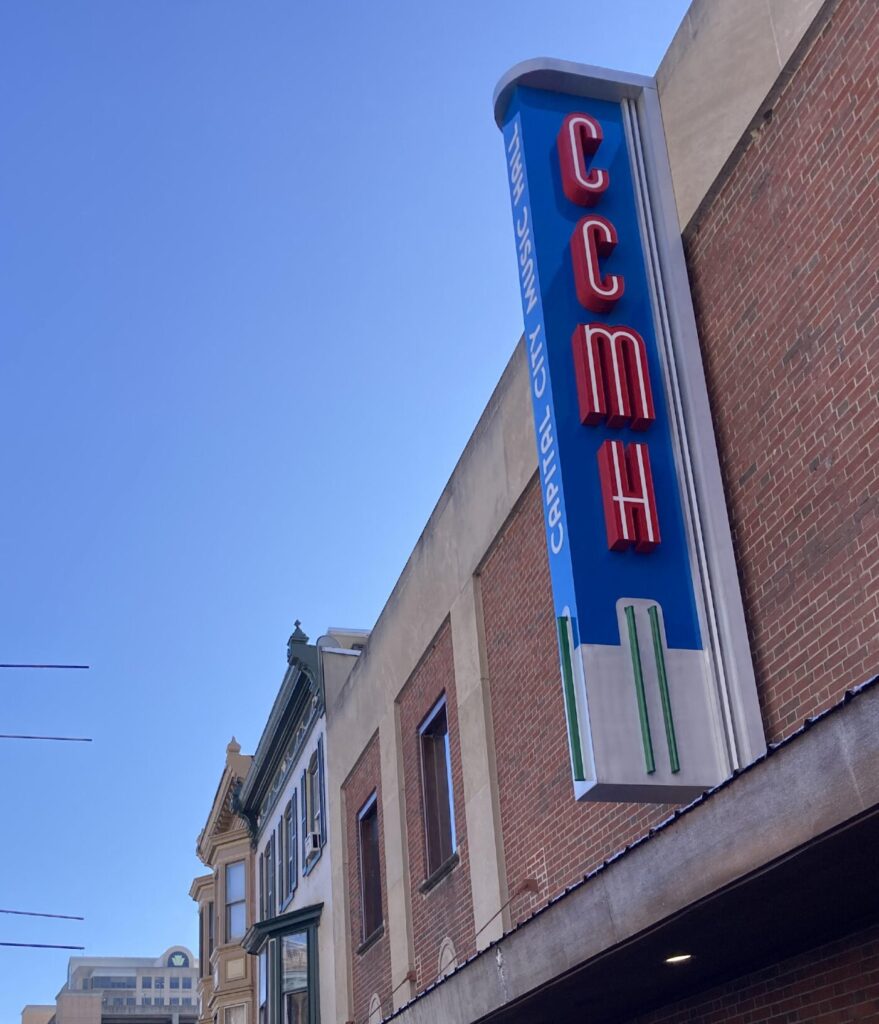
On an otherwise slow-looking Tuesday in downtown Harrisburg, a group of stagehands darted around inside Capital City Music Hall, laying the groundwork for that night’s big show.
“You have maybe 20 people down here all setting up all together,” explained the venue’s Head of Operations Michael McPhillips. “This is a staff of six loaders, a stage manager, a production manager, three sound guys—and that is just our crew.”
There’s an additional team of more than 26 people on the band’s end unboxing sound and stage equipment, complete with their own DJ decks, light columns, fog machines and video wall.
“In between November and February, you’d see something like this probably twice, three times a month. You get into April, May, June. You’re gonna see this four times a week,” McPhillips said.
The venue’s owner, Justin Browning, (also the owner of downtown’s Nocturnal, Sawyer’s and J.B. Lovedraft’s) opened Capital City in October.
The venue is still figuring out its client demographics, he said. Located on N. 2nd Street, Capital City has the benefit of downtown foot traffic—but he estimated as many as 70% of patrons for the roughly 1,000-person space’s live shows were coming from outside the state.
He listed a few: Maryland and Delaware. Virginia and West Virginia. Ohio. New York. New Jersey. Washington, D.C.
“The goal is definitely to have people come for like a day or two, not just for the show, and leave the next day,” Browning said.
It’s the type of goal that is adding major dollars to Harrisburg’s economy. In fact, long before Capital City Music Hall opened its doors, a national trade group was poring over the local industry’s data.
What the National Independent Venue Association came up with, according to a report released earlier this year, was that Harrisburg’s small, live entertainment venues triggered roughly $14.5 million in “off-site” spending for the region in 2024.
“That’s a pretty large impact on the surrounding area,” said Tyler Davis, venue manager at Harrisburg’s XL Live, which commissioned the report.
It found that people coming into Harrisburg for shows also spent roughly $12.2 million on lodging, $1.3 million on food and drink at restaurants, and an additional $1 million on shopping, transportation and other recreation.
Davis said that the venue asked roughly 50 live entertainment hosts across the region—including JB Lovedraft’s, Harrisburg University’s former Riverfront Concert Series, the Farm Show, the Zembo Shrine and more—to contribute data for the 2024 analysis.
“We all played a part in this,” Davis said.
Overall, it estimated $74.1 million in total economic output.

Tres Hermanos manager Eduardo Ortiz
Behind the Numbers
“A lot of it didn’t surprise me,” said Davis of the report. “Just because I look at a lot of it.”
A pre-show meal nearby. Drinks and snacks during the show. A hotel to crash at afterward. A little breakfast the next morning.
“Maybe get half a tank of gas,” Davis added, “And the next thing you know, they’re spending not just $25 to $30 on a concert ticket.”
While he now manages the venue, Davis has been watching music fans spend their money for years—starting in his first role as the kitchen counter person.
“Ringing in food orders,” he said.
No small feat at XL Live, which was originally, aptly named, Club XL—the venue boasts a dance floor for up to 1,200, one of the largest stages in Harrisburg, a bar and concessions area and an upstairs VIP lounge.
“I only had experience in this industry in that I was in a local band for 10 plus years,” Davis said. “I had never worked out of a music venue. I had never worked at a bar even. I started working here because I just love music.”
Promotions followed—he cooked, worked security, ran security and then became assistant manager before assuming his current role in 2021.
When he looks at XL’s sales on Ticketmaster, he said it’s easy to figure that these out-of-town visitors will be stopping in other places as well. He did some quick math.
In the last two years, XL Live has sold more than 178,000 tickets. Knowing that about 60% of XL’s ticket sales come from outside the county, Davis said, one could estimate about 100,000 of these concertgoers are getting a hotel.
“That’s just my numbers,” he said, noting there’s an 11% lodging tax on top of room rates (6% for state, 5% for county). “That’s not including HMAC’s hotel numbers and JB Lovedraft’s hotel numbers or the Farm Show. It’s not including any of that.”
Matthew Little, sales manager at the Crowne Plaza Harrisburg, confirmed that the area’s music venues and festivals are bringing additional customers the hotel’s way.
“We do see an increase in our room overnight accommodations,” Little said.
Eduardo Ortiz, manager at Tres Hermanos located near XL Live, meanwhile corroborated that the restaurant sees more patrons on show nights.
“Sometimes, it gets packed in here,” he said, to the point where there’s a short wait for a table.
“It’s good for us, and we love meeting new people and having people find out about us,” Ortiz said.
Stock’s on 2nd bar manager, William Derrick also noted that, since Capital City opened last fall, the restaurant has had some busier nights, particularly on nights featuring bigger-name acts.
“If it sells the place out, then you know the whole town is going to be busier as a result,” Derrick said.
Browning said that Capital City has a good relationship with restaurant owners downtown because of this.
“I check in with them pretty regularly when we have larger shows, especially, and they’ve all given us positive feedback,” he said. “When there’s a show here, they see an uptick in their sales.”
Hotels, too.
“Some of the employees there have told us, like they see a rise in room rentals whenever there’s certain shows coming through,” Browning said.

XL Live
Tight Margins
Despite the large economic impact live music has on the region, just 12% of the entertainment venues were operating at a profit, according to the NIVA report—a number that jumped out to Davis.
“You’re seeing both sides,” he said. “You’re seeing the struggle we all go through but also the greatness that comes to the city out of it.”
Davis explained that the association behind the report was founded in March 2020 to support “smaller, self-owned” entertainment venues during COVID-19 pandemic shutdowns, which devastated the industry.
“We weren’t doing live shows,” Davis said. “We have upwards, at any given time, of 40- to 60-plus employees. Everybody was out of a job, right?”
Smaller venues have also struggled in recent years to compete with Live Nation venues, which can offer bands more money. On top of that, running a venue in Harrisburg presents unique operational challenges, Davis added.
Parking can prove difficult (for bands with buses and for customers) in the city and a 10% amusement tax is added to every ticket sale price (5% for the city, 5% for the school district).
“When we do a show, if it costs $50, that means the customer has to pay an extra $5 on their ticket. No matter what,” Davis explained.
He added that while ticket prices—meant to pay the band, production and staffing expenses—have risen, the venue doesn’t necessarily see a profit from this. The only positive revenue that most venues see is from bar sales.
“All that other ticket money is going right to the artist,” he said.
Then there’s competition. The best success for all small venues, Davis said, comes when they coordinate with each other.
“We can do a country show while they’re doing a metal show,” Davis said of a competitor. “Or we can do a hip hop show while they’re doing a country show, and both of us can be successful at the same time.”
Davis said that HMAC, which closed recently, and Capital City have been XL’s two biggest competitors locally, as well as Mickey’s Black Box in Lititz.
On top of that, several bigger Live Nation venues, which can typically offer more money to bands, present tough competition.
Still, Capital City’s McPhillips finds that smaller, independent venues give customers certain benefits you don’t find in larger venues.
“Better proximity to the stage, better visibility. More chance of catching the drumstick,” he listed.
Davis provided another: a more intimate connection with the artists.
“When you go to these big venues, those artists are back in the green room in 0.1 seconds after their sets. Over here, they’ll come down to the barricade, walk across, meet the people, stay, sign autographs, take pictures,” Davis said. “You’re not going to get that at a place that seats 10,000 people.”
Overall, Browning thinks that smaller-scale, live entertainment will be an important part of Harrisburg’s overall revitalization.
“Live entertainment is always going to have a draw, and we need something to draw people here,” he said. “Food costs are high; alcohol costs are high. Drinking is lower than it’s ever been. So, some form of entertainment value is necessary. I think live music is definitely going to be a key.”
XL Live is located at 801 S. 10th St., Harrisburg. For more information, visit www.xlhbg.com.
Capital City Music Hall is located at 234 N. 2nd St., Harrisburg. For more information, visit www.capcitymusichall.com.
If you like what we do, please support our work. Become a Friend of TheBurg!