Tag Archives: Bishop McDevitt

Still Running: Harrisburg native Ricky Watters is long retired from the NFL, but his life’s work continues

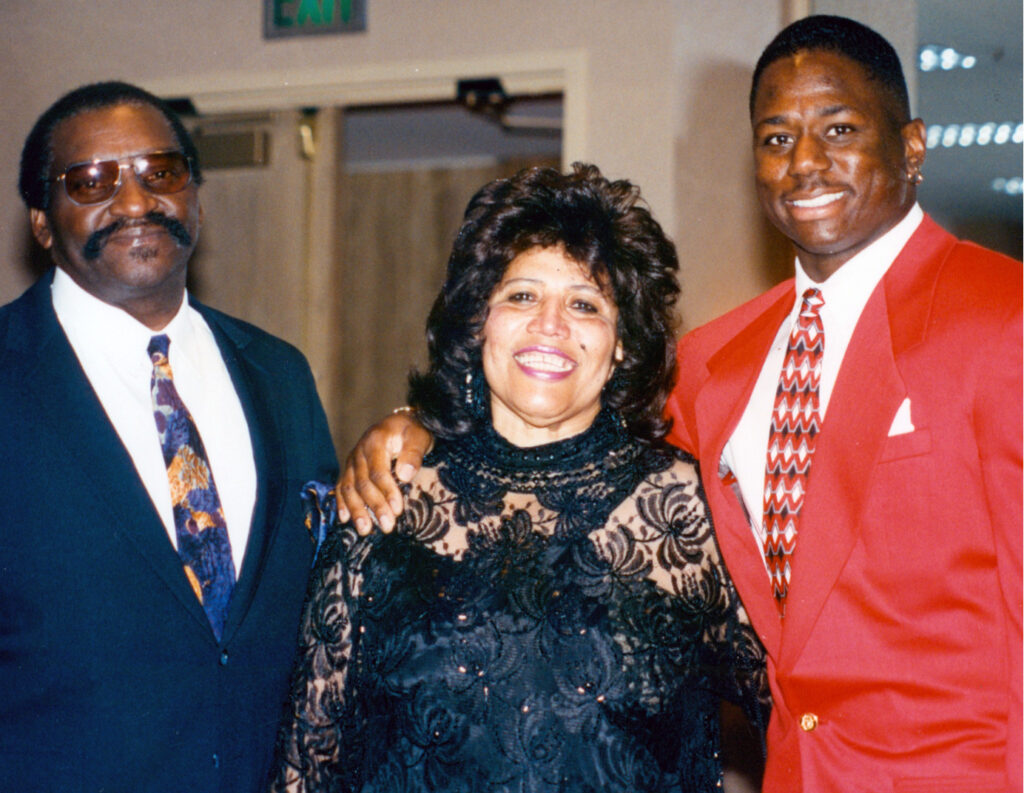
Ricky Watters (right) with his parents Jim and Marie, in the early 1990s.

It’s been more than 20 years since Ricky Watters retired from the NFL. His life now is no better, no worse than it was then, only different.

The Harrisburg native has adjusted quite nicely to a life of not playing the game he still loves. But that doesn’t mean that the transition wasn’t a challenge or that it didn’t take time.

Watters now resides in the San Francisco area, and his life is filled with a growing family, mentoring at-risk youth and public speaking. He also recently launched a new self-help business venture, Impact Wellness.

It’s all fairly typical post-retirement stuff for a former professional athlete in his early 50s, following a not-so-typical lifestyle over the first half. If anything, Watters’ current existence is less centralized and more rounded.

“It definitely took a while to adjust,” Watters said. “Nothing can replace the high from playing or having people cheer for you. It was a tough situation. I’m not really sure how long it took to adjust to life after football. But it’s tough for everyone.”

Watters extracted the most he could out of a 10-year career in the NFL, first with the San Francisco 49ers, then the Philadelphia Eagles and, finally, the Seattle Seahawks, from 1992 to 2001.

An extremely durable running back, Watters posted 2,622 career carries for 10,643 rushing yards and 70 total touchdowns. He enjoyed the type of playing career that created discussions about a possible induction into the Pro Football Hall of Fame.

“I played for three great organizations,” Watters said. “But I’d have to say our Super Bowl victory with the 49ers (in 1995) has to be the highlight. As far as football goes, I still love the game. I always watch my three teams play.”

In 2001, the grueling physicality of the NFL began to take its toll on Watters’ body, and his carries and productivity fell off. It’s a physical investment that the former Bishop McDevitt star is still paying off today.

“It was injuries,” he said. “I didn’t want to stop playing, but we had a new baby on the way. It’s always tough to retire. But I knew it was time to hang it up.”


Badge of Honor

After accomplishing nearly everything a scholastic player could at Bishop McDevitt in the mid-1980s, Watters went on to star at Notre Dame. He helped the Fighting Irish to a 34-21 victory over West Virginia in the Fiesta Bowl and the 1988 national championship.

“Even though I experienced some great moments throughout my career, my mind always takes me back to my championship team at Bishop McDevitt,” Watters said. “At Bishop McDevitt, they taught me how to grind. My teammates were always there for me when I wasn’t so strong and I didn’t know who I was.”

Adopted as an infant, Watters began playing football in Harrisburg as a Pee Wee around the age of 8. His Harrisburg upbringing fostered his appreciation for the family unit, as well as empathy for at-risk kids.

At some point, “buying a house for my mom” became a professional goal, he said.

“Ricky was the most motivated, the most competitive person I’ve ever met,” said Sean Barowski, Watters’ backfield mate at Bishop McDevitt. “And that has played out in his life. He was amazing. In high school, you just knew. Competitiveness can be taken the wrong way, as cocky or conceited, but he was just a winner.”

Geographically, San Francisco is 2,429 miles from Harrisburg, but, because it remains so close to his heart, Watters’ hometown is never far from his mind.

“Harrisburg will always be my roots,” Watters said. “They backed me before I was Ricky ‘Running’ Watters. Back then, I was ‘Skinny’ Ricky Watters. I have a lot of pride about being from Harrisburg. I’m glad I was able to get out, but I’ll always wear it like a badge of honor.”

Outsiders know Ricky Watters as a former football player. But it wasn’t until Watters fully discovered himself as a person that he could allow others to know him.

“I appreciate what football did for me,” he said. “It made me mentally disciplined, physically disciplined, and taught me the value of teamwork. It’s a tough sport, and you take your lumps. I think people know my passion for the game. But I think, off the field, I’m just as passionate for my community.”

Reflective, moral and mature, Watters is in a really good place right now personally. It’s an evolution that can be traced more to his foundation than the playing of any game.

“He’s just a stand-up guy,” said Barowski. “He’s an incredible father and husband. They’re an incredible family. He’s fit into the society the way all former NFL players do. He’s competitive in everything he does, chess, checkers, basketball. It’s just in his blood.”

“As long as I’m still living, I’m going to make a difference,” Watters said. “That’s what it’s all about for me now. You have to learn every day, stay positive and always work on yourself. Just when you think you’ve gotten past one challenge, another one comes along. But the most important thing to know is that everyone has talent.”

For more information on Impact Wellness, visit www.impact-wellness.com.


If you like what we do, please support our work. Become a Friend of TheBurg!


Continue Reading

The Week that Was: News and features around Harrisburg

A past “Family Fishing Day” at Italian Lake

The October issue of our magazine came out this week! We hope you love our spooky cover and fall-themed stories as much as we do. Grab a copy and then catch up on this week’s local news, below.

The Ecumenical Food Pantry has served more than 1.2 million people in the Harrisburg region, our magazine story reported. The outreach recently celebrated its 50th anniversary of combating food insecurity in the community.

Our editor talks about all that TheBurg offers in addition to the magazine, including our online news, podcast and 3rd in the Burg, in his October Editor’s Note.

Family Fishing Day at Italian Lake will offer residents a chance to try their hand at a new sport, our online story reported. A course will teach participants the basics of fishing and provide the supplies to cast a line.

Firefighters from Harrisburg’s Bureau of Fire are stationed in Charleston, S.C., to assist during Hurricane Ian, our online story reported. The firefighters, members of the Pennsylvania Task Force 1, will help with search and rescue efforts.

Harrisburg City Council presented its “Unsung Hero” awards to local community activists and volunteers, our reporting found. Four city residents were recognized at a council meeting on Tuesday.

The Harrisburg School District is moving closer toward reopening the long-vacant Steele Elementary School, our online story reported. At a school board meeting, Receiver Dr. Lori Suski approved a $21.6 million plan for its renovation.

Harrisburg High School-John Harris Campus will receive increased police presence after a fight involving a large group of students took place earlier this week, our online story reported. Officers will conduct wellness checks and help train security officers on responding to situations like these.

M. Camille Erice, a community activist, dancer and founder of Dazante passed away. In our online story, read more about her life and how to honor her memory.

Phil Guarneschelli, the former president of UPMC of Central Pa., retired in September as Lou Baverso assumes the reins. In our magazine story, we share a Q&A with Guarneschelli, who reflects back on his long career in healthcare.

Sara Bozich has a full lineup of fall fun activities for you weekend. Find the festivities happening in and around Harrisburg, here.

Strawberry Square’s Chockablock Clock will move to Shippensburg University in October, our online story reported. Harristown Enterprises will replace the over 30-year-old clock with a new stage and office space.

The “Thin Blue Line” football game will take place on Oct. 7 to honor first responders who were killed in the line of duty, our online story reported. Bishop McDevitt High School, playing on its home field, will face Hershey High School.

Urban Churn, a Harrisburg-based creamery, announced that it will open a third scoop shop in Carlisle, our online story reported. Customers can also now purchase the company’s ice cream in select local grocery stores.

The West Shore Theatre in New Cumberland recently reopened after an extensive renovation and modernization project. In our magazine story, read about what the historic theater now offers to the community through its updated programming.

Do you receive TheBurg Daily, our daily digest of news and events delivered right to your email inbox? If not, sign up here! 

Support quality local journalism. Join Friends of TheBurg today!


Continue Reading

The Bridge receives $4 million state grant to spur renovation of former Bishop McDevitt building

A rendering of the The Bridge Ecovillage, once completed

A proposal to renovate and repurpose the former Bishop McDevitt High School has new energy, as the state has announced a $4 million grant for the project.

On Friday, Gov. Tom Wolf announced grants through the state’s Redevelopment Assistance Capital Program (RACP), including funds for The Bridge Ecovillage project at 2200 Market St. in Harrisburg.

According to the state, the grant would help fund the renovation of the first floor of the former high school into a facility called the JEDI (justice, quality, diversity and inclusion) Innovation Center.

Once completed, the center will include a community concert/lecture hall, library, co-working space, rooftop garden, community kitchen, fresh foods cafe and a full-service medical clinic, according to a release from state Rep. Patty Kim (D-103).

“This funding will allow for this unique building to once again house teaching, education and recreational opportunities for Harrisburg’s young people,” Kim said. “The creation of the JEDI Innovation Center is an opportunity to enrich the lives of our residents and make our city a better place to call home.”

The Bridge Ecovillage’s main building, the former Bishop McDevitt High School

Garry Gilliam, a Harrisburg native and former professional football player, heads up the Bridge as founder and CEO. He and several partners announced the project in late 2019 and ceremoniously broke ground on it in November 2020.

The grant would help finance the first phase of the build-out of the planned mixed-use project that includes numerous components, including housing, retail, urban agriculture, education and entertainment.

The 115,000-square-foot building served as Bishop McDevitt High School for about eight decades before the school relocated to a new campus in Lower Paxton Township in early 2012.

A representative for The Bridge could not immediately be reached for comment.

Click here for a related story on other projects that received RACP grants on Friday.

If you like what we do, please support our work. Become a Friend of TheBurg!
Continue Reading

Harrisburg organizations seek state grants for large-scale development projects

The Hudson Building on N. 6th and Maclay Streets.

Several Harrisburg companies and organizations soon will find out if they will receive state grant money for their large-scale redevelopment projects in the city.

On Friday’s edition of Community Conversations with Mayor Papenfuse, the city’s weekly Facebook Live event, the mayor spoke with several Harrisburg-based applicants who are seeking funds under the state’s Redevelopment Assistance Capital Program (RACP).

“Some of these aging, larger structures in Harrisburg have tremendous fixed costs,” Papenfuse said. “Those costs can really overwhelm an organization which is trying to maintain them.”

The City of Harrisburg is requesting the most money of the nine local applicants. It is asking for $8 million to renovate the MLK City Government Center.

The RACP funding would push forward a plan to increase accessibility and community use of the building, explained Marc Woolley, the city’s business administrator.

Starting at the first floor, the city plans to soften the current cold, brutalist architecture with an overhang on the exterior of the building and a more welcoming lobby space with tables inside. Woolley said the city would add a small business incubator space, as well. Improvements to the other three floors would follow.

“We want to take hold of the namesake of the building—the Martin Luther King Jr. Government Center,” Woolley said. “It’s really about community fairness and accessibility.”

Many types of organizations, both public and private, are eligible for RACP funding. The annual program is for regional economic, cultural, civic, recreational and historical improvement projects, according to the PA Office of Budget.

Leaders of The Bridge Ecovillage hope to secure a significant amount of funding for their renovation of the former Bishop McDevitt school building in Allison Hill. Chief Executive Officer Gary Gilliam said the requested $2 million would go towards beginning construction, installing HVAC and sprinkler systems, roofing and electrical work, among other items.

“Getting that initial funding is paramount to getting the project to succeed,” Gilliam said.

The historic improvement aspect is emphasized in applicant Mighty Group Holdings LLC’s Hudson Building project. Owner Adam Maust is asking for $3 million to renovate the 45,000-square-foot building at N. 6th and Maclay streets.

“For projects of this scale, the cost grows quickly,” Maust said. “This would allow us to get started soon.”

Maust said that he is still considering ideas for what the building will hold, but he is leaning towards an educational aspect and a grocery store.

Marc Kurowski, president of city-based K&W Engineers, also spoke of how the grant money would help fund plans to update and upgrade the historic King Mansion on the 2200-block of N. Front Street. The building serves as K&W’s headquarters, but includes event space, which is used for weddings and large events.

In Harrisburg, other projects that have applied for RACP funds include:

  • Judicial Office Center at Midtown, $3.7 million, to partially fund a five-story, 75,000-square-foot office and retail building, with a separate five-story parking structure, on a 1.5-acre site between Reily, Boyd and Fulton streets, by KevGar HoldCo LLC
  • Harrisburg Scottish Rite Cathedral, $1.38 million, for extensive building renovations and upgrades
  • Presbyterian Apartments, $2.5 million, for rehabilitation to the senior citizen high-rise downtown
  • Whitaker Center, $1.45 million, for building upgrades and renovations and to construct a new STEAM education and innovation studio
  • Olde Uptown Neighborhood Revitalization, $5 million, to continue acquisition and renovation of blighted properties, by WCI Partners LP

Typically, about one-third of applicants statewide receive RACP funds each year and often in lesser amounts than requested.

“We really have a wide array of really interesting projects being proposed for Harrisburg,” Papenfuse said. “For large-scale building projects, there is a need and role for this program.”

Local representatives including Sen. John DiSanto, Rep. Patty Kim (D-Dauphin) and Gov. Tom Wolf’s office will have the say in who is selected for the grant, Papenfuse said. A decision is expected by the end of the month, he added.

“From the city’s perspective, we hope we can fund all the projects,” Papenfuse said.

To view past Community Conversations, visit the city’s YouTube channel. For more information, visit www.budget.pa.gov/Programs/RACP.

Disclosure: Alex Hartzler, co-publisher of TheBurg, is a principal with WCI Partners.

Support quality local journalism. Join Friends of TheBurg today!


Continue Reading

Roll Call, Role Model: Tyrai Anderson sets his eyes on his next goal—becoming a Harrisburg police officer and inspiring city youth

Tyrai Anderson

Tyrai Anderson was always running.

As a high school student at Bishop McDevitt in Harrisburg, Anderson played football, basketball and track and field. In 2009, his track team won the school’s first championship for the sport. Also that year, the football team came out on top as the Mid Penn champions.

He went on to play football at Lock Haven University and was even an NFL prospect, he said.

Anderson started sports when he was young. His mom signed him up to help him stay out of trouble.

When he was 9 years old, a teacher caught him with a pocketknife he found on the ground. The school had just switched to a “zero tolerance” policy. He was in trouble.

“I’ve never been a trouble-maker; I’ve been a kid,” he said. “As a little kid, I had already been going through the juvenile system.”

Growing up in the city, Anderson remembers other encounters with the police.

“I would always resent experiences that I had—run-ins with the police,” he said. “I could’ve easily been someone that had a dislike for law enforcement.”

Back in his football days, Anderson faced his opponents head-on, clashing, tackling, outrunning. But with the police, it was different.

There was a clash, but he decided not to run.

“I always told myself—rather than run away from my fear, why don’t I do something about it?” he said.

Anderson is now enrolled in the Police Academy at HACC. His goal is to graduate and serve as an officer in Harrisburg’s Bureau of Police.

Unique Perspective

Anderson didn’t always see himself as a police officer, mainly because most officers he encountered didn’t look like him.

He wanted to be an athlete, and there were plenty of role models in that realm. One of his influencers was Chris “Handles” Franklin of the Harlem Globetrotters, who mentored him through basketball.

As Anderson grew older, he began to see people of color, like Harrisburg Commissioner Thomas Carter, in law enforcement positions.

He took a position with the Dauphin County sheriff’s office, and it was that job that led him to a career in law enforcement.

Later, he began working as a constable alongside his friend Hanif Johnson, now a magisterial district judge in Harrisburg.

“We both had a passion for sports, and we used that to get a college education,” Johnson said. “Watching him become a member of law enforcement has been very interesting.”

Now, Anderson is training part-time to become a police officer, while continuing to work as a constable.

In his class, he said, he is the only African American.

“I feel like we could have more,” he said. “But I don’t blame them.”

Anderson believes that he brings a perspective, unique from those of his classmates, to the academy, as a Black man from the inner city who has had negative experiences with the police.

“I always remind my classmates and try to be open with them about how I grew up,” he said. “I know what it’s like to sit in the back of a cop car.”

Anderson often goes to Harrisburg schools to talk with kids. He gets their attention with some basketball tricks and then tells them about his story.

He wants to be a role model for kids who are growing up just like he did. To Anderson, representation matters.

“Once I started to see people that look like me in these positions, it made me want to do it,” he said. “I want these kids to know there is someone out there who cares about them.”

Anderson still spends a lot of time out on the field. He is often playing flag football with kids or volunteering with the Holy Name Jets or the Central Penn Crusaders youth football teams. Sometimes, he and Johnson coach together.

“If you made it out of a hard situation and bettered yourself, you should share that blueprint,” Johnson said.

All Love

Tyrai Anderson is always running.

He gets up each morning at 4:45 a.m. to work out at the gym. Then he goes to get his kids ready for school. At 8 a.m., he goes to work as a constable and, afterwards, studies at the police academy until 10 p.m.

But he’s used to hard work.

“I’ve always had to climb up in order to get things,” he said.

Even though Anderson understands the risk that comes with being a police officer, it’s not putting on the uniform that scares him—it’s taking it off.

“I don’t get to wear this uniform all day,” he said, recalling the times he felt profiled or criminalized. “I should be able to look the way I look and talk the way I talk and still be a professional.”

Anderson hopes that becoming an officer will inspire other Black police recruits.

“In order to get young African American males, we have to decorate our police force,” he said. “I wish there was a more diverse police force.”

Anderson is especially passionate about serving his hometown, Harrisburg. He said he wants to follow in the footsteps of one of his heroes—Commissioner Carter.

“The city of Harrisburg is something special to me,” he said. “I don’t want to go anywhere other than the city of Harrisburg.”

Anderson learned a lot during his days as an athlete: hard work, stamina, determination. There’s a lot he can take from the field into being in law enforcement. But the clashing of teams, the polarization—that’s what he wants to avoid.

He remembers what it felt like to be that 9-year-old caught with a knife he had picked up off the ground. He knows the feeling of riding in the cop car.

As a member of law enforcement, Anderson plans to operate on the basis of love, respect and the understanding he has from being on the other side of the law.

“I could literally take someone to jail, and it’ll be all love at the end of the day,” he said.

Support quality local journalism. Join Friends of TheBurg today!


Continue Reading

School’s Out: The century-old William Penn High has long sat vacant. Will it ever turn the page?

Capital Rebirth team at the William Penn High School

Mae Sobczak was a relatively quiet student back in her high school days at William Penn High School. She had lots of friends and participated in the orchestra, her high school’s sorority and intramural sports after school. But she wouldn’t have labeled herself “Miss School Spirit.”

Sixty-four years later, however, things are different.

After graduation, Sobczak started organizing class reunions. Every five years, William Penn alumni get together, and, each six months, the class of ’56 catches up. On top of that, Sobczak and a group of women meet for lunch every Friday to reminisce on the old days and chat about the new.

In 2006, the class celebrated its 50th reunion. Sobczak, along with a committee, organized the event, which included a tour of the old William Penn building. The group went there excited to relive old memories, but left feeling like the building they toured was nothing like their beloved alma mater.

“When we came out to get on our bus, we were saying how it was so sad,” Sobczak said.

Over a decade later, it’s even sadder, as William Penn has sat, deteriorating, since. The classrooms, once full of students, are full of old rubble and garbage, and the halls display crude graffiti. Do a quick Google search of the old school, and you’ll find videos posted by thrill seekers, trespassers on the hunt for ghosts or just curious residents.

Over the years, many fires have been set in the building, requiring the Harrisburg Bureau of Fire’s attention.

“Structurally, that building is in phenomenal shape,” Fire Chief Brian Enterline said. “It’s more that the contents inside are burning, not the building itself. The problem is it’s a large, vacant school building. It’s very difficult to secure.”

All the while, William Penn has sat in the hands of the Harrisburg school district—too damaged to hold on to, too big and costly to give up easily.

People have wondered what will come of the grand old campus overlooking Italian Lake, the school that was once Harrisburg’s pride.

In the Day

It’s the early 1920s in Harrisburg. The city isn’t just growing; it’s thriving. Suburbanization hasn’t led to flight out of the city yet. There’s even a trolley car system. But one of the hottest topics in the city is education. People are looking for modern, quality schools.

David Morrison, president of Historic Harrisburg Association, paints the picture.

People were ready to send their kids to school in the city, but the city wasn’t ready for them, he said. Many city schools were built in the post-Civil War years—the 1870s and 1880s. Once the 1920s came roaring around, the school district needed to play catch up.

“By the ‘20s, the educational infrastructure of Harrisburg was pretty obsolete,” Morrison said.

In the early 1900s, Harrisburg Technical High School, located in the building now known as Old City Hall, was built on Walnut Street and served students for many years. But with people hungry for top-notch education, Harrisburg Tech became a government center and a new, larger high school was proposed.

“In those days, the public school systems were so advanced,” Morrison said. “In some cases, people who lived in the suburbs paid to have their children attend Harrisburg schools.”

Urban architect Charles Howard Lloyd, who would later claim fame for the Zembo Shrine, was busy designing schools. Harrisburg Tech and Simon Cameron School (1896) were formed in his signature gothic style. It was only fitting that the district called upon him for the new school they would call Hoffman’s Woods School (later William Penn), Morrison explained.

But Allison Hill families wanted a school of their own that their kids could walk to. So, the district decided on two separate schools—John Harris and William Penn.

William Penn building plans were scaled back to save funds for the second school on the Hill, but the new blueprints were hardly modest.

“They had huge halls,” local historian and William Penn alum Calobe Jackson recalled. “We would start track right after Christmas, and we would run through the halls for practice.”

Jackson graduated from the class of 1948. He remembers an indoor courtyard and a grandiose auditorium with a balcony. It was beautiful and well designed, he said.

In addition, there was a kitchen, cafeteria, housekeeping suite, science and lab rooms and shop spaces for tech courses, amongst other classrooms, according to “Building Harrisburg,” a book by historian Ken Frew.

“Years ago, they used to say William Penn was the largest high school campus in the U.S.,” Jackson said. “It was really a beautiful school.”

Jackson’s class had a little over 300 students, while the full school had about 1,200. Back then, high school lasted three years instead of four.

When William Penn was constructed in 1926, high school enrollment was swelling. Between 1900 and 1920, student enrollment in the United States quadrupled and then nearly quadrupled again by 1940, according to the public policy magazine, City Journal. But it was in that same decade that the school movement ended. City Journal ties that to segregation and racial discrimination, which had Blacks enrolling at lower numbers than whites.

By the mid-1950s, enrollment at William Penn had only declined slightly. Sobczak remembers that her class of ‘56 had about 264 students. Pride for their school was still strong among students, she recalls.

“We were proud to be city school graduates,” she said.

But the 1950s represented the high mark for William Penn. That decade, the city’s industrial companies began closing, and people started leaving Harrisburg for the suburbs. In 1972, John Harris absorbed William Penn students, the building morphing into a technical school before closing entirely.

Moving Forward

For most William Penn graduates, it’s been a long time since they danced at a sock hop or scored a goal in intramural sports. Most are parents, grandparents and even great-grandparents. Many have passed away. Sobczak’s alumni mailing list gets shorter by the year.

Just like many of the students that once walked its halls, William Penn is old. But that doesn’t mean it’s any less grand. The interior may be decrepit, but the building is still the columned mammoth that it was in the 1920s.

For some, that’s enough to see it ripe with potential.

Superintendent Chris Celmer said the school district is currently taking letters of interest and offers for the William Penn building.

“We want them to have local interest in the community, and they’re going to have to have experience,” he said. “It has to come with the ability to finance.”

Local nonprofit Capital Rebirth put in a $2.5 million bid in March and garnered over 7,500 signatures from the community on a petition of support for the plan they’re calling “The Rebirth Project.” The group wants to create a community center, including space for education, entertainment and wellness, explained founder Mikell Simpson.

“William Penn has always been a historic landmark,” he said. “We know what the needs of the community are and how everyone can benefit.”

Included in the building would be an indoor stadium, classrooms, an enclosed track and offices. Simpson estimates that the work would take three to four years and cost up to $175 million.

But others envision the building as something else entirely.

Jackson could see it as a retirement home with outdoor space for rehabilitation services. Morrison thought turning it into condos or apartments would be nice or even having it join forces with Zembo Shrine across the street for a national organization.

“It has the possibility to really enhance that whole part of Uptown Harrisburg if it’s done right, and that’s why we care,” he said.

There have been other successful school building conversion projects in the city, such as the old Simon Cameron School in Olde Uptown and the former Boas Street School at Green and Forster streets, which both are now apartment buildings.

At the beginning of the year, the redevelopment group, The Bridge, started renting the old Bishop McDevitt school with plans to build an eco-friendly community center. It also has put in a bid for William Penn, according to the developers.

So, builders have big plans for other big school properties in the city.

But William Penn isn’t just big—it’s enormous—including a 222,000-square-foot building and 25 surrounding acres of land.

As Superintendent Celmer said, taking on a project like this requires not only a heart for the community, but strong resources backing it.

The district, he said, continues to weigh all viable offers.

The William Penn building is located on the 2000-block of N. 4th St., Harrisburg.

For more information on The Rebirth Project, visit their Facebook page. To learn more about The Bridge, visit www.thebridgeecovillage.com.


Continue Reading

The New Developers: In Harrisburg, African American builders are revitalizing neighborhoods, cultivating community

Corey Dupree. Photo by Dani Fresh.

Ask Corey Dupree what African Americans can bring to city development, and he says, “I love this question.”

African-American developers “bring perspective” on the power of development to serve comprehensive needs.

“Our objective is to make sure these communities rise from, quote-unquote, ‘the rubble,’ because the phoenix does rise from the ashes,” said Dupree, a partner in the planned transformation of the former Bishop McDevitt High School into an eco-friendly complex.

African Americans comprise about half of Harrisburg residents, but they have traditionally “limited ourselves to a minority stake in projects,” said developer Ryan Sanders. But now, behind the plans for several high-profile projects are African Americans with ties to the city and commitments to community.

In the wake of nationwide protests demanding racial justice—and by extension, equal opportunity—these developers envision impact that goes beyond bricks and mortar.

The Pulse

In Harrisburg’s Allison Hill, Tarik Casteel is building TLC Cornerstone Renewal, with 50 affordable apartments and townhouses and a community center near N. 15th and Walnut streets.

“I picked that area because it’s one of the worst areas in the city,” said Casteel. “I’m from the community, born and raised in Harrisburg, and I wanted to show that this can happen if you want it to.”

Casteel is president of TLC Construction & Renovations, and its nonprofit arm, TLC Work-Based Training Program. The nonprofit trains such hard-to-place people as veterans and the formerly incarcerated, hiring them for projects on the construction side.

“When you’re using these same people in the community, it gives them a sense of pride because they helped build where they live,” said Casteel. “When people take pride in where they live and pay taxes, they’re not going to tear up where they live because they’ve got skin in the game.”

In 2018, Casteel and his aunt, Juanita Edrington-Grant, imprinted the city landscape with the Harrisburg Uptown Building (HUB) with apartments for homeless veterans, plus the adjacent HUB Veteran Housing Campus. It’s about taking the reins and ensuring that the builders who build and the people who benefit “look like me,” he said.

Down in Midtown, Sanders is part of the team behind the planned creation of Jackson Square on N. 6th Street. The partnership, which includes NFL veterans and brothers LeRon and LeSean McCoy, looked at that row of deteriorating buildings with deep roots in Harrisburg’s African-American history—including Jackson House, a Green Book-listed rooming house that hosted legends of jazz and sports—and saw “a great opportunity to preserve culture and history.”

And then back at the top of Allison Hill, Garry Gilliam, Jr., is a partner with Corey Dupree, DeZwaan Dubois and Jordan Hill in The Bridge, a venture planning inner-city eco-villages, starting with the McDevitt campus. The idea emerged, in part, from the time Gilliam, Dupree and Dubois spent as students on the comprehensive Milton Hershey School campus, where they knew that the basics of housing, food, education and security were assured.

When those necessities are met—and The Bridge expects to encompass greenhouses, classrooms, workspace and recreational options—then people see hope, said Gilliam.

“I don’t believe you need to leave Harrisburg for that,” he said. “It can be done with mixed-use development, providing resources for those in those communities, and in a way creating a microcosm of Milton Hershey to break generational curses.”

As the new federal courthouse and state archives accelerate development pressures, the city is working with developers to “make sure that the first thought in new development addresses long-term concerns of the community,” said city Planning Director Geoffrey Knight.

Diversity among developers brings a fresh perspective to those conversations, Knight said. Many African-American developers have told him they’re striving for impact.

“It’s less of a focus on things that are financially viable,” he said. “It’s more of a focus on, ‘This is my community. This is a project that means more to me than just dollars.’”

Gilliam agreed.

“We’re of the community,” he said. “We’ve got the pulse of the community.”

LeRon McCoy & Ryan Sanders. Photo by Dani Fresh.

Never Leaves You

Development that expands opportunity in a traditionally neglected or oppressed community kickstarts change from within, Sanders said. African Americans in development also offer role models for younger generations.

“If we want them to do more, we have to show them more,” Sanders said.

Too often, Black youth see only athletics or entertainment as their way out of inner-city neighborhoods, said Gilliam. Seeing adults succeed in other fields, including real estate and development, presents pathways to the full scope of careers.

Casteel positions his projects to create economic opportunities and to stand as showcases of possibilities.

“People need the opportunity to show what they can do,” he said.

To him, the HUB demonstrated that “African Americans can develop and build a good project and can work together to build their own community,” he said.

Indeed, the city “wants to hear from different people,” said Economic Development Director Nona Watson. Diversity brings people who have experienced discrimination firsthand—something that “never leaves you.”

“You want to give back in a way that will help keep other people from experiencing what you experienced,” she said.

Diversity “creates additional opportunities for individuals who may not have had opportunities to necessarily get into that field,” added city Business Development Director Jamal Jones.

“When you’re working with people who are the decision makers that are from diverse backgrounds, it provides opportunity to other people because there’s a certain level of understanding that there may have been—traditionally, historically—disparity in regard to opportunities. It levels the playing field,” he said.

Tarik Casteel. Photo by Dani Fresh.

From Within

African Americans in Harrisburg development aren’t a novelty, Jones pointed out. Today’s big-project developers are standing on the shoulders of those who have made smaller contributions over the years.

“We should be at a point where this is more of the norm, as opposed to the unicorn,” he said.

When more citizens have access to education and jobs with livable wages, “you’ll see the byproduct in leaps and bounds, from more citizens that can contribute to your tax base, to bringing more people into Harrisburg,” he said.

Barriers remain. Closed doors to the banks and networks that control the money and jobs. Decades of redlining that depress the value of black-owned properties and curtails generational wealth. State contracts awarded to far fewer minority- and women-owned businesses than available, according to the Pennsylvania 2018 Disparity Study.

African-American developers say they are working around and through those obstacles. Casteel has built a strong network of relationships with trusted partners. Sanders’ funding sources include community-impact financial institutions.

“Economic development is one of the building blocks we need to address some of the systematic issues we have,” said Sanders. “I’m always for doing all community first, so you have enough individuals who are looking to do for our own community, and we’ll have the village that is needed to help produce the next generation of leaders.”

Dupree sees stereotypical views of Black men as intimidating or not knowledgeable. But when people realize they are savvy men who know what they want and understand what systematically oppressed people need, “that’s what is meant by ‘by the community, for the community.’”

“We’ve come so far, but we still have a ways to go to be able to have that equal access seat at the table,” he said. “I say it all the time. I’m proud of Harrisburg. When we say that Harrisburg is going to look a lot different in five years, we genuinely mean that.”

Failure to cultivate diversity among developers keeps a city from moving forward and prevents attention from reaching blighted neighborhoods, Watson said.

“Yeah, you have a thriving downtown area, but what happens with the schools, what happens to the neighborhoods?” she said.

At the direction of Mayor Eric Papenfuse, Watson is researching “gap financing” to help developers improve return on investment for less remunerative projects.

In large part, African-American developers “don’t just do development,” said Casteel.

“We do community development,” he said. “We work with the community as a whole. Development isn’t just about building a house. You’ve got to build community.”

Continue Reading

The Week that Was: News and features around Harrisburg

PA Downtown Center and Historic Harrisburg will host a film and discussion on housing inequality.

The weekend is upon us, so it’s time for “The Week that Was,” a weekly recap of our news coverage. This past week, we featured a mix of online stories, events and magazine features. If you missed anything, just hit the links below.

Amtrak rail underpass is a truck-crusher, with numerous trucks each year getting stuck beneath the span. Our February magazine story addresses the problem and asks if anything can be done about it.

Dauphin County Library System will debut its “Hari Jones Hidden Histories Program” later this month, with the first lecture on the subject of, “Who caused the Civil War?” Read our online story to discover more about the series and the inaugural event.

Forster Street in Harrisburg comes under withering criticism from our editor, who describes it as dangerous, poorly engineered and an artifact of shortsighted 1950s-era planning. In his monthly column, he says it’s time to ponder how the road can be improved for today’s needs.

Harrisburg University announced yet another outdoor concert in June, this time for the rock band, Cage the Elephant. This marks the third Riverfront Park concert announcement in as many weeks. Read the details here.

Musical Notes recaps the Harrisburg area music scene each month. Find out what our music columnist says are the can’t-miss shows in February.

Open Stage has debuted “Amelie,” a stage musical based on the popular French movie. Read our magazine feature story then discover what our theater reviewer had to say after she attended opening night.

PA Downtown Center, along with Historic Harrisburg Association, will host a short film and discussion next week on the important subject of housing inequality. We wrote an online story to preview the event.

Sara Bozich has your weekend plans, though it may be tough deciding from among a hundred or so events. Check out her activity list then head on out the door.

The Bridge has rapidly made a name for itself in Harrisburg with plans to redevelop the former Bishop McDevitt High School. But who are the guys behind the concept and why did they choose Harrisburg for their first project? Our magazine story has some answers.

Do you receive TheBurg Daily, our daily digest of news and events delivered right to your email inbox? If not, subscribe here!

Continue Reading

Building The Bridge: Four friends have big plans to transform the old Bishop McDevitt building into an “eco-village.” How did this all get started?

Former Bishop McDevitt High School.

Right now, if you walked into the old Bishop McDevitt building, you might feel like you were stepping into a set piece from a Stephen King novel—cracked walls, boarded-up windows, peeling paint and numerous messages stating that so-and-so was here or “RIP.”

But, starting this year, the almost 100-year-old building will begin to transform into an eco-friendly, multi-use property—that is, according to four old friends who collectively call themselves “The Bridge.”

This development company is headed by four guys who have known each other for many years, most since childhood: former NFL player Garry Gilliam Jr., Corey Dupree, DeZwaan “Dez” Dubois and Jordan Hill, another former pro football player.

The goal of the team is to create a complex where community members can eat, work and play, and what better place to start than in their hometown of Harrisburg?

“In a broad sense, we’re trying to create an environment of systematic empowerment, if you will,” said Gilliam. “It’s an environment of learning, fresh food. You can live here, work here, play here. Everything is here in one place.”

The first phase of the proposed “eco-village” is comprised of co-working spaces, which will be on the main floor of the building. According to Dupree, these spaces will keep the classroom-like feel that already exists, including things like chalkboards and whiteboards. The vision is eventually to include sustainable housing, indoor agriculture, an auditorium, a food court and more.

In a sense, the eco-village is almost like an adult version of Milton Hershey School, where Dupree, Gilliam and Dubois all attended. The school had such a tremendous impact on them that they wanted to recreate it and help their hometown community in the process.


Us Together

Gilliam was only 7 years old when his mother drove him up to Milton Hershey School. They had been living below the poverty line, and he spent his childhood skipping between his mother’s house in Edison Villiage and his grandmother’s house on Susquehanna Street in Harrisburg. He and his mother knew about the school because his cousin went there.

When they arrived, his mother sent Gilliam off to the playground while she signed paperwork. He didn’t know that, soon, Milton Hershey would become his home.

The first few months, he cried every night because he missed his family. Fortunately, Milton Hershey was filled with activities to help distract and support him. Over time, Gilliam got involved in arts, academics and, of course, sports. Eventually, when his mother was more financially stable and ready for him to come home, he didn’t want to leave.

“I didn’t want to leave not just because I had friends, but I knew this was what was best for the family,” he said. “I was a growing boy. I needed a lot of food and an environment that is conducive to success.”

Dupree joined Milton Hershey School around the 9th grade. Though born in Boston, he attended the school thanks to his big brother from the Big Brothers, Big Sisters program. Quickly, central Pennsylvania became his home, too.

It took a while for the two to become friends (Dupree swears Gilliam was after his girlfriend), but they started to click and even became roommates during their last year at the school.

Dubois came to Milton Hershey in the fourth grade and joined the football team years later, where he met Gilliam.

Hill grew up seeing Gilliam, Dupree, Dubois and everyone on the Milton Hershey football team as rivals. Unlike the other three, Hill attended Steelton High School, which had an intense rivalry with Milton Hershey.

In fact, the only time Hill said anything positive to Gilliam was during their senior year, after he found out Gilliam was going to Penn State.

“I remember that,” Gilliam said with a smile. “I think he was committed to Rutgers, and he came up to me and said ‘You going to Penn State, huh?’ I was like ‘Yeah,’ and he goes ‘All right.’”

Fast forward a couple of months, and Hill also received an offer to Penn State. He committed and ended up in the same recruitment class as Gilliam. Fast forward a few more years, and they were both on the same NFL team, the Seattle Seahawks.

“Life has kind of brought us together,” Hill said. “We grew up within a five- to 10-mile radius, went to college together and ended up playing professional football on the same team. It’s very rare.”


Bridge We Need

According to Hill, he and Gilliam had a similar mindset. They knew they needed to prepare for life after relatively brief football careers and, concurrently, they wanted to use their fame and money from football to help give back to their community. For them, the eco-village was the perfect starting point.

It didn’t take much for the friends to all agree on creating The Bridge. Dupree, a self-proclaimed comic book nerd, calls his team the Avengers and says each person brings a different specialty to the table. But they also understand that they have one common goal—to help the community.

Instead of deciding what was best to put in the eco-village, they used the hashtag #TheBridgeWeNeed to see what people wanted in their community. Some of the responses were things like community gardens, grocery stores, mental health spaces and even a room for therapy dogs.

The team took in the responses and, around April of last year, began to nail down their plans for the eco-village. Originally, they had their sights set on the old William Penn High School, but the owner, the Harrisburg school district, has not yet responded to their offer. They still hope to secure that building.

The Bridge plans to start renovation of the Bishop McDevitt building this summer. According to Gilliam, Harrisburg is only the pilot model. They plan to expand and create more eco-villages in Philadelphia, Atlanta, Detroit and elsewhere. They already caught the attention of Philadelphia-born rapper Meek Mills via Twitter.

“We’re from here, so I said we have to do it in Harrisburg first,” Gilliam said. “We have to take care of our hometown before we go anywhere else.”

For more information on The Bridge, visit www.thebridgeecovillage.com.

Continue Reading

Burg Blog: What were our most read stories of 2019? We have the top 10 ranked.

Forster Street in Harrisburg. Our editor’s tale of eating the pavement there was our sixth most-read online story of 2019.

Each December, someone asks me, “So, what were your most popular stories of the year?”

I usually don’t know—not exactly anyway.

But, recently, I looked them up—the most read online stories anyway, since we don’t know which stories gained the most offline interest via our monthly print magazine.

So, without further ado, on this Dec. 31, I give you our top-10 most-read online stories of 2019, as judged by the number of reader page views. Click on the links to read these popular posts, listed in countdown order in the spirit of New Year’s Eve.

10. “Defendant in H*MAC defamation suit arrested in alleged fakes news scheme”

9. “New York realty company buys Kline Plaza, hope to revitalize shopping center”

8. “Religious Movement: Christians in the Harrisburg area are eschewing old church buildings to meet in bars, homes and renovated commercial properties. What’s driving the change?”

7. “Death Cab for Cutie to play in Harrisburg, marking a return of major concerts to the city waterfront”

6. “Burg View: Frogger on Foster”

5. “Surrounded by friends, Elementary Coffee founder announces new location, new home”

4. “H*MAC sale complete: Venue now under new ownership, renovations to begin”

3. “Sustainable, Renewable”: Harrisburg native, football pro Garry Gilliam has big plans for Bishop McDevitt site”

2. “Out by Sunday: With a property sale, a homeless camp disbands and long-time residents wonder where to go next”

1. “Obituary: Naed Smith”

I was surprised by the variety of stories, which included a few business stories, a concert story, an arrest story and an obit. Stories concerning H*MAC took two spots.

All but one were online-only stories, likely because people only had access to those stories via our website, as opposed to also being able to read them in our print magazine. Also, most were breaking news stories. The exceptions were a magazine story about changing worship habits (“Religious Movement”), a blog/editorial (“Frogger on Foster”) and an online feature about a homeless camp (“Out by Sunday”).

We look forward to continuing to serve the greater Harrisburg community with many more features, breaking news stories and opinion pieces in 2020.

Happy New Year, everyone!

Lawrance Binda is co-publisher/editor in chief of TheBurg.

Continue Reading