Tag Archives: Bishop McDevitt

Happy Newsy Year: Join me in the time machine way back to–2019.

With the flip of the calendar, most people turn their focus to the year ahead, making resolutions and plans for the next 12 months.

Not this guy.

Each January, I use this space to review what made headlines in the year just ended. So, without further delay, here’s my look into the rearview mirror, a wildly subjective ranking of the top 10 local news stories of 2019.


10. So Many Murals
Historically, I’ve kicked off my annual top-10 list with a good news story—so why stop now? Last year, Sprocket Mural Works mounted its second Harrisburg Mural Festival, bringing world-class muralists into Harrisburg during the first 10 days of September. The result: big art, beautiful art, permanent art. Not long ago, a stroll up 3rd Street was a dull trek indeed, but now there’s so much to see, admire and Instagram. Who’s up for a selfie?

9. Going Up
Harrisburg has seen precious little new construction in many years, ever since the Reed administration’s creatively financed downtown projects. That’s now changing as a new federal courthouse rises on Reily and N. 6th and, a mile or so down the road, the 17-story Harrisburg University tower gets going. Last year, Harristown announced that it would like to join the party with a new office building on Market Street. However, it appears that this addition to the city skyline remains on the drawing board as the company awaits an anchor tenant.


8. Closing Time
In 2018, the Susquehanna United Methodist Conference announced it would close most of its churches in the Harrisburg area and consolidate congregations. Then, last year, it actually happened, with six churches hitting the market at the same time. You can add that inventory to several other churches, a couple of firehouses and a few school buildings, creating a mass of institutional properties for sale all at once. Brewery? Art space? Community center? What says you, Harrisburg?


7. In the Zone
Here’s how much of a city nerd I am—I love me some zoning (and some planning!). Variances, special exceptions, I can’t get enough. Seriously, land use interests me greatly, sometimes because there’s a fascinating underlying issue, but mostly because it typically means building, renovation and development. Planning and zoning issues really hit the news late in the year after a company called Seven Bridges Development asked the city to rezone a prime swath of Midtown Harrisburg, with an eye towards constructing mixed-used buildings. Soon after, the city itself introduced an ordinance to allow greater density in most residential zones. Both ordinances were later withdrawn, but they’re not dead yet. Watch for these planning and zoning issues to hit the burner again in 2020.

6. Off-Off Year
The 2019 primary election came in hot, with interest way up for the usually sleepy off-off-year contest. The campaign was marked by numerous debates with sizeable crowds, especially for the five contested school board seats. Residents responded, voting for accountability by tossing out all the school board incumbents. However, by the time November’s general election rolled around, the cause had lost its mojo, as, in the interim, state receivership had stripped the board of most of its power. It now will be interesting to see, for 2020, if Receiver Janet Samuels involves the new, reform-minded board members or continues to rule by decree.

5. 3rd and Done
What’s up with 3rd Street? Over the last few years, residents and readers have asked me that question again and again. Their concern is understandable, as the 3rd Street corridor project has taken much longer than expected. But, finally, it’s finished—milled, paved and striped. Some of you may have even grown to like the bump-outs (or maybe not). In any case, I consider 3rd Street just a warm-up for a question I expect to be asked during 2020 (and 2021 and maybe 2022): what’s up with 2nd Street?

4. Road Gluttony
In editorials, I’ve often criticized PennDOT for sitting on its collective hands while cars crash and pedestrians get picked off on its roads in Harrisburg. But, this year, the state transportation agency showed that it can be equally obtuse when it decides to take action. In a scheme that only Robert Moses could love, PennDOT proposed doubling the footprint of I-83, which would further devastate south Harrisburg, already cut to ribbons by roads and ramps. The city fought back with a consultant’s report that recommended modifying the plan to ease the negative impact. Some Harrisburg officials claimed that PennDOT was listening, but, as past is often prologue, I remain skeptical until shown otherwise.

3. Fiscal Fortune
Over the years, Harrisburg finances have been the most consistent topic on this annual list. I believe it’s made my top-10 each year since 2011, when I started the ritual. However, whereas the city’s fiscal situation was once a bad (OK, horrible) news story, it’s now verifiably good news. In 2019, the city again ran a substantial budget surplus and, in June, finalized a five-year financial plan with the state-appointed Intergovernmental Cooperation Authority. Looking ahead to 2020, Harrisburg plans to use its surplus to boost pay for police officers and to pay down debt. It also expects to exit Act 47 this year, finally shedding the moniker of “distressed city.”

2. Water Everywhere
News-wise, I once regarded Capital Region Water as something of a backwater (pun intended)—until, suddenly, it wasn’t. In the spring, I heard rumors that the water/sewer authority planned to implement a new stormwater fee to help fund its 20-year plan to drastically reduce pollutants into area waterways. Then CRW briefed me on the proposal. Then the mayor, in response, told me he might sell the whole darn water system. Then all hell broke loose. For the next two months, upset residents urged the city not to privatize the water system. In a surprise ending, the parties suddenly de-escalated and agreed that a stormwater fee would be imposed but not until July—and that privatization was off the table. So, heading into 2020, there seems to be peace in the (Susquehanna) valley.

1. School Daze
In recent years, I’ve struggled with what subject should rank as my No. 1 news story of the year. Not this time. Without question, the biggest local story of 2019 was the unceasing tumult in the Harrisburg school district. The year began with the appointment of a controversial district solicitor, proceeded with city voters giving the sitting school board the heave-ho and culminated with the June takeover of the district by the state. Since then, the news tempo has moderated, as the state-appointed receiver has ruled essentially by decree. However, a November financial update, which revealed a substantial budget deficit, again underscored the prior administration’s profound dysfunction.

As I said above, this list is my own subjective ranking of the local news for 2019. How subjective? Apparently, very much so, as none of these stories were among our most read online, as judged by readers voting with their clicks.

What were the most popular? Here are TheBurg’s top-five, most-read online (not necessarily magazine) stories of 2019:

5. A January online feature that Elementary Coffee would build out a new, brick-and-mortar location on North Street.
4. A May story on the sale of H*MAC.
3. A November story about major redevelopment plans for the old Bishop McDevitt building.
2. A September feature about the closing of a homeless camp on Cameron Street.
1. A May story on the sudden death of Naed Smith, the long-time manager of the Catholic Worker House on Allison Hill.

So, here we have a business story, a couple of development articles, a community feature and, basically, an obit—not a single wonky city government story among them. Oh, heck, what does your editor know anyway?

Lawrance Binda is co-publisher/editor-in-chief of TheBurg.

Continue Reading

December News Digest

December 2019 News Digest


Harrisburg Approves 2020 Budget

Harrisburg last month passed a 2020 budget that spends more money on police salaries and debt reduction but does not raise taxes.

City Council approved Mayor Eric Papenfuse’s proposed spending plan with no changes.

“I think this is a sign that the government is working well together,” Papenfuse said.

Councilman Ben Allatt, chair of the council’s budget and finance committee, concurred that this year’s budget process was a smooth one.

“We had a lively discussion [during the budget hearings],” he said. “I think there’s general agreement about the budget priorities going forward.”

Council voted 6-1 to approve the budget, with a lone “no” vote by council member Shamaine Daniels.

The proposed 2020 budget, which contains no city property tax increase for a seventh straight year, totals $120 million, which includes a $74.3 million general fund, a $17.5 million neighborhood services fund and a $15.3 million debt service fund.

Papenfuse expects the city to run a 2019 surplus of about $1 million. He has attributed the surplus mostly to earned income and business taxes that exceeded expectations, which indicates a healthy jobs climate in the city.

Harrisburg will use much of that surplus to increase salaries for police officers, with the hope that a pay boost will help the Police Bureau, which has long struggled with retention, keep its young officers.

In fact, City Council last month also approved a new, six-year collective bargaining agreement with the police union to affirm the new pay schedule.

Under the agreement, the entry-level salary for a police officer will remain the same at almost $49,000 a year. However, an officer would be able to move up in pay quickly, so that officers, in year six, would be able to earn as much as $70,000—some $6,000 more than previously.

In all, the city hopes to add 10 to 15 officers to the force, bringing the personnel count to a budgeted 153 officers.

The police union contract didn’t expire for another year. However, the city opened it up early to create the new salary regimen.

“That will hopefully provide an improved retention for our police force,” Allatt said.

The budget also adds four firefighter positions, mostly paid for by reductions in overtime for existing staff. That would bring the Fire Bureau complement in 2020 to 86 total personnel, plus command staff.

Council also approved a resolution that will amend the city’s agreement with its bond insurer, Ambac Assurance Corp.

Under the agreement, the city will prepay $5 million in debt using its substantial reserve funds. With Harrisburg pre-paying, Ambac has agreed to a “multiplier” that would actually reduce city debt by $6.9 million, Papenfuse has said. He also said he would like to refinance existing general obligation debt that extends through 2022 at a lower interest rate.

The budget contained several other notable provisions.

First, the city and the school district have reached an agreement to split the cost of two school resource officers. The district’s SRO program expired in 2009 when funding dried up and was never renewed.

Papenfuse also is proposing renovating the first floor of the MLK City Government Center. Money for that work would come from federal Community Development Block Grant funds.

For 2020, the city is focusing on five capital improvement projects. These include:

  • Beginning the conversion of much of N. 2nd Street to two-way traffic.
  • A roundabout, improved crosswalks and a partially protected cycle track on N. 7th Street.
  • Road and curb improvements to the MulDer Square area.
  • Safety improvements to State Street on Allison Hill, pending cooperation and approval from PennDOT.
  • “East-West connector” project, which consists of improvements to the area around Walnut and Chestnut streets downtown, funded with a state grant.

These debt reduction and capital improvement measures will tap into the city’s budget reserve balance, which now sits at about $24 million, saved up over the last several years. At the end of 2020, the city expects to draw down the reserve to about $15.6 million, Allatt said.


AutoZone, Dispensary Plans Approved

Two contentious building projects are closer to breaking ground after Harrisburg City Council approved their development plans.

Council last month approved the land use plans for both a medical marijuana dispensary on Allison Hill and an AutoZone store in Uptown Harrisburg.

The dispensary generated the most criticism by council members, who passed the building plan by a slim 4-3 margin, with council members Ausha Green, Danielle Bowers and Shamaine Daniels voting against it.

Members who voted in favor stressed that they did so not because they support the dispensary at 137 S. 17th St., but because the building plan itself met all city requirements, which was the issue at stake.

“The project is in compliance with all the city laws and regulations,” said Councilman Dave Madsen.

A company called WH RE LLC plans to build a 3,000-square-foot medical marijuana retail store directly across the street from Hamilton Health Center on what now is an empty lot.

Over a year ago, the state Department of Health awarded a dispensary license to Local Dispensaries, a related company. City Council has no authority over licensing but had to approve the land use plan for the building.

Green said that she voted against the plan to “send a message” that she was unhappy with a process that, she believes, excluded neighborhood residents.

“I would like to see more community input even before the application gets to the state,” she said.

With the approval, WH RE LLC hopes to break ground on the facility in spring and estimates a four-month-long construction process.

Council last month also approved the land development plan for AutoZone, a Memphis-based auto supply chain, to construct a new retail store at the corner of Maclay and N. 7th streets.

Some council members, as well as the city Planning Bureau, had objected to AutoZone’s original proposal for an access point off of N. 7th Street, saying it would create safety issues. AutoZone later agreed to eliminate that driveway, leaving two others—one on Maclay Street and the other on Peffer Street, Madsen said.

Before it can break ground, AutoZone needs to return to council to have several streets vacated on the four-parcel, 1.13-acre site.

AutoZone made its original proposal to locate on the property, now owned by the Vartan Group, about 16 months ago. It plans a $935,280 project consisting of a 6,816-square-foot store and 37 off-street parking spaces.


Development Plan for Bishop McDevitt

A former professional football player from Harrisburg is leading an ambitious effort to build eco-friendly, mixed-used developments in Harrisburg and beyond, with sights first set on the former Bishop McDevitt High School.

Former NFL lineman Garry Gilliam, a Harrisburg native, is heading up a four-person development team comprised of long-time friends who all attended the Milton Hershey School and Penn State.

“We’re going to build what I believe will help a lot of inner city people who don’t have the means or the resources or the education to do something like this for themselves,” said Gilliam, CEO of the company called The Bridge.

Gilliam spent five years in the NFL playing for the Seattle Seahawks and the San Francisco 49ers, which released him earlier this year.

Gilliam’s concept for The Bridge is wide-ranging. In sum, he wants to take existing, aging urban structures, such as obsolete school buildings, and repurpose them for sustainable, 21st-century needs.

For instance, The Bridge first will create co-working, maker and event spaces within the former Bishop McDevitt, which is located at 2200 Market St. in Harrisburg. Gilliam said that he expects those projects to open in 2020.

Other elements of the proposed “Eco Village” project include sustainable, zero-energy housing, commercial areas and indoor urban agriculture. These pieces, which require more planning and engineering, are planned for future build-outs, Gilliam said.

The Bridge is leasing the Bishop McDevitt site from its owner, William Penn Holdings, which bought the sprawling, 115,000-square-foot building last March from the Catholic Diocese of Harrisburg. The building has been empty since 2013, when the diocese moved the school to a new campus in Lower Paxton Township.

Gilliam said that he also has a proposal before the Harrisburg school district to purchase the former William Penn High School, which includes 25 acres of property near Italian Lake.

He said that, over the years, he had thought up the various elements that he combined together for the overarching concept of The Bridge. Then, last year, he discussed the concept with his friend, Corey Dupree, who came on board as chief operations officer.

The pair then brought on two other friends: Dezwaan Dubois, who now serves as chief information officer, and Rob DeJarnett, who is now is chief financial officer. All attended Milton Hershey and Penn State together.

Gilliam said his funding comes from himself and other investors, mostly other “athletes and entertainers.”

The Bridge plans to engage the community before embarking on its plans, said Dupree.

“Having the community input for everything will be very important,” he said.

This is the second time this year that professional football players from Harrisburg have announced plans to develop in the city.

Over the summer, brothers LeSean and LeRon McCoy bought the former Curtis Funeral Home at the corner of N. 6th and Boas streets and are renovating it into three market-rate apartments, with retail space on the first floor. The McCoy brothers have ambitious plans to build dozens of apartments on that block of N. 6th Street and the adjoining 400-block of Herr Street.

The Bridge also has very ambitious plans. After starting in Harrisburg, the partners hope to expand to other cities. On its website, The Bridge lists such cities as Atlanta, Philadelphia, Pittsburgh, Houston and Seattle as “pending areas.”


Renovations for Midtown Cinema

Harrisburg’s Midtown Cinema soon will embark on a major renovation that will make over the building’s façade, along with substantial changes to the interior.

Cinema owner Lift Development is expected to begin work in February following the theater’s annual Academy Awards celebration, with the project wrapping up in time for the Harrisburg Jewish Film Festival in May, said Stuart Landon, the cinema’s director of community engagement.

“Our owners are looking to see what ‘s next for us,” Landon said. “Six years ago, Lift made a big investment in the theater, moving us over to digital and improving the movie-going experience. This is the next step for us.”

The changes will feature a sleek, modern exterior look designed by Midtown resident Rich Gribble, an architect with Camp Hill-based ByDesign Consultants.

The façade will feature a mostly glass exterior topped by a new marquee and new fiber cement board panels. On the east side, a wood-and-metal trellis will extend the building’s footprint, with picnic tables underneath for outside seating.

The design, Landon said, gives a nod to the look of old-time movie film.

“It’s very subtle, nothing too heavy-handed,” he said.

Inside, the lobby and concession areas will be reimagined, improving the flow for patrons, and the three theaters will get new soundproofing and possibly new seating, said Landon. The restrooms may also be renovated, he said.

“It’ll be very different, but still warm, with the same feeling that people love now,” he said.

Midtown Cinema’s building dates back to 1940, when it debuted as the Acme Self-Service Market, one of the Harrisburg area’s first supermarkets. It replaced the Reily School building on the site at Reily and Susquehanna streets. The cinema opened in the building in 2001.

Landon said that the cinema will remain operating during the renovations, but with an “adjusted schedule,” since construction work may affect theater use and screening times.

“We’re really excited about this,” Landon said. “The building will better reflect the organization we are and what we want to be.”


New School Superintendent

The Harrisburg school district is making a change in its top leadership, as the acting superintendent is stepping down.

Dr. John George announced last month that he will leave his post on Jan. 1, replaced as acting superintendent by Chris Celmer, formerly the assistant acting superintendent.

“[Celmer] has been here, on site everyday,” said George, who will continue to act as an advisor to the district. “He has, for all practical purposes, already been serving as superintendent and I, more or less, have been serving as an advisor.”

The district receiver, Dr. Janet Samuels, affirmed that she approved Celmer’s promotion.

Celmer and George have worked together for about a decade, first at the Berks County Intermediate Unit and then at the Reading school district. George brought Celmer to Harrisburg as his second-in-command under Samuels, who was appointed school district receiver in June.

George said that he planned to serve full-time in his current post as executive director of the Montgomery County Intermediate Unit until September, when he would retire from that job to lead the Pennsylvania Association of Intermediate Units.

George and Celmer both said that they’ve worked to stabilize the district’s finances, hire competent personnel, instill a solid governing structure and make academic reforms since they arrived in late June. Going forward, the district will focus particularly on academic achievement, they said.

“I’m excited about the opportunity, and I’m very confident that we’ll continue to make great strides in the Harrisburg school district,” Celmer said.

In his final public statement, George again took swipes at two entities that he’s criticized in the recent past: the former leadership of the district, which he described as having a “perverse self-interest,” and PA House Speaker Mike Turzai, who has proposed legislation to give Harrisburg students vouchers to attend private schools.

“Harrisburg school district will be devastated for generations if Speaker Turzai’s ill-conceived voucher bill becomes law,” George said. “On the other hand, with proper governance and leadership, and the support and patience of elected officials, community members, parents and faculty, I foresee much better days ahead for the Harrisburg school district.”


Home Sales Down, Prices Up

Home prices rose overall but lower inventory depressed sales activity in the Harrisburg area in November.

The Greater Harrisburg Association of Realtors (GHAR) stated that the median price of a home rose 3.4 percent last month compared to November 2018. Sales volume, though, fell 4.9 percent as listing inventory dropped 15.5 percent.

In Dauphin County, the median sales price of a house increased to $165,000 from $156,000 in the year-ago period and sales also increased, totaling 271 units versus 259 the prior November.

Cumberland County last month saw sales drop to 235 units from 277 in November 2018, and the median sales price fell to $197,000 from $205,000 a year ago, GHAR said. In Perry County, sales inched up to 33 units versus 31 in November 2018, and the median price was $188,000, a decrease of $1,000.

In its press release, GHAR stated that, “the number of sales was restrained by the lack of inventory.”


So Noted

FLTBYS LLC has purchased a long-time restaurant building across the street from Midtown Cinema, with plans to turn it into a skate shop and recording studio. New York-based recording artist KOTA the Friend is behind the new concept for the building at 263 Reily St., Harrisburg.

Harrisburg will provide waste and recycling collection for Steelton through June 2024 under a new agreement that both municipalities approved last month. Harrisburg’s Public Works Department began providing sanitation services for the neighboring borough last July after Steelton did not renew its contract with the private hauler, Republic Services.

Janeen M. Latin was named last month as the new president/CEO of UCP Central PA, which provides programs and services for people with disabilities and special needs. Latin has been with the organization for nearly 25 years, most recently as COO. She replaces Judith McCowan, who resigned the post in early December.

LettUsKnow is slated to open early this month in the ground-floor retail space at the Bogg on Cranberry in downtown Harrisburg. This will be the second location for the York-based soup, salad and sandwich company, which specializes in healthier eating options.


Changing Hands

Bartine St., 923: St. Webb to Wyco Investments LLC, $80,000

Bellevue Rd., 2028: K. Feucht to D. Bencosme, $51,000

Berryhill St., 2032: B. Clemente to D. Mann, $40,000

Boas St., 255 & 1831 Park St.: A. & A. McBarnett to Three Bridges Holdings LLC, $156,000

Boas St., 1947: W. & F. Thompson to T. Smith, $74,500

Brookwood St., 1929: C. Frank Properties to Inoma Properties East Shore LLC, $44,729

Catherine St., 1525: W. & P. Hinnant to D. McKeon, $54,900

Chestnut St., 1810: J. Phillips & B. Rice to CR Property Group LLC, $33,600

Division St., 503: D. Grossman to M. Grossman, $88,000

Fulton St., 1629: W. Snader to A. Drake, $124,000

Graham St., 500: K. Mussomeli to R. Goad, $129,900

Holly St., 1840: Capital Properties LLC to G. Brown, $39,900

Holly St., 1915: E. & C. Smith to A. Ramsey, $70,000

Jefferson St., 2355: R. & P. Porter to Da Xing Cheng Inc., $32,900

Jefferson St., 2613: Wilmington Trust NA Trustee to R. Garced, $45,000

Kensington St., 2314: W. Sieruk to J. Regalado, $40,000

Kensington St., 2435: BSR Rental Trust to A. & M. Padua, $64,000

Kensington St., 2335: End Properties to J. Collier, $54,000

Lexington St., 2735: R. Guzman & J. Castillo to Invicta Investments LLC, $55,000

Market St., 2015: L. Baer to T. Evans, $300,000

N. 2nd St., 1319: A Black to S. Musser, $116,000

N. 2nd St., 1327 & 1329: St. Kermes to E. Telfer, $127,000

N. 2nd St., 2001: J. Benson & F. Felbaum to Capozzi & Ehring Realty LLC, $155,000

N. 2nd St., 2243: CPenn Properties Old Uptown to D. Olmsted, $160,000

N. 2nd St., 2245: CPenn Properties Old Uptown to D. Olmsted, $173,900

N. 2nd St., 3016: D. Marcheski & L. Boykin to P. Bernd, $190,000

N. 3rd St., 1618: J. King Jr. to B. Kurama & J. Jobarteh, $98,000

N. 5th St., 2455: Integrity Investors LLC to J. & J. Jones, $44,000

N. 5th St., 3131: PA Deals LLC & PDL Properties LLC to Wylie & Wylie Enterprise LLC, $72,900

N. 6th St., 2013: Condor Ventures to L. Christopher, $58,500

N. 16th St., 1300: B. Potter to R. Grullon, $66,000

N. 17th St., 77: J. Menjivar to A. & C. Munoz, $50,000

N. Front St., 1525, Unit 606: J. & A. Scarnati to K. & S. Kramer, $112,000

N. Front St., 1525, Unit 607: J. Rensch to M. & D. Mahoney, $114,000

N. Front St., 2837, Unit 301: D. Soybell & S. Kelleher to M. Mull, $258,000

N. Front St., 2837: Unit 302: D. Soybell & S. Kelleher to S. MacDonald & M. Warner, $130,000

Penn St., 1610: L. Long to K. Bueti, $165,275

Penn St., 1826: S. Jenakavich to A. Virant, $147,250

Penn St., 2218: G. Neff to B. Henderson, $50,900

Reily St., 263: Cool2Zap Properties LLC to FLTBYS LLC, $194,500

Rudy Rd., 2460: N. Kim to DPM Development LLC, $57,000

Rumson Dr., 2828: A. Ott to C. Hinman, $76,000

Schuylkill St., 636: R. & T. Speece to Breaking the Chainz Inc., $33,000

S. 19th St., 16: F. & E. Badman to J. Monegro & Residential Mortgage Services, $50,000

S. 24th St., 704: Valley Real Estate Holdings LLC to C. Allen, $33,000

S. 27th St., 802: H. Earhart to J. & P. Calla, $41,500

S. Cameron St., 400: Brittany Capital to Yellowstone Investment Partners LLC, $760,000

State St., 1302: A. Chambers Jr. to TKO Rental Properties LLC, $36,000

Swatara St., 1627: J. Rodriguez to T. Pickren, $58,000

Swatara St., 2331: D. & J. Soulier to J. Dennis, $134,900

Wyatt Rd., 308: A. & M. Johnston to K. Peterson, $96,000

Continue Reading

The Week that Was: News and features around Harrisburg

Three partners of The Bridge discuss their development plans with our reporter.

Christmas is knocking and the year is winding down, which often means a last-minute rush of to-do items around Harrisburg.

That made this week especially hectic, as the city passed a 2020 budget, the school district made a big change and new players on the city’s redevelopment scene introduced themselves. As we do each week, we have all our local stories tied up in a nice package in case you missed any of our coverage.

Christmas for Italian-American families traditionally has included a meal called “The Feast of the Seven Fishes.” Our food writer Rosemary offers a twist on that tradition in her monthly column and recipe.

Clear toy candy
is a traditional way to celebrate Christmas in central PA. The craft may have gone out of style, but there are still a few Harrisburg-area candy-makers who are keeping the tradition alive. Read our feature story from the December issue.

Forster Street in Harrisburg is a menace to pedestrians, necessitating immediate action by PennDOT. So says TheBurg’s editor in an editorial that urges PennDOT to understand its obligation to both pedestrians and motorists. Read his plea here.

Harrisburg passed a balanced budget that does not raise taxes but will result in higher pay for police and faster debt relief for the city. The budget process lacked the drama of many past years as the administration and City Council agreed on budget priorities. Click here to read the details.

Harrisburg school district is making a change at the top, as the acting superintendent is stepping down, but not without taking a parting shot at the former administration and a key state legislator. Find out why he’s leaving and who’s replacing him in our online news story.

A medical marijuana dispensary can proceed with construction on Allison Hill after a split City Council approved its development plan. Council also OK’d the building plan for an AutoZone store in Uptown Harrisburg. Read the details here.

Open Stage has undergone a complete transformation with a recent renovation of its downtown Harrisburg theater. Read our feature story then go pay them a visit to see a great holiday show.

Sara Bozich has your list of fun events for any free time you may have between last-minute holiday shopping trips this weekend. There are still many holiday options, as well as monthly favorites like 3rd in the Burg.

State Museum of Pennsylvania has opened an exhibit on muralist Violet Oakley’s preparatory sketches for some of her work inside the state Capitol. Our fine arts blogger wrote about his recent visit.

The Bridge offered TheBurg a tour of the old Bishop McDevitt High School, where the development partners plan to begin building out work, community and living space. Check out our photo gallery to see what the building looks like before its pending transformation.

Whitaker Center recently opened up two newly reconstructed spaces: KidsPlace and the STEM Design Studios. Find out why these improvements were made to the 20-year-old downtown Harrisburg arts center in our feature story.

Do you receive TheBurg Daily, our daily digest of news and events delivered right to your inbox? If not, subscribe here!

Continue Reading

In Pictures: The Bridge begins ambitious transformation of Bishop McDevitt

The old Bishop McDevitt High School is on the verge of a major transformation, and today the development team behind the project opened up the century-old building to TheBurg to speak about their plans.

We first learned last month about The Bridge and its partners—Garry Gilliam, Corey Dupree, Dezwaan Dubois, Rob DeJarnette and Jordan Hill. The old friends all know each other from their years at Milton Hershey School and/or Penn State, and Gilliam and Hill both had professional football careers.

You can read the story here about how they plan to create a multi-use complex that will include co-working, maker, event and community space, and, in the longer term, build out an eco-friendly live/work/play environment. The team also would like to purchase and transform the old William Penn High School in Uptown Harrisburg.

Please look for a magazine feature about the partners and their plans in our February issue. In the meantime, we wanted to share some pictures from Thursday, as the partners gave TheBurg a tour of the interior of the building.

As you can see below, the building needs major work, having been vacant since the Catholic diocese closed the high school in 2013. However, the partners expect to begin renovations soon for a 2020 opening of the first phase.

To learn more about The Bridge, you also can visit their website.

The Bridge partners Jordan Hill, Corey Dupree and Garry Gilliam speak to our reporter.

Garry Gilliam

Partners Dezwaan Dubois and Corey Dupree in the gym area, which will be transformed to community and event space.

The exterior

Main hallway

A classroom blackboard

The Bishop McDevitt mural

Tile surrounds a water fountain

The stage and gym

Fireplace in a classroom

Room 213

A major renovation is ahead for this dilapidated space

Continue Reading

The Week that Was: News and features around Harrisburg

A company called The Bridge has big plans for the former Bishop McDevitt High School.

The Thanksgiving holiday took a bite out of our usual five days of daily news coverage. However, we made the most of the remaining days with several popular and important stories. If a turkey coma has prevented you from reading it all, we have it nicely recapped below for whenever you wake up from a well-deserved nap.

3rd Street in Harrisburg continues its transformation, a project now focused on the downtown area. Read our online story to find out what changes that have been implemented and what is still planned for the area around the state Capitol.

Autumn leaves seemed to fall later this year, so Harrisburg extended its leaf collection by a few weeks. Read our online story to find out what the new schedule is.

Harrisburg released its preliminary 2020 budget this past week, with a proposed pay hike for police and no tax increase. In our online story, read what the mayor has introduced and what City Council will consider in December.

A homeless camp near the Mulberry Street Bridge was disbanded a couple of months ago. Our writer returned to the area recently. Read our online feature story to find out what happened to some of the people she had met, in a follow-up from one of our most-read stories of the year.

Michael Boyd is one of the best-known men’s fashion retailers in the Harrisburg area. On this shopping-focused weekend, read our story and pay him a visit. And don’t toss out your November issue just yet, as it’s packed full of stories and gift ideas for local shopping.

Open Stage debuted its annual staging of “A Christmas Carol,” a tradition that dates back 20 years. Our theater critic was there to tell you what’s new and what’s exciting about the 2019 production.

Sara Bozich got an early start to her weekly blog, listing various Thanksgiving-related events on Wednesday. But there’s so much more to this long weekend, so scan her long list of events then go do something fun.

Theatre Harrisburg this week announced the winners of its 2020 Awards for Distinguished Service to the Arts in the Capital Region—with TheBurg and Jeff Woodruff the two recipients. The Burg is honored to receive an “Arts Award,” and we can think of no more distinguished company than Woodruff, the long-time executive director of the Harrisburg Symphony. Click here to read our story.

The Bridge announced its arrival in the Harrisburg area in a big way—with major plans for the old Bishop McDevitt High School and a story in TheBurg. Read what this new eco-friendly development company has in mind.

TheBurg’s December issue dropped on Friday, packed full of holiday-themed stories. But you’ll also find the usual assortment of community features, news, opinion, culture and events. Pick up the hard copy at your favorite spot or click here to read the issue online.

Do you receive TheBurg Daily, our daily email of news and events delivered right to your inbox? If not, subscribe here!

Continue Reading

Institutions for Sale: Your childhood school, your family church–going once, going twice.

William Penn High School

The neoclassical lintel carved “INDVSTRY” guards a door covered in peeling plywood. Inside, “AMOS” spray-painted his name on an unbroken windowpane. Outside, “L,” “D” and “M” painted their initials on the columns. The fire extinguisher lying in the grass adds a touch of irony, given the Harrisburg Fire Bureau’s growing familiarity with the vacant hulk once known as William Penn High School.

Harrisburg isn’t the only city struggling with obsolete institutional properties for sale, but a sudden flood of churches has further saturated the market. Can outdated people-gathering places be revived? Proponents hope the right alignment of creative ideas and hefty funding brings new life to old icons.


History Spared

Once, they anchored neighborhoods and hummed with activity. Now, William Penn High School is covered in vines. Choirs aren’t singing at Camp Curtin Memorial-Mitchell United Methodist Church and others closed by the Susquehanna United Methodist Conference. Zembo Shrine is active but back on the market after a sale fell through. Bishop McDevitt High School has a new owner, but its status is unclear. [Ed. note: after this story went to press, a development group announced a proposal for the Bishop McDevitt site.]

Bill Gladstone of the Bill Gladstone Group of NAI CIR is marketing six of the Methodist churches, among the many faith-based buildings crowding the real estate listings. Smaller churches tend to sell quickly, he said.

“Everybody’s starting new congregations,” Gladstone said. “They want to move out of the Holiday Inn.”

But not selling are “the bigger churches with no parking.” Many suffer from long-deferred maintenance. Inquiries trickle in, only to confront zoning and parking issues. One woman wanted to paint a church white and “attract thousands of people to come to arts events.”

Some ideas “will work,” said Gladstone, “and some won’t.”

The vast, ornate, non-ADA compliant Zembo Shrine attracted investors who saw an ideal entertainment venue—until they uncovered challenges in booking shows, Gladstone said.

“We’ve had activity,” he said. “We haven’t found quite the right buyer for it yet.”

Historic Harrisburg Association helped keep the doors open at historic Grace Church on State Street and is “trying to help find sympathetic buyers, at least for the churches that have history and architectural attributes,” says Executive Director David Morrison.

Gamut Theatre in the former First Church of God and State Street Academy of Music in the former St. Lawrence Chapel demonstrate that repurposing historic churches “becomes such a win-win, because it’s good for the building,” Morrison said. “It’s good for the organization that’s going to inhabit the building. A lot of expenses were spared, and history was spared.”

Success starts with a realistic—translation, “low”—selling price, to make up for the buyer’s upgrades, Morrison said. With institutional landmarks, “their economic value is one thing, and their community value is another thing. If you make the numbers work, there are investors and developers interested.”

Also required: time and creativity. Midtown Harrisburg’s COBA apartments sat empty for three decades before a developer acquired the building for $1, assembled the financing, reconfigured the layout and built a new elevator shaft. The result: 27 apartments in walkable Midtown.

“Thirty years went by before anybody figured that out,” Morrison said.


Offers of Interest

An old school—all those classrooms panting for conversion into lofts. What could be better? Just pay no attention to the 1,200-seat auditorium. And the gymnasium. And the cafeteria.

Philadelphia-based, multi-state developer Pennrose has made it work at Steelton’s Felton Lofts, converted from the historic Steelton High School (albeit after stepping in when the original developer backed out).

Nearly half of Pennrose’s 250 communities are the products of adaptive reuse—buildings that had “become rundown, dilapidated, an eyesore and deterrent to the values of the community,” said President Mark Dambly. “You want to make sure you have community support, because you’re going to have challenges and obstacles to overcome in order to be successful.”

Collaboration opens doors to resources and such municipal considerations as free property acquisition, waived fees, access to state and federal grants and financing, or relief from zoning and parking restrictions, Dambly said.

As for those spaces that held generations of kids staging “Oklahoma” or eating tater tots, “you want to make them generate something economically if you can, and if not, socially,” Dambly said. The Felton Lofts auditorium leans toward social, hosting community events and support services as amenities for residents.

On the revenue-generating side, look to Scranton, where the state-of-the-art Theater at North hosts such shows as an Elton John tribute tour and Judy Collins live in concert—all in a jazz-era junior high school converted in 2015 to senior-living apartments. Remarkably, the developer was Goodwill Industries of Northeastern Pennsylvania.

As for William Penn High School, now about 10 years on the market, owner Harrisburg School District “renegotiated” the listing with Landmark Commercial Realty in October, said Assistant Superintendent Christopher Celmer. Agent Seymour Barget is accepting and vetting offers.

By early 2020, the district hopes to “have a few serious offers of interest on the property that we’ll be able to sit down and evaluate,” said Celmer. “It could be a sale. It could be someone that would want to do a lease to purchase. There could be a multitude of options.”

With an active school, Camp Curtin Academy, adjoining the site, the district must also “make sure there’s a clear understanding” of boundary lines on the 25-acre property.

“If there’s an ability (for the buyer) to keep some of that history of the building, we would love to see that memorialized—what that building meant for generations that came through,” he said.


Mixed Uses

Re-imagination is hard, but it can zero in on filling community needs, said Harrisburg Economic Development Director Amma Johnson.

“Number one is mixed-use,” she said—those fashionable combos of retail and residential. Farther from the downtown-Midtown core, though, conversions could be “way more residential” until vendors dream up creative approaches to doing business.

The appetite for large institutions is primarily among “developers who have deep pockets and are creative in utilizing mixed-use space for residents—live-work, live-work-play,” added Harrisburg Historic Preservation Specialist and Archivist Frank Grumbine.

He knows, though, that those visions stumble at the sight of Gothic churches. Pittsburgh’s awesome Church Brew Works showcases potential, but “a really cool use for a big space like that is really difficult.”

“Their long-term preservation and maintenance are concerns for anybody who would purchase them,” he said.

Methodist Conference Harrisburg Superintendent Rev. Barry Robinson agrees with the primary challenges of selling large churches—“selling the buildings at a fair price over the cost of keeping them,” plus barriers due to size and condition.

“We would like for the buildings to continue to be used for houses of worship or faith-based ministries,” he said. “However, we would not deter anyone from buying the buildings for other uses.”

The city is “very flexible” about changing permitted uses while being “sensitive to the neighborhoods in which these properties reside,” Grumbine said.

Talks with developers are happening, but specifics are “still being formulated.”

“The most I can say is that the uses are mixed,” he said. “We’d like to see those buildings used as residential, commercial, even urban agriculture—a self-sustaining community within the city.”

Harrisburg Redevelopment Authority Executive Director Bryan Davis notes that developers are accustomed to relatively straightforward warehouse conversions, but repurposing unique spaces demands closer attention to the bottom line.

“It’s always nice if you’re able to find a buyer that also has a passion for historic preservation, so they have an appetite for this kind of investment,” he said. “They acknowledge the value. What that does is narrow the field of candidate buyers, which is not insurmountable.”

Neighborhoods “shudder” when beloved institutions close their doors, but Harrisburg’s monumental icons have potential, said Grumbine. William Penn is “so pretty.” And Zembo Shrine could “have a whole city within just that building.”

“There’s tons of opportunity,” he said. “It’s just who has the creativity and the money to figure it out.”

Continue Reading

Sustainable, Renewable: Harrisburg native, football pro Garry Gilliam has big plans for Bishop McDevitt site

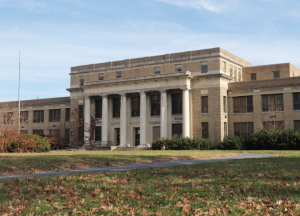
The former Bishop McDevitt High School

A former professional football player from Harrisburg is leading an ambitious effort to build eco-friendly, mixed-used developments in Harrisburg and beyond, with sights first set on the former Bishop McDevitt High School.

Former NFL lineman Garry Gilliam, a Harrisburg native, is heading up a four-person development organization comprised of long-time friends who all attended the Milton Hershey School and Penn State.

“We’re going to build what I believe will help a lot of inner city people who don’t have the means or the resources or the education to do something like this for themselves,” Gilliam, CEO of a new development company called The Bridge, said on a phone call on Wednesday afternoon.

Gilliam spent five years in the NFL playing for the Seattle Seahawks and the San Francisco 49ers, which released him earlier this year.

Gilliam’s concept for The Bridge is wide-ranging. In sum, he wants to take existing, often-historic, urban structures, such as obsolete school buildings, and repurpose them for sustainable, 21st-century needs.

For instance, The Bridge first will create co-working, maker and event spaces within the former Bishop McDevitt, which is located at 2200 Market St. in Harrisburg. Gilliam said that he expects those projects to open in 2020.

Other elements of the proposed “Eco Village” project include sustainable, zero-energy housing, commercial areas and indoor urban agriculture. These pieces, which require more planning and engineering, are planned for future build-outs, Gilliam said.

“I said I have to help Harrisburg first,” he said. “I have to help this place I came from.”

An artist’s rendering of the old Bishop McDevitt High School transformed into The Bridge.

The Bridge is leasing the Bishop McDevitt site from its owner, William Penn Holdings, which bought the sprawling, 115,000-square-foot building in March from the Catholic Diocese of Harrisburg. The building has been empty since 2013, when the diocese moved the school to a new campus in Lower Paxton Township.

Gilliam said that he also has a proposal before the Harrisburg school district to purchase the former William Penn High School, which includes 25 acres of property near Italian Lake.

In a separate statement today, The Bridge said it “aims to acquire five to 30 acres in Harrisburg for sustainable Eco-Village campuses that will produce healthy fresh food, clean water and renewable energy.”

Currently, Harrisburg is considered a “food desert,” with poor access to nutritious food, Gilliam said.

He said that, over the years, he had thought up the various elements that he combined together for the overarching concept of The Bridge. Then, earlier this year, he was speaking with his friend, Corey Dupree, who came on board as chief operations officer.

The pair then brought on two other friends: Dezwaan Dubois, who now serves as chief information officer, and Rob DeJarnett, who is now is chief financial officer. All attended Milton Hershey and Penn State together.

Gilliam said his funding comes from himself and other investors, mostly other “athletes and entertainers.”

The Bridge plans to engage the community before embarking on its plans, said Dupree.

“Having the community input for everything will be very important,” he said.

This is the second time this year that professional football players from Harrisburg have announced plans to develop in the city. Over the summer, brothers LeSean and LeRon McCoy bought the former Curtis Funeral Home at the corner of N. 6th and Boas streets and are renovating it into three market-rate apartments, with retail space on the first floor.

The McCoy brothers have ambitious plans to build dozens of apartments on that block of N. 6th Street and the adjoining 400-block of Herr Street. However, currently, they own only the Curtis Funeral Home site (1000 N. 6th St.) and a small strip of grass at 1008 N. 6th St.

The Bridge also has very ambitious plans. After starting in Harrisburg, the partners hope to expand to other cities. On its website, The Bridge lists such cities as Atlanta, Philadelphia, Pittsburgh, Houston and Seattle as “pending areas.”

The Bridge website also lists a section of “partners,” which include 2020 Engineering, a Bellingham, Wash.-based environmental consulting and civil engineering company, Evergreen, Colo.-based Ecoponex Systems, which specializes in renewable urban agriculture, and AcquaCare Environment, a Bellingham-based aquaponics company.

“We don’t have everything down quite yet,” Dupree said. “Right now, as I say, we’re assembling the avengers.”

Find out more about The Bridge by visiting their website.

Continue Reading

Assessing the Past, Insuring the Future: Over a century, Penn National’s commitment to Harrisburg runs deep.

Call it an executive suite ah-ha moment.

Penn National Insurance officials brainstorming the words to describe their company produced “vibrant.” Also “innovative,” “personable” and “resilient.” Especially “resilient,” infused into a company always trying something new, “no matter how difficult the situation.”

That’s Penn National Insurance President and CEO Christine Sears talking. Around that same time, Sears and her team were preparing for Penn National Insurance’s 2019 centennial, excavating historical nuggets spanning the company’s agrarian origins to its position today providing property and casualty insurance in 11 states.

“We saw how it all came together, and we said that’s exactly right,” Sears said. “This is something that has been in our company for 100 years. We build trust, and we’re caring, and we build strong relationships. We’ve been rewarded by customers who have been loyal to us and continue to do business with us.”

Penn National Insurance is many things, all mirroring the milestones of Harrisburg and national history. It’s that building anchoring Market Square, a landmark in downtown Harrisburg’s turnaround that also leveraged historic preservation. It is a major supporter of education and civic needs. It stands among the top 10 percent of property-casualty insurers in the country.

The company dates to 1913, when enraged farmers created the Pennsylvania Threshermen’s and Farmers’ Protective Association to protest a state law limiting weights on the hulking shared equipment they drove from farm to farm.

After they won repeal in 1915, they turned their attention to workers’ compensation insurance—high on the nation’s agenda since the tragic 1911 Triangle Shirtwaist factory fire in New York. The feisty Threshermen’s Association balked at paying the exorbitant premiums charged by government and private companies. So, on Jan. 6, 1919, the Pennsylvania Threshermen’s and Farmers’ Mutual Casualty Insurance Company filed for a charter.

As the eventful decades of the 20th century unfolded, the company kept pace, branching into industrial coverage. By the 1940s, auto insurance was big. Home and fire insurance joined the lineup in the post-war building (and baby) boom. In 1967, the name changed to Penn National Insurance.

There were down times and crises, missteps and reorganizations. CEO Sears recalled that recovering from a ratings slide in the 1980s required raising additional capital while being transparent in a bid to retain the business of loyal agents.

“You constantly learn and constantly research,” she said. “You understand what’s going on and try your best to put the puzzle together.”

At Linglestown-based Enders Insurance Associates, Penn National Insurance has been “one of our team’s best partners for close to 70 years,” since the company took a chance on rookie agent Donald Enders, Sr., said grandson and Vice President Andrew Enders.

“If they make a promise, they keep it,” he said. “They communicate openly and honestly with us and their clients. They’re good community partners, and they don’t flaunt it.”


All for Harrisburg

Penn National Insurance has never strayed far from its first office in downtown Harrisburg.

By the 1990s, the company had outgrown its landlocked, three-building campus at 18th and Market streets (landlocked because the owner of Sorrento Pizza refused to sell his building, to the eternal gratitude of staff in what’s now Harrisburg school district’s Rowland Academy). The suburbs—parking, no flood plain, bigger footprint—beckoned.

Mayor Steve Reed had other ideas. His legendary persuasion, plus a $2.7 million sweetener from the state and the company’s hard-nosed negotiations for air rights and parking, convinced then-CEO Jim Taylor to build in Market Square.

Except that historic but largely gutted office buildings occupied the site. Perhaps the Senate Hotel’s brownstone façade could be incorporated into the new design. Then again, “that can be tricky, and sometimes you never know what you’re getting into,” said Historic Harrisburg Association Executive Director David Morrison, involved in the negotiations then in his first stint as HHA director.

“Lo and behold, it turned out it was a top-heavy building and didn’t have a lot of structural reinforcement,” he said.

A Penn National Insurance official said that saving the façade would cost $130,000, with no guarantee of success. Morrison counter-proposed. Why not commit $130,000 to historic preservation in the community and HHA would withdraw objection to demolition, “which may or may not be inevitable, anyway?”

The Senate façade came down. Revenue from salvage rights bolstered HHA operations. The $130,000 seeded creation of the Community Historic Preservation Fund, which now stands at more than $239,000. Trustees have disbursed $100,000 in grants and loans for historic preservation and advocacy.

“There’s not much historic preservation money out there anymore, and this is all for Harrisburg,” Morrison said.

That original deal also launched a fruitful relationship, with Penn National Insurance sponsoring HHA events, and employees serving on the HHA board and committees.

The 15-story Penn National Insurance Plaza opened in 1996.

“Local historians view our coming downtown in the late ‘90s as the turning of the tide that reversed the trend of businesses moving out of Harrisburg,” said company spokesman Christopher Markley. “Bringing 500-plus employees downtown saw revitalization of restaurants and other businesses.”


Fabric of Community

Since the days when Penn National Insurance employees volunteered at Melrose Elementary School next door to their 18th Street campus, the company has committed extensive financial and volunteer support to the Harrisburg Public Schools Foundation, the Joshua Group and Dauphin County Library System.

“They are focused on education, and not just traditional education, but all of those supplemental pieces that really make up the fabric of a community,” said Enders.

Penn National Insurance annually donates the maximum $333,333.33 allowed in earned income tax credits to the Harrisburg Public Schools Foundation, said Executive Director Chris Baldrige. Total contributions of $6.5 million have brought health education to students and families, boosted early learning, sent students to Messiah College summer camps, helped high school students earn college credits and backed STEAM learning.

“Penn National Insurance is definitely a leader in supporting Harrisburg and the foundation and supporting the students and the entire community,” said Baldrige. “They are a great example of doing good within your own neighborhood and your community.”

United Way of the Capital Region has benefitted from Penn National Insurance’s “time, talent and treasure” for decades, said Executive Director Tim Fatzinger. Dollar-for-dollar matches have generated $10.5 million in combined employee-employer donations in the last 10 years. Volunteers swing hammers and sling paintbrushes for United Way Day of Caring. Company officials serve on United Way committees, such as the IT security expert who “saves us a ton of money” by sharing his knowledge.

Charitable organizations have “fewer and fewer” local companies to call on for support, Fatzinger said.

“By choosing to stay local and to support local entities and be involved in the community, it improves quality of life for all of us,” he said.

Community involvement is “a part of our fabric,” said Sears. “If you’re at the theater or an arts event or a soup kitchen, you will likely find one of our employees volunteering. It is a good basis for what makes Harrisburg strong.”

Sears is a Steelton-raised, Bishop McDevitt-HACC-Penn State Harrisburg product who said that she has “never strayed far because I enjoy the Harrisburg hbg area.” She joined Penn National Insurance as a financial analyst in accounting in 1980 and, like many employees, grew her career from the inside up.

Today’s diverse workforce generates “different perspectives, (helping) us be able to be more agile, to have different thought processes,” Sears said.

She believes that Penn National Insurance has been a good, stable corporate citizen and employer, “and through that, we have contributed to the community both from an intellectual capacity, but as importantly, from a community and philanthropic opportunity.”

Her hope for the next 100 years?

“Absolutely more of the same,” she said. “That we just continue to be able to thrive and change and be resilient and continue to make a contribution.”


Penn National Insurance is located at 2 N. 2nd St., Harrisburg. For more information, visit their website.

TheBurg thanks Russ Banham, author of “Penn National Insurance: 100 Years of Helping People Feel Secure and Making Life Better When Bad Things Happen,” for historical background.

Continue Reading

Measure of Hope: Renovation arrives suddenly to N. 6th Street

Matt Long of Harrisburg Commercial Interiors inside the Curtis Funeral Home/Swallow Mansion

After decades of blight and inaction, a historic Harrisburg block is undergoing a rapid transformation, removing an eyesore on a prominent city street and adding new apartments to Midtown.

Currently, three long-dilapidated properties are—or soon will be—under restoration on the 1000-block of N. 6th Street, a highly visible street and one of the last remnants of a once-thriving commercial strip that catered primarily to Harrisburg’s African-American community.

Brothers LeRon and LeSean McCoy, under the name Vice Capital LLC, are renovating 1000 N. 6th St.—at the corner of Boas Street—into a five-unit, market-rate apartment building, with additional retail or community space, according to LeRon.

“We looked around and decided to find a project that would be of benefit to both Harrisburg and ourselves,” he said, in a recent phone interview.

The brothers are Harrisburg natives who played football for Bishop McDevitt High School. LeRon, a retired wide receiver, played professionally for the Arizona Cardinals, San Francisco 49ers and Houston Texans, while LeSean, a former Philadelphia Eagle, is currently a running back for the Buffalo Bills.

LeRon McCoy said that building, also known as the Swallow Mansion and, later, the Curtis Funeral Home, is an investment for the pair.

The 1000-block of N. 6th Street, looking north, with the Swallow Mansion in the foreground

“LeSean and I have a desire to develop in Harrisburg,” he said. “It’s something he’s been wanting to do for a long time.”

Last year, the circa-1896, corner building suffered a partial collapse, with bricks and debris spilling onto the sidewalk on the Boas Street side. The collapse seemed to prompt long-time owner, Annette Antoun, to finally part with the property.

Antoun bought it in 2000 from the Historic Harrisburg Association, believing it would become part of former Mayor Steve Reed’s plan to develop the block as an African-American history museum. However, that museum was never built and, over the years, the building remained boarded up and increasingly dilapidated.

LeRon said he expects the project to be completed by year-end.

“It will be high end,” he said. “We want that area to look as nice as it used to.”

Right next door, at 1002 N. 6th St., a company called LBR Properties has begun to renovate that long-neglected building, which Antoun had owned for 35 years. The company is building out three apartments—two one-bedroom units and a “large studio”—as well as a small retail space on the first floor, according to co-owner Rani Rammouni.

“We’re gutting it and bringing it up to par,” he said, expecting the project to be completed in about two months. “We want to bring them as close to class-A as possible. We’ll have all the upgrades a class-A would have.”

Rammouni said that the block was ripe for redevelopment considering all the development in Midtown over the past decade, as well as its proximity to the Capitol complex.

“It’s positioned so well with the commonwealth right there,” he said.

The view of the block looking south, with the Jackson Hotel in the foreground

Next to that building is the beloved burger and sandwich restaurant, the Jackson House, and next to that, at 1006 N. 6th St., sits the “Jackson Hotel,” a former hotel and boarding house that once catered to African-American patrons who were denied service in Harrisburg’s white-only hotels.

Harrisburg Commercial Interiors bought that building last year, and company owner Matt Long said that his company will begin demolition work in September.

The Jackson Hotel has been empty and boarded up since long-time owner German Jackson died in 1998. In recent years, the building’s roof caved in, and the back of the building has collapsed.

Nonetheless, Long expects to fully rebuild and restore the property. Last month, the Harrisburg Architectural Review Board gave Long permission to perform extensive rehabilitation work, including rebuilding the rear portion of the building and installing a new roof, new windows, new floors and other improvements.

When complete, the 3,420-square-foot building will consist of four apartments, with commercial space on the first floor, Long said. Notably, the large mural, which features African-American entertainers and historic figures, some of whom stayed at the hotel, will be preserved.

“I’ve seen these buildings boarded up for as long as I’ve been here,” Long said, adding that he tried to buy the Swallow Mansion from Antoun some 14 years ago. “But they just sat and sat and sat. Now, the time is right.”

Ted Hanson, a Boas Street resident since 1978, said that he’s waited decades for the 6th Street properties to be redeveloped.

“This finally has come to pass now that Steve Reed and Annette Antoun are out of the picture,” he said. “Forces are aligning that some needed development is happening there.”

Long’s company is also performing the restoration work on the Swallow Mansion/Curtis Funeral Home for the McCoys. LeRon McCoy said that he hired Long after seeing the work his company did to rebuild another tumbledown structure—the long-dilapidated building at North and Susquehanna streets that soon will be the new home of Elementary Coffee Co.

Demolition debris piled on the first floor of the Curtis Funeral Home/Swallow Mansion

McCoy said that he and his brother have an even grander vision for the block, which would result in dozens of new apartments.

They want to purchase the Jackson Hotel property from Long and then build a new, larger, market-rate apartment building next to it at the corner of N. 6th and Herr streets, property currently owned by Bethel AME Church. That lot has been empty since the church burned down in 1995.

McCoy said that they’re currently in talks to buy that property from the church.

“This is all part of a larger project we’re working on,” McCoy said. “We have a vision for that block.”

For more detailed history about this block, read our award-winning feature story from 2013. 

Continue Reading

Bishop McDevitt building gets several “offers in writing,” despite auction bust

The old Bishop McDevitt High School in Harrisburg

There are numerous “prospective offers” to purchase the building that long housed Bishop McDevitt High School, according to an official of the company trying to sell the property.

Robert Dann, executive vice president and chief operating officer of Max Spann Real Estate & Auction Co., declined to disclose the potential buyers or the offer prices. However, he said that he felt optimistic that the building would sell in the near future.

“We do have offers in writing that were made before the auction,” he said. “We’re going to negotiate with them and get the deal done.”

Dann said he expected a final sales agreement in “the next week or two.”

Meanwhile, today’s live auction for the property at the Hilton Harrisburg was sparsely attended and did not yield any in-person bids. The reserve, or minimum, acceptable price was set at $400,000.

The Diocese of Harrisburg is selling the sprawling property at 2200 Market St. after moving the school to a new building in Lower Paxton Township in 2012.

The building has been on the market for years, but, despite several potential offers, has never sold. The property comes complete with the 115,000-square-foot, 1930s-era building and the surrounding grounds, including the former football field and a large parking lot, sited on just over eight acres.

Dann said that most of the offers do not propose an educational use for the building, but a conversion to some type of residential housing, either apartments or senior living.

“Some of the proposals are local, and some are from the Philadelphia area,” he said.

Continue Reading