Harrisburg Council proposes changes to strengthen police advisory board, including subpoena power

A screenshot from Tuesday’s City Council work session.

Harrisburg City Council plans to make changes to a proposed police advisory board that would give the body more teeth, including administrative subpoena power.

During Tuesday’s work session, council member Ausha Green said that she will amend Bill 8 based upon input that council received from residents during three town hall meetings held in August.

“One thing that we heard from the public was the need for subpoena powers,” said Green, who chairs council’s public safety committee. “It’s not in our purview to give judicial subpoena powers, but we can afford administrative subpoena powers.”

Green also said she would like to insert a statement of intent into the bill. This would better communicate the board’s purpose of providing accountability to the Harrisburg police bureau rather than serving as a community liaison.

The proposed changes seemed to address additional public comments received by council and read during the meeting last night.

“I have concerns that the bill, as written, has no teeth in holding police accountable and makes the board into little more than a public relations mouthpiece for the police,” one public comment read.

Many public comments during the Tuesday meeting touched on the idea of allowing the board to act independently. In the past, people have asked that police Commissioner Thomas Carter be removed as a non-voting member of the board.

“The board must be allowed to deliberate in private,” resident Vishal Bajpai said. “To be legitimate, the board must be sufficiently independent from the Bureau of Police.”

As the bill stands, the commissioner and the public safety chair would both be non-voting members. Green proposed an amendment that would remove them and, instead, invite them to quarterly meetings. Taking their place would be two more voting members from the city at large appointed by the board, Green said.

Council member Danielle Bowers submitted an amendment, as well. She would like to see neighborhood groups formed throughout the city to confer and bring forth candidates, one from each of the seven policing districts.

“I think this would offer a prime opportunity for them to work together to offer a recommendation that they all feel best represents their neighborhood,” she said.

Council will discuss Bill 8 again at their next work session on Sept. 29. The amendments have yet to be voted on.

“I don’t have an issue with the amendments as drafted,” Mayor Eric Papenfuse said.

On the subject of policing, council discussed a proposed resolution that would establish use of force reporting to council and Papenfuse.

Since the resolution was introduced, the police bureau did provide council and the mayor with a report in June, city Solicitor Neil Grover said. The report included the existing required report on complaints with some information on use of force.

However, several council members said they weren’t satisfied with the report, saying it didn’t include everything they requested.

“It seems very high level,” Green said. “It seems like it was very quickly put together. It needs to be kept up to date on a monthly basis.”

Papenfuse said that he is planning to propose a records management position within the police bureau that is outward-facing and dedicated to reporting.

“We really do have a capacity issue at the police department and that is best addressed by the establishment of some new positions,” he said.

The resolution on use of force reporting will be brought up again at the next work session, as well.

To watch past Harrisburg City Council meetings, visit the city’s YouTube channel.  

Support local journalism! Become a Friend of TheBurg today!



Continue Reading

Harrisburg brings State Street plans to the public, construction in sight

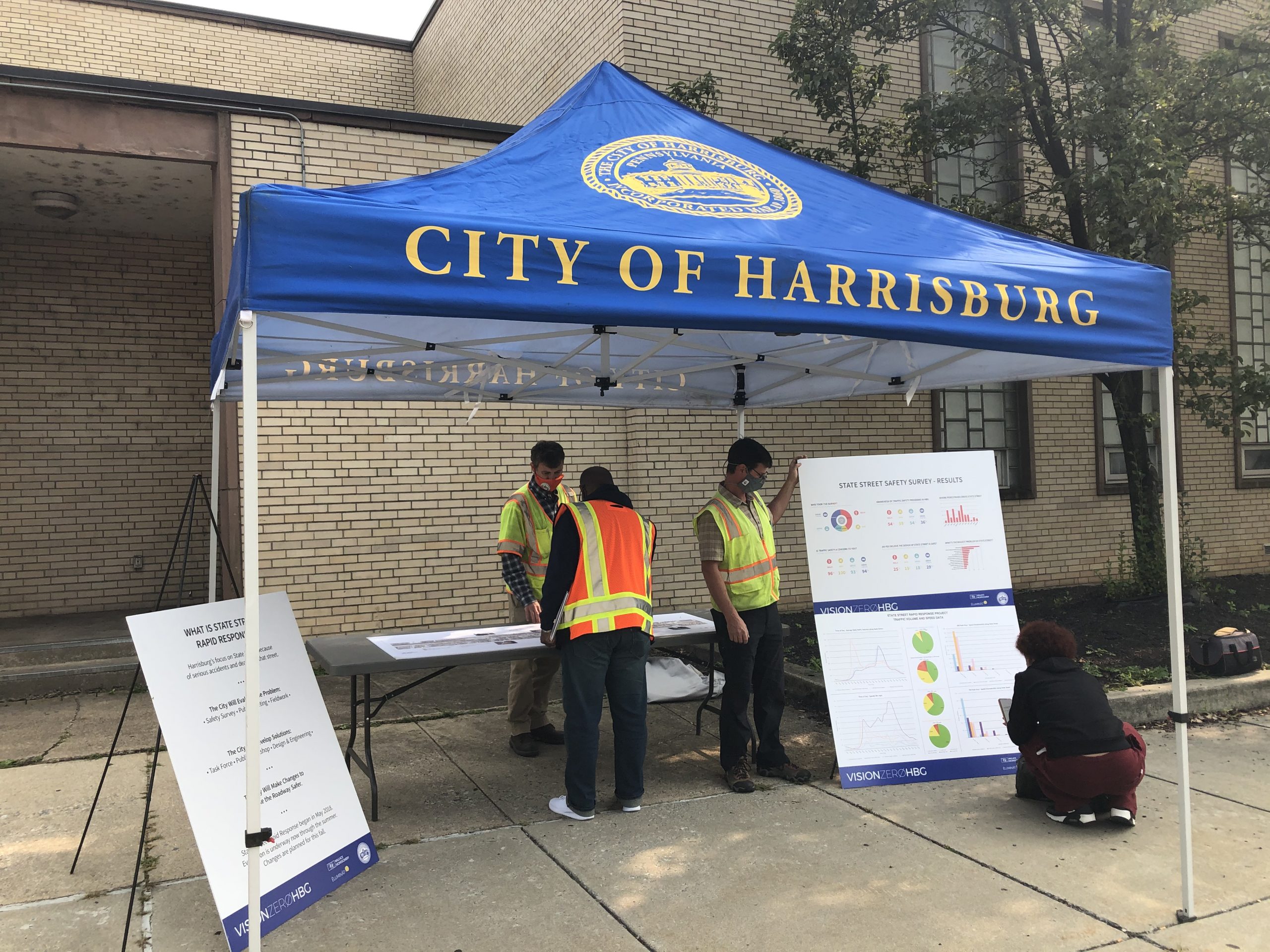
City officials held a pop-up event on Tuesday to educate the community on the plan for State Street construction.

On Tuesday, along one of the busiest streets in Allison Hill, Harrisburg officials spoke with the community about plans to make the street safer—a project with an end finally in sight.

The State Street Rapid Response project was launched in 2018 with the intent to decrease pedestrian fatalities and accidents on State Street in Harrisburg.

“There have been more pedestrian and bicycle accidents on this road than anywhere else on the east coast,” said Ambrose Buck, project manager.

The dangerous nature of the street caused city Engineer Wayne Martin and his team to prioritize State Street, hence the project name “Rapid Response.” But the project hasn’t been very rapid.

Buck explained how Harrisburg maintains State Street, but the commonwealth owns it and essentially must sign off on any proposed construction.

The city had to rework its plan for the street a few times before PennDOT approved it.

“This has been a long time of development,” Buck said. “We are excited to get it done.”

The main goal of the plan is to slow vehicle traffic. Based on a survey the city conducted, residents were most concerned with high vehicle speeds.

State Street will undergo a “road diet,” reducing the number of vehicle lanes from five to three. Buck said that the project will add protected bike lanes and improve crosswalks, including a median refuge island in the middle of the street.

That is expected to be completed in the spring or summer of 2021, Buck said.

“I drive and ride my bike on this street a lot, and I’m glad to see all these improvements finally happening” said Harrisburg resident Lou Searles.

Additional plans for State Street include addressing another top issue found in the city’s survey—street lighting. Buck said they will add new street lights and update existing ones by December.

The project cost is $653,000, with PennDOT contributing $500,000 and $153,000 coming from the city’s fund balance.

The State Street Rapid Response project is part of the city’s “Vision Zero” initiative to reduce the number of pedestrian fatalities in Harrisburg to zero.

At a City Council meeting on Tuesday night, Martin said the pop-up event was intended to engage members of the community who may not be able to access the project plans online. He said about a dozen people attended.

Martin added that the city will likely hold another similar event before construction begins.

For more information on the State Street Rapid Response project, visit https://www.visionzerohbg.org/projects/state-street/.

Support quality local journalism. Become a Friend of TheBurg!

Continue Reading

August home sales, prices rise in the Harrisburg area

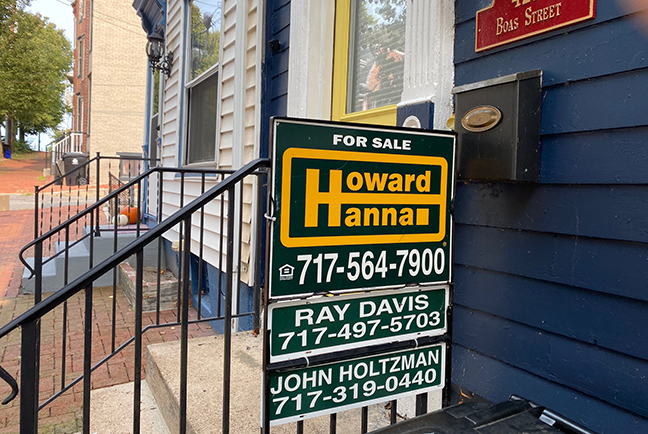
A house for sale in Harrisburg

The summer ended on a high note for residential real estate, with home sales and prices both up substantially in August.

For the immediate three-county region, unit sales increased to 845 from 783 in the year-ago period, while the median sales price shot up to $215,000 from $194,900 a year ago, according to the Greater Harrisburg Association of Realtors.

In Dauphin County, residential sales totaled 385 units versus 347 in August 2019, while the median sales price increased to $185,750 from $175,000 last year, GHAR said.

Cumberland County saw home sales rise to 396 units compared to 357 last year, while the median price increased to $240,000 from $217,000. In Perry County, 43 homes sold, up from 23 a year ago, as the median price rose to $170,600 versus $145,000 in August 2019, GHAR said.

The average number of days on the market decreased in August, down to 36 compared to 42 in the year-ago period, according to GHAR.

Home sales and prices in the Harrisburg area also increased in July.

Support quality local journalism. Become a Friend of TheBurg!

Continue Reading

New film chronicles the “Rising” of Harrisburg University’s e-sports program

“More people consume gaming online than the amount of people that consume ESPN, Netflix and HBO combined.”

So starts the trailer for a new locally produced documentary called “A Rising Storm,” which chronicles Harrisburg University’s ambitious efforts to rapidly become a major player in the global e-sports industry.

“This documentary captures the drive, teamwork and character it takes to field a national championship e-sports team,” said Chad Smeltz, HU’s director of e-sports.

The 30-minute documentary has its premiere on Thursday at the PAX Online 2020 gaming festival. It then will be available worldwide via Amazon video, Apple TV and Google Play.

It already has shown at several film festivals, including PopCon International in Indianapolis, Seoul Webfest in South Korea and India’s Pune Short Film Festival.

The film not only highlights the local team, the HU Storm, but it also was produced locally, a collaboration between Harrisburg University, city-based marketing agency, Pavone, and Harrisburg production company, Cowboy Bear Ninja.

According to HU, Pavone developed the storyline for “A Rising Storm” and then recommended Emmy Award-winning filmmaker Adrian Selkowitz as director.

“I couldn’t believe that a national champion esports team was right here in my backyard, and no one was talking about it,” Selkowitz said. “I knew immediately that I had to tell the story.”

The film examines how HU took its e-sports program from inception to success in just two years, capturing numerous national tournaments including, this past July, the Operating System NYC Collegiate Championship for Overwatch. It addresses how HU went about the process of founding a program, hiring coaching staff, recruiting players and putting together a path to victory.

“It spotlights the team and the many people who work hard behind the scenes to help these students realize their dreams,” Smeltz said.

In the process, the team helped elevate the stature of its home city.

“In addition to our teams’ success, a project like this, that helps to revitalize our hometown of Harrisburg while bringing international attention to Harrisburg University and our program, validates our efforts and is something we’re very proud of,” said HU President Eric Darr.

“A Rising Storm” premieres on Sept. 17 at 2:45 p.m. at PAX Online. It then can be viewed on Amazon video, Apple TV and Google Play. Click here to watch the trailer.

Support quality local journalism. Become a Friend of TheBurg!

Continue Reading

CONTACT Helpline celebrates 50 years of continuous community service

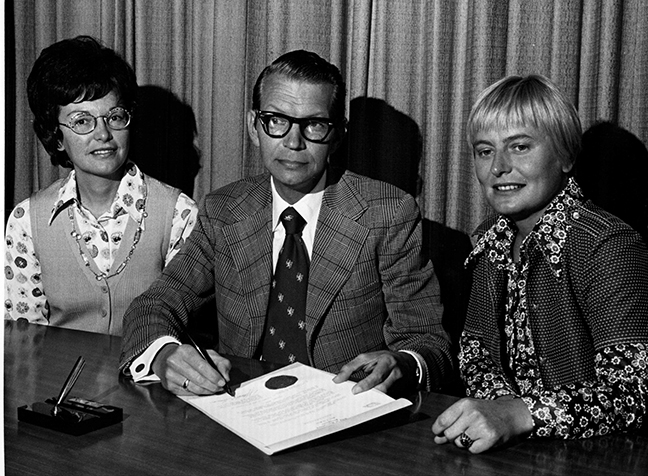
Harrisburg Mayor Harold Swenson signs a CONTACT Week proclamation in 1974, flanked by then-CONTACT President Anna Killinger and Executive Director Helene Oswald.

“Downhearted … distressed … depressed? Let CONTACT Help You.”

On Nov. 15, 1970, these words on a billboard heralded a new tele-ministry in Harrisburg. On that date, the first class of 60 volunteers were commissioned at St. Mark’s Lutheran Church. After the commissioning, the president of CONTACT Harrisburg, the Rev. Robert E. Larson, Jr., crossed the street to the PA Churches United Building and answered the helpline’s first call. Almost 50 years later, CONTACT Helpline, as it is now known, has answered more than a million calls, from people reaching out for emotional support and those seeking connections to human-services information and referrals.

Rev. Larson is a local. He grew up in Harrisburg and attended John Harris High School. After eight years away in college and seminary and two years as an assistant pastor in Boston, he married his wife, Dottie. In 1967, a position as assistant pastor of Pine Street Presbyterian Church offered a return to his hometown.

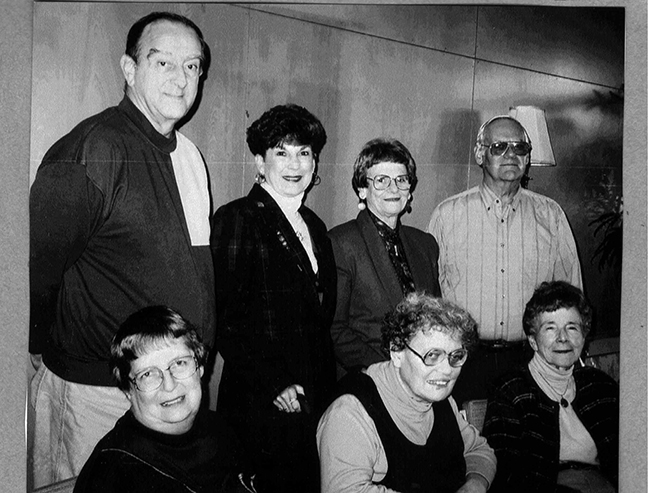
A photo of long-serving former CONTACT volunteers. Top row left to right: Larry Baker, Emily Clemmer, Shirley Remis, Joe Long. Bottom row left to right: Arlene Randby, Mary Anne Beckley and Elsie Corlett

Larson was inspired to establish a CONTACT office in Harrisburg when his family attended a pastors’ conference in Virginia in 1968. After a presentation by Alan Walker, the founder of Lifeline in Sydney, Australia, the Larsons were invited to view a movie about Lifeline, which provides 24-hour crisis support and suicide prevention by telephone. Impressed by their work, Larson then met with Walker for guidance on how to start a service like it back home. He learned that there was already a committee for CONTACT, as Lifeline had become known in the United States, in Nashville, Tenn. Walker advised his new friend to get in touch with them for help. Larson says he returned home, “Pretty well set to do this.”

He met with Chuck Dorsey, the director of the Harrisburg Council of Churches, and George Frank, a local Methodist pastor, to consider developing a CONTACT office. Dorsey worked with the Council of Churches to endorse the idea and the three formed a steering committee. By the spring of 1970, the group was ready to invite volunteers to start their training program. Harrisburg Area Community College hosted the training. According to Larson, “Training got off to a fine start with five great presenters.” It was completed by the fall of 1970. Larson said that he was especially pleased by the wide ecumenical representation among the first class of volunteers.

Recognizing how his church members were often hesitant to share private information with their pastor, Larson said that he knew that anonymity should be the primary component of the Helpline. Volunteers pledge confidentiality with callers and relate to them in a compassionate, nonjudgmental manner through active listening. In this safe environment, callers can trust the CONTACT volunteers to listen and help them find resources to address “the universal and continuing problems of loneliness, isolation, lack of purpose and conflict.”

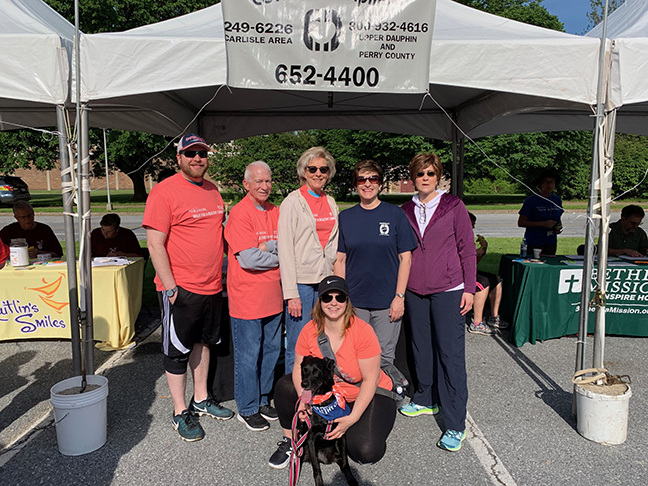
CONTACT Helpline has participated in the Highmark Walk for a Health Community to raise funds for many years. This photo includes Tommy Gollick, Bill Gulik, Jan Gulik, Linda Hunter, Kelly Gollick, executive director, and Jessica McCoy with furry friend Nala.

CONTACT has now supported south-central PA communities through five decades of challenges, including the Hurricane Agnes flood, the Three Mile Island emergency, the 9/11 attacks, the 2008 Great Recession and the COVID-19 pandemic. Originally relying on paper and pencil data collection and Rolodexes, CONTACT now accesses a comprehensive, computerized database of resources.

With today’s cloud phones, callers from across the country are able to reach out to CONTACT for emotional listening support, especially from areas where mental health services are limited. CONTACT originally served Dauphin, Perry and Cumberland counties. As the Capital Region’s PA 211 provider since 2011, CONTACT now serves 11 Central PA counties. CONTACT also assists the 33-county Eastern PA Continuum of Care, assessing callers’ needs for rent assistance, shelter or housing to prevent homelessness. In addition, CONTACT answers the PA Safe Haven Baby Line, which has saved 47 newborns since its inception. CONTACT also collects relevant data to determine areas of unmet need in the region and partners with local agencies such as United Way of PA to increase health and human resources to underserved populations.

CONTACT is preparing a yearlong agenda to celebrate its 50th anniversary. It will start with a Virtual Kickoff on Nov.19, including speakers from various stakeholders and a silent auction. There will be monthly topics on social media, as well as small events and a 50th Anniversary Appeal. CONTACT hopes to hold a culminating celebration in November 2021.

Reflecting on CONTACT’s 50 years, Rev. Larson said that he is grateful for what remains the same about CONTACT Helpline today. It is a confidential, nonjudgmental place to turn for listening and a gateway to human services.

To learn more about CONTACT Helpline, visit their website.

Support quality local journalism. Become a Friend of TheBurg!

Continue Reading

Burg Review: Gamut brings live theater back safely, hilariously with “Love Hurts!”

Almost six months to the day of my last outing, I sat in the audience of a live theater feeling almost naughty.

With proper pandemic protocols in place, new and expensive air filtration, and a maximum occupancy of 51 in the audience, the staff at Gamut Theatre judiciously thought through all the safety aspects of semi-re-opening. Fortunately for the audience, the core staff doubles as cohabitating family, so the actors didn’t have to project their voices through masks.

On the surface, a play titled “Love Hurts,” written by the famous Russian playwright Anton Chekhov, might hint at a dramatically dark story line. Despite the time period of societal upheaval Chekhov wrote during, the script was funny—rife with slapstick, people yelling, over-the-top delivery and some old-fashioned misunderstandings. “Like an episode of ‘I Love Lucy,’” according to Director Clark Nicholson.

Executive Director Melissa Nicholson said, “For our first live show out of quarantine, we wanted to do something fun and silly, getting people laughing.”

“Love Hurts” contains two one-act plays: “The Marriage Proposal” and “The Boor.” Both plays feature a mixture of sparks and love between the main characters in an angrily fervent way that doubles as comedy.

In “The Marriage Proposal,” we meet the fretful Ivan Vassilevitch [Ross Carmichael], who has come to the home of Stephan Stepanovitch [Clark Nicholson] to propose marriage to the headstrong Natalya Stepanovna [Abby Carroll]. Carmichael’s stilted body language and stammering delivery perfectly embody an anxiety-riddled fellow who can’t quite confidently state his romantic intentions. I squirmed uncomfortably right along with that poor guy through every stutter, every heart palpitation.

When the characters fight and snap each other with hankies over non-issues, they cannot and will not attempt to find common ground. As tempting as it was to compare their devolving argument of insults to what I’ve read on my social media feeds for the past five years, Chekhov was really writing about human nature—simultaneously both simple and complicated.

Just as passionate, “The Boor” centers on a grieving, reclusive widow named Popova [Erin Shellenberger] and Smirnov [Lyeneal Griffin], a man who came to collect a debt her late husband owed. When Popova can’t and won’t immediately pay, Smirnov becomes enraged and refuses to leave. Luka the servant [Ross Carmichael] tries unsuccessfully to intervene in the sizzling fight that escalates. The hyperbole intensifies as the ranting characters oscillate between love and revulsion. And when the ranting becomes too intense, there’s a well-placed spit-take to slice the tension in half.

Any marriage proposal Chekhov wrote was certainly filled with more white-hot, blazing fire than my now-husband pitched me 20 years ago. I was washing the dishes in front of my kitchen sink. With my back turned, my beloved said, “So, are we getting married, or what?” I must have been smitten and naïve to fall for a line like that. Our daughter still can’t believe she came into the world because of us.

Gamut Theatre’s own family atmosphere is deeply rooted. “The Boor” was the first play husband-and-wife team Clark and Melissa performed as a company back in 1992 in South Carolina. To Melissa, the second play feels “relatable as an old[er] married couple.”

Now, 23 years later, the family has expanded and strengthened. While no other local theaters have been able to safely open, “To be able to do this in a room with an audience,” Clark said, “we’re giddy.”

 “Love Hurts” runs Sept. 12-27. Tickets must be reserved online in advance, and will not be available at the door. Tickets are available for purchase through Gamut Theatre’s website at www.gamuttheatre.org/tickets.

Support quality local journalism. Become a Friend of TheBurg!

Continue Reading

The Week that Was: News and features around Harrisburg

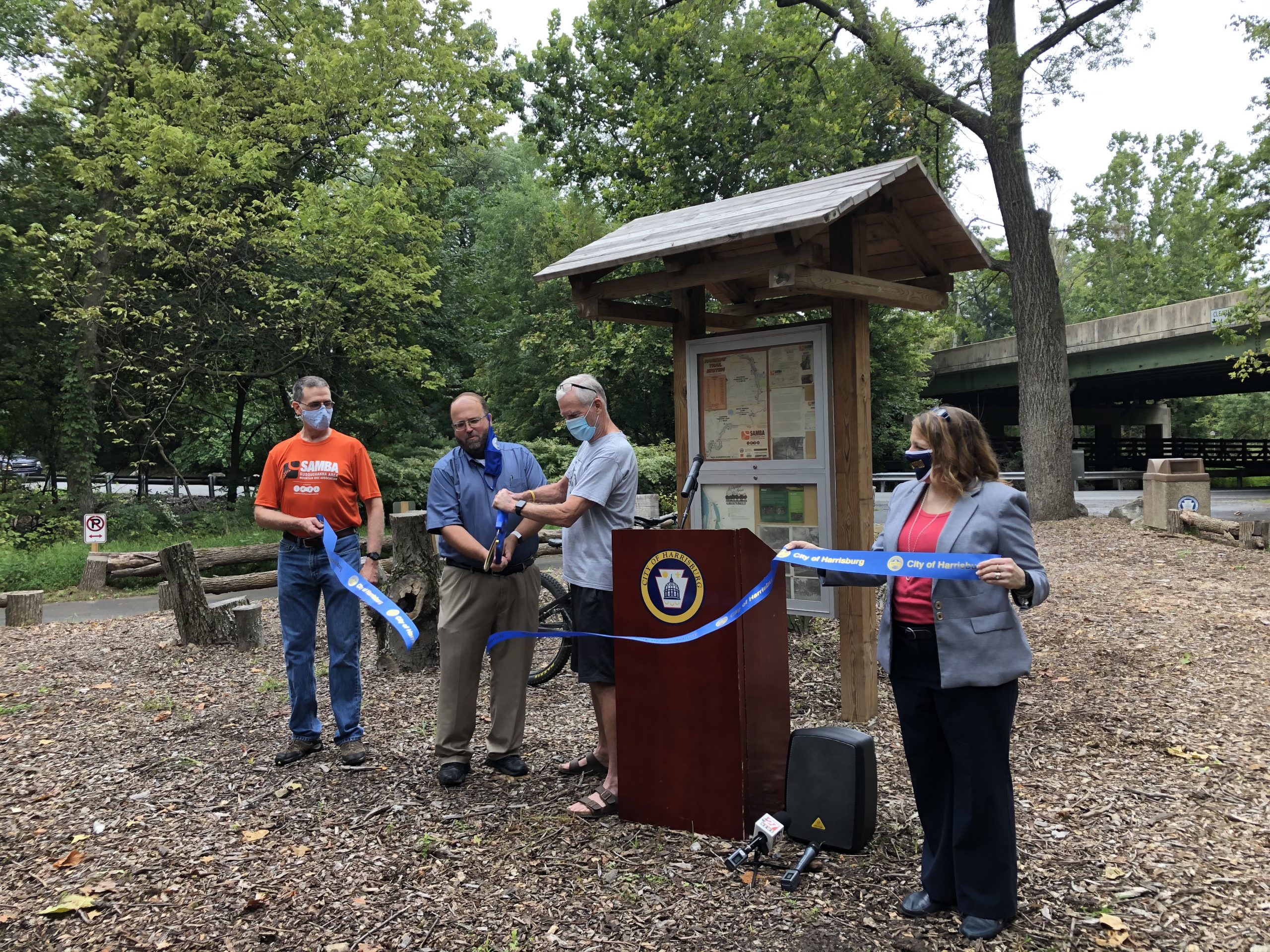
A ribbon-cutting ceremony opened a revived Paxtang Park to the public.

Harrisburg’s Gallery Walk is this weekend! Take a stroll and enjoy some great local art, but first, check out the news you may have missed this past week.

Bob’s Art Blog highlights the Susquehanna Art Museum’s exhibit, “Separate and Unequaled: Celebrating the 100th Anniversary of the Negro League.” In Bob’s story, hear from local historian Calobe Jackson Jr. and Ted Knorr, an expert on the history of Negro League baseball, on the significance of the exhibit.

The Broad Street Market held its first-ever wedding on Sunday. Our online article tells the story of a Midtown couple who wanted to tie the knot at their favorite community gathering spot.

COVID-19 cases in Pennsylvania dipped over the last week. Our weekly coronavirus reporting finds there was an average of over 700 new cases each day.

Harrisburg City Council, on Tuesday, struck down a proposal to hire former City Council President Gloria Martin-Roberts as a communications liaison. Some members accused the mayor of trying to make a campaign move, our online story reports.

Harrisburg Commercial Interiors plans to convert two long-abandoned buildings on Cameron Street into office and residential spaces. Most of the project will take place in 2021 and yield five industrial-style apartments, our reporting found.

The Harrisburg Planning Commission announced two virtual public meetings for next week to present the draft comprehensive plan. After years of delay, the document seems to be nearing completion, our reporting found.

The Latino Hispanic American Community Center will display up-and-coming artists at this weekend’s Gallery Walk. Bob’s Art Blog gives a sneak peek into the paintings, mixed-media pieces and sculptures that will be showcased.

Open Stage Theatre of Harrisburg is presenting a free, all virtual season for 2020-21. Our online story has the lineup of shows available to stream right to your home.

Paxtang Park was long overgrown until the Susquehanna Area Mountain Bike Association got its hands on it. On Thursday, officials cut the ribbon on the revived park, which offers parking and easy access to the Greenbelt trails, our online story reports.

Pennsylvania restaurants can now allow 50% indoor capacity, announced Gov. Tom Wolf on Tuesday. He said this will take effect on Sept. 21, but only for those who agree to a self-certification, our online story reports.

Sara Bozich encourages readers to support local restaurants by celebrating “Harrisburg Takeout Month.” Her Weekend Roundup has recommendations for places to grab a bite to-go.

TheBurg Podcast visits us for its monthly edition, this time focused on hope and food. Host Karen Hendricks shows us that “there’s always more to the story” by featuring three stories from our September magazine, plus “the most Harrisburg thing.”

Do you receive TheBurg Daily, our daily digest of news and events delivered right to your email inbox? If not, subscribe here!

Would you like to support our journalism and get some great benefits to boot? If so, become a Friend of TheBurg!


Continue Reading

New coronavirus cases dip in PA over the past week

COVID-19 cases and tests, over time. Source: PA Department of Health

New COVID-19 cases in PA dipped a bit over the past week, as the commonwealth averaged over 700 new cases per day.

Since last Friday, Pennsylvania recorded an average of 746 newly diagnosed cases per day, according to the Department of Health.

This compares to an average of 810 new daily cases last week, and 622 and 669 new daily cases per day for the prior two weeks, respectively. The department also reports that testing has generally increased over this time (see chart).

Locally, diagnosed cases over the past week are as follows:

  • Adams County: 723 cases (prior Friday, 697)
  • Cumberland County: 1,649 cases (prior Friday, 1,578)
  • Dauphin County: 3,543 cases (prior Friday, 3,410)
  • Franklin County: 1,633 cases (prior Friday, 1,559)
  • Lancaster County: 7,238 cases (prior Friday, 6,960)
  • Lebanon County: 1,807 cases (prior Friday, 1,748)
  • Perry County: 184 cases (prior Friday, 178)
  • York County: 3,995 cases (prior Friday, 3,667)

Today, the department confirmed 1,008 newly positive cases throughout Pennsylvania for the past 24 hours ending at midnight. This includes two recent hotspots in the commonwealth–Allegheny County, which reported an increase of 100 cases today, and Centre County, which reported an increase of 137 cases today.

With today’s update, 142,885 Pennsylvanians have now been diagnosed with the coronavirus, an increase of 5,223 over the past week, according to the state Department of Health.

The department also reported an additional 95 deaths since last Friday, meaning that 7,837 Pennsylvanians have died from the disease since March.

Around central PA, COVID-19 fatalities now stand as follows:

  • Adams County: 24 deaths (prior Friday, 23)
  • Cumberland County: 73 deaths (prior Friday, 72)
  • Dauphin County: 169 deaths (prior Friday, 165)
  • Franklin County: 49 deaths (prior Friday, 47)
  • Lancaster County: 445 deaths (prior Friday, 438)
  • Lebanon County: 57 deaths (prior Friday, 57)
  • Perry County: 6 deaths (prior Friday, 5)
  • York County: 132 deaths (prior Friday, 127)

Statewide, Philadelphia County continues to have the most confirmed cases with 30,206 cases, followed by Montgomery County with 11,537 cases. The two counties also have reported the most deaths statewide from the disease: 1,784 and 867, respectively.

“We know that congregation, especially over holidays and in college and university settings, yields increased case counts,” health Secretary Rachel Levine said. “The mitigation efforts in place now are essential to flattening the curve and saving lives.”

PA nursing homes and personal care facilities have been particularly hard hit by the virus. Of total deaths, 5,290, or 67.5 percent, have occurred in residents from nursing or personal care facilities, according to the health department.

In nursing and personal care homes, there are 21,759 resident cases of COVID-19, and 4,727 cases among employees, for a total of 26,486 at 947 distinct facilities in 61 counties, according to the health department.

In addition, about 10,009 of total cases in PA are in health care workers.

Statewide, 1,794,913 individuals have had coronavirus tests, with 1,652,028 people testing negative, according to the state health department. Last Friday, the state reported that 1,758,488 people had been tested for the virus.

The state reports a total of 2,474,523 PCR tests, which includes many people, such as health care workers, who have been tested more than once.

Of the patients who have tested positive to date, the age breakdown is as follows, according to the health department:

  • About 1 percent are aged 0-4
  • Nearly 2 percent are aged 5-12
  • About 4 percent are aged 13-18
  • Nearly 11 percent are aged 19-24
  • Nearly 37 percent are aged 25-49
  • About 22 percent are aged 50-64
  • Nearly 23 percent are aged 65 or older.

Most of the patients hospitalized are 65 or older, as are most of the reported deaths, according to the state. However, the health department has emphasized that, increasingly, more younger people are being diagnosed with COVID-19.

Levine continued to emphasize that Pennsylvanians should do the following:

  • Wash your hands with soap and water for at least 20 seconds or use hand sanitizer if soap and water are not available.
  • Cover any coughs or sneezes with your elbow, not your hands.
  • Clean surfaces frequently.
  • Stay home to avoid spreading COVID-19, especially if you are unwell.
  • Wear a mask whenever out of your house.

 “Wearing a mask, practicing social distancing, and following the requirements set forth in the orders for bars and restaurants, gatherings, and telework will help keep our case counts low,” Levine said. “Together, as Pennsylvanians, all of our efforts are designed to support our communities to ensure that cases of COVID-19 remain low.”

For more information, visit the PA Department of Health’s COVID-19 website.

Currently, we are providing a COVID-19 update weekly, each Friday, or as breaking news warrants.

Support quality local journalism. Become a Friend of TheBurg!

Continue Reading

TheBurg Podcast: Hope on the Menu, September 2020

Common ground is pretty uncommon these days.

Politics and other issues aside, there is one thing we all have in common: We all need to eat.

While the September 2020 issue of TheBurg might not bring about world peace, “the food issue” is chock-full of stories about restaurants, the people and personalities behind them, and other foodie-related topics.

TheBurg Podcast’s September episode dives into three of those stories, expanding them. And all three serve up a healthy helping of hope.

First, Peter Leonard, CEO of Little Amps Coffee explains how the Harrisburg-based business has stayed strong through this challenging year—and he even reveals Little Amps’ big plans for expansion.

When you consider Jason Meckes’ title (Experience Development Director) at Visit Hershey & Harrisburg, you might wonder what kind of tourism experience is possible amid 2020’s landscape, but he explains how he brewed one up—the Brew Barons Beer Trail.

There’s no question that the restaurant industry is struggling amid the pandemic. In order to help them, Carlisle’s Phil George took a creative approach. His story is proof that one person can indeed make a difference.

How do you describe the personality of Harrisburg? Editor Lawrance Binda tackles that question in his monthly feature, “The Most Harrisburg Thing”—and he serves up a smorgasbord in September.

Show Notes: Links to the print stories featured and expanded on this month’s podcast:

“A Java Well Done”

“Banking on Beer”

“Art with a Heart”

Meet some of the Harrisburg area’s most fascinating people, and hear their own authentic stories, expanded from every month’s magazine, on TheBurg Podcast—because there’s always “more to the story.”

TheBurg Podcast is hosted by Karen Hendricks, a lifelong journalist who also dabbles in PR/Marketing. Visit her website here. 

TheBurg is a monthly community magazine based in Harrisburg, Pa.; Lawrance Binda, co-publisher/editor.

Interested in sponsoring TheBurg Podcast? Contact Lauren ([email protected])

Continue Reading

HBG Planning Commission sets two public meetings as comprehensive plan effort nears final phase

An aerial view of Harrisburg

After years of delay, Harrisburg’s draft comprehensive plan appears to be nearing completion, with the city scheduling two virtual public presentations next week.

Using the Zoom conferencing platform, the city Planning Commission plans to split up the 246-page document, now called “HBG2020,” into two parts.

On Sept. 14, the commission will present the following chapters: the introduction, land use and community facilities, energy and utilities, mobility and access, and economic development.

On Sept. 16, the commission will present chapters on parks, open and civic space, historic and cultural resources, housing, and integration and implementation.

A public comment period will follow the presentations.

In its draft, the planning commission characterizes the comprehensive plan as a document that sets general planning guidelines.

“The City of Harrisburg 2020 Comprehensive Plan (HBG2020) sets forth the framework necessary for orderly growth and development reflecting the community’s values today, while anticipating the needs, wants, and desires of future generations,” according to the document. “Without guided growth and development, overcrowding, congestion, safety, community identity, and an overall deterioration of the current quality of life may result.”

Harrisburg’s current comprehensive plan dates back to 1974. The effort to draft a new plan began in 2014. After numerous community meetings in 2016, the effort hit a roadblock due to disagreements between the city and the architect it had hired to draft the plan. In 2018, the commission took the project in-house to complete it.

According to the current timeline, the commission expects to vote on the draft plan at the end of September. That will open up a 45-day public review and comment period. The document then moves to Harrisburg City Council for final changes and, ultimately, a vote, which the city hopes to hold by year-end.

The draft plan contains many ideas, concepts and goals for Harrisburg over the next 10 to 20 years.

For instance, it suggests the development of “Market Mews” near the Broad Street Market, which would promote development of a “pedestrian-friendly, mixed-use core” of residential and commercial uses. Other ideas include refreshment kiosks in Riverfront Park, a “City Square” mixed-use development along Market Street east of the train station, a downtown gateway and a new “Meander Park” on Allison Hill.

The draft, though, emphasizes that these are proposals, not mandates, and should serve mostly as guidance for future planning and zoning efforts.

“HBG2020 is a guidance document,” according to the plan’s introduction. “At its nucleus are Harrisburg’s collective vision and values, which provide a foundation for future direction.”

The “HBG2020” virtual presentation and public meeting will be held Sept. 14 and Sept. 16, 6:30 p.m. to 8:30 p.m. It will be conducted via the Zoom virtual platform, which can be accessed via https://us02web.zoom.us/j/86047396316 , password: 0920. 

Click here to read Harrisburg’s draft comprehensive plan.

Support quality local journalism. Become a Friend of TheBurg!

Continue Reading