Heart in Harrisburg: As Dennis Green achieved greatness, he took his hometown with him

Dennis Green. Image courtesy of Minnesota Vikings.

He was a husband, an uncle and a role model. He was a coach and a competitor and a mentor.

Dennis Green was a great many things to a great many people. But most of all, Mr. Green—or Coach Green—was Harrisburg through and through.

Not only did he represent his hometown, he lived it. And boy, did he live.

Because he loved Harrisburg and always stayed true to himself, Green took Harrisburg with him wherever he went.

“A lot of people don’t come back when they make it. Dennis came back,” said Michelle Green, Dennis’ niece. “Harrisburg was important to him. He was proud of his city. For him, home was home. And he would always take the time to speak to everyone.”

It’s been five years since Green passed away at the age of 67. And while he continues to be sorely missed around the city, his legacy lives on.

“Dennis Green was an invaluable human being who truly cared about, not only those close to him, but what happened in the world,” said Marie Green, Dennis’ widow. “He was moved by stories of justice and fairness. We try to learn from him the way he wanted us to live. I miss him so much.”

Master Strategist

Green’s passion for life was best manifested through coaching. He coached 38 years on the professional and collegiate levels, including head coaching stints with the NFL’s Minnesota Vikings from 1992 to 2001 and the Arizona Cardinals from 2004 to 2006.

Green, a graduate of Harrisburg High, is one of a handful of coaches—and perhaps the only—from Harrisburg to become an NFL head coach. In 2019, the city dedicated a street in his name, Dennis Green Way, near his childhood home at Walnut and 12th streets, and the tombstone that adorns his gravesite reads, “Faith, Family, Football.”

“It was in that order,” said Marie Green. “Dennis was very competitive. On a scale of one to 10, it was 100. He didn’t even want to lose a flag football game. It was just his personality.”

When Green was hired as the head coach of the Vikings in 1992, he became only the second African-American head coach in the NFL’s history. During his 10 seasons in Minnesota, Green’s teams compiled an overall record of 101-72 and made the playoffs eight times.

Green’s best season as a head coach in the NFL was 1998, when the Vikings went 15-1 during the regular season and lost to Atlanta in the NFC Championship game.

“He was a master strategist,” said Marie Green. “Not only did he have a Plan A, B, C and D, he also had a Plan E, F, G and H. Football is not just a game of strength and force. It was a game of strategy to Dennis.”

But the fact that Green was a people person also made him a player’s coach. He gained a reputation around the NFL as a coach who made the people around him better, and because of that, players wanted to play for Green.

Mentally, physically and emotionally, Green was as tough as nails.

“Dennis made people want to do better at what they did,” said Marie Green. “He saw the potential in people. He was very supportive of me and helped me believe in myself. He saw my potential. He saw what I could do, and he coached me to fill my potential.”

In 1997, Green and the Vikings drafted another Harrisburg native, cornerback Robert Tate. Tate had never met Green before being drafted.

“You knew what to expect from him,” said Tate. “He believed in me, and when someone believes in you, you want to give it your all. Coach Green was a no-nonsense type of coach, but a fatherly type of coach. He held you accountable.”


Transformative

Green graduated from John Harris High School in the late 1960s, and he graduated cum laude with a degree in finance from the University of Iowa. He started coaching at Iowa as a graduate assistant, then went on to become the head coach at Northwestern in 1981 and the head coach at Stanford in 1989.

“He treated everybody equally,” said Tate. “He would tell you what he expected of you. He always said what he was going to do and did what he said he was going to do. He didn’t sugarcoat anything. He told you the way it was. He was a stand-up guy.”

From a close-knit family, Green was one of five brothers who grew up in Harrisburg. Many of his nieces, nephews and cousins still live in the Harrisburg area.

“One of the things I will always remember about him is how important family stayed to him when he reached success,” said Michelle Green. “A lot of times when people reach that level, they forget about where they came from.”

Two years after his passing, Green was inducted into the Minnesota Vikings’ ring of honor. When he died in 2016, the Vikings issued the following statement:

“He mentored countless players and served as a father figure for the men he coached. He took great pride in helping assistant coaches advance their careers. His tenure as one of the first African American head coaches in both college and the NFL was also transformative. Our thoughts and prayers are with the entire Green family.”

The way Green lived his life exemplified what it means to be from Harrisburg.

“Being from Harrisburg was very important to him,” Tate said. “He was always talking about Harrisburg. He had a crew from Harrisburg who would always come to the games. In meetings, he’d always bring up Harrisburg. His heart was from Harrisburg.”

Support quality local journalism. Become a Friend of TheBurg!
 

Continue Reading

June Editor’s Note

Last month marked an important milestone.

No, I don’t mean Harrisburg’s primary election, which had its own sense of importance.

In early May, I received my second dose of coronavirus vaccine, as many of you may have, as well.

Afterwards, I texted my sister, “Look out, world!”

In all honesty, my world hasn’t changed that much.

I once again feel confident dining indoors and have begun to do so. But, as of this writing, I still haven’t boarded a plane, gone to a ballgame or attended a concert—though I expect I will soon.

In other words, my life is beginning to return to normal.

Normalcy—what a concept.

A year ago, in this space, I bemoaned our lost way of life as I sat at my desk and looked out my window at an empty landscape, half-expecting to see tumbleweeds roll down 3rd Street. No more. Today, traffic is humming, people are out and about, and some restaurants seem as busy as ever.

Therefore, I believe it’s an excellent time for our June issue, which, each year, focuses on fun things to do around Harrisburg during the summer months. Correction: each year except last year, when the pandemic robbed us of summer and every other kind of fun.

Sure, we still need to be careful and take precautions. I won’t toss away my large collection of facemasks any time soon and will continue to keep my distance in crowded places.

However, I’m willing to make these small sacrifices if it means that I can safely return to doing the things that I enjoy, which give my life texture and worth. So, look out, world—I’m armed with the June issue of TheBurg, and it’s packed full of enjoyable, entertaining things to do this summer.

Lawrance Binda
Co-Publisher/Editor-in-Chief

Support quality local journalism. Become a Friend of TheBurg!

Continue Reading

Island Eats: Rice & Beans quickly has built a loyal clientele on Allison Hill

Starlyn Rivera and Jose Pichardo

When I walked into Rice & Beans restaurant, I joined a line of hungry customers who, like myself, were eagerly awaiting a lunchtime meal.

The people in front of me ordered like they were regulars, pointing at food behind the glass and naming dishes in Spanish.

When I got to the counter, I was met by Jose Pichardo, who owns Rice & Beans with his wife, Starlyn Rivera.

“I’ve never been here before,” I said behind my mask.

“Well, I’m sorry for you that you haven’t, my dear,” Pichardo said with a grin.

He pointed out the many variations of chicken, pork, beef, oxtail and, of course, rice and beans.

I settled on some chicken, rice and fried plantains.

Pichardo and Rivera are confident in their product. According to the couple, there’s nothing like their Caribbean-style food in Harrisburg. Pichardo described his cuisine as including flavors from the Dominican Republic (his home country), Colombia and Puerto Rico, among others. The dishes are both traditional and unique.

“If you go to a Mexican restaurant, you will get Mexican food,” he explained. “If you go to a Peruvian restaurant, you will get Peruvian food. But here, we have a little bit of everything.”

The authentic flavor at Rice & Beans is something Pichardo worked for years to develop. Back in the Dominican Republic, he cooked in a five-star hotel before taking his skill to a cruise ship kitchen. Eventually, he landed in New York, opening his own restaurant, also named Rice & Beans, and running it for 18 years.

But Rivera and Pichardo had children, and living in New York wasn’t cheap. One of their cousins invited them to Harrisburg to look around and Rivera fell in love with the idea of living in a bigger home in a quieter area. Pichardo saw the potential for bringing his Spanish-fusion cuisine to Allison Hill.

“There’s nobody here that has the same concept as us,” he said.

After months of renovation to the building on S. 17th Street, the couple opened up shop in February 2019. They struggled at first with finding employees, but saw no shortage of customers.

“We’ve been busy since the beginning,” Rivera said. “We didn’t expect that.”

I visited Rice & Beans twice, once on a sunny day at lunchtime and then the next day, in the rainy late afternoon. The latter was supposed to be a “slower” time at the restaurant, better for an interview, but still, a steady flow of customers streamed in. Pichardo and Rivera are used to being busy. Even during the COVID-19 pandemic, they didn’t lose many customers, thanks to the thriving to-go aspect of their business.

Pichardo said that, when they first opened, he was working 17-hour days. The pair barely had time to sleep or spend time with their kids. Now, they have about 10 employees and work around 11-hour days—still difficult, but manageable.

“We try to do the best in what we do,” Pichardo said. “I want customers to really taste the difference when they try my food.”

At Rice & Beans, the staff’s hard work is met with a similar dedication from customers. Simon and Jazmine Arias have frequented the restaurant at least three times each week since it opened.

“This is our spot,” Simon said. “We needed a place like this. We would have to travel for food like this.”

The pair has a high bar for Spanish-style food. Simon is from the Dominican Republic and Jazmine from Puerto Rico. They gave Rice & Beans rave reviews, going on about the authenticity, the atmosphere and even the details, like the free samples.

Simon ordered the mofongo, a Puerto Rican dish that includes mashed fried plantains and often seafood or chicken. It’s a customer favorite, according to Pichardo, and Simon’s go-to order, as well. Not everyone can make mofongo right, Simon said.

He also pointed out their fresh juices that “hit the spot.”

“When we come here, we are ordering straight island food,” he said. “It feels like we are at home.”

Rivera said that they’ve developed a base of regular customers, a diverse bunch. People from all over the city with different cultures, races and languages come in to dine. Some people have even come from an hour away just to eat at Rice & Beans. That’s what makes it all worth it.

“That makes us feel really good, really proud,” Pichardo said.

Rice & Beans is located at 319 S. 17th St., Harrisburg. For more information, visit their Facebook page or call 717-695-7979.

Support quality local journalism. Become a Friend of TheBurg!
 

Continue Reading

Stepping Stones: The Thousand Steps Trail is a rock star among area hiking trails. Why its popularity may be a problem

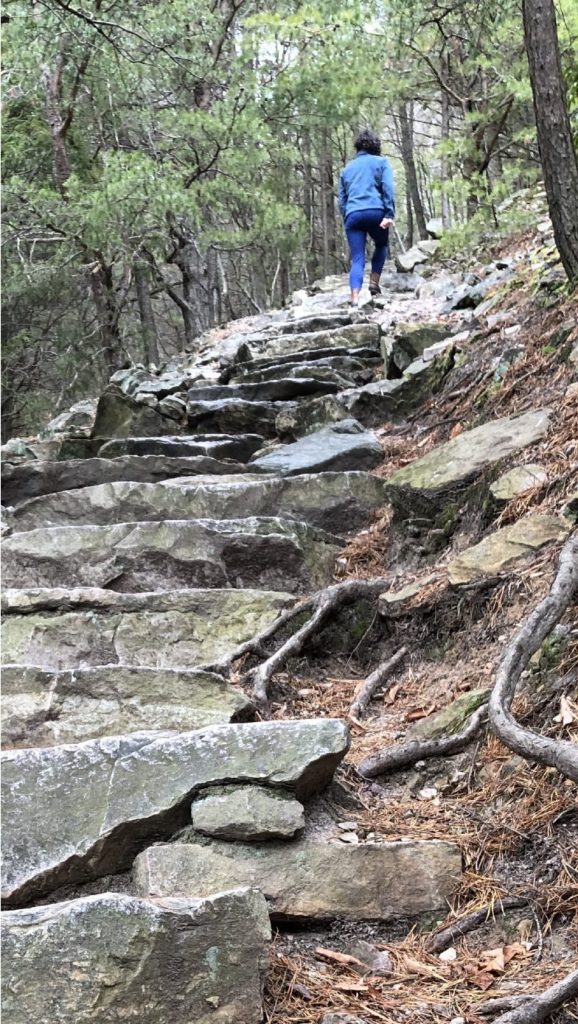
Lots of people count their steps every day. But there’s one area trail where you’re guaranteed to boost your total by a thousand steps.

Additionally, every footstep on the Thousand Steps Trail is a step back in time, up stone staircases built 85 years ago into the side of Jacks Mountain.

No need to count your steps—you’ll see every 100th step labeled on the weathered stone slabs serving as steps. The first 100, 200 and 300 steps go by pretty quickly for many visitors. By 400, 500 and 600, many hikers need the flat “landings” in between staircases to catch their breath. By 700, 800 and 900, climbers are spurred on by glimpses of the view.

The reward for reaching 1,036 steps at the top? A spectacular vista. The Juniata River carves the deepest gorge in Pennsylvania—Jack’s Narrows— splitting Jacks Mountain in two.


Hot on the Trail

“The Thousand Steps Trail… is by far the busiest in the six-county region,” said Matt Price, executive director of the Huntingdon County Visitors Bureau.

Just west of Mount Union along U.S. Route 22, dozens of cars are typically parked, because tucked into the woods is the starting point for the Thousand Steps Trail.

“It’s popular because of its accessibility from a busy highway, but it’s also the mix of the physical challenge of it, and its history,” said Price.

Today, the Thousand Steps Trail is one tiny segment—half a mile—of the 84-mile Standing Stone Trail, which links to a trail system traversing the width of Pennsylvania, and, ultimately, the Great Eastern Trail, which stretches from Alabama to New York.

“The appeal of the Thousand Steps for a lot of people—number one, it’s a challenge. But I think there’s also nostalgia,” said George Conrad, president of the nonprofit Standing Stone Trail Club. “It’s the nostalgia of putting yourself in the shoes of quarrymen going to work every day.”

Back in 1936, the steps weren’t created for recreation.

“Mount Union at one point was the brick capital of the world,” Conrad said. “One of the things it was famous for was firebricks that lined kilns for the steel industry, and, in order to make them, they used the silica atop the mountains.”

In the early 1900s, workers built a gravity railroad into Jacks Mountain to streamline the mining process. They sent rock-filled carts down the incline, across a bridge spanning the Juniata, to the brickmaking plant. The weight of the heavy, descending carts pulled the empty carts back atop the mountain, to the workers.

Think about their commute. Quarrymen, in order to get to their mountaintop worksite, hiked up the mountain every day.

But in the spring of 1936, the Juniata River flooded, wiping out the bridge and cutting off the carts’ connection. Production slowed while repairs were made.

In order to stay employed, the workers—ingeniously—built steps from the mountain’s plentiful ganister rocks. They turned a wild, rock-strewn mountainside into an organized, somewhat jaunty, series of stone staircases.

“They used the steps till the 1950s, then everything shut down and stood idle until the late ’70s or early ’80s,” said Conrad. “Tom Thwaites, who designed the Mid State Trail—he was a Penn State professor—he used the Thousand Steps to connect it together.”

By the mid-’90s, with people already using the trail, the quarry owner agreed to sell the property to the Keystone Trails Association. Donors funded the purchase by contributing $100 per step, and the land was gifted to the Pennsylvania Game Commission.


Rock On

Historical clues intertwine with nature along the trail.

“You can see the geology of the mountain through the steps. Toward the bottom of the mountain, there’s more impurity and red-colored rocks closer to the river, with the whiter-colored rocks due to sand,” Conrad said.

Hikers who continue just a short distance past the final stone steps atop the mountain will see a large stone building, the “dinkey shed,” once used for the narrow-gauge railway’s maintenance.

Following the Standing Stone Trail’s orange blazes northward, hikers can discover the Ledge Quarry Vista. Another 2½ miles of hiking rewards visitors with the Mill Creek Quarry Vista. Conrad encourages hikers to explore more of the Standing Stone Trail—well beyond the Thousand Steps—into “two state forests, two trail towns, two state parks, with miles of solitude and nature, geological formations and wildflowers.”

While hundreds hike the Standing Stone Trail annually, thousands flock to the tiny Thousand Steps segment—which leaves Conrad and others working behind the scenes to ensure its popularity doesn’t become its downfall.

An estimated 20,000 visitors hiked the Thousand Steps Trail annually, pre-pandemic. Fortuitously, trail counters were installed in 2019. Amid the pandemic in 2020, with more people seeking outdoor recreation, usage soared to a documented 42,000 visits.

“We all love the steps, but how do we maintain them?” asked Conrad. “The quarrymen built the steps for their use. Today, with tens of thousands of people on them, they’re not going to be there forever unless they receive some attention.”

That’s why Conrad recently met with state Rep. Rich Irvin (R-81) to make him aware of the issue.

“Specific to the steps, we need to shore them up, to make sure none are loose,” said Conrad. “Every time someone steps on them, it adds a little more stress, and there could be a point when we have to re-do the steps. That’s what I want people to realize.”

For more information on the Thousand Steps and Standing Stone Trails, including how to become a trail club member or make a donation, visit standingstonetrail.org.

Stories on environmental topics are proudly sponsored by LCSWMA

Support quality local journalism. Become a Friend of TheBurg!

Continue Reading

Custodian in Camelot: Harrisburg author debuts with King Arthur fantasy

Philip Moore

By day, Philip Moore cleans downtown Harrisburg’s federal building. By night, he writes modern-day fables inspired by an imaginary kingdom.

The brainstorm for his debut novel, “Camelot’s Heirs,” struck about 10 years ago while he was reading mythology and the legendary tales of King Arthur.

“I was imagining the descendants of Camelot, and all of a sudden, different characters showed up, so I started writing it out to see where they went,” said Philip, 50, of Harrisburg.

It took him on a writing journey that not only led to “Camelot’s Heirs” being published, but to book sales supported by his employer, Goodwill Keystone Area, at more than 40 retail stores. And it’s all the more remarkable when you consider Moore is autistic—a fact that he was happy to share, because, as he puts it, “I want to inspire people in general.”

“I consider it a gift from God,” said Philip, of his writing talent. As for “Camelot’s Heirs,” he said, “God gave me the idea and helped me develop it.”

The book follows the adventures of five teenagers with magical powers, unaware of their heritage linking them to King Arthur, as they combat an enemy plotting humanity’s downfall. Their adventures continue beyond the book’s 300 pages—Philip is close to completing a sequel.

His dream is to become a bestselling author, but it’s not just his name on the book’s cover—he has a very special co-author.

“Since I’m a guy, I have no idea how a woman would act or what she would say,” said Philip.

To help develop his female characters, he enlisted the woman who nurtured his love of reading since childhood—his mother. The fact that she lives in Idaho isn’t a problem—the pair uses Google Docs to write “together.”

“Mom adds flourishes of her own, and she’ll tell me if she thinks something is inaccurate or whether I’ve overdone it,” Philip said. “The stories are mine, but they’re stronger because of her.”


Classic Connection

Jane Moore said Philip, her first-born of five children, has always had an insatiable love of books.

“We both love the classics—books have always been our thing,” she said.

Now, the mother and son team collaborate, about 10 times a month, on writing Philip’s own titles.

“When we write, I love the fact that we have a kind of mental thing that goes between us—we’ve shared 40 to 50 years of books between us,” Jane said. “The amazing thing to me is, when we write we become one person… it’s a relationship that we’ve built that makes it fun to work together.”

She always recognized that Philip was smart and creative. In first or second grade, while all the other children created simple clay pots, Philip sculpted “a perfect elephant—I still have it today,” she said.

It wasn’t until his freshman year of high school that he was diagnosed with Asperger’s Disorder, a form of autism with symptoms that are less severe, without language delays.

“He’s brilliant,” Jane said. “I really believe he’s savant in his abilities.”

She recalled that her son’s Asperger’s prevented him from holding his dream job in high school.

“Because of who he is, he loved the library,” Jane said. “But he couldn’t work in the library because he was trying to reinvent the Dewey Decimal System—he found flaws in it.”

But he discovered a job he “loves”—one that he’s held for the past 20 years—through the Goodwill Services’ program, which provides career training and employment opportunities for people with disabilities.

“I enjoy what I do here,” said Philip of his responsibilities at the Ronald Reagan Federal Building. “It’s a very social job.”

He vacuums and dusts the courtrooms, follows COVID-19 disinfection protocols inside and helps with weeding and pruning outside. But he’s perhaps best known for greeting workers with smiles, striking up conversations and telling jokes.

“Everybody needs a laugh,” Philip said, “and it costs nobody anything.”


Goodwill, Good Journey

Philip is one of about 100 people currently employed by Goodwill’s program, funded by its popular thrift stores that resell donated items.

“The job is a good fit for him,” said Tracy Thompson, Goodwill’s director of business services for 15 years. “I’ve been on the journey with Philip for the whole trip.”

And it was literally on a work-related road trip that Thompson first heard Philip’s stories.

“He told me about his novel, and to kill the time on the drive up to Scranton, he read some of it. That was probably 10 years ago,” Thompson said. “I encouraged him to continue his writing. He had a lot of potential.”

Besides his mother, perhaps no one was cheering for Philip’s success more than Thompson.

“I am so proud of Philip for accomplishing this. It’s been a goal of his,” Thompson said. “To see his progress, it’s so rewarding—it’s why I do what I do.”

And it’s why there’s a display in each Goodwill store, featuring Philip’s photo and story, along with his books for sale, with the proceeds going back to Philip. He even inscribed each of Goodwill’s books with handwritten messages, which took him three days.

Many writers have added their spins to the King Arthur-themed legend—Arthurian literature—over the years, and now Philip Moore can add his name to the list. Perhaps it’s fitting that he’s writing about Camelot, a legendary capital, from Harrisburg—itself a capital city.

So that begs the centuries-old question: Do you believe there was a real King Arthur?

“I doubt it,” said Philip, “But it’s still kinda fun to think there might have been.”

“Camelot’s Heirs: King Arthur Series” by Philip Moore is available on Amazon, as well as more than 40 Goodwill Keystone Area stores in 22 counties. To learn more about Goodwill Keystone Area, including store locations and its business services program, visit yourgoodwill.org.

Support quality local journalism. Become a Friend of TheBurg!

 

Continue Reading

In the Heart of History: Seminary Ridge Museum occupies one of the most historically significant structures in Gettysburg

If you haven’t been to historic Gettysburg since that class trip years ago, it may be time for a fresh look.

Relatively new to this nearby Adams County tourist community is the Seminary Ridge Museum and Education Center, opening in 2013 at—where else?—Seminary Ridge along the National Park Service’s auto tour of the historic 1863 Civil War battlefields.

“We’ve always told groups visiting here that our goal is to connect you with a story that is relatable here on Seminary Ridge,” said Robert Williams, the museum’s director of outreach. “We are so lucky to be able to tell this story. We tell a big story to our visitors in a small and close personal way.”

The museum is located in a three-story, 1832 brick structure that played a key role during the Battle of Gettysburg. Once a longtime Lutheran Seminary, the structure’s cupola initially was established as a wide-range lookout post on the first day of the battle—July 1, 1863—by Union Gen. John Buford and his Signal Officer, Lt. Aaron Jerome, of the U.S. Army Calvary.

That following evening and through July 5, Confederate forces overtook the seminary while it was occupied by hundreds of wounded U.S. soldiers. After the Confederates’ retreat, the building remained a large field hospital until mid-September 1863.

You don’t have to be a “battle buff” to enjoy the Seminary Ridge Museum and Education Center, according to Peter Miele, the museum’s executive director.

“We’re open to more audiences of all ages,” he said. “We often see families come here, so we offer educational guides for parents and children. I used to be an American history teacher, so I think about ways we can catch the interest of younger people who visit our museum.”

One floor of the museum is dedicated to exhibits depicting the battle, while another floor details wartime medical care conducted at the former seminary. Another floor is dedicated to the building’s religious history.

The cupola is scheduled as a personally guided separate tour that runs several times per day each summer and twice daily in winter. Here, visitors can view the vistas where the Battle of Gettysburg took place.

To attract a younger audience, the museum has initiated a historically themed escape room, “Escape from Seminary Ridge.” The activity’s scenario is the first day of the famed battle when Union Gen. Oliver Otis Howard relies on a small Signal Corps team in the attic of the Lutheran Seminary to predict the Confederates’ movements and points of attack. Participants must seek information before retreating or being taking prisoner.

The facility also posts a wide range of digital resources that go far beyond the battle. The museum website offers such courses as “Race, Slavery, Freedom,” “Civil War Medicine/STEM,” and “Civil War Memory.”

“I hope that people get a deeper view of the causes and effects of the Civil War and how that affects the present,” Miele said. “The last room here asks our visitors, ‘What do you think is the unfinished work?’ and people write their responses.”

In 2019, around 20,000 visitors from throughout the U.S. visited the Seminary Ridge Museum and Education Center. The venue also welcomed “well over 100” visiting school groups, Williams noted.

Post-pandemic, museum staff would like to see more locals stop by for a visit.

“You have this gem right here where you can learn more about history,” Miele said.

The museum and education center is operated through the Seminary Ridge Preservation Foundation, a nonprofit organization founded in 1999. The foundation’s stated mission is “to restore, preserve and maintain the national historic Civil War properties, architecture and historic legacies of Seminary Ridge, and provide related education and communication of these legacies for the general public.”

“Every day is a new day for us here; it’s a new adventure,” Williams said. “It’s more than fulfilling to hear people say that they’ve always wanted to stand here.”

The Seminary Ridge Museum and Education Center is located at 61 Seminary Ridge, Gettysburg. For information and tickets, call 717-339-1300 or visit www.seminaryridgemuseum.org.

Support quality local journalism. Become a Friend of TheBurg!

Continue Reading

Full Circle: Mangia Qui owners return to the Broad Street Market with “Streatery”

Elide Hower & Qui Qui Musarra. Photo by Dani Fresh.

 If you’ve dined in any one of Qui Qui Musarra’s trio of restaurants—Mangia Qui, Rubicon and Suba—you’re familiar with the classy, intimate atmosphere that comes with the experience at each.

But Musarra, along with partners Staci Basore and Elide Hower, wanted to try something different—something more casual.

In late April, they opened Streatery at the Broad Street Market in Midtown Harrisburg—returning to where the restaurateurs made their debut 20 years ago as “Pasta Art.”

“It’s an honor to be back in the market,” Musarra said. “The people that know us are as excited as we are.”

That rings true for long-time customer Sharon Webb, who loves Mangia Qui and has befriended the owners. Hower, who is running the operations at the market, is like family, she said.

“I’m always excited when they try something new because it’s always fabulous,” Webb said.

According to Musarra, opening a market stand was an idea the team tossed around for a few years. They wanted to reach a larger audience and bring their food to those who have yet to try it.

“It’s a way of showcasing some of our signature items at Mangia Qui to a broader audience who may not dine with us at the restaurant,” Musarra said.


Fresh, Familiar

The owners—and their restaurants—have gained quite the positive reputation over the nearly 25 years they’ve been in Harrisburg. But even with all of the success, Musarra said that opening Streatery was a challenge.

“You can have all the experience in the world, but once you step into something new, there is the unknown,” she said. “That makes it more exciting.”

COVID took a huge bite out of the restaurants’ finances, forcing them to limit their hours, eliminating lunch completely. With the Broad Street Market’s prime time being lunch, Musarra hopes the new location will fill a gap and allow lunchtime customers to get their Mangia Qui fix.

Patrons can still expect the fresh flavor they’re used to, with a more casual feel. At Streatery, chefs offer an ever-changing menu of internationally inspired dishes. There are sandwiches and salads with flavors from places like Italy and Brazil, stuffed with meatballs, chicken, pork belly, prosciutto and pickled eggs. They have meats like those from Suba and olives from Mangia Qui, Musarra said.

On a Thursday afternoon at lunchtime, Albert Boynton waited for his “Triple Play” sandwich, which contains meatballs, mozzarella and pomodoro. He had never eaten at Mangia Qui, but was excited to try Streatery’s food. In other words, he was just the audience the owners hoped to reach.

“I’m going to have to check out their restaurant after this,” he said.

With Musarra and the team’s spur-of-the-moment style of creating dishes, you never quite know what you’re going to get at Streatery.

“It’s easy, accessible food, but it looks good and tastes good,” Hower said.

She said that they hope eventually to hold food demonstrations, as well.

Even though you may be taking your food in a to-go box instead of sitting in Mangia Qui’s dining room, you can expect the same great presentation.

“Food is our art,” Musarra said. “We present it in a way that has a flair.”


Survive to Thrive

Coming full-circle back to where they first started is meaningful to Musarra. She’s built and grown her business over the years, expanding from one small stand at the Broad Street Market into three restaurants.

Not many businesses that outgrow the market return, she said, but she loves the vibe there.

“Why should we forget where we started?” she said. “It’s an exciting time for the market.”

Musarra saw how important takeout became during the pandemic, something they didn’t even really offer before. Street dining took off, too, with many restaurants, including Mangia Qui, expanding outside service.

This was the inspiration behind the name for the market stand—Streatery.

“It became a way to survive,” she said.

As the partners move forward with their newest venture, Musarra is hopeful. Things aren’t yet back to “normal” at Mangia Qui. But, as life keeps moving, Musarra and Hower will keep cooking.

“Coming out of COVID and doing something new is really uplifting,” Musarra said.

Streatery is located in the brick building of the Broad Street Market in Harrisburg.

Support quality local journalism. Become a Friend of TheBurg!

 

Continue Reading

Fast, Flavorful, Fun: Hersheypark welcomes you back with a long list of new attractions

Candymonium

The last time Hersheypark re-designed their entrance in the early 1970s, the Super Duper Looper was the newest attraction.

I remember walking deep into the park to find the new coaster. After my only ride, my parents bought me a toddler-sized T-shirt boasting my survival.

Fast-forward… Hersheypark has transformed and expanded its entrance so that the newest coaster, Candymonium, is—splat—the first thing you see. You’ll need to get your bearings when you see the refurbished carousel and its accompanying bar moved up front instead of farther in.

“Hershey’s Chocolatetown is a completely different arrival experience from the one we’ve known since the 1970s,” said Quinn Bryner, director of public relations and strategy for Hershey Entertainment & Resorts.

The park’s expansion marks the largest in the company’s history, with 23 acres, $150 million and 15 new features.

The new architecture has a vintage, early-20th century look and feel, with definite nods to Milton Hershey’s style during his heyday as a young entrepreneur, building the town that would become his legacy. You’ll find plenty of modern twists, while still remaining signature Hershey.

Here are a few of the top new experiences:


Hypercoaster

The largest literal twist is Candymonium, a one-of-a-kind “hypercoaster” touted as Hersheypark’s tallest, fastest and longest coaster. With a lift height of 210 feet, a track length of 4,636 feet and maximum speed of 76 miles per hour, coaster enthusiasts should expect an exhilarating ride. But I’m already imagining myself with my head between my knees. I’ll be on the bench with my kettle corn, people-watching, holding my kids’ sunglasses while they ride.


Historically Symbolic Artwork

While I wait, I can admire eye-catching art. The water structure spouts into a Hershey’s Kiss shape. Milton Hershey School students donated a Kiss-shaped bell hung on a beam signed by students. On the walkway is a “Compass Rose” with 22 bronze medallions, honoring key periods of Mr. Hershey’s lasting contributions to the area. Embedded in one of the buildings are bricks from the original entrance, commemorating the old and welcoming the new.

Just next door is a new souvenir store preserving Hersheypark history. Hersheypark Supply Co. is a 10,000-square-foot flagship store with a large collection of souvenirs. The ones you can’t buy are the retired rides placed throughout the store.

“The new store pulls in the ride collection from Hersheypark and the retro pinwheel logo,” Bryner said.

You’ll be able to get up close to a chariot from the old carousel and a portion of the old mini-train.

The store shares space with the three new restaurants, drawing in old-style architecture and the arena building.


New Restaurants

The Chocolatier, one of the new on-site restaurants, has its outdoor deck situated on part of the arena, just above the old ticket counter with its three small windows. The restaurant is backdated by a century, with retro tiles, green color scheme and mirrors on the ceiling to project its showboat lighting. Inside, it has an amazing aerial view of the new store.

Downstairs is Milton’s Ice Cream Parlor. The décor is a throwback to a drugstore soda fountain, complete with stools at the counter, with hand-created sweet and savory items on the menu.

The signature dish is a chicken-and-waffles slider sandwich, a tip of the bowler hat to Milton Hershey’s favorite meal. The grilled sandwiches are encrusted with crunchy Parmesan cheese. And because it’s Hershey, there’s even a chocolate (molé) dipping sauce for chicken and fries. The 12 gourmet signature sauces are decidedly modern, like beer cheese, spicy maple mayo and rosemary aioli dipping sauce.

Rob Gordon, managing director of food and beverage for Hershey Entertainment Complex, loves collaborating with his team to create the menu.

“Working on the menu is a process of experimental discovery,” he said. “More variety to come as development continues.”

You can experiment yourself with Milton’s ice cream menu, with 24 toppings available in unlimited amounts and “ice creamologists” (holding down my dream job), creating locally sourced custom flavors.

Signature flavors include Reese’s Peanut Butter, Toasted Marshmallow, Graham Coaster Station and Malted Memories, which is a Spartan recipe developed by Milton Hershey School students at their creamery. Another must-try is Candymonium, which has chunks of peanut butter cups and chocolate chips in a Twizzler-flavor-based ice cream.

(My own personal walk of shame: waddling out of there.)

Gordon’s main collaborator is award-winning corporate pastry chef Cher Harris. You can watch her handcraft candies and desserts at the is Sweeterie Confectionery Kitchen around the corner.

“The biggest attraction is the interactive element, being able to watch handcrafted fudge being made out front,” Harris said. “It will create interest to watch the old confectionery technique.”

Harris’ open kitchen equipment includes a fudge paddle, kettle, marble tabletops and a sneeze guard.

Her signature desserts are too numerous to list. Many “under-glass” patisserie-style desserts are fashioned after Hersheypark rides, like the Comet coaster bar, Kissing Tower mousse cake and Chocolatetown cheesecake. For the kids, one dessert is shaped like a carousel horse and another like a ladybug.

If you’re anything like me, you go to places for the food, and you plan your day around it. With everything made in-house, I probably wouldn’t make it to the ticketing counter. But if I did, I would wander here…


Virtual Reality Experience

Hyperdeck is an immersive, virtual reality experience. Up to eight players enter into a dynamic virtual world, complete with a full-motion floor and multi-sensory effects (strong winds, heat and earth-rattling movements).

Players can choose from two scenarios. H.A.I.R. is a post-apocalyptic world where a 1980s guitar hero becomes a villain. Dreamsaver is a dream that turns into a nightmare that the player must overcome.

As an extra interactive element, spectators can help or hinder players via tablets.

Whatever your attraction preference, Hersheypark looks forward to greeting visitors again after last year’s pandemic-induced topsy-turvy.

“We know how excited guests are to come back after winter, especially this winter,” Bryner said.

For more information, visit www.hersheypark.com.

Support quality local journalism. Become a Friend of TheBurg!
Continue Reading

Natural Connections: Lake Tobias Wildlife Park brings people, families, animals together

There is a unique, natural and somewhat unexplored common bond that exists between humans and the rest of God’s creatures. Lake Tobias Wildlife Park allows families to delve into that bond, in a family-friendly atmosphere.

In this way, Lake Tobias, located in Halifax, is about families, for families and by families.

Owned and operated by the Tobias family for 57 years, the park is more than 200 acres of wooded land and fields set up to allow humans to closely interact one-on-one with 700 animals representing six continents and nearly 100 different species, only a handful of which are native to central Pennsylvania.

“People seem to have a natural attraction to the outdoors,” said Jan Tobias-Kiefer, one of 10 owners of the park and Lake Tobias’ director of public relations and marketing. “Is it a sense of freedom? The people who come here are young families, outdoors lovers and nature lovers. We advertise mainly to women between 25 to 50, because they tend to make plans for families.”

Because there’s so much to see and do at Lake Tobias, time moves quickly for visitors. A typical visit could last as long as four hours, and everything revolves around seeing animals, learning about them and moving freely in their adopted home.

The Safari Tour, which takes visitors on a guided ride through woods and pastures inhabited by a menagerie of four-legged and two-legged creatures, makes it more than just a zoo. Other attractions include a reptiles and exotics facility, a petting zoo, a zoo baby exhibit, a catch-and-release fishing pond, the J.R. Tobias Museum and Education Center and assorted concessions.

“I think just the fact that it’s family-owned and operated makes it unique,” said Tobias-Kiefer. “It’s family-owned for families. It is very much a family-oriented place. It can be a very nice family day trip, and it’s affordable. And it’s right here in central Pennsylvania.”

During the 2019 season, before the COVID-19 crisis hit, Lake Tobias Wildlife Park hosted an all-time high of more than 249,000 visitors. Of those, about 17,000 were students visiting in May on class trips. Lake Tobias is also a great place for private parties, company picnics and family reunions.

“I like that people come,” said Tobias-Kiefer, a 63-year-old resident of Halifax. “I like that we’re able to offer all of this to the people of central Pennsylvania. I like to be able to continue dad’s dream, just like everybody in the family. And I like that people can get close to the animals.”

Build His Dream

Lake Tobias Wildlife Park was formally opened to the public in 1965. The park was, and continues to be, the vision of James Raymond Tobias, a Halifax native who enlisted in the Marines after high school and then returned to the area to establish a number of excavating and grading businesses.

J.R. passed in 1996, and Lake Tobias Wildlife Park is now owned and operated by six of his remaining children and four of his grandchildren. Some 18 of Tobias’ descendants currently work at the park, which employs 190 mostly Halifax-area residents in the height of the season.

“Dad was always interested in exotic animals,” said Tobias-Kiefer. “He set up exhibits along the road, and people driving by would stop and look at them. So, he started to add exhibits, and, in 1965, he opened the park to the public. All of his businesses helped slowly build his dream.”

Over those years, Lake Tobias Wildlife Park has matured and evolved to feature more, bigger and better exhibits, all with the intent of bringing people and animals closer together.

“People who come and haven’t been here in awhile will tell us how much it’s changed,” said Tobias-Kiefer. “I think it’s become more family friendly. We’ve been able to expand exhibits, and it’s more educational. We want you to leave here with an appreciation for nature and the animals that are here.”

Lake Tobias Wildlife Park’s goal moving forward is simply to keep doing what it’s been doing. It’s more about tweaking, fine-tuning and enhancing the individual experience than repairing something that isn’t broken.

But that doesn’t mean the Tobiases don’t have ideas for adding different animals and new exhibits in the future.

“I think the goal for the future is to improve the facilities we have and improve the experience here,” said Tobias-Kiefer. “We just hope people find this hidden gem and come here and experience what dad’s dream was. We want them to enjoy wildlife as much as he did.”

At Lake Tobias Wildlife Park, it’s all about family.

Lake Tobias Wildlife Park is located at 760 Tobias Rd., Halifax. For more information, visit www.laketobias.com.

Support quality local journalism. Become a Friend of TheBurg!

Continue Reading

Wheels in Motion: School’s out, but Rohrer Bus hits high gear searching for new drivers


Joy Hurley worked in an office for seven years and “hated it.” Her best friend convinced her to switch gears and give a new career a whirl—as a school bus driver.

“I tried it and love it,” said Hurley, of Carlisle. “There are so many things to love about it. I love all my kids—they make my day—and I love the freedom of being outside of an office.”

Nearly five years after getting behind the wheel, Hurley is still driving a school bus, plus she’s added two more responsibilities—training new drivers and inspecting buses as a safety supervisor.

And she’s exactly the kind of employee that Rohrer Bus hopes to attract more of, this summer.


Wheels Turning

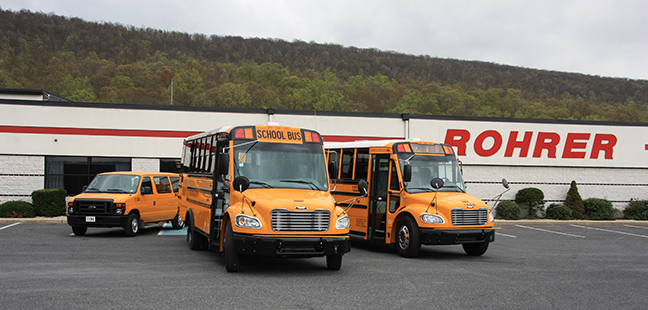
The sunshine, on a recent Saturday morning, matched the traditional color of the bright yellow school buses lined up, waiting for drivers to take them for a spin, at three Harrisburg area school districts. They were “Test Drive a School Bus” events held by Rohrer Bus. Anybody could stop by and give it a try.

One of those people was Corey Mull, 27, of Mechanicsburg, a FedEx driver of three years.

“I’ve driven everything but a bus, so I figured why not try?” Mull said. “I enjoy driving because it’s an escape—and it keeps my mind focused on one thing.”

With Hurley seated behind him for a brief overview, Mull slid behind the wheel, tested the bus’s emergency flashing lights, crossing arm and stop sign, and then he was off for a few loops around the parking lot. After successfully backing up, parking the bus and chatting with Rohrer supervisors, he ultimately told them, “Thank you for the experience.” But Hurley and her colleagues hope they’ve planted a seed for a future employee.

That’s because Rohrer, like many school bus companies around the country, is facing a shortage of drivers. The issue, which existed prior to 2020, was exacerbated by the pandemic.

“A lot of our base is retirees and young parents, and both of those groups have been afraid of the virus,” said Katie Bowers, assistant supervisor of Rohrer’s 40 to 50 bus drivers for the Cumberland Valley School District. She describes the past school year as “challenging.”

“Because we’re already short on drivers, if you’re not feeling well, that puts us even shorter,” said Bowers. “So, it really brought teamwork to a different level, trying to figure out who can pick up the kids… especially with changing school schedules.”

It’s not a long-term solution, but one of the ways Rohrer has scrambled to fill bus routes is with the company executives themselves acting as substitute drivers.

“Last week, I probably drove at least six different routes,” said David Schrantz, Rohrer vice president, representing the fourth generation of the family-owned business. “One driver was out because they had surgery, and I saw his laminated directions with notes on every student—he took the time to leave them. Those are the little things that show me drivers care about doing a good job.”

Rohrer, based in Duncannon, is the largest employer in Perry County with about 1,000 employees and a fleet of about 1,000 Rohrer school buses. They provide transportation to about 50,000 students across 24 school districts in 14 counties including Adams, Cumberland, Dauphin, Perry and York. Only two or three school bus companies in the state are larger.

But the current driver shortage is one of the largest issues Rohrer has faced in its 100-year history, coincidentally being marked this year.


Angst, Optimism

“My grandfather farmed—that’s how a lot of school bus companies got started, in rural parts of the country,” said Howard “Skip” Rohrer III. “He started with a horse and buggy transporting students into a one-room schoolhouse. Then he bought a chassis from Governor Pinchot and had a carpenter in Harrisburg build a body with bench seats and transformed it into a motor coach.”

By 1967, Rohrer operated 15 buses, and, by 1975, they diversified and became a school bus dealership, as well.

“I can remember, from the time I was 5 years old, coming out every summer, to clean and wax school buses—that was my life,” Skip said.

He, along with brother-in-law and Rohrer co-president John Schrantz, grew the school bus contracting side of the business from 1982 to its current level.

“Now, we’re trying to do creative things to attract applicants… because it takes about six weeks to get drivers through the [training and certification] process,” John said.

One of those creative strategies includes the “Test Drive a School Bus” events, in preparation for the new school year. Another creative strategy? Shirts, bearing the slogan, “Community Hero,” worn by the events’ drivers and instructors.

Fears can also put the brakes on potential drivers.

“It might be overwhelming for some people to think about handling kids on a bus, but once they build relationships with those students, it turns around,” Skip said.

Others are afraid of driving school buses due to their size, but David points out they’re the safest vehicle, structurally, and in terms of safety records, on the road.

David, who represents the future of the company, said he’s trying to maintain an optimistic outlook about the driver shortage.

“It’s getting hard—I’ve got to be frank with you. It’s the biggest problem I’ve focused my attention on for five years, and it’s nationwide,” he said. “But I’m optimistic for our industry. People from all walks of life can make this a good fit for them—young parents, especially mothers… people in between jobs, and it’s a great job for a retiree. Being a bus driver helps them get up in the morning, and it keeps them young.”

For more information on Rohrer Bus, see rohrerbus.com. The next “Test Drive a School Bus” event is set for June 26, 10 a.m. to 2 p.m., at Lower Dauphin Middle School, East Pennsboro and Cumberland Valley High Schools.

Support quality local journalism. Become a Friend of TheBurg!

Continue Reading