 Located in Uptown Harrisburg, Beacon Clinic for Health and Hope serves uninsured and underserved adults in Dauphin, Cumberland and Perry counties.
The clinic, which opened in 2015, serves about 375 patients per year, many who return quarterly to manage chronic conditions like diabetes.
While Beacon is faith-based, it welcomes patients of all backgrounds.
Debra McClain, executive director, said that patients come from 54 different countries and speak 37 different languages. She tells the story of a 51-year-old man with worsening vision visiting the clinic.
“He was working intermittently in a low-wage job and relied on an interpreter to communicate with the care team,” she said, adding that he delayed medical care for months due to financial concerns.
With the team at Beacon, he created a plan to manage his uncontrolled diabetes.
“He had already lost significant vision in one eye, and, within months, he began actively managing his diabetes and his blood sugar improved significantly,” McClain said.
This is just one case where Beacon has helped. According to McClain, surveys confirm that the Harrisburg area has some of the highest rates of uninsured individuals—70% of whom have jobs and are working hard each day.
Beacon is designed to feel less like a system and more like a relationship.
“We have active practicing doctors and nurses at Penn State Health and UPMC who are all volunteers who are dedicated to providing continuity of care,” McClain said.
Some patients are shocked to learn that they qualify for services, she said.
“Eligibility extends to those earning up to 300% of the federal poverty level—roughly $47,000 a year for an individual, $66,000 for a couple and $99,000 a family,” she said.
Importance of Partners
The Harrisburg-based nonprofit receives funding from a variety of sources: individual donations, churches, foundations and grants, corporate sponsors and fundraising events. One such collaboration ended up being a huge blessing for the clinic and its patients.
“We began paying a membership fee to partner with the Dispensary of Hope in 2019, and this enables us to give people free meds,” McClain said.
Previously those medications cost the clinic $40,000 a month.
“That wasn’t sustainable, but, through the partnership and a collaboration with a local pharmacy, we pay less than $20,000 a year,” said McClain, whose background in insurance and financial services has helped her navigate the sometimes-murky waters that exist when creating a sustainability plan. “That was a huge win for a clinic like ours.”
The clinic also has provided thousands of free medications—5,669 in the most recent count—with many patients receiving multiple prescriptions per month.
Beacon’s list of partners is long, and McClain has been thrilled with how many have stepped up to the plate.
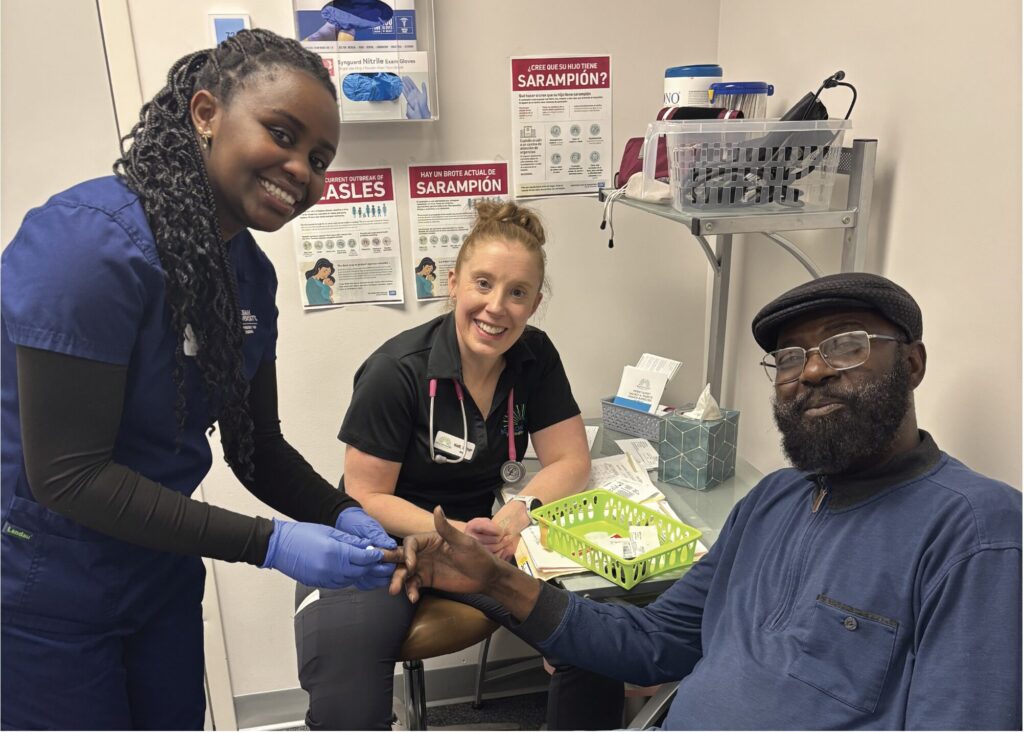
“UPMC helps cover labs and X-rays and Messiah University and York College nursing students visit for clinical training and sometimes return as volunteers,” she said.
In addition, Penn State College of Medicine students and residents shadow physicians, Dickinson students in the Spanish for Health program help as live interpreters, and Penn State Health offers free pathology labs for services like biopsies.
“We have dermatologist volunteers as well, and often we can see patients within just one month,” McClain said.
In 2019, Beacon was able to open up a healthy cupboard as part of its “Food as Medicine” initiative.
“Penn State Health gifted us with a refrigerator, healthy snacks and drinks for our waiting room,” McClain said.
The Foundation for Enhancing Communities provided a grant to buy freezers to add more items like frozen fish, meat, chicken and vegetables.
“Our nutritionist advises patients on how they can use the items, and recipes from Penn State College of Medicine are posted in different languages,” McClain said.
Community Steps Up
A base of 58 volunteers allows the clinic to operate with a lean staff that includes a nurse, a nurse practitioner, a receptionist, a nursing care coordinator, a clinical director and an executive director.
“This makes it easier for a clinic like Beacon to process new patients within two weeks today when, in the past, it would take between six and eight weeks,” McClain said.
Beacon’s board of directors reflects a similarly broad base of support with members from real estate, healthcare, strategic planning, medicine, financial services and other sectors.
Fundraising is also essential to sustaining operations.
The clinic’s primary event, the “Triple Crown Gala,” takes place in May and is held at the West Shore Country Club. It includes networking opportunities, a silent auction, a live auction, a raffle and more. A cornhole tournament is a more casual, family-friendly event and is held annually in the fall.
Through a combination of clinical care, partnerships and community support, Beacon robustly serves the greater Harrisburg community, while expanding its reach.
“No one can do what we’re doing in a silo,” McClain said. “If you don’t have people to collaborate with you, you’d be a sinking ship.”
Beacon Clinic for Health and Hope is located at 2626 N. 3rd St., Harrisburg. To learn more, visit beaconclinicpa.org. or call 717-775-1111.
TFEC + TheBurg: Partners in Purpose is a quarterly collaboration spotlighting the vital work of local nonprofits serving Dauphin and Cumberland counties. Through this community-centered initiative, four selected 501(c)(3) organizations receive an in-depth feature in TheBurg’s print and digital publications in 2026—at no cost to them—thanks to the support of TFEC. Together, we’re elevating the stories of those strengthening our region and making a meaningful impact across central Pennsylvania.
This is sponsored content.
If you like what we do, please support our work. Become a Friend of TheBurg!