June News Digest

Williams Wins Mayoral Primary

Harrisburg soon will have a new mayor, as City Council President Wanda Williams narrowly defeated the two-term incumbent for the Democratic nomination last month.

With all 28 precincts reporting, Williams won by just 56 votes, capturing 1,776 votes compared to Mayor Eric Papenfuse’s 1,720 votes.

Two other challengers also ran strong. Businessman Dave Schankweiler won 1,329 votes, and former City Council member Otto Banks took 1,237. The fifth candidate, Kevyn Knox, won 66.

“To the residents of this city, this is their victory,” Williams said after the final votes came in.

Williams, a longtime council member, pledged to work closely with council, which often has had a contentious relationship with Harrisburg’s mayors, as well as on behalf of city residents.

“It’s just a wonderful feeling knowing that I now have the responsibility to make decisions for the residents,” she said.

After the final results came in, Papenfuse called to congratulate her and promised a “smooth and seamless transition.”

To become mayor, Williams still needs to win the general election race in November. On the Republican side, city resident Timothy Rowbottom won that party’s nomination running unopposed and tallying 367 votes.

Harrisburg is overwhelmingly Democratic in party registration, so Williams will go into the general election in a comparatively strong position.

For City Council, Harrisburg voters nominated Democratic incumbents Ausha Green and Shamaine Daniels, as well as challengers Ralph Rodriguez and Jocelyn Rawls. The four candidates will almost certainly win four-year council seats in the November general election, as no one competed for the Republican nomination.

Harrisburg also had a competitive primary race for school board director.

In that race, Democratic incumbents Danielle Robinson and Brian Carter were the top vote-getters for four, four-year seats, followed by challengers Roslyn Copeland and Jaime Johnsen. On the Republican side, Ezra Match ran unopposed, so will appear on the November ballot. He had cross-filed for both parties, but failed to get the Democratic nod.

Terricia Radcliff captured the Democratic nomination for the only two-year seat on the board, running unopposed. No Republicans ran in that race.

Harrisburg’s city controller position was also on the ballot. In that race, Democratic incumbent Charlie DeBrunner ran unopposed and faces no Republican opposition in the November election.


School Tax Rate Steady

Harrisburg School District Receiver Janet Samuels approved a $159 million proposed budget for the 2021-22 academic school year last month, a spending plan that includes federal COVID relief funding.

The budget would remain balanced for another year due to $52.9 million in federal Elementary Secondary School Emergency Relief (ESSER) funds headed towards the district. The one-time dollars would fill a $5.6 million deficit that the district would likely have had otherwise.

There will be no property tax increase this year, although officials warned that they may have to raise taxes in future years.

“That’s a big win for taxpayers in such a difficult year that we are coming through,” said George Longridge, the district’s financial officer.

This year’s school district budget compares to a $158.2 million 2020-21 budget, which was balanced using a previous round of ESSER funds.

At the meeting, the district also noted that school board Director Jayne Buchwach has resigned her seat.


Two-Way 2nd Street Work Begins

Construction began last month to return much of N. 2nd Street in Harrisburg to two-way traffic.

Mayor Eric Papenfuse broke ground on the $5.7 million conversion project, which aims to make the street safer and the neighborhood more walkable.

“We are about to embark upon reversing one of the worst engineering decisions in our city’s modern history,” he said.

N. 2nd Street was long a two-way, neighborhood street. However, the state and city converted several streets to one-way traffic, including N. 2nd Street, in the 1950s to accommodate suburban commuters.

Harrisburg now will return the pattern back to two-way traffic from Forster to Division streets, adding pedestrian and bike-friendly elements, Papenfuse said. The switch to two-way will come near the end of the project next year, city Engineer Wayne Martin said.

Construction includes adding over 100 ADA-accessible ramps to intersections along the corridor, in compliance with PennDOT’s construction guidelines, according to Martin. Portions of the brick sidewalk near the intersections will be replaced, as well.

The city will then replace traffic signals with mini-roundabouts in the intersections at Kelker, Verbeke and Reily streets.

New traffic signals will be added to accommodate the two-way flow of traffic, along with new crosswalks and pedestrian refuge areas in the middle of the road. New markings on the road will remind drivers to share the road with bicyclists.

During construction, sections of the corridor may shift to two lanes for brief periods of time, Martin said.

Once this work is done, the section of N. 2nd Street will switch to two-way traffic with a 25-mph speed limit. The entire stretch will be repaved, along with some sections of the intersecting roads. Martin expects all construction to be completed by mid-October 2022.

The N. 2nd Street project falls under the city’s Vision Zero initiative to reduce pedestrian fatalities in Harrisburg, city officials said.


Sidewalk Widening Finished

The circle is now complete, as Harrisburg cut the ribbon on the final stretch of sidewalk expansion around the state Capitol.

Last month, city officials unveiled a new ADA-accessible length of sidewalk on N. 3rd Street surrounding the building.

About a decade ago, the state expanded the narrow strip of concrete that long surrounded much of the Capitol along Walnut and N. 3rd streets, constructing a full-sized walk. However, it left the job unfinished near the front of the building.

The newly reconstructed sidewalk extends the full-sized, 10-foot-wide walk from State Street to North Street, completing the loop around the building. The sidewalk expansion removed parking spaces along the street. However, that parking loss was made up last year, when the city built additional angled parking spaces and electric vehicle charging stations in front of the State Museum.

Across the street, at a bus stop near the intersection at North and 3rd streets, a bump out from the sidewalk also was added. City Engineer Wayne Martin said that this will increase safety for riders by making it easier for them to board the bus. ADA-accessible ramps were added to the sidewalks, as well.

The state Department of General Services helped the city fund the sidewalk project.


Financial Report Mostly Positive

Harrisburg’s fiscal condition is “sound” and its budget is in surplus, according to a largely positive annual report issued by the city’s financial oversight body.

The Intergovernmental Cooperation Authority for Harrisburg (ICA) issued its second annual report last month to the governor and legislature, stating that the city is in generally good financial shape.

“The report acknowledges a number of areas where progress has been made, while also identifying several priorities for improvement in fiscal management,” according to an ICA press release.

In 2018, the state created the ICA to oversee the creation of a five-year financial plan for Harrisburg.

The 26-page report submitted on Friday is substantially more positive than last year’s annual report, which robustly criticized the city for several alleged financial and accounting deficiencies.

Some of those criticisms—including a “low collection rate” in accounts receivable in the city’s Neighborhood Services Fund (sanitation), an outmoded IT infrastructure and a long-delayed audit of the city government’s physical assets—remain in the 2021 report.

Downtown Apartments OK’d

Downtown Harrisburg soon will have another new apartment building, as City Council last month approved an office-to-residential conversion.

During a virtual legislative session, council members unanimously passed the land development plan for the century-old, eight-story building at 112 Market St.

Harristown Enterprises will lead the $7 million project, which will include about 35 one- and two-bedroom apartments, with first-floor retail space, according to CEO Brad Jones. The 51,000-square-foot structure has served as an office building since its construction in 1918.

In recent years, Harristown and several other local developers have renovated and converted numerous aging, often rundown office buildings to apartments, adding hundreds of new residential units to the downtown.

Council last month also passed a resolution to enter into an agreement with Impact Harrisburg to conduct a disparity study to determine where diverse business vendors are underrepresented in the city’s public procurement and contracting processes.

Impact Harrisburg plans to hire a company to conduct the study to determine where the city can provide additional resources for minority, women, LGBTQ, disabled and veteran-owned businesses.

Both the city and Impact Harrisburg will contribute up to $125,000 for the study.

City Council also approved a settlement agreement with bond insurer Ambac Assurance to help pay down debt related to general obligation bond defaults incurred during the city’s financial crisis in 2012 and 2013. Through the agreement, the city hopes to accelerate debt payments and reduce its overall debt load.


Charter School Proposed

A new charter school is seeking to come to Harrisburg, with a focus on preparing Dauphin County students for the healthcare field.

The Pennsylvania Nurses Middle College Charter School came before the Harrisburg School District last month for a virtual public hearing on its application to create a charter high school in Midtown.

According to CEO Betsy Snook, the charter school seeks to create a pipeline for students in grades 9 through 12 to enter the nursing field. She said that they also hope to address the racial disparity in the field by attracting and training minority students.

The school was founded by the Pennsylvania State Nurses Association, which Snook also oversees, and the Nursing Foundation of Pennsylvania.

Snook said that she hopes the charter school will encourage students to pursue baccalaureate degrees in nursing.

If approved, the charter school would open for the 2022-23 academic year to all Dauphin County students, who would be chosen by a lottery system. Snook said that the school would seek to enroll 120 9th-grade students for the first year and add additional grades each year.

Classes would be STEM-focused with hands-on curriculum, practicums and summer employment opportunities in local healthcare settings, she explained. The school also would offer first-aid, CPR and Certified Nursing Assistant (CNA) in partnership with HACC.

The school would be located in GreenWorks Development’s Midtown II building, alongside the PA STEAM Academy.


Home Sales, Prices Gain in April

The Harrisburg-area housing market took flight in April, with both home sales and prices up substantially.

For the month, 686 houses sold in the area, compared to 465 homes for April 2020, as the median sales price increased to $225,000 from $200,000, according to the Greater Harrisburg Association of Realtors (GHAR).

In Dauphin County, 347 homes sold versus 220 a year ago, while the median sales price jumped to $200,000 from $171,000, GHAR stated.

Cumberland County had sales of 274 homes, compared to 216 in the prior year, as the median sales price rose to $267,000 from $234,950.

In Perry County, sales increased to 35 homes versus 22 houses in April 2020, as the median price declined to $156,000 from $174,200, GHAR said.

Houses were also selling much faster than last year, as the average “days on the market” declined to 22 days versus 50 days in April 2020, according to GHAR.

Notably, the number of home sales in April 2020 was held down by the COVID-19 pandemic and the state-mandated shutdown of businesses.

However, sales and price data in April also were strong compared to two years ago. In April 2019, 619 homes sold for a median price of $180,000 throughout GHAR’s three-county coverage area, according to the association.


So Noted

Broad Street Market
last month launched an online fundraiser to raise money to fix and upgrade their iconic sign, following storm damage over the winter. To pay for the project, the market hopes to raise $40,000 through a GoFundMe fundraiser and corporate sponsorships.

CoExist Glass Gallery in Steelton plans a mosaic mural this summer. The “Co-Exist in Kindness” mural will cover the gallery’s building on S. Front Street, using local and national talent. To find out more and how to participate, visit www.calyxglass.com/blog.

Dauphin County Library System last month launched a $3.5 million capital campaign to raise funds for the expansion and renovation of the McCormick Riverfront Library in downtown Harrisburg. The project entails connecting the building to the historic Haldeman Haly house next door, as well as improvements to both buildings.

GK Visual last month received two Communicator Awards of Excellence for its documentary web series, “Poured in PA.” The Harrisburg-based boutique video production company received the top awards for “campaign or series—web series” and “campaign or series—food and beverage” in the program honoring creative excellence for communications professionals.

Harrisburg again extended its eviction moratorium by 30 days, the fifth straight extension. The new moratorium extends through mid-June, as does a water shut-off moratorium, both imposed due to the COVID-19 emergency.

Harrisburg’s two public swimming pools should open later this month, the city said. The Jackson Lick and Hall Manor pools are slated to open by the end of June after being closed last year due to the COVID-19 pandemic.

Jeff Haste retired as a Dauphin County commissioner last month, resigning partway through his fifth term in office. The county Court of Common Pleas is charged with appointing a replacement for the remainder of the term, which expires in January 2024.

Rovenia (Roe) Braddy
has been named vice president of programs for Big Brothers Big Sisters of the Capital Region. According to the Harrisburg-based organization, she brings almost 30 years of experience working with community youth.

Ryan Unger will be the next president and CEO of the Harrisburg Regional Chamber & CREDC, the organization announced last month. Unger, the CEO of the Harrisburg-based nonprofit Team Pennsylvania Foundation, will assume the post on July 1 following the retirement of long-time Chamber leader, Dave Black.

TheBurg received 22 Keystone press awards last month in the annual, peer-reviewed journalism contest sponsored by the Pennsylvania NewsMedia Association Foundation. TheBurg received awards for reporting, writing, design and illustration, including the prestigious “Sweepstakes” award for the best performance statewide in its category.

The Vegetable Hunter last month announced its second location, at 46 W. High St. in downtown Carlisle. The Harrisburg-based restaurant offers a menu of vegan and kosher dishes, along with selections from its on-site craft brewery.

Changing Hands

Barkley Lane, 2522: W. Workie to F. Ashenafi, $65,000

Berryhill St., 1331: SU Hogar LLC to G. Gutierrez & R. Soto, $31,000

Berryhill St., 2216: A. & L. Smith to B. & P. Mishra, $72,000

Berryhill St., 2320: A. Balkaran to T. Jones, $76,000

Briggs St., 1504: W. Brown to A. Almonte, $50,000

Chestnut St., 1937: F. Gutierrez & D. Sosa to NA Capital Group LLC, $42,000

Chestnut St., 1938: S. Dunbar to J. Cruz, $55,000

Chestnut St., 1951: K. Connor to F. Elizy, $80,900

Crescent St., 306: PD Estate Properties LLC to 2020 Real Estate Ventures LLC, $49,000

Cumberland St., 212: S. Reed to N&R Group, $116,800

Cumberland St., 222: D. Landis to S. Rubinstein & H. Choi, $182,500

Derry St., 1212: J. Cervantes to J. Alducin, $35,000

Derry St., 1727: Bank of New York Mellon to D. Boyle, $31,500

Derry St., 2001: K. Causey to M. Martinez, $112,000

Derry St., 2014: R. Do to Two Three Two Investments LLC, $71,675

Emerald St., 245: SPG Capital LLC to JTA Consulting Group LLC, $57,500

Forster St., 1932: J. Rawls to S. Rawls & G. Fallings, $50,000

Green St., 1109: Dilks Properties of Harrisburg LLC & American Heritage Property Management to CWJK Holdings LLC, $233,000

Green St., 1203: PA Deals LLC & Revolutionary Deals LLC to T. Jones, $156,500

Green St., 1314: J. Holman to G. Paterson & M. Goyo, $130,000

Green St., 1517: J. Bowser to J. Kavanagh & A. Jones, $166,000

Green St., 1718: A. Bargh & S. Moore to R. & H. Deighan, $220,000

Green St., 1943: J. Chu to D. & K. Wadlington, $211,800

Green St., 2006: B. Colucci to R. McCauley, $215,000

Green St., 2039: E. & K. Woolever to WCI Partners, $165,000

Green St., 2114: K. Abdelrahman & Susquehanna Realty Management to ECP3LLC, $105,000

Green St., 3218: S. Roblyer to J. & K. Fasut, $165,000

Harris St., 231: 231 Harris Street Land Trust, Dustin L. Palmer Trustee to K. Martin, $180,000

Hoerner St., 111: A. Otwell to Q. & C. Sherard, $44,000

Hoffman St., 3229: D&F Realty Holdings LP to J. & B. Rodriguez, $115,000

Holly St., 2023: I. Ward to K. Ward, $30,000

Kelker St., 319: Standing Tal LLC to C. Hurwitz, $140,000

Kensington St., 1940½: D. Boyle to A. Hernandez, $30,000

Logan St., 2212: S. Palmer to SPG Capital LLC, $48,000

Luce St., 2314½: Care Properties LLC to R. & B. Lomax, $50,000

Luce St., 2332: Care Properties LLC to R. & B. Lomax, $55,000

Market St., 1713: J. & L. Hendricks to M. Karlson, $117,300

Market St., 2000: D. Garcia to A. Robinson, $120,000

Mulberry St., 1164: J. Ripa to M. Mignogno, $145,000

North St., 250: RJ Shultz Enterprises Inc. to G. & K. Beeman, $85,000

North St., 252: RJ Shultz Enterprises Inc. to G. & K. Beeman, $100,000

North St., 1942: Neidlinger Enterprises LLC to R. Nolt, $146,900

N. 2nd St., 806: H. Fang & K. Zhu to Di Wu & M. Hu, $238,000

N. 2nd St., 1331: S. Mimm to J. Wacker & E. Walker, $199,900

N. 2nd St., 1831: Vantage Rentals LP to WCI Partners LP, $160,000

N. 2nd St., 1839: Trip Acres 1839 LLC to WCI Partners LP, $225,000

N. 2nd St., 2001: Capozzi & Ehring Realty LLC to WCI Partners LP, $240,000

N. 2nd St., 2226: J. Hall to B. & A. Capptauber, $265,000

N. 2nd St., 2235: K. Deardorff to Beyond Holdings LLC, $200,000

N. 2nd St., 2237: K. Deardorff to Beyond Holdings LLC, $200,000

N. 2nd St., 2719: J. MacDonald to P. & K. Miovas, $248,000

N. 2nd St., 3220: Noble Colt LLC to A. Bull & D. Parkent, $194,900

N. 3rd St., 2347: K. Mohamed to Next Level Opportunity LLC, $185,000

N. 3rd St., 2415: M. Delgado to S. Hurst, $156,000

N. 4th St., 1432: D. Martin & N. Douglas to Keystone Brothers Investment LLC, $71,500

N. 4th St., 2316A: S. Bornak to N. & L. McCoy, $55,000

N. 4th St., 3013: T. Wylie to D&A Homes LLC, $55,000

N. 5th St., 1928: E. Stoute to Hillside Financial LLC, $70,000

N. 5th St., 2034: J. & D. Riddle to R. Seidel, $135,900

N. 5th St., 2428: P. Burke to Neidlinger Enterprises LLC, $47,000

N. 13th St., 126: T. Lloyd to S. Samuel & K. Lucas, $90,000

N. 13th St., 504: D. Malesich to Harrisburg Cemetery Association, $115,000

N. 15th St., 1611: S. Dunbar to M. Freeman, $54,000

N. 16th St., 1100: M. Johnston to Nehema LLC, $112,500

N. 16th St., 1208: Omaha Property Manager LLC to HLI Properties PA LLC, $79,900

N. 18th St., 807: A. Graves to F. Florian & J. Ricardo, $62,500

N. 19th St., 718, 722 & 724: A. LaTorre to A. Miller, $100,000

Penn St., 1515: M. & C. Magilton to J. Elliott, $186,000

Reel St., 2416: CR Property Group LLC to J. Johnson, $117,500

Reel St., 2635: J. & H. Moore to G. Chisholm, $45,000

Regina St., 1428: G. Osborne to F. Luciano, $37,000

Reily St., 217: R. & E. Killeen to A. Troutman, $154,000

Reily St., 422 & 424: T. Harden & C. Freeland to 400 Reily Street LLC, $80,000

Revere St., 1716: J. Carter to Biyaki Enterprises LLC, $50,000

Revere St., 1718: J. & L. Carter to Biyaki Enterprises LLC, $32,000

Rolleston St., 1203: J. & W. Colon to N. Caba, $62,000

Rolleston St., 1229, 1405 N. 15th St., 430 S. 17th St., 1002 N. 18th St., 2455 Reel St. & 3015 N. 6th St.: DRW Properties LLC to N. Maurer, $195,000

Seneca St., 263: K. Strohm to L. Cervantes, T. Astuto & E. Marquez, $98,000

Showers St., 591: K. Lavalee to M. Minaya, $135,000

South St., 101: C. Dotto to M. & K. Rittel, $130,000

S. 12th St., 1503: L. Williams to Neidlinger Enterprises LLC, $65,000

S. 13th St., 330: S. & A. Fisher to R. & M. Antonio, $48,000

S. 13th St., 400: A. & E. Taylor to G. Piatt, $95,000

S. 18th St., 17: R. & D. Stevenson to XVL Properties LLC, $42,100

S. 18th St., 151: CPenn Patriot Properties LLC to J. Medina, $40,000

S. 18th St., 946: Darna Investments LLC & A. Gomaa to 946 South 18th LLC, $150,000

S. 19th St., 1338: N&R Group LLC to B. Skaggs, $168,999

S. 21st St., 2: G. & W. Heise to A. Hart, $270,000

S. 23rd St., 519: R. & L. Rivera to L. & P. Gurung, $157,000

S. Front St., 705½: J. & A. Juratovic to S. Jackson & C. Colon, $147,000

S. Summit St., 37: J. Gulbin to Sunnyvale Properties LLC, $84,000

Spencer St., 1849: B. Davis to D. Boyle, $30,000

State St., 231, Unit 706: LUX 1 LP to S. Chaudhuri, $137,200

State St., 1300: MSP Associates Inc. to Shutter Real Estate LLC, $195,000

State St., 1807: Storm Investment Properties LLC to D. & R. Nelson, $75,000

Swatara St., 2142: Top Notch Homes LLC to Neidlinger Enterprises LLC, $69,000

Sylvan Terr., 160: D. Miller to Guardian Realty LLC, $145,000

Thompson St., 1613: 4880 East Prospect LLC to J. Linc Holdings LLC, $30,000

Verbeke St., 256: J. Morris to J. Speakman, $206,500

Verbeke St., 313: A. & A. Davenport to D. & J. Fitzsimons, $195,000

Vernon St., 1356: J. & C. Peters to J. Hernandez, C. Rodriguez & M. Mendez, $35,000

Vernon St., 1413: T. Sweet to 1413 Vernon Enterprises LLC, $75,000

Whitehall St., 1819: W. Morse to M. Bettis, $99,000

Woodbine St., 622: CR Property Group to K. Chow, $115,000

Harrisburg property sales for April 2021, greater than $30,000. Source: Dauphin County. Data is assumed to be accurate.

Support quality local journalism. Become a Friend of TheBurg!

Continue Reading

History, Updated: Harrisburg works to revise, clarify its historic district guidelines

Before and after photos of Anne Kough’s Midtown Harrisburg house.

New homeowner Paul Northrop was confused by what he thought was the city’s vaguely worded historic preservation guidelines.

His rotting porch railings weren’t original to his 1896 home, but was he required to replace them with Gilded Age exactitude?

He was not, but the vagueness of Harrisburg’s “Historic District Design and Preservation Guidelines” kept him wondering until he got answers from the city’s historic preservation specialist.

Now, city officials hope that pending revisions to the guidelines will minimize confusion, explain options, and encourage owners of historic properties to do their part to protect Harrisburg’s architectural heritage.


Not That Scary

In Harrisburg, exterior alterations and repairs in buildings within six municipal historic districts might require review and approval by the Harrisburg Architectural Review Board, or HARB, and City Council. When changes, removals or alterations are “visible from a public right-of-way,” HARB must review for architectural appropriateness of materials and features.

Until this spring, anyone opening the city’s historic preservation guide was met, first, with the name of Harrisburg’s mayor—Stephen R. Reed. His 28-year tenure ended in 2010.

Around 2018, HARB officials recognized the need for change, not so much for the mayor’s name but for the generalities used to explain HARB standards and processes. Public input on revised guidelines was collected through May 2021. A HARB vote to recommend approval is expected in July, before final adoption by City Council.

HARB Chair Trina Gribble hopes the update will “empower people to understand the value of preserving buildings.”

“We wanted to communicate that and improve the lines of communications between the neighborhoods and HARB,” she said.

The city’s Historic Preservation Specialist and Archivist Frank Grumbine got the staff assignment to rewrite the guidelines, following his hiring in 2019. In this role, he works directly with homeowners, presenting options and explaining the process. If they reach agreement on materials or products to be used, property owners can get “administrative approval” without needing to plead their case before HARB.

And though HARB has no data to show it, Grumbine believes that administrative approvals have increased during his tenure, slimming down the HARB meeting agendas.

“Everybody’s scared of the HARB, for some reason,” Grumbine said. “It’s really not that scary.”

Paradigm Change

Anne Kough bought a long-vacant Midtown rowhome in 2020 to renovate as a rental. Behind a façade covered in vines, she saw a beauty, tall and strong. She fell in love and made the purchase.

Working with Grumbine, Kough won administrative approval for much of the restoration. She could replace the front windows—not original to the home—with a matching look, but couldn’t replace rotting cedar shakes with faux-wood vinyl.

“We’re OK with that,” she said.

In the process, Grumbine recommended that Kough’s front door be repaired, while her contractor suggested making a replica—a pricey option—and donating the original to a museum. With safety measures for added security, she decided on repair and preservation.

“It has the old 1900 Victorian winding doorbell, a mail slot and smoked glass that’s in great shape,” she said. “If it was worthy of a museum, I felt it was worthy of saving and featuring on the house.”

A mindset of “preserve, repair and replace” can uphold the historic integrity of individual homes and entire blocks while it protects property values and promotes sustainability, Grumbine reminds property owners.

“The big goal is to change the paradigm, change the perception that historic preservation is bureaucratic, and there’s some nerdy dude in city hall who’s a big jerk,” he said.

Changes pending in the historic district guidelines include:

  • A new chapter on the HARB application and review process, explaining its decision-making structure and describing in detail whether projects don’t need HARB review, qualify for administrative approval, or require HARB consideration.
  • Explanations of why HARB might, or might not, approve replacing vintage materials with modern, maintenance-free alternatives, plus a list of the materials that can earn administrative approval without HARB review, such as Hardie siding and Trex composite decking. As better materials hit the market, “the HARB generally is becoming a bit more progressive in terms of approving different materials,” Grumbine said.
  • All-new photos of city properties to illustrate the points, such as a once-blighted Uptown home where cementitious fiberboard provided an acceptable replacement for wooden clapboard.
  • Detailed explanations of the wealth of inappropriate sidings that sprouted citywide in the 20th century (Insulbrick, anyone?). Removing such horrors can offer low-cost options for restoring historic integrity, since they often hide original materials underneath, Grumbine said.
  • Specifics on practices that are recommended (“Installing clear, low-emissivity [low-e] glass or film without noticeable color”) and not recommended (“Retrofitting historically clear windows with tinted glass or reflective coatings”).

The revised guidelines add explanation to situations that continue to be decided on a case-by-case basis.

“Obviously, a wood window would be easily approved by HARB if it’s the same, but it’s not that simple,” Gribble said. “The configuration, the style, the profile—all that kind of detail is important to the look of the historic buildings. We wanted to elaborate more on that and not so much on just solely the materials.”


Adding Context

Paul Northrop and his girlfriend were longtime Midtown renters who finally bought a home in New Cumberland but missed the neighborly feel of Midtown. Just before the pandemic, they found their dream 1896 home in the 1500-block of Green Street—with a garage! However, it hadn’t seen much upkeep since the 1990s. Many of the windows, handrails and spindles were rotting away.

“Anything that’s not brick on the exterior is being replaced or repainted,” said Northrop.

Grumbine’s intervention clarified Northrop’s options, including custom-milling new wood spindles to replicate those not-original porch spindles.

The vagueness of the old guidelines, Northrop feared, could have disincentivized homeowners from maintaining their aging properties.

“A lot of people are probably scared away,” he said. “It’s not clear what you can do. So, if you’re risk averse, it makes you feel you can’t do anything to the home.”

By adding context to the guidelines, Grumbine hopes to share the gospel of repairing rather than replacing.

“Everybody wants to replace everything all the time because they want everything to be clean and shiny and new,” he said. “But people need to realize that, if you live in a 150-year-old neighborhood in a 150-year-old house, you should embrace the patina. You should embrace the alligatoring of the old paint under the new paint. Things aren’t going to look new because, you know, they’re not.”

Harrisburg’s tradition of protecting historic architecture is paying off in “unique flair that attracts people,” including the metropolis dwellers discovering the pleasures of life in a smaller, more manageable city, said Gribble.

They have a sense of place,” she said. “They know where they are. That’s attractive to people, and there are proven economic benefits to preservation.”

As Northrop sees it, if Grumbine’s approach to hammering out solutions reflects how the guidelines have been revised, “then they’re headed in the right direction.” He loves the timelessness of his home.

“Just the original architectural details that we don’t have anymore,” he said. “It’s a representation of a bygone era. So, we’re going to do our part to make sure it’s around for another 126 years or so.”

Support quality local journalism. Become a Friend of TheBurg!

 

Continue Reading

Flavor-Filled Fun: Outdoor options, new dishes spice up Harrisburg’s summer dining scene

Outdoor dining at 1700 Degrees Steakhouse. Photo by Rachel Lindsley.

Last summer, dining in Harrisburg was limited to whatever outdoor space a restaurant could quickly cobble together.

Tables were set up in parking lots, sidewalks, even on downtown streets.

Widespread al fresco dining will continue this summer, a rare positive offshoot of the pandemic. In fact, many restaurants will offer both inside and outside options, whether you prefer your eating to be open-air or air-conditioned.

Inside the Hilton Harrisburg lives Ad Lib Craft Kitchen & Bar and 1700 Degrees Steakhouse, two local establishments that welcome guests with an updated al fresco menu.

“We have expanded our offerings towards pre-pandemic times as restrictions have eased and look forward to providing our guests with a large selection of delicious food and beverage options,” said Anthony Bianco, executive chef.

Both restaurants continue to offer old favorites, but are revitalizing their menus with summer ingredients such as green garlic scapes, morels, English peas, gooseberries and asparagus. Seasonal featured items include vichyssoise (a cream of leek and potato soup), fava bean mousse, porcini tortellini, chicken consommé, Faroe Island salmon and monkfish.

As some food connoisseurs remain wary to travel due to the pandemic, Harrisburg restaurants also provide a cultural escape—just in your own backyard.

TASTE, a rotating tasting room concept, brings the Florida Keys to you. Float away at Taste Key West, where you can bask in steamed seafood and tropical drinks. With over 20 margarita flavors, assorted rum drinks, and of course, Key Lime pie, you’re transported to Florida’s southernmost point.

Take a breezy trip to the Caribbean at Los Tres Cubanos, known for their authentic Cuban cuisine near the river in Shipoke. With outdoor seating and homemade daily dishes, they are excited to welcome guests back.

For first-time visitors looking for a menu recommendation, owner Pat Manjon shares a well-known, traditional dish to try.

“Our most sought-after Cuban dish is masita de puerco—tender pork chunks lightly fried to perfection, sautéed with garlic and marinated onions in our signature mojo sauce, served with your choice of a side,” Manjon said.

Just don’t forget about dessert.

“And, to end the meal, guests can try our signature tres leches—a three-layered milk cake,” Manjon said.

From there, take your taste buds east to Asia at Café Fresco-Center City. Spice up your palate with this feng-shui inspired metropolitan retreat. Executive Chef Scott Robinson is freshening up their menu this season with new medleys.

“Scott is a self-described purist, priding himself on creating dishes using organic, garden-fresh ingredients,” said owner Brian Fertenbaugh. “He brings with him experience in five-star restaurants on both the east and west coasts.”

As all dining constraints have been lifted, Café Fresco-Center City and Level 2 are open on Friday and Saturday nights and welcome patrons for easy bar seating. Happy hours have also resumed just in time for after-work drinks on Monday through Friday. Sample some of their Asian-inspired finger foods on discount such as spicy shrimp bao bun, karaage and mushroom pot stickers.

If European dishes are more your style, Rubicon and Mangia Qui pair French ambiance with indulgent cuisine. As a joint venture, they are offering specialty dinner selections including pesce di giorno—Chef Qui’s fresh fish of the day.

Want to stay in for the night? Rubicon even offers delivery on Wednesday and Thursday evenings beginning at 5 p.m. Visit their website to find out more.

On Saturday nights starting at 3:30 p.m., Harrisburg is once again sectioning off its main streets for outdoor dining. These streets include 2nd Street (Market to Pine), State Street (from Church to N. 2nd), North Street (from Susquehanna to 3rd Street) and Conoy Street.

Many restaurants also offer Sunday brunch, including Ad Lib Craft Kitchen & Bar, which features a “Sunday Funday” experience with live entertainment, complimentary mimosas, a discounted raw bar, a bloody Mary bar, and their specialty, Ad Lib monkey bread.

“Our Sunday brunch offerings are the perfect cure to a long weekend,” Chef Bianco said.

As local dining experiences offer sought-after destinations this summer, Harrisburg invites foodies to dine around the world—without leaving the city.

To learn more about “Saturday Nights in the City,” visit www.harrisburgdid.com.

Support quality local journalism. Become a Friend of TheBurg!

Continue Reading

Deep Waters: One year later, Harrisburg’s Sharkman reflects on skating through the pandemic

He was literally a fish out of water.

Throughout 2020, someone dressed in a bright blue shark costume roller-bladed throughout Harrisburg, primarily along the Susquehanna River.

“In the beginning, there was a lot of shock,” said Sharkman, of the initial screams and stares.

Those surprising and somewhat comical shark sightings gave way to smiles—no small task amid bleak pandemic days. His positive presence was like a lifeline.

It’s why, last June, TheBurg featured his photo on the cover, which contributed to both his stardom and enigma. Who was this lone shark? Our “cover fish,” interviewed a week later on “TheBurg Podcast,” said, “I’m not really sure who’s benefitting more—the people I’m trying to entertain or myself.”

Now, one year later, he sat down with TheBurg for a deeper reflection on his pandemic persona. And we found there’s a lot more to Sharkman than meets the eye.


Lone Shark

Spoiler alert—he still wants to keep his identity anonymous. But we can tell you this much: “Sharkman Hbg,” as he’s known on his Facebook and Instagram accounts, is a 33-year-old Swatara Township resident who lives with his wife (occasionally spotted in a pink shark costume), two cats and Pomeranian. He’s an electronics technician who installs security systems. And he’s had a lifelong fascination with sharks.

“They’re amazing creatures—I went diving with them twice,” said Sharkman. “I just think they get a bad reputation—they’re misunderstood creatures.”

Just as sharks are considered outliers of the ocean, kids who grow up on roller blades are often perceived as counter-culture outsiders. Sharkman knows—he’s been skating since the age of 4 or 5. To him, the quirky hobby hits all the right notes.

“All the wonderful sounds from the wheels hitting different surfaces—I love that,” he said.

Last March, the pandemic provided the perfect storm of ingredients for this self-described “shy, practical joker” to become Sharkman.

“My smartwatch was asking me if I was OK, because I was coming home from work, doing nothing—I basically had six hours of inactivity every night,” said Sharkman. “Everyone was stuck inside, so I thought maybe I could entertain people, get some exercise at the same time, and the idea to become Mr. Sharky Shark went from there.”

Sharkman made his skating debut on April 10, 2020, by testing the waters in his neighborhood. Then he was ready for bigger, uncharted territory.


Shark Stardom

Initially, his motive was simply to lift people’s spirits. As his stardom grew, Sharkman saw another opportunity to do good. He created Sharkman-themed artwork, stickers and photo books—at his own expense—to give to fans in exchange for donations. But instead of pocketing the money, he had social media fans vote on which businesses should receive the proceeds, and several thousand dollars went into tip jars at Rubicon, Queen’s BBQ, Urban Churn and Alvaro’s.

As the weather warmed through 2020’s pandemic, more people ventured outdoors—and encountered Sharkman. Some of the top questions he received?

Can I take a picture with you? “Yes, always.”

Are you hot? “It depended on the day, but, honestly, there were more times I was cold than hot.”

What do you wear under your costume? “Wrist pads, shorts, a T-shirt, ball cap and helmet. I wash my costume after every outing … it was $50 on Amazon, and I don’t even know how to begin to leave a review for it.”

How fast do you skate? “Normally around 8 miles per hour. But during speed runs, I travel 14 miles per hour sustained for half an hour.”

Scariest moments? “I got bit by dogs twice on my knee—that was the worst. And I crashed three times last year, including straight into a wall near Knead, one of my favorite stops.”

Funniest moments? “There were so many, but the funniest was probably being netted by Jenny from J.B. Kelly at the Broad Street Market. She was apparently carrying a fishing net all day, waiting for me.”

How far did you skate? Total mileage, April 2020 through January 2021: 800 miles

Who are you? Why be anonymous? “I didn’t want any of the recognition to myself as a person. This was something I was doing for the city and to help businesses. I have a good paying job, and some people were really affected by the pandemic,” he said. “A lot of people wanted Sharky items, and I didn’t feel right charging—I never want money to complicate things—that’s not what Sharky is about.”


Diving Deeper

About 15 years ago, Sharkman’s teen years were rough. He endured bullying in high school. As he approached the age of 18, he had a vision to get his life back on track by attending HACC and pursuing a trade.

“Moving to Harrisburg and going to HACC saved my life—that’s the truth,” he said.

After earning two degrees from HACC, he decided to stay and make Harrisburg home. He kept a low profile—until he surfaced as Sharkman.

“As time went on and more questions were asked about Sharky—and I guess coming to terms with things in my own life—becoming Sharky became a tribute to my best buddy,” he said. “We skated together pretty much every day growing up. He ended up committing suicide two years ago. We were supposed to go shark diving together, but it never happened. It’s affected me greatly. So, it’s a tribute to him—being a shark, as well as skating, since it was his hobby as well as mine growing up.”

How did he turn something so painful into a positive?

“As tragic as it was, you still have to find good things to hold onto, and I think that’s what helped me,” he said. “Because of the popularity of Sharky over the summer, I didn’t want the perception to be, ‘He’s just using his friend’s death for his own gain,’—and I still don’t want to do that. I try to do what I can, with the means that I’ve been given.”

Sharkman has scaled back from his pandemic schedule of five weekly skates, but he hasn’t hung up his skates entirely. He makes charity appearances and organizes occasional group skates via social media.

The first time he asked skaters to join him along the river last year was “special.”

“That was probably the first time I skated with anyone by my side, since we—my buddy and I—skated together. My buddy would’ve wanted that,” he said.

Just as sharks are often misunderstood creatures, Sharkman hopes his story—and Sharky persona—ultimately helps others. This shark, it turns out, has a heart.

“It’s good for me to share these life experiences and be part of Harrisburg,” he said. “People want to know the story about the shark, whereas, as a person, they might not. Sharky is relatable.”

You can find Sharkman Hbg on Facebook at www.facebook.com/MrSharkyShark and @sharkmanhbg on Instagram.

Support quality local journalism. Become a Friend of TheBurg!

 

Continue Reading

Heart in Harrisburg: As Dennis Green achieved greatness, he took his hometown with him

Dennis Green. Image courtesy of Minnesota Vikings.

He was a husband, an uncle and a role model. He was a coach and a competitor and a mentor.

Dennis Green was a great many things to a great many people. But most of all, Mr. Green—or Coach Green—was Harrisburg through and through.

Not only did he represent his hometown, he lived it. And boy, did he live.

Because he loved Harrisburg and always stayed true to himself, Green took Harrisburg with him wherever he went.

“A lot of people don’t come back when they make it. Dennis came back,” said Michelle Green, Dennis’ niece. “Harrisburg was important to him. He was proud of his city. For him, home was home. And he would always take the time to speak to everyone.”

It’s been five years since Green passed away at the age of 67. And while he continues to be sorely missed around the city, his legacy lives on.

“Dennis Green was an invaluable human being who truly cared about, not only those close to him, but what happened in the world,” said Marie Green, Dennis’ widow. “He was moved by stories of justice and fairness. We try to learn from him the way he wanted us to live. I miss him so much.”

Master Strategist

Green’s passion for life was best manifested through coaching. He coached 38 years on the professional and collegiate levels, including head coaching stints with the NFL’s Minnesota Vikings from 1992 to 2001 and the Arizona Cardinals from 2004 to 2006.

Green, a graduate of Harrisburg High, is one of a handful of coaches—and perhaps the only—from Harrisburg to become an NFL head coach. In 2019, the city dedicated a street in his name, Dennis Green Way, near his childhood home at Walnut and 12th streets, and the tombstone that adorns his gravesite reads, “Faith, Family, Football.”

“It was in that order,” said Marie Green. “Dennis was very competitive. On a scale of one to 10, it was 100. He didn’t even want to lose a flag football game. It was just his personality.”

When Green was hired as the head coach of the Vikings in 1992, he became only the second African-American head coach in the NFL’s history. During his 10 seasons in Minnesota, Green’s teams compiled an overall record of 101-72 and made the playoffs eight times.

Green’s best season as a head coach in the NFL was 1998, when the Vikings went 15-1 during the regular season and lost to Atlanta in the NFC Championship game.

“He was a master strategist,” said Marie Green. “Not only did he have a Plan A, B, C and D, he also had a Plan E, F, G and H. Football is not just a game of strength and force. It was a game of strategy to Dennis.”

But the fact that Green was a people person also made him a player’s coach. He gained a reputation around the NFL as a coach who made the people around him better, and because of that, players wanted to play for Green.

Mentally, physically and emotionally, Green was as tough as nails.

“Dennis made people want to do better at what they did,” said Marie Green. “He saw the potential in people. He was very supportive of me and helped me believe in myself. He saw my potential. He saw what I could do, and he coached me to fill my potential.”

In 1997, Green and the Vikings drafted another Harrisburg native, cornerback Robert Tate. Tate had never met Green before being drafted.

“You knew what to expect from him,” said Tate. “He believed in me, and when someone believes in you, you want to give it your all. Coach Green was a no-nonsense type of coach, but a fatherly type of coach. He held you accountable.”


Transformative

Green graduated from John Harris High School in the late 1960s, and he graduated cum laude with a degree in finance from the University of Iowa. He started coaching at Iowa as a graduate assistant, then went on to become the head coach at Northwestern in 1981 and the head coach at Stanford in 1989.

“He treated everybody equally,” said Tate. “He would tell you what he expected of you. He always said what he was going to do and did what he said he was going to do. He didn’t sugarcoat anything. He told you the way it was. He was a stand-up guy.”

From a close-knit family, Green was one of five brothers who grew up in Harrisburg. Many of his nieces, nephews and cousins still live in the Harrisburg area.

“One of the things I will always remember about him is how important family stayed to him when he reached success,” said Michelle Green. “A lot of times when people reach that level, they forget about where they came from.”

Two years after his passing, Green was inducted into the Minnesota Vikings’ ring of honor. When he died in 2016, the Vikings issued the following statement:

“He mentored countless players and served as a father figure for the men he coached. He took great pride in helping assistant coaches advance their careers. His tenure as one of the first African American head coaches in both college and the NFL was also transformative. Our thoughts and prayers are with the entire Green family.”

The way Green lived his life exemplified what it means to be from Harrisburg.

“Being from Harrisburg was very important to him,” Tate said. “He was always talking about Harrisburg. He had a crew from Harrisburg who would always come to the games. In meetings, he’d always bring up Harrisburg. His heart was from Harrisburg.”

Support quality local journalism. Become a Friend of TheBurg!


Continue Reading

June Editor’s Note

Last month marked an important milestone.

No, I don’t mean Harrisburg’s primary election, which had its own sense of importance.

In early May, I received my second dose of coronavirus vaccine, as many of you may have, as well.

Afterwards, I texted my sister, “Look out, world!”

In all honesty, my world hasn’t changed that much.

I once again feel confident dining indoors and have begun to do so. But, as of this writing, I still haven’t boarded a plane, gone to a ballgame or attended a concert—though I expect I will soon.

In other words, my life is beginning to return to normal.

Normalcy—what a concept.

A year ago, in this space, I bemoaned our lost way of life as I sat at my desk and looked out my window at an empty landscape, half-expecting to see tumbleweeds roll down 3rd Street. No more. Today, traffic is humming, people are out and about, and some restaurants seem as busy as ever.

Therefore, I believe it’s an excellent time for our June issue, which, each year, focuses on fun things to do around Harrisburg during the summer months. Correction: each year except last year, when the pandemic robbed us of summer and every other kind of fun.

Sure, we still need to be careful and take precautions. I won’t toss away my large collection of facemasks any time soon and will continue to keep my distance in crowded places.

However, I’m willing to make these small sacrifices if it means that I can safely return to doing the things that I enjoy, which give my life texture and worth. So, look out, world—I’m armed with the June issue of TheBurg, and it’s packed full of enjoyable, entertaining things to do this summer.

Lawrance Binda
Co-Publisher/Editor-in-Chief

Support quality local journalism. Become a Friend of TheBurg!

Continue Reading

Island Eats: Rice & Beans quickly has built a loyal clientele on Allison Hill

Starlyn Rivera and Jose Pichardo

When I walked into Rice & Beans restaurant, I joined a line of hungry customers who, like myself, were eagerly awaiting a lunchtime meal.

The people in front of me ordered like they were regulars, pointing at food behind the glass and naming dishes in Spanish.

When I got to the counter, I was met by Jose Pichardo, who owns Rice & Beans with his wife, Starlyn Rivera.

“I’ve never been here before,” I said behind my mask.

“Well, I’m sorry for you that you haven’t, my dear,” Pichardo said with a grin.

He pointed out the many variations of chicken, pork, beef, oxtail and, of course, rice and beans.

I settled on some chicken, rice and fried plantains.

Pichardo and Rivera are confident in their product. According to the couple, there’s nothing like their Caribbean-style food in Harrisburg. Pichardo described his cuisine as including flavors from the Dominican Republic (his home country), Colombia and Puerto Rico, among others. The dishes are both traditional and unique.

“If you go to a Mexican restaurant, you will get Mexican food,” he explained. “If you go to a Peruvian restaurant, you will get Peruvian food. But here, we have a little bit of everything.”

The authentic flavor at Rice & Beans is something Pichardo worked for years to develop. Back in the Dominican Republic, he cooked in a five-star hotel before taking his skill to a cruise ship kitchen. Eventually, he landed in New York, opening his own restaurant, also named Rice & Beans, and running it for 18 years.

But Rivera and Pichardo had children, and living in New York wasn’t cheap. One of their cousins invited them to Harrisburg to look around and Rivera fell in love with the idea of living in a bigger home in a quieter area. Pichardo saw the potential for bringing his Spanish-fusion cuisine to Allison Hill.

“There’s nobody here that has the same concept as us,” he said.

After months of renovation to the building on S. 17th Street, the couple opened up shop in February 2019. They struggled at first with finding employees, but saw no shortage of customers.

“We’ve been busy since the beginning,” Rivera said. “We didn’t expect that.”

I visited Rice & Beans twice, once on a sunny day at lunchtime and then the next day, in the rainy late afternoon. The latter was supposed to be a “slower” time at the restaurant, better for an interview, but still, a steady flow of customers streamed in. Pichardo and Rivera are used to being busy. Even during the COVID-19 pandemic, they didn’t lose many customers, thanks to the thriving to-go aspect of their business.

Pichardo said that, when they first opened, he was working 17-hour days. The pair barely had time to sleep or spend time with their kids. Now, they have about 10 employees and work around 11-hour days—still difficult, but manageable.

“We try to do the best in what we do,” Pichardo said. “I want customers to really taste the difference when they try my food.”

At Rice & Beans, the staff’s hard work is met with a similar dedication from customers. Simon and Jazmine Arias have frequented the restaurant at least three times each week since it opened.

“This is our spot,” Simon said. “We needed a place like this. We would have to travel for food like this.”

The pair has a high bar for Spanish-style food. Simon is from the Dominican Republic and Jazmine from Puerto Rico. They gave Rice & Beans rave reviews, going on about the authenticity, the atmosphere and even the details, like the free samples.

Simon ordered the mofongo, a Puerto Rican dish that includes mashed fried plantains and often seafood or chicken. It’s a customer favorite, according to Pichardo, and Simon’s go-to order, as well. Not everyone can make mofongo right, Simon said.

He also pointed out their fresh juices that “hit the spot.”

“When we come here, we are ordering straight island food,” he said. “It feels like we are at home.”

Rivera said that they’ve developed a base of regular customers, a diverse bunch. People from all over the city with different cultures, races and languages come in to dine. Some people have even come from an hour away just to eat at Rice & Beans. That’s what makes it all worth it.

“That makes us feel really good, really proud,” Pichardo said.

Rice & Beans is located at 319 S. 17th St., Harrisburg. For more information, visit their Facebook page or call 717-695-7979.

Support quality local journalism. Become a Friend of TheBurg!

 

Continue Reading

Stepping Stones: The Thousand Steps Trail is a rock star among area hiking trails. Why its popularity may be a problem

Lots of people count their steps every day. But there’s one area trail where you’re guaranteed to boost your total by a thousand steps.

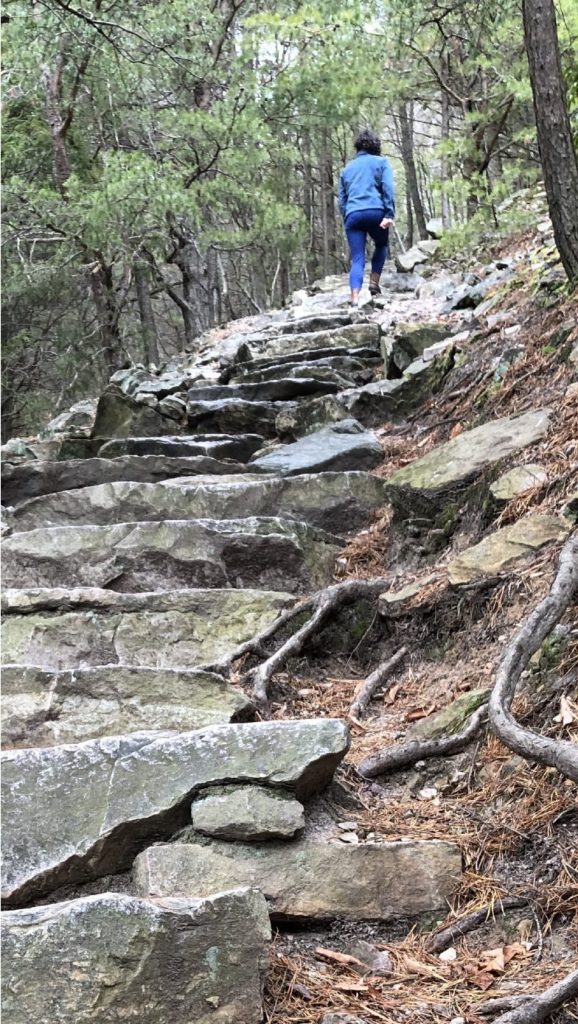
Additionally, every footstep on the Thousand Steps Trail is a step back in time, up stone staircases built 85 years ago into the side of Jacks Mountain.

No need to count your steps—you’ll see every 100th step labeled on the weathered stone slabs serving as steps. The first 100, 200 and 300 steps go by pretty quickly for many visitors. By 400, 500 and 600, many hikers need the flat “landings” in between staircases to catch their breath. By 700, 800 and 900, climbers are spurred on by glimpses of the view.

The reward for reaching 1,036 steps at the top? A spectacular vista. The Juniata River carves the deepest gorge in Pennsylvania—Jack’s Narrows— splitting Jacks Mountain in two.


Hot on the Trail

“The Thousand Steps Trail… is by far the busiest in the six-county region,” said Matt Price, executive director of the Huntingdon County Visitors Bureau.

Just west of Mount Union along U.S. Route 22, dozens of cars are typically parked, because tucked into the woods is the starting point for the Thousand Steps Trail.

“It’s popular because of its accessibility from a busy highway, but it’s also the mix of the physical challenge of it, and its history,” said Price.

Today, the Thousand Steps Trail is one tiny segment—half a mile—of the 84-mile Standing Stone Trail, which links to a trail system traversing the width of Pennsylvania, and, ultimately, the Great Eastern Trail, which stretches from Alabama to New York.

“The appeal of the Thousand Steps for a lot of people—number one, it’s a challenge. But I think there’s also nostalgia,” said George Conrad, president of the nonprofit Standing Stone Trail Club. “It’s the nostalgia of putting yourself in the shoes of quarrymen going to work every day.”

Back in 1936, the steps weren’t created for recreation.

“Mount Union at one point was the brick capital of the world,” Conrad said. “One of the things it was famous for was firebricks that lined kilns for the steel industry, and, in order to make them, they used the silica atop the mountains.”

In the early 1900s, workers built a gravity railroad into Jacks Mountain to streamline the mining process. They sent rock-filled carts down the incline, across a bridge spanning the Juniata, to the brickmaking plant. The weight of the heavy, descending carts pulled the empty carts back atop the mountain, to the workers.

Think about their commute. Quarrymen, in order to get to their mountaintop worksite, hiked up the mountain every day.

But in the spring of 1936, the Juniata River flooded, wiping out the bridge and cutting off the carts’ connection. Production slowed while repairs were made.

In order to stay employed, the workers—ingeniously—built steps from the mountain’s plentiful ganister rocks. They turned a wild, rock-strewn mountainside into an organized, somewhat jaunty, series of stone staircases.

“They used the steps till the 1950s, then everything shut down and stood idle until the late ’70s or early ’80s,” said Conrad. “Tom Thwaites, who designed the Mid State Trail—he was a Penn State professor—he used the Thousand Steps to connect it together.”

By the mid-’90s, with people already using the trail, the quarry owner agreed to sell the property to the Keystone Trails Association. Donors funded the purchase by contributing $100 per step, and the land was gifted to the Pennsylvania Game Commission.


Rock On

Historical clues intertwine with nature along the trail.

“You can see the geology of the mountain through the steps. Toward the bottom of the mountain, there’s more impurity and red-colored rocks closer to the river, with the whiter-colored rocks due to sand,” Conrad said.

Hikers who continue just a short distance past the final stone steps atop the mountain will see a large stone building, the “dinkey shed,” once used for the narrow-gauge railway’s maintenance.

Following the Standing Stone Trail’s orange blazes northward, hikers can discover the Ledge Quarry Vista. Another 2½ miles of hiking rewards visitors with the Mill Creek Quarry Vista. Conrad encourages hikers to explore more of the Standing Stone Trail—well beyond the Thousand Steps—into “two state forests, two trail towns, two state parks, with miles of solitude and nature, geological formations and wildflowers.”

While hundreds hike the Standing Stone Trail annually, thousands flock to the tiny Thousand Steps segment—which leaves Conrad and others working behind the scenes to ensure its popularity doesn’t become its downfall.

An estimated 20,000 visitors hiked the Thousand Steps Trail annually, pre-pandemic. Fortuitously, trail counters were installed in 2019. Amid the pandemic in 2020, with more people seeking outdoor recreation, usage soared to a documented 42,000 visits.

“We all love the steps, but how do we maintain them?” asked Conrad. “The quarrymen built the steps for their use. Today, with tens of thousands of people on them, they’re not going to be there forever unless they receive some attention.”

That’s why Conrad recently met with state Rep. Rich Irvin (R-81) to make him aware of the issue.

“Specific to the steps, we need to shore them up, to make sure none are loose,” said Conrad. “Every time someone steps on them, it adds a little more stress, and there could be a point when we have to re-do the steps. That’s what I want people to realize.”

For more information on the Thousand Steps and Standing Stone Trails, including how to become a trail club member or make a donation, visit standingstonetrail.org.

Stories on environmental topics are proudly sponsored by LCSWMA

Support quality local journalism. Become a Friend of TheBurg!

Continue Reading

Custodian in Camelot: Harrisburg author debuts with King Arthur fantasy

Philip Moore

By day, Philip Moore cleans downtown Harrisburg’s federal building. By night, he writes modern-day fables inspired by an imaginary kingdom.

The brainstorm for his debut novel, “Camelot’s Heirs,” struck about 10 years ago while he was reading mythology and the legendary tales of King Arthur.

“I was imagining the descendants of Camelot, and all of a sudden, different characters showed up, so I started writing it out to see where they went,” said Philip, 50, of Harrisburg.

It took him on a writing journey that not only led to “Camelot’s Heirs” being published, but to book sales supported by his employer, Goodwill Keystone Area, at more than 40 retail stores. And it’s all the more remarkable when you consider Moore is autistic—a fact that he was happy to share, because, as he puts it, “I want to inspire people in general.”

“I consider it a gift from God,” said Philip, of his writing talent. As for “Camelot’s Heirs,” he said, “God gave me the idea and helped me develop it.”

The book follows the adventures of five teenagers with magical powers, unaware of their heritage linking them to King Arthur, as they combat an enemy plotting humanity’s downfall. Their adventures continue beyond the book’s 300 pages—Philip is close to completing a sequel.

His dream is to become a bestselling author, but it’s not just his name on the book’s cover—he has a very special co-author.

“Since I’m a guy, I have no idea how a woman would act or what she would say,” said Philip.

To help develop his female characters, he enlisted the woman who nurtured his love of reading since childhood—his mother. The fact that she lives in Idaho isn’t a problem—the pair uses Google Docs to write “together.”

“Mom adds flourishes of her own, and she’ll tell me if she thinks something is inaccurate or whether I’ve overdone it,” Philip said. “The stories are mine, but they’re stronger because of her.”


Classic Connection

Jane Moore said Philip, her first-born of five children, has always had an insatiable love of books.

“We both love the classics—books have always been our thing,” she said.

Now, the mother and son team collaborate, about 10 times a month, on writing Philip’s own titles.

“When we write, I love the fact that we have a kind of mental thing that goes between us—we’ve shared 40 to 50 years of books between us,” Jane said. “The amazing thing to me is, when we write we become one person… it’s a relationship that we’ve built that makes it fun to work together.”

She always recognized that Philip was smart and creative. In first or second grade, while all the other children created simple clay pots, Philip sculpted “a perfect elephant—I still have it today,” she said.

It wasn’t until his freshman year of high school that he was diagnosed with Asperger’s Disorder, a form of autism with symptoms that are less severe, without language delays.

“He’s brilliant,” Jane said. “I really believe he’s savant in his abilities.”

She recalled that her son’s Asperger’s prevented him from holding his dream job in high school.

“Because of who he is, he loved the library,” Jane said. “But he couldn’t work in the library because he was trying to reinvent the Dewey Decimal System—he found flaws in it.”

But he discovered a job he “loves”—one that he’s held for the past 20 years—through the Goodwill Services’ program, which provides career training and employment opportunities for people with disabilities.

“I enjoy what I do here,” said Philip of his responsibilities at the Ronald Reagan Federal Building. “It’s a very social job.”

He vacuums and dusts the courtrooms, follows COVID-19 disinfection protocols inside and helps with weeding and pruning outside. But he’s perhaps best known for greeting workers with smiles, striking up conversations and telling jokes.

“Everybody needs a laugh,” Philip said, “and it costs nobody anything.”


Goodwill, Good Journey

Philip is one of about 100 people currently employed by Goodwill’s program, funded by its popular thrift stores that resell donated items.

“The job is a good fit for him,” said Tracy Thompson, Goodwill’s director of business services for 15 years. “I’ve been on the journey with Philip for the whole trip.”

And it was literally on a work-related road trip that Thompson first heard Philip’s stories.

“He told me about his novel, and to kill the time on the drive up to Scranton, he read some of it. That was probably 10 years ago,” Thompson said. “I encouraged him to continue his writing. He had a lot of potential.”

Besides his mother, perhaps no one was cheering for Philip’s success more than Thompson.

“I am so proud of Philip for accomplishing this. It’s been a goal of his,” Thompson said. “To see his progress, it’s so rewarding—it’s why I do what I do.”

And it’s why there’s a display in each Goodwill store, featuring Philip’s photo and story, along with his books for sale, with the proceeds going back to Philip. He even inscribed each of Goodwill’s books with handwritten messages, which took him three days.

Many writers have added their spins to the King Arthur-themed legend—Arthurian literature—over the years, and now Philip Moore can add his name to the list. Perhaps it’s fitting that he’s writing about Camelot, a legendary capital, from Harrisburg—itself a capital city.

So that begs the centuries-old question: Do you believe there was a real King Arthur?

“I doubt it,” said Philip, “But it’s still kinda fun to think there might have been.”

“Camelot’s Heirs: King Arthur Series” by Philip Moore is available on Amazon, as well as more than 40 Goodwill Keystone Area stores in 22 counties. To learn more about Goodwill Keystone Area, including store locations and its business services program, visit yourgoodwill.org.

Support quality local journalism. Become a Friend of TheBurg!

 

Continue Reading

In the Heart of History: Seminary Ridge Museum occupies one of the most historically significant structures in Gettysburg

If you haven’t been to historic Gettysburg since that class trip years ago, it may be time for a fresh look.

Relatively new to this nearby Adams County tourist community is the Seminary Ridge Museum and Education Center, opening in 2013 at—where else?—Seminary Ridge along the National Park Service’s auto tour of the historic 1863 Civil War battlefields.

“We’ve always told groups visiting here that our goal is to connect you with a story that is relatable here on Seminary Ridge,” said Robert Williams, the museum’s director of outreach. “We are so lucky to be able to tell this story. We tell a big story to our visitors in a small and close personal way.”

The museum is located in a three-story, 1832 brick structure that played a key role during the Battle of Gettysburg. Once a longtime Lutheran Seminary, the structure’s cupola initially was established as a wide-range lookout post on the first day of the battle—July 1, 1863—by Union Gen. John Buford and his Signal Officer, Lt. Aaron Jerome, of the U.S. Army Calvary.

That following evening and through July 5, Confederate forces overtook the seminary while it was occupied by hundreds of wounded U.S. soldiers. After the Confederates’ retreat, the building remained a large field hospital until mid-September 1863.

You don’t have to be a “battle buff” to enjoy the Seminary Ridge Museum and Education Center, according to Peter Miele, the museum’s executive director.

“We’re open to more audiences of all ages,” he said. “We often see families come here, so we offer educational guides for parents and children. I used to be an American history teacher, so I think about ways we can catch the interest of younger people who visit our museum.”

One floor of the museum is dedicated to exhibits depicting the battle, while another floor details wartime medical care conducted at the former seminary. Another floor is dedicated to the building’s religious history.

The cupola is scheduled as a personally guided separate tour that runs several times per day each summer and twice daily in winter. Here, visitors can view the vistas where the Battle of Gettysburg took place.

To attract a younger audience, the museum has initiated a historically themed escape room, “Escape from Seminary Ridge.” The activity’s scenario is the first day of the famed battle when Union Gen. Oliver Otis Howard relies on a small Signal Corps team in the attic of the Lutheran Seminary to predict the Confederates’ movements and points of attack. Participants must seek information before retreating or being taking prisoner.

The facility also posts a wide range of digital resources that go far beyond the battle. The museum website offers such courses as “Race, Slavery, Freedom,” “Civil War Medicine/STEM,” and “Civil War Memory.”

“I hope that people get a deeper view of the causes and effects of the Civil War and how that affects the present,” Miele said. “The last room here asks our visitors, ‘What do you think is the unfinished work?’ and people write their responses.”

In 2019, around 20,000 visitors from throughout the U.S. visited the Seminary Ridge Museum and Education Center. The venue also welcomed “well over 100” visiting school groups, Williams noted.

Post-pandemic, museum staff would like to see more locals stop by for a visit.

“You have this gem right here where you can learn more about history,” Miele said.

The museum and education center is operated through the Seminary Ridge Preservation Foundation, a nonprofit organization founded in 1999. The foundation’s stated mission is “to restore, preserve and maintain the national historic Civil War properties, architecture and historic legacies of Seminary Ridge, and provide related education and communication of these legacies for the general public.”

“Every day is a new day for us here; it’s a new adventure,” Williams said. “It’s more than fulfilling to hear people say that they’ve always wanted to stand here.”

The Seminary Ridge Museum and Education Center is located at 61 Seminary Ridge, Gettysburg. For information and tickets, call 717-339-1300 or visit www.seminaryridgemuseum.org.

Support quality local journalism. Become a Friend of TheBurg!

Continue Reading