Harrisburg plants trees in Allison Hill to celebrate Arbor Day

Volunteers plant trees on Market Street in Allison Hill

What better way to celebrate Arbor Day in Harrisburg than by planting some trees?

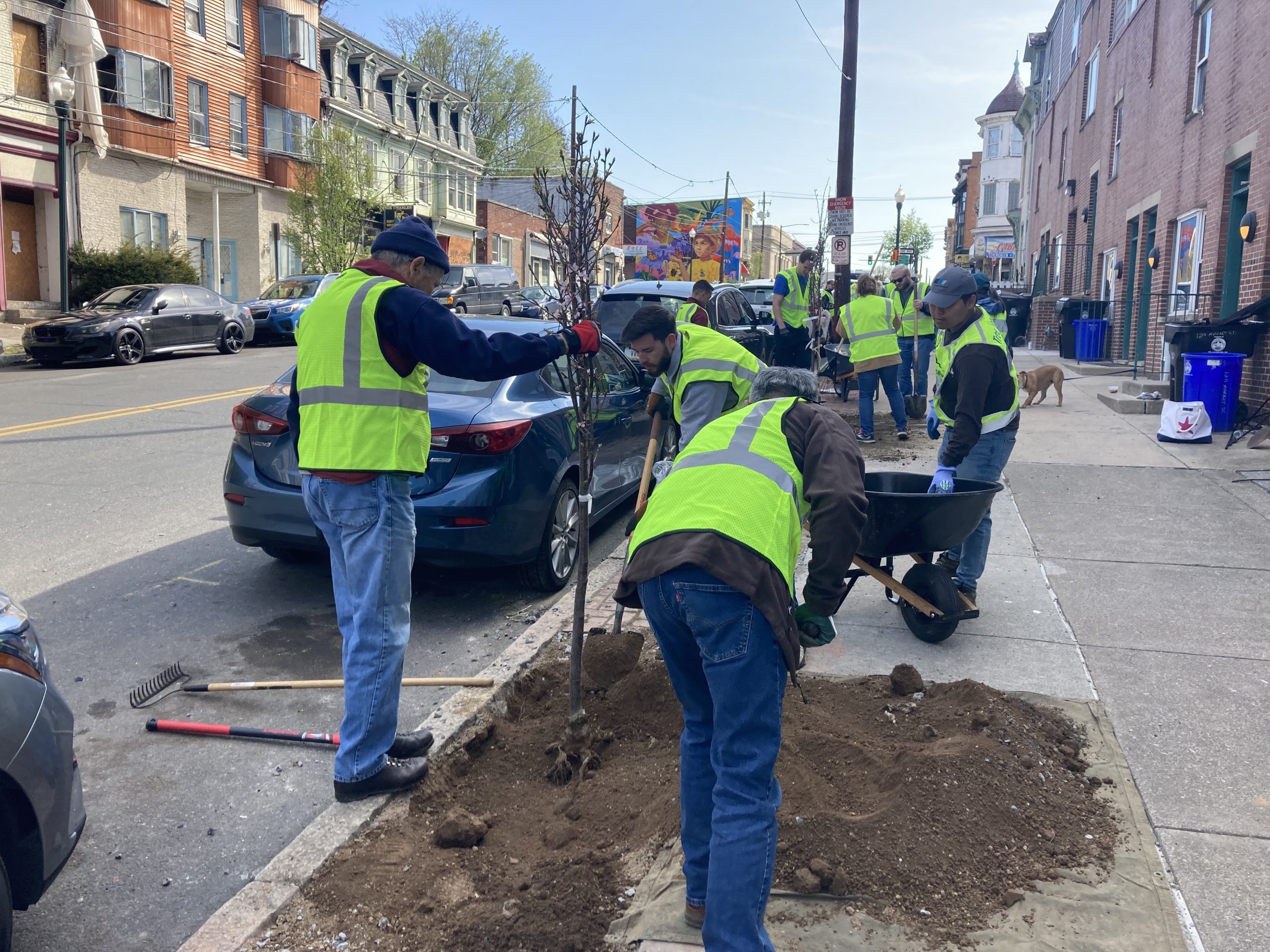
On Friday, volunteers planted trees along Market Street, between Cameron and 15th streets, coinciding with the 150th anniversary of the holiday.

“This is the city of Harrisburg’s way of showing support for our community and celebrating Arbor Day,” said Dave Baker, director of parks and recreation for the city, at a press conference.

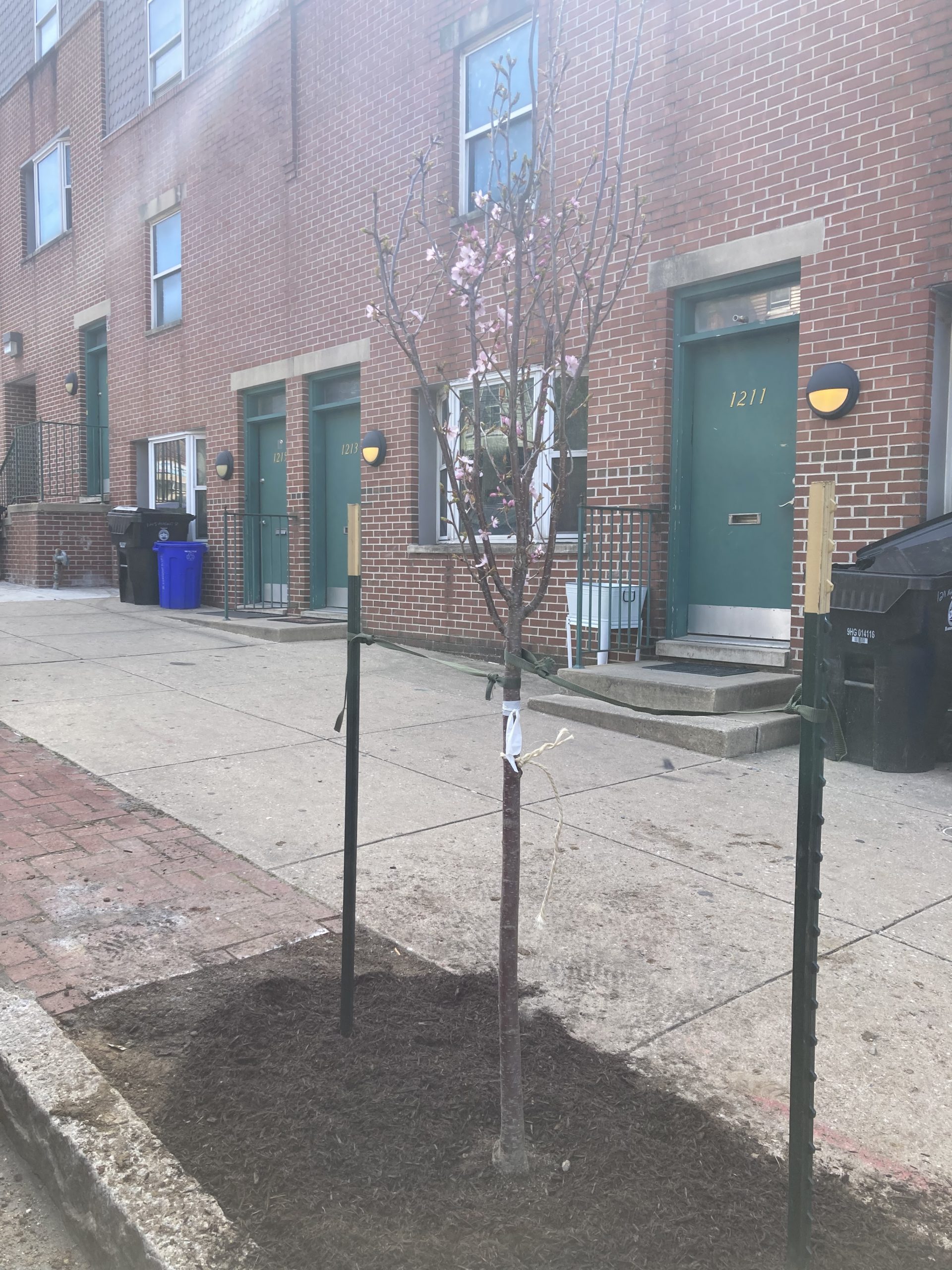
A new cherry tree planted on Market Street

On Friday and Saturday, volunteers will plant nearly 50 trees, mostly cherry, along the corridor. In March, the city removed around 30 dead and dying trees from the street with help from Pennsylvania Power and Light (PPL), who donated their services.

The city received a $21,500 grant from the Arbor Day Foundation and the United Parcel Service’s (UPS) “Planet Protection Program,” to assist with its efforts. Several UPS employees volunteered at the tree planting on Friday, as well.

The National Recovery Agency also pitched in, by donating $1,000 for a future tree planting.

At the press event, the Pennsylvania Department of Conservation and Natural Resources (DCNR) awarded Harrisburg, for the 30th time, the designation of Tree City USA in conjunction with the Arbor Day Foundation.

Earlier this month, the city also planted 17 trees along Vernon Street between 13th and 17th streets.

“These trees add a tremendous amount to a community,” said Ellen Roane, city forester. “They’re environmental workhorses.

Besides beautifying a neighborhood, Roane said that street trees better the environment, increase property values and can even encourage business.

A tree planting volunteer, Shelly Page, summed it up best.

“The world needs more trees,” she said, at Friday’s event.

If you like what we do, please support our work. Become a Friend of TheBurg!


Continue Reading

Some construction to resume on State Street, as Harrisburg begins to draft project redesign

State Street on Allison Hill in Harrisburg

Construction along State Street in Harrisburg is slated to resume on Monday, focused mostly on completing unfinished sidewalk ramps.

Late on Thursday, Matt Maisel, the city’s communications director, issued a statement saying that the halted project would re-start next week in a limited scope.

This work includes finishing construction of the ADA-compliant sidewalk ramps at intersections. Work also will begin on drainage enhancements and traffic signal pole installations, according to Maisel.

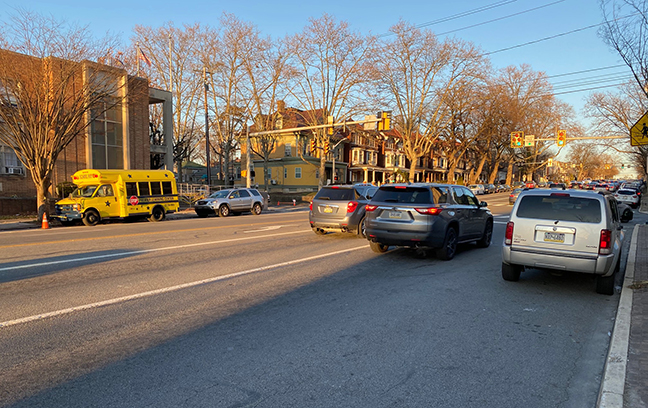
All work on the State Street Rapid Response project stopped last week after the city issued a cease-and-desist order. In its original configuration, the project would have reduced lanes on the state-owned road from five to three, would have created a median refuge area for pedestrians, and would have added protected bike lanes.

This work is designed to improve safety on State Street, which has been the site of numerous pedestrian fatalities in recent years.

However, the “road diet” would have forced residents parked along the street to move their cars during peak traffic hours, as there would be no parking in the westbound lane heading into the city in the morning and none in the eastbound lane heading out of the city in the afternoon.

This prompted objections from some Allison Hill residents, which led the city to issue the cease-and-desist order. Meanwhile, some city bicycling advocates were displeased that the work had stopped.

According to Harrisburg’s business administrator, Dan Hartman, the city’s engineering department is working to create a new road design that will address the State Street community’s parking needs, while still providing for pedestrian, bicycle and vehicle safety and mobility.

“The prior plan didn’t really incorporate all of those components in a fair way,” he told members of the Intergovernmental Cooperation Authority, the city’s state-appointed financial oversight body, at a meeting on Wednesday. “But with the amount of space we have in the area, it’s completely doable.”

The outreach process will kick off this Tuesday at a City Council meeting, when the administration will make a brief presentation on the project to council members and the public, Hartman said.

“They’ll listen to comments and concerns from city residents at that meeting,” he said.

The city then hopes to have a new design drawn up “in the next two months,” Hartman added.

In the meantime, work will continue on the sidewalk ramps, which have to be widened to comply with federal Americans with Disability Act (ADA) requirements. That work will impact parking between 6 a.m. and 6 p.m. until that part of the project is finished, which is expected to take about one month, according to Hartman.

If you like what we do, please support our work. Become a Friend of TheBurg!

Continue Reading

2022 Midstate Table

Celebrate Harrisburg Restaurants!

Over the past two years, Harrisburg area restaurants have been through a lot. Of all the businesses that have suffered through the pandemic, our restaurants may have had the most obstacles to overcome. But overcome, they have! That’s why there’s extra reason to celebrate this year as we bring you our annual special section dedicated to local dining.Flip through this array of delicious dishes then venture out for something tasty. Savor the meal—and savor the moment, too.

Sponsored Content

Continue Reading

Look Both Ways: Along 2nd Street, Harrisburg is on the verge of righting a 7-decade wrong turn

Eli Downie

Eli Downie has a love-hate relationship with his Midtown neighborhood.

“The community is super friendly,” he said. “It’s very welcoming here. All of my neighbors are great. Even the funeral home across the street is very, very courteous.”

And what about living on the de facto highway known as 2nd Street?

“That’s where the hate comes in,” he said. “My car got hit twice.”

Until this spring’s curb cuts and road milling began, city residents could be forgiven for doubting that the conversion of 2nd Street from one way to two, from Forster to Division, would actually occur. But it is happening, with the two-way switch slated for June, say city officials.

On that day, 2nd Street goes back to the future, with a feel that was lost in the 1950s when the city and state converted the pleasant, two-way boulevard to one way, all in the name of giving suburban commuters a quick escape route.

Percy Bullock

The stars of the 2022 conversion are the roundabouts at Verbeke, Reily and Kelker streets. On a misty afternoon recently, Percy Bullock, project manager and acting director of the city engineering department, stood at 2nd and Verbeke and shared the details with TheBurg.

Drivers approaching from the north and south will navigate the roundabouts like a wheel. Pedestrians will cross 2nd Street via raised walkways. A bicycle lane will circle with the roundabouts and continue along 2nd Street between parked cars and curbs.

At the roundabouts and at intersections along the project route, large crosswalks will guide pedestrians across the street, and yellow hobnails in the ADA-accessible curbs will alert the visually impaired to crossings while providing traction for wheelchairs.

It’s all part of Vision Zero, the 2019 plan for safer city streets, said Bullock. On 2nd Street, the issue has been vehicles racing down the 25-mph boulevard at speeds more like 50 or 60.

“Slow the traffic down, and that is the point of it,” Bullock said. “People may not like that, but that’s the point, to slow down traffic and give people an opportunity to not have an accident.”

As a result, he predicts, more businesses will set up shop and neighborhoods will be safer.

“You highlight the city, make it more homelike,” he said. “You’ll see a miracle happen.”

TheBurg just had to ask. Will the approach to the roundabouts be painted with the same squirmy-looking arrows at the new 7th and Reily streets roundabout?

“They do throw you off,” Bullock agreed. “I understand. Once you go through it a few times, you say, ‘I see what they mean.’ Most of the people driving here are regulars. They get used to it.”

The work will continue through October, said Bullock, who started his career digging streets 15 feet down and can tell you a few things about the types of boot soles needed when pouring hot asphalt.

Remaining tasks include repaving, completing the roundabouts, replacing outdated utility poles and street signs and rerouting electric lines. Some intersections will feature left-turn lanes and pedestrian islands. Traffic lights will hang on poles instead of wires, and they will be the dimming type that keeps motorists guessing until they’re close.

On paving days, there will be no-parking notices and 7 a.m. wake-up calls from police sirens alerting residents to move their cars, because backing up a hulking paver to cover a missed area costs the project time and money. Besides, the alternative for residents is paying hundreds of dollars for towing and ransoming the vehicle from storage.

“I really don’t want you towed,” Bullock said.

As for that asphalt, it’s a durable model expected to last 10 or 15 years. Sadly, Bullock couldn’t promise fewer potholes.

“We don’t see that coming up, but Mother Nature can split potholes in the north,” he said. “This is a much more durable surface. Engineers have come a long way in figuring out the impact on surfaces of inclement weather.”

Rumors fly, of course. One resident heard that the roundabouts won’t have fountains or trees in the middle so big trucks that can’t navigate the curves can drive right through.

Not quite.

“(Vehicles) may have to run up on the edge of the curb to get around, but in no way would they be driving over the middle,” said city Communications Director Matt Maisel. “That would be highly illegal and is why we would not expect anyone to do that.”

Ruth Prall

Uplift & Upgrade

Ruth Prall, owner of Note. Bistro & Wine Bar at 2nd and Harris streets, has been a conversion supporter from first announcement. She already loves her location.

“It feels like you’re in the middle of the coolest little neighborhood, and we are,” she said.

Prall envisions heightened visibility for her business and a more pleasant atmosphere for the customers dining al fresco under the lights strung over the corner (where the project also delivered a “lovely little improvement” in the form of a new sidewalk to accompany the curb cuts).

“I think it’s going to be a serene city street,” she said. “It’s going to be more pedestrian friendly.”

As the city continues attracting new residents, the conversion could lure businesses farther uptown, Prall added.

“That would do everybody good, to have a little more commerce there,” she said.

Ed Jaroch is renovating a long-vacant duplex in the 1500-block of 2nd Street for his own home and rentals, and he is “all in on the two-way camp.” With the one-way street, traffic “takes off like it’s a drag race,” he said. As a member of Midtown Action Council, he looks forward to the safer walk to the Susquehanna River for all Midtown residents.

“We have miles of undisturbed riverfront view,” he said. “In many other cities, they put highways down their riverfront. That’s the gem of what makes Midtown such a nice neighborhood.”

Sydney Musser, Downie’s neighbor in the 1300-block of N. 2nd, counts the toll of accidents by the missing side-view mirrors on parked cars. She triple-checks before crossing the street to walk her dog, looking both ways because she has seen cars going the wrong way.

When the milled street slowed traffic considerably, Musser didn’t have to “dart across before somebody comes whipping through.”

“I feel like I am always very, very aware of my surroundings,” she said.

Musser and her neighbors worry about the project’s impact on an already cramped parking situation, but the conversion will unveil a safer scenario for people and vehicles, she believes.

“I do think it’s a good thing,” she said. “I hope it makes things much safer. I hope it slows people down. I hope it makes it feel more like a residential area.”

Downie’s front-door security camera has filmed numerous accidents and the occasional wrong-way driver. He understands the need for snazzy downtown and Midtown infrastructure. As a former Allison Hill resident, he hopes to see similar investments citywide.

“For safety purposes, it’s really great they are investing in the city,” he said. “I wish they would invest even more in more places to bring up the overall quality of life for people not just in Midtown but in Allison Hill and other portions, as well.”

The final project—early wake-up calls and all—will lead to happier residents, tourists and businesses, as well as safer pedestrians, Bullock said.

“I enjoy seeing Harrisburg uplift and upgrade,” he said. “Things are changing. When that takes place and everybody comes together in one accord, everything is possible. That’s a plus.”


If you like what we do, please support our work. Become a Friend of TheBurg!

Continue Reading

Portrait of a Mayor: For 2 decades, Wanda Williams has made her priorities, her policies known in Harrisburg. Now, she occupies the city’s highest office

Wanda Williams. Photo courtesy of the City of Harrisburg.

“I think everyone knows about Wanda already,” Harrisburg’s new mayor said when I told her I wanted to write a story not so much on her position, but on her, as a person.

“Just going to the grocery store, I only had to get six things, but it took me two hours to get out of there because I was stopped about 10 times,” Wanda Williams said.

Even people from surrounding cities have approached her. She’s traveled to Philadelphia and Maryland and has been recognized, she said.

“That makes you feel good.”

It’s true, as a lifelong resident of the city and long-time public figure, Williams is widely known. She’s known in this town, not only for her time on Harrisburg’s school board or as City Council president, but as a neighbor, relative, friend, cheerleading coach and after-school tutor for neighborhood children.

Williams is right—a lot of people do already know who Wanda is and have way more stories about her than I could ever fit into this piece. And as Harrisburg’s 39th mayor for the past four months, Williams has taken on even more recognition and responsibility in the community she calls home.

This recognition, this position, it’s a place that, as a young girl, she never envisioned herself having. In fact, it stands in contrast to her personality for much of her younger years.

“I was a quiet individual,” Williams said. “I kept to myself.”

She mostly spent time with her sisters and family, she noted. Coincidentally, her closest childhood friend was also named Wanda. “Wanda 1” and “Wanda 2,” as they were called, remained friends for years.

Her high school years started the introverted young Williams on a new course, as she joined the debate team with the encouragement of her high school teacher.

Before his passing, Williams’ father would tell her, “You’re always my little debater.”

She went on to attend HACC, where she studied criminal law and met her husband Jerome. Since then, she worked in the office of the attorney general, for the local AFSCME branch as a union president and for the Teamsters Union.

“I’ve always wanted to be an advocate for those who couldn’t speak for themselves,” Williams said.


Becoming a Fighter

In 1998, Williams joined the Harrisburg school board as a concerned parent of children in the district. But, after becoming unhappy with how former Mayor Steve Reed was handling the school district as the receiver at the time, she decided to run for City Council. From 2006 to 2021, she served on council, sitting as president for her last two terms.

“I was quiet all of my life, but then my husband told me, ‘You’ve gotten to be such a fighter,’” Williams said. “I said, ‘I have to, there’s a reason and a cause now. I’m going to be the voice for the people.’”

After her 15 years on council, Williams, 68, was ready to retire. She and her husband had all of their vacation plans laid out. But then, Williams grew distrusting and unsatisfied with incumbent Mayor Eric Papenfuse as he prepared to run for a third term. So, as she had done with school board and city council before, she decided to do something about her concerns. In March 2021, she announced a run for mayor. She won the race and was inaugurated in January.

But the process getting there wasn’t an easy one emotionally for Williams, who faced harsh criticism and personal jabs from Papenfuse, who, after losing the primary, launched a write-in bid for the general election.

“My father got a little upset when he heard of all the negative criticism and he said, ‘If I was younger, you know I would do something about that,’” Williams said with a chuckle. “He encouraged me to keep my head up.”

At the same time, both of her parents’ health was declining. Before Williams’ mother was diagnosed with dementia, she knew her daughter was running for mayor, and she was so proud, Williams said.

Within a few weeks of each other, during Williams’ campaign season, both parents passed away.

“My dad, one last thing he said was, ‘You’re going to win, I love you,’” she said, tears running down her face.

Facing the criticism during that time, Williams said that she reached a peak of anger, wanting to clap back at the negative messages being shared about her. But, she remembered her parents.

“I wanted to come out negatively, but I remembered, it’s not good, just keep your faith,” she said. “But I won. I was victorious. I’m here for four years, and they can’t do anything about it.”


Trust Building

During her campaign, Williams leaned heavily on her position as a lifelong city resident, counting on recognition to win votes. She repeatedly assured constituents that she would be an approachable, relational mayor.

For her first few months in office, she believes that she has followed through on that. She pointed out her open door initiative on Fridays, where residents can meet with her to voice concerns. Williams also has taken to visiting the scenes of residential fires and other emergency situations.

She shared a story about visiting the home of a young woman whose roof was severely damaged during a windstorm. Walking through the house on a Saturday, Williams discovered a dysfunctional furnace, busted pipes, doors without locks, and a disabled family member suffering in the cold. Since then, the city has made repairs to the home, and, through federal housing funds, is installing a new furnace and working pipes.

“These are the kind of things that make me feel like I needed to be in this position,” Williams said. “The most important thing I have with people in this city is that they trust me. They know that, if they ask for assistance, I’m going to try hard.”


A Legacy for Harrisburg

Williams recalled, in high school, the first time a Black student was chosen as homecoming queen. It served as a beacon of hope for her that things were changing in the wake of the Civil Rights era. Yet, as a girl, she was still a long way from seeing a woman or person of color as mayor of her city. It was even more unimaginable that she would be in that seat one day, she said.

Now, Williams is Harrisburg’s second female and second Black mayor. She’s already seen what that’s meant to many city residents.

“It is such a legacy for the young people that I’ve engaged with,” she said. “One girl said, ‘Well if you’re the mayor, then I can be the president.’”

Caring for the city’s youth has been one of Williams’ priorities. After all, she is a mother of five, a grandmother of 18 and a great-grandmother of 16, with another on the way.

Beyond that, she’s passionate about creating more affordable housing, paving streets, providing consistent city services, cleaning up trash, demolishing blighted buildings and promoting homeownership. Gun violence is another priority, as it has spiked recently in the city. Williams’ administration is taking steps to address that, she said, through a possible contract with an organization that would study group violence in Harrisburg and work to prevent it, among other goals.

She also soon plans to propose uses for the city’s $48 million portion of federal American Rescue Plan funds, a historic inflow of cash for the city.

But overall, Williams summed up her vision for the city, her home, as “a revitalized Harrisburg.”

“I want to see people walking around and just enjoying the city,” she said.

Williams’ work has really only just begun. She inevitably will face long hours over the next four years with many obstacles and frustrations, as well as victories.

So, when she gets home for the night, and her husband has dinner ready, which he’s been doing since he’s retired, it’s “just wonderful.”

“I kick off my shoes, sit down and watch NCIS.”

If you like what we do, please support our work. Become a Friend of TheBurg!

Continue Reading

Poetry in HBG: Local poets heal, find meaning through putting pen to paper

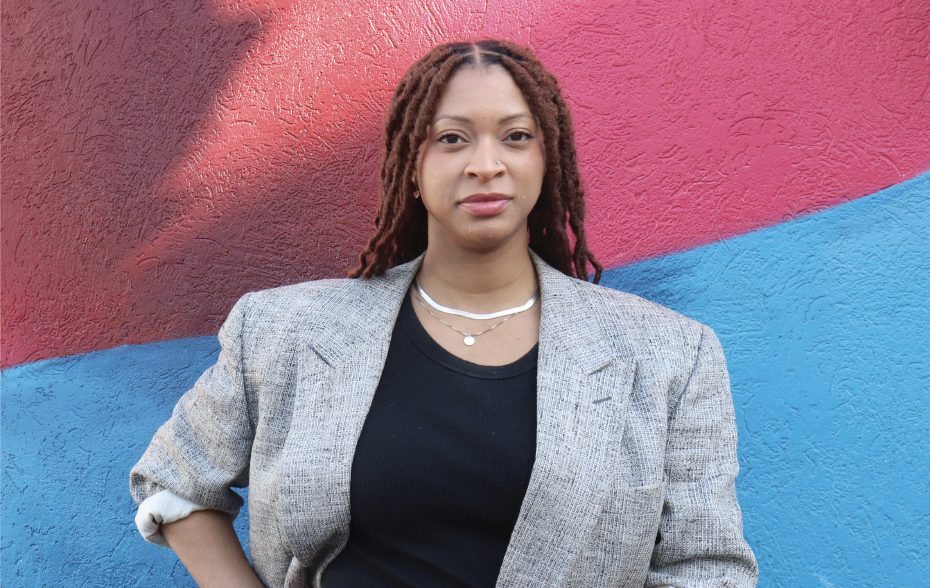
Erika Eberly

Picture this. A poet finishes reading her newest work in a dimly lit basement. The audience doesn’t snap, as is customary for these kinds of gatherings, but just claps. Revolutionary. It’s almost poetic in itself.

The not snapping, the plastic-cup-of-alcohol drinking, the incense burning—it all sets the scene for Thursday nights at H*MAC in Midtown Harrisburg.

On my right sits a guy in a hoodie and trucker hat, on the left, a young woman in a cheetah print dress and cheetah print jacket, and across the room, an older man in a matching set—fur hat, fur coat and fur leg warmers.
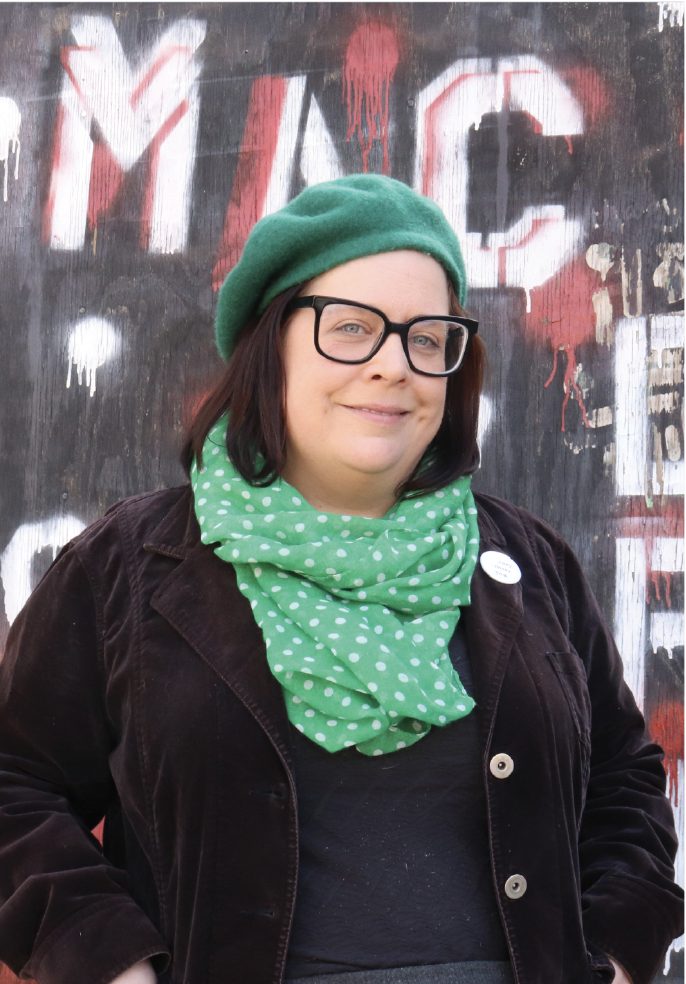
Amy Trout

The self-professed “leader of this ragtag group,” Amy Trout, steps onto the stage in her pink beret hat. She recites a poem that starts out about men bothering women at a bar and ends with the scathing realities of sexual assault and its victims who aren’t always believed. She speaks intentionally fast and passionately. And then, ding. She taps the bell on the string-of-lights-wrapped podium, signifying the end of the poem.

Ringing the bell is one of only two rules of the poetry-reading group. The other is that you can’t apologize. Throughout the night, only one person slips up on that rule, and the group catches it. Lastly, the readings are uncensored—a fact that the group seems to take pride in, that you can get on stage and say whatever you want. You have a captive audience.

These are the Blacklisted Poets of Harrisburg, a group that Trout formed as a continuation of the former Almost Uptown Poetry Cartel, which ended in 2021 when its organizer retired.

One thing I learned from the Thursday night reading was that poetry takes many forms and is very diverse in its expression. That’s something you’ll see evidenced in the Harrisburg poets featured in this story. However, poetry seems to serve mostly the same purpose for writers—it’s therapy. And after the past few years that we’ve had, who couldn’t use a little therapy?

 Cathartic

Thursday night’s poetry reading covered every topic—the backstabbing ex, the loss of a loved one, the love affair and entitled men. Ding. Also mental health, science, pregnancy and God. Ding. Then some that either I wasn’t artsy enough to comprehend or just didn’t quite make sense. Ding.

Anthony Honorowski, aka hoodie guy, was the third to step on stage after science poems guy.

“When you come here, you can let it out and express anything you want,” Honorowski told me earlier that night.

That hasn’t always been his experience, he explained, especially during his time in the military.

“It’s very ‘grin and bear it,’” he said. “A lot of stuff gets bottled up.”

At the reading, he shared a poem about a girl who he met in a psych ward.

Honorowski, now an EMT, has seen how the pandemic has affected mental health—it’s affected his own. What was already an issue for him, caused him to spiral during COVID. But through the poetry group, he found release.

“It was a very liberating experience,” he said of his first time reading in front of the audience.

Erika Eberly has had a similar experience. She’s been part of the poetry group since 2017, when it was still the Almost Uptown Poetry Cartel, although she’s been writing since she was 7.

“Poetry has always been a way of getting something out there,” she said. “It’s cathartic, releasing and healing.”

Eberly is also a local actress and has performed with Harrisburg’s Narçisse Theatre Company. But there’s something about the vulnerability of poetry that allows her to fully express herself, she said.

“I always tried to put on a happy face,” she said. “But it’s good to lay yourself down naked sometimes.”
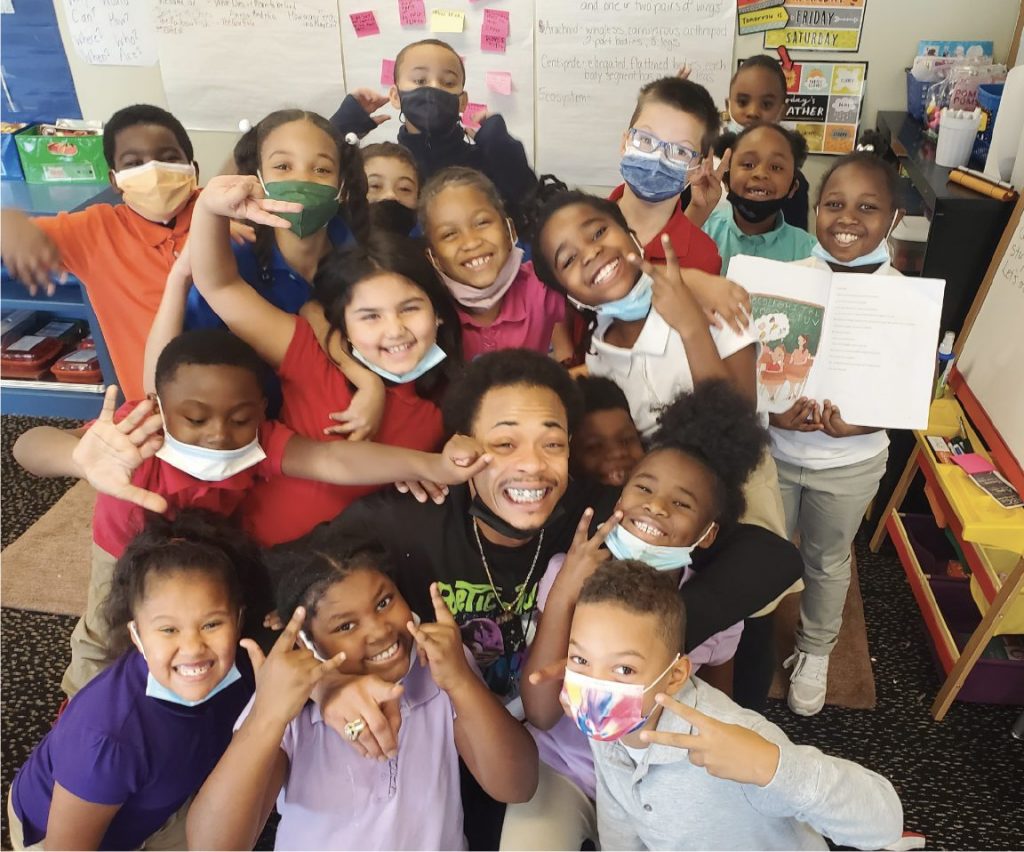
 

Juelz teaching poetry classes.

Literary Legacy

As opposed to the Blacklisted Poets, oftentimes, Harrisburg-native Julian “Juelz” Davenport’s one rule is to censor when reading poetry. It makes sense since he’s regularly reading to young, impressionable minds at local schools.

Davenport has published several poetry books that share his experiences growing up in poverty, witnessing violence and spending time in prison, among other things. He writes to heal himself, but also to help those in the same situations that he once was in.

“I don’t want the kids to go through what I once went through,” he said. “I wish I knew then what I know now.”

Davenport has taught poetry workshops at several area elementary, middle and high schools, including the recently opened STEAM Academy charter school in Harrisburg and Milton Hershey School. He has also visited several juvenile detention centers and youth programs.

“What I’m teaching them is to take what’s inside them and to bring it out,” he said. “I didn’t know how to place my feelings when I was younger. A lot of them are experiencing the same things.”

Davenport even wrote a poetry book specifically for children that encourages kids to have dreams, to stand up to bullies, and accept their peers despite differences.

Davenport has big plans for his poetry and brand, IME Vision, with new books on the way and plans to continue teaching poetry classes to adults and students.

But it all started when he first put pen to paper, as a young man writing letters to his father in prison.

Basil “BooBee” Talib had a similar experience of writing to incarcerated family members.

The Brooklyn, N.Y., native had a rough childhood, he said. His mother died when he was 5, and he never really knew his father.

Talib’s “Aunt Easy” raised him, cared for him, and taught him how to face his fears, he said. She also taught him street smarts: never touch someone’s food, money or girl. Those come in handy, he said.

In his youth, Talib fell in love with the works of writers like Langston Hughes and Malcolm X. They sparked something in him, and he began to write poetry himself.

“I felt like that was the only person that listened to me—that paper,” he said.

When Talib was incarcerated, he continued to write, sharing spoken word poems with other inmates and writing for the prison newsletter.

“In my poems, I share things that I would’ve never shared,” he said. “Without poetry, I would be a ball of rage.”

These days, Talib is a single dad of two sons and coaches their basketball team at the Camp Curtin YMCA in Harrisburg. He has written eight poetry books and speaks at churches, retirement homes and nonprofits, among other places. He has also participated in the American Literacy Corp.’s “500 Men Reading” event. And if you ever ride the public bus in Harrisburg, you might find one of Talib’s poems resting on a seat. He tends to do that, his son Zahkee told me—carry a bunch of print-outs around in his backpack, leaving one here or there for someone to find. Talib just wants to inspire.

“I’ve done so much negative in my life, but why can’t my legacy be positivity?” he said. “When I talk to people, I want to make a lasting impact.”


Gardens

Back at H*MAC, the bell dings again. One poet leaves the stage, making room for Taylor Lagyak. When she first joined the group, she had just given birth to her first child and needed a creative outlet. The first time she read a poem, she spoke fast—she was nervous. During a critique group, the other poets advised her to slow down, that they couldn’t understand what she was saying.

But she’s come a long way. On Thursday night, she recites her poem, “I Don’t Need No Hype Man.” It’s all about confidence.

American poet Marianne Moore once said that “poetry is the art of creating imaginary gardens with real toads.” What has inspired a lot of the Blacklisted Poets, as well as Davenport and Talib, is real pain, mistakes and trauma. It’s even what brought most of them to poetry in the first place. But through poetry, on their terms, they’ve turned those toads into gardens.

A selection from Davenport’s poem, “Young Entrepreneur,” exemplifies this:

Something in us sets us apart from the rest.

Ambition is key to the ignition for what beats in your chest.

Failure is just a fuel for actions or just a tool to build every vision that’s been

thought up by you.

I dropped this little note to keep you on your path.

Go get it!

Be persistent, create your own thing and make it last!

Ding.

For more about Julian “Juelz” Davenport and to purchase his books, visit www.iamjuelz.com. To contact or book Basil “Boobee” Talib or purchase his books, email him at [email protected]. For more information on the Blacklisted Poets of Harrisburg, find them on Facebook.


If you like what we do, please support our work. Become a Friend of TheBurg!

Continue Reading

Recipe for Survival: How did Harrisburg’s restaurants fare through two years of pandemic?

Illustration by Rich Hauck

Save the restaurants!

In the spring of 2020, such was the call around Harrisburg, as the fledgling pandemic looked like it might stick around awhile.

Spoiler alert—it did.

Two years and four surges later, I think we can begin to assess the damage, looking across the landscape as one might do following a devastating storm.

Most restaurants survived, but we lost a few good ones, too (I may forever be in mourning for Bricco’s Kennett Square mushroom pizza).

To discover the secret sauce of survival, I spoke with several Harrisburg restaurateurs to ask them one question—how were they able to make it through this unprecedented catastrophe? It seemed an appropriate query for this month, as May is our annual dining-focused issue.

Even in the best of times, restaurants are among the toughest businesses going—and these certainly were not the best of times. In fact, with apologies to Charles Dickens, they may well have been the worst of times.

At Yellow Bird Café, co-owner Stephanie Perry credited their survival, in part, to a well-placed window that allowed food to be passed from the kitchen to customers waiting outside on Sayford Street.

“We immediately transitioned to the window, and, fortunately, all of our food is takeout-friendly,” she said.

More importantly, though, the Harrisburg community stayed loyal, seeing the snug eatery through the toughest weeks and months. Yellow Bird sits smack-dab in the middle of the Midtown residential neighborhood, so regulars working from home often strolled up to the window to get breakfast, lunch or a snack.

“We already had a good customer base built, plus people really wanted to get out,” Perry said.

A strong customer base was vitally important in getting through the lean times, agreed Beth Taylor, director of operations at Cork & Fork. So was a loyal staff.

“Our team is super-dedicated and stayed with us throughout,” she said. “That alone allowed us to survive. Do you have a good culture to retain your team and can you keep them motivated through this really terrifying moment?”

Like other restaurateurs I spoke with, Taylor described Cork & Fork’s survival strategy as “multi-faceted.” They pivoted quickly, making greater use of their outside seating area and then, when the weather chilled, setting up heated, plastic tents along the sidewalk.

“We had to constantly think of ways to survive,” she said.

But that’s nothing new for the food industry, she added. Even in “normal” times, restaurants need to stay light on their feet, as they’re faced constantly with unforeseen complications and challenges—from staffing problems to supply snags to food costs to customer issues. This experience served them well when the ultimate crisis hit.

Still, the ever-changing pandemic and health instructions required Gumby-like flexibility.

“At first, it was like—just wear a mask, don’t touch this, and don’t do that, and Plexiglass will save you,” Taylor said. “Then it was like—actually, none of that will save you, and, oh, here are a bunch of new variants.”

Over at Deco Grab & Go, owner Callie Alvanitakis was in a unique position. She opened her downtown eatery in early 2021, after a couple of COVID surges had passed, with several more yet to arrive.

Therefore, she started with “pandemic volume in mind,” intent to stay lean and highly adaptable until better times.

“Someday, I’ll have an employee, but right now is not the time,” she said.

In some ways, Alvanitakis considers herself lucky. By beginning when she did, she was able to avoid the cruel rollercoaster ride faced by many other restaurants—shutting down, reopening, scaling up, scaling down, laying off staff, trying to hire them all back.

Still, she did have one unique challenge. Located across the street from the PA Capitol, her business relies greatly on the hunger pangs of state workers, who fled the city en masse and still haven’t returned to full complement.

But even here she’s optimistic. Before starting Deco, Alvanitakis worked at several other downtown spots, and some folks she once served now are discovering her new place.

“Volume is picking up,” she said. “I’m beginning to see some familiar faces again.”

So, then, what’s the bottom line? How did some Harrisburg restaurants survive the culinary cataclysm when others didn’t?

After interviewing these intrepid restaurateurs, I credit their survival to some combination of flexibility, community support, local ownership and sheer hard work and willpower.

So, the next time you’re happily ensconced in your favorite local haunt, I hope you’ll ponder this mini-miracle. Maybe you’ll look around and think to yourself—wow, how did this place survive—and then delight in the fact that it did. Recall what it was like, two years ago, when all seemed lost, when there appeared to be scant hope for the restaurants we love so much.

Compliment the owner, the staff. Savor your meal. Be patient. Tip extra.

Lawrance Binda is co-publisher/editor-in-chief of TheBurg.

If you like what we do, please support our work. Become a Friend of TheBurg!

Continue Reading

Behind the Seams: Harrisburg designers custom make many of the most unforgettable looks at local proms

Jaylene Crawley, Kevin Berry, Satin Monroe and Keya Wilson

Jaylene Crawley remembers getting her first American Girl doll at 8 years old as a gift from her mom. It was an expensive purchase for a mother of four kids, but she saved up, and the two squealed with joy when the doll arrived in the mail.

Crawley was into fashion even as a young girl and couldn’t wait to dress up her doll. But she knew that her family wouldn’t be able to afford extra outfits for it. Instead, she taught herself to sew, picking up tips from her aunt. For hours, Crawley would sew by hand in her room, crafting little dresses for her doll.

She recalls a time when she got caught sewing in class at school. Instead of punishing her, her teacher, Mrs. Cooper, held her after class to give her a sewing machine.

“That’s what jump-started everything,” Crawley said.

These days, she’s still making dresses for American girls, but this time they’re real-life ones. You might see a few of these young women showing off her work this month, as it is prom season.

Crawley is one of several Harrisburg designers working behind the scenes to make local students stand out in their gowns and tuxes for that special night of the year. Chances are, if you’ve seen the pictures of bright, flashy, extravagant prom attire, you were looking at the handiwork of one of these local fashion gurus.


Sew Sisters

Crawley designed her first prom dress for a client in 2007. For the first few years, she stuck to creating one dress a year for prom. But over the years, that number rose to as high as 21 for a single prom season.

Depending on the gown, it can take anywhere from a few hours to weeks to design and sew a dress. She described herself as a designer as “avant-garde,” which “means over-the-top in fashion,” she said. Crawley explained her work as wearable art. And there’s no better example than her money dress.

“I want to look like a million bucks…literally,” a former prom client of Crawley’s explained to her.

Fifty-five hours of work and many stacks of fake money later, and the student was walking into her high school prom covered in cash. It didn’t take long before the dress went viral online.

“Just to see the girls light up makes my day,” Crawley said.

During the sometimes stressful and taxing season of designing, Crawley is grateful for her support system—her “sew sisters.”

A handful of years ago, she met two other Harrisburg designers, Keya Wilson and Satin Monroe. They instantly clicked and, since then, have leaned on each other with encouragement, questions and, when needed, by lending an extra zipper.

“Everyone can succeed, thrive and still help each other,” Crawley said. “We don’t need competition. No one takes from the other. We all want to see each other do well.”


Tuxceded Expectations

While the “sew sisters” get the ladies ready for prom, Kevin Berry of Covered By Style and Grace is making sure all the guys look just as fly.

“When you dress good, you feel good,” Berry said.

While Berry always had a “passion for fashion,” as Kanye West, his fashion role model, said, it wasn’t until a few years ago, after a job loss, that he could finally make that passion a business.

His style has remained the same over the years. It’s sophisticated and elegant, but often with a unique touch. He remembers his own prom experience, when his dad took him to get his first custom suit in Philadelphia. It was inspired by, of course, Kanye. Berry would still wear that suit, if it fit, he said. It still hangs in his closet—off-white with a bright pop of coral pink.

Now, like his dad did for him, he makes other young men’s fashion aspirations come to life. He’s worked with clients from Bishop McDevitt, Harrisburg High School, Susquehanna Township, Milton Hershey and Lower Dauphin, among other schools.

He has also partnered with the “sew sisters” on prom pop-up shops, and it’s not uncommon for one of his clients to be headed to prom with one of Wilson’s clients. They’ve created a few matching prom looks.

While he hasn’t yet mastered tailoring, Berry designs all the suits and works with local Giovanni’s Tailor Shop.

“If it’s not something I would wear, it’s not something I would give you,” he said.


A Million Bucks

“I’m really picky,” admitted Makayla Tumer, who graduated from Susquehanna Township High School last year.

Prom was something that Tumer thought about since she was a little girl. Once she was in high school, she planned for the big night for over a year.

“I didn’t want a dress that looked like anyone else’s in my school or in the area,” she said. “I wanted to look different.”

When she approached Wilson, who owns Pieces of Me, a design business, Tumer was unsure if Wilson would be able to make her vision come to life. She envisioned a dress adorned with tiny mirror pieces and rhinestones. It wasn’t easy, but what’s Wilson if not the fairy godmother of prom dresses?

“It was the best dress of the prom,” Tumer said, without hesitation.

When you commission Wilson to make a dress, you don’t just get the dress, you get a whole experience. She’s constantly communicating with you during the design and fitting process and will often personally come to your house on prom night to make sure you’re ready to go.

“The best part is, when it’s complete, and you see them dressed up and they’re so happy,” she said. “It’s really rewarding.”

Like Crawley, Wilson is largely self-taught in sewing. What began as a way to make unique clothes for herself grew exponentially once people started asking for custom pieces from her.

Handling the volume of dresses that she works on each year is a challenge—she once sewed her fingers together—but it’s worth it.

“It can be stressful, but I never get tired of it,” she said.


Stitching Smiles

While “sew sister” Satin Monroe had training in fashion design, it wasn’t until after she gave birth to her daughter that she really got serious about it. She needed some extra income and decided to sit back down at her sewing machine.

“My daughter was my inspiration,” she said. “It made me fall back in love with being creative. Taking a chance on myself led me to where I am.”

Now, she designs a minimum of 20 gowns each prom season. She hopes, one day, to design a collection of gowns and to hire some staff members to help with the workload.

There are a lot of hours, thread and sequins that go into prom outfits that turn heads and make the newspapers. There’s also a lot of passion and heart for the clients that the designers are dressing.

While custom designs can be expensive, Berry works to make sure his tuxes and suits are still affordable.

“I want everybody to have the opportunity to dress well,” he said.

Wilson also caters to those who may not be able to afford a custom gown by designing and giving away a free dress to one student each year.

Diamond Thomas, who attended Central Dauphin East High School, was one of these recipients. After Wilson heard of Thomas’ struggle with chronic pain, she decided to give her a special prom experience.

Not only did she make her a custom dress, but she paid for her hair and makeup to be done and came to her house to help her get ready.

“She worked her magic,” Thomas said. “It was a rough year, so it was like a weight lifted off my shoulders. I will forever remember that experience.”

When Wilson and the other designers are stressed, working long nights to get all of their prom orders finished, these reactions keep them going. It’s about more than a gown or tux. It’s the business of making people feel good, making them happy.

“In the end, it’s the smile that keeps me going,” Crawley said.

Jaylene Crawley, Keya Wilson, Satin Monroe and Covered by Style and Grace by Kevin Berry all can be found on Facebook.  

If you like what we do, please support our work. Become a Friend of TheBurg!
Continue Reading

Heritage Heralded: May event to celebrate, support Harrisburg’s Asian American, Pacific Islander community

Ellen Min (front, center) and members of HAAPI

“The Atlanta shooting just wrecked me,” said Ellen Min.

As Min sat in the Green Street Little Amps, the March day seemed like any other. People greeted one another as they took their seats in the cozy neighborhood coffee shop. But for the Asian American and Pacific Islander (AAPI) community, it was anything but just another day.

It marked the one-year anniversary of the targeted killings of eight people, including six Asian women, in Atlanta.

Min unfortunately had become accustomed to hatred and violence being directed toward her, her mom and dad, grandparents, aunties and uncles. Growing up, she experienced eggs, bricks and tomatoes thrown at their house. There was name-calling and a fight at 10 years old because of her Korean appearance. And in the ‘90s, someone defaced her childhood home with a painting of a swastika and tagged it “gooks.”

“I’ve been told to go home more times than I can count,” said Min.

During the pandemic, walking with her daughter on Front Street, a group of men yelled that they were the coronavirus and should go home. Her 3-year-old waved back in greeting, misunderstanding and thinking they were saying, “Hi.”

Min described another distressing event.

“My husband and I were at the Farm Show Complex and we were drinking our milkshakes and were in a crowd of people, and somebody stuck their head between us and said go the f*** home, you chink,” she said.

The person disappeared in the crowd before Min’s husband could react.

Even with all of that and more, it was the Atlanta shooting that galvanized Min, who admittedly had bought into the myth of the model minority and, up until that point, had continually told herself, “it’s not that bad.”

“It was like the final culmination, like hatred runs so deep that somebody actually would kill us because of it,” Min said. “That stereotype could kill us.”

Immediately after the shootings, a friend, Tiffany Chang Lawson, called Min.

“I need help,” Min told her. “I need to grieve with someone.”

So, they gathered outside around a fire pit, sobbing about the lives lost, about how they saw their aunties and mothers in the faces of those who died.

That’s also when they realized that they needed a group where they could do this very thing—gather, connect and share. So, the Harrisburg Asian American Pacific Islander (HAAPI) group was formed.

Crawdaddy’s Restaurant and Bayou Bar graciously offered HAAPI a place to meet, even though the restaurant wasn’t actually open. And people came.

One of those people was Joe Lee. At HAAPI’s one-year anniversary celebration with music, drinks and lots of conversation, he said that the group offers “unspoken, implicit understanding of a shared experience.”


Bright Light

Two group members with that shared experience are Virginia Lucy and Amy Zecha, both biracial and navigating two worlds, often feeling like neither racial group welcomes them fully. Because of this, Lucy was anxious about trying out the group.

“It was so much better than I thought it would be—a bright light among so many dark moments,” she said.

Zecha, whose Asian American mother had passed away, craved the connection with other Asian Americans. Lucy described being not Asian enough for Asians and not white enough for whites. But she realized, she said, that, “I’m never going to be Asian enough for everybody. I’m never going to be white enough for everybody, just my best version of myself.”

That evening was the first HAAPI event for Sarah Herr. Joining her Caucasian family through adoption, Herr described feeling a sense of loss. She said that she’s never had an Asian friend or been around those of Asian heritage.

“I’m having a midlife crisis at 23,” she said.

The vivacious young woman also described being harassed for her Asian heritage. Once at the doctor’s office, someone told her “go back to your country for bringing corona over,” she said. She described that and incidents of people trying to “jump her” on State Street in Harrisburg and in Washington, D.C.

“It’s a lot,” she said.

The harassment, along with the shootings and assaults of other Asians, made her anxious and at times afraid to go out.

“It’s times like that, that I wished I had an Asian community of friends that could understand,” Herr said.

That defines HAAPI, a community whose motto is, “Stories not Status.” From the beginning, the rule was not asking people what they did for a living. That provided automatic leveling, making the statement that this isn’t a networking group—it’s a group committed to being there for one another and celebrating their heritage.

HAAPI will celebrate Asian Pacific American Heritage Month with the entire Harrisburg community this month during 3rd in the Burg, over the weekend of May 20 and 21. The event will kick off at the Broad Street Market, with happenings at the Midtown Scholar and Midtown Cinema, emphasizing AAPI contributions, stories and culture. Min hopes that this event can help break down walls and bring understanding of people as individuals rather than as a dehumanizing monolith.

“I love the idea of the celebratory, because you bring together people with food and festivities, but the deeper reason is because…when you understand and get to know culture so deeply, your stereotypes, your prejudice, the discrimination melt away because there’s a humanization and dignifying of the communities,” Min said.

At Crawdaddy’s, the group settled in with drinks and comfortable banter. The feeling of relaxed familiarity permeated the scene.

“This is definitely a community in central PA that we didn’t have,” Lee said.


The Harrisburg Asian Pacific American Heritage Month celebration takes place May 20 and 21. To learn more about HAAPI and the event, visit Instagram @AAPIHBG or contact HAAPI at [email protected]

If you like what we do, please support our work. Become a Friend of TheBurg!
Continue Reading

“Here’s the Keys”: Jeannetta Politis takes the reins of Joshua Group, continuing the group’s pro-education, anti-poverty mission

Jeannetta Politis

Joshua Group may have a new leader, but its mission remains unchanged—to help disadvantaged youth in Harrisburg.

In February, Jeannetta Politis was appointed executive director, filling the shoes of well-known founder, Kirk Hallett, who retired after a long career.

“I plan to continue Kirk’s mission of providing at-risk youth in Harrisburg with educational opportunities and to expand the program,” Politis said. “I also want to find additional ways to serve our students with developing a strategic plan to provide more services.”

Joshua Group operates as a nonprofit learning center, offering pre-school, kindergarten, summer and scholarship programs at no cost to qualifying families through its various funding and donors. For Joshua Group’s board of directors, Politis’ appointment was a slam-dunk, according to board president Matthew Brouillette.

“Everyone immediately and unanimously embraced the idea,” he said. “Having served on the board herself and understanding both the mission and culture of Joshua, we all knew Jeannetta would be the perfect successor to carry on the work that Kirk started over 20 years ago.”

Hallett founded Joshua Group in 1998 with a broad goal of wanting to help Harrisburg children, he recently recalled.

“I had a mission to help kids in Harrisburg to get an education so they can contribute to society, as well as the job market,” he said. “Joshua Group has always believed in the power of education as the anti-poverty program that works.”

The nonprofit started up that year in the former St. Francis School building and gym, beginning mostly as a recreational program. More programs followed, focused largely on educational issues, helping kids stay in school and encouraging graduation, according to Hallett.

In 2003, Joshua Group representatives and supporters restored a house on the 1400-block of Market Street as an operational base.

“This new location… gave us a greater presence in the neighborhood and allowed us to establish a variety of new programs to include tutoring to fulfill the increased demand for our outreach services,” Hallett said

In 2007, the organization became a program partner of the United Way for its local community work. The Joshua Learning Center opened in 2014, offering a range of educational programs and services in Allison Hill. The facility currently serves around 250 low-income children and families from the Harrisburg School District.

The Joshua Group Preschool Program runs at the center from Head Start’s waiting list for 3- to 5-year olds from low-income families in Harrisburg. Joshua Group also offers a full-day kindergarten licensed by the state Department of Education for up to 17 students, as well as a seven-week summer learning program. The center’s J-Crew After-School Program is a comprehensive academic tutoring and social mentoring program serving more than 175 K-12 students.

Politis has a lot on her plate in her new role, overseeing these many programs and responsibilities. But Hallett said that she has the knowledge, experience and skills that he knew his successor would need.

Indeed, Politis brings “business and numbers” expertise to the job, coming from a career spanning more than 20 years in the retail and commercial banking industry. During her nine years as a Joshua Group board director, she assisted Hallett with a strategic course of philanthropy to better coordinate corporate giving with Joshua Group’s educational mission. In fact, she most recently served as the board’s secretary.

“Jeannetta has been perfect for us,” Hallett said. “I believe she was the first person to come to me and say that she wanted the job, and I said to her, ‘Here’s the keys.’”

The Joshua Learning Center is located at 1459 Market St., Harrisburg. For information about its programs or to donate, visit www.joshuagroup.org or call the center at 717-972-0129 or office at 717-236-4464.

If you like what we do, please support our work. Become a Friend of TheBurg!

Continue Reading