Tag Archives: Tom Wolf

More than 200 new COVID-19 cases, 7 total deaths, reported in Pennsylvania

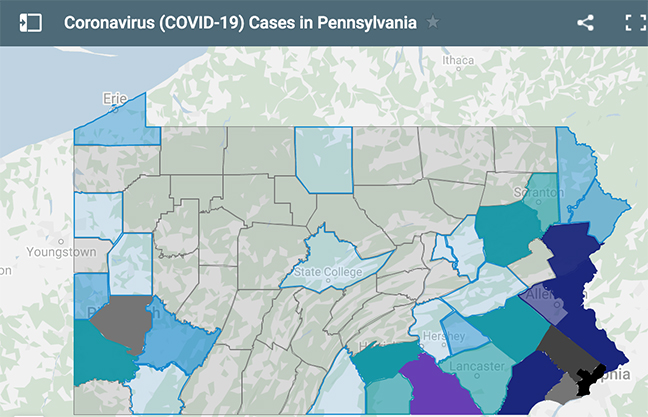
This shaded map from the PA Department of Health shows COVID-19 cases in Pennsylvania.

The number of new COVID-19 cases has experienced its greatest one-day jump yet, with 207 new cases reported throughout Pennsylvania.

The state Department of Health today said that positive cases jumped to 851 from 644 on Monday.

The state also has reported seven deaths from the virus—two in Northampton County, two in Allegheny County and one each in Montgomery, Monroe and Lackawanna counties.

“Our notable increase in cases over the last few days indicate we need everyone to take COVID-19 seriously,” Secretary of Health Dr. Rachel Levine said.

The virus has now spread to 40 of Pennsylvania’s 67 counties, up from 34 counties yesterday.

Just as the state has seen a surge in confirmed cases, so too have local jurisdictions. Locally, Dauphin County now has four confirmed cases, Cumberland County has 13 cases, Lancaster County has 10 cases, York County has 18 cases, Lebanon County has three cases and Adams County has six cases.

Statewide, Philadelphia County has reported the most cases, with 177, followed by Montgomery County with 144.

Statewide, 9,494 coronavirus tests have been performed, with 8,643 testing negative, according to the state health department. Yesterday, the state reported that 7,239 people had been tested for the virus.

On the first day of enforcement on Monday, the Pennsylvania State Police said they had issued 27 warnings to “non life-sustaining” businesses that had not followed Gov. Tom Wolf’s order to close their physical locations.

“As expected, we found the overwhelming majority of people and businesses across the commonwealth are voluntarily complying with the order and doing their part to stop the spread of COVID-19,” said Col. Robert Evanchick, state police commissioner. “This process is two phased beginning with warnings to gain voluntary compliance, followed by enforcement as necessary.”

Levine continued to emphasize that Pennsylvanians should do the following:

  • Wash your hands with soap and water for at least 20 seconds or use hand sanitizer if soap and water are not available.
  • Cover any coughs or sneezes with your elbow, not your hands.
  • Clean surfaces frequently.
  • Stay home to avoid spreading COVID-19, especially if you are unwell.

 For more information, visit the PA Department of Health’s COVID-19 website.

Continue Reading

PA schools ordered to remain shut for another two weeks

Harrisburg’s Lincoln School building

Public schools in Pennsylvania will be closed for at least another two weeks due to the COVID-19 pandemic.

Secretary of Education Pedro Rivera announced on Tuesday afternoon an extension of the closure order until “at least” April 6. The prior order extended only through the end of this week.

“Protecting the health and safety of students, families, teachers and all employees who work in our schools is paramount during this national health crisis, and we must continue our efforts to mitigate the spread of the virus,” he said.

Rivera said that this directive aligns with Gov. Tom Wolf’s “stay at home” order issued on Monday for seven counties: Philadelphia, Montgomery, Allegheny, Bucks, Chester, Delaware and Monroe.

Rivera on Monday also cancelled standardized testing for students in career and technical education (CTE) programs for the 2019-20 school year. Last week, the department cancelled all PSSA testing and Keystone exams for the 2019-20 school year, as well as the Pennsylvania Alternate System of Assessment (PASA).

“The number of positive cases increases daily and we’re seeing it spread to more counties. We must adhere to the social distancing guidelines,” Rivera said. “Extending the closure will help every community in its efforts to mitigate the spread.”

Continue Reading

More than 100 new COVID-19 cases reported in PA, including first in Dauphin County; state police to begin enforcement

The state Department of Health’s map of COVID-19 cases in Pennsylvania, shaded to indicate affected counties.

Pennsylvania now has 479 confirmed cases of COVID-19, including the first positive case in Dauphin County.

This represents an increase of 108 confirmed cases since yesterday, according to the state Department of Health. Deaths from the disease remained unchanged at two people statewide.

Locally, besides the single positive case in Dauphin County, Cumberland County has 11 cases, York County has 10 cases, Lancaster County has six cases, Lebanon County has three cases, and Adams County has reported five cases.

Thirty-three of Pennsylvania’s 67 counties have now reported cases, five more than yesterday.

Philadelphia County now has the most cases, with 91, overtaking Montgomery County, which has reported 87 cases.

“Our notable increase in cases over the last few days indicate we need everyone to take COVID-19 seriously,” Secretary of Health Dr. Rachel Levine said. “Pennsylvanians have a very important job right now: stay calm, stay home and stay safe.”


Cases are increasing rapidly in the state, but so is testing for the coronavirus.

The health department said today that 5,443 people have been tested in Pennsylvania, with 4,964 testing negative for the virus. That’s an increase of 1,574 tests since yesterday.

Separately, the state police today said that, beginning at 8 a.m. on Monday, they would start assisting in the enforcement of Gov. Tom Wolf’s order to shut down the physical locations of “non life-sustaining businesses.”

“The priority of the Pennsylvania State Police is protecting lives and maintaining order in the commonwealth,” said Col. Robert Evanchick, state police commissioner. “In light of the ongoing COVID-19 epidemic, troopers and liquor control enforcement officers are prepared to ensure compliance with Gov. Wolf’s order.”

Businesses, he said, “face possible criminal penalties” if they refused to shut down. Last week, the state Liquor Control Board stated that liquor license-holders faced sanctions and penalties if they refused to comply with an order banning on-premises consumption.

Wolf also issued a statement today to “remind” state residents that grocery stores, food processors and food banks remain open during the COVID-19 pandemic. Pennsylvanians, he said, “should feel confident in the food supply and shop for food at their normal rate.”

“Even in a pandemic, grocery stores and food banks are life-sustaining and accessible; food production and distribution are continuing,” Wolf said. “I urge all Pennsylvanians to have faith in our food system.”

He also cautioned against hoarding.

“If each one of us commits to only buy what we need, there will be enough for everyone and their neighbors,” he said.

He also credited the state’s agricultural industry “for providing a safe, continuous food supply.”

“I’m incredibly proud of and grateful for this dedicated industry,” Wolf said. “These times will pass. But in the meantime, you can know that they’re working hard and making smart decisions to fill the shelves of your local grocer.”

Levine continued to emphasize that Pennsylvanians should do the following:

  • Wash your hands with soap and water for at least 20 seconds or use hand sanitizer if soap and water are not available.
  • Cover any coughs or sneezes with your elbow, not your hands.
  • Clean surfaces frequently.
  • Stay home to avoid spreading COVID-19, especially if you are unwell.

For more information, visit the PA Department of Health’s COVID-19 website.
Continue Reading

The Week that Was: News and features around Harrisburg

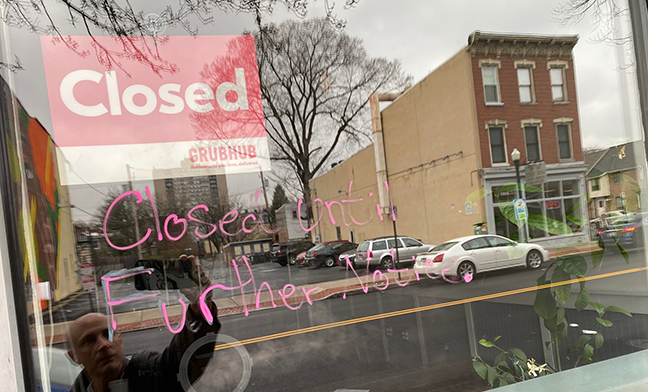
“Closed” signs abound throughout Harrisburg’s business districts.

Around Harrisburg, the past news week amounted to all-coronavirus, all the time, as all other stories understandably took a back seat to the pandemic. At TheBurg, we had both a statewide and local focus, and, if you missed some of our coverage, we have it all listed and linked below.

Art can be seen and sometimes even made out of doors. So, our arts blogger is going directly to nature for his art fix, adding a planned plein air event, with adequate social distancing, naturally.

Broad Street Market remains open as a vital food resource in Harrisburg. Our online feature story explains the surprisingly upbeat and very community-oriented vibe inside the city’s historic food and farmers market.

Gov. Tom Wolf ordered the closure of all “non life-sustaining” business offices, telling people to self-isolate at home unless they’re an essential worker. This office shutdown was arguably the most severe restriction of several over the past week.

Harrisburg declared a state of emergency in the city and shut public access to the city government center as a result. Dauphin County followed suit, closing down public access to county facilities. Our online story offers information on how to continue to do business with both governmental bodies.

Harrisburg suspended street parking enforcement for 10 days, along with street sweeping enforcement. Capital Region Water also explained its policies and actions in light of the crisis. We published an online story explaining both.

Harrisburg school district and the city police are collaborating on ways to feed the city’s schoolchildren, now that school has been suspended. Find out how you can help in the effort from our online story.

Mayor Papenfuse went higher tech than usual this past week, employing Facebook Live to connect with residents and answer questions. The fire chief and police commissioner joined him, addressing many COVID-19-related topics.

Methodist churches closed throughout the Harrisburg area last year. Our magazine feature tells what happened with one parish, in our only non-coronavirus story of the week.

PA Department of Health began a daily coronavirus update of cases in PA, with a county-by-county breakdown. We covered them all, including the latest from Saturday.

PA Liquor Control Board cracked down on license-holding bars and restaurants that have refused to close for on-premises consumption. Sanctions will be imposed on violators, warned the PLCB, which also closed all its state liquor and wine stores.

Restaurants and other small businesses are already suffering immensely, forced to shut down to prevent the spread of the virus. In a blog post, our editor makes a plea for the community to support them.

Runners are a committed bunch. So, even though springtime races have been cancelled, they ran the races independently, taking precautions to ensure social distancing. Our reporter, a runner herself, described the scene along the river.

Sara Bozich traded in her usual list of events for a more important list—guidance on how to support local businesses facing devastating economic times. Visit her story and help your neighbors.

Do you receive TheBurg Daily, our daily digest of news and events delivered right to your email inbox? During these difficult times, it’s more important than ever to subscribe here.

Continue Reading

Governor orders all “non life-sustaining businesses” to shut down physical locations

A closed sign on N. 3rd Street in Harrisburg

All “non life-sustaining businesses” in the commonwealth must close their physical locations, according to an order issued late today by Gov. Tom Wolf.

Previously, Wolf had encouraged businesses to close, but now is mandating closures of physical locations by 8 p.m. on Thursday.

Wolf said that he’s requiring businesses to shut down their locations to slow the spread of the COVID-19 virus. As of today’s noontime update, the state Department of Health reported 185 confirmed cases of the virus, including one death.

“To protect the health and safety of all Pennsylvanians, we need to take more aggressive mitigation actions,” Wolf said.

A life-sustaining business includes a broad range of businesses including food, health, transportation and telecommunications businesses. It excludes most consumer goods retail, arts and professional services businesses. Find a list here.

According to a statement from the governor’s office, Wolf derives the power to shut down businesses under the Emergency Management Services Code, once an emergency declaration has been issued.

Failure to comply, Wolf said, could result in enforcement actions including citations, fines or license suspensions.

“This virus is an invisible danger that could be present everywhere,” he said. “We need to act with the strength we use against any other severe threat. And we need to act now before the illness spreads more widely.”

For more information, visit the PA Department of Health’s COVID-19 website.

 

Continue Reading

State adds pressure to ban on-premises consumption in bars, restaurants

A sign on the door of McGrath’s Pub on Tuesday, stating that only takeout is allowed.

The state has turned up the heat on non-compliant businesses, threatening bars and restaurants with liquor license citations if they refuse to stop consumption inside their establishments.

All businesses carrying liquor licenses must cease on-premises consumption of food and beverages by 8 p.m. on Wednesday until further notice, according to the PA Liquor Control Board.

“Medical experts and public health professionals from around the world agree the best step we can take to slow the spread of COVID-19 is to stop gathering in public spaces,” said PLCB Chairman Tim Holden.

Licensees that fail to comply risk citation and suspension of operating authority, according to the PLCB. Ultimately, citations could put the business’s liquor license at risk, both through the citation process and upon application for renewal, the PLCB stated.

In Harrisburg, most restaurants and bars shut down either late last week or on Monday, after Gov. Tom Wolf ordered all “non-essential” stores closed.

Tuesday was St. Patrick’s Day, which typically means overflow crowds at Harrisburg’s many bars and restaurants. However, with bars closed, downtown was deserted.

Bars and restaurants can continue to offer takeout service, which many are doing.

In addition, yesterday, all state-owned Fine Wine and Good Spirits stores closed until further notice. According to the state, beer distributors can continue to operate, but are encouraged to practice “social distancing” and limit store traffic to fewer than 10 customers at a time.

Other places to purchase alcoholic beverages for carryout include license-holding markets and convenience stores, as well as breweries, wineries and distilleries.

“Extraordinary times require extraordinary measures, and this decision is not made lightly,” Holden said. “But saving lives and protecting the health and safety of our communities is our highest priority right now.”

Continue Reading

Harrisburg school district, city police team to ensure food access for students

Harrisburg’s Benjamin Franklin School, one of the meal pick-up locations

On Monday, all K-12 Pennsylvania schools closed for 10 business days in accordance with Gov. Tom Wolf’s mandate during the coronavirus (COVID-19) epidemic.

As a result, the Harrisburg school district will be closed through at least March 27.

But it’s not just classroom instruction that students will miss, as they regularly receive free breakfasts and lunches at school, as well. The district, however, is ensuring that students continue to be fed, even with the epidemic.

“We are trying to put food into our families’ hands,” Acting Superintendent Chris Celmer said.

The school district is giving free grab-and-go breakfasts and lunches to enrolled students. Resources come through their collaboration with the Pennsylvania Department of Education and the National School Lunch Program.

This week, parents can receive food for their children through Friday, between 10 a.m. and 11:30 a.m., at their children’s school. The district asks parents of pre-K to fourth-grade students to arrive at 10 a.m.; fifth- to eighth-grade students to arrive at 10:30 a.m.; and ninth- to 12th-grade students to arrive at 11 a.m.

According to Celmer, a plan for next week is still being developed, although the district should have more information about it on Wednesday.

In addition to breakfast and lunch options, the Harrisburg Police Bureau, in partnership with the Central Pennsylvania Food Bank, will provide students with dinner meals.

“We understand our children have limited means and that creates an obstacle for a lot of families,” Community Policing Coordinator Blake Lynch said. “We want to try and step in because the commissioner and our offices understand that serving is important.”

Parents can pick up these meals on Wednesday, from 10 to 11:30 a.m. and 4 to 6 p.m., and on Friday at the same times.

Food pick-up locations for all three meals are:

  • Foose School (1301 Sycamore St.)
  • Rowland Academy (1842 Derry St.)
  • John Harris Campus (2451 Market St.)
  • Downey School (1313 Monroe St.)
  • Ben Franklin School (1205 N. 6th St.)
  • Camp Curtin Academy (2900 N. 6th St.)

Lynch expects to see the program continue next week. However, the police bureau is working closely with the district to see how plans develop.

Food is being packaged and handed out through the help of community members and groups volunteering alongside the bureau and the school district.

Celmer encouraged families to resist congregating at pick-up sites to reduce the risk of spreading the virus.

The district is also working on academic enrichment activities for students to participate in outside of the classroom, Celmer said. Regular updates will be posted on the district’s website.

“This situation is unparalleled, but we are working together to do the best for our students,” Celmer said.

For more information, visit https://www.hbgsd.k12.pa.us/student_and_families/coronavirus___c_o_v_i_d-19_

Continue Reading

Gov. Wolf orders PA schools closed for 2 weeks

The Harrisburg school district’s Lincoln School

Pennsylvania schools will close for 10 business days in response to the coronavirus threat.

Gov. Tom Wolf made the announcement on Friday afternoon that he was ordering all K-12 schools to close for two weeks beginning on Monday.

“We understand that these are trying times and recognize the impact of the coronavirus on our students and communities,” he said, in a statement. “First and foremost, my top priority as governor—and that of our education leaders—must be to ensure the health and safety of our students and school communities. As such, I am ordering that all schools in the commonwealth close for the next two weeks.”

As a result, schools will not be penalized this year if they fail to meet the 180-day threshold, Wolf said.

Wolf added that the state received a waiver from the U.S. Department of Agriculture to allow eligible schools to serve meals to low-income students in a “non-congregate setting,” such as a drive-through or grab-and-go, during this closure.

Later in the afternoon, the Harrisburg school district affirmed that it would be shut for two weeks, planning now to reopen on March 30.

“Working in collaboration with the governor’s office, we will do our part to ensure the health, well-being, and safety of our students and staff, and to mitigate the spread of COVID-19 throughout the Harrisburg School District and community,” said Acting Superintendent Chris Celmer, in a statement.

The district said that it was committed to continuing free meals for qualified students, but didn’t specify how that service would continue.

“In a district such as ours, we know that closing schools will impact families who depend on the free meals that we provide to students five days a week,” Celmer stated. “To help mitigate the impact on families, the administration will continue internal and external meetings and conversations with our food service department, vendors, and community partners to address this concern.”

In its daily update, the state Department of Health today said that four more residents from Montgomery County and two from Delaware County are presumed to have the coronavirus, bringing the state’s total to 28 cases. All are in the hospital or isolated at home, according to the department.

So far, all presumptive cases have been in eastern Pennsylvania. There have been no cases reported in the immediate Harrisburg area.

This story has been updated with information regarding and comments from the Harrisburg school district.

Continue Reading

Harrisburg St. Patrick’s Day parade, other events, cancelled due to coronavirus concerns

Harrisburg’s 2nd Street, where the St. Patrick’s Day parade was due to take place.

There will be no St. Patrick’s Day parade in Harrisburg this year, due to the nationwide coronavirus health crisis.

The Harrisburg Downtown Improvement District (HDID), which sponsors the event, made the decision on Thursday afternoon to scratch the March 21 parade, saying it was canceling the annual march “due to safety and health concerns related to COVID-19, commonly known as the coronavirus.”

Likewise, the Lucky Charm 5K/10K, which was to precede the race, has been cancelled, though runners are encouraged to complete a “virtual race” of equivalent distance to receive their medals.

In its press release, the HDID said that the 2020 St. Patrick’s Day parade would not be rescheduled, but that fees, sponsorships and donations would automatically be applied to next year’s parade. Alternatively, people can request a refund in writing by mail to HDID at 22 N. 2nd St., Harrisburg, 17101, or by email to [email protected].

The parade and race cancellations are arguably the most visible cancellations yet in the Harrisburg area due to coronavirus concerns. Other cancellations today included the Central PA Handbell Festival and Workshop for this weekend and VIBE, the largest annual event of the Harrisburg Regional Chamber  & CREDC, which was slated for March 18 at Hershey Lodge.

“We understand the uncertainty surrounding coronavirus (COVID-19) for your business, your employees and your families,” said Harrisburg Chamber/CREDC president and CEO David Black, in a statement. “The health and safety of our community is our top priority.”

On the local stage, Gamut Theatre Group announced that it would cancel all public performances for the next three weeks, starting with its Friday performance of “An Enemy of the People.”

“This is a difficult decision and was not decided lightly,”  said Will Mueller, Gamut spokesperson, in a statement. “This decision will cause financial hardship for our company, of which we will feel the ripple effects for some time.  But nothing is more important than keeping our community safe and healthy.”

These cancellations came soon after Gov. Tom Wolf released a statement this afternoon urging the suspension of gatherings of more than 250 people, as well as discouraging travel to recreational activities such as gyms, movie theaters and shopping malls.

As of Thursday, the commonwealth has reported 22 suspected cases of coronavirus in Pennsylvania, although none so far in the immediate Harrisburg area. Of these cases, 13 have been reported in Montgomery County.

“While people are free to travel, I ask that everyone refrain from non-essential travel,” Wolf said. “We all need to do our part to help stop the spread of the coronavirus. The time to do this is now. We cannot wait.”

For the latest information on the coronavirus in Pennsylvania, visit the Department of Health website.

Continue Reading

CRW receives $13 million state loan, will begin greening projects Uptown, Allison Hill

This catch basin in front of the Broad Street Market in Harrisburg was recently installed as part of Capital Region Water’s green infrastructure program.

Capital Region Water is in line to receive a multi-million-dollar state loan that should provide a boost to its ongoing battle against stormwater runoff.

Gov. Tom Wolf’s office announced on Wednesday that Capital Region Water (CRW) would receive a $13-million, low-interest loan for green infrastructure projects in several Harrisburg neighborhoods, including South Allison Hill and Uptown.

“On behalf of Capital Region Water’s board of directors, we wish to express our gratitude for the financial assistance provided through PENNVEST,” said Charlotte Katzenmoyer, CEO of CRW. “This funding will help Capital Region Water protect public health and the environment while offsetting the financial burden placed on our customers.”

CRW’s loan from the Pennsylvania Infrastructure Investment Authority (PENNVEST)  constituted a fair chunk of the $98 million in water infrastructure funding announced on Wednesday by Wolf’s office. In all, 11 counties received funding for a variety of drinking water and wastewater projects.

In Harrisburg, the loan, which carries an interest rate of 1 percent, will allow CRW to initiate two major projects next year, said Tanya Dierolf, CRW sustainability and strategic projects manager.

The first project will take place in the heart of Allison Hill around the intersections of Derry, 14th and 15th streets. There, CRW will install a variety of green infrastructure, including tree trenches, planter boxes and catch basins, along with new, ADA-compliant ramps, Dierolf said.

These improvements are expected to capture 50,750 gallons of stormwater per year, she said.

The second project planned for 2020 will take place Uptown near the Camp Curtin YMCA. That project will include planters, bumpouts, inlets and catch basins, as well as new ADA-compliant ramps, Dierolf said.

This project is expected to capture some 100,000 gallons of stormwater a year and result in four additional green acres in the neighborhood, Dierolf said.

From 2021-24, the loan will fund additional stormwater projects in Uptown Harrisburg and near the Paxton Creek, she said.

CRW is under a partial consent decree with the U.S. Department of Environmental Protection to slash pollutant levels flowing into area waterways. Much of the problem lies with Harrisburg’s obsolete combined sewer system, which allows untreated stormwater and wastewater to flow into the Susquehanna River during moderate and heavy rainfalls.

CRW plans to invest $315 million over the next 20 years to upgrade its sewer system and install green infrastructure, which is a major part of its plan to reduce stormwater flows through its system.

Dierolf said that CRW’s plan includes implementing 50 acres of greening throughout the city, which should capture 20 to 40 million gallons of stormwater per year.

In central Pennsylvania, in addition to CRW’s loan, several projects in Lancaster County were funded, including a $11.2-million loan to Lancaster city to upgrade a wastewater conveyance system. Like Harrisburg, Lancaster is under a federal consent decree to reduce pollutant flows into local waterways.

“PENNVEST funding has provided much-needed financial assistance to Pennsylvania’s communities for decades, but as the need for costly infrastructure improvements continues to grow, so must our responsibility to be a commensurate partner in those investment increases,” Wolf said, in a statement.

For more information about Capital Region Water, visit their website.

Continue Reading