Musical Notes: Note of Experience–This month, veteran talent comes to town.

Every month, I have to fill three slots for the “Musical Notes” column. My job often leaves me feeling like I am reviewing applicants for an open position at a company. Well, if that’s the case, then October may boast some of the most impressive résumés that I have reviewed thus far.

It could be said that I tend to prefer my music obscure and my venues intimate, and I think my past recommendations have reflected that preference. I’d rather “hire” the untested upstart daring enough to submit a mixtape in lieu of a résumé. Well, those frustrated with my tendencies will be pleasantly surprised by this month’s slate. The talent and experience coming into the midstate are just too impressive to ignore.

PUSS N BOOTS (ft. NORAH JONES), 10/10, 8PM, FED LIVE, $25/$30

Puss N Boots is a Brooklyn-based alt-country band that just happens to count Norah Jones as a member. Yes, that Norah Jones. The famed songstress has taken a break from her jazzier solo work to jam with her friends Sasha Dobson and Catherine Popper.

Puss N Boots started in 2008 as a creative outlet for Jones to work on her guitar skills and quickly grew into an escape from the pressures of professional music-making. Members practiced when they had time and would occasionally play lightly promoted shows in pool halls and bars. They finally decided to record and release a proper album, this year’s “No Fools, No Fun.” The band is stopping in Harrisburg as part of an East Coast tour.

ROY BOOK BINDER, 10/12, 7:30PM, FORT HUNTER CENTENNIAL BARN, $20

The blues are like a good whiskey, the older the better. Roy Book Binder and his finger-pickin’ blues guitar prove this point, having channeled the hobo aesthetic of the likes of Ramblin’ Jack Elliot for more than 45 years. He began his career in the famed Greenwich Village scene of the early ‘70s and has been wandering, singing and telling stories ever since. In fact, his penchant for storytelling has become his signature as a performer.

Book Binder is being welcomed by the Susquehanna Folk Music Society, and his performance at Fort Hunter will be preceded by a potluck supper beginning at 6 p.m.

MARCO BENEVENTO, 10/16, 8PM, THE ABBEY BAR, $12/$15

Marco Benevento is hard to categorize. As an accomplished pianist, he certainly has the aura of a composer. But he also has a keen ear for pop arrangement. It is no surprise then that he has graced the stage at both Carnegie Hall and Bonnaroo.

Benevento’s music revolves around his unique approach to the piano, using pedals and synthesizers to alter the sound of his acoustic instrument. Add to that his love for circuit bending—the art of electronically modifying toys and low-voltage electronics for musical effect—and you are left with soundscapes that are simultaneously familiar and otherworldly.

Mentionables: The Swingle Singers, Rose Lehrman Arts Center, 10/2; Jessica Hernandez and the Deltas, Fed Live, 10/17; Ian MacLagan and the Bump Band, HMAC, 10/17; The Jellybricks, Underground Cartoons and the Polins, HMAC, 10/18; Jimkata, The Abbey Bar, 10/25

Continue Reading

A City Made Whole: The Front Street redesign may be the start of something much greater.

Screenshot 2014-09-30 00.24.03Last month, Harrisburg made an announcement that took many people by surprise. Next year, said the Papenfuse administration, Front Street will go from three lanes to two lanes, plus a bicycle lane.

The Front Street project long had been on the 2015 schedule for PennDOT, which periodically repaves the state road. But the redesign, which stretches from Division to Herr streets—that was something different.

“We think this is a terrific step that will make Harrisburg a more pedestrian- and bicycle-friendly place to live,” said Mayor Eric Papenfuse, who had pressed the state to expand the project beyond just a repaving job.

“Step” might be the right word. If the city has its way, the Front Street project will be the first of a multi-year effort that could fundamentally change the way cars and pedestrians get around Harrisburg—and could change the nature of the city itself.

A City Shredded

The way that people and cars relate to and interact with the city of Harrisburg was once much different.

For the most part, Harrisburg was built with a 19th-century urban design, which emphasized collections of neighborhoods. Street architecture complemented that design, allowing people to live, shop, go to school and work within high-density, walkable neighborhoods that, when stitched together, made up the fabric of the city.

This integrated structure was shredded after World War II. With the fall of heavy industry, people began migrating out. Government on every level deepened the urban decline, funding massive highway and bridge programs that allowed people to quickly leave their city jobs for cheap land and new houses in the suburbs.

Though it may seem strange today, Harrisburg was complicit in its own demise. City officials went right along with the program as federal and state governments pushed road projects that plowed through stable, long-established neighborhoods.

In 1956—just months after its plan was unveiled—the city converted Front Street from a slow-moving, two-lane, two-way local road to a noisy, three-lane urban highway. Its northbound counterpart—wide, tree-lined N. 2nd Street—simultaneously suffered a similar fate. Both roads intersected with Forster Street, which, just a couple of years earlier, had gone from a sleepy, leafy neighborhood road to a six-lane asphalt canyon that cut off Midtown from downtown.

The fate of Harrisburg was sealed. Who wanted to live in a city that had become a collection of deafening traffic islands, circled daily by streams of speeding commuters?

Larger Point

On the day that the Front Street news broke, Papenfuse sat in a large chair in his office in city hall, facing a couple of TV news cameras, his eyes darting among several reporters gathered before his desk.

He first expressed sympathy at the passing of former police Capt. Elijah Massey, who had died the day before. He then segued into the day’s good news—the reconstruction, beginning early next year, of Front Street.

He said he was unhappy with the first news reports, which he felt focused too much on the addition of the bike lane, missing the larger point. So, then what was that?

Though he didn’t put it in exactly these terms, he wanted reporters to understand that he hoped to undo the damage of Harrisburg’s past—the 1950s past—at least as much as he could.

Like a general plotting his way to victory, he said the first battle had been won.

For a two-mile stretch in Uptown and Midtown, Front Street would go from three lanes to two. Harrisburg would get its first dedicated bicycle lane on the park side of the street. New curbs, a shoulder on the other side and pedestrian crosswalks would slow down traffic, improve safety and re-integrate the street with the city.

In short, after 60 years, he wanted to yank Front Street from the people who didn’t live in Harrisburg and return it to the people who did.

He then set out his next goals. The city, he said, planned to use state funds to improve ugly, imposing Forster Street, making it less dangerous to pedestrians and facilitating vehicle access to N. 7th Street, which already has been widened to encourage northbound commuters.

That done, N. 2nd Street needed to be reintegrated into the city, returned to the people as a welcoming neighborhood road. The state, he said, had begun to examine redesigning N. 2nd, between Forster and Division streets, transforming it back to two-way, with a northbound bike lane, a study confirmed by PennDOT spokesman Greg Penny.

Finally, about three years out, the state will help bring back to life the abandoned, CAT-owned Cumberland Valley Railroad Bridge as a pedestrian and bike crossing that would connect the area around Harrisburg Hospital to the West Shore. Funding is already available for that project, Papenfuse said.

Penny also confirmed this, adding that he expected a portion of the bridge to be used by CAT as a dedicated transit route. That project should go out for bid in late 2016, he said.

Since the Front Street announcement, reaction has fallen along predictable lines. Suburban commuters seem to hate the idea, believing it might inconvenience them, while those who live and, especially, bike in the city seem to like it.

“I’m pretty excited by this,” said Front Street resident Ashley Merris, who hopes for a safer street after witnessing two horrific car crashes directly in front of her house over just the past three months. “This might be a very good thing.”

And so the pendulum swings back. Once, Harrisburg politicians gutted their own city to benefit the suburbs. Some are now trying to reverse the damage, attempting to return this urban center to its people.

Continue Reading

Craftinistas: Three area women are proving that beer isn’t just for the guys anymore.

Brandalynn Armstrong

Brandalynn Armstrong

There’s an age-old adage about imbibing and gender: Men drink beer and women drink wine. But is this assumption accurate anymore? 

On the one hand, even as the culture surrounding craft beer evolves, it continues to feel like a men’s club. On the other hand, we don’t have to look far to find women disproving this dated presumption. Conveniently, I was able to join three of these women at the Federal Taphouse in Harrisburg for a chat about this change in beer culture.

We introduced you to one of the women, Brandalynn Armstrong, a year ago in an article about Alter Ego Brewing Co., which she co-founded with her husband Theo. She was joined by Tierney Pomone, the founder of the craft beer blog, Stouts and Stilettos, aimed at a female audience, and Sara Bozich, a PennLive columnist, the owner and editor of the nightlife blog SaraBozich.com and the host of “What’s on Tap,” a local interview program.

It didn’t take long to witness one of them turning the tables.

Fighting Assumptions

Tierney, who arrived before the rest of us, is waiting at the bar. As I walk in, I see her sitting next to a couple of men in suits, your typical downtown happy hour patrons. They are obviously new to the Taphouse, are intimidated by the exhaustive tap list and are doing a poor job of hiding it. They coolly try to outsource their anxiety to Tierney by asking her what she is drinking. 

“Allagash Victor,” responds Tierney.

“Uh… what’s that?”

She proceeds to provide them with an unexpected lesson on Belgian strong ales. After seeing me, she cuts her explanation short, and we relocate to a corner booth, leaving the gentlemen dumbfounded.

“I don’t think they knew what they were getting into,” quips Tierney.

Sara and Brandalynn arrive just as I put in my own beer order, a Sculpin IPA from Ballast Point. Sara orders an Ommegang Belgian Independence Limited Release IPA, while Brandalynn asks for a Collette Saison from Great Divide Brewing Company.

All three women know each other well, so there is no need for introductions. Instead, we get right to heart of the issue.

As co-founder of Alter Ego, Brandalynn has as much to do with their product as her husband. Yet, all too often, she is nagged by the assumption that she’s just along for the ride, or at most, the public relations face of the beer-making start-up. 

“True, Theo is the brewer,” says Brandalynn. “But we developed our recipes together. I can brew all of our beers, as well.”

Fittingly, when Alter Ego was asked to join in a beer collaboration with other area brewers, Brandalynn put on her heavy rubber brewer’s boots and got to work.

Tierney Pomone

Tierney Pomone

Tierney, a beer writer and expert, also stays sharp by home brewing. But even being a brewer doesn’t guarantee a man’s respect.

“At a recent home brew event, I asked my boyfriend to come along to help me serve in case I had to step away or go to the bathroom,” says Tierney. “Yet men would come to our booth and ask my boyfriend about the beer, despite the fact that I was the one pouring, and he didn’t know anything about it.”

But for Brandalynn, Tierney and Sara, it is equally important that they take themselves seriously.

“When I was starting my blog,” says Tierney, “I thought a lot about credibility.”

Bloggers often don’t have resumes when they are starting a new venture. Tierney had to believe that what she was writing was worth reading. She had to know she was an expert from day one and not ask readers for permission. 

“We have to break down our own assumptions about our role in beer culture,” adds Brandalynn.

For Sara, it has been a little easier.

“I’m lucky because of my experience,” says Sara. “I came to appreciate craft beer on the job.” 

Sara has spent many years as the go-to ambassador for Harrisburg social life. As a woman respected for her taste, she was swept into the craft beer scene as it gained popularity. 

But all three have had to focus on not buying into the status quo themselves, just as they have had to work hard to convince others not to buy it either.

Sara Bozich

Sara Bozich

Change Is Coming

Thankfully, the craft beer scene does seem to be taking notice of the changing demographics. 

For example, Stoudt’s Brewing Company, located in Lancaster County, was founded by Carol Stoudt, who has earned the nickname “The Queen of Hops.” Other famed craft breweries are adding women to their brew staffs, not just their sales departments.

“Just look around,” says Sara. “Places like Federal Taphouse know they need women if they want
to succeed.”

Tierney recently hosted an “IPA Day” at Sturges Speakeasy on Forster Street. The place was packed, starting at 4 p.m., a testimony to Tierney’s power and influence within the Harrisburg beer scene.

Unfortunately, some men continue to treat beer culture as their territory and women as guests who have to play by men’s rules. Thankfully, women like Sara, Tierney and Brandalynn are doing well to break down the invisible walls that segregate this culture by gender. 

And it seems that most men, myself included, are overjoyed to see craft beer becoming more inclusive. I suspect those who aren’t are soon going to find themselves drinking alone.

For more information on what Brandalynn, Tierney and Sara are up to, check out alteregobrewing.com, stoutsandstilettos.com and sarabozich.com, respectively.

This article has been updated with additional biographical information about Sara Bozich.

Continue Reading

Harrisburg, Let’s Get To Work: Have a great business idea? We might help fund it.

Screenshot 2014-09-30 00.58.15Among the many hidden talents in our capital city is a burgeoning entrepreneurial class.

People of all ages are striking out on their own to build businesses and careers on their own terms, and they are backing up their ideas with hard work. These businesses, both small and large, make up much of the daily fabric of our city and provide the foundation of its creative lifeblood. For a city of such modest size (about 50,000 people), Harrisburg has more than its fair share of risk-takers and entrepreneurs.

Whenever asked, I always say that the hardest part of being an entrepreneur is taking that first step and giving up your day job. My path exemplifies this. I studied hard, completed college and law school, took a job at a leading law firm and, after only five years into my legal career, decided to quit and take a 50 percent pay cut with stock options at a start-up company formed by two immigrants from Morocco.

Not long after taking this entrepreneurial leap, two other partners and I purchased the company from its founders, dramatically grew its revenues and, a few years later, sold it to another company in California. It was, by any measure, a tremendous success. Had we failed, however, it would have been a very difficult and long road back for me to replace the income and considerable perks and prestige that I enjoyed as a lawyer. When I made the decision to leave my stable legal career, the path before me was precarious and uncertain. But, as it turned out, it was the best career decision of my life.

At their heart, entrepreneurs are a peculiar group. Being one of them (and married to another, very talented one), I am familiar with their many quirks, ambitions, unconventional outlooks on life and otherwise wily ways that can sometimes make them a bit foreign to others.

An entrepreneur is a risk-taker. He or she eschews convention in exchange for freedom and control. Whereas some paths are predictable, entrepreneurs revel in the unknown. Whereas some paths extend the status quo, entrepreneurs seek to disrupt it.

Entrepreneurship is a mindset, a constant way of thinking and being. Its practitioners are relentless, resilient and self-assured (some might say a little too much), but the best ones also listen and consider carefully the advice of a group they trust most (my “personal board,” as I call it), even if they sometimes ignore it.

Entrepreneurs are bold, yes, but also humble in the deepest sense, and from that humility springs an indefatigable drive to stay focused “like a dog on a bone”—never letting go. They always seek to get to “yes.” “No” is just another step on the path to getting there.

In a word, entrepreneurs are different. Culturally, we like to celebrate (and also sometimes malign) the feats of the individual entrepreneur. Names like Jobs, Gates, Ellison and Musk are associated with incredible accomplishment and success, just like the names of Ford, Rockefeller, Carnegie and Vanderbilt before them. It is true that entrepreneurs succeed (and often fail) individually like no other, due in large part to the traits described above. But it is equally true that success in entrepreneurship always contains a healthy dose of assistance from others who believed in them as much as they believed in themselves.

In that vein, just last year, Adam Porter and Adam Brackbill began an effort to formalize and promote entrepreneurship in the city. From their modest offices on N. 3rd Street in Harrisburg, they provide office and creative space for those who wish to dream and create. St@rtup is a terrific new venture, and they and many others (not the least of whom is Lori Fortini at WCI Partners—an employee of the company I co-own, but also a true entrepreneur in her own right) have inspired me to expand my investments in the next generation of dreamers and doers.

Therefore, with some pride and excitement, I am pleased to announce to you, our readers, that I, along with several established business leaders, want to encourage and financially support other Harrisburg entrepreneurs. In short, we want to invest in your business.

Here are the criteria:

  1. Own and operate a business that is either Harrisburg based or supports Harrisburg residents. We prefer that you live in the city, but having your business here is a great start.
  2. Have invested your own money already. If you aren’t “all in,” you aren’t really trying. Most investors want to see “skin in the game.” We certainly do.
  3. Fill a niche. Another restaurant or coffee shop will have to be truly exceptional to be considered, as we already have great offerings in those areas.
  4. Get started. A mere business plan, without some preliminary action to get rolling, is very difficult to evaluate, let alone invest in. Showing initiative to get at least part of the idea into practice is important and exemplary.
  5. Expect that initial investments will be modest—maybe $5,000 or $10,000. Follow-on investments are possible. But six-figure proposals will not be funded (at least not by us alone).
  6. Make sure you plan to be profitable and convincingly show how. This is not charity; it’s business.
  7. Apply. Send your idea, business plan and profile to [email protected] and to [email protected].

TheBurg has always reported on entrepreneurs and businesses that we find interesting. With this program, I hope to complement TheBurg’s coverage of local success stories by helping to get new ones off the ground.

The United States is still the land of opportunity. Let’s get busy, Harrisburg.

J. Alex Hartzler is publisher of TheBurg.

Continue Reading

Bulls-Eye Blues: At River City, it’s music, fun and, if you’re lucky, a game shot.

Screenshot 2014-09-30 00.34.44What do B.B. King and Phil “The Power” Taylor have in common?

The great blues guitarist and world champion darts player both would feel perfectly at home inside Harrisburg’s newest club.

That’s right—a musical style and a niche sport have inter-bred, and the result is River City Blues Club & Dart Room, located in a large space on Cameron Street, just (if you’ll excuse the pun) a dart’s throw away from I-83. A brightly lit electronic sign beckons passers-by to step inside the tidy brick building, once home to Sacred Heart Catholic School.

The sign isn’t the only beacon for enthusiastic music lovers. Social media has been buzzing as the word spreads about the new venue. At the late August grand opening, the large parking lot was filled to capacity, and eagle-eyed patrons waited their turn to jockey for position as coveted spaces became available.

A staff member sat vigil at the door collecting the $5 cover charge, which customers gladly forked over to hear several live blues acts on tap for the warm summer evening.

Upon entering, a few curious patrons climbed the stairs to check out the dart room and watch a little friendly competition before heading downstairs where musicians entertained the crowd.

Partners Phil Dobson, Jonas Hair and Rick Hefelfinger—all veterans of Harrisburg’s entertainment and arts scenes—have succeeded in striking just the right balance of atmosphere, space and acoustics in the room where both local and out-of-state musicians perform. The dimly lit space feels cozy, but not cramped, and patrons can converse without shouting as they listen to the band.

The sometimes edgy, but interesting and tastefully displayed artwork created by Root 222 lines the walls both upstairs and downstairs, and many customers take the time to walk up and inspect the colorful pieces more closely. Hair, who has experience working with art galleries, plans to use his connections to feature other artists on a rotating basis.

Seats were at a premium during opening night as guests lined the bar, sat around tables, or scooted together along the black leather sectional that hugged the side and back walls. Some shared appetizers like nachos, or jalapeño crab poppers, while others chose from a variety of wings, burgers, salads and sandwiches listed on the two-sided menu.

There wasn’t a bad seat in the house when Eli Charleston, ragtime-blues guitarist, took the stage. After finishing his set, Charleston commented on the new venue.

“I love it,” he said. “It’s classy, and it’s nice to have a fresh face in Harrisburg.”

For now, live music will be limited to Thursday through Saturday, according to Hair. Thursdays will be open mic nights, and Hair encourages those who want to share their musical talents to arrive before the 9 p.m. start to secure a place on the roster.

The downstairs may be hopping on weekends, but the upstairs takes on a life of its own every day. In the dart room, five traditional English dartboards line a back wall for steel-tip dart players, and nine state-of-the-art Phoenix Electronic dartboards automatically record scores, making it easy for those with a competitive streak to show off their skills.

Mark Fair and John Kuczynski are professional dart players who oversee operations and ensure the dart leagues and equipment run smoothly. Both men have traveled all over the world to play. Kuczynski competed on the U.S. team in Hong Kong and Korea and won world titles in Chicago and France. Fair has competed on the U.S. team in Hong Kong, Korea and Las Vegas. Both men are willing to help others learn the game.

Ryan Davis, league and tournament coordinator, will be available to lend a hand, as well. Would-be players need to just show up, and someone will get them started. The cost is 75 cents per game, and those who choose to join a league can opt to play anywhere from one night a week to all seven.

“We know we have the best dart room on the East Coast, if not the entire country,” said Fair.

Thirsty players can take time out to order a drink at the bar just outside the dart room, relax inside the roomy café upstairs, or grab a bite to accompany their favorite libation. Happy hour runs from 7 to 9 p.m., and doors open at 6 p.m. every day of the week.

Guest who come for the live music and fail to secure a seat downstairs will be glad to learn that they can enjoy the music being played downstairs on the televisions upstairs via live feed.

Hair said the response to the new club has been phenomenal, and he hopes to continue to add to the schedule.

“Harrisburg has always been a blues town, and I’m very happy to be doing this,” he said. “We plan on building upon what we have now to continue to showcase both local and out-of-state talent.”

River City Blues Club and Dart Room is located at 819 S. Cameron St., Harrisburg. For more information, visit www.rivercityhbg.com.

Continue Reading

Abstract Expressions: Reina_76: Fragments of a life, re-assembled.

Portrait of Reina_76 by Michael Fitzgerald.

Portrait of Reina_76 by Michael Fitzgerald.

In what at first glance appears to be a random splashing of colors and materials, the Harrisburg-based artist who signs her work as “Reina_76” tells stories of social conflict and class separations cutting across economic, national and technological spectra.

“Even in the colonies, there is no equality,” she said of a recent show mounted at WITF headquarters in Swatara Township.

The display featured eight sculptures, abstract presentations including “Military Colony,” “Urban Colony,” “Medical Colony” and “Gated Colony.” The pieces used such materials as light bulbs, vacuum cleaner belts and pieces of plastic netting to tell their stories.

In another show, Reina used old sport coats, seemingly random paint colors, a beer can, pieces of news clippings and other flotsam to create what she called “pop culture” pieces about music and the military.

Somehow, it works, with a minimum of explanation.

“It says Katy Perry ‘Last Friday Night,’” Acacia Bellamy of Lower Paxton Township said, reading words from a snippet of a creation based on an old beige sport coat.

“It’s very pop culture,” she added, pointing to a QR code, a peace sign, Atomic Balls candy and a picture of Gen. David Petraeus.

Another visitor called the display “pretty … unique, totally eclectic.”

“Usually, when you walk into a gallery, you expect to see frames,” said Megan Weber of Harrisburg, pointing out what Reina’s art is not.

Reina_76 was born Reina Ercilia Aguilar Wooden to the son of a Susquehanna County hog farmer and daughter of a Venezuelan textile worker.

“I really applaud my mother,” she said, and the admiration is clear.

One Christmas, her mother took her two daughters and her son to Venezuela to visit their grandmother. Reina, who “was into being 17,” was impressed with the poverty and class that permeated the South American nation.

“The shower was a bucket and a hose,” she said. “Tin huts and animals everywhere.”

Her mother had come to the United States after answering an ad in a Venezuelan newspaper offering opportunities to learn English and work in a variety of industries. Here, she met the man who would be Reina’s father, a graduate of Howard University, doing post-graduate work at American University in Washington, D.C.

“She didn’t want to go back to Venezuela,” Reina said of her mother, who later graduated from Cheney University in Philadelphia.

Reina returned home to finish high school. She went on to college and, in 1998, graduated magna cum laude from Howard University.

Her bachelor’s degree in business administration, or BBA, “grounded” her, she said. But it also left her determined there would be “no suits” in her intended future.

She returned to Harrisburg in 2003 and met a guy who was into art, but turned out also to be into heroin and abuse. It was a relationship that resulted in a hospital stay and a night in a county jail when she was arrested in a barroom brawl.

“The abuse rattled my self-esteem,” she said. It also led her from work as a successful business consultant to a job in a grocery store.

“In an odd way, it led me to believe in art again,” she said.

Reina_76’s journey into the art world has sometimes been at odds with her family. Her sister, one year her junior, works on legal issues with the Environmental Protection Agency. Her brother, a year younger, is a member of the Secret Service.

She grew up surrounded by post-modern art her parents purchased, but they do not support her pursuit of art as a career.

“They felt it is not a respectable profession,” she said, recalling a time when her mother went to the basement, ripped several of her paintings from their frames and tossed them in the trash.

“My dream is to have an exhibition in MOMA,” Reina said, referring to the Museum of Modern Art in New York.

She said the artist with whom she has best connected has been Jean-Michel Basquiat. Basquiat was the offspring of Haitian and Puerto Rican parents and a one-time muse to Andy Warhol. His father was an accountant who wanted nothing to do with art.

“I saw his show at MOMA,” Reina recalled.

Her abstract creations are a reflection of her discomfort verbally expressing her thoughts. Some of the conflict derives from her visit to Venezuela as a teenager. Her familiarity with fabrics and textures comes from time spent on her grandfather’s farm.

Now 38, she has no spouse, no children, no tattoos and minimal jewelry; she appears for an interview wearing a small-jeweled ring and a matching wristwatch. Her abstract commentaries have been shown in Harrisburg and also in the MARFA gallery in New York’s East Village.

“Somebody from Brooklyn found me on Facebook and said she had bought one of my paintings,” she said of a recent contact. It was one of four acrylic-on-glass creations shown and sold at the Vivant Art Gallery in Philadelphia’s Old City.

As to what’s next for Reina, she said she’s cooking up creations for local shows over the coming months, which will continue to offer our area samples of her abstract, often avant garde, approach.

“Harrisburg has some great artists doing wonderful work,” she said. “But we need to embrace a more contemporary, interactive approach to art. It is the future of art.” 

There are two chances to see Reina’s art this month. She will exhibit “The Faces of Reina 76” at Historic Harrisburg Association, 1230 N. 3rd St., Harrisburg, during 3rd in The Burg, Oct. 17. She will show her installation piece, “An Immigrant for a Day,” in the group exhibit “Alienation” at Graham Street Studio, 312 Graham St., Harrisburg. The reception for that show is Oct. 18, 6-9 p.m.

Readers may contact John Messeder at [email protected].

Continue Reading

Room For Improvement: A story in TheBurg inspired a Harrisburg couple to try to save the historic Jackson Rooming House. Will their efforts be too late?

Screenshot 2014-09-30 00.23.14“Why are you hesitating?” Lessa Helm said. She was speaking to her husband, Kerry, who had just pulled back the thin plywood panel that stood between the intermittent traffic of N. 6th Street and the historic, crumbling Jackson Rooming House, which they had bought the previous Friday for one dollar.

Lessa, who has neck-length wavy gray hair and a tanned face, wore jeans and a Chincoteague Island sweatshirt. She kept one eye on a granddaughter who roamed the vacant lot next door, intent on ditching her flip-flops in the tall weeds. Kerry, on lunch break from the Department of Education, where he works on the state English language and literature assessments, wore a red, button-down shirt with rolled-up sleeves and sunglasses perched on his brushed-back golden hair.

Why was Kerry hesitating? This wasn’t the Helms’ first experience of a rundown old building. Their current home, on the 1700-block of N. 3rd Street, had been gutted when they bought it back in 2009. They’d since converted it to 3rd Street Studio, an art gallery with inviting window dressing, erratic hours and an apartment on the second floor. Before they renovated their first home, in Virginia, it had been shuttered for 13 years. “We generally like older places,” Kerry says—places where you could “leave your mark.” When Kerry decided the old home needed a hallway, he picked up a sledgehammer and, presto, a hallway there was.

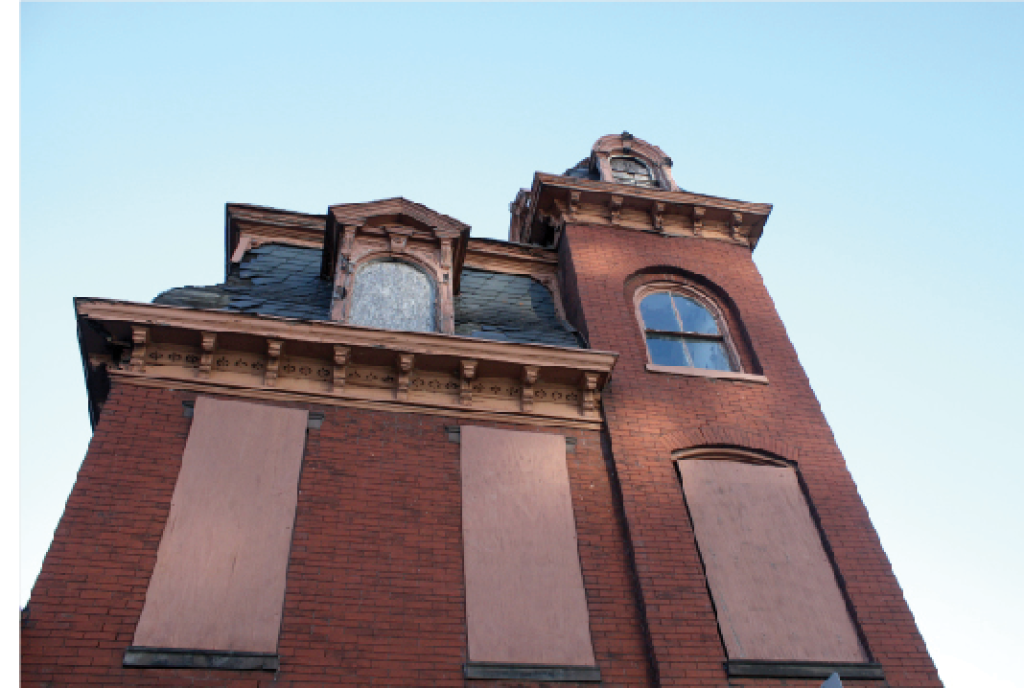
Plus, as far as the Jackson house was concerned, the Helms had already waited plenty. The building, a four-story brick structure with a distinctive corner cupola and an elegantly curved roof, has been catching Kerry’s eye for years. “It looks like a haunted house,” he said. “It’s just cool.”

The Jackson Rooming House is named for its former owner, German Jackson, who was once a bellhop at the Penn Harris Hotel and who remains a local legend. His house offered room and board to prominent blacks in the era of segregation; the adjoining Jackson House burger joint also bears his name. In 2012, the Historic Harrisburg Association placed two properties on the block on its list of “preservation priorities.” One was the so-called “Swallow Mansion” on the corner, once the parsonage of the abolitionist preacher Silas Comfort Swallow and, later, the black-owned Curtis Funeral Home. The Jackson Rooming House was the other.

The rooming house and the restaurant building were attached as one parcel. In his will, Jackson referred to the latter as “my store room.” Last spring, the owner of the restaurant, Dave Kegris, who inherited the property from Jackson, announced he was looking for someone to take the rooming house off his hands. “If someone wants it, they can come and get it,” Kegris said, for a story in this magazine. Not long afterward, Kerry Helm got in touch with Kegris. “He thought it was a great building and wanted to see somebody restore it,” Kerry recalled.

As it turned out, getting hold of the property would involve more than a simple sale. Splitting the parcel required action from the planning bureau, the county and city planning commissions, as well as City Council. The process was further complicated by delays, such that the Helms ultimately didn’t close on the property until Sept. 12, more than a year after they read about its precarious fate in TheBurg.

A few days later, on a sunny, windy morning, Kerry stood in the foyer of his newly purchased rooming house, peering into the dark interior. Lessa, coming up beside him, at last saw why her husband was stalling. “Oh my gosh,” she said.

Inside was what remained of the Jackson Rooming House—two stories’ worth of split timber and plaster, lying in a heap in the middle of the floor. A couple of antiquated light fixtures hung innocently from the ceiling. Above, a beam of light shone through an empty window frame, illuminating an old chest that was stranded, tantalizingly, on a few shards of floorboard. Along the right-hand wall, a dark wooden staircase climbed up from the foyer’s tile floor, strewn with debris. It looked like a giant wrecking ball had been dropped from the third story.

“It was better than this when we started the process,” Kerry said equably. But Lessa was less forgiving.

“You know what?” she said. “It is all because the city took so long.”

 …

Over the summer of 2013, the Helms started procuring the documents they would need to formally subdivide the Jackson properties. From Melham Associates, an engineering firm on N. Front Street, Kerry obtained a site survey, which he submitted to the planning bureau on Nov. 7. At the time, all three floors in the house were intact, but with winter approaching, Kerry sought to move quickly. “I hope to be able to cover the roof before any heavy snow or ice occur,” he wrote the city planner, Geoffrey Knight, in an email, “since much damage has already been done over the years and it is causing significant issues inside the building.”

When Knight started working for the city, in December 2012, he was the only person in a bureau that once employed five people. The city has recently hired a second planner, but, at the time of the Helms’ application, his office was overwhelmed. “It was an issue of, we’ve got a million things going on in the planning bureau at any one time,” he said.

Kerry didn’t hear back for several months. Finally, in March, he reached Knight, who said he hadn’t yet looked at the drawings. On March 20, Kerry sent an email to the mayor, Eric Papenfuse. “I am not writing to complain,” he began. Recent activity around vacant buildings and blight—in February, Papenfuse had defended the arrest of a local preacher whose abandoned church had collapsed in south Harrisburg—had caught his attention. He worried about the damage caused by the long winter and was eager to expedite the process. “It could be that if it continues to sit vacant for much longer it will become virtually impossible to restore,” he wrote.

Three days later, Knight emailed him to apologize for the delay. He appended a description of the “process for filing a Subdivision Plan.” It entailed submitting a short application along with 15 copies of the site plans. “I wish we could have gotten the application sooner,” Kerry wrote back. Unable to gather the documents for the planning commission’s April hearing, he set his sights on May.

At the May hearing, on a Wednesday evening, Knight presented his bureau’s report on the application. It included a lengthy description of the building, identifying its architectural style as “Second Empire” and singling out such elements as the roof cupola, an entryway transom and an ornate brick chimney. Helm asked for a copy of the report, which he found “very detailed.” “You did a great job Wednesday,” he told Knight in a subsequent email.

Knight’s report recommended approval of the subdivision plan, noting the historic nature of the house and the Helms’ intent to rehabilitate it. In the meantime, though, the house had deteriorated. On May 11, Mother’s Day, Kerry entered it for the first time since the previous October to discover the third floor had partially collapsed. Where he had once been able to access the roof through a third-story window, the floor beneath it was now gone and the second floor landing was blocked by debris.

There was also another administrative kerfuffle to come. As part of the subdivision process, the planning bureau required four 2-by-3-foot copies of the drawings for final signatures, which Kerry delivered—only to learn in July that the city had lost them. “They were distributed to several Bureaus to help with the review of the application,” Knight wrote Kerry. “[U]nfortunately, I have not been able to locate them.”

“That’s when I freaked out and called the mayor’s office,” Kerry said. Two days later, Knight wrote again, saying he’d found three of the copies and the signatures could proceed. (Knight attributed the misplacement of the plans to a lack of “secretarial support,” along with the volume of paperwork that enters his office. There were “only so many horizontal spaces in the bureau,” he told me.)

A month and a half later, Kerry stood outside his new property, a thick carpet of ivy shimmering on its north-facing wall. “I’ve got nothing against Geoff,” he reflected. An employee of the state, he is no stranger to bureaucratic delays. In any case, all the red tape may have saved his life; if the floors were going to come down, at least they did it when no one was around.

“I think it’s an awesome project,” Knight told me, adding that it helped to signal an “improving market” in Fox Ridge, the neighborhood behind the properties. Looking over the building, the Helms had a quieter assessment. “It’s got history,” Kerry said. “It looks the way it looks.” Considering the extent of the damage, he worried they might wind up having to knock it down. But he still hoped to follow through on their original plan—restoring it into a home they could live in.

If that didn’t work, at least they’d made one mark on its future, by getting it onto a separate deed. “We don’t really own anything,” Kerry mused. “We have it while we’re here, and then we move on.”


Continue Reading

An Apartment in Paris: Living, dying and the heartbreak of real estate.

Screenshot 2014-09-30 00.35.20Every country has its little quirks that are unique to its culture—traditions or circumstances that foreigners would look upon with puzzlement and would not fully be able to understand without firsthand experience.

One such example is the “viaje,” a French transaction in which an individual buys a property at a very cheap price, but cannot use the property until the seller dies—and commits to paying a monthly fee until said death. In some circumstances, the viaje is a rough deal, as the seller may continue to live for another 30 years, but, sometimes, the buyer gets “lucky,” and the seller dies shortly thereafter. But the concept can be seen as a gamble—and this is exactly what playwright Israel Horovitz had in mind with “My Old Lady,” his stage play-turned-film.

Kevin Kline plays an attention-loving, bankrupt, recovering alcoholic named Mathias Gold—he says his friends call him Jim, but he does not have friends—who has inherited a “viaje” apartment in Paris from his late father. As Mathias’ last hope was to sell the apartment (he is 57 years old with very little to show for it), he is disappointed to find what the “viaje” actually entails. It seems that poor Mathias has inherited his father’s debt.

The seller happens to be a 92-year-old Englishwoman named Madame Mathilde Girard (Maggie Smith), who has lived in the apartment since she was 20 and is in excellent health, thank you very much. Her daughter, Chloe (Kristin Scott Thomas), also lives there and is infuriated to find that Matthias, desperate to pull his life out of a rut, is interested in selling to a Frenchman who would like to tear down the building and turn the whole lot into a hotel. As Chloe tries to save her home and Matthias tries to salvage his life, the past begins to unravel before their eyes, turning this simple story about an apartment into a complex drama that captures what it’s like when your past impinges on your future. As Madame Girard so wisely reflects, “You have life left, Mathias—there is no greater wealth.”

There are a few scenes in Horovitz’s adaptation that don’t translate quite well to the big screen. While Mathias’ personality lends a theatrical tinge to certain scenes, there are moments that lay it on a bit thick. And the ending feels a little forced, like the filmmaker ran out of time to wrap things up, but did anyway.

Because of this, the resolution seems almost jarring. But, overall, the story is engaging, with plenty of emotional twists that artfully reveal the characters’ many layers throughout the film—a nod not only to the well-crafted story, but also to the brilliant acting. Dame Smith convincingly ages herself for the role, presenting a delightful blend of stubborn old-lady charm and blissful ignorance. Kline both shocks and wins your heart with his unstable, almost childlike persona, and Thomas plays her part with refreshingly raw spirit.

“My Old Lady” is a fun film about life and its struggles—something you should be sure to check out. It will be playing this month at Midtown Cinema.

Sammi Leigh Melville is a staff member and film reviewer at Midtown Cinema.


Midtown Cinema October Events

Brunch & a Movie Series
10/5, 11:30 a.m. brunch, 12:30 p.m. movie
“E.T. The Extra Terrestrial”
BYO champagne & Cinema provides the OJ (and Reese’s Pieces!).

Down in Front!
10/10, about 9:30 p.m.
“Fire Maidens of Outer Space”
Our improv trio rips apart the terrible 1956 sci-fi B-movie. BYOB… you’ll need it.

Saturday Morning Cartoons
10/11 & every second Saturday, 9:30-11:30 a.m.
Halloween-themed classic cartoons!

Mommy & Me Matinees
10/11 & every second Saturday
Stroller parking and babies welcome!

Foreign and Classic Film Series
10/12 6 p.m. and every 2nd Sunday
“The General,” Buster Keaton’s silent action comedy.

Silent & Scary Film Series
Every Sunday in October at 8 p.m. BYOB.
10/5 “Nosferatu” (1922)
10/12 “Phantom of the Opera” (1925)
10/19 “The Cabinet of Dr. Caligari” (1920)
10/26 “Dr. Jekyll and Mr. Hyde” (1920)

“Night of the Living Dead”
10/5, 7:30 p.m.
10/19, 7:30 p.m.
10/28, 7:30 p.m.

“Halloween”
10/17, 9:30 p.m. 3rd in the Burg $3 Movie
10/24, 9:30 p.m.
10/31, 9:30 p.m.

“The Rocky Horror Picture Show”
Oct. 31, 8 p.m. & 10:30 p.m.
Let’s do the time warp again!

Moviate Presents
Mike Kuchar, in-person, 10/22, 7:30 p.m.
Filmmaker and actor Mike Kuchar returns to the MC.

Moviate Presents
“Beetlejuice,” Oct. 26, 7:30 p.m.
The classic 1988 Tim Burton comedy on 16mm.

National Theatre Live
10/26 and 10/28
The National Theatre presents “Frankenstein,” mature audiences only (contains nudity)

Continue Reading

Big & Digital: Whitaker Center retires IMAX as large-format technology advances.

Screenshot 2014-09-30 00.32.19“Film is becoming obsolete,” stated Steve Bishop, vice president of Science and Cinema Programs for Whitaker Center. “It’s going the way of 8-track tapes and the typewriter.”

Indeed, the way movies are made and viewed is changing, and Whitaker Center is getting ready to make the switch. By the time you read this article, IMAX movies will no longer have a home in Harrisburg. In their place will be something equally immersive and awe-inspiring: a digital technology called D3D.

Beginning Oct. 18, visitors to Whitaker Center will experience theater on a giant screen digital film set-up that comes with a more than a $1 million price tag. That may sound like a lot of money, but, according to Bishop, D3D is well worth the expense.

“If we [and other theaters] want to stay in business, we have to convert to digital,” Bishop explained.

Out with IMAX

The IMAX system, while providing an amazing visual experience, had its share of quirks. For starters, each reel of IMAX film measures 6 feet in diameter and weighs up to 600 pounds. A feature-length IMAX film reel contains 61 miles of film, making it costly to receive and ship.

Film is also very delicate and sensitive to changes in temperature and humidity. Too much of either will cause the film to curl, leading to what Bishop termed “a bad hair day in the IMAX projection booth,” so that the film won’t run through the projector. On average, each film could be shown no more than 500 times before faded and scratched images ruined the picture. Then the film had to be disposed of, or in rare cases, shipped overseas to a theater that couldn’t afford a brand new copy.

Instead of miles of celluloid film, the D3D projection system is small and simple. It consists of a hard drive the size of a hardback novel that plugs into the computer projector. When the center is done showing that particular movie, the hard drive is returned for use at another theater, making it much more environmentally friendly than the IMAX system. The screen will be slightly smaller—instead of being six stories tall, it will be more like 4½ stories.  The picture and sound quality will be comparable, and the ticket price will remain the same.

What might change, and for the better, are the new ways to use the theater. While the center will still show a mix of Hollywood hits and documentaries, Bishop and his staff are looking for creative ways to use the digital technology, possibly including things like live-streaming concerts and video game competitions.

“Anything on a computer screen could be put on the theater screen,” explained Bishop.

Right now, the center has a program called “Surgery Live,” where actual surgeries from Hershey Medical Center are shown to students in real time to get them interested in a career in the medical field. The surgeon, nurses and other staff talk to the students, and the students can respond back. More than 5,000 students have participated in the program over the past six years, but the current classroom can hold only 100 students at a time. If the program moved to the theater, attendance could double.

The First Films

To debut D3D, Whitaker Center theater will show two films on the new system this month: “Jerusalem” and “Watermelon Magic.”

When determining which movies to show, Bishop has a short list of criteria. He might look for a film that complements an exhibit at the science center or go by reviews from his colleagues at other museums. It is also important to find movies that “take advantage of the huge screen” and have an educational value, since “more than three-quarters of the school kids and half the families see a film” during their visit.

“Watermelon Magic” is one of those family-friendly educational films. It is a 30-minute movie that follows the story of a little girl named Sylvie as she learns how to grow watermelons on her family’s farm in Bucks County. Through amazing time-lapse photography and simple storytelling, young viewers will learn the importance of healthy food and sharing.

According to Bishop, “Watermelon Magic” is a good example of how the move away from IMAX will help filmmakers. He said that IMAX film cameras are huge, about the size of an oven, and weigh around 300 pounds. They can only hold three minutes worth of film, since each frame on an IMAX film reel is the size of a playing card, creating many stops and starts in the movie-making process. Therefore, making an IMAX movie is very expensive and time-consuming. The move to a giant digital format allows small-scale, independent filmmakers to make large-format movies at a fraction of the cost.

The second movie at the center is “Jerusalem,” a 3-D National Geographic film about the city of Jerusalem and the cultures within, as seen through the eyes of three women: Jewish, Muslim and Christian. The movie shows that, “In 1 square mile, you see how these cultures have learned to live together, and it shows that different cultures can co-exist,” according to Bishop. The movie also follows an archeologist as she searches through some of the interesting historical sites of the city.

Running in correlation with the film is a photo exhibit titled “Jerusalem: Beyond the Wall.”  In 2004, photographer Jason Eskinazi distributed disposable cameras to both Israeli and Palestinian children in Jerusalem so they could document their lives through pictures. Ninety-eight of the images from the project will be on display on the lower level of the science center beginning on Oct. 18.

Since 1999, more than 1.7 million people have watched IMAX films at Whitaker Center.  One man who has seen nearly all of them is Phil Russotto, co-chief projectionist. Russotto oversaw the installation of the IMAX system in 1999 and was at the final showing on Sept. 21 to say goodbye to his old friend. He says it is “bittersweet” to see the end of the IMAX era, but he’s “excited to learn the ins and outs of the new system.”

Beginning this month, you can see the changes for yourself.

Whitaker Center is located at 222 Market St., Harrisburg. For more information, visit www.whitakercenter.org.

Continue Reading

A Dress to Impress: Unique, affordable fashions slip into Camp Hill.

Screenshot 2014-09-30 00.26.17Pretty, sophisticated yet understated clothes, eclectic music, and helpful staff greet those who enter Camp Hill’s newest clothing boutique, Little Black Dress.

Located on Market Street in Camp Hill, Little Black Dress, with its distinctive yellow awning, sits between Nino’s Bistro and Body Logic Therapeutic Massage.

Lisa Bedway DeCavalcante opened Little Black Dress, which shares her initials, on Sept. 1. After 12 years of retail experience as a buyer and co-manager of a local boutique, she wanted to create a unique clothing experience.

“Little Black Dress tries to fill a niche that isn’t currently being addressed in the retail scene in the greater Harrisburg area,” said Bedway DeCavalcante.

That niche is affordable, comfortable and unique designer clothing. The shop carries everything from exercise wear to swing dresses.

An Edge, a Twist

Little Black Dress recognizes that women’s lives and personalities are multidimensional, busy and diverse. So, their clothes should negotiate the many aspects of their lives.

According to Bedway DeCavalcante, women, at the end of the day, should “never feel like ‘get me out of this outfit,’” and clothes at Little Black Dress are “no Spanx required.”

Comfort and good design aren’t mutually exclusive, however. Little Black Dress carries clothes that are not only comfortable but also fashion forward— designer lines such as Cartise, Lucky Brand and Julie Brown Designs.

The store offers what Bedway DeCavalcante called “staples with an edge, a twist.” The python print exercise leggings by Pheel, the Barbara Gerwit two-toned gray, long sleeve T-shirt with a twisted back panel, and the slate blue Baci top with dolman sleeves exemplify this edge.

Sales associate Jocelyn Hambrook has known Bedway DeCavalcante for three years and is excited about seeing the vision of Little Black Dress come to life. A 20-something, she is particularly enthusiastic about the Lysee Leggings and Turk Collection for the younger set and what she calls the store’s “cool vibe.”

Little Black Dress desires to meet the needs of fashion newbies as well as sophisticates. Women unfamiliar with designer fashion can come to Little Black Dress and get help maneuvering the brands and making good choices.

Asking questions serves as the first step in assisting women through fashion decisions. If a woman isn’t sure what to purchase, Bedway DeCavalcante asks about her type of work, likes, dislikes and personality. Based on that information, the staff makes suggestions about what might work.

This represents another hallmark of Little Black Dress—customer service. Staff members take pride in providing great service, whether a person is spending $20 on accessories or $2,000 on a new wardrobe.

“We know the clothes well, and we know women’s lives well,” said Bedway DeCavalcante.

Not Everywhere

At Little Black Dress, the expectation to understand the customers’ wants and needs is paramount.

It offers designers that women know and want, such as its two denim lines, Not Your Daughter’s Jeans and Kut from the Kloth. However, it also stocks lines that women may not know as well, such as Barbara Gerwit. In fact, the store may stock a limited number of a specific garment to allow for uncommon clothing expression.

“You aren’t going to see these clothes everywhere,” said Bedway DeCavalcante.

Julie Nagle of York visited the shop during its first week of business. She said that the clothing is ”very nice quality” and that there aren’t many shops in the area like it.

Two doors down at Underneath It All, owner Kimberly Over hasn’t been in the shop yet, but is looking forward to visiting.

“I am so happy to see a new business in there, and I wish them the best of luck,” she said.

Bedway DeCavalcante wants to collaborate with other small businesses in Camp Hill to support one another. For example, Blooms by Vickrey, a few blocks up on Market, supplies the shop’s flowers. One Good Woman, just behind Little Black Dress, will provide refreshments for the Oct. 4 premier party.

Little Black Dress seeks to offer clothing that women will feel comfortable and confident in when attending events, working, relaxing and, as Bedway DeCavalcante put it, “shlepping bags” from the grocery store.

The clothing staple, the little black dress, offers women economy, flexibility and style in their wardrobe. The boutique Little Black Dress desires to do the same.

Little Black Dress is located at 1845 Market St., Camp Hill. Hours are Monday, Tuesday, Wednesday and Friday, 10 a.m. to 5 p.m.; Thursday, 10 a.m. to 7 p.m.; and Saturday, 9 a.m. to 4 p.m.; closed Sunday. For more information, call 717-525-7488, email [email protected] or visit www.littleblackdresscamphill.com.

Continue Reading