Street Wise: Education Row–20 years of learning, a stone’s throw away.

Screenshot 2014-12-29 08.58.10The idea goes like this.

A student begins her pre-K education in a building midway down the 1400-block of N. 3rd Street in Midtown Harrisburg. Three schools and 20 years later, she’s moved just a few yards down the road after graduating with an associate’s degree from HACC.

She has experienced an entire lifecycle of education within half of a city block.

Doug Neidich, CEO of GreenWorks Development, has dubbed this strip of 3rd Street “Education Row,” a vision he’s closer to realizing after his purchase a few months back of the building that last housed Midtown Paint & Hardware. Following a total renovation, the 9,000-square-foot edifice is slated to become the newest home of U-GRO Learning Center.

“Students would be able to go from one building to the next as they get older,” said Neidich. “It will take them 18 years to go about 30 feet.”

Age-wise, Education Row is taking shape in reverse.

In 2006, GreenWorks bought the century-old Evangelical Press Building at 1500 N. 3rd and converted it to Midtown 2, part of HACC’s expanding presence in the neighborhood.

Across Reily Street, GreenWorks next built Campus Square, which Commonwealth Connections Academy, a K-12 public cyber charter school, has called home for the past two years.

U-GRO would extend the student population further up the block once its preschool and daycare sets up shop at 1408 N. 3rd.

“The priority of GreenWorks over the last few years has been focused almost exclusively on education,” said Neidich. “If you do education well, everything else will follow.”

It Will Come Back

If any street demonstrates both the promise and the heartbreak of Harrisburg, it may well be the 1400-block of N. 3rd Street.

In its heyday, 60 or 70 years back, the block was an integral part of a thriving Midtown community. You could shop, get flowers, have a beer, eat a meal and deposit a check all within the few hundred feet between Calder and Reily streets.

Anchoring the block was the imposing, circa-1910 West End Republican Club building, a sturdy, if whimsical, stone-and-brick structure. Through the heavy, paneled front door, a grand center staircase swept upwards to two spacious levels, a proper testament to a city both increasingly prosperous and highly political.

What happened next is a familiar story in Harrisburg—it all fell apart. As people and their money left the city, the block turned seedy and became dominated by dilapidated properties, boarded-up buildings and rundown bars where men, some visibly intoxicated, loitered.

The Republican Club moved, and its old headquarters had its guts ripped out. The grand staircase was destroyed to open up the first floor for a retail store. To reach the upper floors, one had to climb a rickety ladder and enter through a cavity in the ceiling. Not that anyone went up there. The 6,000 square feet of space upstairs sat mostly unused and, today, old political posters and magazines from the 1960s can be found where they were dropped some 50 years ago.

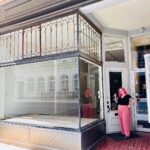
The exterior hasn’t fared well either. Decades ago, a modern “skin” was bolted on to the front of the building, blocking the original façade. Today, the strange arched design appears dingy, even campy, someone’s terrible idea of modernist, jet-age retrofit that makes little sense on a block dominated by brick, Victorian-era buildings.

Neidich’s plan is to rip off the false front, restore the original façade and completely renovate the building for U-GRO. He hopes to get started on the $2.5 million project in mid-2015, with U-GRO moving in the following spring.

In addition, he plans to tear down two small, dilapidated buildings next door that GreenWorks already owns, constructing a two-level, indoor/outdoor play area in their place.

“Surprisingly, the (main) building is in very good shape,” Neidich said. “It will come back very well.”

Kids from All Over

Neidich founded GreenWorks a decade ago after selling an electronics manufacturing business he had started. His idea was to use the proceeds of the sale to help build an integrated urban community in Harrisburg, and he chose N. 3rd and Reily streets as the center of his effort.

At the time, the historic Evangelical Press Building was empty and, last used as state office space, was slowly falling apart. Neidich bought the 130,000-square-foot building for $3 million and embarked on a $14 million renovation so that HACC could expand its nascent Midtown campus.

A couple of years later, GreenWorks purchased a gas station and auto repair shop across the street and constructed the 73,000-square-foot Campus Square building. When the HACC administration moved into the four-story building, some thought the college’s future lay in Midtown.

HACC, however, soon suffered financial setbacks, as well as turmoil within its leadership. After John “Ski” Sygielski became president in 2011, the administration moved back to the main Wildwood campus, leaving Campus Square in need of an anchor tenant.

In contrast, Commonwealth Connections Academy was looking to expand in the area, said Maurice Flurie, CEO of the cyber charter school. It took some space in the building in late 2012 and has been increasing its presence since. Today, its teaching center occupies several floors, and it even has its administrative offices there.

“The central location is very important to us,” said Flurie. “We have kids here from the West Shore, from Steelton, Harrisburg, etc. We want to be a solution for a broad range of kids in the capital region, not just in the city.”

Like Neidich, Flurie sees a future when children will begin an education at U-GRO before stepping over to Commonwealth Connections and then across Reily Street to HACC.

“U-GRO is the important pre-K part of this,” he said.

Coherent Structure

“Education Row” also has given a new dimension to the redevelopment of this part of Midtown.

For several years, it appeared that HACC would gobble up much of the land around N. 3rd and Reily, with other businesses opening to serve the expanding student population. Up the block, it was hoped that redevelopment associated with the new federal courthouse would bleed down Reily Street.

HACC, though, has reduced its Midtown footprint, and the courthouse appears to be on long-term hold. The new plan by GreenWorks shifts the focus back to the central commercial area of N. 3rd Street, which should further benefit by the opening this month of the new Susquehanna Art Museum—a cultural institution with its own educational mission—across the street.

With the old Republican Club/hardware store rehabbed, only a few unrestored properties will remain on the block, most notably two small bars and the former Volunteers of America retail store and apartments. That’s out of more than a dozen properties that, a decade ago, were almost all in poor shape.

Neidich indicated that he has plans for the remaining dilapidated properties along the street, though he would not say specifically what those plans were.

“GreenWorks is an initiative to help the revitalization of the city,” he said. “So, we’ve thought hard about what has to happen to put the most concrete, coherent structure together.”

 

Continue Reading

Student Scribes: A Palace of Bygone Days

Screenshot 2014-12-29 09.09.49“How a state chooses to represent itself, artistically and architecturally, speaks volumes about how its citizenry wishes to perceive itself at the particular moment of a capitol building’s creation.” – Ingrid Steffensen

The day the security guard handed me my “key to the kingdom” in the form of a swipe card, I decided to take time every day during my internship with the House of Representatives to explore the Pennsylvania Capitol, a building that is a haven in a broken and battered city. But I soon realized that I needed to step outside the Capitol too, to see a different reality of the city.

I cannot remember a time I did not find myself intrigued with the beautiful craftsmanship of previous generations; whether it is simply a doorknob, or a huge plantation manor, every aspect of its history draws me in. Perhaps that is why I am so fascinated with the Pennsylvania State Capitol. The emerald tiles of the dome set against an azure sky dotted with fluffy clouds always makes me smile.

The Capitol, standing in downtown Harrisburg two blocks from the Susquehanna River, is the third building that Pennsylvanians have had the pleasure to call theirs, and unarguably it is the most impressive. In 1902, Joseph Miller Houston designed the current Capitol in a contest set on replacing the brick “Cobb” Capitol. The Cobb was plain, unadorned and could easily have blended in with the smokestacks of any manufacturing town. But the building standing today eventually won the contest and outdid anything Pennsylvanians had ever seen before. The building still houses all three branches of the state’s government under one roof, but, for most, it is better known as being a masterpiece of immense proportion. All 600-plus rooms exude awe and artistry.

The plans created by Houston brought together the best Pennsylvania artisans, people like George Grey Barnard, Violet Oakley, Henry Chapman Mercer and Edwin Austin Abbey, who incorporated stained glass, paintings and sculptures. Designed in the Beaux Arts style, the Capitol’s halls also boast elements of Renaissance design. In fact, scholars claim that Houston introduced well-known European architecture to the people of Pennsylvania.

The room that most consider the greatest display of the arts is the main rotunda. The wide Vermont marble staircase matches the Grand Staircase at the Paris Opera House. The terra cotta dome, visible from all over the city, resembles St. Peter’s Basilica in Rome. This rotunda is the axis of all activity in the Capitol. People from every reach of government mix with the curious tourists and school tours.

When I was in fourth grade, my class took one of those school tours. I can remember standing in the middle of the rotunda floor and staring up into the paintings and gold-gilded heights. I remember feeling like I was going to fall backwards as I lost my sense of balance and reality. It was beautiful, the most beautiful thing I had ever seen, like a glimpse into heaven with its gold streets. Perhaps, if that were true, my school chorus and I were the angels praising the glory of it all from the staircase.

On the few lucky instances where I have found myself in the rotunda alone, I have felt the weight of history and the lost decorum of times past, and it is humbling. I can almost see President Roosevelt there on Oct. 4, 1906 during the dedication, declaring it the “handsomest building I ever saw,” a moment immortalized by a carved tile marking the place where he stood. His tile is just one of 400 tiles picturing the history, animals, industries, occupations and transportation of Pennsylvania in a grand canvas of folk art.

Another subtle detail that intrigues me is the bronze doors standing sentinel. In the rush to get through security and into the large, open space of the 272-foot-high ceiling, the 17-foot doors are easy to miss since they are always open and pushed to the side. The doors are carved with the three-dimensional heads of individuals who helped design and construct the building, according to the brochure available a few steps inside. The head of Huston lifts to reveal the keyhole to unlock the Capitol.

This place stands as a memorial to the Pennsylvanians who helped develop this commonwealth and their determination to maintain a strong government run by and appreciated by citizens. While the building was valued at $13 million at the time of its creation, it is deemed priceless in today’s economy. While the building is one of the few truly beautiful and valuable pieces of history left to the state, it isn’t far from the Capitol that I have encountered other realities of the capital city’s people.

I first was introduced to the reality of the city during the first month of my internship with the public relations department. About a block from the Capitol building is a parking garage full of Mercedes and BMWs mixed with more moderately priced vehicles. I was shocked to find that in the block between this parking garage and the Capitol is a very busy soup kitchen. When you drive down the alley to the garage, you pass the homeless and down-on-their-luck people waiting at the doors for their breakfast. I noticed that these people watch the constant stream of cars pass them by and couldn’t help but wonder if they feel neglected and forgotten in the midst of the bustle of downtown.

The second time I was struck by the reality of the city was toward the end of my internship. I came down the alley and saw a young man who had taken shelter under a dirty blanket he had pinned to the brick wall. He was cold, wrapped in blankets and huddled under the blanket tent. I was sad to see that this man had only a blanket to buffer him from the cold rain coming down, when there was a building less than a block away that boasts gold leafing and Italian marble. This is a story echoed down every street and alley of the city of Harrisburg.

If you step out two blocks from the Capitol to Front Street along the river, there are stately old mansions that are now housing different interest groups and associations. These homes are well maintained and historically stunning. The riverfront park is well-kept, and men in suits and joggers spend sunny afternoons enjoying the view. One night, as I walked to the Market Street Bridge, I heard a man’s tone rise and ebb against the arches and echo back down to the river’s water beneath. His song of worship to God lent an air of awe to the sunset over City Island. There was a woman walking on the sidewalk beside a furry white rabbit who would hop off the path to inspect a bush. “He makes a better husband than my real one when he won’t leave his video games,” she told me, motioning to the rabbit. They are the people of Pennsylvania.

Not far from this bridge, under an overpass to I-83, is where several of the city’s homeless have created their own little drifter camp. Their tents are braced against the support columns of the interstate, covered in tarps with trash bags surrounding them to keep their few belongings from the weather. The camp is easy to miss, and the only reason I saw it one day was when I caught a glimpse of a man stumbling toward the ramp with an empty water bottle. He looked tired and disheveled. I wondered where he had come from and was shocked when I looked back under the interstate and saw the answer. Just like the man under the bridge, and the woman and her pet rabbit, he too is one of the people of Pennsylvania.

This city, full of beauty, eccentrics and dishevelment is our state capital, a place of both wealth and poverty. The people who make up Pennsylvania can see the beauty, and yet, there are those who have also seen the very worst of what the commonwealth has to offer. But there is one great treasure that all of these people can call their own. It stands as a testament to better days, to past and present glories. Its emerald dome stands as a beacon of hope above the city skyline; it is a Palace of Bygone Days.

Ashley Sheaffer is a senior English major at Penn State Harrisburg. She continues to work for the Pennsylvania House of Representatives.

Continue Reading

December News Digest

No Tax Hikes in Budget

Harrisburg City Council last month weighed a balanced 2015 budget that included a $2 million investment in sanitation, nearly $250,000 in staff raises and the hiring of 14 additional public safety personnel, but no tax increases.

The budget proposed hiring five firefighters and nine police officers. After the hires, the total number of city firefighters will be 81, up from 76 last year and 62 in 2013.

According to Mayor Eric Papenfuse, the $59.4 million budget contained “no gimmicks,” a reference to a multimillion-dollar “plug” that was used to balance the 2014 budget without cutting certain unfunded, though vacant, positions.

The budget also committed the city to greater transparency, he said, by replacing hundreds of thousands of dollars in off-book discretionary accounts with dedicated funds subject to oversight by City Council.

Council held two hearings on the budget last month and indicated it might make small changes to the spending plan before passage.


DeHart Land Sale Proposed

Capital Region Water, the city’s water and sewer authority, last month agreed to examine a proposal for a $1 million sale of land above the DeHart Reservoir, the lake that supplies Harrisburg’s drinking water.

The sale would occur under a conservation partnership that would generate revenue while keeping the property in public hands, said Capital Region Water CEO Shannon Williams.

The sale, to the Pennsylvania Game Commission, would be federally funded through the Department of Defense’s Army Compatible Use Buffer program, or ACUB, which seeks to maintain undeveloped spaces around military installations.

The program would partner Fort Indiantown Gap, a National Guard training facility near the reservoir, with the Conservation Fund, a national environmental charity. Under the sale, the Conservation Fund would purchase the 384-acre parcel with ACUB funding and then transfer the property to the Game Commission.

The parcel, at the furthest upstream edge of Capital Region Water’s 8,200 acres in Clarks Valley, would form a bridge between two existing tracts of state gaming lands on either side of the reservoir.

After examining the proposal, Capital Region Water will vote in February whether to proceed with the deal.


Study Detects “Fragile” Ground

A second engineering report of sinkhole potential in south Harrisburg shows additional areas of concern, in a region that a city official described as “fragile, but not unstable.”

The report, prepared by Camp Hill-based engineering firm Gannett Fleming, is based on an expanded survey of the surrounding neighborhood, as opposed to the single city block that was studied in a prior report.

The previous report, released in August, showed evidence of five fractures in the limestone bedrock and several potential voids beneath the 1400-block of S. 14th Street, where a series of sinkholes opened in March.

For the latest report, engineers surveyed an expanded area bounded by S. 12th Street to the west, Scott Street to the east, Hanover Street to the north and Cloverly Terrace and S. 13th Street to the south, a neighborhood encompassing some 200 buildings, most of them single-family homes.

The report shows evidence that previously detected fractures extend across the larger area and also introduces evidence of possible additional fractures and voids throughout the neighborhood.

City Engineer Wayne Martin said that the report showed the area was “fragile, but not unstable,” adding that the city had determined it was safe to keep roads in the neighborhood open.


New Parking Zones

Park Harrisburg last month unveiled four different parking zones in downtown and Midtown Harrisburg, each with its own pricing.

  • Central Business District covers much of downtown, and street parking costs $3 per hour.
  • South of Central Business and Old Midtown districts include street parking south of Chestnut Street and from Forster to Verbeke streets, respectively. These districts cost $1.50 per hour.
  • New Midtown District, which covers Midtown from Verbeke to Harris streets, on and around N. 3rd Street. These spots cost $1.50 per hour, with the first 15 minutes of parking free.

Separately, a company called Pango USA introduced an application last month that will allow motorists in Harrisburg to buy street parking via their mobile devices.

The app, which is free to download, requires customers to establish an account and register a method of payment. Once the account is established, a customer can purchase parking with a few taps of the thumb.

For each transaction, Pango will charge customers an additional 14 cents on top of the regular cost of parking. Visit www.mypango.com for details of the app.


Water/Sewer Rates Increase

Harrisburg water and sewer customers will see higher bills in 2015, following a unanimous vote to increase water rates by Capital Region Water.

Under the hike, the current water consumption charge of $6.61 per 1,000 gallons will increase by 57 cents to $7.18 while an additional “ready to serve” fee will increase by 45 cents to $5.67.

The effect on the average customer’s monthly bill will be an increase of $3.29 based on an average consumption rate of 5,000 gallons per month.

Harrisburg sewer rates, meanwhile, will remain at $6.05 per 1,000 gallons.

The hikes will help fund a $48 million budget that sets aside $10 million for capital improvements, $13 million for debt service and $20 million for operations and maintenance. It also provides for the hiring of 21 new employees.

In addition, Capital Region Water announced an agreement with federal and state regulators that provides a timeline for reaching compliance with laws governing pollution of local streams.

The agreement begins to address a number of violations that the Environmental Protection Agency and the state Department of Environmental Protection discovered during inspections in 2010 and 2012.

The agreement, known as a partial consent decree, sets forth some initial steps for bringing the system into compliance, and is primarily focused on gathering information, Williams said.

A future agreement will set out tangible steps the authority can take to comply fully with regulations, a process that Williams said could take upwards of 20 years.


County Taxes Unchanged

Dauphin County taxes will not increase under a $246 million 2015 budget passed last month by the county commissioners.

For a 10th straight year, county taxes will be unchanged at 6.87 mills.

The budget represents a small hike from the 2014 spending plan. Commissioners, though, attributed the increase to about $8 million in pass-through state and federal funds, which then were forwarded to municipalities in the county.


Shimmel School Project OK’d

A split City Council has approved the re-use of the empty Shimmel School as a mental health and addiction treatment center.

By a 4-3 vote, the council approved the land use plan by the for-profit, Lebanon-based Pennsylvania Counseling Services to renovate the facility at 548 S. 17th St. for a new treatment center.

Several council members voiced objections, saying that this area of South Allison Hill already has a plethora of similar rehabilitation facilities and halfway houses. In addition, Councilwoman Susan Brown-Wilson said she was stunned that the school district would sell the school for just $680,000, as it underwent a nearly $20 million renovation under former Mayor Stephen Reed.

The sale will put the school onto the tax rolls. Harrisburg expects the facility to generate property tax revenue of nearly $14,000 in 2015.


New Shopping Center

A new shopping center is coming to Allison Hill, as Harrisburg City Council has approved a plan to open an eight-unit retail center.

Harrisburg-based D&F Distributors will build the center at 137 S. 17th St. that will consist of seven 950-square-foot shops and one 1,925-square-foot shop. The estimated $500,000 project will include a convenience store and a sandwich shop, according to owner David Peffley Sr.

The property has long been an eyesore along the S. 17th Street corridor, recently serving as a vehicle storage lot. It sits across the street from the new Hamilton Health Center, which has helped spur developer interest in the corridor.


Parking for Pinnacle

PinnacleHealth soon will have another place for employee parking, as the Harrisburg City Council approved its plan to turn a plot of land into a surface parking lot.

Council gave its unanimous consent for Pinnacle to demolish a dilapidated building at 157 Paxton St. and resurface the blighted site for 78 parking spaces. The building, which once housed a daycare center, has been empty for years and has been repeatedly flooded.

Pinnacle has vowed to enhance the property with landscaping and incorporate stormwater management techniques to reduce the flow of polluted surface water into Paxton Creek and the Susquehanna River.


Firehouse for Sale

Harrisburg is putting the art deco Paxton Fire Co. station on the market, months after it shut down the firehouse.

Council unanimously agreed to hire RE/MAX realtor Wendell Hoover to market the structure at 336 S. 2nd St. The city is asking $200,000 for the property. The building dates to 1937, though a firehouse has occupied the site for 150 years.

Several years ago, former Mayor Linda Thompson tried to shut down the station as part of a move to cut escalating Fire Bureau expenses. She abandoned the plan, but Mayor Eric Papenfuse revived it in March.


Changing Hands

Adrian St., 2455: P. Okane to L. Mahoney, $45,000

Berryhill St., 2316: W. & J. Collins to D. & Y. Jiang, $46,500

Bigelow Ct., 3: D. Schultz & Schultz Properties to G. Neff & M. Murphy, $34,000

Boas St., 1812: PA Deals LLC to Mid-Atlantic IRA et al, $41,400

Grand St., 927: G. & T. Morcol to J. Gustitus, $88,000

Green St., 1517: R. Lewis to J. Bowser, $71,500

Harris St., 210: J. Provins Jr. & C. Good to B. Stefek, $139,900

Kensington St., 2105: PA Deals LLC to Mid-Atlantic IRA et al, $61,700

Lenox St., 1912: E. Clark to C. Saterstad, $31,000

Linden St., 145: P. Scott to E. & M. Kinchloe, $73,000

Mulberry St., 1217: A. & P. Sena to Ministerio Casa de Oracion, $45,000

North St., 1619: H. Halilovic to K. Sol, $33,000

North St., 1724: PA Deals LLC to B. & C. George, $62,900

N. 2nd St., 603: Mercy Home to D. & C. Peltier, $240,000

N. 2nd St., 1110: W. Moyer to MC Investment Properties LLC, $117,000

N. 2nd St., 1701: Colorado Federal Savings Bank to C. Troutman & B. Jackson, $76,000

N. 2nd St., 3005: Wells Fargo Bank NA to H. Sharifi, $36,000

N. 3rd St., 510: R. & S. Schreckengaust to 510 North Third LLC, $243,115

N. 3rd St., 1225: S. & D. Donofrio to I. Rosario, $116,000

N. 3rd St., 3117: N. Mastrippolito & L. Oechler to M. Means, $140,000

N. 7th St., 1303: 1303 North 7th Corp. to Pennsylvania Higher Education Assistance Agency, $2,750,000

Penn St., 2242: J. McDonel to W. Hoover, $60,000

S. Front St., 707: K. Scofield to D. & G. Dowen, $140,000

Susquehanna St., 1338: B. Smith to J. Grubbs, $108,000

Zarker St., 1941: Habitat for Humanity to T. Reid, $82,800

Harrisburg property sales for November 2014, greater than $30,000. Source: Dauphin County. Data is assumed to be accurate.

Continue Reading

Cutting Edge: Stylist Eric Moon gathers ideas from around the world, then brings them home to Harrisburg.

Screenshot 2014-12-29 09.03.31What’s next? This may be the question you’re asking yourself right at this moment. What are you going to achieve in 2015? And what will life throw at you?

For Eric Moon, owner and creative director of Salon Edjii, the answers of his own ‘What’s next?’ have revealed themselves organically. It’s been through natural conversation with peers and friends and sometimes complete strangers, as Moon has progressed and transitioned from an art student at Kutztown University to traveling the world as an artist and educator with TIGI, the world-renowned hair care brand and culture.

Moon first encountered TIGI years ago at the salon where he was working.

“I was really drawn to this brand by their imagery and what they were doing,” he explained, listing off the terms “new wave,” “punk” and “edgy” as his inspirations. “And I wanted to be a part of that.”

One day, Moon struck up a conversation with a TIGI sales representative who frequented the salon. A few weeks later, after he had caught the attention of more representatives at a training session, he received a phone call inviting him to a training program.

Almost a decade later, Moon travels nearly every week for TIGI. Some of these excursions may be local educating opportunities, but about half are “fly-aways” as Moon calls them—no pun intended. It’s these unique opportunities to travel that sets Salon Edjii—located on Derry Street in Paxtang—apart from other salons in the Susquehanna Valley.

“I love being able to bring everything I experience outside of Harrisburg back to central PA to share with my clients,” Moon explained. “Harrisburg has a reputation (and part of it is true) that we’re a little behind the times when it comes to fashion. We have a great restaurant, art and music scene here, but fashion is not quite there.”

Still, there are people who are hungry for the Harrisburg fashion scene to take off, he said.

“People will sit in my chair and ask what I’m seeing in this city or country and ask what’s new,” he said. “Because I get to travel, I’m able to have a good answer for what’s new, what’s current and what’s next, so people can be ahead of the curve.”

Taking Chances

Born in England to a military family, Moon moved around a lot as a child to locations as varied as Newfoundland, New Jersey, Colorado and Pennsylvania.

“I have that cool dual-citizenship thing going on. I have at home what I call my Jason Bourne drawer. There are multiple passports, guns and money—if it’s empty, I’m gone,” he teased, with an infectious laugh.

His initial fling with haircuts and color started with experiments using grocery-store-bought boxed color on high school classmates. In college, he even traded haircuts and color for beer, food and art supplies.

His experience mixing colors started during one of his first real salon jobs.

“There were times that I had free time at that salon, and I brought a friend in so [my employer] could see what I could do,” he said. “I got to go to the back room and mix real color—it was awesome! I was hooked. I loved it.”

For Moon, it was the 1980s that inspired him and sparked his initial love for new wave, punk and just plain cool edginess.

“A lot of people look back at the ‘80s with disdain right now,” he said. “Granted, there were a lot of things from that decade that were pretty terrible, but I appreciated that the ‘80s took a lot of chances. Since then, everything has been regurgitated from another decade. We look at something and say ‘Oh, this has a ‘40s feel.’”

Something Good

Today, Moon travels with TIGI, sharing his knowledge and experience with salons all over the world—then brings new concepts back to Harrisburg.

When opening Salon Edjii, Moon chose Paxtang due to its central location for his many urban and suburban clients. He also had the opportunity to build a salon based upon his own design ideas. Moon focused on an atmosphere that included distressed brick, high ceilings and other urban, industrial features.

“For my vision, I got to experience other workspaces and salon environments—what things I liked as far as décor, feel and atmosphere,” he said. “I figured out which of those things that I liked were a part of my personal brand and salon culture. The idea was to create a salon culture that I felt was missing from the Harrisburg area. Something that’s modern in a creative space.”

The result is what he calls a comfortable atmosphere that’s not too cool for his widely varied clientele.

“I remember being a student and having this idea that ‘I can’t wait to get out of here and I’m going to have all these cool clients that are new wave and punk and edgy. I’m going to make purple and pink hair on everyone, all the time,’” Moon said. “And, you might get to do some of that, but as I explain to students now, get good at brown and blonde.”

Although Harrisburg is not exactly the center of edginess that Moon dreamt of in the ‘80s, he remains a central PA cheerleader.

Screenshot 2014-12-29 09.03.44“One thing that’s great about Harrisburg—and I feel like everyone says this, but rarely takes advantage of it—we are conveniently located two hours away from everything cool. Not that Harrisburg isn’t cool, but if you want to go to Baltimore or DC—boom—down I-83, you’re there,” he said.

After his last salon job, he purposely stayed in Harrisburg because it’s where he wanted to be and because, he believed, he could contribute.

“Sometimes, people get this idea that they’re bigger than Harrisburg and that they should get out,” he said. “I turned that around and said I’m not too good for Harrisburg; I’m something good for Harrisburg.”

In light of the New Year, I asked Moon what mindset clients should have when they visit him for the first time. His answer: an open mind to truly have a new experience.

“Every city has a slightly different hair and fashion culture,” he said. “For example, you go to New York, and it can be very dark. The city’s atmosphere and how it bares down on people has an influence on their fashion. In Miami, everything is vibrant and colorful and free. San Francisco and Seattle embrace the outdoor culture.”

While Moon may visit these other places, he plans to stay right here.

“I like grass between my toes in the summer and sitting on my patio with a cocktail and a fire pit,” he said. “I think open fires are probably frowned upon in New York.”

Salon Edjii is located at 3401 Derry St., Harrisburg. For more information and to schedule an appointment, call 717-564-1089 or visit www.salonedjii.com.

Continue Reading

Harrisburg Hopes: A few simple things would improve life in this city in 2015.

Screenshot 2014-12-29 08.55.59It’s a new year. With that come new expectations for the City of Harrisburg. Here are a few things I’m looking forward to, hoping for, and counting on in 2015.

A brighter city

It’s a top issue people have with the city—too many streetlights are burnt out, broken or missing.

It makes for a dark, sinister and scary public realm. Anyone who has travelled down one of the city’s darkened streets knows what I mean.

But that’s all supposed to change in 2015.

With grant money from the Pennsylvania Energy Development Authority to kick-start the project, Harrisburg is planning on inventorying, prioritizing, fixing and converting its 6,000 streetlights to LED technology. By the end of the year, most, if not all, of the city’s lights should be in good, energy-efficient, working order.

While this is set to happen, there’s a New Year’s resolution every resident and business should make to help the cause—turn on your lights.

If all residents turned on their porch lights, neighborhoods would instantly become safer and more attractive. If all businesses kept the outside of their buildings well lit, the city automatically would be more appealing.

It’s one of the simplest and most effective things each of us can do to add to the enlightenment of Harrisburg.

A cleaner city

Like the darkness of broken lights, the rubbish of Harrisburg is a tragic turnoff.

It’s one of the city’s most serious problems—trash. It’s everywhere. There are bags of ripped trash piled high along curbs. Trash cans overflow without tight-fitting lids, and that’s not the only city law people ignore. Televisions sit on the street. Mounds of furniture are put out. Even public trashcans spill junk onto the sidewalks.

Yes, there’s trash in any city, but I have to say, in general, Harrisburg is a mess. In fact, it verges on being filthy.

This is something also scheduled to change.

The city’s Public Works Department has proposed an ambitious strategy to overhaul the way it picks up trash. New trucks, new hires, new bins and new rules are all part of the plan for 2015.

However, that won’t be enough. It’s going to take more people properly pitching their garbage and picking up litter to help clean up this city.

It’s another thing for every resident, business, commuter and visitor to add to their lists of New Year’s resolutions. It’s time we all care more to keep Harrisburg clean.

A more unified city

The rich differences that make up Harrisburg are precisely what give this urban core its energy and vibe. Its diversity is what makes it a city.

However, those very differences can cause problems that hinder Harrisburg’s potential.

Around here, there’s a tendency to fall into an “us” and “them” mentality. The lines are drawn based on skin color, culture, ethnicity, income, how long you’ve lived here, where you’re from, who you know and who you don’t know.

In the past, this damaging fragmentation has been encouraged for a variety of reasons by a variety of people.

The fact is—disunity holds Harrisburg back.

Harrisburg’s success is dependent on teamwork and collaboration. The most important concept to impart is “partners.” No one person or group can do all that needs to be done to make this place better.

There’s a common call for more, but it will only happen if more of us work together.

A virtuous election

It’s a major election year in the city. Seats are up for city treasurer, four city councilors, six school directors and 10 district judges.

Harrisburg needs more people involved. Hopefully, this year, more residents will engage not only by running for offices but also by participating in the process.

In Greek, there is a word arete. In its most basic sense, it means to be the best one can be. It means striving for excellence and endeavoring to reach great human potential. Possessing arete means to find ways to overcome the difficulties of working with others and of working on projects in order to reach a common good that’s best for as many people as possible.

Having arete is to be informed, to be part of various social endeavors, to listen well, to find compromise, and to strive for shared goals.

It’s a trait expected of all citizens. A person who has arete recognizes civic duty and is an active part of the community.

Just what Harrisburg needs, especially in an election year.

Less gripe, more hype about the many good things in Harrisburg

Enough said.

Tara Leo Auchey is creator and editor of today’s the day Harrisburg. www.todaysthedayhbg.com

Continue Reading

Fitness Forward: AspireFIT aims to make healthy living a feasible goal.

Screenshot 2014-12-29 09.02.39Eat healthy and exercise seem like simple enough instructions for anyone to follow—until you actually have to do it.

Telling people to live a healthy lifestyle is one thing, but showing them how to do it is the goal of doctors Richard Rayner and David White, creators of AspireFIT, a new branch of a growing practice based on practical, personal care.

Rayner and White created AspireCARE five years ago when they combined their experience in primary and urgent care services to open a new health facility. The goal was to form seamless communication between the medical provider and patients—and the idea took off.

“We started Aspire with the goal of showing people the value of preventative care as a long-term solution for treating disease and injury,” White said. “We have the desire to equip people to take ownership of their health. That’s where the name came from. We desire that our practice would inspire our patients to aspire to something better as it pertains to health.”

While working out the introductory kinks of a new business venture, Rayner and White wanted to incorporate their ideas of community fitness early on. They created Team Aspire, a weekly running and walking group that focused on training for the Harrisburg Marathon, as a way to get exercise together.

For many patients, hearing the advice to get fit and active is easier to swallow knowing that Rayner has been on the other side. Growing up obese, he decided to start running in high school as an alternative to group sports, finally taking the leap in 2002—at age 40—to enter his first marathon.

“Training and running a marathon is a bit like scaling a very high mountain in the sense that, when you first think about it, it’s completely overwhelming,” Rayner said. “But when you’ve done it, the sense of satisfaction is huge because you’ve done something that you couldn’t even get your head around.”

With Team Aspire, he dipped his toe into group fitness, while encouraging patients to practice prevention.

“When you exercise by yourself, sometimes it feels like suffering,” Rayner said. “When you exercise with community, it feels like you’re accomplishing something.”

AspireFIT grew out of that sense of community, transforming it into a more instructive, multi-faceted sense of fitness.

Don’t think of AspireFIT as a gym or the more institutional medical center because it isn’t either of those things, according to Rayner and White. Instead, it’s a high-care environment that focuses on the technology of determining someone’s body mass index and resting metabolic rate, while being very interactive, not only as a community, but through the instruction of professionals.

AspireFIT is open to anyone in the community, whether or not they are referred by their physicians. Typical programs last 12 weeks, with workouts and diet created for individuals and their unique needs.

Since launching AspireFIT on Oct. 13, Rayner and White have been intentional about making the facility feel like anything but a gym. Similar to the medical practice, it was designed with warm colors and the natural elements of wood and stone with the complement of natural light.

“Coming to AspireFIT is an investment of time, of person, of finances in an effort to pursue something that is transformation for a lifetime,” White said. “We live in a society that is prone to reach for the quick fixes with the least amount of effort. What we’re embracing is a philosophy and a lifestyle that will transform who they are.”

The concept of health as a lifestyle has been a beneficial concept for Liz Yarnell, a 62-year-old Colonial Park resident and walker with Team Aspire. As a patient at AspireCARE, Yarnell was urged to get active.

“I’m a little lazy in that I have no desire to run, and I don’t even want to walk 13 miles,” Yarnell said. “But I can walk six or seven.”

Yarnell is among six walkers who meet up with the runners of Team Aspire to participate in that community concept of exercise. Despite different fitness levels, the group motivates runners and walkers alike.

“Physically, it has done so much for me, but there really is a great social element to it,” she said. “There are a lot of commonsense things I’ve learned from participating. I’ve adjusted my diet. I look at health as not just one troublesome issue, but how I feel as a whole person.”

Misti Demko, a competitive runner who helps organize Team Aspire, said the group concept is making sure everyone belongs—whether they walk or run.

“There is a lot of work that goes on to validate people and tell them their goals are worth it,” Demko said. “That is unheard of in medicine. The whole idea that you can reach your goal, not matter what it is, and they’ll walk beside you the whole way. It’s just not something you see.”

Those who run with Team Aspire aren’t just going out on their own and reporting their progress to Rayner and White later. Often, you’ll find the two of them running alongside their patients, living out their desire for community wellness.

“My dream would be that people come to AspireFIT feeling one way and leave after 12 weeks saying, ‘I’ve never felt this way before,’” Rayner said. “I want people to feel joyful and come to a place where their bodies work the way they should.”

For more information on AspireFIT, visit www.aspirebetter.com.

Continue Reading

Grounds for Change: Before long, the sprawling State Hospital site will hit the market, and that has some people concerned.

Screenshot 2014-12-29 08.58.29Dick Norford has led hundreds of bicyclists on Greenbelt rides, and newbies always have the same reaction when the trail crosses into the lush grounds of the former Harrisburg State Hospital.

“They’re absolutely in awe that there’s that much green space right in the middle of the city, right next to one of the busiest roads in the city, with Cameron Street and that huge parking lot for the Farm Show building, and how close it is to Interstate 81, and yet here’s these hundreds of acres of green just sitting there,” says Norford, a spokesperson for the Capital Area Greenbelt Association and president of Bicycle South Central PA.

The verdant slopes and tall trees of the former State Hospital grounds are open to the public but largely unknown. Now, the state is preparing to sell several hundred acres of the largely undeveloped grounds, and the pending sale raises questions.

Is the State Hospital’s emergence into the light of day a blessing or a curse? Is it time for a hidden gem to take on a larger role as community asset? Will the sylvan setting be lost to developers hungry for rare urban acreage off an interstate highway? Can a local coalition help balance the preservation of natural and historic assets with the site’s economic development potential?

Tremendous Space

The Pennsylvania State Lunatic Hospital was founded in 1845, after reformer Dorothea Dix crusaded for humane treatment for the mentally ill. Her self-sustaining city offered peaceful, rolling hills, secluded from the capital city that would grow up near its boundaries. Even as government peeled off pieces of the 1,000-acre grounds for agency offices and the Farm Show complex, the State Hospital’s original core remained largely untouched.

Today, employees from the state Department of Public Welfare, Pennsylvania State Police and Department of General Services work in the old buildings, in what’s known as the DGS Annex, but they’re slated to exit for new digs at Strawberry Square’s Verizon Tower in 2016.

Before the land can go up for sale, possibly not until mid- to late-2016, DGS must develop a plan for legislative approval, recommending how to parcel it off.

“We’re at the very beginning of this process, and a lot of things have to take place before any sale could happen,” says DGS spokesperson Troy Thompson.

The targeted area includes part of the Capital Area Greenbelt. It also includes about 30 buildings from the original asylum and 183 acres in a surrounding arboretum that won National Register Historic District designation in 1986.

As news of the pending sale began to spread in early 2014, a Committee for the Future of Harrisburg State Hospital emerged to promote a balance of historic and environmental preservation with economic development.

The site’s original obscurity was, by design, to create “a refuge and an enclave” for the mentally ill, says David Morrison, interim executive director of Historic Harrisburg Association, a CFHSH leader. Maybe, adds Harrisburg historian and coalition member Jeb Stuart, a certain mystery has kept the site “not on the public radar. It’s a tremendous space, but it’s never been marketed, never been promoted.”

The site’s obscurity also explains why the Capital Area Greenbelt winds through it today, says Norford. Completion of the original Greenbelt, begun in the early 20th century, stalled before it could circle the city, he says. By the 1990s, the reborn Capital Area Greenbelt Association, striving to close the loop, sought out lands that had escaped the march of post-war development. The pristine State Hospital grounds helped close a gap from Reservoir Park to Wildwood Park.

“I don’t know if it’s been preserved or ignored or sacred ground,” Norford says. “At the end of the day, it was preserved.”

But even Norford, a self-described “student of the Civil War,” hadn’t known of the site’s pre-Civil War origins or its role as a kitchen for Union soldiers training at nearby Camp Curtin until he got involved in CFHSH.

A 60-foot easement protects the Greenbelt from development. On the buildings and grounds with National Register designation, private owners would face restrictions only if they sought public funding or federal or state permits. But large tracts remain available outside the green and historic sections, and the CFHSH hopes for a mindset that rises above restrictions and views development “through the lens of future opportunity,” says Morrison.

Perhaps “the stigma of being an off-limits institution” could be lifted by transferring recreation areas to Dauphin County or Susquehanna Township, where much of the land is situated, says Morrison. The CFHSH also hopes the state will declare the National Register portion eligible for federal historic rehabilitation tax credits.

“There are companies all over the country that look for these opportunities,” says Morrison. Pair up reuse of the historic portion with development of the non-historic areas, and “the net benefit to the region, to the community, to the municipalities, to the general public is enormous.”

“We’re not only not wringing our hands over the sale of this property, we’re saying it offers tremendous potential benefit,” says Morrison.

The sale offers “an exciting project from an aerial perspective,” says Chuck Heller, senior associate with Landmark Commercial Realty, based in East Pennsboro Township. “You have 600 acres there at the crossroads of 322 and 81 and quick access to downtown Harrisburg, the Farm Show complex.”

Many Uses

Other area developments, such as TecPort near the Harrisburg Mall and Rossmoyne in Upper Allen Township, have successfully converted open space into bustling commercial spots, with such uses as high-end office, research and development and warehousing, Heller says.

At the State Hospital grounds, “There’s going to be a lot of people pushing for large, big-box industrial,” Heller says. “That is a perfect location, but there’s enough for many uses.”

The site’s development potential far exceeds the vacant lots and buildings of nearby Cameron Street, Heller says. There, city taxes, flooding risks, low ceilings and brownfield remediation hinder reuse. The State Hospital grounds would probably require rezoning to allow development, but a lack of neighboring residents and many nearby assets—a large post office, Harrisburg Area Community College, Dauphin County’s Wildwood Park, PSECU, state offices—make it “a very interesting site.”

“It’s a good opportunity for the state to do something that’s forward-thinking to help the community,” Heller says.

CAGA doesn’t want to interfere with land sales, but “it would really be nice to save the historical and environmental and recreational value of the whole area,” Norford says. The sale could become a blessing or a curse, he believes, but, for now, the attention is elevating the site’s profile as a unique asset for all to enjoy.

“It’s very much a blessing that we can go just a short distance from any of our homes and enjoy that beautiful setting. We haven’t really used it. This is a facility that I don’t think we’ve ever exploited as a park setting, so maybe this whole effort will put this area into the focus of more people.”

Continue Reading

The Found Grape: You now can enjoy Carmenere, once thought lost forever.

Screenshot 2014-12-29 09.09.23In the world of wine, the French region of Bordeaux is usually associated with the pinnacle of all things that involve turning a grape into a bottle of pleasure. This is where, arguably, the best (and, certainly, the most expensive) wines on Earth are made. From the Middle Ages, when Bordeaux wines were known as “claret,” to modern times, demand has outstripped supply.

Much of this was due to the fact that the Bordelaise were master wine blenders. They had six different grapes at their disposal: the noble Cabernet Sauvignon and Merlot, as well as the lesser Cabernet Franc, Petit Verdot, Malbec and Carmenere. At harvest, each grape was made into wine and then blended to maintain each chateau’s style and quality.

In 1855, Emperor Napoleon III ordered the classification of the Bordeaux vineyards by price and quality. This coincided with the Paris Exposition of the same year. Now, thousands of visitors to the French capital had the world’s best wine available to them with a system to rate each one. Heady times indeed.

Bordeaux vines also had been imported to the Americas, where they were planted in places such as California’s Napa Valley and Chile’s Santiago region, bringing the New World into the modern age. Then the unthinkable occurred.

In 1863, the phylloxera aphid was discovered in the Gallic vineyards, a nasty insect that came over from America. There was no defense and, by 1870, the grapes had withered and died. Gradually, it was discovered that the European vinifera could be grafted to American rootstock, which was impervious to the grape louse. The growers set about making the great conversion, which took many years. Eventually, the great regions of France returned to their former glory, and Bordeaux once again became the top of the wine pyramid. Only, this time, the blenders had but five grapes. Carmenere had vanished.

Bordeaux and Napa both became powerhouses with quality and personality that developed markets in every corner of the globe. Chile has made good wine for decades but never developed the following of France or California.

In 1994, wine expert Jean Michel Boursiquot was invited to the Apalta Valley in Chile to examine some odd Merlot. After DNA testing, the grape in question was found to be Carmenere. Overnight, thousands of acres of grapes were of a variety that had been missing for more than 100 years.

Some growers and vintners took this news and made the once-extinct grape into their signature quaff. Carmenere is lighter than Cabernet or Merlot. If not fully ripe, the wine has a tendency to taste vegetal. When done right, it is a smooth, dark wine, with unique spicy aromas and deep flavors. Because the tannins are not heavy, it is a food-friendly wine that matches well with grilled meats and Indian cuisine.

This wine is a survivor. It is the culmination of accidents and decisions that have brought us to a new, unique place in wine history.

Keep sipping, Steve.


Apaltagua Rose Carmenere Chile Reserva 2013
Code 80255

A somewhat non-traditional use of the Carménère grape, this rose shows some tart fruit flavors as well as raspberry and rose petal notes. It is the perfect choice when serving Asian or spicy food.

$10.99


Marques de Concha Carmenere Rapel 2012
Code 72404

Jackie Spironello, South American Wine Buyer, loves this wine for its black ripe fruit, spicy black pepper and hint of chocolate. Pair it with roasted meats, cheeses and rich red sauce. 90 points Wine Spectator May 2014.

$21.99


Santa Rita Pehuen Carmenere 2008
Code 33540

Wine Specialist Mark Wolf calls this a “big, bold wine that drinks well now with a bit of decanting,” and notes its 91-pt score from both Wine Enthusiast and Wine Advocate.

$19.99

Continue Reading

On the Road: Teen driving can be a major cause of parental stress–but it doesn’t have to be.

Screenshot 2014-12-29 09.14.03Parents tell me they are not sure which is worse: shuttling their teenager from one activity to another or waiting for their teenage driver to return home. Watching your teenager get behind the wheel is a big deal, so I always review basic driving rules with new drivers and parents.

In the state of Pennsylvania, individuals are eligible for an initial learner’s permit at 16 years of age. The application process requires teenagers to have a “medical qualification certificate” completed by a medical provider. This form asks providers to certify that a new driver has no medical conditions, which would impair safe operation of a motor vehicle.

New drivers also complete a knowledge test and an eye screening at the Driver License Center. Once these are passed, teenagers may begin behind-the-wheel practice. Sixty-five hours of adult-supervised skill-building are required before the road test may be taken for a junior license. Even with a junior license, there are restrictions on nighttime driving (11 p.m. to 5 a.m.) and the number of passengers, specifically those under 18 years of age.

As I complete the medical qualification certificate for teenagers in the office, I like to emphasize the following points with parents and new drivers:

1) Seatbelt on. This is clear-cut and non-negotiable.

2) Minimize distractions. Parents know good driving requires both managing yourself and anticipating the moves of others on the road. This is harder to do when distracted. Teenagers should get all controls set before pulling out. Specifically, adjust mirrors, the radio station and temperature controls before driving. Meals should not be eaten while driving, as managing a drink and food without spilling is an unnecessary and added complication. Cell phones should be set to vibrate or silenced to eliminate the distraction from arriving text messages or emails. If a call must be made while driving, teenagers should pull over into a safe spot and stop the car.

3) Leave enough time. A colleague of mine gives his son an absolute latest time he must be out the door if he wants to drive himself to school. Many of us are guilty of leaving the house late and driving just a “little bit faster” in an attempt to make up the time. Again, this is a terrible idea for experienced drivers and even worse for new drivers.

4) Admit when you are not safe to drive. All my parents agree that they prefer to get a late night phone call to pick up their teenager rather than get a phone call about an accident. Teenagers should absolutely not drive after drinking, using any other substances that impair judgment, or even if they are sleepy. This may be a tough phone call for a newly licensed teenager to make, but the consequences of an accident or violation are worse. Junior license holders in Pennsylvania who accumulate six or more points or have a single high-speed violation are subject to a 90-day license suspension.

5) Take it slowly. After passing the road test, a new driver is still inexperienced. As with any new skill, it is best to start with something familiar and advance. For example, as children learn to read, they progress from simple picture books to small chapter books and then full novels. Similarly, a new driver should start off by taking short trips in daylight, in good weather on more familiar roads, building comfort and confidence.

Additional skills parents should address include pumping gas, location of the spare tire, calling for roadside assistance, and location of the car registration and insurance.

Driving is an exciting step towards independence for both parents and teenagers. Though it is certain to cause some anxiety for both parties, discussion and planning can help mitigate many of the challenges.

Dr. Deepa Sekhar is a pediatrician at the Penn State Milton S. Hershey Medical Center.

Continue Reading

Midstate Makeover: Carmina Cristina brings out the beauty of central PA.

Screenshot 2014-12-29 09.01.58Heading outside into the frigid January air, most women would never forget to put on their coat, scarf, hat and anything else that would insulate them against winter’s chill.

However, many women think nothing of going out into the cold without applying some type of skin care to protect their face. That sends shivers up Carmina Cristina’s spine.

“Why would you not do the same for your face?” she said, speaking from her Camp Hill boutique, which had its grand opening in November.

If a stereotypical professional makeup artist exists, Carmina isn’t it. Romanian born, she graduated from law school, met her husband and headed to the United States. While deciding what route to take in life, she received some inspiring advice from her father-in-law: “Do something you love.”

That love is makeup and skin care, but her true aspiration is to bring out the beauty in women. She seeks to help women feel attractive, confident and energized. She desires to use makeup to enhance a woman’s features, to emphasize “the good that God put on your face,” as she puts it.

Carmina also argues that women should care for their features by first tending to the body’s outer layer. She states that good skincare provides a foundation for good makeup and will determine how long makeup lasts. A licensed aesthetician, her expertise in the understanding of skin and makeup application came from her education at Complections International Academy of Makeup in Canada and Kruger-Brent Makeup Academy in Romania.

Products to provide this care are available through her signature skincare and cosmetic line, Carmina Cristina. It includes cleansers, moisturizers, eye cream and multitasking products. Most products are simple—fragrance-free, paraben-free and hypoallergenic.

The skincare and makeup line come together to allow women to “look spectacular every day of your life,” Carmina said. She also stated that women in their 40s and 50s often “have a youthful soul” that doesn’t always reflect on their faces.

Her boutique offers tools to allow that youthfulness to blossom. Women also can learn about skincare and makeup though her workshops and seminars.

Lasting three hours, workshops offer a live camera, close-up view of makeup demonstrations. Participants then practice the skills themselves with complimentary tools, brushes and products and receive Carmina’s input, which, she said, is “very honest.” Topics include teenage makeup; over 40; skincare; day and evening looks and more.

She conducts shorter, more focused lessons through her seminars. Lasting 90 minutes, they are suitable for larger groups and include lessons on subjects such as brows, blush, lips and trends. Private group seminars and workshops also are available.

Cheryl Garman of Lewisberry described Carmina as an “excellent educator” and added that she makes applying makeup easy for anyone.

Most events are held in the Camp Hill boutique, which Carmina describes as “cozy, cute and an intimate place.” The shop features large front windows that fill the space with natural light, essential for good makeup application. Outside of her store, she offers makeup services for commercial clients, special events, weddings and individuals.

Amy Youtz of Harrisburg, who has participated in Carmina Cristina’s seminars and private makeup sessions, said that her products rival more expensive lines at a much better price.

“Why would you go to Sephora or Macy’s?” she asked, stating that you can have local, knowledgeable, affordable and personalized service from Carmina Cristina instead.

Carmina had a bit of a makeover herself when she decided not to practice law. The decision did not make her law education irrelevant, however. That schooling has bolstered her business skills, she said, adding that higher education “affects goals and thinking” in a positive way.

Though the boutique just opened, 2015 already promises new things for customers. Carmina said she plans to add “beauty memberships,” yearly memberships that include makeovers, discounted products and free seminars, supporting her belief that continual skin maintenance is paramount.

Her goal is to dress women’s skin every day and to help the women of central Pennsylvania look and, more importantly, feel beautiful.

“I want to have a nice place for ladies to care for and enjoy themselves and draw out the beauty in them,” she said.

Carmina Cristina is located at 2209 Market St. in Camp Hill. Boutique hours are Tuesday to Friday, 11 a.m. to 6 p.m., or by appointment. For additional information, visit www.carminacristina.com or call 717-343-2805.

Continue Reading