Memory Lane: A great deal, a step into the past, at A. Lane Furniture

Screenshot 2016-04-28 13.04.31 Screenshot 2016-04-28 13.04.04Wendy Turns discovered A. Lane Furniture by “accident”—but made a very deliberate purchase.

“I liked what I saw,” Turns said, when, two years ago, she purchased a bedroom set for her daughter. “You can’t find that kind of furniture—so put together—anymore. It was probably from the ‘30s. What’s more, at $275, for hardwood furniture, it was a real steal.”

The furniture wasn’t the only thing about A. Lane that dated from the time of art deco and jazz. Established in 1926, A. Lane long has been a Harrisburg institution, offering furniture and other goods at affordable prices, said fourth-generation owner Eric Epstein.

Located on Market Street just off Cameron, A. Lane is a treasure hunt. In addition to sturdy furniture, you might find expensive china, a blender, a 1926 high-school yearbook or old Life magazines.

“We’re the one-stop shop if you need a new wardrobe, dining room suite, kitchen table or any basic furniture,” said Epstein.


Eccentric, Kind

A. Lane has always been a family affair. lt was founded by Abe Lane and then run by his daughter Rebecca.

Nephew Eugene Fievish, known as Gene, took over in 1964 and continued to run it until his death last fall.

“My uncle was also the last vestige of the East European Jewish merchants who once populated Market Street,” Epstein said.

Never married, Fievish was devoted to his business, getting up at 5 a.m., coming home late and attending auctions or estate sales five nights a week.

But he had two other passions: his family, with whom he lived his entire life, and his synagogue, Kesher Israel, said Epstein. It wasn’t unusual for Rabbi David Silver to show up at the store asking for help.

“But Uncle Gene was very shy and never wanted to be acknowledged for his philanthropy,” Epstein said. “He was eccentric but kind and gave people money if they needed it.”

Though Fievish also co-founded Lemoyne Sleeper, he became inseparable in the public’s mind from A. Lane. He was also known for never negotiating a price but always delivering free—within a 10-mile radius.

A determined Fievish steered the store through troubled times—natural disasters like Hurricane Agnes and Tropical Storm Lee, and man-made challenges, including a 1974 arson and relocation.

Toward the end of his life, he suffered from dementia and an infected leg, a by-product of undiagnosed cancer, according to Epstein.

“But though he was clearly in decline mentally, he went to work every day,” he said. “He was very stubborn and regimented.”

Personally, I was charmed by the store and fascinated with Fievish, who sold us a breakfront and bookcase when we moved to Harrisburg and then bought a dining room set from us when we moved away.


Selling Memories

Until taking over A. Lane, Epstein was better known as the founder of a nuclear energy watchdog group. But it’s really Clyde Ferguson, a 20-year veteran at A. Lane, who manages the store and is “the force behind it,” Epstein said.

“I took care of most of everything when Mr. Fievish was alive,” Ferguson said. “But there was no one like him. He was a very nice man, generous. He did a lot for people other people didn’t realize.”

Admittedly, the two clashed in one way. Fievish liked the store messy.

“When he was away, we’d try to straighten it out, but when he came back he’d put it back the way it was,” laughed Ferguson.

Epstein was “little more than a child” when he began to help out at A. Lane, making deliveries and cleaning up, to the degree permitted. By the time he was a teenager, though, he had made up his mind not to be involved in the business.

Now, after his uncle’s passing, Epstein’s commitment to the store has come back strong.

“I will try and run it as long as it’s financially practical,” he said. “The last five years were rough.”

But he and Ferguson have already made improvements. Formerly, the store had no website or fax machine; now, it has both. Epstein replaced the old rotary phone. A. Lane did no advertising before, but that too has changed.

Missing is the “bunch of old guys out front,” he said. The staff is leaner than it was, but the inventory is robust, and there’s an adjacent warehouse.

“The customers appreciate the changes,” Epstein said. “The store is less cluttered and more navigable. Items are organized by function.”

Challenges remain: being in a flood plain and having limited parking, among them.

On the other hand, there is family nearby. Stevie Pearlman, Epstein’s cousin, runs Atomic Warehouse, an antique and vintage store, next door.

And people’s sentimental connection with A. Lane is “overwhelming,” Epstein said. “So I’m pretty optimistic.”

It could be said that the furniture store is “selling memories.”

“People would come in and say they had bought an item at A. Lane 10 or 15 years ago, and when it’s time to downsize, they’ll sell it back to the store,” said Ferguson.

Thus, the legacy continues.

A. Lane Furniture is located at 1025 Market St., Harrisburg. For more information, call 717-232-8612 or visit www.alanestore.com.

Continue Reading

Craft Cuisine: Christian DeLutis leads a kitchen perfectly paired with Troegs’ beer artistry.

On Good Friday this past March, Troegs Independent Brewing in Hershey was bustling as families and friends embraced the beginning of spring.

The malty aroma of brewing beer filled the echoey tasting room and the modestly named “Snack Bar.” Despite its location in an old warehouse, Troegs has a warm and welcoming atmosphere, a quality in which head chef Christian DeLutis takes pride.

“I feel like the room’s inviting,” he said. “It’s comfortable. It’s a place where you can sprawl out a little, even if it is busy.”

DeLutis, who is celebrating his fourth year at Troegs, grew up in Hummelstown in a big Italian family. Homemade food and wine were priorities and dining out was not.

“I didn’t have a good scope of what good food was outside of my grandmother’s cooking,” he said. “But I understood that food was important to bringing people together and happiness in life.”


Food Around Beer

DeLutis didn’t enter the profession right out of high school, as so many chefs do. He went to college in Pittsburgh with a goal of becoming an English teacher.

Meanwhile, he cooked for friends and worked in a restaurant, where he discovered his true passion for food. When a friend mentioned he should go to culinary school, DeLutis didn’t realize the option even existed.

He eventually enrolled at the Pennsylvania Culinary Institute in Pittsburgh and, after finishing school, took an internship at the five-star Harbor Court Hotel in Baltimore, where he was immersed in every facet of the restaurant industry. The hotel was large and semi-corporate but still privately owned, a setting that appealed to him. Over the course of five years there, he “went from putting a tomato at 12 o’clock on a salad for 5,000 plates in a wedding to being executive chef.”

DeLutis stayed in the Baltimore-Washington area for a little more than a decade, working in fine dining and learning about wine and craft cocktails. He came back to central PA for what he thought would be a pit stop on the way to another big city, taking a job at the now-closed Brew 22 in West Hanover Township.

“That was my first real exposure to craft beer,” he said.

In the process, he became familiar with Troegs, which, at the time, was outgrowing its Paxton Street location in Harrisburg and planning a move to Hershey.

During a phone interview for a position in Philadelphia, he received another call from Delaware restaurateur Matt Haley, whom the Troegner brothers had hired to help develop a new dining concept for the Hershey brewery, which had opened with scant food options.

Sixteen interviews with Haley and four years later, DeLutis can say he knows a bit more about craft beer now.

“I look at our beers as ingredients,” he said. “I try to create food around it.”

While he and his team occasionally cook with beer, the main goal is to pair the brews with complementary and contrasting foods. For example, a hoppy IPA would go well with a ripe peach, a combination that was on DeLutis’s mind lately as he planned dishes for the spring menu.

“I don’t use ‘farm-to-table’ very often or preach that, but we just do that,” he said. “I kind of create these pantries for each season that we always refer back to. And not only are they ingredients-based, but they might be feelings-based or nostalgia-based.”


Core Values

DeLutis prioritizes food that is made from scratch and is seasonal, although popular dishes like the brown butter popcorn, soft pretzel and five tons of French fries per week have become year-round staples.

“I think the rest of our menu is kind of always being sketched about and things erased and things penciled in and—just always open for discussion really,” he said.

DeLutis’s dishes also fit the time constraints of the Snack Bar’s fast-casual style, but don’t limit quality or creativity. That was an adjustment from his slower-paced fine dining background. He shifted his thinking to paper boats instead of ceramic plates, fewer garnishes and letting the ingredients speak for themselves, leaving room, of course, for the beer to shine.

DeLutis also feeds off of the enthusiasm of customers, as well as the greater philosophy at Troegs.

“What we grow towards really is cultivated by what people have to say about who we are,” he said. “I think it’s important, but we also really have our core values.”

DeLutis, who doubles as the company’s food and beverage director, said he values communication among everyone, from his five sous chefs to the in-house baker and butcher to the marketing department—and, naturally, to Chris and John Troegner themselves. He has his hands in many aspects of the Troegs operation—he designed the kitchen with special ovens to accommodate the extra-tall bread loaves.

Weekdays are spent doing behind-the-scenes office work, but, when Friday night comes, he’s on the floor, whether that means in the kitchen, interacting with guests, cleaning tables or pouring beer—wherever he’s needed.

An open kitchen and a facility that is designed for roaming and observing remind customers that Troegs doesn’t take itself too seriously. DeLutis wants the experience to feel like one where everyone is invited, from the family looking for a casual meal to the beer snob whose brain he can pick.

“Cooking is truly when I’m the happiest,” he said. “I try to be here a lot because I’m happy to be here.”

Troegs Independent Brewing is located at 200 E. Hersheypark Dr., Hershey. For more information, visit www.troegs.com.


Continue Reading

A Growing Family: The Conklins complete a transition from finance to farming.

Screenshot 2016-04-28 13.06.59Looking at the father/son team, with their muddied hoodies and worn work pants, one would never guess that, just two years ago, both men donned suits and ties and worked in corporate finance.

But here are Joseph Conklin and son Joe at the PA Farmers Open Air Market, standing beside veteran vendors hocking fruits, vegetables, meats and cheeses. Last season was the first summer for the “two Joes,” the first time they presented themselves publicly as farmers.

The senior Conklin purchased the 1865 house and 65-acre Newville farm in 2004, with a thought of eventually working the land. Those plans accelerated when, after graduating from the College of New Jersey and beginning a career as a sales representative for a payroll company, Joe discovered that a financial career didn’t suit him. He described coming home from work and saying to his dad, “I can’t do this anymore. I’m done.”

After that, Joseph suggested they open the farm. Joe never considered a career in agriculture. So, to test the waters, he interned at a farm near Pittsburgh. It stuck. About that same time, Joseph’s employer offered him an early retirement, and Conklin Farms launched.

The Conklins didn’t just want to farm, though. They wanted to farm organically.

“God gave us this land, and we should treat it with the utmost respect, and we should not only leave it like we found it, but improve it for the next generation,” Joe said.

Their farm’s mantra reads, “Healthy soil, nutritious food, happy people.”


Twin Benefits

Organic farming is (ahem) a growing business. According to the Organic Trade Association, organic food sales increased by $24 billion between 2004 and 2014. Joseph noted that this type of farming should allow his son to make a living long after his retirement.

But, mostly, the Conklins chose to farm organically for the twin benefits of a decreased carbon footprint and increased nutritional value. They grow a variety of vegetables—Asian greens, broccoli and sweet potatoes, to name a few—as well as some fruits like melons and strawberries on their 20 acres.

Produce picked at Conklin Farms is rinsed within an hour and placed in a refrigerated room in the barn, chilled to 40 degrees as quickly as possible. According to Joseph, the quicker the produce temperature decreases to 40 degrees, the better preserved it will be.

The Conklin farm also includes livestock such as chickens, turkeys and pigs.

On a recent spring day, the Conklins’ pigs greeted them enthusiastically as they walked toward the pen. The 200-pound-plus animals romped around like Labradors at the dog park and insisted on belly rubs and scratches. The pen is moved from place to place in the field to allow the pigs to eat bugs, worms or anything else they can root up and to provide manure for soil fertilization. The pigs are lean because of their movement, Joseph said, adding that one customer commented that they have athletic animals.

Organic farming does come with its share of headaches. The federal government has strict rules for organic farms, requiring attention to detail and plenty of spreadsheets. Fortunately, the men’s previous careers have prepared them for this. Joseph supplies the numbers end of the farm, and Joe supplies farming know-how and market knowledge.

“We complement each other,” Joseph said.

“We know each other’s strengths and weaknesses,” added Joe. “Some of his weaknesses are my strengths, and some of my weaknesses are his strengths.”


Hard Work, Commitment

The farm offers three different CSAs (Community Supported Agriculture) programs: a meat and vegetable CSA, which includes eggs and meat; a market CSA, which allows customers to purchase any items from the market stand; and a winter CSA, which includes many varieties of greens, broccoli and other cool crop vegetables.

Moving forward, the Conklins plan to farm an additional 10 acres and to add beef. Both father and son look at the past 18 months and can hardly believe all the changes to the farm. Back then, the barn stood a mess, crops unplanted and livestock nonexistent.

“Look at where we’re at,” Joseph remarked.

After hard work, with many 100-hour workweeks, the pair has chickens, pigs, turkeys, summer and winter crops and sells all of this at three farmers markets.

The PA Farmers Open Air Market served as the Conklin’s first market presence. Both Conklins have great things to say about the market and its manager, Meg Gleason, who welcomed them as the market’s first Certified Organic producer.

When the market opens this month, customers again will benefit from the Conklins’ hard work and commitment.

“To be able to do that with my son and my wife, my two best friends, my daughter as well, is perfect,” said 56-year-old Joseph. “It doesn’t seem like work.”

For more information on Conklin Farms, including how to purchase products from their CSAs, visit www.conklinfarms.com.

The PA Farmers Open Air Market opens for its 42nd season on May 3 and runs each Tuesday, 9 a.m. to 6 p.m., at the PA Farm Show Complex parking lot. For more information, visit the Facebook page: PA Farmers Open Air Market.

Continue Reading

Courage, on the Screen: Many countries, moods represented at the annual Jewish Film Festival.

Screenshot 2016-04-28 13.20.54Courage, in many forms, is a dominant theme of this year’s diverse Harrisburg Jewish Film Festival, which returns this month for its 21st year.


In “Zemene,” a young Ethiopian girl with a life-threatening spinal deformity fights back with spirit until a Jewish doctor intervenes to obtain a surgical cure.

The documentary is the first film by Melissa Donovan, a cinematographer who happened to be in the country working on another project when she heard about the girl and Dr. Rick Hodes.

“I was captivated by Zemene’s amazing smile,” said Donovan. “And Rick Hodes is a remarkable man.”

In “Look at Us Now, Mother!,” another documentary, the filmmaker asks a question many adults can relate to—will she ever be able to forgive and cherish her mother “before time runs out.” Among other things, Gayle Kirschenbaum’s mother waged a relentless campaign for her daughter, from age 15 on, to have a nose job.

Rather than wallow in her resentment, Kirschenbaum found the courage to take her “emotionally abusive” mother on a journey of reconciliation.

“’Look at Us Now, Mother!’ has become a movement, not just a film,” she said. “After showings, people stand in line to tell me their stories. Many are in pain—successful on the outside but hurt. If you’re hurt when you’re a child, the pain remains.”

Still, the filmmaker, who will speak at the festival, hopes the film will “help teach them to forgive.”

“The mission of the Jewish Film Festival is to enrich the cultural life of the greater Harrisburg area by presenting films that reflect contemporary and historical Jewish and Israeli experiences,” said chairwoman Julie Sherman, who heads up the independent festival, held under the auspices of the Jewish Federation of Greater Harrisburg.

Likewise, the protagonist of “Atomic Falafel” demonstrates a type of courage. This comedy by Israeli director Dror Shaul involves a 15-year-old trying to cope with a perpetually grieving mother, the family business of selling Israel’s national food from a cart to soldiers perpetually ready for war, and living in the town that houses the country’s secret nuclear weapons program.

When Nafar discovers that Israel is contemplating a “first-strike” nuclear attack on the home of her best Facebook friend in Iran, she works to save the day.

“Nominated for four Israeli Academy Awards, the film is fun and quirky, a modern-day ‘Dr. Strangelove,’” said Sherman. “I haven’t seen anything like it.”

The festival this year presents films from many countries and includes documentaries, comedies and dramas. Movies that relate to Israeli life and to the Holocaust also are featured.

“Focus,” a film based on distinguished playwright Arthur Miller’s only novel, examines the intense anti-Semitism in the United States during World War II. In “Secrets of War,” a drama by Dennis Bots, a young girl arrives in a Nazi-occupied Dutch village and befriends two male best friends—while causing both their hearts to flutter. Conflict arises when one boy’s father has links to the Resistance, while the other’s has Nazi sympathies.

“It’s a really lovely film, which explores the limits of friendship in extraordinary circumstances,” Sherman said.

In “God’s Slave,” a heart-pounding thriller by Joel Novoa, a terrorist who bombed the Jewish Community Center in Buenos Aires is pitted against the implacable Israeli special agent determined to uncover his terror cell.

On a lighter note, “Time to Say Goodbye” features Simon, a 12-year-old boy on the cusp of his bar mitzvah, who is caught between his separating and religiously warring parents. His father wants Simon finally to be circumcised; his mother objects strongly. Complicating the situation is a beautiful female rabbi, who steals the hearts of both father and son.

“It’s not a laugh-out-loud movie, but is a very relatable tale of first love and coming-of-age,” said Sherman. “The film is both silly and charming.”

Sherman said that the film festival committee hopes the inclusion of these new films will appeal especially to younger members of the community.

The festival features two special appearances by filmmakers. At the opening event on May 19, Melissa Donovan will speak about her film “Zemene.” On May 25, Gayle Kirschenbaum will be on hand for the screening of “Look At Us Now, Mother!”

Except for the opening event, which takes place at the JCC, 3301 N. Front St., all films will be shown at the Midtown Cinema, 250 Reily St.

“This is our second full year in the Midtown, and we love that it’s a neighborhood cinema art house,” said Sherman

Tickets for the opening event are $10 each. Regular screenings cost $8, while matinees are $7. Friends of Midtown Cinema pricing is valid for the JFF.

Celebrating its 21st season, the festival is supported by the Harrisburg Jewish Film Festival Fund of the Jewish Community Foundation.

For more information about the 2016 Harrisburg Jewish Film Festival, visit www.hbgjff.wordpress.com.


2016 Jewish Film Festival Schedule

May 19
7 p.m.: “Zemene” at the JCC
With filmmaker Melissa Donovan
Reception follows

May 20
5:30 p.m.: “Rock In the Red Zone”

May 21
8 p.m.: “The Seder”/“Serial (Bad) Weddings”

May 22
10 a.m.: “Focus” (book club discussion follows)
1:30 p.m.: “Secrets of War”
3:30 p.m.: “Time To Say Goodbye”
7 p.m.: “Wedding Doll”

May 23
3 p.m.: “Rosenwald”
5 p.m.: “God’s Slave”
7:30 p.m.: “Once In a Lifetime”

May 24
3 p.m.: “The Seder”/”Serial (Bad) Weddings”
3:15 p.m.: “Secrets of War”
5:15 p.m.: “Once In A Lifetime”
5:30 p.m.: “Time to Say Goodbye”
7:15 p.m.: “Rock in the Red Zone”
7:30 p.m.: “Atomic Falafel”

May 25
3 p.m.: “Wedding Doll”
5 p.m.: “God’s Slave”
7 p.m.: “Look At Us Now, Mother!”
(with filmmaker Gayle Kirschenbaum)

May 26
3 p.m.: “Look At Us Now, Mother!”
5 p.m.: “Atomic Falafel”
7 p.m.: “Deli Man”
(closing reception follows)

All films shown at Midtown Cinema except for opening night.


Continue Reading

A Pasta Party: Bricco celebrates 10 years in downtown Harrisburg.

Screenshot 2016-04-28 13.06.20Restaurant years are similar to dog years—their age measured in a special way that goes beyond a mere accounting of time.

So, a restaurant that lasts five years? A success. 10 years? It must be doing something special that people are responding to.

This year, Bricco hits the decade mark, observing an anniversary that only a small number of restaurants reach. The Tuscan-style trattoria set up in a redeveloping area of downtown Harrisburg in 2006 and has patiently stayed as the area improved and hesitant first-timers became regulars.

“The Harrisburg restaurant landscape seems to be in a constant state of flux, with big names closing and new and interesting alternatives popping up on a regular basis,” said Bill Collier, executive chef and general manager. “So, Bricco’s ability to not only survive, but thrive, for 10 years is an accomplishment worth celebrating with all of our patrons.”

One of those regular patrons is Rosemary Ruggieri Baer, TheBurg’s food writer and lover of all things Italian. She and her husband, John, visit Bricco often for a range of pasta, pizza and meat dishes.

“Bricco really is a unique place that has many faces,” she said. “It’s a special occasion restaurant, but also a place where you can sit at the bar, have a great martini and a gourmet pizza on a Friday night.”

Bricco began its three-month-long anniversary celebration in February, featuring a series of promotions and special events, such as “Shuckin Special Oyster Night” and “Mixologist Monday: Italian Aperitifs.” Although most anniversary festivities have concluded, diners still can enjoy a spring menu that was introduced last month, said Collier.

“Our diners can expect an eclectic mix of local products displayed in an upscale fashion,” he said. “We use quality ingredients displayed in great flavors.”

The restaurant changes its menu four times each year to match the seasons. Collier said he especially enjoys this time of the year, when he’s able to prepare dishes with fresh spring ingredients like fiddlehead ferns, spring onions and mushrooms.

“Spring doesn’t last long in Pennsylvania,” he said. “We have a little bit of it in April and May and then—bam—it’s hot.”

Collier himself is a local product. His interest in cooking took root watching his mother and grandmother make Sunday dinner for 20 each week while he was growing up in Elizabethville. He then attended the Pennsylvania Culinary Institute in Pittsburgh “right out of high school.” He’s been at Bricco since 2008 and took over the top job in 2014 after the departure of long-time executive chef Jason Viscount.

Bricco, he said, is Harrisburg’s only DiRoNa, meaning it’s listed in the “Distinguished Restaurants of North America” guide to fine dining across the United States and Canada. With a wine list of more than 175 varieties, it’s also been recognized by Santé and Wine Spectator magazines.

“We have great selections of wine and Pennsylvania brews at our bar,” Collier said.

Originally owned locally, Bricco became part of the Denver-based Greenwood Hospitality Group in 2012 in a sale that included the Hilton Harrisburg. Bricco also is a partner of the Olewine School of Culinary Arts at Harrisburg Area Community College. Since 2006, dozens of students have worked alongside Bricco’s full-time chefs each semester.

“It’s a good environment for them to learn in,” Collier said.


Ciao Baby

In addition to the flagship restaurant, Bricco is closely affiliated with two other entities in the same building complex: Table at Bricco and Ciao! Bakery.

Table at Bricco is an intimate dining room for 10 to 14 people. It offers tasting menus of six small courses with wine pairings. Diners can watch their food prepared by one chef, usually Collier.

“It’s a private setting where you don’t have the hustle and bustle of the restaurant,” Collier noted.

Ciao! is a full-service bakery serving a variety of breads and sweets, as well as soups, sandwiches and gourmet coffees.

Veteran pastry chef Cassandra Callahan, who’s been with Bricco from the start, oversees the operation. She said that, for May, Ciao! will offer a line of spring items such as key lime pie, coconut pie and iced coffees. Every month brings a new special sandwich, as well as lemon or pecan bars, peanut butter truffles, honey wheat or rosemary and olive oil baguettes—and, hopefully, plenty of chocolate chip cookies.

“Everyone gets mad when there are no chocolate chip cookies or our bread,” she said. “There are not many places in Harrisburg that have fresh bread every day like we do.”

Now that the weather has warmed, the outdoor tables at both Ciao! and Bricco have become popular again. Baer says that she and her husband love to claim a sidewalk spot outside Bricco, order a pizza and take in the increasingly vibrant neighborhood that continues to change and develop.

“It is a unique location unlike any other restaurant area in the city,” she said. “At Bricco, there is something for everyone, and you don’t have to spend a bundle.”

Bricco is located at 31 S. 3rd St., Harrisburg. For reservations, call 717-745-1531 or visit www.briccopa.com. Bricco also offers cooking classes on occasion for the general public.

 Table at Bricco is located at 306 Chestnut St., Harrisburg. For more information, call 717-724-0222 or visit or www.briccopa.com.

Ciao! Bakery is located at 304 Chestnut St., Harrisburg. Ciao! can be reached at 717-724-0236 and at www.briccopa.com.

Continue Reading

True Food: Vrai–healthy, tasty–and maybe a glass of wine.

For their first restaurant venture, Shelly and Mike Page had a plan. They wanted to offer healthy options to area diners and do so in an atmosphere evocative of an informal European bistro.

So, they transformed a former Verizon store, located in a small strip mall, into a contemporary, attractive space and planned a menu around one simple word—Vrai— French for “true.” Pronounced with a long “a” sound, Vrai is all about “clean” food, according to Shelly.

“No hormones, no pesticides,” she said. “We use no white sugar, avoid white flour and use vegetables as a bigger part of the plate.”

By providing consumers with more wholesome options, the health-conscious couple taps into a movement towards more nutritious consumption. According to the National Restaurant Association, locally sourced and minimally processed foods are both among the top five restaurant trends for 2016.

The couple chose Lemoyne for its proximity to their home.

“I thought it would be a great location because I knew I’d have community support,” Shelly said.

The short commute also factored into her decision.

“Especially since I knew I would be living here seven days a week,” she added.

During the day, the large glass window at the front of the restaurant allows ample natural light to illuminate the space. After dark, modern, green-glass lighting fixtures combine with pendant lighting to lend a soft glow. A curved marble bar seats about 14 patrons, and the teal and black banquettes along the wall are comfortable and spacious. Chairs in black and white are paired up with wooden tables in the middle of the room.

Shelly remarked on the provenance of the chairs.

“They’re made of Coca-Cola bottles,” she said.

Most striking of all, though, is the beautiful, black-and-white tiled Mugnaini wood-burning oven located behind the bar, which hails from Italy and spans from floor to ceiling.

“I feel like the wood fire does make a better product than the gas,” said Shelly. “The wood is FDA approved and bug- and chemical-free.”

The oven does indeed get a workout. The pizzas are popular and range from the traditional Margherita, to mushroom, sausage and a special vegan pizza, with broccoli, sweet pepper, tomato sauce and a dairy-free cheese.


Passions

Shelly embarked upon the ambitious undertaking after a 25-year career in accounting and finance.

“I think that, when you get older, you get this urge to fulfill some passions that you have,” she said.

Taking the next step, she enrolled in the National Gourmet Institute for Health and Culinary Arts in New York to learn more about running a restaurant and healthy food preparation. The menu at Vrai includes starters like flatbreads, with toppings ranging from dates to figs and prosciutto. Turkey meatballs are a crowd pleaser, as are wood-fired vegetables like Brussels sprouts, beets and cauliflower.

Among the selection of five salads are arugula with whole-grain croutons, shaved gouda, egg and Meyer lemon vinaigrette, a kale and farro salad, which includes dates, apricots, pumpkin seeds and shaved fennel, and the special Vrai salad, which is comprised of baby greens, roasted honey carrot, pickled and grilled corn, smoky carrot chips and orange tarragon vinaigrette.

Entrees include chicken, vegetarian options, the aforementioned pizza, fish and a selection of pasta like house-made, short-rib ravioli served with a horseradish cream and pecorino.

Rounding out the menu are dessert selections like vegan blondies and zucchini brownies with homemade ice cream.


Rewarding

Vrai is not only breaking ground in Lemoyne cuisine-wise, but drink-wise.

Serving alcohol in the borough was banned until six years ago, and Vrai is the first restaurant to obtain a liquor license there, acquiring it from the former Coakley’s in New Cumberland. So, wine, craft beer and cocktails are now offered for those who enjoy an alcoholic beverage with their meals.

“I’m thrilled to have an additional healthy and sophisticated dining option in this area, and Shelly has done a tremendous amount of research to find high-quality ingredients using local sources,” said customer Sharon Turner.

Among the menu items the Lemoyne resident has sampled are the salmon, cod, Vrai salad and BBQ chicken pizza, all of which received applause. Turner also appreciated the wine selection.

“The wine list offers great variety at a reasonable price,” she said. “They’ve really done their research and know their wines.”

Patron Erin Martin echoed Turner’s appreciation for a healthy dining alternative in a beautiful setting.

“You feel like you’re in a different city,” said the Mechanicsburg resident. “I’ve had the homemade ravioli with butternut squash that was absolutely out of this world and the vegan black bean sweet potato burritos, which were delicious, and the pizza is also good.”

According to Shelly, plans for Vrai might include an expansion of the brand, but, for now, the couple is thrilled to fulfill their dream of running just one restaurant.

“Food brings people together, and being able to focus on providing healthy, good food for our customers is very rewarding,” she said.

Vrai is located at 1015 Market St., Lemoyne To learn more, call 717-412-0067 or visit www.vrairestaurant.com or the Facebook page: Vrai Restaurant.

Continue Reading

A New Craving: At Crave the Food, the cuisine, decor are all grown up.

Screenshot 2016-04-28 13.07.37 Screenshot 2016-04-28 13.07.14Recently, the website WalletHub dubbed Harrisburg as the state capital with the most restaurants per capita.

Indeed, Harrisburg has a wealth of amazing eateries for such a small city. But, come on, we can’t eat all our meals in the urban confines, right?

So, recently, I took a break from the Midtown and downtown scenes to a newish place serving modern American cuisine.

Crave the Food bears a similar name to an all-vegetarian restaurant on 2nd Street. However, that’s where the similarity ends. When I crave food, I’m an unapologetic carnivore, so I felt more than comfortable heading out to Colonial Park.

The restaurant’s sleek décor and muted lighting contain no trace of Friendly’s, the building’s former tenant. Ten years ago, when my little guy was actually little instead of towering over me, Friendly’s was his favorite place. Specialty ice cream and placemats with crayons kept him happy. With the exception of a small selection of kids’ choices for breakfast, Crave the Food is a decidedly grown-up bistro lounge.

Burgundy red walls, black accents, deep wooden floors and smatterings of mossy green natural elements make the inside look subdued. It smacks of a place you would meet someone other than your significant other. I invited my husband instead. He didn’t mind the lack of placemats.

Just to be sure I would provide a fair assessment, I sampled multiple dishes on multiple trips. When my husband gave me one of his snippy stares for ordering dessert, I shot back, “My research is thorough.” I would have shoved a bit of gooey, mixed-nut baklava in his mouth to silence him, but that would have meant one less bite for me. It tasted too amazing to share, even with him.

The menus contained the normal fare for breakfast, lunch and dinner—plus a few upscale and ethnic items to keep it saucy. The breakfast menu featured options like salmon, Nutella and different versions of eggs Benedict.

A Middle Eastern drink called sahlab appeared on each menu. I took my cue from whatever forces higher than mine (the power of three?) that I should try it. More like a hot pudding than a drink, it tasted like steaming peanut butter milk and smelled like roses. The waitress thoughtfully served it with a spoon.

The smoothie I ordered was pure, perfect pulp. The server pulsed the fruit instead of using the puree setting. That attention to detail took extra time, and it made all the difference in texture and taste.

The kitchen, whose noises I could hear as part of the ambience, gave that same attention to detail to the food preparation. Garden colors balanced themselves against a backdrop of greens and blackened chicken. Even in late winter, the produce held that familiar, summertime lip-smack.

The main dishes, even the obligatory Lenten Friday fish, were seasoned well with a successful palette of spices. My husband and I usually sneak a bite of each other’s meals. It’s safe to say we crossed forks like dueling swords several times—over fish, of all things—mine fried and flaky, his steeped in butter and lemon.

Most people eating breakfast and lunch at Crave the Food were either coworkers or retirees chatting under the patter of Fleetwood Mac and Air Supply on the local radio station. The dinner crowd drew couples for BYOB and live music. The venue could well accommodate a semi-large party (if you’re the person who has to find a location for your next office party, you might give them a call).

On review sites such as Yelp! and TripAdvisor, Crave the Food initially craved higher ratings. It seems to have worked out most of the initial kinks with service and food quality found with many new restaurants.

If you’re looking for a relaxing, bistro-lounge atmosphere and appealing options served by a detail-oriented staff, then consider Crave the Food.

Crave the Food is located at 4010 Jonestown Rd., Harrisburg. For more information, call 717-545-0700 or visit the restaurant’s Facebook page.

Continue Reading

An Educator of Health: An online message prompts a recollection of one of our area’s most celebrated doctors.

Screenshot 2016-04-28 13.13.32Recently, I received a Facebook message from a woman named Suzanne, living in North Carolina, who had been searching for her father’s obituary for several years to no avail.


Suzanne knew about my work with the historic Midland Cemetery, an African-American cemetery just outside Steelton. Former slaves are buried there, along with black soldiers from conflicts dating back to the Civil War. Suzanne knew, from the cemetery’s website and Facebook page, that I occasionally do genealogy research for people looking for information on their ancestors. She was looking for a George Albert Jones, a doctor who’d once had an office in downtown Steelton. I asked her a few key questions and, in a matter of minutes, located the obituary. She was thrilled.

The conversation pulled at a memory of my own, from many years ago, when I visited Dr. Jones to get a physical for my driver’s permit. I learned to drive on my dad’s car, an old black Rambler with push buttons, and I would later take the exam in my brother’s old ‘58 Pontiac Bonneville. Back then, the state police administered the test—and of course, the officer who got in the car seemed like the meanest person alive, his deep voice causing your heart to pound to the point you thought someone was blowing a horn.

My parents sent me to Dr. Jones by myself, as if to help usher me through the gateway to young adulthood. His office was in a beautiful, gray stone building on N. Front Street, behind an iron gate that opened on a pathway leading to a large wooden door. When he asked why I was there, I quietly explained that I needed a physical to get my driving permit paper signed. He checked my heart with the black tubes of the stethoscope, then my lungs, and then signed my paper and sent me on my way. That was not too bad, I thought, on my way back up to Bessemer Street on that hot June day. But I was so glad it was over.

I love finding out about people and their connection to my little town of Steelton. When I started to research Dr. Jones, I quickly realized what a life he had. He affected the lives of thousands, yet he remains unknown to many in the area, especially the young.

George Albert Jones was born in New York in December 1904. His family moved to Harrisburg some time after his mother died. His father, James, owned James’ Restaurant on Pine Street downtown, where George would work as a waiter for years. He attended the Harrisburg Technical High School for boys, where he played the cornet in the orchestra and band, but, at some point, he abandoned thoughts of being a musician and focused his efforts on a medical career. He may have been inspired by Dr. Charles Crampton, a well-known Harrisburg doctor and one of the physicians for the school’s sports teams. When he graduated, in 1924, his high school yearbook noted that he “expects to enter Howard University, at Washington, D.C., where he will pursue the study of medicine.”

At that time in America, in the era before the Civil Rights movement, to go to college, let alone to become a doctor, was a dream many blacks did not entertain. Slavery was a not-too-distant memory, and Jim Crow laws still reigned in the South. But George was surrounded by eager, aspiring peers. He spent his undergraduate years at Lincoln University, in Chester County, Pa., an institute designed for people of African descent with the motto, “If the Son shall make you free, ye shall be free indeed.” Among his classmates were Thurgood Marshall and Langston Hughes.

After graduating from Howard University Medical School in 1935, George went on to an internship at Freedman’s Hospital. Freedman’s had been established in 1862 as the “Contraband Hospital,” serving slaves and people seeking freedom in the D.C. area. Students of color could only practice on people of color, and Freedman’s gave students a place they could spend their internships, working with the hospital’s African-American patients. Jones became a licensed physician in Pennsylvania on Jan. 22, 1937.

I found notice after notice of Dr. Jones’ civic involvement. He joined a group of African-American doctors in the area who sought to curb the problem of tuberculosis in the black community. They tested children at schools and workers at restaurants and hotels. Dr. Jones was also an avid speaker, constantly seeking to enlighten the community on health issues. He spoke at the Hygienic Civic Club and during Negro Health Week at the Phyllis Wheatley Branch of the Y.W.C.A. In 1938, he orchestrated a drive for diphtheria prevention.

He also advocated for social justice in the schools. He tried to get the Steelton school system to let his daughter—Suzanne, the woman who would call me all those years later—attend the mainstream Felton School. Other schools in Steelton had already embraced integration, yet Dr. Jones, despite several attempts, was unsuccessful. Around the same time, he became involved with the Non-Partisan League, which wrote, in an open letter to the school board, that it seemed “very strange that we of Harrisburg should allow segregation and discrimination to exist in our educational system when the radio, the press and liberal-minded commentators throughout the country are bitterly protesting the same.”

One of Dr. Jones’ most notable projects was to raise money for the United Hospital Building Fund for the benefit of Polyclinic Hospital and Harrisburg Hospital. The funds were to be donated in memory of the great African-American scientist George Washington Carver. At the time, Jones said it was the project committee’s aim “to have every Negro resident of the region represented in the fund which will perpetually honor Dr. Carver in the hospitals which are dedicated to the health protection of all.” With the help of area churches and fraternal organizations, he exceeded the campaign’s $10,000 goal.

Jones died Feb. 26, 1992, and is buried at William Howard Day cemetery. His daughter Suzanne told me that he wrote his own obituary, which mentioned he was the first African-American doctor appointed to the medical staff of the former Polyclinic Hospital. Through his lectures, his civic involvement and his practice, Dr. Jones laid the foundation for equal rights in education and health in our community.

Barbara Barksdale is the founder of Friends of Midland, a nonprofit devoted to maintaining the grounds and records of Steelton’s Midland Cemetery.

Continue Reading

Stocked Market: So–have you been to the Broad Street Market lately?

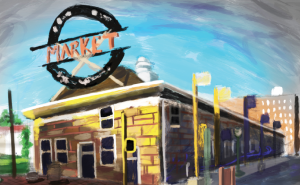
illustration by Rich Hauck.

illustration by Rich Hauck.

“This market is rocking!”

A few weeks back, on a Saturday afternoon, an enthusiastic Ryan Hummer gave me his assessment of the action at the Broad Street Market.

The thing is—I hadn’t asked him.

My wife and I were at his stand, Hummer’s Meats, collecting our usual provisions for the coming week, when he spontaneously shared his excitement over the crowds of people elbowing their way through the narrow aisles of the brick building.

“Quite a change,” I said.

“Day and night,” he responded.

Hummer’s Meats is a market stalwart, and the family traces its roots there back to the 1920s. Ryan is the fifth generation to cut meat and, for a while, it looked like he might be the last of his family to sell anything inside Harrisburg’s only city market.

“I’m just about out of here,” he told me four years ago, after an infestation of bugs and rodents forced the market to shut down, the second time it had closed in two years for basically the same reason.

Back then vendors were at wit’s end—angry with management, with the board, even fighting with each other. The market still had its regulars, but, on many market days, more people seemed to be working there than shopping there.

The 150-year-old market was in the same funk as the rest of Harrisburg—a once great place now dirty, depopulated and struggling.

Then something happened—or, more accurately, a series of somethings.

Ask vendors what that was, and you’re likely to hear a trio of reasons: better management, a better mix of vendors and a better neighborhood.

Two years ago, Ashlee Dugan was appointed market manager followed, last year, by Beth Taylor. The vendors I spoke with described both women as caring, committed and competent, with a hands-on, problem-solving style of management. They also praised them for helping to bring stability to a market long plagued by turmoil.

Importantly, Dugan and Taylor put recruitment of new, high-quality vendors near the top of their priority lists, and that effort has born fruit.

On a typical Friday or Saturday, large crowds huddle around three newcomers that have their stands in a row in the brick building: Radish & Rye Food Hub, Evanilla doughnuts and Elementary Coffee Co. But it’s not just the newbies. Long lines often greet the hungry at long-timers like Fisher’s Deli, Lil’s Pretzels and Peach Ridge Produce. The newer vendors, though, clearly have injected life and brought fresh faces into the market.

Lastly, the neighborhood in general—and the Millworks in particular—deserve some credit, vendors told me.

For years, Midtown Scholar Bookstore was about the only complementary business to the market. But, over the past year, Zeroday Brewing, H*MAC (especially the Kitchen and the monthly HBG Flea), the Susquehanna Art Museum and the Millworks have recruited people into Harrisburg. Several vendors singled out the Millworks not so much for generating pedestrian traffic across Verbeke Street (though there is some of that), but for introducing—or reintroducing—folks to Midtown, some who return to shop at the market.

Interestingly, not one vendor I spoke with cited the once-ballyhooed Broad Street Market Task Force as a player in the improvement. More than two years ago, the city formed the task force to make recommendations on how to improve the market and, last year, the group issued its report.

Perhaps most significantly, the task force suggested changing the market’s complex management structure, currently a multi-tiered mess consisting of the city, the Broad Street Market Corp. and Historic Harrisburg Association. Instead, the report said, the market should become a nonprofit entity, which would better enable it to raise money and operate smoothly.

That hasn’t happened yet, nor have the report’s other suggestions been implemented (with the possible exception of slightly expanded market hours). Still, progress—substantial progress—has been made, judging by the large crowds and seemingly satisfied vendors. So then what’s the lesson?

Well, leadership matters a lot and, by leadership, I mean committed, every day, on-the-ground (not board-level) leadership. Secondly, synergy matters a lot. It was tough to get outsiders to venture into a desolate Midtown but got easier once several new businesses created a buzz and more options in the neighborhood, allowing people to walk from one place to another.

What doesn’t matter so much? Bureaucracy, reports, endless meetings. Perhaps, one day, the market will shed its layers of overseers. But, until then, it clearly can make headway regardless. As for the task force’s other recommendations—heck, we already knew the market needed infrastructure improvements, better hours and a focus on good food.

The Broad Street Market, like Midtown itself, has been struggling for decades, and numerous administrations and consultants have devised plans to fix it. Nothing seemed to work. All the reorganizations and master plans could not solve its two greatest problems: a dearth of high-quality, focused leadership and, most importantly, a lack of customers.

After years of almost nonstop woe, people have been returning to the market. It seems so sudden and unexpected, but perhaps it shouldn’t be any surprise that, as Midtown goes, so goes the Broad Street Market.

Lawrance Binda is editor-in-chief of TheBurg.


Continue Reading

More than Just Plays: Outreach as important as acting at Gamut Theatre.

Screenshot 2016-04-28 13.20.36Shouldn’t it be enough to just do good Shakespeare? Or, more generally, shouldn’t it be enough to just put on good plays?

It is a question that could be asked of any theater company, but Gamut Theatre Group has a firm stance on the matter—no.

“You need to be committed to some form of outreach and some form of community engagement in order to make what you do accessible,” said Thomas Weaver, associate artistic director of the company and part of the team that focuses on community outreach.

Harrisburg is a city with a complicated and divisive racial and class history, and one way to try to achieve greater unity is through art, Weaver believes. Art, he said, helps create a city’s identity, and the goal of any arts organization should be to connect with the people it serves to help build up that identity.

In its origin, Gamut Theatre Group was known solely as the Popcorn Hat Players, a children’s theater company that still is a focus in the organization.

“Gamut was founded in a lot of ways on a basis of outreach,” Weaver said. “We don’t expect the audiences to always come to us; we go to them.”

The Popcorn Hat Players are, primarily, a touring company, reaching schools, daycares and community centers across the state and beyond. Later this month, during the city’s annual Artsfest celebration over Memorial Day weekend, the Popcorn Hat Players will present Kidsfest, offering free performances, face painting and craft making.

“Kidsfest is a way for us to reach people who may not have the means or ability to join us at our theater downtown,” Weaver explained.

It is in Gamut’s mission to tell stories in a new and exciting way to help engage, educate and elevate the community, he said. However, that mission is not exclusive to the Popcorn Hat Players.

One of the greatest outreach programs that Gamut offers every year is actually with its other company in the group, Harrisburg Shakespeare Company— Free Shakespeare in the Park.

Shakespeare in the Park has taken place annually on Allison Hill for more than two decades.

“It’s one of our biggest productions every year in terms of budget, cast, crew and the amount of resources that go into producing it, and it’s offered absolutely free,” Weaver said.

The event is unique not only in its free-ness, but in its opportunity to engage with the community.

“There are families that expect us to be there that wouldn’t be able to see us otherwise,” Weaver said. “During rehearsals, we have families and neighborhood kids come out, right after school, and watch us, oftentimes learning the actors’ lines and fight choreography.”

They may be doing free Shakespeare, but those kinds of connections with the families of the neighborhood are just as, if not more, important than putting on a good play.

Weaver said that Gamut’s principals and actors firmly believe they must try to reach and include everybody in what they do, as one of the primary purposes of art is to enrich lives. Theater provides this to a community because art is a communal experience.

“It’s the same reason why people like to go see live music— it’s not just to hear the music, but to be in a room and experience that thing with others,” Weaver said. “It gives a sense of commonality. It’s a unique experience for people to come together and experience and feel something.”

Ultimately, the goal of an arts organization is to make meaningful connections with the people in the community, Weaver said. If you aren’t putting in the effort, you aren’t making those connections.

Gamut, he added, makes connections all over the place: from Popcorn Hat Players to Free Shakespeare in the Park to a mentorship program at Ben Franklin Elementary School to Kidsfest. There are many ways in which the company does more than just good plays.

The Popcorn Hat Players will offer Kidsfest during Harrisburg’s Artsfest celebration, May 28 to 30, at Riverfront Park, Harrisburg.

Harrisburg Shakespeare Company will present “The Merry Wives of Windsor” as its 23rd Annual Free Shakespeare in the Park in Reservoir Park on Wednesday, Thursday, Friday and Saturday evenings beginning June 3 through June 18. More information can be found at www.gamuttheatre.org or by calling 717-238-4111. 


MAY THEATER EVENTS
AT HARRISBURG’S
PROFESSIONAL DOWNTOWN THEATERS

AT GAMUT THEATRE
www.gamuttheatre.org

POPCORN HAT PLAYERS PRESENT “ROBIN HOOD”
May 14-21
Saturdays at 1 p.m.
Wednesday and Thursday performances available for groups of 20+ in advance
Tickets $8

TMI IMPROV TROUPE MAINSTAGE SHOW
May 20
Bar opens at 6:30 p.m.
Show starts at 7:30 p.m.
Pay what you will

POPCORN PLAYERS PRESENT ANNUAL KidsFest at ArtsFest!
May 28-30
Look for our tent in Riverfront Park
Craft making, face painting and free performances offered throughout the weekend


AT OPEN STAGE OF HARRISBURG
www.openstagehbg.com

2016 STUDENT SHOWCASE
May 1
An evening of scenes, monologues and songs
7 p.m.
Free admission

OSHKids Performance Company presents
“NARNIA: THE MUSICAL”
May 12-15
Tickets $10

Continue Reading