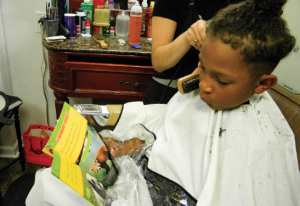
Books and Buzzcuts: “Books in Barbershops” aims to bring education back into shops.

Photo by Yaasmeen Piper.

 I learned a lot about life in the checkered walls of the barbershop: local politics, neighborhood gossip and what an “interception” was. Growing up, I watched my father and brother’s barber morph into therapist, teacher, even news anchor at times.

Reading material was always around, but, eventually, Candy Crush and Twitter seemed to replace magazines and newspapers. Harrisburg Councilman Cornelius Johnson believes it’s time to bring back the barbershop as a place both to get a haircut and learn a little something.

With the help of the American Literacy Corp. (ALC), children’s books for ages 2 to 12 are now shelved in 10 Harrisburg area barbershops. Begun in late May, the “Books In Barbershops program means to return education to barbershops with a child-friendly environment that may help boost the literacy rate for young boys.

The key concept I wanted to integrate was not just providing the bookshelves and the books, but to find appropriate barbershops where the barbers will support it—knowing to refer the kid to the books, and asking them reading comprehension questions, Johnson said.

Johnson, who is a weekly customer at his barbershop, said some days he spends hours in the chair.

I go once a week,” he said. “My barber’s never on time, so I’m spending about an hour and a half in there each time.

He’s not alone. Some kids, maybe waiting for their father and brother, might spend a good two hours inside a barbershop.

So [reading] keeps them engaged as far as keeping them out of ‘grown folks’ conversation,” he said. While some of that conversation may be relevant to the kids, a lot of that conversation is for adult men. So, it’s good to have that space where they can grab a book and read.”

Originating in Harlem, the program was created by a nonprofit called Reading Holiday Project, which sought out barbershops because of their cultural influence on black men. According to the U.S Chamber of Commerce Foundation, only 18 percent of AfricanAmerican fourth-graders are proficient in reading. For eighth-graders, that number drops to 16 percent.

Young black boys are performing lower than anyone when it comes to literacy rates,” Johnson said. I think it’s good to highlight and target them to get their performance rate up. Even though [black males] may be a target, that does not mean a female or anyone can’t come up and read a book. It’s for anyone to read, but [black males] continue to be our target audience because they are the ones who are sitting behind.”

Johnson blamed technology, socioeconomic stress and the absence of proper representation and diversity in children’s books for the decline in boys reading.

You want to see yourself [when you are reading],” he said. You want to build your imagination. It’s hard to build your imagination when you’re constantly looking at images that don’t look like you.”

Johnson and his team, which includes Brandon Flood, executive director of the Pennsylvania Legislative Black Caucus, Rob Lesher, director of the Dauphin County Library System, and others from salons and nonprofit organizations, set out to collect books that properly represented their audience. Some classics were thrown into the mix, such as Charlotte’s Web, Goosebumps and Johnson’s childhood favorite, “The Cat in the Hat.

And the reading doesn’t have to end when the haircut is done. Kids are allowed to take their books with them and build a home library.

When you’re reading to the kids, they ask you a lot of questions,” said Anthony Cuthbertson, owner of GQ II Barbershop in Penbrook. “It goes deep with me. My roots are in the community.

Cuthbertson grew up in Hall Manor so, he said, understands the importance of giving back.

A lot of people don’t understand the role that you play when you’re reading to someone,” he said. You’re opening up a whole new world for them. You see their eyes booming. They can’t wait until you get to the next page.”

Johnson hopes that, in the years to come, he will be able to spread the program throughout the city and reach more young men.

When asked what message he had for young black boys, the answer seemed already to be on the tip of his tongue.

Just keep reading,” he said. We don’t realize the power in reading until it’s too late. Society is not too accepting of people who have low literacy rates.

The “fundamental base” to life, Johnson said, is reading.

It’s how you develop further knowledge,” he said. If you don’t have the ability to read in today’s society, you have no place to advance.”

Find a Book
“Books in Barbershops” can be found at the following barbershops in the Harrisburg area:

Gifted Hands
1008 N. 3rd St.
Harrisburg

GQ2
2801 Penbrook Ave.
Harrisburg

Super Star Status
1925 Derry St.
Harrisburg

The Greatest Barber Shop in the World
145 N. Front St.
Steelton

I Am That I Am
1312 Derry St.
Harrisburg

Hair Design Plus Inc.
3031 Walnut St.
Harrisburg

Heads Up
2286 N. 6th St.
Harrisburg

Faded
6110 Derry St.
Harrisburg

Ebony 1
29 N. Front St.
Steelton

Steelton Hair
227 S. 6th St.
Steelton

Author: Yaasmeen Piper
Continue Reading

When I’m Mobile: Marco van brings exploration, imagination to the people

 Once, there was a great explorer named Marco, who visited places far and wide.

Now, there is a van, also named Marco, that lets you explore the limits of your imagination and creativity.

Earlier this year, Marco set sail on its first voyage through Dauphin County, bringing with it state-of-the-art technology, customized experiences and free Wi-Fi.

“It’s literally a library on wheels, the first vehicle of its kind,” said Ann Bruner, community outreach and engagement administrator for all nine libraries in the Dauphin County Library System.

Named after the Venetian explorer, Marco Polo, the attraction promotes exploration, bringing the library’s resources directly to the people. Bruner noted that public transportation often can pose a problem for residents who wish to visit the library but can’t.

“It’s designed to give residents in both rural and urban areas better access to all of the services the library provides,” she said.

Here’s what Marco is not—a book mobile.

“Marco is an exploration station that promotes literacy of all kinds,” Bruner said. It can teach people how to quickly access the best information.”

Marco’s cargo reflects the changing trend in learning.

Equipped with 10 laptops and a flat-screen TV mounted to its side, Marco has its own power source, offering wi-fi access to surrounding areas wherever it is stationed.

“Visitors can even bring their own devices and connect directly to the internet to explore all the services and use the tools the library offers,” Bruner said.

While Marco does carry some books, it’s also equipped with diverse resources that allow the outreach team to customize an experience for any age—from toddlers all the way to senior citizens, explained Bruner.

Since its March launch, Marco has been in high demand, traveling to such events as Artsfest in Harrisburg and school fairs, said Donna Husted, youth services specialist and, frequently, Marco pilot.

“We can help children use their summer productively—avoid the summer slide—so school isn’t so difficult for them in the fall,” she said.

Marco also delivers instruction, training and support to teenage and adult community members. This summer, Marco will visit summer camps and senior centers.

“We can offer interactive experiences that engage audiences in a variety of ways,” said Husted.

Chris Black, library supervisor at the McCormick Riverfront Library in downtown Harrisburg, said Marco helps expose people to DVDs, CDs and, of course, books.

“We want to help everyone become aware of all the great things the library has to offer,” Black said.

Connections, especially those with the underserved populations across Dauphin County, are another central objective of Marco, explained Bruner.

“We can meet the community where they are and help provide them access and education to all things, from voter registration services to how to access health information,” she said.

Bruner noted that the outreach department recently has been seeking staff members who possess second-language skills to help address the diversity within the communities. She said that non-English speakers often feel isolated and view the physical library as a daunting place.

“When the library extends a helping hand in someone’s own neighborhood, many people feel more comfortable to accept the help,” she said.

To build Marco’s outreach, the library system hopes to partner with organizations looking to better serve the community, including local food banks and ESL support organizations. Bruner envisions outreach programming that could include Marco hosting a computer class on City Island or visiting a nursing home to teach residents about digital literacy.

Marco’s busy schedule is clear evidence that there is demand for its services, and there’s even talk of adding a second van. Any expansion, however, relies on donor-funded support.

Marco would not have been possible without the support of the donors and partner organizations,” Bruner said.

Of course, another way to support Marco is simply to get out and attend an event.

“There will be a lot going on this summer,” Bruner said.

To keep up, she hopes to offer an interactive map so people can track where Marco is around the county.

“Its extremely exciting,” she said. The possibilities are endless.”

For more information on Marco or to schedule a visit to an event, visit www.DCLS.org and click on “Make A Visit/Request A Visit.

Author: Jen Fertenbaugh

Continue Reading

July News Digest

Housing Funds Disbursed
Harrisburg City Council doled out some $1.9 million in federal housing funds last month, but not before making tweaks to the administration’s proposal.

Council provided $25,000 to the Heinz-Menaker Senior Center from the city’s portion of annual Community Development Block Grant (CDBG) funds, a program of the federal Department of Housing and Urban Development.

The city administration had denied funding for the center, saying its application scored too low to merit a grant.

To make room for the Heinz-Menaker grant, $15,000 was taken from a proposed allocation for the city’s Police Bureau, which still will receive $90,000 to help pay for a new community policing van and a police cadet program.

Another $10,000 was taken from the city’s Department of Community and Economic Development, which still will receive about $43,000 to cover unreimbursed costs related to the sinkhole project on S. 14th Street.

Like last year, the greatest single amount of money, $562,248, went to repay federal loans the city backed during the Reed administration for several development projects, including the disastrous Capitol View Commerce Center project.

Other CDBG recipients included:

  • City Housing Rehabilitation Programs: $330,000
  • Tri-County HDC: $150,000
  • City Emergency Demolition: $120,000
  • Harrisburg Fire Bureau: $51,686
  • Habitat for Humanity Greater Harrisburg Area: $30,000
  • Rebuilding Together: $15,000
  • Christian Aftercare Recovery Ministries: $25,000
  • A Miracle 4 Sure: $25,000
  • Latino Hispanic American Community Center: $25,000
  • Fair Housing Council: $25,000
  • Mid Penn Legal Services: $15,000
  • Neighborhood Dispute Settlement: $3,900

While the city undertook the annual process of distributing CDBG money, funding is not assured as the Trump administration has threatened to end the program.


Riot Gear Debated

Harrisburg City Council last month left for summer break without voting on a plan that would supply the city’s police with new protective gear.

Council members said they would take up the matter once more after they returned from hiatus in late August and, in the interim, urged police to engage with residents to discuss the issue.

The Police Bureau is seeking to transfer $65,000 from unspent personnel funds to purchase 30 “top to toe” protective suits. The bureau’s current gear is old and inadequate, police say.

Some city residents have urged council not to approve the transfer, saying that so-called “riot suits” would escalate tense situations. Police, though, say that protests, particularly at the state Capitol, have become more frequent and more violent, and that officers need the equipment for personal protection.


College Plans Move to City Hall

Eastern University announced last month that it would like to move its satellite campus into the basement of Harrisburg city hall.

“I want to be in the city,” said Wesley Bunting, an official with the St. Davids, Pa.-based Christian college, whose satellite campus currently is located in Lower Paxton Township.

Therefore, the university approached the city with a novel offer. It would spend about $615,000 to fully renovate the mostly empty, worn-out basement of the MLK Jr. City Government Center on N. 2nd Street.

The city would be able to use a portion of the space for a new, state-of-the-art emergency operations center. It also would get access to classroom space when not in use and to the lounge, which could be used as a break room. The city would receive the improvements but no monetary rent during the 10-year lease term.

If approved by council, the project could start immediately and would take less than a year to complete, Bunting said.

“This is a substantial investment in the building with resources that we otherwise would have to draw from somewhere else,” Mayor Eric Papenfuse said.

Papenfuse said the project also would bring more people downtown, would boost building security, especially after hours, would offer technology upgrades in the building and would help create a “critical mass” of colleges downtown, adding to the existing presence of Harrisburg University, Temple University and Messiah College.


HDID Seeks Renewal

The Harrisburg Downtown Improvement District last month asked City Council for a five-year reauthorization, a plan that would expand the district to State Street.

Executive Director Todd Vander Woude outlined a few recent activities by the group, including last year’s “Dino-Mite Summer” public art project, this year’s “Discover the Ducks Downtown,” the St. Patrick’s Day parade, several new murals, more bike racks, brightly painted planters and a new safety substation.

“Our focus is making downtown clean, safe and beautiful,” said Vander Woude, who received a generally positive reaction from council.

In 2015, council refused to grant a full, five-year term, offering only two years with instructions to become more visible and active. Back then, some council members said that HDID wasn’t doing enough to attract people downtown.

Getting firm council support is particularly important this year, as the HDID is seeking to expand its northern boundary from Pine Street to State Street, bringing 58 more properties into the district and upping the organization’s annual budget by $40,000 to $820,000. Each commercial property is assessed a 1.75 mil surcharge on its city property taxes to cover the cost of HDID services, which also include cleaning, safety and beautification measures.

Property owners within the proposed district have 45 days from last month’s council hearing to vote against the district. Forty percent of properties within the boundary must vote against it for reauthorization to be defeated.


City Payment Restored

Harrisburg will receive its full state funding after all, as the legislature passed a budget re-inserting a $5 million payment to the city.

The $32 billion state budget for 2017-18 includes full funding of the “Capitol fire protection” line item, a type of payment in lieu of taxes that the city counts on to help fund emergency services.

Gov. Tom Wolf included the payment in his proposed budget in February, but it was later stripped out by the state Senate.

Over the decades, this annual payment has ranged widely from nothing to the current $5 million, an amount decided upon while the city was under state receivership. However, the money is not guaranteed, meaning that Harrisburg isn’t certain it will receive the funds until the always-fraught state budget is passed.

The money lands in the city’s general fund, but Harrisburg officials say it offers compensation for services that the city provides to about 30,000 state workers. The state pays no property taxes on its massive holdings in the city, which include some 50 state-owned buildings on about 42 percent of the city’s land.


New Grocery Store

If you’ve been hungering for an urban-style grocery store in Harrisburg, your wait is almost over.

In a few months, Provisions will open in Strawberry Square, emphasizing natural, organic and locally produced goods, mostly sold in bulk.

Provisions will occupy 2,350 square feet of space next to Fresa Bistro with a storefront entrance on N. 3rd Street, said Brad Jones, CEO of Harristown Enterprises, which owns Strawberry Square.

“You’re going to be able to get fresh food that you can shop daily for,” said Jones, who described the market as a “locally grown Trader Joe’s.”

Jones expects the build-out of the space to begin immediately, with the store opening in mid-October.

Provisions is the brainchild of Shaun Donovan, the owner of the online grocery store Appalachian Organics, and Adam Porter, co-owner of the co-working space, StartUp Harrisburg.


Steelton Redevelopment

A new development called Renaissance Row soon will begin to rise in downtown Steelton, in part thanks to a tax incentive program.

Dauphin County and Steelton officials last month credited property tax abatement for enabling the project, which will feature 80,000 square feet of commercial space and 46 one-and two-bedroom apartments across the street from Steelton Borough Hall.

“Providing property tax relief for new construction and renovation can make the difference between making it viable to move forward on a project,’’ said county board Chairman Jeff Haste.

Philadelphia-based developer Chariot Companies will build Renaissance Row. A second development featuring 12 new townhouses on Adams Street should break ground later this year.

All of Steelton is part of a Local Economic Revitalization Tax Assistance (LERTA) program, which provides tax breaks on property improvements for 10 years.


Home Sales Climb

The Harrisburg area scored another solid month for home sales, as purchases increased 4.2 percent year over year.

The Greater Harrisburg Association of Realtors reported 1,147 sales in June compared to 1,101 sales in June 2016 for its coverage area, which covers all of Dauphin, Cumberland and Perry counties and parts of York, Lebanon and Juniata counties.

The median price also rose, increasing to $183,000 versus $175,000 in the year-ago period, GHAR said.

In Dauphin County, 389 homes sold, an increase of 23 units, with the median price rising to $163,500 from $160,000. In Cumberland County, sales totaled 398 units versus 388, with the median price jumping to $210,000 from $190,900.

Perry County had 51 home sales against 33, with the median price rising to $143,000 from $129,900 a year earlier.

So Noted

Fine Wine and Good Spirits will open an 11,500-square-foot retail store at the Capital City Mall this fall, according to mall owner PREIT. Next year, a Dave & Busters also will open, offering a casual dining and entertainment option.

Harrisburg University is relocating its Philadelphia campus, which will more than quadruple its space. The new site at 1500 Spring Garden St. in Center City will allow the university to offer full, four-year bachelor degrees at the campus without students needing to transfer to the main campus in Harrisburg.

Merit is the new name of the Harrisburg-based marketing and innovation firm, Sacunas. The company, founded by Nancy Sacunas, said it changed its name to better reflect its mission under now-owner Adam Vasquez.

Mom’s Tamales & Papusas is expected to open this month at 263 Reily St., across from Midtown Cinema. Owner Josue Osorto, a veteran of many Harrisburg restaurants, will run the eatery specializing in food from El Salvador.

PinnacleHealth has completed the acquisition of four hospitals in three surrounding counties. The Harrisburg-based company bought Carlisle Regional Medical Center, Heart of Lancaster Regional Medical Center, Lancaster Regional Medical Center and Memorial Hospital of York.

Rite Aid and Walgreens have dropped their plans to merge. Instead, Walgreens will buy 2,186 Rite Aid stores for $5.2 billion, leaving East Pennsboro Township-based Rite Aid with 2,350 stores after the deal is complete.

In Memoriam

Robert Marquette, long-time president and CEO of Members 1st Federal Credit Union, died last month, said the Mechanicsburg-based company. Marquette, 68, also was the face of the Members 1st, donning a superhero-type outfit and making homespun pitches during numerous advertisements.

Benjamin Olewine III, lifelong Harrisburg resident, businessman and philanthropist, has died at the age of 95. Olewine grew his family’s food business into one of the top food distributors in the country, selling it in 1988 to giant Sysco Corp., where he continued to work until a few years ago.


Changing Hands

Allison Ct., 7: B. Schaeffer to Flipside Home Renewal LLC, $32,000

Barkley Lane, 2503: F. Scott to L. Holloway, $62,500

Bellevue Rd., 2026: M&N Associates LLC to N. & S. Diehl, $70,000

Berryhill St., 1621: G. Campos to B. Brown, $30,000

Capitol St., 901: G. Ulrich to C. Lenz Jr., $117,900

Capitol St., 1003, 414 Forster St. and 919 & 923 N. 2nd St.: PLM Real Estate Investments & M. Stuski to AON LLC, $265,000

Chestnut St., 1822: G. Neff to A. Brown, $43,900

Derry St., 1408: M. Neidigh to J. & D. Judge, $30,000

Derry St., 2334: R. Miller & D. Shellenhamer to N. Hanna, $35,000

Derry St., 2400: J. Seibert to 2400 Derry Street LLC, $65,000

Edgewood Rd., 2315: R. Everngam Jr. & D. Bottini to I. & A. MacFarlane, $204,900

Fulton St., 1418: Ocwen Loan Servicing LLC to PA Deals LLC, $61,960

Fulton St., 1733: J. & R. Gregoire to M. Shelleman, $121,000

Grand St., 919: L. Bolan to A. Chen, $114,900

Green St., 1809: M. & R. Monticchio to D. Caley, $140,000

Harris St., 342: Keystone Properties Group LLC to D. Shelley, $89,000

Herr St., 211: M. Rudderow to G. Broome, $119,900

Herr St., 259: B. Eppley to J., J., & P. Millner, $150,000

Holly St., 1946: M. Naranjo to A. Mercado, $105,500

Hudson St., 1106: J. Raab to K. Fernandez, $60,000

Hudson St., 1215: A. Powers to PI Capital LLC, $33,500

Kelker St., 231: A. DeHoff to D. Rubenstein, $174,900

Lewis St., 303: E. Gadsen to E. Torres, $124,000

Market St., 810, 812 & 900; 24 & 26 N. 10thSt.; and 12, 21 & 23 N. 9th St.: Patriot News Co. to 812 Market Street LLC & Twenty Lake Holdings, $644,286

Market St., 1848: Kusic Financial Services to E. Lewis, $37,100

Muench St., 212: K. & K. Warner to C. Kim, $169,900

Mulberry St., 1162: Stoute Housing Inc. to Evidence Group LLC, $73,000

N. 2nd St., 1225: M. & L. Day to S. Shaffer, $125,000

N. 2nd St., 2011: M. Patterson to S. Gallagher & C. Prestia, $139,000

N. 2nd St., 2915: K. & K. Russell to L. Whitcomb & M. Quinn, $315,000

N. 2nd St., 3004: S. Jusufovic to L. Bolan, $219,000

N. 3rd St., 1722: M. Kravanis Jr. & N. Melton to A. Glickman, $112,000

N. 3rd St., 1728: Leonard J. Dobson Family Limited Partnership to Keystone Brothers Investments, $106,000

N. 3rd St., 1730: Secretary of Housing & Urban Development and Information Systems & Networks Corp. to S. Bernhard, $72,000

N. 3rd St., 1928: Secretary of Housing & Urban Development to J. Hobbs, $70,000

N. 6th St., 3107: E. Willis to S. & K. Wright, $99,500

N. 6th St., 3136: M. Naranjo to L. Seay, $55,000

N. 12th St., 47: Hobbeze Inc. to E&K Homes LLC, $35,000

N. 16th St., 521: D. Taylor to Wells Fargo Bank NA, $38,262

N. Front St., 1525, Unit 413: H. Michels to J. Becker, $93,900

N. Front St., 2201, 2225 & 2229; and 2200, 2214, 2216 & 2218 N. 2nd St.: 2201 Partners LP to 2201 NFS LLC, $1,800,000

Penn St., 1805: L. Urban to T. & K. Hand, $93,000

Penn St., 1933: WCI Partners LP to D. Ranson, $139,900

Rudy Rd., 2145: M. & K. DeRosa to G. Broadnax, $178,000

Rudy Rd., 2409: N. Ishman to W. & A. Krahn, $149,900

Rumson Dr., 2843: N. & I. Nanov to C. Rojas, $35,000

S. 13th St., 340: JKC Properties LLC to Round Rock Investments LLC,, $101,000

S. 17th St., 927: M. Maniari & Z. Erroudi to A. Mejia, $89,900

S. 18th St., 1128: J. Buzby to T. Ro & J. Musa, $95,000

Verbeke St., 116: H. Reynolds to M. Zecharya & B. Macavoy, $30,000

Verbeke St., 215: J. & S. Bircher to J. & & E. High, $215,000

Verbeke St., 235: S. Will to A. & C. Maset, $146,000

Author: Lawrance Binda

Continue Reading

Total Eclipse of the Heartland: Prepare now to view the Great American Eclipse

 On Aug. 21, one of Mother Nature’s most glorious spectacles will grace the skies of the mainland United States: a total solar eclipse.

The moon will completely block the sun in a roughly 70-mile-wide corridor that runs east-southeast from Oregon’s Pacific coast, cutting right through Wyoming, Nebraska and Missouri, and all the way across the continent to South Carolina.

People inside this narrow path will be dazzled by the unforgettable spectacle of a pitch-black hole in the sky—where the sun is supposed to be—surrounded by the diaphanous whitish glow of the solar atmosphere (the corona). There’s no other sight like this in the world.

 Having seen five total solar eclipses myself, I cannot stress enough that it’s absolutely worth your time and effort to do whatever you can to get inside the path of totality at the time of what’s being called the Great American Eclipse. To paraphrase Mark Twain, the difference between a total solar eclipse and a 99.99-percent partial solar eclipse is like the difference between a lightning bolt and a lightning bug.

 But if you remain in the Harrisburg area, you can still enjoy watching a partial solar eclipse unfold over the course of 2 hours and 42 minutes. But make sure you take the proper precautions to view the eclipse safely.

 The time of when the eclipse begins and ends depends on your exact location. But if you’re in or near Harrisburg, the moon will begin to move across the sun’s disk at 1:17 p.m. The maximum blockage of the sun will occur at 2:41 p.m., when the moon will cover 77 percent of the sun’s disk. And the eclipse will end at 3:59 p.m.

Although 77 percent sounds like a lot of sun blockage, you probably won’t notice any darkening of the sky, though you might notice slightly cooling temperatures.

 Looking directly at the sun for just a few seconds, even when the partial eclipse is at maximum, can cause permanent damage to your eyesight if you don’t use the proper protection. And whatever you do, do not look at the sun directly for even a brief moment through a telescope or binoculars unless a special filter is mounted on the front end of the instrument.

 Fortunately, there are inexpensive methods for observing the partial eclipse safely.

You can order eclipse glasses online, and many public libraries are giving them away for free. These glasses block out almost all of the sun’s light, so you can stare safely at the sun for hours. But do not use eclipse glasses with a telescope or binoculars; they are for your naked eyes only.

 Another way to view the partial eclipse is to project the image of the sun by punching a small hole in a sheet of paper and letting the eclipsed sun’s light pass through the hole onto another sheet of paper. Alternatively, if you stand near a tree, its leaves will act as natural pinhole cameras, projecting dozens or hundreds of images of the partially eclipsed sun on the ground or pavement.

 If you plan to use a telescope or binoculars, make sure to securely install a special solar filter on the front end of the viewing instrument. The least expensive option is Baader AstroSolar Safety Film, which has the texture of aluminum foil. You can tape the film over the front of the telescope or over both lenses of binoculars.

 If you travel into the path of totality, it’s perfectly safe to remove the filter and view the eclipse with your naked eyes or with binoculars once the sun is completely blocked at totality. In fact, if you use a filter during totality, you’ll see nothing at all. If you’re near the center of the narrow path, totality will last two to two-and-two-thirds minutes, depending on your location.

 Obviously, there won’t be anything to see if your sky is cloudy at eclipse time. In general, the western United States has the best weather prospects. But no matter where you go, I recommend checking the weather forecast the night before the eclipse and be prepared to drive to an alternate location with better prospects for clear skies at eclipse time. With tens of millions of eclipse chasers from all over the world expected to be in the path of totality, expect heavy traffic.

 If you’re interested in photographing the eclipse, my advice is to use the time between now and the eclipse to practice photographing the sun at the local time of the eclipse. Numerous websites, such as MrEclipse.com and Eclipse-Chasers.com, offer practical tips. But if you’re in the path of totality, spend almost all of your time actually looking at the eclipse. Don’t waste this precious time fiddling with camera equipment.

 The Aug. 21 eclipse will be the first to touch the U.S. mainland since 1979. And it’s the first coast-to-coast eclipse since 1918. The path of totality crosses 14 states (although just tiny portions of Montana and Iowa) and five state capitals. And amazingly, it’s the first solar eclipse in which totality can be seen exclusively from the United States since our Founding Fathers declared independence in 1776.

 A typical location on Earth gets one total solar eclipse every 375 years on average. The last total eclipse to pass over Harrisburg was in 1478—before Columbus’s first voyage to America. The next won’t take place until 2144—when nobody reading this article will still be alive.

 If you miss the Aug. 21 eclipse, you’ll have another shot on April 8, 2024. A total solar eclipse will cross the United States from Texas to Maine, and the narrow path of totality will pass over the very northwestern part of Pennsylvania, in and around Erie.

The State Museum of Pennsylvania’s planetarium will run shows about the eclipse from Aug. 9 to 20.

Raised in Hershey, Robert Naeye was editor-in-chief of Sky & Telescope magazine from 2008 to 2014.

Continue Reading

Full STEAM Ahead: Getting creative at MakerShift

Photo by Dani Fresh.

 Ingenuity, technology and creativity descended on Midtown Harrisburg recently.

The event, called MakerShift, brought area businesses, individuals and schools together to show off their STEAM (science, technology, engineering, arts and math) creations and capabilities.

“Our goal is to expose the public to the great creativity and innovation that’s happening in the region and celebrate that,” said Chad Frey, president of Foundry Makerspace, an organization that helps Harrisburg schools bring STEAM into the classroom.

Event venues, marked with balloon towers, ran up N. 3rd Street from St@rtup Harrisburg to the Susquehanna Art Museum.

Fourth-grader Sylvia Givler watched as a 3D printer crafted a Coffin’s cube—a three-dimensional puzzle.

“I just like it because it’s cool, and you can learn new stuff,” she said, remarking on the technology. “It’s tricky, and I like a challenge.”

Cinematographer Seth Umbenhauer stood next to a young man trying out the Vive virtual reality headset. Controllers in hand, he played a game called Longbow, pulling and releasing his imaginary bowstring, defending his castle against attackers.

“It’s great to see the community come together and celebrate creativity,” Umbenhauer said.

Just outside, Michael Peluso demonstrated the ancient art of glassmaking.

“There’s not a lot of forgiving things about glass—gravity is always working against you,” he explained as he moved the molten glass in circles. You have an ally in centrifugal force.”

He allowed onlookers to use didymium glasses, which serve as eye protection and show the heat content of the glass. He also explained that minute amounts of metal oxide produce colors in glass.

Watching Peluso, Central Dauphin High School sophomore Jordan McBarnett described the connection between art and STEAM.

“As you know, art comes from everything; it’s universal,” he said. We should appreciate and respect it. Art is in chemistry and engineering, and coding is a language.

McBarnett is part of the robotics team, (In) Formal Logic, at Covenant Christian Academy. The group created a cubed robot that collects then shoots balls.

The Makers

The folks displaying their creations are called makers.

“That’s an individual who basically creates for the love of creating within the STEAM field,” said event volunteer Allen Fernandez. “They range from inventors to entrepreneurs and innovators.”

Frey said that, for 21stcentury jobs, workers must be able to communicate and innovate. Projects like those represented at the MakerShift showed the adaptability necessary for employment and “design thinking, walking through a process of building and making,he said.

Cases in point: Francis Davis, 16, and Emmitt Altland, 12.

Davis designed and constructed a diabetic travel kit in which insulin pens could be kept cold until used. Insulin pens are often wasted because they can’t be recooled after becoming warm, he said. He described his technological challenges with the project.

“I made a cube into a spike when I was trying to make a rectangle,” he said.

Altland was creating a pocketknife that automatically opened after taking it out of your pocket. He made a hook that caught on the pocket and activated the knife latch. His problems were more mechanical.

“I had to bend the wire, and it was difficult to keep the same shape,” he said.

Better Understanding

Businesses like Dillsburg-based Katapult Engineering need this type of original thinking. To help the inspiration along, the company has started a makerspace, Katapult Libratory, in the old Dillsburg Library.

Makerspaces allow like-minded STEAM folks to come, use the equipment, create and have fun. For those who can’t make it to the makerspace, Katapult provides the option of a MakeBox, a monthly project subscription.

The State Library of Pennsylvania also has a makerspace open to schools during the academic year and a full schedule of free classes for makers in the summer. This year’s theme is anatomy and physiology.

Frey praised the growth of STEAM, but said that the thinking around it needs to evolve. Makers, he said, have typically lived in large cities and been of higher socioeconomic status.

A shift needs to start to think more democratically—not just men, not just white, not just with money,” he said.

Anyone attending the MakerShift would have seen a great deal of diversity and left with a better understanding of STEAM (remember the art!). They may have had a first-time experience with the Vive and an up-close and personal view of a 3D printer in action. More importantly, they would have walked away amazed at the ingenuity just under their noses in the capital region.

To learn more about Foundry Makerspace, visit www.foundrymakerspace.com.

Author: Susan Ryder 

Continue Reading

The Little Chill: ”A Ghost Story” is quietly haunting

 When you were a kid, chances are you considered being a ghost for Halloween.

Today’s ghosts have gotten very creative and gruesome, with bloody face paint or some wispy remnant of who the person was in life. But no one can forget the iconic bed-sheet ghost, with eyes cut out.

Writer/director David Lowery’s “A Ghost Story” makes use of this classic, but not in the way that you would expect. The film, framed in a 4:3 aspect ratio that gives the impression of an old-fashioned home video, mostly follows a couple, played by Rooney Mara and Casey Affleck (they are listed simply as M and C, respectively), who seem to have differing opinions about the house they live in: she wants to move, and he would rather they stay. While it is clear that they love each other—the first half hour is peppered with quietly intimate moments between the two—the house is definitely a point of contention.

The tension rises slowly and nearly imperceptibly. This is a languid film, which makes no rush of the bare-bones plot, relishing in each scene as if holding onto its memory. While the film never tips into the horror genre that the title suggests, the noises the couple hears and odd glimpses of refracted light on the walls suggest something is awry. However, the horror our audience expects is more of a poignant, relatable fear of death, which is faced quite suddenly when C dies in a car crash.

This is when things start to get interesting. Our lovable bed-sheet ghost comes out to play. And, yes, I will warn you, you are going to uncomfortably wonder if you should laugh or not. There is something so silly about Lowery’s ghost—and yet chillingly beautiful. As M continues on with her life, the ghost watches his slip away. You don’t often get to see through the ghost’s perspective like you do here, probably because it achieves the opposite effect of a ghost story. It won’t make you scream; it will make you ache.

But that is the beauty of this film, and it goes deeper, even playing with the concept of time itself as the ghost does all he can to hold onto the house, even as things begin to shift and others inhabit it. There is even another ghost in the house next door, a piece that is beautiful in meaning, but ruined a little bit by the completely unnecessary captions for the conversations the two ghosts have (the story would still be understood without the captions, and my only guess is that Lowery was trying to make the audience laugh).

While both Mara and Affleck give compelling performances (Mara’s scene eating a pie is heartbreakingly difficult to watch in its honesty), the film’s true character is revealed in the cinematography. The long takes, with starkly minimal content, create a quietly alluring perspective that sets stillness as its focal point and really lets you meditate on the heart of the story, rather than extraneous details. This is a refreshing take on love and loss, one that will haunt you with its sincerity. “A Ghost Story” is coming soon to Midtown Cinema.


UPCOMING SPECIAL EVENTS AT MIDTOWN CINEMA

Director’s Collections: Spike Lee

“Do The Right Thing”

Saturday, Aug. 5, 7:30 p.m.


National Theatre Live

Salomé

Monday, Aug. 7, 7 p.m.

“Angels in America, Part 1: Millennium Approaches”

Saturday, Aug. 19, 6:30 p.m.

Sunday, Aug. 20, 1 p.m.

Monday, Aug. 28, 6:30 p.m.


Angels in America, Part 2: Perestroika”

Sunday, Aug. 20, 6:30 p.m.

Monday, Aug. 21, 6:30 p.m.

Tuesday, Aug. 29, 6:30 p.m.


Free Outdoor Film Series

“Harry Potter and the Sorcerer’s Stone”

Friday, Aug. 11, at dusk

Rain date: Saturday, Aug. 12


“Star Wars: The Force Awakens”

Friday, Aug. 25, at dusk

Rain date: Saturday, Aug. 26

Author: Sammi Leigh Melville 

Continue Reading

Runners without Borders: Harrisburg’s architecture, parks create a parkour playground.

Photo by Ben Miller

I soared through the air across a 13-foot gap and jutted my feet firmly in front, aiming for a concrete ledge another 10 feet off the ground. In an ideal world, I’ll land on the balls of my feet on the ledge, sticking like glue to the cement.

Parkour is an adrenaline rush, more than anything,” said Daniel Sorbello, a traceur, another word for parkour practitioner, from Maryland. “I’ve been training a little more than four years now, and I’ve never found something that quite compares.”

Since the sport’s birth in the late 1990s, parkour has spread around the world, even finding its way to Harrisburg. Daniel and a training partner, Patrick Smith, travelled up to give the city a shot. I met with the two of them at the Capitol Complex to kick off a session in May. With its refined and elegant architecture, the complex’s unique walls and ledges make it a perfect place to put theory into practice.

“It’s based around freedom,” Patrick said. Your freedom to move and jump just the way you like. That’s what I like so much about it. I’ve got a lot of creative energy and parkour allows me to release it all.”

Tough One

The very essence of parkourand what draws most traceurs to the sport—is the ability to break free from the conventional. Many athletes, like Patrick, have an innovative and creative style, their movement unique to themselves. The idea of something so exclusive is one of the compelling traits of parkour.

The pair spent longer than 10 minutes working on one jump. They took off from one leg to a wall, 8 feet away and 4 feet higher than the take off. A jump like this leaves potential for injury, making it necessary to focus very intently on everything that goes into it. Their dedication to the maneuver caught the attention of some government employees. Interested and astonished, they began to ask questions.

“What is it?” one asked.

“Um, that’s a tough one,” Patrick said. It’s an expressionistic style of movement, one where you’re able to use the obstacles around you to jump and flip off from. It’s kind of like dance, almost, in an urban setting.”

Parkour is known for its showy features, such as roof gaps and unthinkable flips, which often get attention from onlookers. Thus, the sport is often misunderstood and seen as harmful. I feel a responsibility to educate people, to make them aware what we practice.

The workers’ interest grew. They asked if it was popular, and Patrick said, “Yeah. All around the world. It’s become a very widespread practice.”

So much so that Patrick and I travelled to Washington, D.C., in May for a parkour event called Beast Coast. There, I spoke with Mark Toorock, founder of American Parkour, a national parkour organization.

“I really, right off the bat, connected with it and thought this was going to be a thing that people really enjoy,” he said. There are no boundaries [in parkour]. The world is so full of divisions. There is no division between us as people. Parkour is just about people wanting to move, and that’s a human trait.”

Mark began doing parkour in 2002 in London. Two years later, he created American Parkour and hosted one of the world’s largest events in 2016 with more than 650 people. Speaking with him opened my eyes to the vastness of parkour, that it helps people transcend what they once thought was impossible, both mentally and physically.

“We’re meant to explore,” he said. We’re meant to play. We’re meant to skin our knees. That’s how we grow.”

Beauty and Wonder

A huge part of parkour circles around exploration. We, as athletes, take any opportunity given to us to venture to places we wouldn’t otherwise go. Parkour has taken me all over the East Coast and introduced me to many friends. The desire to explore is a trait that traceurs share.

Mark mentioned that some people have a negative image of the sport.

“I try to help them understand why there’s nothing wrong with parkour,” he said. “A lot of the negative perceptions come from things that aren’t actually part and parcel to parkour.”

Many in the community have dealt with people seeing them as mischief-makers who harm the environment and themselves.

After spending a couple of hours training at the Capitol Complex, Daniel, Patrick and I made a quick stop at Kunkel Plaza and finished our session at the PinnacleHealth building

on Front Street. That spot is so exposed that we attracted the attention of many passersby. After jumping for a while, a police officer pulled up.

“We got a call saying there were some kids vandalizing and loitering here,” the officer said, getting out of his car.

“We weren’t trying to vandalize anything,” Patrick said. I understand if that’s what it looked like, but that’s the last thing we want to do.”

We mentioned parkour, and that rang a bell.

“I’ve seen that on the internet,” he said. “That’s awesome.”

We showed him a little of what we do, flipping off the walls and stairs. He appreciated our display and politely told us to find a different spot to train. We thanked him and were on our way.

“I understand it’s a liability issue,” Daniel said. That’s why we leave when people ask us to. I don’t ever want to infringe. This kind of thing happens almost every time we train. I just like walking away knowing they understand we didn’t have any malicious intentions.”

Parkour, as a means of self-expression, has given Patrick, Daniel and me the ability to see the beauty and wonder in exploration. The sport provides a new appreciation for architecture and the simple structures in cities like Harrisburg.

“I hope to spread the knowledge of parkour with as many people as possible,” Patrick said. “I think it’s an incredible addition to society.”

Benjamin Miller will be a senior studying at the Capital Area School of the Arts Charter School (CASA).

Continue Reading

Sweet Shop: Perfect your nest with Sweet 504

Sweet 504

 Rebecca Werley was blessed with a decorator’s eye and an artistic flair, but, until recently, considered herself just a hobbyist. Then she joined the growing contingent of enterprising female entrepreneurs who have set up shop in Camp Hill.

Deemed “Sweet 504,” the shop name is a combination of the phrase “Home Sweet Home” and the area code that, if dialed, connects to the Big Easy.

“My whole family is from New Orleans,” explained Werley.

The boutique shop is located a stone’s throw from the specialty gift and coffee shop, One Good Woman, and shares a corner property and a rear entrance with MollyBee Kids, a toy store that opened last year.

Werley explained how the pieces of the puzzle fell into place to inspire her to make a go of it in an area that is known for supporting small businesses.

“I have a background in many things,” she said. Prior to moving here, I was COO of a workforce development corporation and, before that, I was a software director of training.”

Werley, who also worked as a stay-at-home mom for about a decade, was ready to launch into something new when her husband was transferred to the area.

“We both decided I would do something different and creative,” she said.

The concept evolved almost organically as Werley went about her day-to-day life gaining a reputation for having an “eye for design.”

“I kept helping friends with projects,” she said. One asked me to design a foyer, an entrance, a living room and dining room on a shoestring budget of $600.”

Werley set the wheels in motion to make it work, pulling in thrift and antique items, as well as their existing pieces. The outcome was well received, and the positive response inspired her to continue.

“Since then, I started taking on individual clients, just for fun, and it just evolved into a business where I curate pieces and spaces and help people work within their budgets to create what works for them,” she said.

On any given day, customers are likely to find something different in Werley’s cozy shop.

New items, like organic textiles produced by Chambersburg-based Zestt, are displayed alongside vintage pieces—from china to giftware to furniture like a mid-century modern orange/gold sofa, a purchase inspired by a recent issue of Architectural Digest.

I always ask myself if it’s well made before I buy it,Werley said.

She’s also a big believer in the motto, “reduce, reuse, recycle,” and takes satisfaction in giving pieces “new life.” She gains pleasure from the thrill of the hunt—finding that perfect piece for a difficult puzzle that few have the ability to tackle.

“One of my friends came in the other day with pictures—sometimes people need one or two things in specific dimensions for an entryway, for instance,” she said. I’m often on the lookout for pieces to fit in odd-sized spaces.”

Beautiful Pieces

Shelley Sheker met Werley at a Pilates class in New Cumberland. At the time, the Camp Hill resident found herself in a difficult space, both literally and figuratively.

“I had lost my mother to cancer and, when I was moving her belongings, I was having a tough time, and Rebecca asked me if there was anything she could do, Sheker said.

She shared that she inherited a series of family heirlooms that were near and dear to her heart.

“My mother had beautiful pieces that belonged to her and my aunt, but they didn’t fit into the style of my home,” said Sheker.

Werley decided to help her friend find a way to integrate the items into the décor.

“It became a beautiful collection of eclectic pieces that matched my style,” Sheker said. She stepped in and did a wonderful job at a very difficult time.”

Erica Moffitt-Dilks tells a similar story.

“My family and I moved to Camp Hill in June, and we loved our new space, but we knew it needed to be lightened, brightened and updated, but we didn’t know where to start,” she said. I spoke to Rebecca at a get-together, and she mentioned that it was something she enjoyed doing.”

Werley was able to work within a budget to make inexpensive changes that transformed the space.

Her suggestions were spot on,” said Moffitt-Dilks. She has such a vision and is able to see it the way you want it to be.

Frances Montresor agrees that Werley tends to think outside the box.

“She redid our living room and dining room and asked our daughters to create a painting to tie it all together,” she said.

And although Werley doesn’t claim to have an eye for landscaping, that hasn’t stopped her from bringing that aspect of design into her equation, as well.

It’s unlikely that Werley will branch out into landscaping. For now, she’s content to continue to pursue her passion of helping others create and customize their own perfect nests.

Sweet 504 is located at 1849 Market St. (rear), Camp Hill. For more information, call 717-884-4919 or visit or the Facebook page: Sweet 504.

Author:Stephanie Kalina-Metzger 

Continue Reading

Like Maestro, Like Son: Zev Malina is already an accomplished pianist and composer—and he’s just 15 years old.

Zev Mailina

 I’ve had a long-lasting musical love affair with Schubert’s “Trout Quintet” for piano and strings.

So, I snatched up tickets when I saw this piece on the program for a concert last winter at Whitaker Center. But what I remember most from that evening was the opening act—a spirited, nearly flawless solo piano performance of Chopin’s technically demanding Scherzo No. 2 by high school freshman Zev Malina.

“Wow, this kid’s got talent!” I thought to myself.

And I wasn’t alone. The audience gave the young man a standing ovation—quite an accomplishment for a musician making his professional debut and who felt nervous walking onto the stage.

 If the surname Malina rings a bell, it should. Zev is the son of Harrisburg Symphony Orchestra Music Director Stuart Malina. Stuart recognized Zev’s talent at an early age, when he realized his son had “perfect pitch”—a rare ability to identify a single note without any reference tones.

“He was always a very good music student,” said Stuart. “He learned things really fast. His ear and memory are remarkable. After playing through a piece of music once, he would know it by memory.”

 Zev started playing the piano around the age of 4. He enjoys the feeling of touching the keys, and he relishes the piano’s sound and its wide range of capabilities for melody, harmony and expression. He is fond of many composers, but said that, “anything Chopin wrote is great to listen to and to play.”

 Zev balances life as a Central Dauphin High School student with his musical exploits. He tries to practice piano 30 to 45 minutes a day, but certain times of year are busier than others. He’s currently learning works by Bach, Beethoven and Copland, along with Shostakovich’s Second Piano Concerto, which Zev describes as “a monstrous piece.” 

When approaching a new piece, Zev starts off by following the composer’s intentions as closely as possible. But, as he gets to know the work better, he starts adding his own unique flair.

“I stick to the composer’s directions until I feel I have the right to elaborate,” he said. 

More Gifted

Zev has been studying the piano for about five years under the tutelage of Ya-Ting Chang, who co-directs Market Square Concerts with her husband, violinist Peter Sirotin.

“Right from the first time I heard him play, I remember telling myself that this is one of those rare, talented kids who I don’t want to micromanage,” said Chang.

 Zev sings in his high school choir, but he particularly enjoys playing bassoon in the band. He remembers hearing the bassoon solo that opens Stravinsky’s “The Rite of Spring,” which sparked his interest in the woodwind instrument.

“The world needs more bassoon players,” Zev said. It’s kind of a dying art, which is a shame.”

And if being a precocious instrumentalist were not enough, Zev may be more gifted as a composer.

“Zev’s mind works much more creatively than mine does,” said Stuart, who studied composition in college. “You’d be hard-pressed to find many 15 year olds who are writing music of this sophistication.”

 Zev recently submitted a five-minute orchestral piece titled Dreamscape to the National Young Composers Challenge. More than 100 composers aged 13 to 18 from all over the country submitted entries, and Zev was one of the three winners in the Full Orchestral category. The other two were three years older than he is.

 What Comes Next

Zev started composing around age 9 by writing a waltz for solo piano, a piece his father describes as “very advanced” for a child who had no formal training in composition. He since has expanded his repertoire, and professional musicians have performed several of his compositions publicly. 

His best-known work is a 20-minute musical accompaniment to a narration of Robert McCloskey’s 1948 illustrated children’s book Blueberries for Sal. The book’s pictures and story inspired Zev as he was growing up, and he wrote the piece when he was 13. Violin, piano, clarinet, bass and drums accompany the narration. The piece was performed publicly at the Forum in 2015, with Zev as narrator and his father on piano.

Zev intends to write pieces for the bassoon, the double bass and other underserved instruments. For example, at age 11, he composed a quartet for double basses, which was performed by the Shenandoah Conservatory Bass Ensemble.

Besides music, Zev enjoys reading, writing and acting. He still has not chosen a career path, but most of his interests involve the arts.

“Nowadays, it’s hard to find a stable career in the arts, which is unfortunate since those fields are such an important part of culture and society, he said.

It would be natural to assume that Zev’s father is pushing him toward a musical career. But Stuart has refrained from steering his son in any particular direction, and emphasized that Zev’s interest in music is entirely self-motivated.

“I think he’s going to do great things no matter what he ends up doing,” said Stuart. “I know that music will be some part of his life. But I’m incredibly proud of what he has accomplished already at this young age, and I just can’t wait to see what comes next.”

For samples of Zev Malina’s works mentioned in this story, visit www.youtube.com/watch?v=uE9zVOjJbPI www.youtube.com/watch?v=6LjPt53vwe4 and www.youtube.com/watch?v=2KtI_JSna5k. For more on classical music in the Harrisburg area, visit www.harrisburgsymphony.org and www.marketsquareconcerts.org.

Author: Robert Naeye

Continue Reading

Heat & Energy: Hot bands for warm nights

Hank & Cupcakes

Summer may be growing short, but there are still plenty of long nights to get some good music in. This month, I’ve found a few groups that promise to bring feel-good vibes with their own unique styles. If you’re a fan of indie rock, classic rock, blues/roots, funk and dance music, these acts are for you. If you’ve ever wanted to get into something new, what better time than now? End your sleepy summer right with these killer shows.

HANK & CUPCAKES, 8/5, 9PM, H*MAC STAGE ON HERR, $8

Making a return to H*MAC in early August, Hank & Cupcakes will bring the party with them. The dynamic duo of vocalist/drummer Cupcakes and bassist Hank originally hailed from Tel Aviv, Israel. After coming to New York in 2008, the group became known as a “must see” act in the local music scene, eventually signing to BMG’s label. After their first release,Aint No Love,” in 2012, the two decided to walk away from the label and produce their music more independently. Their latest album, “Cheap Thrill,” was recorded in Hank and Cupcakes’ Atlanta home in a custom setup where microphones were set up all over the inside and outside of the house to create “an array of sonic chambers and an ambient live record.” Brooklyn producer Van Goose is set to join them for the evening, and he is credited with helping them produce “Cheap Thrill.” This is going to be a unique and energetic live show that you won’t want to miss.

MARK DEROSE & THE DREADNOUGHT BRIGADE, 8/13, 6PM, ITALIAN LAKE, FREE

I hate to break it to everyone, but this is, unfortunately, the last free Italian Lake concert this year. The good news is it looks like it’s going to be a good one. Mark DeRose and his band, The Dreadnought Brigade, will bring a blues roots and classic rock sound to close out the summer. If you like Van Morrison, Counting Crows or The Band, this group’s for you. Their music has been called “thoughtful and provocative, laden with metaphors of hope and celebration for life” by Fly magazine, a Lancaster publication. Grab a friend, bring a lawn chair, and get ready for some feel-good summer vibes while the sun’s still hot.

STARSHIP MANTIS, 8/19, 8PM, THE ABBEY BAR, $10

The Abbey Bar is coming at you with some fresh funk out of Pittsburgh. Starship Mantis was founded by bassist Beni Rossman and strives to defy single genre stereotypes,embodying influences from hip-hop, funk, jazz-fusion, pop, rock, electronic and dance, to name a few. Creating an all-encompassing genre they call “Unity Music,” they say that their groovy style is “designed to cross the barrier of feel-good music and intellectual music, so as to make your mind and body communicate as one cohesive unit.” Far out, right? Joining them for the evening is Dr. Slothclaw, the Abbey Bar’s “favorite doctor of funk.”

Mentionables: Electric Love Machine, Aug. 11, H*MAC Stage on Herr; Yarn, Aug. 17, The Abbey Bar; Lara Hope and The Arktones, Aug. 17, JB Lovedraft’s Micro Pub; Taylor Perry, Aug. 18, Spring Gate Vineyard; Kenny Wayne Shepherd Band, Aug. 25, Whitaker Center

Author: Kait Gibboney

Continue Reading