In Early: Green to fill open Harrisburg council seat.

Ausha Green

Ausha Green will be Harrisburg’s next councilwoman, as City Council plans to appoint her to an open seat.

Council President Wanda Williams announced tonight that council will name Green to the seven-member body, forgoing a competitive process that has marked recent council vacancies.

Williams said that council has reached an “informal consensus” to appoint Green, who currently serves on Harrisburg school board. A formal vote will occur during the Oct. 24 legislative session, after which Green will be sworn in, Williams said.

The seat became vacant after the unexpected resignation last week of former Councilwoman Destini Hodges, who is leaving Harrisburg to take a job out of state.

Come January, Green would have assumed a council seat anyway, as she won the Democratic nomination for council in May, along with incumbents Wanda Williams, Shamaine Daniels and Ben Allatt. There is no Republican opposition for the four, four-year seats.

Williams said that appointing Green just made sense given her inevitability as a future council member. The appointment will allow Green to participate in the lengthy 2018 budget process, which begins next month.

A two-year council seat also will be on the November ballot following the resignation in August of former Councilman Jeffrey Baltimore. Councilman Dave Madsen, appointed a month ago by council, is running unopposed for that seat.

Continue Reading

$100,000 Idea: Startups make their best pitches at “Rise of the Rest.”

Linsey Covert pitches her startup, TEAMology, today before the “Rise of the Rest” judges, including AOL founder Steve Case (seated right), at H*MAC.

It’s not every day that a billionaire comes to town and cuts a check for $100,000.

But that happened today when Steve Case, a venture capitalist and founder of AOL, came to central Pennsylvania with his “Rise of the Rest” tour, which stopped in York and Lancaster before ending in Harrisburg.

“Rise of the Rest” is a series of nationwide events promoting innovation outside of coastal areas. At each stop on the tour, Case visits local businesses, meets entrepreneurs and policy leaders and hosts a pitch competition for nascent startups.

The winner of the pitch competition receives a $100,000 investment from Case.

Today, that money went to Device Events, a York startup whose cloud-based software extracts and aggregates FDA data on adverse medical events and recalls. Founder and CEO Madris Tomes delivered the company’s pitch and accepted the prize money at the competition.

The central Pennsylvania pitch competition took place at H*MAC and was open to startups from the greater Harrisburg, Lancaster and York metro area.

Each of the nine startups had four minutes to deliver a pitch to Case and the judges. The six judges, who included Rosa Stroh, retired vice president and treasurer of the Hershey Co., and Timothy Reese, former Pennsylvania treasurer, had an equal amount of time to ask the entrepreneurs questions.

Before the pitch competition, Case participated in a moderated discussion at H*MAC with Penn State President Eric Barron. Gov. Tom Wolf appeared to give opening remarks, calling on central Pennsylvania to mend its regional divisions.

“I say I’m from York County, but really, we’re all from central Pennsylvania,” Wolf said. “Together, we’re probably better than we even think we are.”

During the discussion, Case said that the regionalism he’s noticed in central Pennsylvania could hurt the area as a whole.

“Lancaster, Harrisburg and York will rise faster if it’s about central Pennsylvania, but that requires you to be more collaborative and less parochial,” he said.

Case praised the region for its strong work ethic and “humility.” He also said that central Pennsylvania has ample capital and wealth, as well as a population with expertise in many diverse sectors.

Case and Barron also touched on topics including diversity in tech and how to create opportunities for low-income or indebted students. Barron said that many low-income or first-generation college students have to be risk adverse, but the United States will have a “national problem” if they are precluded from entrepreneurship.

“There’s a whole population of creative, hardworking people who can’t take a step to get an idea out there, and we have to think about enabling those individuals,” Barron said.

He and Case discussed policies that would make the tech world more accessible for students, such as a loan deferment program for entrepreneurs or university scholarships for students to complete tech internships.

A 2017 Brookings Institute report found that entrepreneurship is driving economic growth in the Harrisburg metro area. Between 2010 and 2015, jobs at young firms (those aged five years or less) grew by 16.8 percent, the report said.

During the same time period, however, annual wages fell for African Americans and Asians in the region.

That trend mirrors national data suggesting that the tech boom isn’t benefitting all Americans equally. Case and Barron discussed the fact that less than 10 percent of tech funding goes to women, and less than 1 percent to African Americans.

Continue Reading

The Brave, the Fallen Honored at Annual Fire Bureau Ceremony

Harrisburg Fire Chief Brian Enterline speaks before a crowd assembled for the bureau’s annual awards ceremony.

After an emotional year that included four deaths by fire and one fallen officer, the Harrisburg Fire Bureau today celebrated its officers at its annual awards ceremony, held appropriately at the Pennsylvania National Fire Museum on 4th street.

“We lost too much to fire this past year,” Chief Brian Enterline said in his opening remarks.

The bureau responded to two deadly structure fires that claimed a total of four lives in 2017, and also lost an officer, Lt. Dennis DeVoe, in the line of duty.

Councilman Cornelius Johnson, who chairs the council’s public safety committee, praised the department’s resilience in the face of tragedy.

“This was one of the most challenging years for our Fire Bureau, and they showed the utmost poise and professionalism,” Johnson said.

Mayor Eric Papenfuse thanked the firefighters for their “acts of heroism, bravery and cooperation that take place on a daily basis.”

He also commended the department’s management, saying that they set an “outstanding” example of budgeting for other city departments. The Fire Bureau operates an $8 million annual budget, Enterline said on Tuesday.

Harrisburg firefighters await before their awards and promotions are announced.

Many members of the department were given awards this afternoon for their achievements in the line of duty. Papenfuse also swore in newly promoted officers, including a battalion chief and two lieutenants. The bureau also recognized two officers who retired.

The ceremony concluded with a ceremony to commemorate DeVoe, who lost his life in March on his way to fight to a deadly fire on Lexington Street. He was driving on Market and 14th streets when a drunk driver T-boned his car and killed him.

The Fire Museum placed DeVoe’s name on its memorial wall, which records the names of fallen officers in the Harrisburg area.

Continue Reading

Be Like Spidey: Rappel down a building, help your community.

CEO Maddie Young today announced the “Over the Edge” event, flanked by other members of Big Brothers Big Sisters of the Capital Region and Harrisburg Mayor Eric Papenfuse.

Like many kids, you may have grown up with dreams of being a superhero.

This week, you can get discover your inner Spiderman right in downtown Harrisburg with “Over the Edge,” a fundraiser in which people without evident superpowers will rappel down the 220-foot, 18-story Market Square Plaza Building.

Big Brothers Big Sisters of the Capital Region is sponsoring the event, which will start with a preliminary descent late Thursday afternoon before continuing all day Friday.

“We hope that people will come out and see the feats of bravery,” quipped Mayor Eric Papenfuse.

Papenfuse said the event’s objective is two-fold: to raise money for the organization and to bring awareness that 50 young people in the Harrisburg area are in need of big brothers and big sisters.

In the eyes of CEO Maddie Young, the fundraising part is already a success, exceeding its goal before it even begins. So far, the organization has 60 people lined up at $1,000 or more to get strapped in and make the descent, with pledges totaling more than $80,000, she said.

Nonetheless, walk-up spots will still be available on Friday for a $1,000 donation, said Papenfuse.

Young said that the actual descent will be operated by Over the Edge, a Halifax, Canada-based company that specializes in adventure experiences and has staged this particular event many times. The company already has examined the building and received all the necessary permissions, she said.

“Many Big Brothers Big Sisters organizations have done this very successfully,” she said, adding that the event has been a year in planning.

Market Square Plaza Building

Papenfuse said that he doesn’t anticipate any problems, as the company exercises robust safety procedures, but city police and fire still will be on hand for the duration of the event.

He added that he hoped the publicity will lead to a big brother or sister for every young person on the list who needs a mentor.

“It is so essential to the health and fabric of this city,” he said.

“Over the Edge” runs 5 p.m. to 7 p.m. on Thursday and 9 a.m. to 5 p.m. on Friday at 17 N. 2nd St., Harrisburg. Click here to learn more about Big Brothers Big Sisters of the Capital Region.

Continue Reading

Annual wages slipping for blacks, Asians in Harrisburg area, report says

Photo by Dani Fresh.

Entrepreneurship is driving economic growth in Harrisburg, but data show that it isn’t being shared equally among all its residents.

African American and Asian residents in the Harrisburg-Carlisle metro area saw decreased annual wages from 2010-15, even as wages for whites and Hispanics increased, according to a recent report from the Washington, D.C.-based Brookings Institute. Poverty also rose during that time period for all demographic groups except Hispanics.

Brookings economists surveyed data from the nation’s 100 largest metro areas for its “2017 Metro Monitor,” a report aimed at shaping regional and metropolitan economies. The Harrisburg-Carlisle metro area achieved middling to above-average rankings on its job growth and prosperity, but fell far behind its peers on measures of inclusivity.

The variation of economic outcomes among demographic groups mirrors national trends, according to the report, which is available in full here.

“Despite improving economic conditions during the 2010 to 2015 period, most metro areas still face gaps between headline growth and bottom-line prosperity and inclusion,” the executive summary reads.

“The Metro Monitor” evaluates cities on three criteria: growth, prosperity and inclusivity. Though Harrisburg trailed other metro areas on growth indicators, ranking 56th nationally overall, it ranked 12th for its growth of jobs at young firms.

The report defined a “young firm” as a private-sector firm in business for five years or fewer. In the Harrisburg metro area, jobs at these companies increased by 17 percent between 2010 and 2015.

Harrisburg saw 3.8-percent job growth overall and a 5.8-percent increase in gross metropolitan product. Brookings says that Harrisburg is underperforming the nation, which had an almost 9 percent change in job growth from 2010-15.

While gains in prosperity were uneven across the nation, Harrisburg ranked in the top quarter of metro areas for its productivity and average annual wage growth.

Brookings found, however, that rising wealth had not spread equally among all members of the population.

Although annual average wages in Harrisburg increased by 6 percent, that growth was shared mostly by white and Hispanic residents. Hispanics saw the largest increase in annual earnings: almost 13 percent during the survey period. Whites saw a 1 percent change.

Black and Asian residents, meanwhile, saw their annual earnings fall by 8.3 percent and 3.2 percent, respectively.

As a result, Harrisburg ranked 97 out of 100 metro areas on the report’s metric of inclusivity.

Gerald Cross, director of the Pennsylvania Economy League, said that income inequality is particularly pernicious in a state like Pennsylvania, where aging tax codes place disproportionate strain on urban areas.

“Our local government system is old fashioned in that we assume that everyone has wealth and it’s equally distributed, but that isn’t true,” Cross said.

Since local governments rely on taxing property and income, Cross added, the growing prosperity among whites has benefitted suburban areas. Meanwhile, the tax bases in more diverse, urban areas have shrunk.

“Places that lose wealth and earning power lose revenue, which means they lose services or have a harder time financing them,” Cross said. “That will lead to reduced services or higher taxes, and often you are [increasing] taxes on citizens with a lower ability to pay them.”

One trend that united almost all of the demographic groups in Harrisburg was the rise in relative poverty, or the share of people earning less than half of the local median wage.

Relative poverty rates rose by 6.8 percent among whites, 5.3 percent among blacks and 4.1 percent among Asians. In the Hispanic community, however, it fell by almost 2 percent.

Continue Reading

Pending Trump visit outside Harrisburg limits, mayor says city never reimbursed for April rally.

Trump held a rally at the Pennsylvania Farm Show Complex in April to mark his 100th day in the office, but he’ll speak outside of the city when he returns to the region this Wednesday.

President Donald Trump still hasn’t settled his tab with the city of Harrisburg, but he reportedly won’t add to it when he visits the region on Wednesday.

Mayor Eric Papenfuse confirmed this afternoon that the city has not received tens of thousands of dollars in security bills from Trump’s April rally at the Pennsylvania Farm Show Complex.

Trump visited in April to mark his 100th day in office, delivering a lengthy, boastful speech about his administration and a vicious attack on the press. The speech was touted as a campaign event for the 2020 election cycle, and the city billed the Trump campaign for the extra security.

The White House confirmed late last Friday that the president would make another visit to the Harrisburg region this Wednesday to promote his tax plan. Details about the appearance were scant, however, and his administration has not yet announced a time or place.

Papenfuse said on Monday that the event would not be held in Harrisburg city limits, but he declined to comment on the specific venue.

He did, however, confirm that the city is also also waiting on payments from Hillary Clinton’s campaign, which made stops at Broad Street Market and Zembo Shrine in 2016.

Papenfuse doesn’t expect to see money from either campaign anytime soon.

“I don’t think we realistically anticipate getting paid,” Papenfuse said.

Continue Reading

Burg Blog: The waiting is the hardest part

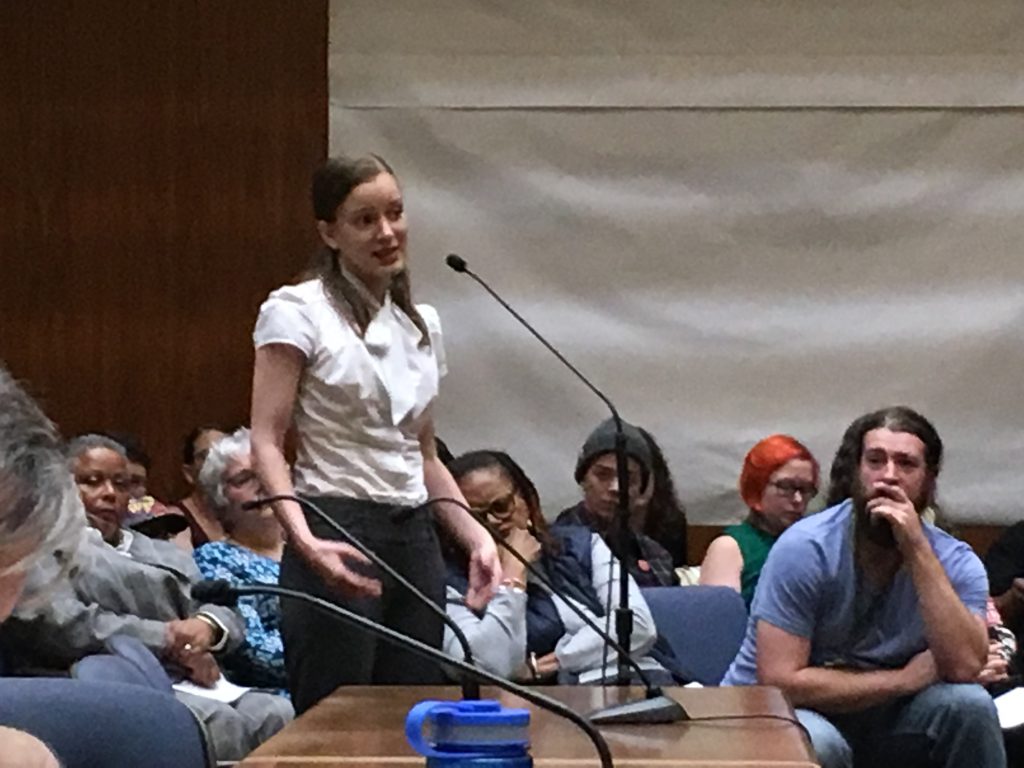
An August 29 City Council meeting drew large crowds, as is typical of sessions with agenda items related to policing. During an Oct. 3 work session, many residents who came to talk about community policing departed during council’s three hour meeting.

Decisions are made by those who show up – or so the saying goes.

That’s what a number of Harrisburg residents tried to do at Tuesday’s City Council meeting. Council was scheduled to discuss a resolution creating a community policing task force, which would, among other charges, research and recommend new community policing initiatives and trainings.

Discussions of policing typically draws large crowds to council meetings. The trend held steady this week, and about 15 community members came to speak during the public comment session.

But something strange happened during Tuesday’s meeting, simultaneous to something very dull.

I’ll start with the latter. Council spent more than three hours Tuesday evening doing the unglamorous but necessary work of legislating. They considered a contract to renew Harrisburg’s online bill payment software, questioned representatives from the National Civil War Museum on the deal they’re brokering with the mayor, and heard from a parks and rec employee about a small grant that department is seeking.

As I said: not particularly glamorous. Council members don’t call any votes during their work sessions. Instead, they debate and revise legislation, often with guest appearances from stakeholders. Discussions can quickly become esoteric and often feel like a college English seminar where only some of the students did the assigned reading.

As Tuesday’s meeting dragged on, residents who came to comment on the task force began to peter out. Some retreated to the city hall atrium to chat freely and wait for their turn to speak. But, as two hours ticked into three, some left all together.

The end result? Only three residents spoke during the public comment section. Three hours of legislative discussion concluded with less than 10 minutes of public input.

Some residents feel that, by moving public comment to the end of the agenda, council squandered the opportunity for a robust public discussion.

“I stayed as long as I could, but had to leave because I came straight from work and had not eaten,” said Carrie Fowler, who came out to comment on the task force resolution.

Chris Sienneck left for similar reasons.

“I didn’t see urgency within the council, so I didn’t feel that I needed to be there any longer, after being fatigued from my day anyway,” he said.

Is the perceived inefficiency of council meetings by design, or by necessity? As Sienneck pointed out, council’s discussions can provide necessary context for items on the agenda. He said that the way council facilitated Tuesday’s meeting was “actually really good” because it scheduled discussion before public comment.

Fowler, however, disagrees.

“I feel like it was purposely done to wear the residents out and have them leave before the issues they came to advocate for was brought to the floor,” she said.

It’s easy to see why residents who came to Tuesday’s meeting could feel slighted. Council President Wanda Williams has final authority on meeting agendas, and, in the past, has held public comment at the beginning of meetings. That’s probably what they should have done on Tuesday. It was obvious from the start that the public comment section would be longer than usual, and it’s not every week that council draws a large crowd.

But the unpalatable truth is that most machinations of democracy are slower, creakier and more earthly than we like to think. For instance, any discussion of a policing task force would require the presence of the police. But the law enforcement officials who spoke on Tuesday only appeared halfway through the meeting, as a shooting in the afternoon had sucked up most of the Police Bureau’s resources.

In setting Tuesday’s agenda, council also had to consider the schedules of all the invited stakeholders, including the bill-pay technicians and Civil War Museum reps. I couldn’t reach the City Clerk’s office for comment on this, but it’s possible that Tuesday’s agenda order just made the most logistical sense.

Decisions are shaped by those who show up. But sometimes, you have to wait a bit.

Author’s note: After publication, councilman Ben Allatt wrote in with this note about public comment sessions:

Public comment is held during the beginning of legislative sessions so the public can comment on pending legislation up for vote. Public comment for work sessions is held at the end so people have the ability to offer comment on the legislation that was discussed during that meeting. 

Continue Reading

Gearing Up: Mayor announces new boulevards at Bike Share launch

Mayor Eric Papenfuse announces the establishment of two bike boulevards during the Bike Share launch on Thursday.

Community members joined city officials this morning for the official launch of the Harrisburg Bike Share, where the mayor also announced a new initiative to encourage motorists to share the road with cyclists.

Speaking from the atrium at Strawberry Square, Mayor Eric Papenfuse said that the city will establish its two bike boulevards in the spring on low-speed, low-traffic streets. A boulevard on Aberdeen Street will connect the Capitol complex and the Harrisburg Transportation Center, and another on North Street will extend from the Capitol to Riverfront Park.

The city will paint both roads with “sharrows,” road signs indicating a shared lane for cyclists and motorists. The signals do not designate the roads as bike-only lanes.

Other than the road signals, the bike boulevards will not receive additional traffic control mechanisms or construction.

Though they may be a small step, the boulevards are part growing bike infrastructure in Harrisburg, Papenfuse said.

“Soon, we will have an interlocking system of bike lanes and bike boulevards in the city,” he said.

He added that the city hopes to create bike lanes on 2nd street when it is repaved and painted for two-way traffic, a project still a few years away.

Harrisburg’s Bike Share has been in operation since last Friday. The program comprises 55 communal bicycles docked at 11 stations throughout the city’s Midtown, Uptown and downtown neighborhoods.

Ryan Riley, president of Communities in Schools Pennsylvania, the organization spearheading the program, said 145 new members have collectively taken 205 trips with the Bike Share since last Friday.

Riley also reported that two docking stations are forthcoming at the Harrisburg Transportation Center. All nine others are already installed and operable.

The Bike Share is sponsored by the Dauphin County Commissioners, Strawberry Square and Highmark. All technical support and bike maintenance is managed by Zagster, a startup that operates more than 100 bike shares across the country.

Riders must pay to use the bikes, which they can unlock through the Zagster phone app. A $25 annual membership gives riders free access to bikes for periods shorter than two hours and then charges $2 for each hour after that. “Pay as You Go” members will be charged $2 for each hour they use a bike.

Users who register in October can get a $10 discount on annual memberships by entering the promo code “rideharrisburg” in the Zagster App.

Continue Reading

“Light at the End of the Tunnel:” city to buy first sinkhole homes next week

Homes on South 14th street have been uninhabitable since a sinkhole erupted in March 2014.


It’s been years coming, but homeowners along a sinkhole-ravaged street in south Harrisburg are about to be relieved of their damaged and destroyed properties.

The city is preparing to purchase 52 homes on the 1400 block of S. 14th Street that were rendered uninhabitable when a sinkhole erupted there in 2014. The first closings are tentatively scheduled for next week, according to Jackie Parker, director of Community and Economic Development, and the city hopes to conclude all the sales by the end of the year.

Parker said that the homes are being appraised at their “pre-event” value, meaning the appraisers will not take the sinkhole into consideration. Certified appraisers hired by the city have assessed home values ranging from $32,000 to $59,000 since they began appraisals 18 months ago, she said.

According to Parker, homeowners have the right to bring in a certified appraiser to challenge the value suggested by the city; to her knowledge, however, no homeowner has done so.

The city has obtained $4.7 million in funding from a variety of sources, including FEMA (though the Pennsylvania Emergency Management Agency), HUD’s Department of Community and Economic Development, and state Community Development Block Grant funding. Dauphin County contributed an additional $1 million.

All of the money that the city has obtained so far will cover acquisitions and relocations for tenants. Though the city is required to provide benefits to those tenants under state rental law, Parker said that it cannot reimburse homeowners for costs they incurred for emergency or short-term housing. Twenty-six of the properties slated for purchase are rentals.

A small amount of funding will be used to help with demolition. The city plans to turn the area into a green space, but still must secure funding for debris removal and landscaping.

The sinkhole on 14th street ravaged road pavement, sidewalks and lawns when it opened in March 2014, likely due to heavy rains during Hurricane Lee.

Ten homes were condemned, forcing residents to relocate immediately, and other residents moved out gradually as they secured temporary housing.

The city, county and school board have waived property taxes for all of the lots going back to 2014. Since the parcels are virtually worthless, selling to the city is the only path of recourse for most owners. But Parker said that participating in the program is strictly voluntary.

“Right up until the closing, the homeowner can say they do not want to participate,” Parker said. “They do not have to sell.”

The city had to negotiate individual deals with every property owner, and Parker said that each one is accompanied by a lengthy paper trail.
The city must abide by federal guidelines for buying damaged property, conduct title searches for each lot, and take into consideration any problems with deeds, mortgages or outstanding liens.

Parker said that city officials and homeowners alike are happy to see the long process nearing its end.

“Residents have been very patient and great to work with,” Parker said. “Hopefully they see light at the end of the tunnel.”

Continue Reading

Weekend Roundup with Sara Bozich

The Weekend is Here!

And what lovely weather we have.

I have zero plans this weekend. Andy’s going out of town for work/hunting, and I threatened to have a banger at our house. These days, that means eating popcorn with the dog while watching garbage television (I like Better Things and The Good Place for home alone watching).

On your list: Oktoberfests galore (I cannot wait to participate next year), National Apple Harvest Festival (bring me some donuts), Harvest Hopfest AT Tröegs??!!

What are you doing this weekend?

(more…)

Continue Reading