Student Scribes: “You Are . . .”

You’re a shadow—yes a memory

Of something that I once knew

A teasing glimmer of sun through clouds

That never breaks quite through


You’re an empty silence

Where once there was noise

Like unfolding sorrow—

Collapsing the used-to-be joys


You’re a promise spoken carelessly

A heart desperate for security held to

Only to be shattered because you said

Things you hadn’t realized aren’t true


You are the cold of winter before spring

That the tired soul just wants to leave

But no—you’re constant, biting, and nonchalant

So even those who still have hearts can’t grieve


You’re an ignorant stab with a dull knife

And an offhand apology to follow

Saying “it’s in your head—get over it”

Leaving your poison—in my mouth to swallow


You’re a feeling in myself I can’t express

Not angry—not really—just distraught

And unable to explain the torment

Of you constantly reminding me what I’m not


Joy Boettinger is a junior elementary education major at Penn State Harrisburg.

Continue Reading

Student Scribes: “What It Is to Live”

I’m walking lightly across crisp stale leaves

that crinkle from my toes.

Goldfoil sparks across the screaming sky

Roaring and laughing in glee.

Last signs of shivelight burn through the trees

Gone now with the impending storm.

The white lace of my dress drags behind in

Muddy puddles frosting over.

My bare feet coated in ashy dust

Leave blacked prints to follow by.

Time is catching up. It was never on my side.

It left my skin creased and dry

Desperate and craving and barren.

I bend to stroke the soft petal

Of a lightly shaded pansy. Petals broken and

Torn apart. Time took it too.

Echoes chase me down, impatient calls

And worried shouts. They wonder where I’ve gone.

My skin was poked and prodded

cut and sewed too many times to count.

I’m done with all the pain and tears

I’m here now where I belong.

Coated in cool misty rain among

The nature I dreamed of.

I can’t go back.

Stuffy fake air suffocated my lungs

Now burning clear and free

with the sharp tang of incoming rain.

They say I need the machines to live

But without them I have never been more alive.


Megan Jamnicky is a first-year communications major at Penn State Harrisburg.

Continue Reading

Student Scribes: “Shangri-La”

Beyond is a bleak, grey skyline

I barely recognize my vignette

Yet here I am, walking that thin white line

As if I had not met him yet


I barely recognize my vignette

Black swans move like serpentines

As if I had not met him yet

Slow, calculated, but ready to strike at cloud nine


Black swans move like serpentine

He still whispers in my ear, I just cannot forget

Slow, calculated, but ready to strike me at cloud nine

“Pulvis et umbra sumus,” was his epithet


He still whispers in my ear, I just cannot forget

Their banshee bugle wails overcome; I am confined

“Pulvis et umbra sumus,” was his epithet

Like smashed cherries, their eyes were as bloody as port wine


Their banshee bugle wails overcome; I am confined

He wanted to mold to be a useful asset

Like smashed cherries, their eyes were as bloody as port wine

I gladly follow those threats


He wanted to mold me to be a useful asset

What called them on was my mental upset

I gladly follow those threats

There is nothing to regret


What called them on was my mental upset

It is foolish to once think I could outshine

There is nothing to regret

All I have ahead is a relentless battle line


It is foolish to once think I could outshine

I am merely a pathetic statuette

All I have ahead is a relentless battle line

Soon they all will forget


I am merely a pathetic statuette

Onyx swans call me to the brackish streamline

Soon they all will forget

It is there I snipped that innocent white line


Onyx swans call me to the brackish streamline

He influences my mindset

It is there I snipped that innocent white line

Time becomes frigid as I sink into that brine outlet


He influences my mindset

My body is limp in the alkaline

Time becomes frigid as I sink into that brine outlet

It is there I found no lifeline


My body is limp in the alkaline

The onyx swans fly in a v-line sextet

It is there I found no lifeline

He brought me to the finish with no reset


Beyond was a bleak, grey skyline

Yet there I was, walking that thin white line.


Rebecca Bestwick is a first-year marketing major at Penn State Harrisburg.

Continue Reading

Student Scribes: “Rest Stop”

The car halts by the gas pump

Underneath glaring yellow lights.

I get out, car door echoing through the lot

Against the small building’s brick walls.


Inside, I join the few people

Sitting alone on the benches

Or enjoying the company of a mutually silent companion.

I buy a coffee and let the steam drift over my smiling lips.


No one is in a hurry.

No one disturbs the serenity we have found here.

There is a certain sense of human connection

As we come together for merely a blink of existence.


People come and go here.

This is no one’s destination,

Merely a place that they pass through

While a hint of something more still lingers.


I return to my car under the smoldering yellow lights

And look at the washed-out sky,

Unable to see any stars behind the haze.

Still, I know they are there, as they always are.


Julia Freidly is a junior computer science major at Penn State Harrisburg.

Continue Reading

Growth Strategy: Onward and upward (mostly upward) for Harrisburg’s tree-planting efforts.

Trees have lives of their own, far outlasting ours, says Harrisburg Parks Maintenance Director Ronald Taylor.

“A tree goes from a seed to a sapling to a tree to dying,” he said. “Once it’s merged in the earth, it becomes carbon fuel, so it can become coal, so it can also become a diamond.”

Trees bring lots of good stuff to cities. They soak up carbon dioxide. They break up the urban hardscape. They provide shade that cools people and homes.

“Studies have shown that people buy more and tend to be happier in communities where there are more trees,” said Taylor. “The more green covering, the better.”

Happy trees, happy community. That’s why Harrisburg public officials and private citizens are pushing to revive the tree canopy citywide.

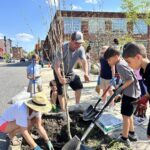
In 2018, the city expects to plant some 200 trees, with help from volunteers from United Way, Deloitte and neighborhood groups. Currently, Harrisburg’s 6,826 street trees—those that line streets in public rights-of-way—create a canopy that cover less than 30 percent of city streets, well short of the 47 percent goal set by the U.S. Forest Service.

Moreover, about 800 dead or sick trees in Harrisburg “need to come down,” said Taylor. Planting 200 in one year won’t close the gap, but with 300 slated for planting next year and more to come, the plan puts the city on target to full canopy in 10 years, he said.


Tree-Up

Harrisburg, like most old cities, has a legacy tree problem. Trees are aging, falling over, dying and, until relatively recently, little consideration was given to what makes a good replacement.

So, towering oaks, elms and other species that need a lot of room for their roots and canopies were stuffed into little tree boxes, surrounded by concrete and asphalt. That was bad for the tree, the street and the sidewalk.

“Right tree, right spot,” asserted Specialist Ellen Roane of the state Department of Conservation and Natural Resources (DCNR) Urban Forestry Program

In other words, indiscriminate plantings often lead to complications later.

Indeed, some trees are better equipped to handle the stress of urban environments, and more specifically, each tree has its own microenvironment to deal with. Power lines are a big problem, limiting a tree’s maximum height. The once-popular Callery pear species, including the ubiquitous Bradford pear, has turned out to be prone to splitting, and it’s invasive. The city’s tree-up plan increases the diversity as well as the number of trees.

Another 50 pin oaks, given by an anonymous donor, will be planted along Front Street and Riverfront Park, where many existing trees “need some care,” said Taylor. Many others there must come down because “they have been, shall we say, sick for some time and are not in the best of health.”

This is a fight with no end. Victory comes through maintenance and vigilance, tree experts said. Everyone gets a feel-good rush from planting trees, but maintenance in the early years is crucial to assuring survival. Urban trees need a little nudging and pruning to assure they grow straight and have a single growth “leader,” instead of multiple leaders that grow simultaneously and make the tree prone to splitting.

“A large, mature shade tree’s potential lifespan is 80 to 100 years if it’s in a good location and properly cared for,” said Roane. “We’re trying to get (municipalities) to think about planting every year, and even more, pruning trees they’ve got and removing some. They don’t live forever.”

Clear Winner

Some municipalities have Shade Tree Commissions—state-sanctioned citizen panels that monitor and encourage tree affairs—but Harrisburg has a Tree Advisory Committee, a group of volunteers focused on urban forestry.

Members work on the ground, often taking courses offered by Tree Tenders, a Pennsylvania Horticultural Society program that teaches the basics of tree planting and care. They also work with the city on planning and tree selection, and they helped revise a tree ordinance now under city review to strengthen regulatory options. Committee Chair Pat Buckley hopes that a soon-to-be-hired city arborist will keep the city’s tree inventory, dating to 2013, updated so the committee can target areas of greatest need.

On the neighborhood level, Friends of Midtown has its own “Street Trees for Midtown” project, boosted by a $1,575 TreeVitalize grant from DCNR, in partnership with the Pennsylvania Urban and Community Forestry Council. Currently, the group is raising matching funds so it can plant 15 trees this spring. Following Roane’s mantra, all are “right tree, right spot,” a range of maple, oak and locust types that offer durability and growth that provides shade quickly “but not catastrophically.”

“I would love to have 15 more people come at me for next spring and the spring after that,” said Friends of Midtown Beautification Committee Co-Chair Rachel Reese. “What I really want is for people to continue to express their interest.”

The Midtown planting is planned for April 28, depending on weather.

Some homeowners “politely decline” to have trees planted in front of their homes, said Roane, but most “like being able to look out at a tree.”

“If the homeowners can keep them watered, we’re going to work with a cadre of Tree Tenders to keep them pruned,” said Reese. “We can prune so they’re not always being whacked by parked cars, or there aren’t limbs blocking pedestrians. If the trees are being watered and mulched, we can prune every three or five years as they establish themselves.”

Also in the fight is Capital Region Water, which is developing its City Beautiful H2O storm water management plan. In community meetings for the plan, green infrastructure emerged as “a clear winner” among available options, said Community Outreach Manager Andrew Bliss.

“People were overwhelmingly interested, and it makes sense, where it’s cost effective, to invest in green projects rather than going underground,” he said.

Even greening with grass doesn’t prevent storm water from running wild, he said. Tree leaves hold and scatter rain as it falls and roots “infiltrate” it into the ground. Initial projects, sort of “early action” demonstrations, include greening at 13th and Market streets and streetscaping at 14th and Derry streets in conjunction with Tri County Community Action.

“This is stuff we’ve been talking about for the last two years,” said Bliss. “We felt we really needed to show what we’re talking about.”

CRW is also partnering with the city on green “bumpouts” for the 3rd Street overhaul, and it is funding street tree plantings at some residences, where the homeowners will be required to perform maintenance.

Harrisburg’s Taylor lauded the cooperation he’s witnessed among city officials, residents and community organizations to care for the city’s trees.

“All entities are working together to make sure our tree population is not only sustainable but continues to grow,” he said. “It’s a beautiful city in the summer. We want to maintain that and continue that growth.”

For information on upcoming Tree Tenders workshops, visit www.extension.psu.edu/tree-tenders.

To find out more about Friends of Midtown’s tree-planting efforts, visit www.friendsofmidtown.org.

To volunteer with the city’s tree efforts, email Ronald Taylor at [email protected].

To learn the species of tree outside your house, visit www.opentreemap.org/patreemap/map.

Stories on environmental topics are proudly sponsored by LCSWMA.

Continue Reading

Through It All: In springtime, the thru-hikers take to the A.T.

Each spring, about 3,000 people set off on the journey of a lifetime.

That’s how many attempt to “thru-hike” the entire 2,190 miles of the Appalachian Trail (A.T.). According to the Appalachian Trail Conservancy, about 750 people—one in four—succeed.

But what drives someone to attempt this feat, and what does it take to accomplish it? We asked three central PA hikers just before they headed south to begin their treks.

Slow Down

Connor Phiel, 24, of Gettysburg, is what many describe as a typical A.T. thru-hiker. A recent college graduate, he’s worked as an architect for about two years, with the goal of saving enough money to take a “gap year” in 2018.

“I look at it as a good transition year, a chance to slow down,” he said. “You’re crammed through school into a job—it streamlines you and you get caught up in it. For me, hiking the trail is a conscious decision to slow things down.”

The groundwork for his trip was laid in childhood. Growing up, Phiel was a Boy Scout, attaining the rank of Eagle Scout. His father was a park ranger at Gettysburg National Military Park for more than 30 years, and the family regularly traveled to national parks.

Despite this pedigree, Phiel worked hard to prepare. He’s been running, biking and weightlifting to build strength and endurance. He tested his gear during two- and three-night backpacking trips locally. He said that carrying everything on his back forced him to think about what he truly needed to survive. For him, that included hot meals when possible. So, he’s packing a small stove resembling a Bunsen burner. The average A.T. hiker burns 6,000 calories daily.

“My food will probably be my biggest luxury item—I want to enjoy a hot cup of coffee or tea,” he said. “I’m also bringing my phone, a charger, a sketchbook and journal, which will add weight and are really luxury items, too.”

He launches his journey this month.

“I’d say I’m most excited to see the Smokies and the South, plus the White Mountains in New Hampshire,” he said. “But, beyond that, it’s really about challenging yourself, self-fulfillment and personal growth.”

Mental Marathon

Like Phiel, Andrew Burd, 22, of Newville, is a recent college graduate whose parents worked in forestry—first for the Allegheny National Forest in western PA, followed by the Green Mountain National Forest in Vermont. He grew up in both locations. He also earned the rank of Eagle Scout.

“I’ve been hiking my entire life, but I got serious about backpacking in college,” Burd said.

Through the Department of Experiential Education at Gettysburg College, Burd embarked upon hiking and kayaking trips. After hiking the A.T, he plans to launch his career in tourism management on the West Coast.

According to the Appalachian Trail Conservancy, most thru-hikers begin at Springer Mountain, Ga., between February and April, then spend six months hiking northward through 14 states, eight national forests, six national parks and numerous state parks and forests—including several in central PA—to arrive at Katahdin, Maine, in the late summer or fall.

Burd’s plan fits this timeframe. He set out in late February and hopes to arrive in Maine by late July.

What will it feel like to finish up?

“I imagine it’s going to be a mix of utter exhaustion and elation,” Burd said. “It’s going to be the most physically and mentally demanding journey of my life. At first, the physical challenge drew me in, but now the mental challenge intrigues me.”

According to the Appalachian Trail Conservancy, hikers like Burd and Phiel are the ones who stand a good chance of making it all the way.

“Hikers who have some degree of preparedness are generally the ones who succeed,” said Jordan Bowman, public relations and social media manager.

Testing out equipment and being financially prepared are one thing, but the keys to a successful thru-hike include physical and mental preparation, he said.

“Physically, it’s tough, but it’s all about persistence, which is where the mental aspect comes in,” Bowman said. “You’re going to be hiking through rain, also hiking when it’s hot, you’re going to be sweating, exhausted. There’s a lot of discomfort, and it becomes a mental marathon.”

Brad Duffan, 35, of Dover, also began hiking the A.T. in February, with the goal of finishing in time for his brother’s wedding in September. By registering with the ATC, he could tell that 10 other hikers were starting on the same day.

Duffan left his full-time job as a heavy equipment operator in order to hit the trail.

“It’s been a goal of mine for a long time,” he said. “I kept thinking, ‘I’ll do it later,’ and pushing it off. Well, if I keep pushing it off, I’ll be 60 before you know it. I decided I needed to do it now, because I’m not getting any younger.”

For more information about the Appalachian Trail, visit appalachiantrail.org. You also can visit the Appalachian Trail Museum at 1120 Pine Grove Rd., Pine Grove Furnace State Park, Gardners, Pa. Visit atmuseum.org.

Continue Reading

Weekend Roundup with Sara Bozich

Happy Weekend!

How many of you have a long weekend? We’ll spend Friday shooting some b-roll for Poured, getting lunch at Tröegs (Bo’s first Tröegs trip!) and picking up at the Market. I signed up for my first veggie CSA with Village Acres spring share. Do you guys CSA? I have a garden but typically only have success with peppers and tomatoes (helps I buy a bajillion each of them), but that’s what summer shares have a lot of, too.

Saturday will be more pick-ups (I got a flourless chocolate cake from Raising the Bar and a carrot cake from Dalicia Bakery for Easter), plus seeing additional family. It’s also the first day of fishing season, so Andy will be hitting the streams.

Of course, Sunday is Easter, and I’m hosting. Good thing Ryan talked me into the big ham from R.G. Hummer Meats and Cheese (more Market love), because we’re expecting nine adults, 1 toddler, and 1 baby. This is a lot for my small house. If hosting isn’t for you, be sure to scroll down because there are ample local Easter brunch options.

What are you doing this weekend?

(more…)

Continue Reading

Bringing It Back: Long-blighted buildings marked for renovation in downtown Harrisburg.

The blighted exteriors of 254 and 256 North St., Harrisburg.

There’s an old saying in real estate that one should try to buy the worst property in the best neighborhood.

By that measure, Matt Krupp would seem like a savvy buyer, as he recently purchased two terribly blighted, yet well-located and widely recognized buildings in downtown Harrisburg.

On March 14, Krupp, the Dauphin County prothonotary, closed on the purchase of 254 and 256 North St., and, this week, began the long process of clearing out and stabilizing the Civil War-era, brick-and-clapboard buildings.

Krupp lives just across the street from them and, decided that, since no one else seemed interested in taking on the costly rehabilitation, he would do it. So, he purchased the two buildings from the Harrisburg Redevelopment Authority, which owned them for nearly 11 years, for $34,300.

“If you go up and down North Street, these are the only remaining, boarded-up buildings on the block,” he said. “It got to me living next to them for four years.”

The buildings sit on an otherwise-charming, tree-lined block, home to such restaurants as Mangia Qui, Rubicon and Home 231, and just down the street from the state Capitol complex. Nonetheless, they’ve been vacant for decades, marred by graffiti, holes, shattered glass, peeling paint and boarded-up windows.

The two, two-story buildings, which together total about 3,000 square feet of interior space, have first-floor commercial areas with apartments on the second floor and parking in the rear. The corner building at 256 North St. once housed an upscale, reservation-only French restaurant called The Coventry, which closed around 1990. The Redevelopment Authority took possession of the buildings in 2007.

“Because of where they sit, I was surprised that nobody had bought them after all this time,” Krupp said.

Amid piles of trash, one of the buildings still shows signs of when it was a French restaurant, more than 25 years ago.

Krupp expects a two-year turnaround for the project. The first year, he said, will be devoted to shoring up the structures to ensure they’re safe and dry. Much of the renovation work will take place the second year, he said.

He said that he doesn’t expect any changes to the buildings’ historic uses, with expectations that a small business, such as a law firm or lobbying firm, will take the first-floor commercial space.

David Morrison, executive director of Historic Harrisburg Association, applauded the purchase, saying that HHA was about to place the buildings on its annual “Preservation Priority” list, as they were considered endangered.

“This is great to finally see,” Morrison said. “They’re high-profile buildings on a street that gets a lot of visitation.”

Continue Reading

Burg Review: “The Flick”–Connections through small gestures.

A scene from “The Flick”

Annie Baker’s Pulitzer Prize winning play, “The Flick,” is being produced right here in Harrisburg, but not in the place you may expect. Instead of being performed at Open Stage, Baker’s tragicomedy—set in a movie house—takes place at Midtown Cinema, bringing with it an exciting new dimension of realism.

Stuart Landon’s production of “The Flick” focuses on how our shared need for human connection plays out among movie theater ushers. This three-person show follows Sam (Brennen Dickerson), a 30-something who continues to be passed over for promotions, Rose (Maddie McCann), the cinema’s dominating projectionist, and Avery (Andre Tucker), the bashful film pundit who’s new on the job.

As I collected bits of character information, I delighted in watching almost nothing happen. It’s the conversations you have with your coworkers in the hallway, before meetings, and on breaks. The seemingly insignificant conversations to distract from the monotony of work that serve as subtle life lines against the mundane.

Landon himself is quite fond of the understated nature of the play.

“I think we’re just bumping around, searching for connection in this big world,” he said. “With ‘The Flick,’ Annie Baker allows us the great privilege of being able to watch three fellow humans trying, and perhaps failing, to figure it out, to connect, in the small, repetitive world of a rundown movie theater. It’s a slow-brew journey and great fun.”

All three actors handle the text of Baker’s uber-realism, which reads similarly to that of Carol Churchill, with great ease, something that is particularly noticeable in Tucker’s flawless delivery of the one-sided phone conversation monologue.

Dickerson brings an incredible comedic timing to his portrayal of Sam that cannot be missed. His brilliant, fast-paced quips to Sam are heartbreakingly offset by his jerky moments of vulnerability.

McCann takes the wilder aspects of Rose as a character and gives us a more accessible version of the sexually aggressive party girl with issues.

One of the many perks of mounting “The Flick” at Midtown Cinema is that there is an actual screen in front of the audience. Landon uses this to his advantage, showing credits, movie trailers and scenes from well-known films to fill, for lack of a better term, scene changes.

This production certainly embraces the non-urgency of real life at times. But it’s really the sincere look into the creation and deconstruction of human relationships and connections that should not be missed.

Open Stage presents “The Flick” at Midtown Cinema, 250 Reily St., Harrisburg. This previously sold-out run has added one final performance on April 29. Tickets are $20 and may be purchased on Open Stage’s website at openstagehbg.com, by calling 717-232-6736, or e-mailing [email protected]. Student discounts are available. The production is sponsored by Abby and John Tierney.

Continue Reading

Cheese It: Midtown Speakeasy to benefit HHA (but you didn’t hear it from me)

A bunch of mugs and dolls from last year’s Midtown Pop-Up Speakeasy, which returns next week.

Hey, all you flappers and four-flushers, you goons and grifters.

We got your chews, your giggle juice, even your rats and mice.

For the second straight year, the historic Central Trust Co. building in Midtown Harrisburg will roll back in time, transforming itself into a Prohibition-era speakeasy, complete with period cocktails, jazz music and games of chance.

The Midtown Pop-Up Speakeasy is a natural fit for the bank building, now the home of the Historic Harrisburg Association, the beneficiary of the fundraiser, said event co-chair Ralph Vartan. Indeed, it takes little to imagine the 1920s heyday of the brownstone at N. 3rd and Verbeke streets, with lines of people waiting at teller windows as the industrial city boomed around them.

“It was a huge success last year, even drawing a new demographic to HHA,” Vartan said. “It’s meant to be a fun event where people can let their hair down.”

Vartan said he was impressed with how attendees got into the spirit of the event, dressing up in slinky dresses, pinstriped suits and hats, hats and more hats. The HHA board of directors considered the sold-out event such a success that they upped the maximum attendance this year.

“It’s meant to really bring the community together to benefit a great cause,” Vartan said.

Café 1500 will provide heavy hors d’oeuvres, bartenders will make old-fashioned drinks (including Old Fashions), a Roaring ‘20s band will give you the crazy legs and Hollywood Casino will bring in gaming tables (thus, the rats and mice, which is Jazz Age slang for a type of gambling).

In the spirit of the speakeasy, bartenders will dress up as phony bank tellers and take drink orders using coded messages.

So, don your glad rags and ankle on over, but leave your gats outside. Don’t snitch, and it’ll all be jake.

The Midtown Pop-Up Speakeasy takes place April 6, 9 p.m. to 1 a.m., at the Historic Harrisburg Resource Center, 1230 N. 3rd St., Harrisburg. Tickets are $35. For more information, visit www.historicharrisburg.com or HHA’s Facebook page.


Continue Reading