Health Plan: With a new long-term strategy, Harrisburg Area YMCA shoots, scores for stronger people, communities

A water bottle filling station. 

That’s what David Botero wants to see at the East Shore YMCA for his Hope in Handball students. The old-style water fountain just doesn’t cut it for thirsty teens.

“There’s a lot of slurping,” he said. 

The Harrisburg Area YMCA—the nation’s eighth oldest, founded in 1854—is entering its 172nd year with a strategic plan focused on community impact while its branches get facelifts for the 21st century.

The strategic plan is “based on real needs in the community,” meant to offer hope in an unraveling world, said President & CEO David Ozmore. 

“We want everyone to thrive,” he said. “That’s spirit, mind and physically and mentally. And then, everyone belongs. We want people to feel welcome.”


In the Plan

Ozmore took the reins in 2022, with goals to deepen YMCA partnerships and lead strategic planning. 

The plan emerged from long staff meetings airing organizational strengths and weaknesses. The board spent hours parsing a nine-word vision statement: “To strengthen communities where hope thrives and everyone belongs.”

The process yielded “Thrive Together: A Vision of Hope and Belonging,” a plan built on safety, security, hope and belonging. 

The plan’s four pillars include fostering welcoming environments; inspiring and empowering youth; creating community environments where spaces are accessible and within reach of the full community; and expanding health equity with programs that address disparities. 

Watch for signs of progress as programs grow and refine in coming years in accordance with the plan.

Supportive environments will nurture the educational, social and emotional development of infants, young children and teens. Senior adults will find respite from isolation, according to the plan.

There will be modernized spaces, behavioral health supports, and virtual health programs. More money will be raised, and endowment funds will be distributed as financial aid. There will be enhanced leadership, staff and volunteer training. 

The plan also includes partnerships—lots of partnerships. Interlocked community organizations can fill the gaps in lives where one of the four pillars is crumbling, said Ozmore.

“Imagine a kid who’s coming to us from a dysfunctional family, but the church rallies, the community rallies, the school rallies,” he said. “We can still support the development of that child until the fourth pillar rebuilds itself.”


Partnership Power

Dr. Sabina Grant-Spencer, early childhood director for Harrisburg School District, reached out to the YMCA for academic and social support for Harrisburg schoolchildren and for early childhood education for their families, including the infant care that helps parents keep their jobs. 

“As a parent, you want to know you’re coming into a safe place, where your kids are going to learn and enjoy being here, and that’s something we established at the Camp Curtin Y,” she said.

As the plan unfolds, Grant-Spencer envisions more mentoring and initiatives that teach organizational skills and promote career learning. To overcome transportation barriers, the Y could deliver afterschool programming to children in their own schools. 

Through the partnership, the Y released endowment funds to finance memberships for 200 of the district’s displaced families, giving students a place where “they know they’re going to fit in wherever they go, and a parent knows that they’re going to be safe,” she said. “And they make friends.”

Sometimes, the Y is “just the facilitator,” said Ozmore—as in, offering the Harrisburg Area Food Pantry a home at the Camp Curtin YMCA in Uptown Harrisburg since early 2024. 

As food insecurity surged, the pantry struggled with space constraints, said Executive Director Deidre Lenker. Since moving to Camp Curtin, they are “blowing our records out of the water.”

“We could not have done that with the physical layout of our own facility,” she said.

Clients from urban and rural food deserts easily find Camp Curtin for its familiar location, parking and accessibility. 

“We’re thrilled to be a part of this organization and be able to serve as many people as we are serving,” she said. “And we get great support.”

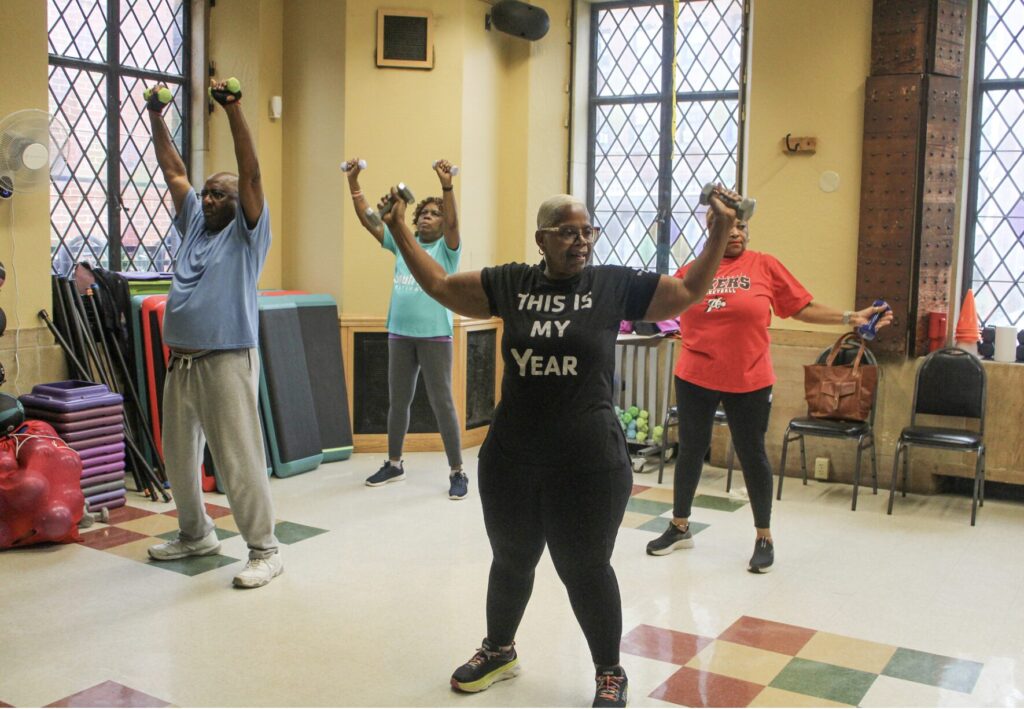
Battling the isolation of older adults took its place in the strategic plan because they were the first group to resume Y membership after COVID. 

“They missed their friends,” said Ozmore. “The Y is a tremendous social organization for connection and belonging.” 

The Y could expand partnerships that help area senior centers offer more exercise classes to their members.

“Could we partner with a senior center that only runs two or three classes a day?” Ozmore said. “Could we help to manage and give them resources to run senior programs at other times of the day?”

Since Botero and Sally Snyder co-founded Hope in Handball in 2009, it has operated at the East Shore Y in Harrisburg. The program unites adult volunteers from a range of professions with middle and high school students for tutoring, mentoring, character development and, of course, handball. Students travel for tournaments, learn sportsmanship and meet new people—“that’s code for networking,” said Botero.

The historic, circa-1933 East Shore Y has been “gracious enough” to host Hope in Handball, provide students with YMCA memberships, help them through family emergencies, and invite them to events featuring the Harrisburg mayor and Pennsylvania governor, said Snyder. 

Many Hope in Handball alums have gone on to their own careers, including a new dad working in finance and, now, mentoring today’s players. 

As the YMCA implements its strategic plan and upgrades, Botero hopes for his water-bottle filling station, and Snyder would love to see the Y offer students volunteer and job opportunities. 

“We’re a community, and we’re a family there,” she said. “It’s beautiful to have that space where we can walk the steps to that handball court. It’s such a special space. We have pictures on the walls and tournament winners posted, and we can walk down memory lane. The kids can see where they were 15 years ago, and now, they’re one of the leaders.”


Physical Changes

Throughout the YMCA network, multi-million-dollar renovations are completed, underway or on the drawing board. Branches are slated for HVAC upgrades, modernized amenities, state-of-the-art child care facilities, and inclusion of gender-neutral changing spaces in the locker rooms to accommodate individuals and families who need privacy. 

Construction began on Camp Curtin’s $1.1 million project this fall, with a teen center, recording studio, and—for the first time—air conditioning in the 60-year-old building.

At the East Shore Y, the 86-bed residential upper floors serve people who “need a clean, safe place to stay,” said Ozmore, but supports are limited.

“How do we lift these folks up?” he said. “How do we provide food security? How do we make them ready to handle their own finances? How do we get them to lift themselves out of their current position and really be a flourishing member of society again?” 

To answer those questions, the Y is negotiating with a potential partner to provide transitional services and leverage its resources, plus available public funding and seed capital from the Y, into a “big facelift” for the residence area. 

That facelift—phase one of a $10 million, three- to five-year renovation of the entire building—would upgrade kitchen, shower and rooms, “giving the amenities a nicer glow,” said Ozmore. For accessibility, an elevator would be installed in what is now a five-story walkup. 

The goal is a space and services that help residents achieve independence, said board chair and capital campaign co-chair Jim Mooney.

“It’s a way to lift people out of their current position in a big way,” he said. 

When work on the residence is complete, the East Shore Y’s public side will follow, with a new roof, HVAC and “general maintenance for a nearly 100-year-old building,” said Mooney. The pool, lobby, gym and locker rooms will undergo makeovers, not yet designed.

“The general public would walk into a 21st century YMCA,” said Ozmore, adding that the expanse of construction “ties into community. It’s not just that we’re building beautiful buildings, but we’re building beautiful buildings for a reason.”


Sticking Around

In the future envisioned in Harrisburg Area YMCA’s strategic plan, the scattered branches and staff are more unified, finances continue to strengthen, and collaborations instigate growth throughout the community, said Ozmore. It culminates in “safety and hope.”

Food insecurity took the spotlight during “the craziness” of the 2025 government shutdown, said Lenker, and that makes way for the Harrisburg Area Food Pantry to grow along with the Y.

“We are getting donors and volunteers coming left and right, so we have a lot of hope for a lot of things that will make us even more effective,” she said. 

Ozmore sees promise in the diversity and joy of Y events, the camaraderie of older adults, and the cheer that fills the East Shore Y lobby, “the heartbeat of our community.”

“That’s why we’ve survived for over 100 years,” he said. “Not many organizations have been around for 171 years, but because we’re embedded in the community, that’s our magic.” 

For more information on the Harrisburg Area YMCA, visit www.ymcaharrisburg.org. Read the YMCA’s strategic plan at  www.ymcaharrisburg.org/strategic-plan.

If you like what we do, please support our work. Become a Friend of TheBurg!

Continue Reading

January Publisher’s Note

On an icy, cold evening, 17 years ago, we delivered the very first issue of TheBurg.

It was January 2009, and I remember driving around the area, dropping off copies of a publication that no one had heard of before.

We had no idea what would happen next. Would we be accepted? Could we get advertisers? Would we even make it a year?

Well, the road hasn’t been easy but here we are: four city mayors, three U.S. presidents, two recessions and one pandemic later. We even managed to survive the virtual collapse of the local newspaper industry.

No small feat.

But, as my staff likes to remind me, TheBurg has not only survived but thrived. Along the way, we began covering daily news, hosting events, adding features and winning over 200 press, business and community awards.

And now it’s time to look ahead. So, what does 2026 hold for TheBurg?

We just hired another reporter, so we’d like to dig down deeper in our local news coverage. Magazine-wise, we hope to increase our page count, add content, expand our distribution area and print more issues (demand routinely exceeds supply).

Of course, this all will depend on what we can afford to do, as we always plow our earnings back into our business. So, if you’d like to help us meet our goals, please become an advertiser, a sponsor, a supporter or even a Friend of TheBurg.

And, with that, welcome to our January issue, focused on health and wellness. We expect you’ll find some fun, interesting and novel ideas to help kick off the new year in the best way possible.

Speaking of healthy: each month, we strive to add to the health of our community, hoping to make it a little better story by story, event by event, issue by issue. Over 17 years, that’s one thing that hasn’t changed. 

Lawrance Binda

Publisher/Editor

If you like what we do, please support our work. Become a Friend of TheBurg!

Continue Reading

Harrisburg City Council overrides mayor’s budget vetoes; several top positions to lose funding

Harrisburg City Council on Monday

The future of several of Harrisburg’s top administrative positions is unknown, as council has slashed salaries.

At a special meeting on Monday, City Council voted to override Mayor Wanda Williams’ vetoes on several of council’s 2026 budget amendments. Council’s vote reconfirmed its changes to the budget, which zeroed out salaries for several top officials.

Williams last week vetoed several amendments that council had previously made to the 2026 budget, which council passed earlier this month.

Most notably, council zeroed out salaries for the city’s interim business administrator, project director for business administration/LERTA and the police bureau’s director of community engagement and relations. Council also defunded the city’s portion of the salary for the interim director of building and housing development, which supplements the portion of the salary funded through the U.S. Department of Housing and Urban Development.

Council’s veto override means that their changes will be restored.

“The mayor is absolutely livid,” said Mischelle Moyer, the city’s communications director, following the meeting.

Each of the four overrides to the vetoes received votes of 5-2 in favor of the measure. For the funding changes to the housing director, business administrator and project director for business administration/LERTA, council members Crystal Davis and Ausha Green voted against overriding Williams’ veto. For the funding cut to the police bureau’s director of community engagement and relations, council members Davis and Shamaine Daniels voted no.

The future of the defunded positions is unknown. At a previous council meeting, City Solicitor Neil Grover said that he wasn’t sure where things would go from here.

If you like what we do, please support our work. Become a Friend of TheBurg!          

Continue Reading

Harrisburg mayor vetoes council’s changes to 2026 budget; council to weigh overriding vetoes

Harrisburg Mayor Wanda Williams (right) and Communications Director Mischelle Moyer (file photo).

Harrisburg’s 2026 budget is in flux as officials disagree on salaries for several top city positions.

Mayor Wanda Williams last week vetoed several changes City Council made to the general fund budget before passing it earlier this month. She stamped vetoes on council’s amendments that zeroed out or significantly reduced salaries for the city’s business, economic development and housing directors.

Council since announced that it would hold a special legislative session on Monday evening, with the budget back on the agenda. Council has the power to override Williams’ vetoes.

On Dec. 15, council passed the 2026 budget for the city, making amendments to zero salaries for the city’s interim business administrator, project director for business administration/LERTA and the police bureau’s director of community engagement and relations. Council also zeroed out the city’s portion of the salary for the interim director of building and housing development, which supplements the portion of the salary funded through the U.S. Department of Housing and Urban Development.

During the meeting, council members expressed concern over the length of time that “interim” directors had been in their posts without council approval, and said they were dissatisfied with the performance of others.

Williams has line-item vetoed all of those changes.

Council does not have the ability to fire city employees, but, as council noted during budget meetings, does have the power of the purse.

However, Williams protested the way council exercised that power.

In her “veto statement” attached to her budget vetoes, Williams said that, for at least two of the positions, council failed to “cite any financial basis for eliminating this funding, which is the limit of the council’s authority.” She also said, under her justification for vetoing one of the zeroed positions, that “the action effectively terminates an existing employee, which is an executive power exclusively vested in the mayor.”

Williams also repeatedly stated that council’s amendments would harm the city and taxpayers, stressing the importance of the roles and the reorganization that would need to take place in city hall if the positions were unable to be filled.

Council attempted to make similar changes to last year’s budget, eliminating the city’s portion of funding for the housing director’s role, removing funding for the police bureau’s community engagement director, and lowering proposed raises for other staff. However, Williams vetoed those amendments near the end of the year. Council had no meeting scheduled in time to consider an override.

The city’s budget process again highlighted the deep divide between Williams and council. Council said that many of the issues came down to communication and placed the blame on Williams’ shoulders. However, members of Williams’ administration said that she was open to communicating with council.

For council to overturn the mayor’s veto on Monday, they would need a vote of five or more.

As for what would happen next if council successfully yanks funds from several city positions, officials have said that remains to be seen.

If you like what we do, please support our work. Become a Friend of TheBurg!          

Continue Reading

The Week that Was: News and features around Harrisburg

A DIY sun catcher, a great wintertime activity for families and children

We hope everyone had a wonderful Christmas, busy with family and friends. Of course, it was a slow holiday news week around Harrisburg, but, around our own celebrations, we still managed to publish some local news. If you were busy with gifts, dinners and general merriment, we have our reporting all wrapped up below.

2025 was a very busy news year around Harrisburg. What were our most read stories of the past year? Our publisher has our annual top-10 list, as voted on by your clicks.

Downtown Harrisburg had a very tough year, but 2026 might be the start of renewal. Local officials announced seed money for a redevelopment plan, with more funds likely on the way, according to our online story.

“Nutcracker” is an annual holiday tradition for parents, children and even schools. In our magazine story, we describe how the Pennsylvania Regional Ballet is introducing dance to area youth.

Poached opened recently in Mechanicsburg, offering different takes on everyone’s favorite meal. Our magazine story has all the delicious details on this new brunch/lunch spot.

Sober Ride Home will be back in effect on New Year’s Eve, our reporting found. The program promises free Uber vouchers to deter intoxicated driving over major holidays.

SusqueCycle bike share program had a strong year in 2025, with ridership up for the year, said our online news story. An expansion and some changes are ahead for next year, according to organizers.

Tiramisu for Christmas? Why not, says our food columnist. She details how this Italian favorite might be the perfect dessert for your holiday table.

Wintertime can be a tough time for families with children. Our “Family Time” columnist comes through with some creative ideas on how to brighten up the dark, cold season around your house.

If you like what we do, please support our work. Become a Friend of TheBurg! 

Continue Reading

Year in Review: The most popular stories of 2025, click by click

Has another news year already passed us by in Harrisburg?

Indeed, it’s the annual slow holiday week between Christmas and New Year’s, which can only mean one thing: TheBurg’s annual rundown of our most popular stories of the year.

These are the stories that you clicked on most often. This favors our online-only reporting, which means that our print magazine stories may be at a disadvantage. But those are the digital breaks so, without further delay, here are the stories that garnered the most page views on our website in 2025 out of nearly 1,000 stories we published over the last year.

10. Senior Spot
In Harrisburg, housing was a big topic this past year, and several of our stories on the subject cracked the most-read list in 2025. In the No. 10 spot: an online news story from July that reported that Harristown Development would begin work to convert a downtown office building into a new, 39-unit senior living complex, in conjunction with Select Capital and Garden Spot Communities. When complete, the building, at 112 Market St., will be Harrisburg’s first market-rate building for ages 55-plus, in a city touted as one of the best places for retirement in the country.


9. Where There’s Hope
The struggles of downtown Harrisburg continued unabated in 2025 and, arguably, got worse, as more small businesses closed. As is often the case, we wanted to emphasize possible solutions, not just problems. So, in May, we published a lengthy magazine feature about folks who are remaining in, and even investing in, the downtown. The story featured restaurant owners, arts groups and nightlife impresarios who look at downtown and see a bright future ahead, albeit one with considerable challenges. As a common thread, they seemed ready to move into a future far less reliant on what has long driven the city’s economy—the huge state workforce that now largely works remotely.

8. Gee Whiz!
Every year, one story makes the top 10 list that comes as a total surprise to me. In 2025, that story was a May magazine feature on the reopening of the Cheesesteak Guy, a small eatery that moved to Lemoyne from the Broad Street Market. Restaurant stories are a staple of TheBurg, and they often do well eyeball-wise. This story, though, proved especially appetizing, likely due to the highly rated food and the local renown of the owners, who also understand how to use social media. So, hit the link and discover their secret sauce, or, better yet, pay them a visit and chomp down on one of the best cheesesteaks in central Pa.

7. Principal Problem
The Harrisburg School District is one of our core beats but rarely does a school story rank among the most read. In 2025, one did just that, as we reported in October that Harrisburg High Principal Christopher Sattele would resign after just a year on the job. In recent years, the position has been something of a revolving door. Sattele replaced Laquan Magruder, who similarly lasted just over a year. The school board then appointed long-time district official Roma Benjamin to replace Sattele on an interim basis until a new full-time principal could be recruited in 2026. In my view, there was little compelling about this short, online news story to cause it to climb up the charts, other than the continuing drama surrounding this vital, if volatile, position.

6. Housing Hits
In recent years, affordable housing projects have popped up in several Harrisburg neighborhoods. Sycamore Homes is one, as developer George Fernandez and local officials cut the ribbon on the 23-unit building in late April. Later in the year, Fernandez broke ground on another affordable housing project, the 48-unit Woodward Lofts project for seniors. Fernandez has been quite active in Harrisburg, and his projects always get plenty of attention. So, I expect big web traffic with the eventual ribbon-cutting, likely in 2027, for that ground-up development.

5. Home Fronts
In Harrisburg, all kinds of new housing are needed: market rate, affordable and transitional. In October, we ran a magazine feature detailing how several groups are offering solutions for the unhoused, often in innovative ways. These new developments range widely, from a better organized tent community to tiny house developments to a large apartment building, all in south Harrisburg. Together, these projects promise more humane living conditions than the jumble of makeshift structures from “tent city,” often with vital social services embedded into the plan.

4. Building Boom
Another day, another affordable housing project in Harrisburg. This time, former NFL player LeSean McCoy and his company, Vice Capital, cut the ribbon in June on JMB Gardens, a 41-unit development in the Uptown neighborhood. Much like fellow developer George Fernandez, McCoy has even bigger plans ahead. Vice Capital also expects to build “The Savoy 48,” a 48-unit development on the 1500-block of N. 6th Street. That project will be a mix of affordable and market-rate units, offering Harrisburg two types of housing that it desperately needs. In Harrisburg, new housing—plus a hometown hero—equals big clicks.

3. Zero’d Out
I begin writing this annual column in early December, and it seems that, every year, some late-breaking story tosses my list into the air. That tradition continued in 2025, as Zeroday Brewing Co. announced it would close its flagship taproom at the end of the year. The story rocketed up the list, the latest bad news in a very bad year for the Harrisburg small business community. Throughout the year, TheBurg wrote numerous other stories and columns about the fallout from a largely absent state and office workforce, a years-long trend that has slammed shops and restaurants in the city, especially downtown.

2. Sound Space
Every year, a local business opening makes the top 10 list, often near the top. For instance, just last year, the debut of Karma was our No. 1 story. This year, the April announcement of another nightlife venue, Capital City Music Hall, nearly replicated the feat, placing second. The story explained how local businessman and impresario Justin Browning and a partner planned to renovate the former Federal Taphouse and transform it into a music space. The story also offered some hope for downtown Harrisburg, which has suffered immensely without the presence of the state workforce. A subsequent magazine feature offered further details about the venue, which opened its doors in September.

1. It’s a Miracle
This August story, about the opening of “A Miracle Community” in south Harrisburg, was our most-read story of the year, by a lot, which came as no surprise to this editor. It had it all. It was a well-written, well-reported, online-only breaking news feature about a subject that folks really care about—a new encampment for the unhoused. This project offered some hope following the years-long saga of the chaotic “tent city” encampment and what would happen after its closure.

For a different take on 2025, I will have my annual list of top local news stories in the January magazine, which drops on Dec. 30. Does my subjective list differ from that of our readers, who voted with their clicks? Return on Tuesday to find out!

Lawrance Binda is publisher/editor of TheBurg.

Support quality local journalism. Become a Friend of TheBurg!

Continue Reading

Initial funding to kickstart downtown Harrisburg revitalization plan; more funds promised

Vacant properties on N. 2nd Street in downtown Harrisburg

The first steps towards a redevelopment strategy for downtown Harrisburg are beginning to take shape.

On Monday, Harrisburg-area officials announced that an initial grant of $50,000 will be used to engage the Pennsylvania Downtown Center (PDC) to start the public engagement, planning and convening process for an eventual revitalization plan.

“This funding allows us to begin doing what revitalization requires most—bringing people together around a shared vision, said Ryan Unger, president and CEO of the Harrisburg Regional Chamber and CREDC, in a statement.

The Harrisburg-based PDC is a statewide nonprofit dedicated to revitalizing central business districts throughout the commonwealth. Last week, the Intergovernmental Cooperation Authority (ICA), a state-appointed body that oversees Harrisburg’s finances, voted to give $50,000 of its own funds to kickstart the planning process.

According to area officials, additional funding will be announced in early 2026 to conduct and complete a comprehensive recovery plan for the downtown, which has suffered major business and job losses following the pandemic and the loss of a large number of office and state workers to remote and hybrid work.

In addition to CREDC, the ICA and PDC, other partners in the initiative include the city and the area’s legislative delegation, which secured additional funds as part of the state’s 2026 budget.

“As we finalize the details on a significant amount of funding dollars we have secured, we look forward to announcing a downtown planning process that addresses both immediate and long-term priorities for Harrisburg city,” said Sen. Patty Kim (D-15), in a statement.

The goal is to complete a recovery plan, which then will serve as a blueprint to attract redevelopment funds into the downtown. A model is the plan for Pittsburgh, which eventually generated over $600 million in downtown investments, according to Unger.

“We can replicate the successes seen elsewhere in 2026,” said state Rep. Nate Davidson (D-103). “We just need to finalize a plan, which I am confident we will do soon.”

For more information on the Pennsylvania Downtown Center, visit their website. 

If you like what we do, please support our work. Become a Friend of TheBurg!

Continue Reading

Tips for Hiring an Employment Lawyer in PA

The modern workplace shifts constantly. Policies, role requirements and expectations change. These changes happen sometimes at a moment’s notice. In Pennsylvania, this pace can make it hard to know when an employer’s behavior crosses the line into illegal conduct. Knowing when and how to find an experienced employment lawyer in Pennsylvania could make the difference between losing a job and keeping the lights on.

Understanding Your Rights as an Employee

Your initial consultation with experienced employment lawyers determines the course of the rest of the conversation. Pennsylvania employment law firms, such as Weisberg Cummings, P.C., emphasize that documenting incidents is essential, as patterns can be more significant than isolated events. Acting at the right time can save your income, reputation and job prospects.

Pennsylvania is an at-will employment state. However, employers must comply with federal regulations regarding discrimination. Federal law prohibits employers from firing or retaliating against employees based on race, color, religion, sexual orientation, age, disability or national origin. Other protections include harassment and wage issues.

For areas falling under federal authority, the United States Equal Employment Opportunity Commission (EEOC) collects reports and mitigates issues for employees. The most recent report shows the EEOC saw an over 9% increase in new discrimination charges compared to the fiscal year 2023, with 88,531 new charges filed.

State agencies investigate cases of discrimination, wage complaints and similar issues. Pennsylvania employees may also be required to follow specific administrative requirements and adhere to specific time periods to preserve claims. Given the fact-specific nature of the analysis, seeking legal advice as early as possible is helpful. Seeking professional intervention before things escalate can prevent you from making missteps that might hurt your case later.

Knowing When to Seek a Lawyer

Some workplace issues do not require legal representation and may only need internal clarification or review. An employment lawyer can help determine if you have a strong case, particularly when it involves disciplinary action, a potential violation of your rights or a statute of limitations — a strict deadline for filing a claim. People can often settle cases out of court and move forward with agreements that protect their jobs.

Dismissals based on protected characteristics or activities receive scrutiny, regardless of state at-will laws. Wage and hour issues, such as unpaid overtime or misclassification, also often affect multiple employees and may indicate other systemic violations that extend across state lines. This is a key reason why a local firm’s national reach is so important. For example, a firm like Weisberg Cummings, P.C., can investigate a complaint from its Harrisburg, Pennsylvania, office and use it as the basis to file a class-action lawsuit nationwide.

Retaliation occurs when an employer penalizes an employee for engaging in a legally protected activity. For example, if a worker files a formal HR complaint and is then disciplined, has their hours cut or is removed from shifts, that may constitute illegal retaliation. Workers should consult an attorney if they experience any form of retaliation.

How Do You Find an Experienced Employment Lawyer in Pennsylvania?

Choosing an employment lawyer requires considering more than credentials. Key factors include practice area focus, local knowledge and communication style. Use these five tips to find a seasoned employment lawyer in PA.

1. Seek an Employment Law Specialist

Employment law is a constantly evolving area of statutes, regulations and enforcement. Employment lawyers stay attuned to changing legal and regulatory developments, leading to faster identification of issues and a more effective strategy.

Experts also know how documentation, witness statements and internal complaints can influence the potential outcome, allowing them to steer employees clear of mistakes from the start.

2. Verify Their Experience

State experience is also essential, as Pennsylvania’s courts apply different standards for at-will employment, damages and administrative exhaustion than those in other states. Agency knowledge shapes case development. If you have any concerns about the integrity of a lawyer, you can look up disciplinary action on the PA Disciplinary Board website.

Attorneys who regularly handle Pennsylvania employment cases are more familiar with local regulations and better equipped to predict how judges will weigh testimony and evidence. For example, Weisberg Cummings, P.C., brings that experience to the Harrisburg and other parts of Central Pennsylvania.

3. Clarify Costs

Legal fees vary based on the type of claim and its complexity. Employment attorneys charge by the hour, on a fixed-fee basis or on a contingency basis. Reasonable attorneys address fees openly so that employees can make an informed choice. They clearly explain billing terms, including the potential for additional legal costs.

4. Bring Questions

Preparing for the consultation by bringing documents, timelines and questions is likely to result in better advice. To determine a lawyer’s experience, ask them about their case history and how often they handle Pennsylvania cases specifically about employment law.

Get a handle on their strategy by asking them about their process and how they prioritize particular deadlines. You can also learn how they communicate by inquiring about how you will get updates, how often and who the updates will come from.

Additionally, ensure you understand the fee structure and any additional costs. Asking these questions will give you a sense of the attorney’s style and methods.

5. Trust Your Gut

Employment-related conflicts often produce personal and professional ramifications. Continuing in a role may become difficult with heightened emotions. A strong attorney-client relationship promotes clearer, more rational thinking. More than anything, the right lawyer explains those risks honestly, listens to and acknowledges priorities beyond the task, and gains your trust based on their advice and the frequency of conversations.

What to Expect After You Hire a Lawyer

After you retain an attorney, matters can proceed to a review of documents, a chronology of the facts, examination of the causes of action, or the sending of an investigation or demand letter before filing in court.

If the parties cannot agree on a settlement, the case proceeds to litigation, which may include discovery, motions and settlement negotiations. Your lawyer should instruct you on the timing and the risks associated with each step.

Protecting Your Rights in Pennsylvania

An employment problem will rarely resolve itself. Having knowledge of the basics of Pennsylvania employment law, recognizing warning signs and seeking experienced legal counsel can be beneficial. If you feel you are not being treated fairly, write down the dates, gather records and seek an experienced employment attorney in your area to determine next steps.

Sponsored Content

Continue Reading

Sober Ride Home program to offer free Uber vouchers over the New Year’s Eve holiday

Officials launched Sober Ride Home in 2024.

A local organization will help people ring in the new year safely.

Tri-County Regional Planning Commission will bring back its Sober Ride Home program for New Year’s Eve, offering Uber vouchers to bar and restaurant patrons.

The organization on Monday announced the restart of the initiative in hopes of deterring drunk driving. Tri-County runs Sober Ride home with a grant from the Federal Highway Administration and the Safe Streets and Roads for All (SS4A) program, and in partnership with Uber and Commute PA.

The program will operate from 7 p.m. on Wednesday, Dec. 31 to 3:30 a.m. on Thursday, Jan. 1 in Cumberland, Dauphin and Perry counties.

Bar and restaurant patrons who have consumed alcohol can visit the Sober Ride home website to scan a QR code for a one-time Uber voucher for $20. Vouchers are available while supplies last. To access a voucher, users must have an active Uber account with a credit card on file.

Sober Ride Home launched in 2024 and has offered vouchers over many holiday weekends.

For more information, visit their website.

If you like what we do, please support our work. Become a Friend of TheBurg!          

Continue Reading

SusqueCycle ridership up this year, 41% of rides from City Island

SusqueCycle bikes sit in a rack.

SusqueCycle saw a significant increase in ridership this year.

At the Harrisburg Area Transportation Study’s last meeting of the year Friday, the Tri-County Regional Planning Commission provided an update on the Harrisburg-based bike share program, which boasted more than 3,321 rides this year.

This is up from 2,993 rides in 2024.

“We basically have no funding for advertising, so this is being done by word-of-mouth and by people just getting to know the bikes around the region,” said Transportation & Community Planner Karen Dixon at the meeting. “Without having any advertising, and with still showing growth, that shows we actually have a need for this kind of transportation in our area.”

Of SusqueCycle’s 2025 rides, 41% were from the City Island station. 

Behind this, the stations with the most rides were State Street (16%), Market Square (11%), and the Broad Street Market (10%).

Together, the remaining stations accounted for the other 22% of rides.

According to Dixon, half of the SusqueCycle fleet went into hibernation on Dec. 1 and the other half were put at the top seven performing sites. 

“Due to reduced usage in the winter,” she explained.

According to Dixon, PennDOT has approved three new rack locations that will go in around March. They will go along Italian Lake at the Jewish Community Center, at Fort Hunter, and along the Greenbelt near Paxton Parkway.

SusqueCycle, which is operated by Tandem Mobility and administered by Tri-County Regional Planning Commission, is in its third season. It has 10 stations in Harrisburg and one in Hummelstown.

For more information about SusqueCycle’s numbers, view today’s HATS meeting information packet.

If you like what we do, please support our work. Become a Friend of TheBurg!

Continue Reading