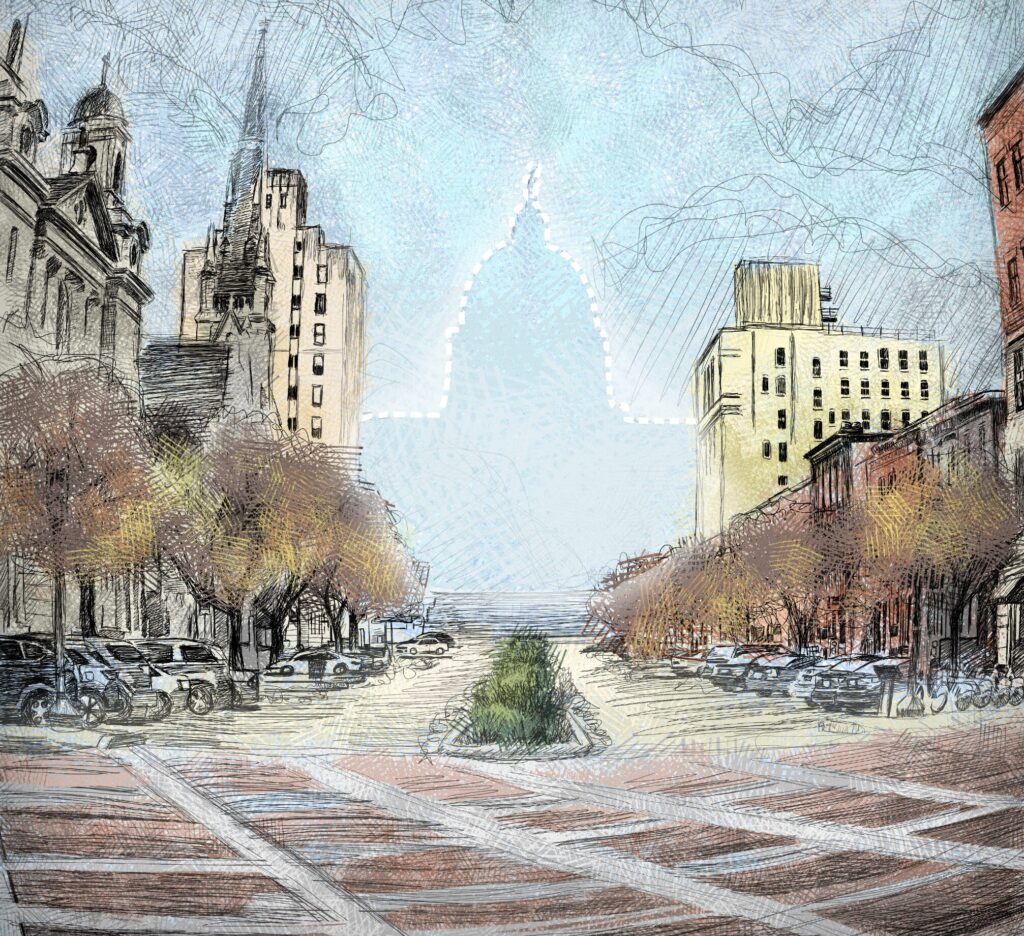
Illustration by Rich Hauck
When I first moved to Harrisburg, Aleco’s was my go-to spot for a quick, cheap meal.
At the time, the (very) casual eatery was located at North and 2nd streets, a cozy spot frequented mostly by neighborhood denizens like me.
Aleco’s was run by Jose, originally from Mexico and one of the hardest-working people I’ve ever met. If you dropped in at 7 a.m., he’d happily grill up a breakfast sandwich for you. For lunch and dinner, he furiously dished out burgers, cheesesteaks, sandwiches and huge salads. On Saturday nights, the late-night drinking crowd showed up, standing in a long line that often wound up the block, for greasy slabs of pizza at 2 a.m.
The place never seemed to close, and Jose never seemed to take a day off.
Mike, an older guy who lived nearby, waited every week for the Tuesday night pasta special—a mountain of spaghetti, meatballs, salad and garlic bread, all for about eight bucks.
“Look at all this food,” he said to me more than once, marveling at the pile on his plate. “It’s the best deal in town.”
Unfortunately, Aleco’s salad days (excuse the pun) wouldn’t last. About eight years ago, his landlord didn’t renew his lease, wanting the first-floor storefront for himself. So, Jose relocated a few blocks away, just across from the Capitol building, hoping to tap into the state worker market. Unfortunately, by now, we all know how this story ends.
A pandemic, 25,000 missing state employees, empty office buildings—and another Harrisburg small business down the drain, another dream shattered. In late October, I tried to stop in for lunch, but found the doors locked, the always-open place dark and empty. I tried calling, and the phone went unanswered.
Recently, TheBurg was named Small Business of the Year by the Harrisburg Regional Chamber, and, this month, I have the great honor of accepting this award on behalf of my amazing, creative, committed staff.
Because of this, I thought I might write a column about what it takes to be a successful small business in Harrisburg, an admittedly tough place to make it. I even sketched out a few ideas, addressing concepts like consistency, quality, flexibility, responsibility and dedication, which I believe are components of our success.
But then I realized that, no, that’s not enough. In Harrisburg, you can be a business that does all these things right—and still find yourself run over by some force beyond your control.
A pandemic might hit. Inflation may roar. And, worse of all, your Capitol customer base might stop showing up for work. Over the last five years, all these things happened to the hardest-working man in Harrisburg.
Of course, it isn’t only Jose. The catalogue of shuttered downtown businesses is a long one. Just last March, I wrote about another sandwich shop, Deco Grab & Go, which suffered a similar fate, and, well, I could go on and on. The list goes far beyond lunch spots, including law firms, lobbyists, banks, shops, consultants, bars, etc., which, since the pandemic, have closed, downsized or relocated, leaving many buildings half or fully empty.
My phone rang recently and a building owner, clearly upset, told me that he feared losing his anchor tenant, a downtown business that likely wasn’t renewing its expiring lease. He placed the blame squarely on Gov. Shapiro, who continues to allow most state workers, much of the time, to work remotely.
He said that he believed Shapiro had a responsibility either to order all state workers back to the office or to help fund the redevelopment of downtown Harrisburg—say, a one-time $100 million payment to help convert empty offices into residential space, where there is a demand.
Great idea, I told him, but, also, good luck with that. The problem, I said, is that Harrisburg is an orphan. Neither party gives a hoot about its own capital city.
For the Democratic governor, allowing state employees to continue working from home is the path of least resistance. Why rock the boat, upsetting the workforce, even if in-office work is superior? A future Republican governor might try to reverse that. However, that could prove difficult, considering that so many workers have grown accustomed to remote work or hybrid schedules.
Last year, I wrote a column saying that we, in Harrisburg, need to admit that state workers aren’t coming back and move on, opening a new chapter in the city’s history. I imagine a future in which Harrisburg finally fulfills its destiny as a great small city located on a majestic river, with a walkable, mixed-use downtown full of shops, restaurants and attractions. But, sure, such a transition will take gobs of money, and I have no idea where that will come from.
Even if it happened, it’ll be far too late for Jose and the many other small business owners who have become collateral damage since the pandemic. One day, a whole new crop of starry-eyed entrepreneurs will take their place. I can only wish them better luck than the poor souls who, deciding where to locate their businesses, once looked at the sprawling, stately Capitol Complex, with thousands of weekday workers, a guaranteed customer base, and confidently thought, “Well, at least this will never go away.”
Lawrance Binda is publisher and editor of TheBurg.
If you like what we do, please support our work. Become a Friend of TheBurg!