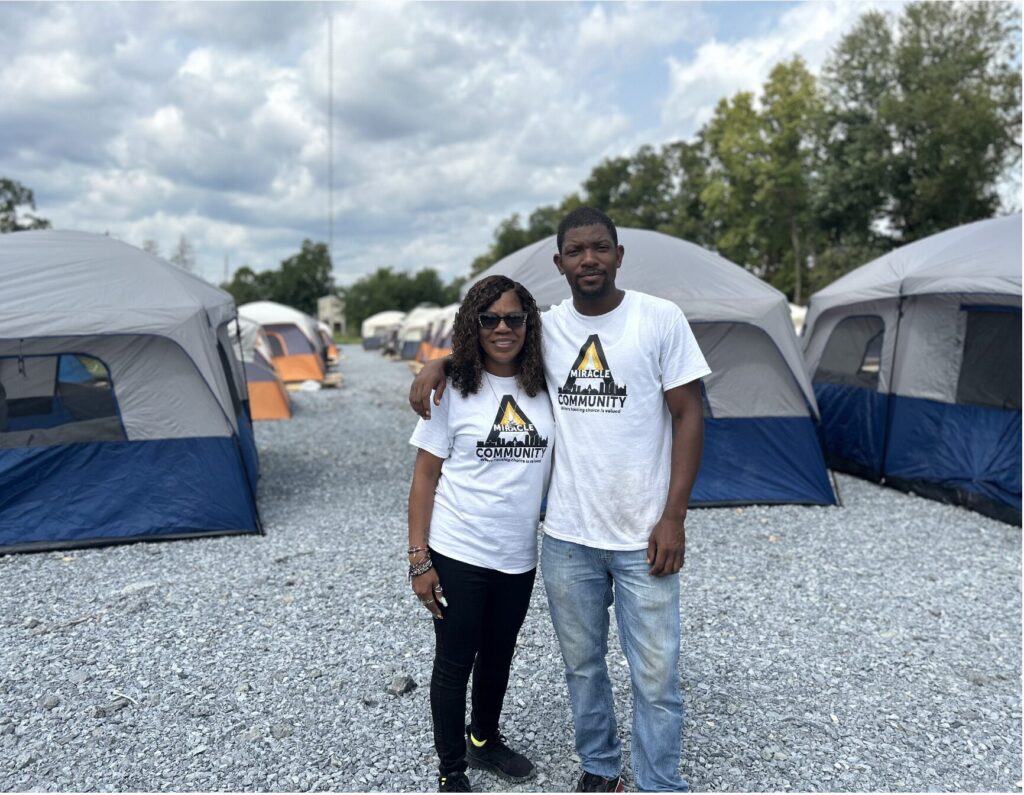
Marsha Curry-Nixon and Tim White
Marsha Curry-Nixon had sat in on countless meetings about how to help Harrisburg’s largest homeless encampment, dubbed “tent city.”
City resource providers have long known that the camp, which has housed over 100 people in south Harrisburg near the PennDOT building at various times, would be closed. As part of a project to expand I-83, PennDOT shared that the encampment site would be impacted, and occupants would be required to move. Since then, city, county and state officials have met to come up with some sort of answer to the question: “Where would all these people go?”
Curry-Nixon, as the founder of Amiracle4sure, which assists people re-entering society after prison and helps the unhoused, was at the table for these meetings. Meeting by meeting went by without finding a solution, even as the move-out deadline loomed.
“We got to the end of the wire,” she said. “All they knew is we needed to find a place to move them to.”
However, discussions around how best to address homelessness had taken place way before the tent city eviction and, of course, are not exclusive to Harrisburg. There is no one-size-fits-all “cure” to the issue, as evidenced by the simple fact that people still sleep outside, in cars and on couches every night.
But nationally, and now locally, people and organizations have stepped forward with fresh, innovative ideas to try to make a dent.
In the case of the Harrisburg tent city relocation, Curry-Nixon and her son, Tim White, who also works for Amiracle4sure, decided only a few months before PennDOT’s late September move-out date, to take on the task.
“Amiracle4sure has always addressed issues each time they came up. That’s what we do. We are the doers in this city,” White said. “This was just an extension.”
White drew inspiration from a planned, organized encampment in Los Angeles that he read about in an article. Tents were arranged on a plot of land in a grid-like fashion, with oversight and amenities like porta-potties for occupants.
Like that one, Amiracle4sure’s “Miracle Community,” now sits on a gravel lot off Cameron Street in Harrisburg.
Space of Belonging
On a warm September day, Curry-Nixon and White worked with volunteers to assemble tents to add to the 56 that were already full of former tent city occupants and other unhoused people from the area.
While the group of volunteers broke for lunch, the neighborhood of tents was largely quiet, despite there being over 150 residents. An older man sat on a lawn chair outside his tent, and one man politely approached Curry-Nixon to ask for a bottle of water. Walkways between tents were clear and clean. One person exited a portable shower on site, and clothes were hung to dry on a communal clothesline. Additionally, people have access to cooking stoves, electricity and other resources.
The scene was drastically different from that of tent city, which had a reputation for being jumbled and chaotic. Curry-Nixon attributed the difference to the power of taking ownership of your space.
“When you create a space of belonging, you become part of it,” she said. “There’s something about the dignity of not being concerned about where you’re going to lay your head at night and not being concerned about whether or not you’re going to wake up in the morning. That’s how you restore humanity. You meet people where they’re at.
White said that, so far, rules are respected and there have been no incidents, besides minor interpersonal spats. While they do have guidelines about keeping the area clean and safe, Curry-Nixon said that they don’t control what people do inside their tents, but they don’t allow prohibited activity in public, such as drunkenness.
“The residents are policing their own area,” White said. “They respect me; they respect my mom.”
Curry-Nixon and White said they treat each person with respect—keeping in mind that this is their residence—and invite input and discussion from occupants.
“We’re going to use the word humanizing,” Curry-Nixon said. “We have conversations with folks, like ‘this is our idea, what do you think about it?’ They have ideas. They need to be included. I tell them, ‘I don’t live here, y’all do.’”
Of course, the pair hopes that the more controlled encampment environment will be a steppingstone for people to obtain permanent housing. They also have plans to build housing on the site in the future.
A main challenge for the Miracle Community—finances. Amiracle4sure used a Dauphin County grant to purchase the land for the camp but is still seeking money for ongoing costs to sustain it.
“We’re still applying for all the grants and funding,” White said.
The community has yet to be tested by time and has concerns about winter approaching, but so far, White and Curry-Nixon believe it’s working.
Trying Tiny
Past the cleared tent city location and past PennDOT on S. Front Street, three projects to address homelessness are in the works. One was completed a year ago, one is under construction, and one has yet to break ground.
All these projects aim to provide housing to those without, and all of them are incorporating the same innovative tool—tiny houses.
The idea of building tiny homes to address homelessness is said to have originated in the early 2000s but seems to have taken off in the past decade or so.
Inspired by a tiny home community in Wisconsin, Veterans Outreach of Pennsylvania (VOPA) brought the first one to the Harrisburg area.
Bill Reed first heard about VOPA’s idea to build tiny houses for homeless veterans while working at the YWCA of Greater Harrisburg, where he assisted veterans for years.
VOPA co-founders Tom Zimmerman and Val Fletcher approached Reed with their plan, bringing along a veteran who was passionate about the idea.
“They talked about the tiny homes and how this veteran thought that tiny homes were a better fit for a lot of homeless veterans and talked about how things didn’t work in the area for him,” Reed said. “Well, he was talking about me, because I was the one with these other programs that weren’t working for him. I said to myself, ‘I feel like we’re only 85% there. It sounds like this group has an idea how to help that other 15%.’”
In May 2024, the team cut the ribbon on their tiny home community, Veterans Grove, which offers 15 snug, temporary houses, along with a community center.
Executive Director Jordan Purcell emphasized the importance of VOPA’s “therapeutic community” model, which uses peer-to-peer support and intensive engagement with the vets. Without that programming, neither Purcell nor Reed believe VOPA would have the same effect.
However, the tiny homes are really what make Veterans Grove unique.
Through his years of experience in the field, Reed has seen the common “housing first” model, which emphasizes securing shelter as the foundation and first step of addressing an unhoused person’s challenges, work for many, but not all. Some people don’t have success, he said, because they are isolated in individual housing and don’t stick it out long enough to get to next steps, such as addressing mental health or employment.
At Veterans Grove, the tiny homes give vets a safe, quiet place of their own that is small and manageable, not overwhelming. But the homes are arranged in a circle, creating a community that goes to meetings, has meals and socializes together.
“I think, without the tiny homes, many wouldn’t stay in the therapeutic model long enough for it to work,” Reed said. “It gives them that sense of control and space they need until they can grow in being comfortable around others.”
Reed has seen the program working.
“There were at least seven residents in this program that were in prior programs, that I’m very familiar with,” he said. “One who’s been here, I could tell you where his tent was. So, it works. It’s amazing.”
Purcell realizes that not every homeless vet is going to be ready or willing to try their program, but he and his team are regularly planting seeds, offering assistance for whenever they’re ready.
“It takes time,” Reed said.
Huge Difference
The VOPA team said that people have already expressed interest in copying their tiny home model elsewhere. Reed believes that the model could help other communities as well, if the holistic services are incorporated.
Actually, another group already has a plan to build a similar community next door.
A group of local friends has partnered with Missouri-based Eden Village to bring a tiny home community to any unhoused person, not just veterans, to a plot of land next to Veterans Grove.
“While out serving the community, we realized permanent housing was needed,” said Khary Lane, one of the board members.
The group, which was made up of members with real estate and housing connections, decided to do something about the issues they saw. They made a plan to construct 32 tiny homes on land donated by local philanthropist Peggy Grove, who also provided land to the other two construction projects.
Like VOPA, Eden Village of Harrisburg will work to provide wraparound services to its residents.
“The goal is to get the person a house and allow them to work on things that they might need to,” Lane said.
Eden Village is still in the fundraising and site prep phases but hopes to break ground sometime next year.
The final of the three south Harrisburg homeless community projects has been spearheaded by New York-based Tunnel to Towers, which broke ground in the spring. They plan to offer permanent housing in the form of 64-unit apartment building and 20 small “comfort homes” for unhoused veterans, similar to VOPA.
Eden Village board members are working closely with both Tunnel to Towers and VOPA and are excited about the number of people investing in the homeless community in Harrisburg.
“This could be the only place in the nation with three projects all side-by-side addressing homelessness,” said board member Wendell Hoover. “These three projects, they’re not going to solve [homelessness], but they’ll make a huge difference.”
At Veterans Grove, some participants have already felt that difference.
Two residents, who VOPA chose to keep anonymous for their privacy, shared that they struggled with loneliness, alcohol use and significant health issues. At Veterans Grove, they said that they feel safe, connected and “don’t have to worry,” one said.
“After leaving the service, I missed camaraderie,” one resident said. “You laugh together, cry together, celebrate accomplishments and feel the pain of your brothers and sisters like they are your own. Civilian life is the opposite of that. Here, we are surrounded by likeminded people. Everyone is pushing to complete a mission, helping and carrying each other the same as we would in battle.”
Their Choice
At press time, the deadline for occupants to leave Harrisburg’s tent city was pending. Service providers realize that not everyone will seek shelter at the Miracle Community or turn to VOPA or other local programs, although some already have. What will become of the city’s remaining unsheltered population remains to be seen.
Still, groups continue outreach and work to lower barriers to housing and build unconventional programs for those who haven’t found success securing housing yet.
For Marsha Curry-Nixon at the Miracle Community, that even includes helping those who choose to sleep outside, with the hope that they will eventually find a path towards permanent housing. It’s a process, she said.
“I will always honor what people value for themselves. It’s about meeting people where they’re at,” Curry-Nixon said. “I’m waiting for the day that someone says, ‘Thank you for creating this opportunity when I needed it. I’m so excited I’m moving into my apartment next month.’ That’s my vision, if that’s their choice.”
For more information about Amiracle4sure, visit www.amiracle4sure.com.
To find out more about Veterans Outreach of Pennsylvania, visit www.veteransoutreachofpa.org.
Learn more about Eden Village of Harrisburg at www.edenvillageusa.org/harrisburg-pa.
If you like what we do, please support our work. Become a Friend of TheBurg!