Start to Finish: Rolling Acre hemp farm is about as central PA as it gets

Talk about homegrown.

Rolling Acre hemp farm in Carlisle is just that—producing CBD and CBG products from seed to plant to processing.

Situated on a little over 100 tillable acres, the farm used to house horses and grow hay, wheat, soybeans, and, for a short time, garlic. Farmer Rich Roush switched to cultivating hemp a few years ago, after the state government opened hemp permits to producers.

He considered producing industrial hemp for the plant’s fibers, but after realizing that there were no processors in the commonwealth at the time, decided to give another aspect of hemp a shot.

Rolling Acre has since developed a line of CBD and CBG products for personal consumption—tinctures for both pets and humans, and, soon, a topical salve. Because it is not regulated or recognized by the FDA, CBD companies cannot legally market their products as having health benefits.

This is where Rolling Acre’s transparency and education comes in.

“It’s not about selling to every human we encounter,” Roush said. “But it’s that they have a good experience, and they understand it.”

Drive It Home

Rolling Acre products are distributed solely by PennHemp, another homegrown brand, developed by lifelong friends who grew up in Susquehanna Township. PennHemp provides marketing services for Rolling Acre and distributes and sells its products online and across various locations in and around central Pennsylvania.

So, when Matt Wilson, who manages PennHemp’s marketing and distribution, holds down a table at a retail store or an agricultural conference, he shares his personal experiences with CBD and CBG.

“Our thing is trying to educate people and be transparent about things,” Wilson said. “We want people to be comfortable taking our product.”

Upon getting Rolling Acre’s products into a store, Wilson offers to talk to potential customers about the products, educate them about the body’s cannabinoid system, and share customer testimonials.

“If someone’s on the fence, and we tell them we handle [the product] all the way through [the process], they feel much better about it,” Wilson said. “And we really try to drive that home.”

Roush’s parents are in their 90s, and his mother has glaucoma. Roush said that CBG has helped her ocular pressure.

Roush and Wilson both stress the importance of transparency in their operations, as they are responsible for every stage of production. The entire process, they stress—from growing to extraction—happens on the farm in Carlisle.

Many CBD brands get their products from a third party, which makes it difficult to know where it came from and what it contains. But, at Rolling Acre, they buy their seeds from Oregon CBD, grow them in a greenhouse, nurture them in the ground through the summer, harvest the matured plants in the fall, remove the flower, and break it down for cannabinoid extraction—all on-site in Carlisle.

Rolling Acre’s products are third-party tested at the farm and sent to a state-licensed lab that sends the results to the state, a legally required process for hemp growers and CBD producers in PA.

“One of the things about the plant itself is that it draws everything out of the soil,” Roush said. “So, we have to be very careful with what we use.”

Learning Curve

Rolling Acre’s entire process is organic.

They introduce water as necessary through underground irrigation, and they use organic fertilizer. Roush tested the farm’s soil for contaminants, like heavy metals, before he started, and he has never used pesticides, because hemp will draw all of that into its root system.

Roush grew up on a farm and has a professional background in chemistry, which helped him convert the former horse barn into a processing laboratory. The cannabinoid extraction process isn’t just a chemical procedure, though.

“There’s definitely a learning curve with growing it, but also extracting it takes some real finesse to get a clean raw product” for cannabinoid processing, Roush said.

He learned a lot from online courses and training sessions and through pooling the knowledge of colleagues at his environmental consulting firm.

Roush believes that legalizing CBD and other cannabinoids would level all producers under shared regulations and make for cleaner, more straightforward processes.

“The two big things we pride ourselves on, being from PA, are trying to get our name out in our home state that we love so much, and that everything in our products, we know what it is and where it came from, because we do the whole process, from start to finish,” Wilson said.


To learn more about Rolling Acre Farm and its products, visit www.rolling-acre.com.

Support quality local journalism. Become a Friend of TheBurg!

 

Continue Reading

Long Live the Law: Harrisburg firm Nauman Smith marks 150 years of practice

The attorneys of Nauman Smith

Few things reach 150 years of age.

Some turtles and whales come to mind. A law firm? Not so much.

But, here in Harrisburg, such a long-lived firm does exist. This year, Nauman, Smith, Shissler & Hall LLP celebrates its sesquicentennial, making it one of the city’s oldest continually operating businesses.

Sarah Schrank, marketing and communications administrator, credits her firm’s longevity to its dedication in building and maintaining relationships.

“We’re very proud of that,” she said.

The city’s oldest law firm was founded in 1871, when Nauman Smith began representing railroads, a booming business at the time as Harrisburg sat at a crossroads of the rapidly expanding freight and passenger rail system.

“Most of those relationships are still intact,” Schrank said. “Even as the earlier versions of the railroad companies have changed hands and maybe changed names over the years, we’ve still maintained those relationships, and we are still well known in that industry.”

It takes integrity to operate in the same city for 150 years, Schrank said.

“The things that we’ve been doing that have gotten us to this point are the things that we’ll continue to do,” she said. “That doesn’t mean we’re old-fashioned, not at all, but we are time-tested.”

The firm’s long history has allowed the partners to see the cyclical nature of the economy and the challenges that small businesses face in the area.

“There’s a lot of confidence and a lot of trust that can be found there,” Schrank said.

Nauman Smith specializes in the law involving small and medium-sized businesses, nonprofits, municipal zoning and regulations. To further fortify its services, it recently brought Ted Benchik, a bankruptcy attorney, to the area.

“Having a bankruptcy lawyer and bringing this new practice in our firm really provides a new way that we can serve our community and our clients,” Schrank said. “So, what we’re trying to show is that there’s help, and that it doesn’t have to be something that you’re afraid to talk about.”

Over 150 years, Nauman Smith attorneys have maintained another practice, one that is not so common any longer among today’s business leaders—civic engagement.

Each of the firm’s five current partners—Spencer Nauman Jr., Benjamin Dunlap Jr., J. Stephen Feinour, Craig Staudenmaier and Joshua Bonn—are active members of the community in organizations such as The Foundation for Enhancing Communities (TFEC), the Harrisburg Area YMCA and the Harrisburg Regional Chamber and CREDC, among others.

“The partners are very respectful of each other, and they really do look for consensus when they’re making decisions,” Schrank said.

Bonn, the youngest of the Nauman Smith partners, joined 12 years ago and is positioned to help lead the firm into the future. He said that joining the firm gave him immediate advantages.

“The partners have such a good reputation in the community that there’s already a level of trust—they already know our high ethical standards,” he said. “We’d like to build a relationship with our client, find out why they’re successful, why their business works and then how we can assist in moving them forward.”

Bonn explained that both he and the other partners prefer to hear directly from their clients and seriously consider their recommendations.

“We never want to tell the client that we do something because that’s the way it’s always been done,” he said.

Bonn said that he anticipates spending the rest of his career with Nauman Smith and recruiting the next generation.

“We’re not just happy to sit back and rest on our 150-year legacy, but we’re looking forward to being around for another 150 years and finding young, diverse talent that wants to partner with us,” he said.

Schrank said that a sustained focus on employing good people and maintaining high ethical standards has led to the firm’s success over so many years.

“You don’t get to be 150 years old and have some of the same clients that you’ve had for decades and decades without realizing that it is relationships that are going to get you to that place,” she said.

Nauman, Smith, Shissler & Hall is located at 200 N. 3rd St., 18th Floor, Harrisburg. For more information, visit www.nssh.com.

Support quality local journalism. Become a Friend of TheBurg!
 

Continue Reading

Mayor as Manager: Who wants the hardest job in Harrisburg?

Illustration by Rich Hauck.

What’s the toughest job in America?

From time to time, business publications come out with lists, often dominated by positions like health care worker, police officer and, well, I’ve even seen newspaper reporter make the cut.

My vote might go to another job that’s been called the “worst” in America: big city mayor. Now, here’s a job with high stress, endless problems, enormous customer dissatisfaction and constant personnel turnover—and that just scratches the surface.

With about 50,000 people, Harrisburg can’t be described as a “big” city. But, as I’ve said before in this space, it is almost a perfect microcosm of a larger city. It’s like Washington, D.C., shrunken down to (in candy bar terms) “fun size.”

Harrisburg has all the issues you find in a big city, only in miniature. It’s a business and nightlife center, but also has challenges that include everything from infrastructure to crime to poverty to development. Residents also reasonably expect decent service delivery—and will let you know if their trash isn’t picked up or their street isn’t plowed.

I bring this up because the city’s mayoral primary is this month. Five Democrats, including the incumbent, are on the ballot, as is one Republican.

I realize that people will choose their candidate for a variety of reasons. But, when I go to my polling station, I will vote for the person who I believe is best able, day in and day out, to do what I consider to be the hardest job in Harrisburg.

I think that people should have no illusions about this job. It’s not glamorous or glorious. It’s a grind. For a whopping $80,000 a year, you’re rewarded with seven-day workweeks and 12-hour workdays, constantly buried under a mountain of problems, pressures, complaints and frustrations.

Being mayor of Harrisburg is not about cutting ribbons, thinking great thoughts, making inspiring speeches or basking in adulation. First and foremost, it’s about stone-cold management.

Can you manage a 450-person workforce? Can you create and execute a $136 million budget? Can you oversee a dozen departments ranging from housing to public safety to IT?

As mayor, all of this falls on your shoulders. Do you have the skills, the energy, the patience? Can you do it competently, with at least a modicum of good humor? Can you handle the relentless, often cruel criticism from the public, the press, social media? Can you resist the lure of corruption?

To be honest, I don’t like Harrisburg’s “strong mayor” form of government. I think that the city would be better served if run by a professional city manager—someone educated and trained specifically to manage a municipality—under the direction and legislation of an elected city council.

Why do I think this?

As I state above, being mayor is largely a management job. Many elected mayors simply lack these skills. It may not be their fault, as they’ve never been trained to create budgets, manage staff and deliver services. A person can’t walk in off the street and instantly know how to run a complex organization with a $100-million-plus budget.

In addition, elected mayors are, by definition, politicians, and politicians do things for political reasons, which sometimes does not comport with the best interests of the public.

In Harrisburg, one need look no further than the 28-year tenure of former Mayor Steve Reed to see what can happen when a city government is overly politicized and mismanaged. A dozen years after Reed left office, Harrisburg is still trying to dig itself out of a financial hole.

But this is wishful thinking on my part.

Harrisburg has the form of government that it has, and I can’t change that. However, I can try to make people aware of what the “strong” mayor’s job actually is, how hard it is, and the deep skill set that it requires.

I should mention that I decided to write this column after witnessing several of the mayoral campaigns, which seem to be dominated by statements of lofty ideals and sweeping change.

In reality, a mayor has a very narrow window to foster change, given the grim realities of budget constraints, time constraints and competition among needs. A mayor may not be able to fundamentally change a city, but a good, honest, hard-working one can lead a well-run, well-managed government, setting the stage for reliable service delivery that helps to make the city a place where people want to live, visit and work. That’s the essence of the job.

So, when I cast my ballot this month, I won’t look to who has made the most inspiring speeches or promised to change the world. Instead, I will assess who has the intellect, the stamina and the competence to best manage the complex undertaking known as the city government of Harrisburg. And that’s the person I’ll vote for.

Lawrance Binda is co-publisher and editor-in-chief of TheBurg.

Illustration by Rich Hauck.

Support quality local journalism. Become a Friend of TheBurg!

 

Continue Reading

Where Wurst Is Best: Josie’s German Café & Market turned a skeptic into a believer

Jägerschnitze

Josie’s German Café & Market is a place that I’ve passed many times.

It’s easy to overlook. The humble yellow abode sits back off the street, its presence announced by a simple sign that appears to have been almost an afterthought.

I learned about the food they serve at Josie’s quite by accident by virtue of having some rare extra time on my hands while meandering around the Mechanicsburg area.

As I approached the door, I read a sign asking would-be diners to call ahead for seating. Fortunately, I was more curious than hungry, so went in to check out what seemed like an intriguing find.

Once inside, I browsed a selection of food merchandise, all of which hailed from Germany: coffee, vinegar, hot mustard, cookies, jarred red beets, mustard pickles, gherkins, canned herring, noodles, chocolates and more.

As I made my way into an adjacent room, the focal point was the deli case full of German specialties like bratwurst, weisswurst and liverwurst. Then there was the blood sausage and headcheese—neither of which I’m likely to try. For those unfamiliar with headcheese, it has been described as “meat jelly” from the head of a cow or pig and served in aspic. Not for me.

As I pondered these things, a friendly man emerged from the back and asked if he could help me with anything. So, I decided to satiate my curiosity about the restaurant, asking him if it was open.

“Yep, best German food in the area,” he claimed.

I learned later that Josie’s owners are Ashley Larew and Stephen Keslar and that the shop has been operating for over three decades, thanks to Josie Keslar, who was at the helm for many years.

Larew said that her husband worked with his mom at the shop since the tender age of 10.

“He’s carrying on her legacy now and uses all of her recipes,” said Larew. “Adding a restaurant to the shop was his idea.”

Larew describes her customers as coming from all walks of life, and she sees quite a few older, German customers. Operating a business during COVID is generally no small feat, but, according to Larew, it has been a positive experience for the couple.

“This has been one of our better years as new customers become more focused on small businesses,” she said. “So, it has worked out well for us.”

Welcomed

When I arrived home that day, I asked my husband (a Metzger) if he felt like indulging in a little German cuisine and, of course, he was game. The man has never met a brat he didn’t like—pronounced “brought” by the way, in case anyone gets any ideas.

We chose a table in the room adjacent to the deli, in the shadow of a picture of the famous Neuschwanstein castle. There, we perused the menu offerings, which included dishes like sauerbraten, goulash, rouladen, Bavarian pork roast, jägerschnitzel and a sausage plate comprised of bratwurst, weisswurst and knackwurst.

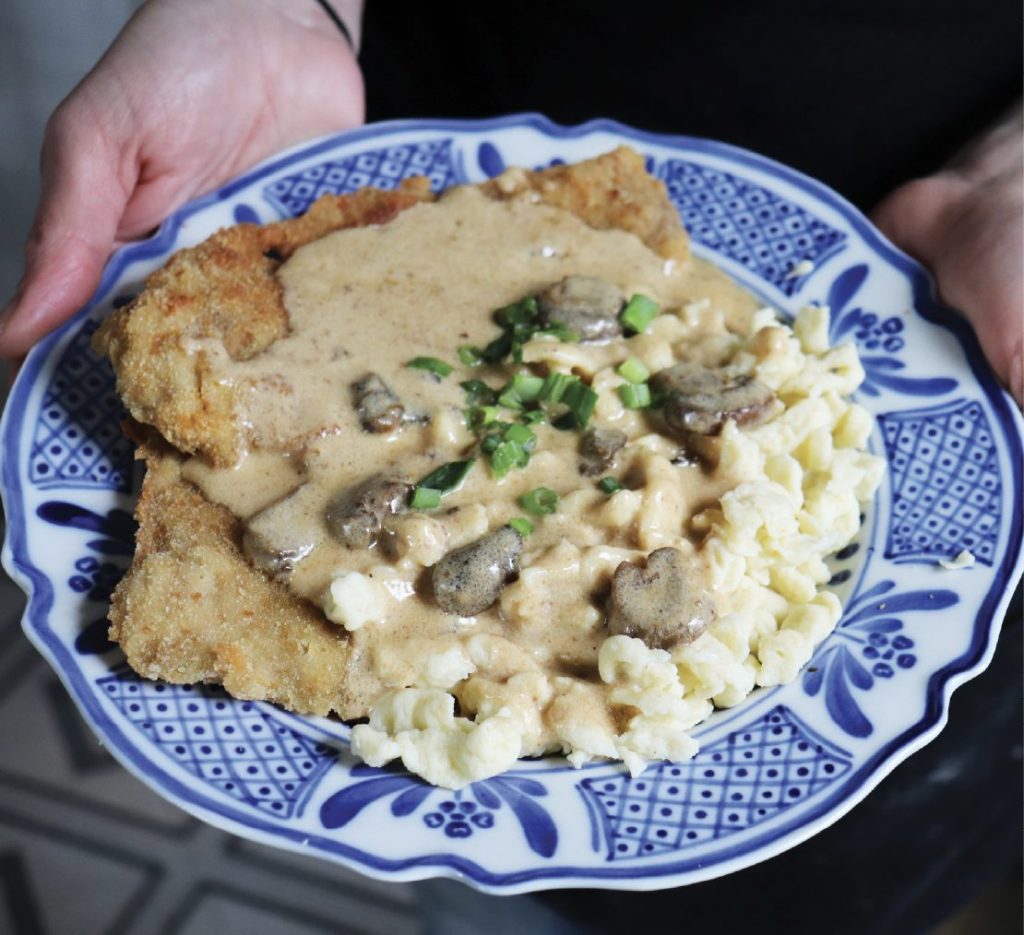
I was geared up to order the Bavarian pork roast—that is, until I was informed that they were out of the popular dish. That unexpected push carried me out of my comfort zone and into the jägerschnitzel, a dish described on the menu as “tender pork cutlet breaded and pan fried with a white wine cream sauce made with fresh mushrooms and served with spaetzle.”

My husband decided on a cubed beef dish braised with onions and spices, finished with red wine and served with spaetzle and red cabbage, known as Hungarian goulash.

Pretty soon, we heard pounding in the back as the schnitzel was being freshly made. About 15 minutes later, we were digging into our respective entrees.

The jägerschnitzel was delicious and a far cry from being bland, as I feared, and the spaetzle was reminiscent of the rivels I make for chicken corn soup, but lighter and flatter. Each one was coated with a rich, heavenly mushroom cream sauce that I won’t soon forget. The pork was tender and moist, and the breadcrumbs that covered the cutlets were light and crisp, not dissimilar to panko. My husband enjoyed the authentic goulash, which tasted of wine, onions and paprika.

I wished I could have kept eating, but, eventually, I gave up and took about a third of the generous dish home with me. If I had saved room, I would have been tempted by the variety of desserts like Black Forest cake, apple strudel, plum cake and peach torte.

Cara Bordner is another satisfied customer, a transplant from Michigan who now lives in New Cumberland and was once stationed in the army in Germany.

“My mom found the place and would stop in often and visit with Josie,” said Bordner.

She now visits with her son, whose favorite is the currywurst. She said that, over the years, she’s taken well-traveled guests to the eatery, and they’ve attested to the authenticity of the food. She also keeps returning for the rapport.

“If you are a repeat customer, they call you by name, and you always feel welcomed,” she said.

As for me, I’m glad I wandered off the beaten path to try something other than the pork roast. I am looking forward to returning, and I’ll be hard-pressed to have anything other than that delicious jägerschnitzel. That is, unless they are out of it, in which case I’m perfectly willing to be steered in another direction.


Josie’s German Café & Market is located at 5238 Trindle Rd., Mechanicsburg. For more information, visit www.germanfoodatjosies.com/market.

Support quality local journalism. Become a Friend of TheBurg!
 

Continue Reading

Suds & Salsa: Zeroday Brewing Co. has a new flagship taproom, with Mexican fare on the menu

Those who are familiar with the Appalachian Trail may know that hikers have a lingo all their own. I once met a thru-hiker who informed me that her trail name was cashmere. Why?

“Because I’m a sweater,” she said, with a laugh.

Zeroday is another word that is prominent among Appalachian Trail hikers. It means taking a break and embracing the idea of doing little or nothing. Theo Armstrong wants his newest taproom, located on the 900-block of N. 3rd Street in Harrisburg, to be just that—a respite for those who need a break from the hectic pace of everyday life.

“Come in, relax, have a great beverage,” he said. “That’s what we’re all about.”

And, to that, add some tacos, enchiladas, chips and homemade guacamole because the new location has a full-service, Mexican-inspired restaurant on site.


Feel at Home

Zeroday’s new taproom/restaurant marks the latest in its rapid expansion.

The brewery opened its first location in Midtown Harrisburg in the spring of 2015. The 5,000-square-foot space, located in back of Midtown Cinema, was divided between the brewery operations and a small taproom.

In 2017, Zeroday expanded for the first time, opening an “Outpost” inside the Broad Street Market in Harrisburg.

Then, early last year, Armstrong announced a major expansion. Zeroday would build a new brewery/restaurant on 3rd Street, near Forster Street. It also would open a second Outpost inside Midtown Cinema, along with a gourmet hot dog bar. For the trifecta, it would partner with the owners of ShakeDown BBQ for a restaurant/brewery concept in the new Susquehanna Union Green off of Linglestown Road.

Obviously, more beer would be needed, so the original taproom would be converted to production-only space.

Then the pandemic hit, and the best-laid plans came to a screeching halt—for a little while anyway.

“We started in February of 2020 and were forced to shut down construction for three months,” Armstrong said.

State-mandated restrictions further affected plans for the Midtown Cinema Outpost, which opened late last year, and, more importantly, for the taproom and eatery in Midtown.

In March, Zeroday’s new flagship location on 3rd Street finally debuted, with room for about 150 customers inside and another 60 to 70 in an outdoor courtyard, where a firepit and heaters will prolong the season when the weather again turns cooler.

The spacious and attractive interior—a product of the combined talents of Chris Dawson Architect, Best Space Design and Born Creative—features exposed brick, modern fireplaces and mixed seating. The bar fits about 25 and features a large, eye-catching Zeroday logo and two televisions, which display digital menus.

A separate section can be closed off for parties, receptions, karaoke and other gatherings. That room features a small-batch, three-barrel brewhouse, so customers can have an “immersive experience” watching the brewing process and even chatting with the brewers, Armstrong said.

Especially charming are separate areas where groups of friends can socialize on comfy chairs and couches.

“We want our place to be like a community living room, where people can feel at home,” Armstrong said.

A Buzz

Beth Taylor has worn many hats. Some may know her as the person who oversaw the Broad Street Market’s revitalization.

“That experience told me that I can do anything,” she said.

She now runs the onsite restaurant called “La Catrina Modern Mexican Kitchen at Zeroday Brewing Co.” It features scratch fare with selections like enchiladas, fajitas, ceviche, tacos, quesadillas, churros and tres leches cake, to name just a few.

“We think that the Mexican-inspired menu really complements Zeroday’s great craft beer,” said Taylor, who manages the kitchen on behalf of Harrisburg-based Nourish Hospitality Group.

Brew-wise, Zeroday continues its reputation for a diverse tap list, featuring numerous beer types, along with a few innovative experiments.

“We’re offering many different styles, from triple IPAs to lagers,” Armstrong said. “Sours are very popular right now.”

On tap, you’ll find such Zeroday stalwarts as the ever-popular “Mango Habanero,” a perfect fit for the new cuisine, as well as rotating selections and some one-and-done concoctions. The brewery recently released a strong ale called “COVID Ruined Our Birthday.” Believe it or not, it will remind you of birthday cake, with a kick.

If beer isn’t your thing, Zeroday has a license also to sell Pennsylvania wines and spirits.

“Pennsylvania is producing excellent wines these days,” Taylor said.

The spirits selection includes everything from bourbon to tequila to vodka, liquors that also fortify a new line of signature cocktails that include “Raspberry Gin Fizz” and “Maple Bourbon Ginger Splash.”

Armstrong and Taylor said that the new Zeroday is off to a great start, and the team is excited that they’ve created a buzz in the heart of Harrisburg.

“We are so happy to welcome everyone back and share a beer and a great meal,” Armstrong said.


Zeroday Brewing Co. is located at 925 N. 3rd St., Harrisburg. Zeroday also has “Outposts” in Midtown Cinema and at the Broad Street Market. For more information, visit
www.zerodaybrewing.com.

Support quality local journalism. Become a Friend of TheBurg!


Continue Reading

Dog Days of Spring: Time to enjoy the city—with your furry companion

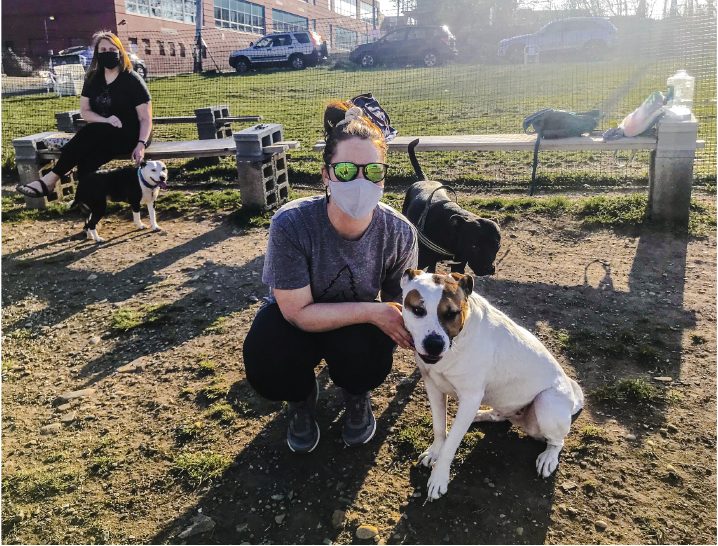
Friends of Midtown Dog Park.

There’s no better way to socialize than with man’s best friend. So, when making weekend plans, naturally you look for activities where you can include your four-legged partner.

According to the Humane Society of Harrisburg Area, about 300 dogs were adopted and given a home in 2020. The pandemic pushed many dog-lovers to adopt a companion during the lonely months of quarantine.

“We were happy to see that the pandemic did not affect people’s willingness to adopt,” said Amanda Brunish, director of marketing and outreach at the Humane Society. “In fact, we saw an initial spike in adoptions at the beginning of 2020. We attribute this to people knowing they would be at home and have the time to commit to bringing a new pet, especially a dog, into the home.”

As more dogs fill the city, [new and old] pet owners are looking for ways to incorporate their furry friends into day-to-day life. Whether you’re a city dweller or a suburbanite, Harrisburg offers outdoor options for everyone to join in.

Sip & Slurp

Since the start of spring, outdoor seating on “Restaurant Row” has taken over the sidewalks downtown to encourage visitors to dine safely outside. Eateries such as Cork & Fork, Burger Yum, Federal Taphouse, Cafe Fresco, Stocks on 2nd and Arooga’s welcome leashed pets to experience the atmosphere of 2nd Street while their owners dine.

Near the state Capitol, several dining establishments, including Sammy’s Italian, Mangia Qui, Rubicon and Home 231, offer curbside seating for your furry guest. Don’t forget to feed your doggie, too. Some restaurants, including Sammy’s, offer off-the-menu “puppy bowls” or sliced grilled chicken à la carte.

Just across Forster Street, Sturges Speakeasy is known for greeting pets with a smile. From keeping a stack of water bowls nearby to making the outside deck easily accessible, this centrally located pub considers Fido to be a valued customer.

“We enjoy seeing our customers bring along their pets when visiting us,” said owner Adam Sturges. “We have a crew of regulars who like to bring their dogs when the weather gets nice, and we have a few items on the menu that they can enjoy, such as ice cream and whipped cream.”

Be sure to check the hours of business online or call to make a reservation as many restaurant hours have changed due to COVID-19.

Several local breweries also welcome pets for bites and brews, including Zeroday Brewing Co., which has a special doggy entrance.

“Our new taproom located on 3rd Street offers a comfortable outside patio for dog owners to enjoy with their pals,” said Jess Moody, operations manager at Zeroday. “We even have a special entrance in the back of the building for dogs to walk through. As they enter, they will find cold water dishes for thirsty pups.”

For humans, Zeroday even offers a pooch-inspired hefeweizen called “When Did We Get A Dog?” Other local breweries such as the Millworks and the Vegetable Hunter welcome dogs to sit outside while their owners sip and sample from their beverage menus.


Trails & Treats

Harrisburg’s first dog park, Friends of Midtown Community Dog Park, is an off-leash playground where pups can roam free in an enclosed space and meet other neighbors. Located on Granite Street, this dog park is open every day of the week from dawn until dusk and has small and large dog play areas. Visit their Facebook page for COVID-19 regulations.

If you don’t have time for the dog park, any outdoor trail will do. Take a stroll on Front Street through Harrisburg’s Sunken Gardens and Riverfront Park. With a nice breeze from the Susquehanna River, this path provides great exercise for you and your pup.

For a quieter scene, travel across the walking bridge to City Island. There, patrons can walk the one-mile loop while taking in the views of the city skyline and the island’s attractions.

In Midtown, the Broad Street Market welcomes friendly pups onto its courtyard to socialize. Inside, you’ll find Doggie Delights, a gourmet dog treats store selling flavored treats, doggie chews and ice cream—all made from natural ingredients.

“This spring, we will be selling our fresh goat’s milk ice cream,” said owner Donnie Farner. “Our Colby Cups come in several flavors, including blueberry, peanut butter and maple bacon. This is the perfect treat to cool down your pup while still offering nutritional benefits.”

Brunish, of the Humane Society, recommends having treats available as you walk your pooch through city streets to reward them for good behavior.

“Check out our online resource library for great tips on life with your dog,” she said.

With sunny days ahead, there is no need to leave your pup at home or travel outside the city for dog-friendly fun. Harrisburg welcomes your canines as members of the community and encourages you to enjoy the city together as a (furry) family.


For more information on the Friends of Midtown Community Dog Park, visit their Facebook page.

Looking to support the Humane Society of Harrisburg Area? Participate virtually in their GLOW 5K Run/Walk from June 6 to 12. To learn more, visit www.humanesocietyhbg.org.

Support quality local journalism. Become a Friend of TheBurg!


Continue Reading

Mom in Mind: Rosemary suggests a springtime pasta dish, perfect for Mother’s Day

In May 2012, on a lovely, warm afternoon in Assisi, Italy, the friends with whom we were traveling took us for “lunch” at a hillside restaurant called Metastasio.

I’ve never preferred eating a big meal with wine in the afternoon, but our friends love it and claim it’s an Italian “thing.” We sat on an open deck that overlooked the green hills of Umbria. Only the church bells from the little town of Assisi broke the silence.

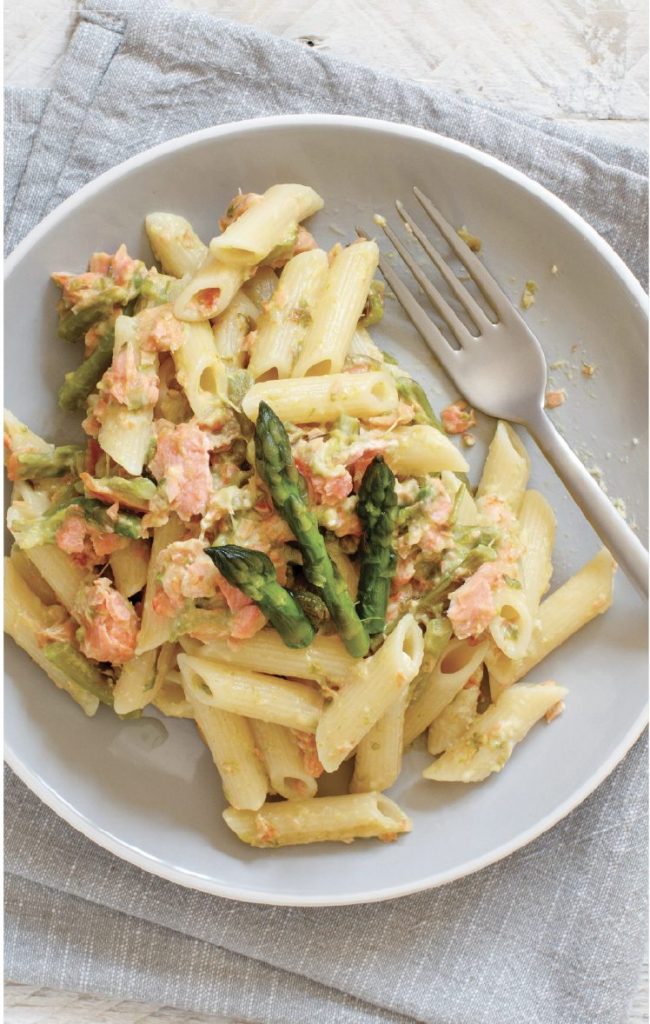
I have always remembered what I ate that day and have been thinking that it would be lovely for a Mother’s Day brunch. Pasta with salmon and asparagus in a light cream sauce offers a nice change from the usual egg strata, quiche and frittata. The only accompaniment needed is a fresh fruit salad and chilled peach bellinis or orange mimosas to drink. Pasta for brunch? Why not?

Italian cookbooks contain many versions of pasta with “salmone.” Some call for smoked salmon instead of fresh, peas rather than asparagus, and others for a “spike” of lemon rather than the tomato in Giuliano Hazan’s recipe below. Hazan calls for penne, but you could use a string pasta like linguine or even cheese tortellini. This dish is fun to experiment with. Mom will love it.

 Pasta with Asparagus and Salmon (Penne agli Asparagi e Salmone)

Ingredients

  • 8 ounces fresh asparagus
  • ½ medium onion (sweet onions are best)
  • 2 tablespoons extra virgin olive oil
  • ¾ pound (12 ounces) fresh ripe tomatoes (plum tomatoes are a good choice as they have less liquid)
  • 1 pound of pasta (choose shape to your liking)
  • 1/3 cup heavy cream
  • ½ pound (8 ounces) fresh, skinless salmon or smoked salmon, if you prefer
  • Salt and pepper to taste

Directions

  • Fill a wide sauté pan with water, place over high heat, and bring to a boil.
  • Cut off the woody bottom portion of the asparagus spears and peel the remaining bottom third. Add 1 teaspoon of salt to the boiling water, and slide in the asparagus. Cook until tender, 5 to 6 minutes. Then lift them out and set aside. (Watch carefully and don’t allow the spears to get mushy.)
  • While the asparagus are cooking, finely chop the onion and put it in a large skillet with the olive oil over medium-high heat. Sauté until golden, about 5 minutes.
  • Cut the asparagus into ¾-inch lengths, add to the onion, and sauté for another 5 minutes.
  • Bring a large pot of salted water to boil for the pasta. Cook until al dente.
  • Peel the tomatoes and coarsely chop them. Add to the asparagus/onion mixture and cook until all the liquid is gone.
  • Add the cream to the onion/asparagus/tomato sauce and cook for 1-2 minutes until it thickens a little. Cut the salmon or smoked salmon into strips and add to the pan with salt and pepper to taste. Cook for another 2 to 3 minutes.
  • When the pasta is done, drain it and toss it with the sauce and serve.

A few cooking notes:

  • If you are using smoked salmon, a little chopped fresh dill added at the end is very good.
  • Frozen baby peas are a great alternative to the asparagus. The dish is still very “spring-like.”
  • Save a little of the pasta cooking water if you need to thin the sauce.
  • You can eliminate the tomatoes if you prefer. The dish will still be good.

Many Harrisburg-area restaurants will be serving brunch on Mother’s Day. Mangia Qui, Note and Home 231 are some of my favorites (especially their Bloody Mary’s!). But if you are looking to treat Mom at home, pasta with salmon is a lovely choice for brunch or an early dinner on the patio, even without a view of the Umbrian countryside.

Support quality local journalism. Become a Friend of TheBurg!

 

Continue Reading

Divide and Conquer: Dauphin County and state officials are ready to build bridges across the digital divide

It’s a beautiful concept: Public libraries are designed to provide all residents with equal opportunities to information.

“Libraries are supposed to be equalizers—print materials did that for a long time,” said Karen Cullings, executive director of the Dauphin County Library System (DCLS). “Now, it’s not just the information itself. It’s how that information is accessed.”


Internet Injustice

Amid COVID-19, the eight libraries that comprise DCLS are connection points for many residents, especially those who need computer access. Applications for rent relief and other pandemic aid programs, vaccine appointments, unemployment claims and job searches are all online.

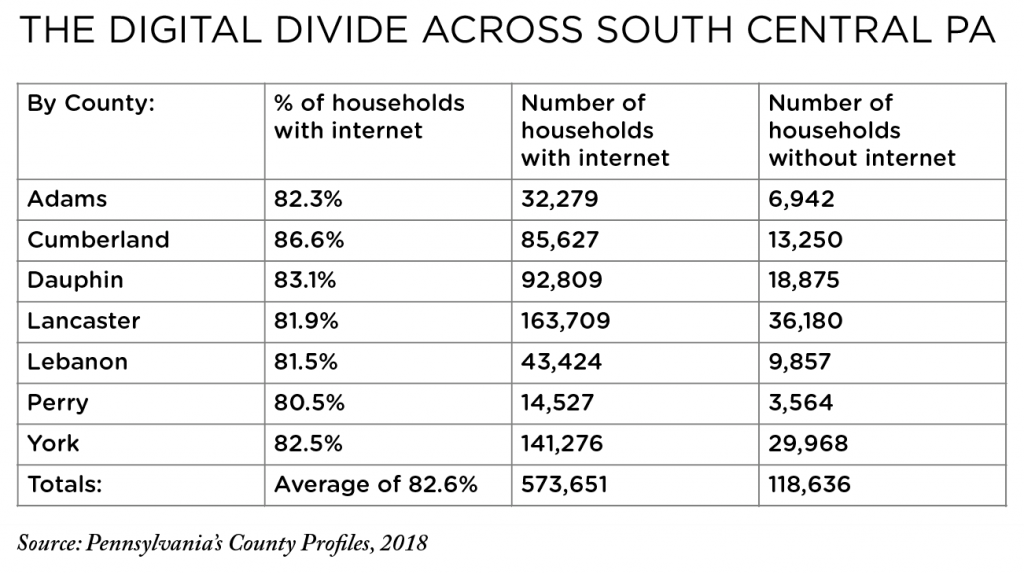
In Dauphin County, 83% of all households have internet access. That leaves 17%—or nearly 19,000 households—disconnected. But the problem goes even deeper.

“When we start talking about the digital divide, it’s not just an access program—it’s a skills gap, too,” Cullings said. “People coming in for help already have other struggles in their lives—it’s frustrating for them and sometimes demoralizing. They’re already behind a curve.”

Library staff have become increasingly technology-proficient—showing visitors how to navigate relief programs and schedule vaccine appointments, helping students without highspeed broadband at home to log onto library Wi-Fi, and assisting patrons without email addresses in setting up email accounts.

“Lot of times, we look at disadvantages as a racial or socioeconomic gap, but, in my experience, it’s also often an age or generation gap,” Cullings said. “Our population is aging, and some of our older citizens are really struggling with that skills gap. If they didn’t grow up with a mouse in their hand, it can be a tough transition.”


Costly Connections

The library system’s annual budget of $7.5 million includes $1.2 million for internet and technology costs. About $150,000 is provided by the federal E-Rate program, which helps schools and libraries with internet costs, based upon poverty levels. And during the pandemic, E-Rate guidelines were relaxed, allowing libraries to push Wi-Fi signals beyond their walls and into neighborhoods, to increase internet access.

“Broadband is expensive,” said George Hartwick, Dauphin County commissioner. “This ties into a national discussion on broadband and access to the underserved community. And now we have the opportunity to pull significant resources in, with the American Rescue Plan.”

Thanks to that plan—a COVID-19 stimulus plan recently passed by Congress—Hartwick and county officials hope to partner with Rush, Jackson and Jefferson townships, where the county’s greatest need for broadband exists, and hire a consultant to maximize the impact of federal funding.

“If we leverage those dollars to address this in a holistic way, we have a real possibility to put a real bridge to the gap that exists,” Hartwick said. “I don’t remember a time when we’ve had the resources to address this in such a dire way.”

Hartwick serves on the broadband task force for the National Association of Counties’ board of directors. And you can tell he’s passionate about the issue.

“No one should be limited by geography, income, race or the community you live in, to be able to achieve access to the information that’s critical for sustainability and upward mobility,” he said. “We have an obligation from the public perspective to give folks an equal opportunity to succeed. If you have the ability to access things, it’s only a click away—and providing that access in this country, in this day and age, is critically important.”

To his knowledge, information redlining—discriminatory access to internet by providers—is not a factor.

“If there is information redlining going on, I want people to contact me immediately,” he said. “I assure you, disenfranchising information from individuals based on income will not happen.”

Internet Implications

Dauphin County is a microcosm of the range of circumstances faced by Pennsylvania’s 600 library systems. It’s a county library system with a large urban center, surrounded by suburbs and a rural zone—northern Dauphin County—with spotty internet.

“There is an overwhelming need to address this digital divide as aggressively and cost effectively as we can,” said Glenn Miller, deputy secretary and commissioner for libraries under the Pennsylvania Department of Education. “We know the economy functions with the internet as the backbone—job applications are online and a whole range of other services.”

He likens today’s digital divide to the post-Depression era’s drive for rural electrification, in which public demand played a role.

“The public needs to come in and say this is a central right,” Miller said. “Broadband is an essential for functioning in this economy.”

It’s a role that Cullings feels compelled to fill on behalf of library patrons she sees and serves every day.

She cites a report by Tracie Hall, executive director of the American Libraries Association, which states that “76% of the nation’s Black residents and 62% of Latinx residents are slated to be shut out of or underprepared for 86% of U.S. jobs by 2045” due to a “racial tech gap” that puts them “a decade behind white households in broadband access” and on the verge of an “unemployment abyss.”

The digital divide existed prior to the COVID-19 crisis, but the pandemic and its patchwork of online programs exposed the divide along a variety of fracture lines. Now, public libraries and public officials are stepping into the divide to champion the cause.

“It means we’re going to have to look at how we’re providing services and what we can do to be part of the solution to social justice issues,” Cullings said. “And making sure we’re providing equal access.”


For more information on the Dauphin County Library System, see dcls.org.

 Support quality local journalism. Become a Friend of TheBurg!

 

The Digital Divide Across South Central PA

By County: Percentage of households with internet Number of households with internet Number of households without internet
Adams 82.3% 32,279 6,942
Cumberland 86.6% 85,627 13,250
Dauphin 83.1% 92,809 18,875
Lancaster 81.9% 163,709 36,180
Lebanon 81.5% 43,424 9,857
Perry 80.5% 14,527 3,564
York 82.5% 141,276 29,968
Totals: Average of 82.6% 573,651 118,636

Source: Pennsylvania’s County Profiles, 2018


Continue Reading

Back in the Swing of Things: The pandemic battered Minor League baseball, but the Harrisburg Senators are stepping up to the plate

Photo courtesy of the Harrisburg Senators.

Pam MacNett started walking from her house in downtown Harrisburg to games on City Island when she was just 8 years old.

It was one of the few fun things to do in the city at the time, she said. From then on, it stuck. She has held Senators season tickets every year since 1999 and has even hosted players at her home during the season.

“I’m pretty dedicated,” she said. “It’s a very large part of my life.”

It was no surprise to hear that MacNett already had her season tickets for 2021. She was eager to return to her happy place—beer in one hand, hot dog in the other. After all, the pandemic had deprived her of baseball in 2020 when the minor leagues cancelled its season. It was the first time in years that she missed a season.

“Being able to have something back that has been such a big part of my life for the last 20 years is super exciting,” she said.

Really Tough

Senators fans, players and officials are all ready to get back into the swing of things, and, this month, they will.

“We are so happy to be able to play again,” said Senators President Kevin Kulp. “We live for game day.”

They kick off the season on May 4 against the Patriots at Somerset, N.J., and play their home opener on May 11 against the Richmond Flying Squirrels. In total, the Senators will play 120 games, 60 at home and 60 away.

The season starts a month late due to COVID restrictions at spring training complexes, but will extend two weeks longer than usual.

The team will play six-game series, Tuesdays through Sundays. They’ll play almost every team in the league, facing the same team for six games in a row. Kulp said that this will help reduce travel time and costs—a great benefit.

With the 2020 season cancelled, the Senators revenue decreased by over 90% compared to the 2019 season, Kulp said.

“We went a year and a half with no revenue—that is not how minor league teams are supposed to support themselves,” he said. “We don’t make a lot of money in the best of years. The last 20 months have been really tough.”

Things aren’t going to magically get better when the 2021 season starts either, Kulp said. They will be operating at about 30% capacity in the stands to accommodate for social distancing.

However, Kulp was quick to say that this doesn’t mean fans won’t experience the usual fun, family atmosphere.

“We are not going to skimp on what fans can expect when they come to the ballpark,” he said.

Time for Celebration

MacNett and others can still buy their game day essential foods. Families will also be able to participate in kids’ activities in a safe way. Most importantly, fans can cheer on their team as they play.

As excited as fans are, players like Rhett Wiseman are even more ready to suit up and step onto the field, after months of missing the diamond.

“I’m excited to be able to get out on the field and play the game that I love,” said Wiseman, who played for the Senators in 2019. “If there’s anything COVID showed me, it’s that I love the game.”

At the same age MacNett started regularly watching baseball games, Wiseman began regularly playing in them, since he was 8. Again, 2020 was the first one he missed.

Minor league players found out on the first day of spring training in 2020 that the season was cancelled. They were told to pack up their bags and head home.

“You realize all this training you put in is going to go to waste,” Wiseman said. “It was tough.”

For the year off, players were left to find a way to continue to practice and stay in shape. Wiseman connected with a group of players in his hometown of Nashville, Tenn., playing backyard pickup games and training together. He knows not everyone had the same experience, though.

Wiseman predicts that there will be some rust the players will need to shake off, but he feels prepared to play, with whichever team he’s on.

“I feel like these guys are going to make sure their minds and bodies are ready for the season,” Kulp said. “It’ll be impressive to see how they rebound.”

It’s not just the players who are hoping to rebound, but the Senators as a whole. Kulp stressed that the team needs fans to head to City Island, now more than ever.

“We are here as an outlet for affordable family entertainment, and we need the community’s support now,” he said.

For the hardcore sports fan and those who just go for the food or entertainment, baseball marks another sense of normalcy as society approaches post-pandemic life. May 11, the Senators’ first home game, can’t come soon enough.

“It’s going to be a very emotional day,” Kulp said. “It’ll be a time for celebration.”


Tickets for the Senators’ 2021 season are being sold in pods of two, three, four or six to allow for social distancing. May tickets are on sale now. For more information, visit the Harrisburg Senators’ website.


Swing Batter!

The Senators’ 2021 home schedule:

Tuesday, May 11 through Sunday, May 16 – Richmond Flying Squirrels

Tuesday, May 18 through Sunday, May 23 – Altoona Curve

Tuesday, June 1 through Sunday, June 6 – Portland Sea Dogs

Tuesday, June 15 through Sunday, June 20 – Reading Fightin Phils

Tuesday, June 29 through Sunday, July 4 – Somerset Patriots

Tuesday, July 13 through Sunday, July 18 – Akron RubberDucks

Tuesday, Aug. 3 through Sunday, Aug. 8 – Erie SeaWolves

Tuesday, Aug. 10 through Sunday, Aug. 15 – New Hampshire Fisher Cats

Tuesday, Aug. 24 through Sunday, Aug. 29 – Hartford Yard Goats

Tuesday, Sept. 7 through Sunday, Sept. 12 – Bowie Baysox


Support quality local journalism. Become a Friend of TheBurg!
 

Continue Reading

Art, Nature, in Harmony: Native garden and sculpture park debuts in Perry County

By definition, a “bower” is “a pleasant, shady place; a retreat or sanctuary.”

It’s the perfect word to describe a new native plant garden and sculpture park, nestled between the Tuscarora and Kittatinny ridges of the scenic Appalachians in Perry County.

“The Bower,” a bucolic landscape and fine art venue, opens May 1, spread across the 36-acre residential homestead of Bill and Jane Allis. The Allises initiated the project two years ago, recruiting a multi-faceted team of designers, developers, landscapers and artists to bring their vision to life.

The couple said that they were inspired to create The Bower after traveling to New Zealand and Utah in 2018, which, in turn, “gave us increased recognition for the need for conservation.” Bill and Jane decided to sell their downtown Harrisburg home and return permanently to their property in Shermans Dale, where they had lived for many years while raising their family.

“We did a lot of traveling over the years, which inspired us,” Bill said. “After we returned home, though, we realized that central Pennsylvania is the most beautiful place we’ve ever been to.”

Lofty Goals

The Allises began their ambitious project by recruiting the help of a Penn State landscape architecture student. Their shared vision was to “create an accessible, intimate and diverse landscape that joins nature and art in harmony and provides many serene and intriguing places to enhance the visitors’ experience,” according to the couple.

“We considered ourselves very capable of doing this, but we had some pretty lofty goals,” recalled Bill, a retired environmental engineer.

Jane was no slouch in environmental design, either. A retired early childhood educator, she oversaw the environmental design and construction of the Londonderry School in Susquehanna Township.

“I had my hands in project management (before The Bower),” she said. “I wanted to make this a place that can be enjoyed by all ages of the public.”

The Allises created a master plan under the “guidance and insight” of Oehme von Sweden, or OvS, a Washington, D.C.-based landscape architecture firm. The firm created a concept that celebrated the “Pennsylvania Salient,” or the characteristic folding of the Appalachian Mountain range in the state’s central region.

Philadelphia-based Larry Weaner Landscape Associates (LWLA), which specializes in native plant horticulture, was also commissioned. Landscape designer Ethan Dropkin took the existing master plan and “changed around to a new plan” that involved trail systems, gardens and meadows to collect storm water onsite, all based on Bill and Jane’s feedback.

The resulting design was cultivated through mid-2020 and planted in late fall. The work is expected to culminate in continuing growth over the next several years as “a resilient, low-maintenance landscape demonstrating the value, benefits and subtle beauty of diverse native plant communities for visitors, as well as pollinators and wildlife,” the Allises described.

“Our clients wanted a completely organic landscape,” Dropkin said.

To achieve just that, his firm dotted the landscape with more than 100 native species using seed mixes, live plants and shrubs, grasses and ferns.

“Working organic has its challenges,” he said. “It takes more applications of natural treatments than chemical for treating weeds.”

He noted, though, that the property has a great deal of diversity.

“It’s on the side of a mountain with everything from a full canopy to a full sun meadow,” he said. “There are a lot of interesting plants like orchids, meadows and a variety of native grasses.”

Bold, Harmonious

The Allises also enlisted Brigette Mayer, a Philadelphia-based gallerist and art consultant, to the project. She guided The Bower’s advertising, selection, commissioning and design of site-specific sculpture. Initially, 130 sculptors from the United States, Europe and South America submitted proposals. Ultimately, final selections were narrowed to 10 artists to create sculptures.

Stonemason, designer and artist Thea Alvin and her partner, Michael Clookey, created The Bower’s entrance piece, “The Kiss.”

“I was very excited to be a part of the process,” Alvin said.

She and Clookey spent two weeks in Shermans Dale with the Allises to finish the massive work that comprises 100 tons of stone recycled from an old barn foundation.

“It’s held together using gravity and physics and has no mortar or glue,” Alvin explained. “It’s an old, proven technique thousands and thousands of years old that I taught myself.”

The Bowers’ remaining sculptures were created offsite in 2020 and installed in late summer.

Philadelphia-based artist Rebecca Rutstein created “Ridge & Valley,” a monumental, 67-foot-long work of plasma-cut steel depicting Pennsylvania’s eco-regions. The three-panel piece weighs a mighty 17 tons.

The sculpture sits in an inclined meadow surrounded by trails and wooded areas, its cut lines illuminated at night by solar lighting. Onsite installation required a 70-foot crane and “drilling lots of holes” in metal supports anchored by subgrade concrete, Rutstein said.

“It surprises with the way it transitions through the seasons,” she said. “It was challenging to do something that was bold but harmonious with the surroundings.”

Rutstein also created “Interstices,” a path using cutouts from her “Ridge & Valley” sculpture, as well as another commissioned work, “Sanctuary,” a 5-by-10 foot painting for The Bower.

“To see it all come to life was very exciting,” she said.


The Bower: A Native Garden and Sculpture Park is located at 1190 Bower Rd., Shermans Dale. Free public visits to The Bower are by appointment only. For information, visit
www.thegardenbower.com or follow @gardenbower on Instagram.

Stories on environmental topics are proudly sponsored by LCSWMA

Support quality local journalism. Become a Friend of TheBurg!

 

Continue Reading