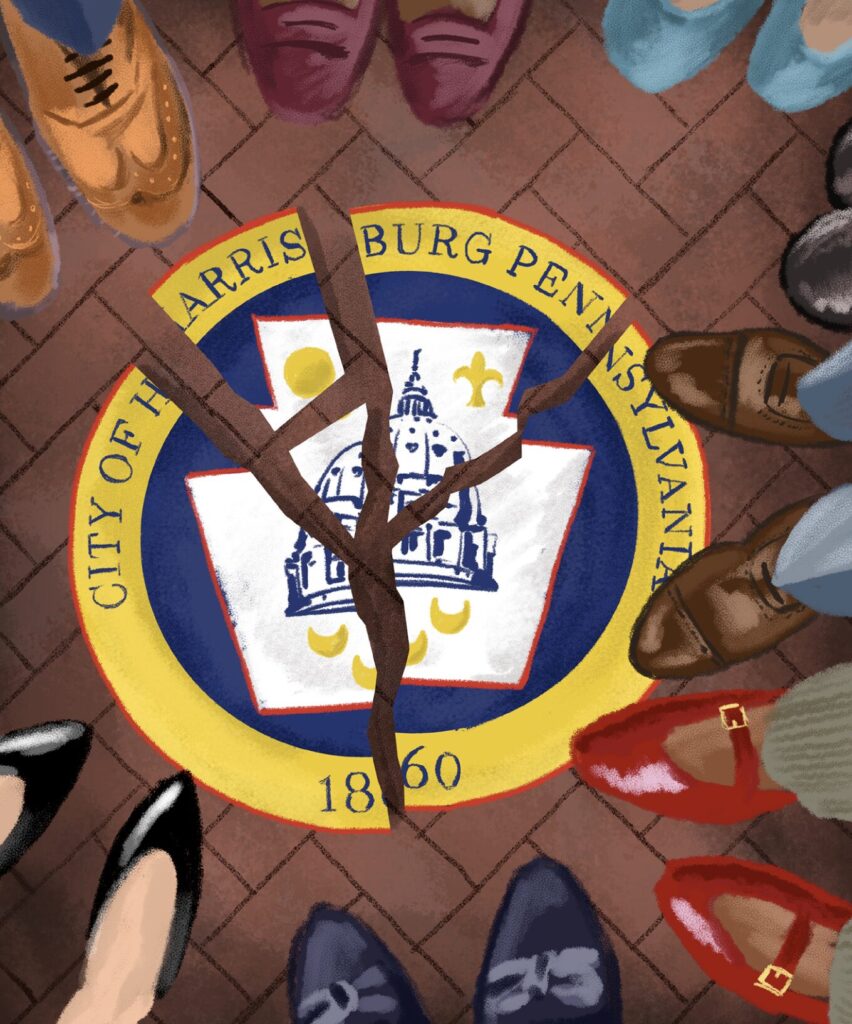
Illustration by Rich Hauck
During her final meeting as City Council president in 2021, Wanda Williams cut herself off, mid-goodbye speech, to keep her tears at bay.
She had been elected Harrisburg mayor the prior November and was about to bang her council gavel for the final time, but first she had some words to share.
“I love each and every one of you,” Williams said to her colleagues. “You are experienced, you’re leaders, you’re workers, you’re compassionate about what you do, and I’m so, so proud of each and every one of you. This is the best council that I think that we’ve ever had in the last 16 years.”
A smiling Danielle Hill, who served alongside Williams, presented her with a gift and plaque on behalf of council.
Four years later and Hill, now council president, said that she has virtually zero communication with Williams, who was recently sworn in for a second term as mayor. She doesn’t even attempt to call or text her anymore because her calls go to voicemail and texts go undelivered, she said. She believes that Williams has blocked her, which the mayor denies.
“I think she mentioned that we should text or email her,” Hill said. “When she served as the council president, I know she didn’t check her email so I’m not really sure how I’m supposed to communicate.”
Williams said she hasn’t blocked Hill and that, in city hall, council members have passed her without saying a word.
A Cycle Repeats
Back in 2021, after a rocky end to the relationship between former Mayor Eric Papenfuse and council, the stage was set for a smoother one under the new Williams administration. After all, Williams had spent years on council, and now her former council colleagues would serve as governing partners.
Despite a decent start—Hill said that she met with Williams weekly at first, though Williams disputes that—the relationship quickly backslid.
According to city Solicitor Neil Grover, history has repeated itself.
“I tell this story again and again. In 1860, we became a city and, in 1861, the very first mayor sued the very first council for who had power to do what,” Grover said. “That has repeated itself 20 and 30 and 40 years apart several times.”
Tensions between the two bodies reached that same point during this year’s budget cycle. Williams has now sued council, after a back-and-forth of budget vetoes and overrides, as council eliminated salaries for several top city officials.
Council defunded the business administrator role, one of the city’s highest posts, saying that the interim director had remained in the position without council’s approval, past the allowed time for a temporary employee. They reduced the salary for the interim director of building and housing development for the same reason.
They also zeroed out the salary for the project director for business administration/LERTA, expressing dissatisfaction with the director’s work, and for the police bureau’s director of community engagement and relations, saying they felt the position was not needed.
For the roles that are unfunded, directors were terminated, and no one can be hired because there’s no money to pay them.
The lawsuit hinges on a disagreement over where the line is drawn between the two bodies’ powers. The mayor said that council crossed into “territory that does not belong to them,” by trying to assume an executive function such as personnel management. Williams called it an “overreach.” However, Hill maintained that council was within its rights by removing funds and didn’t fire anyone. “That is not under our purview,” she said.
“It’s fundamental questions of government,” Grover said. “What is the legislative authority? Where’s the line? What is executive authority? Where’s the line?”
But what is really behind the issue? Why can’t council and the mayor work it out, outside of court?
“Is that what you’d boil the issue down to—the lack of communication?” TheBurg asked Hill.
“I think so, I guess,” she said. “It just saddens me because, when does the cycle end?”
Dependent on Each Other
Going back to the basics, Harrisburg is a third-class city with a mayor-council form of government. Unlike other municipalities that may have a city manager or commissioners, Harrisburg’s mayor is given significant power. Harrisburg has a strong-mayor form of government, as opposed to the weak-mayor model, where the mayor is ceremonial.
Harrisburg first adopted the strong-mayor setup in 1970. Democrat Harold Swenson became the first strong mayor, after the question of changing the governmental structure appeared on the 1969 ballot and was approved by voters, according to newspaper clippings from the time.
While the mayor handles daily operations—hiring, firing, spending, etc.—council is supposed to serve as the fiscal watchdog and legislative body. For example, council approves an annual budget with spending allocations, but the mayor and her staff prepare that budget, spend that money and execute projects. Both the mayor and council can introduce legislation.
Harrisburg may have a system in which the mayor has broad executive authority, but without council on board, her power can face barriers.
According to Grover, the mayor-council system relies on the two branches working together.
“The government cannot run if the branches of government don’t work together. You see that here, you see that everywhere,” Grover said. “That’s how it’s designed. It makes them each dependent on each other.”
Ultimately, the cost of bad blood between council and the mayor lands on the taxpayer’s bill. The two bodies can keep score of wrongdoings, argue over who is at fault or cling to grudges, but in the tug of war, residents are the ones who suffer.
Whether that plays out in stalled city services, costly legal fees or lack of progress, something gets caught in the middle.
“I always tell both branches of government, you need to guard your powers jealously,” Grover said. “People gave them to you. You’ve got to guard them, but then you also have to figure out where the line is.”
The issue now is that both the council president and the mayor blame the other for the problem, and each seems to be waiting for the other to budge.
“It’s not productive, and the people who lose out in this are the residents,” Hill said. “It’s a little time intensive going back and forth, and it doesn’t have to be. If communication improves, perhaps that’s one avenue. But I would like to reiterate that I don’t have a communication issue.”
On the opposite side, Williams said that it’s council that has the issue.
“It’s unfortunate that we cannot collaborate more together. My doors are open […] knock on my door,” Williams told reporters in January.
With the tense council-mayor dynamic recurring through the years, is there another option for Harrisburg?
Outside of officials joining hands, the city could re-evaluate its structure by enacting a “home rule charter,” a complex process that would examine various governmental structures and possibly recommend a new one for residents. It’s something that Grover said has been brought up over the years but hasn’t made it to a vote.
In Harrisburg’s current governmental structure, officials are hopeful that relationship repairs can be made. Both Williams and Hill said as much.
How that will happen, especially with the feud landing in court, and most elected officials at the start or middle of their terms, remains to be seen.
“I’m actually a believer in institutions,” Grover said. “I believe there will be a point where they come together—it’s just how do you do it? I completely believe that will happen. I believe when you force the question, solutions arise.”
If you like what we do, please support our work. Become a Friend of TheBurg!