Illustration by Rich Hauck
“What brought you to this lowly state?”
Over the recent holiday season, I watched “A Christmas Story” for the umpteenth time as, maybe, you did too. If so, you may recognize that quote, muttered by the “old man” during the scene in which Ralphie imagines himself poisoned and blinded by Lifebuoy soap.
Hearing that quote, I thought of—wait for it—Harrisburg. Ridiculous, right?
Except that Harrisburg does find itself in a lowly state, and, from online comments, it seems that lots of folks, maybe newer to the city, don’t understand how we got here. How has downtown, specifically, become riddled with closed businesses and empty storefronts? I thought a quick review was in order.
Gather ‘round, boys and girls, and let me tell you about the 1990s.
Britney Spears was cranking out pop hits, “Y2K” was about to destroy the planet, and, in Harrisburg, “mayor for life” Steve Reed was spending money (as my mother would say) like a drunken sailor.
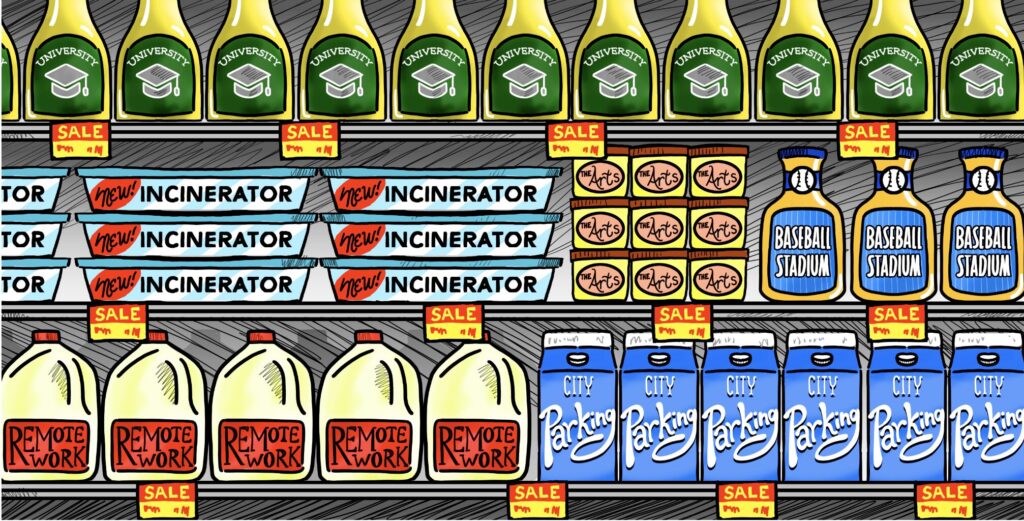
Reed was ambitious, wanting things for Harrisburg found in many other cities: a university, an arts center, museums, a sports hall of fame, a baseball stadium. And he wasn’t about to let the annoying fact that Harrisburg couldn’t afford any of these things get in his way.
At around the same time, the city’s cursed incinerator kept polluting and failing—and polluting and failing. Something needed to be done about that.
So, Reed and his yes-men stumbled upon an “ingenious” solution they thought could kill two birds with one stone. They heard about an experimental technology that, they hoped, would burn trash cleanly, expand capacity and generate electricity. If it worked, the city would dispose of its garbage, get the EPA off its back, and, to boot, pocket some cash, a constant Reed obsession as he pursued his many grandiose, incredibly expensive schemes.
Only it didn’t work—and bad money followed more bad money trying to bang the darn contraption into shape. In a few years, Harrisburg found itself nearly half-a-billion dollars in debt and on the brink of bankruptcy.
In fact, in late 2011, City Council tried to declare municipal bankruptcy but was blocked from doing so by the state legislature, which mandated a receiver instead. A couple years later, the receiver drafted a financial recovery plan that sold off the incinerator and leased the city’s most valuable asset—its parking system—back to the commonwealth for 40 years to pay off Harrisburg’s massive debt.
And that’s how the city lost control of its parking.
So, if you have complaints about the insane rate of street parking, or the insane rate of garage parking, or the insane rate of parking tickets, don’t bother trekking to city hall. They can’t help you. Stroll over to 3rd and State streets, ascend the grand stone staircase and rap on the Capitol’s front door. Those are the guys who control the city’s downtown parking.
Now, to summarize: What brought Harrisburg to this lowly state?
At its core—bad leadership, at the both the state and local levels.
For years, Reed ran amok with the city’s finances and the state, which is supposed to supervise municipal spending, looked the other way. Then, once it all hit the fan, the state prevented the city from declaring bankruptcy and forced it into receivership.
As part of the financial workout, the state took over the city’s parking system, issuing bonds to pay off the city’s creditors. It then hired a parking manager, whose wacko response to weak demand was to keep jacking up rates. Downtown Harrisburg now is one of the most expensive places on earth to park a car, and people have responded by not visiting and not using the system.
But the parking nightmare didn’t end there either.
After the pandemic, the state allowed most of its workforce, most of the time, to work remotely. State employees usually didn’t need to pay for parking, but others did: lobbyists, lawyers, contractors, consultants, caterers, constituents, businesspeople, visitors—each day, tons of people met with and supported the 25,000 or so folks who worked at the Capitol complex. So, in that way, the state sabotaged its own parking regime.
These visitors also supported downtown businesses. They robustly patronized cafés, lunch spots, hotels and restaurants, often not shy about flexing their expense accounts. For Harrisburg’s small downtown, these customers made a huge difference—today, they’re mostly gone.
Meanwhile, back at city hall, leadership is also wanting. We have virtual gridlock because City Council and the mayor are locked in a bizarre, deeply personal cold war. Instead of joining forces and marshalling resources to help solve the city’s problems and revitalize downtown, they’ve essentially stopped communicating, aside from the occasional dig or media taunt.
At long last, the people of Harrisburg need—and deserve—quality leadership from all its elected officials. In recent Harrisburg history, this leadership has been, at turns, irresponsible, negligent, arrogant and profligate, and it’s a major reason why the city, today, finds itself in “this lowly state.”
Lawrance Binda is publisher and editor of TheBurg.
If you like what we do, please support our work. Become a Friend of TheBurg!