 For Sam McKinney, history is his passion.
He throws around words like “dendrochronology” like we use the terms “like” or “as.” The self-employed restoration constructor, who specializes in structures built before 1850, now has reason to celebrate. A project, which has been years in the works, has finally come to fruition.
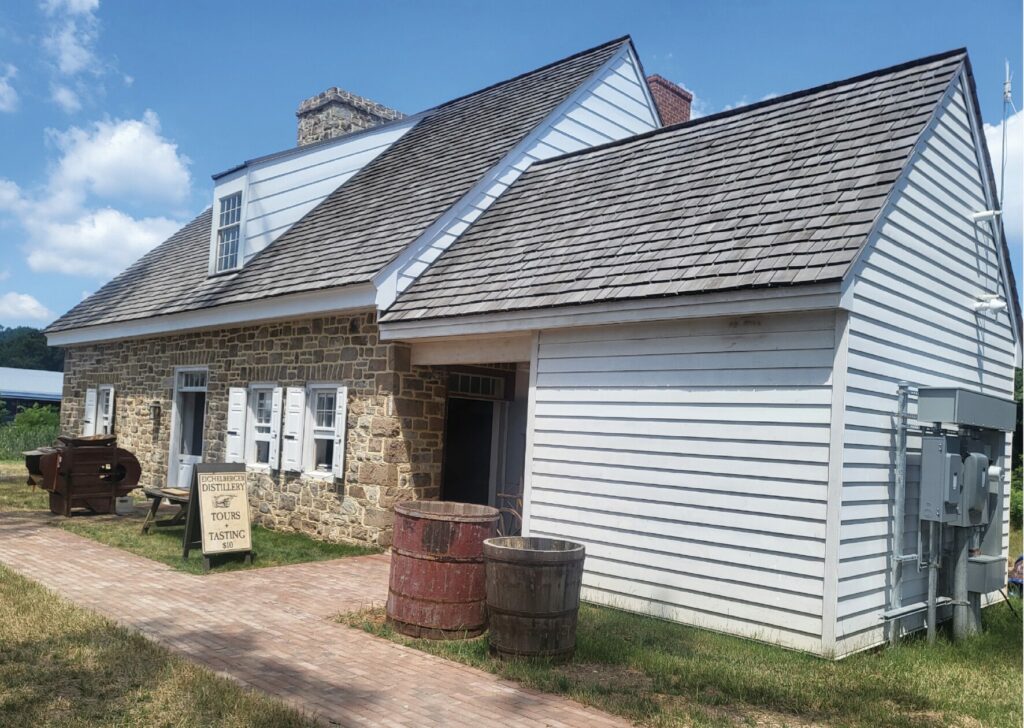
The Eichelberger Distillery on the grounds of Dill’s Tavern in Dillsburg is now open for visitors. McKinney had been working at the Northern York County Historic and Preservation Society (NYCHAPS) site for a decade before proposing the idea to re-create the distillery, with the impetus being a number of handwritten ledgers.
“When an auction for the main tavern building occurred in 1991, the ladies hosting it had an enormous sale with documents, books and maps of Dillsburg,” McKinney said. “In all that stuff were the original ledgers from the site.”
Descendent Bob Eichelberger saw the information, ended up buying the tavern property and later tracked down the person who purchased the ledgers.
“He had to buy them back,” McKinney said.
The distillery tells the tale of two immigrant families who, for three generations, tended to thirsty American settlers. It allows visitors to the historic site to engage their imaginations and picture themselves bellying up to the bar where the conversation once flowed as liberally as the libations.
For a fee, guests today can take part in a tasting to understand what the colonists were throwing back all those years ago.
Murray Small, who narrates the distillery tours, explained that, amid the controversy of the Whiskey Rebellion in western Pennsylvania, the third generation of Dills converted the log tavern to the stately stone one seen today on Baltimore Street in Dillsburg. Small shared historical details during the tours, explaining that one reason the Whiskey Rebellion occurred was because whiskey was often used for bartering.
Visitors who take the tour learn that most towns built a church first, followed by a tavern and, as such, spirits played more of a part in the community than they do today.
Current statistics reveal that the average American drinks 2.83 gallons of alcohol a year, which pales in comparison to the hollow-legged colonists who downed about seven gallons per annum. Hold my beer indeed.
On the tour, guests also lay eyes on the carefully re-created still and discover what the buzz is all about.
Murray explained that volunteers discovered rare, documented plans of an early Pennsylvania distillery featuring wood-fired copper stills encased in a masonry envelope. They studied the plans to create a reproduction that volunteers now use to produce the spirits served in the tasting room, which will later be sold at the distillery.
On the tasting menu there’s whiskey, Fish House Punch and Cherry Bounce, which was a favorite of George Washington, and packs a punch. Research revealed that “Bounce” once meant a “sharp blow,” which explains the moniker. As for the origins of the Fish House Punch name, Small explained that the forefathers would retreat to a clubhouse located along the Schuylkill River to fish and drink, so Fish House Punch, made with dark rum and peach brandy, became the official drink for the club that was frequented by Washington, Franklin and Jefferson.
Prior to the purchase of Dill’s Tavern, the Eichelbergers had been tavern-keepers and wagon-builders, in addition to distillers. These additional assets helped them expand the distillery business and take advantage of the means to transport their spirits to larger markets like Baltimore.
NYCHAP’s vision for the distillery is to use it as an educational and interpretive center to pay homage to the entrepreneurial legacy of its founders, thereby making it as authentic as possible. This includes constructing the roof of hand-planed, overlapping, symmetrical cedar shingles and employing masonry contractor Bruce Trostle to cut stone to 8 inches thick and piece them together like a puzzle onto the front of the building.
To hear McKinney talk, raising money for the distillery was an easy task. Governmental regulations and compliance, however, came with their own sets of challenges.
“Apparently, 18th-century distillery customers couldn’t find the door without an exit sign,” he quipped, when referring to regulatory codes.
For NYCHAPS, hewing to history has been a laborious, but rewarding undertaking. Now, it’s on to the next chapter for the distillery, which includes selling the spirits onsite to help with future NYCHAPS expenditures.
“It has been a long, but rewarding road, and we are looking forward to what the future holds,” McKinney said.
The Eichelberger Distillery is located at Dill’s Tavern, 227 N. Baltimore St., Dillsburg. For more information, visit www.northernyorkhistorical.org/eichelberger-distillery.
If you like what we do, please support our work. Become a Friend of TheBurg!