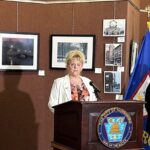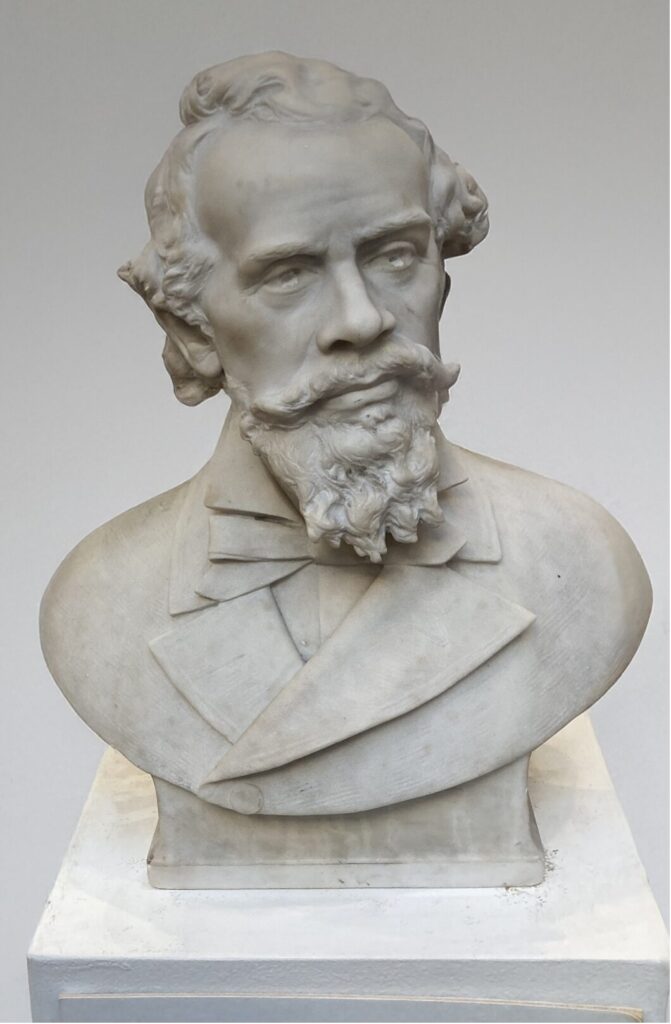
The Commonwealth Monument Project recently gifted this bust of William Howard Day for display in the PA Capitol Complex.
True learning, said William Howard Day, is not the “extent” of memorizing lines from textbooks but the “depth” of knowledge.
“And the depth will never be sounded until the mind of the student can by application weave the thought of the author into thoughts of his own period until the implanted lessons can be deduced—let out—into thoughts which are ours,” Day said at the 1893 dedication of the new Harrisburg Central High School. “That is education.”
William Howard Day channeled his talents, education and skills as teacher, administrator, politician, printer, editor, minister and orator into a life devoted to abolition of slavery, post-Reconstruction equal rights, and schools that equalized society.
Day was nationally known, a colleague of John Brown, Frederick Douglass and Harriet Tubman whose life after the Civil War brought him to Harrisburg. Here, he continued pushing back against the erosion of civil rights while breaking boundaries as the nation’s first Black school board president.
Fighting for Freedom
William Howard Day was born on Oct. 16, 1825, in New York City. Through his activist parents, he encountered veteran abolitionists who saw the talented young Black man “as a prodigy, like he was going to be the chosen one to abolish slavery in the country,” said Todd M. Mealy, author of the Day biography, “Aliened American.”
At age 13, William’s mother sent him to Massachusetts to live with a white newspaper publisher who taught him the printing trade.
“He could be formally educated and given all the best things,” Mealy said. “The best clothing. The best education, whatever he needed, and his mom bought into it.”
He graduated from Oberlin College, taught the children of freedom seekers, conducted on the Underground Railroad, and worked as a printer. A pioneer in Black media, he published the first edition of his newspaper, the Alien American, in Cleveland in 1853.
The 1850 Fugitive Slave Act that jeopardized the freedom of all African Americans launched Day into the movement to establish sanctuary colonies in Canada. In 1859, he departed for Great Britain on a fundraising tour for the Buxton Mission in Ontario.
He stayed in Europe until 1864, “representing the cause of freedom,” in Mealy’s words.
And was he, maybe, also a fugitive from justice for his seditious secret—the act of printing abolitionist John Brown’s “Provisional Constitution?”
“John Brown’s idea was to start a slave revolution, and he asked William Howard Day to print a guideline or constitution, and William Howard Day funded that,” said Harrisburg historian Calobe Jackson, Jr. “In fact, when John Brown raided Harper’s Ferry, William Howard Day was in Europe trying to raise money. Otherwise, he would have been tried in the conspiracy. It was very dangerous. Very dangerous.”
Reconstruction and Jim Crow
William Howard Day was a big-picture man with a can-do spirit. On his 1864 return to the United States, he joined famous African American abolitionists, including Douglass, strategizing for a constitutional ban on slavery.
“The Emancipation Proclamation is not enough,” Mealy said. “If the Civil War ends without a plan, does slavery pick up again?”
During early Reconstruction, Day oversaw schools in Wilmington and Baltimore. As a Pennsylvania Republican Party organizer, he crisscrossed the state to help Black men exercise the suffrage they won in the 15th Amendment—a right still not enshrined in the Pennsylvania Constitution.
In 1873, he took a job in the Pennsylvania auditor general’s office. He bought a house in Harrisburg and made the city his home until his death on Dec. 3, 1900.
Few Americans today understand the tightening vise of Reconstruction and Jim Crow—“slavery by a different name”—that Day resisted, said historian and genealogist Sharonn Williams. Emancipation didn’t equate to freedom, even for Black Americans born in non-slave states.
“Before, they were recognized as ‘free people of color,’” Williams said. “Now, they’re just ‘people of color.’ At some point, they lost things along the way.”
Her grandfather, Williams added, “was an admirer of William Howard Day, and he instilled in me that you are not better than anybody, but you are not less than anybody. You have certain gifts, and you need to share those gifts.”
A Living Voice
In 1877, Day spoke at the dedication of Lincoln Cemetery in Harrisburg, and he would be buried there at his death.
Day’s words—“Our history is not written. It lies upon the soil watered with our blood. Who shall gather it?”—encapsulate the mission of Saving Our Ancestors’ Legacy, the project led by Rachael Williams to preserve the historic Black cemetery.
Day connected the dots needed “to create freedom and abolition, and raising the money, and connecting people, and speaking this truth and telling the history,” Williams said.
She “firmly believes” that Dr. Martin Luther King, Jr.’s “I Have a Dream” speech echoed Day’s 1865 speeches in Washington. In one speech on the White House lawn, he said that the people emerging from bondage were following pathways forged by previous generations.
“The change, socially, may be silent, but on it moves,” he said. “It fills its years.”
Education for All
When the Harrisburg school board president died in 1891, the board turned to one of its members—William Howard Day—to fill out the term.
Day’s experience as an educator and the injustice of Pennsylvania’s legalized school segregation first inspired him to run for what would become six terms on the board.
In 1892, board members praised Day’s intellect and fairness as they reelected him as president. The rare honor emerged from “the combination of who he was and how well respected he was for the work he’d done in the city,” Mealy said.
Accepting his reelection, Day thanked board members for emphasizing that “the accidents of birth or circumstances or matters over which a man can have no control, amount to nothing in considering the interests of the thousands of children committed to your care for tuition and training in the public school—the People’s College.”
After more lofty words, Day listed the work ahead. There were schools to unify, free textbooks to supply, and music instruction to put into classrooms.
Day’s commitment to serving Harrisburg “speaks volumes” about his sacrifices while other civil rights leaders found fame from Washington and New York City, Mealy said.
“One of the things I would argue that makes Day so heroic is the fact that he localized his efforts, which goes against the grain of national popularity,” he said.
Continuing the Legacy
Day’s name lives on in Harrisburg’s W. Howard Day Homes, the William Howard Day Cemetery in Steelton, and since 2015, the Pennsylvania School Boards Association’s William Howard Day Award for outstanding contributions to public education (the indefatigable Day was a PSBA president).
But the Day Homes were founded for Black residents, said Williams. She nurtures the memory of Day’s accomplishments because the places named for him “are the things that are segregated,” she said. “Part of that offends my sensibility because he was an abolitionist.”
On Oct. 16, 2025, Downey Elementary School students sang “Happy Birthday” to celebrate Day’s bicentennial. The school was built to educate the children of Day Homes, and alumna Yvonne Echols-Hollins, a retired educator, is leading the memorialization of Day’s legacy by strengthening ties between the school and the Day Homes, with lessons on Day’s life, inviting Day Homes families to adopt classrooms, and introducing students to successful alumni and memories of the “phenomenal teachers” who encouraged them to achieve.
“A lot of good things came out of Downey School and the William Howard Day projects,” said Echols-Hollins. “We are keeping that legacy alive by doing this and letting the students know where their roots are, because if you do not know where you started, you will have no idea as to how you can get where you’re going.”
Day’s legacy lingers in “his thirst for education” and his prescient advocacy for learning steeped in independent thought, said Jackson. He revolutionized Harrisburg education by leading the construction of the unified high school that he dedicated in 1893, said Jackson.
“The idea was to end segregation,” Jackson said. “Back then, it was a big thing to build a high school. A lot of students dropped out after elementary and junior high school. The boys, especially, could go to work in the steel mills and railroads. In fact, you had to pass an exam to enter high school.”
Day himself reminded Harrisburg school board members that education invited students of all circumstances to enter “the training place for future American citizenship.”
“Climb!” he said. “Climb up the steep ladders, up the winding stairs, through the mist and dark of this hour to the sun-lit plains above you. Are circumstances against you? Cast them off. Are prejudices, grey with age, in your path? With God’s help, breathe upon them the spirit of your achievement, and they will take wings and vanish. Is Poverty walking with you arm in arm? Treat her gently and let her speak for you. But go forward.”
Historic Harrisburg Association celebrates the centennial of Black History Month with historians Calobe Jackson Jr., Barbara Barksdale, and Elizabeth Jefferies who share Harrisburg’s legacy as one of the first communities nationwide to celebrate “Negro History Week” in 1926. Fourth Monday series, 6 p.m. Feb. 23, Historic Harrisburg Resource Center, 1230 N. 3rd St., Harrisburg. Free. www.historicharrisburg.org.
If you like what we do, please support our work. Become a Friend of TheBurg!