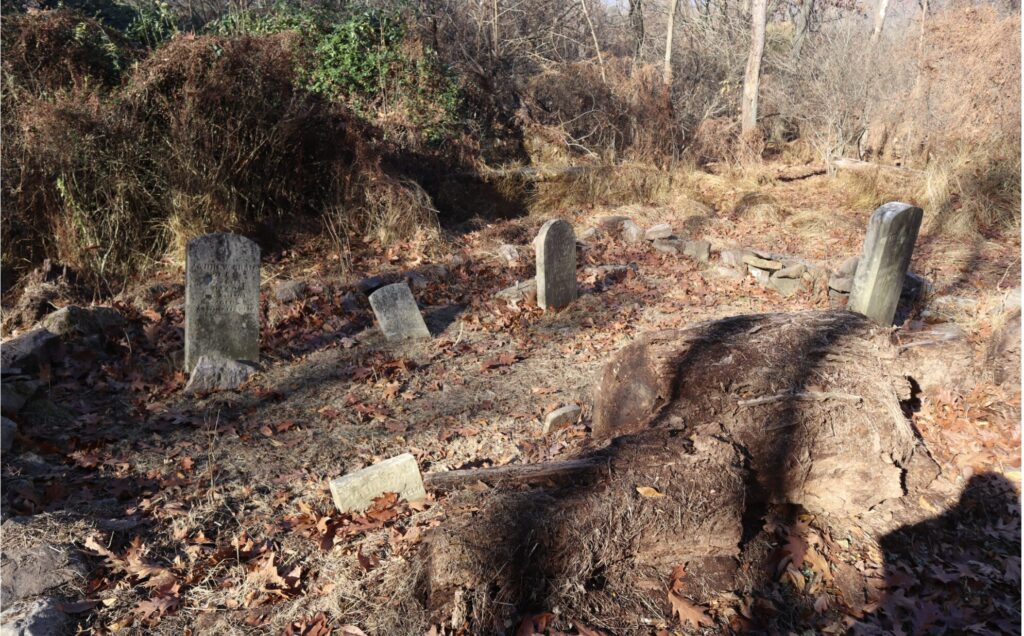
Photos courtesy of Amiya Marbles
Andrew Craig was born into slavery to a family that owned a farm modeled on a southern plantation envisioned by George Washington.
Gaining freedom by law on his 28th birthday but with no money or property, Craig continued working as a free man for the family that had enslaved him.
Through hard labor and persistence, he made a new life, marrying a free Black woman whose family had emigrated from Haiti.
They bought a house not far from the farm where Craig had been enslaved. They would have 11 children, seven of whom lived into adulthood.
Neither Craig nor his wife could read or write, but their children went to school and were educated. Craig accumulated $300 worth of real estate and $200 worth of personal property—earned through backbreaking seasonal farm labor.
Only this wasn’t the Deep South. This was Middle Paxton Township in Dauphin County, where Craig and his wife Rachel Enty Craig purchased their home not far from Fort Hunter, where Craig was enslaved by the family of Archibald McAllister from his birth in 1795 until age 28—the earliest he could be freed under the Pennsylvania Act for the Gradual Abolition of Slavery, signed into law in 1780.
Andrew Craig died in 1863, and his wife Rachel in 1889. They are among the members of the Craig family buried in marked graves in what is known as the Craig Family African American Cemetery, which is east of Fort Hunter and south and east of the McAllister Family Cemetery.
Three other members of the Craig family—two sons and one daughter of Andrew and Rachel Craig—are also believed to be buried in the cemetery, based on obituaries and a July 1912 story in the Reading Eagle, said Dr. Steven B. Burg, a Shippensburg University history professor.
The Craig Family Cemetery is also known—erroneously—as the Fort Hunter African American Cemetery. The cemetery was originally part of the Fort Hunter estate, but, in 1933, land including the cemetery was transferred to the Country Club of Harrisburg by the will of Helen Boas Reily, who died in 1932.
Reily’s decision to transfer the land to the country club “was critical in seeing this site protected over time,” Burg said in a presentation at Fort Hunter on the Craig Family Cemetery in November.
Hike into History
Working with the country club, the task of preserving and protecting the Craig Family Cemetery—and telling and interpreting the stories of those buried there—now is being undertaken by a partnership of three organizations: Dauphin County Library System, the Popel Shaw Center for Race and Ethnicity at Dickinson College, and the International Institute for Peace through Tourism (IIPT).
This goes far beyond the history of the cemetery itself, said the late Lenwood Sloan, an African American historian who was executive director of IIPT and the Commonwealth Monument Project.
“Our story is of the above ground. Who were the people, where did they live, how did they come up out of enslavement, how did they prosper, how did they create other passageways?” said Sloan, who was interviewed shortly before he died in late December. “There’s the underground story of where they died, and then there is the overground story of (how) they lived.”
The cemetery lies in a wooded area so remote that legal access is possible only through guided tours provided by the country club. The club has suspended tours until spring, due to slippery terrain during winter on the trail leading to the cemetery.
Protecting the cemetery is also a concern. The cemetery has been vandalized. Tombstones have been damaged by people shooting bullets into them.
“It’s not an amusement park,” Sloan said. “We do not want to attract people to the site. We want to encourage them to delve into the history of the people who were placed there.”
The cemetery at one time was much more accessible, perhaps a 15-minute walk from the Fort Hunter Mansion.
That changed over time due to the intervention of man-made structures. First, the Pennsylvania Canal was built through Fort Hunter in the 1820s, dividing the property in half. The railroad, now Norfolk Southern, followed and eventually came construction of the old Route 322 highway.
Due to these obstacles, reaching the Craig cemetery now requires a rugged guided trek of at least 45 minutes’ duration—after dismounting a golf cart taking you to the edge of the country club golf course.
The journey includes a foot bridge across a creek, hiking up a mountain, crossing two plateaus, and descending a cliff at a 45-degree angle by hanging onto a rope.
A rock hung from a tree branch serves as a marker, so people don’t get lost on their way back to the country club, said the Rev. Yvette B. Davis, director of the Popel Shaw Center, who has taken the guided tour to the cemetery three times.
Shine a Light
A big part of the partnership’s mission is educating people about the Craig Cemetery without them having to hike there.
A photo exhibit about the cemetery can be found in the Harrisburg Transportation Center at 4th and Chestnut streets. Technology is enabling the partnership to bring the cemetery to the public in other ways.
WHBG-TV 20, Harrisburg’s cable TV channel, has broadcast a video about the Craig Family African American Cemetery entitled, “Under Our Radar,” featuring aerial views of the cemetery using a drone. The video can be seen on YouTube.
Destiny McFalls, a 2025 Dickinson College graduate, has designed and done research for a TikTok series on the cemetery and those buried there, said Davis.
Kelly Summerford, a former Harrisburg City Council member, spoke of using augmented reality as a tool for people to learn about the cemetery without going there. AR allows people to point a smartphone in any direction and view a digital augmentation overlay about any conceivable subject.
Summerford also plans to bring stories of those buried in the Craig Family Cemetery to life through Pennsylvania Past Players, a group of living history interpreters.
In October, the Country Club of Harrisburg started hosting Chautauqua series public lectures on the Craig Family Cemetery. The series continues Feb. 19 with a Chautauqua lecture at the Country Club on Hannah Craig, one of the 11 children of Andrew and Rachel Enty Craig and believed to be buried in the cemetery.
Dauphin County Library System plans to build a collection focused on the cemetery that will be accessible to the public through its eight branches and online resources, said DCLS Executive Director Ryan McCrory.
Much of the renewed interest in the cemetery followed its inclusion on the National Register of Historic Places in November 2024. Being placed on the register can protect a historic site from an imminent threat and qualify the site for tax credits.
But Burg said that the most important thing the National Register does is “shine a light” on places, to show their communities and the country that these are places people care about and that matter.
That has certainly been the case regarding the Craig Family Cemetery, Burg said, which provides a unique look at the legacy of slavery right in our own backyard.
“We often think about Reconstruction as something that happens after the Civil War,” he said. “But right here in Pennsylvania, in the early 19th century, we see the process of reconstruction, of society being restructured, people building new lives and transitioning from slavery to freedom.”
Visit YouTube to view the video, “Under Our Radar: The Craig Family African American Cemetery.”
If you like what we do, please support our work. Become a Friend of TheBurg!