
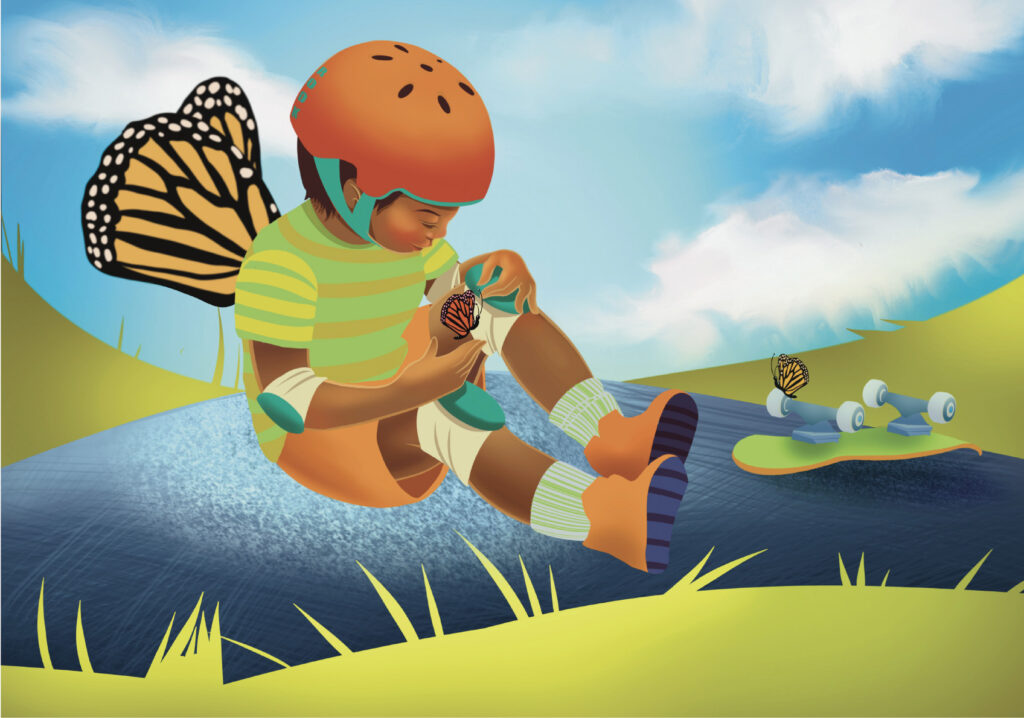
Illustration by Aron Rook
Have you ever heard of the comparison between raising teenagers and butterflies?
When a butterfly emerges from its cocoon, it wriggles, like trying to escape a sleeping bag. Ripping through tender membranes from the inside takes struggle. That struggle allows their wings to grow strong, filling their intricate veins with fortifying blood. Fluid pressure builds, allowing the wings to reach their fullest size, taking shape and solidifying.
Shedding the cocoon is a process that butterflies must do independently. If someone cuts the cocoon to let the butterfly out, blood won’t flow to its wings, and it won’t grow strong enough to fly on its own.
A nun delivered this parenting allegory to an assembly of parents of rising sixth graders. In case the symbology didn’t deliver, Sister spelled it out: “If your child forgets their lunch, don’t leave work to drive fast food to the school office. Don’t do their math homework. Don’t stay up late to paint their solar system planets. Don’t email the teacher and ask for deadline extensions on book reports.” Each example made me shrink more in my seat.
“Your kids will figure things out for themselves. They might succeed, or they might fail,” Sister said. “The best thing you can do is let them handle things either way.”
Nuns are seasoned and wise, but they are not parents. When I researched to find the original author of the butterfly allegory, I found scads of licensed parenting experts and child psychologists using this same comparison. So… origins unknown. Stellar parenting advice, nonetheless.
For solid advice on bridging teenagers into young adults, I interviewed four veteran parents with grown children. All agree that letting kids fail and experience consequences is a necessary rite of passage, both for parents and teens. And most agree with parenting experts that parental oversight should become increasingly less as children grow. (My mother was my first interview volunteer. I delighted in saying, “No,” followed by, “because I said so.” Take that, Boomer.)
Wherever your parenting style lies on the sliding scale between helicopter and laissez-faire, “Most of us raise our kids the way we were raised,” said Harrisburg resident Alan Foster, father of two sons, 31 and 33. Although Foster’s own childhood was not bad, he intentionally made better parenting choices, with a lifelong dedication to “never stop learning.” Like many parents, he balanced between being involved and respecting when his sons needed space, like during failures, dating and heartbreaks.
“Giving space sometimes means being there after they make mistakes, and not gloating by saying, ‘I told you so,’” said Bill Albert, of Camp Hill, who raised a son (44) and a daughter (50). While teaching or helping young adults to find their own balance, you can offer support without enabling. For example, when Albert’s daughter moved into her first apartment and then asked him for rent money, he told her, “You’re welcome to join me for dinner at my house if you’re hungry, but now you need to pay your own bills.”
Time to Fly
There’s no magic age to remove the figurative scaffolding bolstering your children. While the average butterfly cocoons for one to two weeks, some take months or years.
“I believe I gave my daughter too much freedom, expecting her to be responsible for her actions,” Albert said, “Different story with my son. He told me he saw his sister’s mistakes. Our efforts to guide her helped him to take responsibility in his life,” developing a solid work ethic and becoming a safe driver.
If you think about any sibling set, they all grew in the same garden, but turned into different flowers. There’s no guarantee that the seeds you plant will grow the best fruit, but starting your garden on the right foot helps.
As a mother of seven children aged 23 to 33, Michelle Lingle instilled early parenting structures. A real-life Leslie Knope, Lingle presented a united parental front with her husband, formerly my pastor in Harrisburg. They installed time management systems, enforced consistent standards and healthy routines, and used chore charts to teach basic housekeeping. They chaperoned field trips, coached teams, attended holiday concerts, and served as a hub for friends and exchange students.
Depending on the child and the situation, sometimes they helicopter-parented, and sometimes they let off the gas, encouraging kids to advocate for themselves.
“I think there’s a fine line between helping and enabling your children,” Lingle said. “It’s important to meet them where they are, physically, mentally, spiritually. Some of our children had major success with minor helicoptering as they matured. Others not so much . . . they continued to make the same mistakes.”
A technique Lingle used to help her kids solve their own problems was “sounding off.” If they needed to talk about frustrations, parents made themselves available.
“We tried not to fix things for them,” Lingle said. “If they were struggling, we made suggestions. But through the process of listening to them, they often resolved their issues.”
Just before graduating high school, my daughter asked me for a comprehensive list of everything an adult should know. Specifically, what were her knowledge gaps? (In the midst of gathering advice from other parents, I started to wonder, “Where’s MY list, Mom and Dad?”) Resentment aside, I received great advice I hadn’t considered before. Handy tips surfaced, like answering a work phone, inflating a tire, and social media cleanliness (employers do look, Albert reminded). Many commonalities surfaced beyond basic survival skills, like honoring commitments, empathetically respecting others, volunteering/being globally and community-minded, and stepping outside your comfort zone.
A Harrisburg bartender with children 33 and 38 offered these basic parenting reminders, “Let them be kids. Let them be the age they are, but don’t be friends with them,” she said. “And give them unconditional love, no matter what choices they make.”
Parents, I wish you success in your own teenaged butterfly gardens.
If you like what we do, please support our work. Become a Friend of TheBurg!