 When my child was younger, he loved to “garden” by hurtling a chubby handful of bird seed into the backyard of our apartment complex. He liked it so much that I built a raised bed to let his baby hands work in the soil.
Digging in the dirt made him feel useful, and I couldn’t help smiling as he squealed and squelched by my side. The birds got an easy meal, the worms ate their compost, and springtime was merrier for our contribution.
A fascination with dirt continues in our household today. In honor of Earth Day and the splash-able puddles of April, we decided to learn more about mud. To do this, we visited places where mud is prominent, then measured its depth, observed surrounding wildlife, and drew an illustration. Discovering the secrets of soil is easy with proper scientific equipment. We gathered a measuring stick, notebook and pencil in a Happy Meal bucket. Other tools that could elevate your fun are a magnifying glass, thermometer or containers to gather non-living specimens (leave wildlife wild).
To ensure sample diversity, we mapped the following places to gather data:
- Fort Hunter’s Susquehanna River access because it is a large, slow-moving body of water
- Harris Hills Greenbelt access for Asylum Run, which is a small, fast-moving body of water that flows out of Paxton Creek
- Boyd Park Pond, which consists of still water
Digging Deep
On the banks of the Susquehanna River, the mud was slimy and stinky, staining our fingers. We were able to submerge our measuring stick to 2¼ inches. The soil contained colorful pebbles glittering orange, white and green. Rocks can appear as different colors due to varying minerals contained in them. Suggest that your children gather several handfuls of rocks then organize them into color groupings.
Minnows ebbed in schools near the riverbank, snails accomplished slow climbs up rocks, and egrets and herons soared overhead. Wildlife thrives in Susquehanna mud. Intrigued by how the riverbed held our boot prints, we gathered some to see if we could make DIY clay.
At Asylum Run, the mud was smooth and easily worked into a ball when rolled between palms. My kid was thrilled to plunge the measuring stick in 4¾ inches. We observed chickadees and sparrows, but didn’t spot any fish.
Encourage creative thinking by asking questions. Are there animals you don’t see but that you think may live here? Water striders zipped around in circles, so we hypothesized that tadpoles may spring to life soon, since frogs love to eat bugs. This spurred another question: If tadpole eggs are laid here, where do the frogs live during winter, summer?
At Boyd Park Pond, we were surprised to find the mud was tangled up in plant roots, and we were unable to drive our measuring stick in further than an inch. Cattails grew along the bank, which are incredibly fun to dissect, containing fluffy seeds that rely on wind to spread. Ask your little one to think of other plants that use wind to spread their seeds.
Creative Concoction
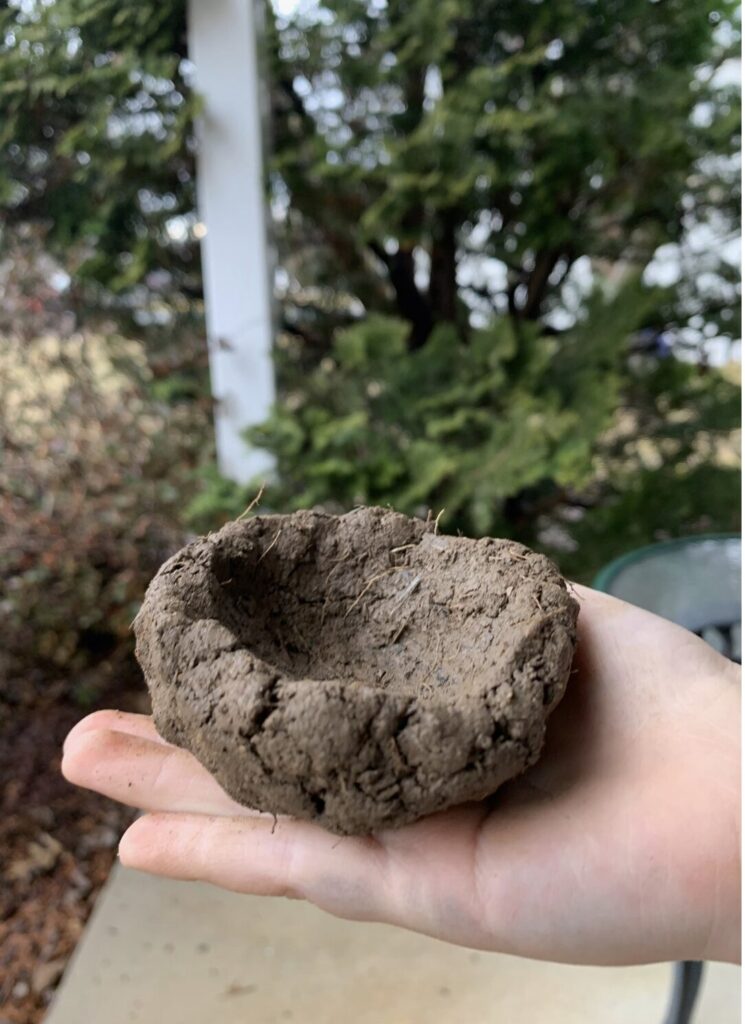
To make DIY clay, you need both time and optimism. The first step is to dilute the mud with water until it becomes a slurry. Let the slurry settle overnight then strain it through a screen into a different bucket to remove impurities. This step left us with a thick, wet piece of mud, which kind of felt like what we started with. Next, let the clarified mud dry on cardboard for about eight hours or until the consistency seems workable—then you are ready to mold! Surprisingly, my kiddo was able to coax a pinch pot from our foraged clay, which we’ll fill with treasures from upcoming adventures until it falls apart.
Let’s Grow
Having learned more about soil, we are excited to grow. We plan to get this summer’s crops at Harrisburg Urban Growers’ Seed Giveaway and Plant Swap on Saturday, April 26 from 10 a.m. to 2 p.m. at Berryhill Community Garden in Harrisburg. HUG is a network of local gardeners and food growers who work to inspire and equip folks to grow their own food in our urban environment. They are an excellent resource for getting involved with the community and educating yourself and your family on gardening. The HUG event encourages registration. Make sure to get your free ticket early as there are only 300 slots available.
April splashed into us, muddling all the sedentary winter gloom and transforming it into something new. Let this month encourage you to look down, get messy, and make time to appreciate the tiny beings we share our world with.
Fort Hunter Mansion and Park is located at 5300 N. Front St., Harrisburg. For more information, visit www.forthunter.org.
Asylum Run, near the old Harrisburg State Hospital, can be accessed by the Capital Area Greenbelt. Find a greenbelt map on their website at www.caga.org.
Boyd Park is located at 2801 Continental Dr., Harrisburg. For more information, visit www.susquehannatwp.com/parks-recreation/bulletins/boyd-park.
For more information on Harrisburg Urban Growers, visit their Facebook page.
If you like what we do, please support our work. Become a Friend of TheBurg!