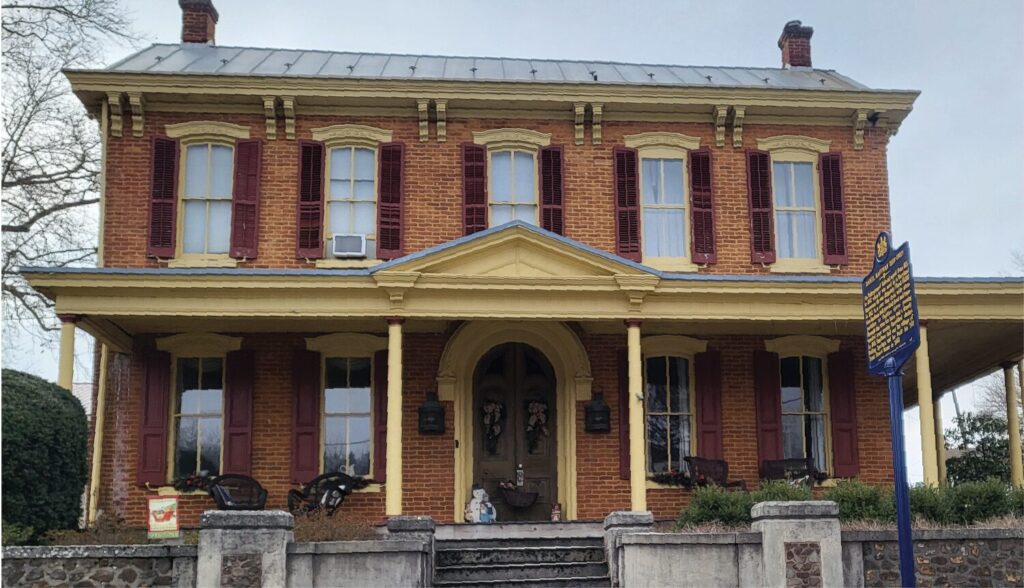
Home of Daniel Kaufman
Boiling Springs is a charming, scenic village that often flies under the radar—unless you’re a hiker, drawn to its location along the Appalachian Trail, or an angler lured by the trout-filled waters of Children’s Lake.
Named for the natural springs that appear to “boil” to the surface, the village holds a significant place in history as a stop on the Underground Railroad. Located along a key escape route from Maryland to Pennsylvania, Boiling Springs provided a haven for freedom seekers, thanks to the efforts of Daniel Kaufman, a local farmer and dedicated abolitionist.
Finding Freedom
In the 19th century, Boiling Springs was home to an iron-making complex, where free Black employees helped shelter freedom seekers.
Kaufman, who lived on a farm near the ironworks, operated an Underground Railroad station at his home and in a dense, wooded area known at the time as Island Grove—that is, until a Maryland slave owner sued him for assisting 13 enslaved people in escaping.
According to historian Matthew March, the significance of the area can’t be understated.
“Stories of the Underground Railroad are often passed down as oral traditions, but the Boiling Springs area is one of the few fully documented sites, partially due to the press coverage surrounding Kaufman’s lawsuit,” he explained.
Because of the unique documentation, the site is recognized by the National Park Service as part of the “National Underground Railroad Network to Freedom.”
“The Underground Railroad was an important network that helped many people escape enslavement and find freedom,” said Dr. Ka’mal McClarin, Network to Freedom program coordinator.
McClarin explained that the historical sites in Boiling Springs and nearby areas are key parts of this chapter in our nation’s history.
To educate visitors about the area’s significance, the Cumberland County Historical Society created a companion brochure in 2013. It takes people on a walking tour of 17 sites located in and around the village.
Trail Stops
March touched upon some of the sites located in the brochure, starting with the Iron Furnace, located across from Children’s Lake.
“This cold-blast furnace was used on the iron plantation, which was one of Cumberland County’s first industrial sites,” he said.
Nearby is the Ironmaster’s Mansion, a stately structure that sits high atop a hill, complete with a “widow’s walk” that allowed the ironmaster to oversee operations. The mansion was built by Michael Ege, ironmaster of the ironworks. Enslaved people labored at both the mansion and the ironworks, and some are said to be buried on the terraces by the lake.
The Kaufman House and Barn is another highlight, although the area is now private property. According to the brochure, Kaufman sheltered freedom seekers at the secluded millrace on his land and the nearby Island Grove.
“Kaufman claimed to have aided at least 60 freedom seekers through his station during the 12 years it was in operation,” March said.
Kaufman’s efforts were eventually discovered by a slave owner from Maryland who hired trackers, men who sought to capture escaped slaves.
“They came right up the Cumberland Valley and to his front door,” said March, adding that people had spotted enslaved people on his property.
In 1847, Kaufman was hauled into court.
“Cumberland County was a Southern-leaning region at the time, and Kaufman was found guilty,” March said. “It was then sent to a federal court, and, two years later, he was fined $5,000, which was a fortune back then.”
Randy Harris of the Lancaster County Historical Society, whose job is in research and community outreach for the future Thaddeus Stevens and Lydia Hamilton Smith Center for History and Democracy, said that the famous abolitionist Thaddeus Stevens, who represented Kaufman in court, left his mark on the entire southeast Pennsylvania region.
“Stevens, who also represented those accused in the uprising in Christiana in 1851, is rarely elevated to the stature of a great American political hero, but he certainly deserves to be,” Harris said.
Today, tourists can see the home at 301 Front St., which ultimately became Daniel Kaufman’s retirement home.
“He built the large, Federal-style house in 1880 where he lived until his death in 1902 at the age of 84,” March said.
March speculated that donations from abolitionists across the country likely made their way to Kaufman to help him recover financially.
“This was one of the first instances of a ‘go fund me’ campaign, with abolitionist newspapers encouraging readers who could spare $5 to send it to the Abolition Society in Philadelphia,” March said.
Today, the 17 stops along the walking tour pay homage to the courage of those who sought freedom and those who helped others achieve it.
“These sites honor those who bravely sought liberty, and they give us a chance to learn from the past,” McClarin said. “The Network to Freedom program supports preserving these sites so future generations can understand and appreciate this shared history.”
For more information on the Boiling Springs Walking Tour, visit the Cumberland County Historical Society, 211 N. Pitt St., Carlisle, or online at www.historicalsociety.com.
If you like what we do, please support our work. Become a Friend of TheBurg!