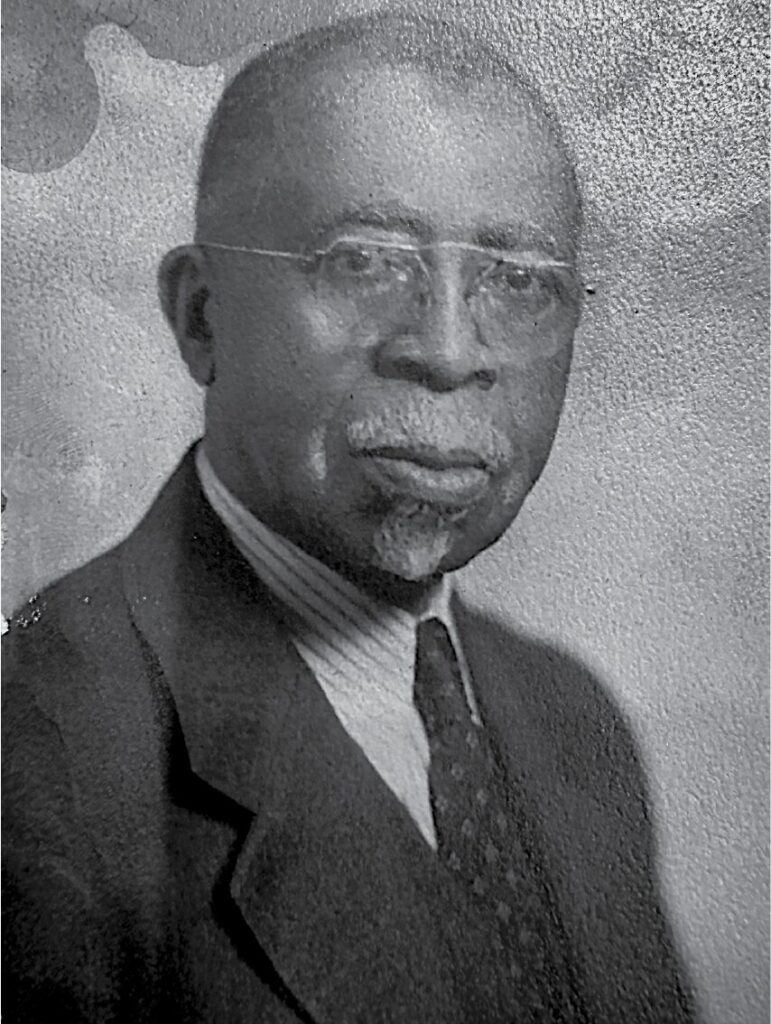
W. Justin Carter. Photo courtesy of Patricia Howard-Chittams.
On a sunny September day in 1897, Harrisburg’s African American leaders led a crowd to a forested spot north of Harrisburg to dedicate two headstones.
One stone memorialized a beloved fugitive slave who built a cabin there. The other capped the grave of an unknown fugitive who took his own life there as his enslaver’s slave catchers neared.
One speaker, W. Justin Carter, focused on the theme of his life’s work—the oppression of the powerful that would, ultimately, yield to the defiance of those leading a “barren life.”
“It is the scorn of sacrilege that has destroyed despotic thrones, encompassed the fall of tyrannic princes, created states and through the countless aggression of power, preserved the privilege of the weak from the rapacities of the strong,” Carter orated.
This is Harrisburg’s W. Justin Carter. Respected but quietly excluded African American attorney. Early leader of the NAACP and fighter against injustice. Secretary to the lieutenant governor and reformer of workers’ compensation. Presidential appointee to the 1911 Universal Races Congress in London.
Even near his death in 1947 at age 80, the indefatigable Carter chaired a rally demanding that the Pennsylvania governor open the Pennsylvania National Guard to Black soldiers.
“His legacy is showing the possibilities that existed in this world in which there didn’t seem to be a lot of possibility,” said Kenneth Mack, Harrisburg native and Harvard University School of Law professor who has researched Carter’s life. “He clearly, from the moment he showed up in Harrisburg, wanted to inspire Black people and wanted to inspire white people to believe that change was possible and that we could be in a better world.”
Starting a Practice
William Justin Carter was born in 1866 in Richmond, Va., to formerly enslaved parents. He graduated from Virginia Normal and Collegiate Institute but, after starting in the prestigious profession of education, switched careers and graduated from Howard University School of Law.
In those days, Southern courtroom etiquette still recognized Black attorneys as “esteemed colleagues,” but the growing clamor by whites to codify the Black race as inferior—somewhat silenced during Carter’s Reconstruction-era childhood—was worming back into society and courthouses, Mack said.
That could explain Carter’s decampment to Harrisburg in 1892. Or maybe someone told him that he could make a living in town. Whatever the reason, he set up practice as the city’s second Black lawyer.
Carter found a more level playing field in Harrisburg—to an extent. In 1904, the Dauphin County Bar Association took a secret membership vote via balls dropped in a box: white for yes, black for no. The five black balls needed to reject Carter’s application, no reason necessary, carried the day.
It took 98 years, after member Francis B. Haas uncovered the incident, for the bar association to reverse the only rejection without cause in its history. The posthumous membership, correcting an “egregious mistake,” attracted national attention.
Here was a man who spoke up in 1922 for a congressional anti-lynching bill, declaring that the nation “has no right to protest against the atrocities committed against other races in foreign countries so long as lynching is permitted within the borders of the United States.”
That courage impressed Patricia Howard-Chittams of Washington, D.C., when she stumbled across her accomplished great-grandfather in “Who’s Who in Black America.”
“He was a civil rights advocate when it wasn’t sexy, when you had very real consequences of not following the status quo, unlike a lot of social-justice warriors today who can stand in front of a video and say whatever they feel without fear of repercussion,” said Howard-Chittams, a nurse practitioner and member of the District of Columbia Board of Nursing. “What he was doing at the turn of the 20th century, it could cost you your life.”
The Fighter
In photos, Carter’s demeanor says “professional,” but in news stories, he gets scrappy. Even with a schedule loaded with orations and travel, he remained a working attorney, taking on the hard, attention-grabbing cases.
He sought new trials for aldermen convicted of conspiracy. Managed to “win” a second-degree murder conviction, as opposed to first-degree, for a Black man charged with shooting a white police officer. Won acquittal of a young girl charged with poisoning her baby. Received a bouquet of flowers from a jury impressed with his successful defense of an Italian man accused of murder.
“He must have been a person with a lot of grit,” Mack said. “You’ve got to be really scrappy and enterprising and self-confident.”
Carter was no fan of saloons, but it didn’t stop him from representing a hotelier, evicted from Harrisburg’s demolished 8th Ward, seeking a liquor license for a new hotel and bar.
“The law has sanctioned this business,” Carter told the judge, “and this client asks his rights under its provisions.”
That establishment would serve Blacks and whites together, relieving Black patrons from closed doors at hotels and the vile, cologne-based concoction of “jigger whiskey” they were usually served in bars. In a contentious hearing, Carter challenged an opponent to defend why, if whites could have their million-dollar Penn-Harris Hotel planned for downtown Harrisburg, “the colored people (shouldn’t) have one costing $3,000.”
Carter’s civil-rights advocacy didn’t pull punches while managing to frame messages in terms that white Americans would understand. Speaking on “The Duty and Responsibility of the Anglo-Saxon Idea of Citizenship” to the white Eureka Literary Society in Penbrook, Carter lauded the Anglo-Saxons’ thousand-year stewardship of freedom and its ideals.
But he didn’t stop there.
“No race has been so domineering, none stronger and with more exclusive spirit of caste,” he continued, and “none more violent in prejudice once formed.” The Anglo-Saxon need for racial hierarchies excluded Blacks and immigrants from the liberty prized by whites, but he still saw the “pearl in the Anglo-Saxon mollusk.”
“If the Republic is true to the great principles of liberty and justice which it proclaims, if you have learned the lesson of your own history, . . . then will Anglo-Saxon genius and achievement glow like a mighty flame to light the path of struggling men,” he said.
Civil Rights Pioneer
In 1905, Atlanta professor W.E.B. DuBois and Boston publisher William Monroe Trotter called for Black men to gather in favor of the radical idea of escaping oppression through political and legal action.
Carter heeded the call, traveling to Ontario, Canada, and joining the 29 co-founders of the Niagara Movement. “We refuse to allow the impression to remain that the Negro-American assents to inferiority, is submissive under oppression and apologetic before insults,” they declared.
“He must have really felt strongly about it to go,” Mack said. “We understand this is history being made, but it’s not obvious to the people at the time.”
The Niagara Movement morphed into an organization driving for social and political change—today’s NAACP, founded as the National Association for the Advancement of Colored People. In its second year, Carter joined its Committee of One Hundred national governing body.
Howard-Chittams believes that Carter would “roll over in his grave” to see that the NAACP that her great-grandfather helped create no longer “holds a mirror to the Black community.” She sees her ancestor “as one who liked to fight the good fight—not fighting for the sake of fighting, but the good fight.”
Few of W. Justin Carter’s orations were transcribed, but we can close with one that was—his words over the graves of two men whose humble lives made powerful statements.
“Take a glowing truth, compress it into the fiber of a fearless heart and let it touch the thrilled nerves of a sensitive soul and the man, thus created, is a daring foe to crime, a maker of epochs and the harbinger of reform,” Carter said. “Eloquence, poetry, drama is potential in every turn of his mighty brow.”
If you like what we do, please support our work. Become a Friend of TheBurg!