



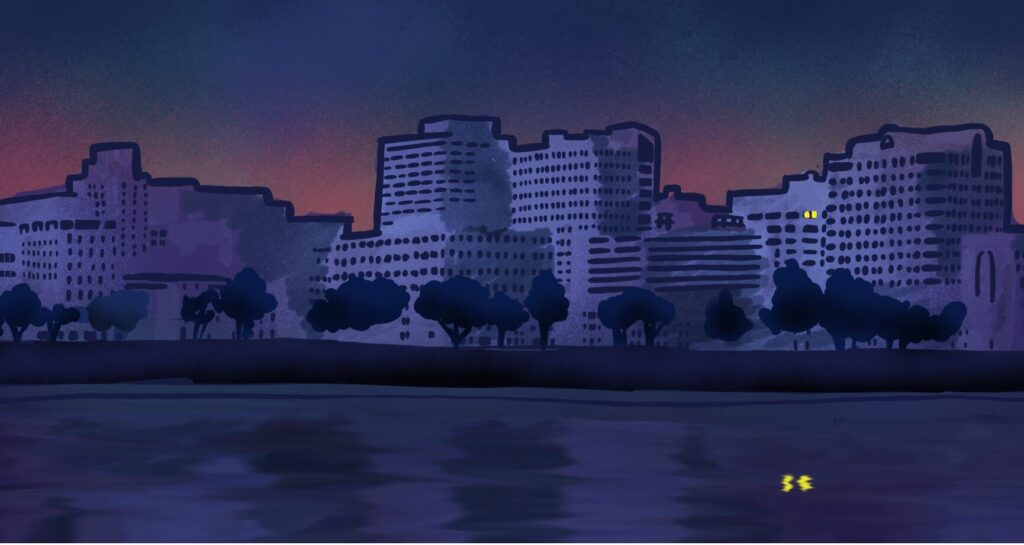
Illustration by Rich Hauck
A few months back, I participated in a focus group on downtown Harrisburg.
Harristown Development organized the study, conducted by the Washington, D.C.-based Urban Land Institute (ULI), as part of an effort to create a new strategic vision for the downtown.
For a day, ULI interviewed dozens of downtown “stakeholders” on what’s right with downtown, what’s wrong, and how problems could be addressed.
The first question went something like, “What challenges do you see for downtown Harrisburg?”
There were four of us in my group, and the person to my right, a real estate guy, spoke first. He responded that the answer was easy. Before the pandemic, tens of thousands of state workers commuted into Harrisburg daily and now, they don’t.
I piped up.
“Case closed,” I said. “We can all go home now.”
Of course, we didn’t go home. We stayed and continued chatting for the next hour, delving into subjects like parking, crime, small business and governmental leadership. Still, we kept looping back to the haunting absence of all those state workers.
For me, the subject of missing people was not a new one. In 2009, when I relocated to Harrisburg from D.C., I was taken aback by the empty streets. On my second day in the city, I took a long walk around downtown and Midtown and felt like the last man on Earth—sort of like a character from one of those old “Twilight Zone” episodes where everyone disappears (I think there were several like that).
In fact, a short time later, when I began this “City View” column, I addressed exactly this topic. The article was entitled, “Harrisburg Needs People.” Well, all these years later, Harrisburg still needs people, though the situation is somewhat changed.
Back then, I felt I could stroll safely down the middle of 3rd Street in Midtown. Not anymore. Today, there’s plenty of both car and foot traffic as Midtown’s commercial district has become increasingly vibrant. I’ve witnessed the dramatic change personally as, from my office desk, I stare out onto 3rd Street all day, every day.
In mid-August, PennLive held its own panel discussion about the state of downtown Harrisburg, and this same point was made—the city’s residential neighborhoods are doing comparatively well. Gloria Vazquez Merrick, the longtime head of the Latino Hispanic American Community Center, shared her assessment of an increasingly bustling Allison Hill.
“We have a lot of restaurants; we have businesses popping up,” she said. “It is vibrant; it’s robust. Then I see Midtown, and Midtown is vibrant, it’s robust. Then sandwiched between we have [downtown] Harrisburg, and it’s very disappointing.”
Indeed, it’s the central business district, essentially an office park starved of workers, that’s suffering most.
So, as we move forward, there should be a singular focus on getting people back into downtown, which long has been the city’s main economic and tax revenue driver. It won’t be easy.
At the PennLive forum, Marshall Snively, president of the nonprofit Lancaster City Alliance, outlined several reasons for his city’s success in revitalizing its now-lively downtown. Among these: community/business/government cooperation, a commitment by major businesses to stay in the city, and a long-term plan, funded by corporate leaders, that was developed and followed.
Harrisburg lacks all these. In fact, I found it ironic that PennLive, which itself left downtown for the suburbs a dozen years ago, hosted this forum. But to be fair, many companies preceded them, and many have followed. The commonwealth, even with its withering workforce, is one of the few major employers left.
Having said that—there is hope for downtown Harrisburg.
Recently, the Harrisburg Chamber & CREDC announced that they would pick up the ball, leading a Lancaster-like effort to formulate a long-term revitalization plan. I’m confident their efforts will result in a thoughtful blueprint, though success ultimately will depend on the dedication and cooperation of stakeholders like the state, the city and what’s left of the business community.
Fortunately, Harrisburg isn’t starting from scratch. As mentioned above, its neighborhoods are arguably healthier than they’ve been in decades, and its assets, such as the stunning state Capitol, the gorgeous waterfront and a growing arts scene, are real and significant. These were brought up both in the PennLive forum and the ULI focus group.
Moreover, Harristown, showing true foresight, already has seeded downtown with some 250 high-quality residential units, with more to come. That’s a solid start towards moving away from the old urban office park and creating a mixed downtown that includes residential, office, recreation, nightlife and tourism.
Like in Lancaster, downtown Harrisburg’s comeback will take many years, much effort and sustained investment. You can’t replace 30,000 missing people overnight, but I am pleased that we’ve finally started a real discussion on how to bring folks back to the historic heart of Pennsylvania’s capital city.
Lawrance Binda is publisher and editor of TheBurg.
If you like what we do, please support our work. Become a Friend of TheBurg!