Tag Archives: Salvation Army

The Salvation Army Harrisburg 13th Annual Shoe Strut

WIN Women INvolved, auxiliary to The Salvation Army Harrisburg, will be hosting its 13th annual Shoe Strut event on Friday, September 20th at 11:00 a.m. at the Hershey Lodge. Join us for Central PA’s largest networking lunch, silent and live auctions. This year there will be NEW fashion and contest elements in addition to the “Best shoes at the table” runway strut. Proceeds from the event provide funding for The Salvation Army Harrisburg’s programs and services to the local community. Also, each ticketed guest enables us to provide a shoe voucher to a local child in need. 700 guests are expected, so reserve your spot before the event sells out!

For sponsorship and ticket information, visit www.shoestrut.com or contact Cindy Minnich at 717-233-6755 ext. 119 or via email at [email protected].

Sponsored

Continue Reading

Celebration of Dreams Honoring Harlem Globetrotter Chris “Handles” Franklin and Anne Deeter Gallaher, “Others Award” Recipient

The Salvation Army Harrisburg’s Annual Spring Event: Celebration of Dreams Honoring Harlem Globetrotter Chris “Handles” Franklin and Anne Deeter Gallaher, “Others Award” Recipient

Thursday, May 2nd, 2024 @ The Hershey Lodge
5:00 PM – Basketball Free-Throw Competition and Arcade Games, Networking, Cash Bar
6:15 PM – Dinner & Program

We will begin the evening with networking, free-throw competition sponsored by Planet Fitness, double-shot arcade basketball games to challenge your friends, and cash bar.

Join us for dinner and a fireside chat with Chris “Handles” Franklin to discover how he reached his dreams to become a Harlem Globetrotter. We will also enjoy a demonstration of his mad basketball skills! Anne Deeter Gallaher will be awarded The Salvation Army’s “Others” Award for the countless ways she has impacted our community through Salvation Army Harrisburg and many other local organizations.

Attire: Business Casual

Tickets and Sponsorships: https://DreamsTSA.givesmart.com

Sponsored Content

Continue Reading

16 apartments headed to Harrisburg, as The Lofts breaks ground in former Salvation Army building

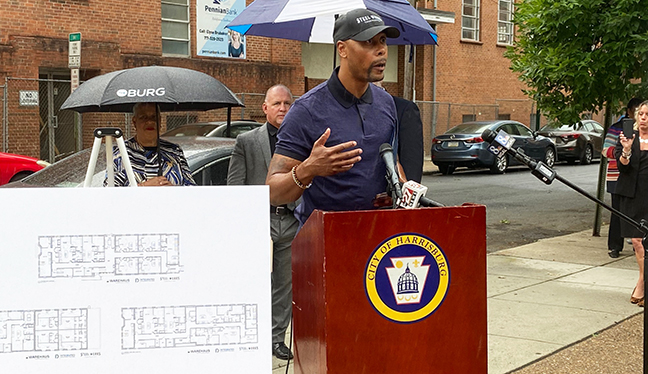
IDP’s Jonathan Bowser and Harrisburg Mayor Wanda Williams flank a rendering of the layout for The Lofts, joined by other IDP officials and Dauphin County commissioners George Hartwick and Chad Saylor.

In a place where folks once played basketball and held meetings, people soon will be eating, sleeping and simply relaxing.

The Lofts officially broke ground on Tuesday in the former Salvation Army building at Green and Cumberland streets in the heart of residential Midtown Harrisburg.

Harrisburg and Dauphin County officials were on hand to ceremonially inaugurate the project, which is being developed by Wormleysburg-based Integrated Development Partners (IDP).

“Today, we’re celebrating what’s to come here at the Lofts of Midtown and what will become a beautiful addition to an already beautiful neighborhood,” said Mayor Wanda Williams. “Each day, the future is getting brighter for the city of Harrisburg, and we’re looking forward to seeing what’s next.”

Since its founding in 2018, IDP has undertaken several area projects, most notably the mixed-use Steel Works revitalization project in Steelton.

The company first proposed the Lofts in December 2020 as a for-sale condominium project, but since has changed the business model to rental units, according to Managing Partner Jonathan Bowser.

IDP officially bought the 18,500-square-foot, mid-century building last year from the Salvation Army, which relocated in late 2019 to a much larger facility on S. 29th Street.

The Lofts project includes 16 one- and two-bedroom units, plus 32 parking spaces located in a surface lot across the street.

IDP’s Jonathan Bowser spoke at the ceremonial groundbreaking on Tuesday.

Bowser said that his company called the project “The Lofts” because several units are being built in the former, multi-story Salvation Army gymnasium.

“Those will be two-story lofts, so we’re very, very excited about that,” he said.

Rents will range from about $850 a month to $1,500 a month based upon numbers of bedrooms and the sizes of units, with several apartments meeting the city’s affordable housing guidelines, Bowser said. Units will range in size from about 700 square feet to 1,200 square feet.

He added that interior demolition recently began in the building, with construction expected to follow in several months. He anticipates occupancy in spring 2023.

On Tuesday, Dauphin County commissioners George Hartwick and Chad Saylor were on hand to issue a proclamation declaring June 14, 2022, the “Lofts of Midtown Day” in the county.

“We want to make sure everyone is aware this level of redevelopment is happening throughout the city of Harrisburg,” Williams said. “It’s an incredibly exciting time to be in the city of Harrisburg. We’re turning blight into bright.”

If you like what we do, please support our work. Become a Friend of TheBurg!

Continue Reading

Pieces of Peace: This spring, take a contemplative stroll along Harrisburg’s new Peace Promenade.

Lenwood Sloan

Lenwood Sloan brought home a peace offering from Hawaii.

Inspired by a conference on global tourism in the Aloha State, he accepted the challenge to take part in the 2018 Global Peace Park Project, with the vision of erecting “peace parks” in all 24 time zones.

In Harrisburg, his idea now spans more than two scenic miles along the east bank of the Susquehanna River. He assembled a “Peace Promenade,” featuring seven existing, but frequently overlooked, monuments, along with the Harrisburg Riverboat, to represent eight pieces of peace.

He hopes that joggers, bikers, power-walkers, festival-goers and motorists moving along Front Street will pause for a moment and consider this pathway of peace. He realizes that far too many passersby never even look up, blinded by haste, jaded by the familiar, or unaware of the significance that inspired the stones.

The promenade is a passion project for Sloan, a self-anointed “catalytic agent” who formerly worked as the city’s arts and culture director and the state’s film commissioner.

When he began, Sloan found that the monuments along the riverfront, tragically, “were foster children.” The city cut the grass around them, but no one took responsibility for them, he said. Worse, few people even knew they existed—even though they may push a stroller or zoom by them in their climate-controlled cars every day.

He was initially “despondent” after several potential supporters declined to help with the project. But he persisted, eventually stitching together what he calls “a crazy quilt” of more than 40 organizations and 200-plus individuals, including state Rep. Patty Kim, the Dauphin County commissioners, local history aficionados and the downtown community.

Riverfront Park, he said, was a natural fit for the park because it already served as a backdrop to so many summertime celebrations on long holiday weekends and is the scene of many 5Ks and family reunions.

“Although we are often a diverse and conflicted community, everyone finds the river as common ground,” Sloan said.

The promenade starts at Market Street and continues to the Peace Pole and Garden, near Emerald Street, built decades ago by the Physicians for Social Responsibility. In the yearlong program, many businesses along 2nd and 3rd streets are offering community conversations as part of the “ground-up movement of coalition-building,” Sloan said, including the Art Association of Harrisburg and the Susquehanna Art Museum.

“This is a passion project by people who are already doing this work, but often in isolation,” he said.

Oasis
The project began last fall with dialogues on the nature of war and peace. After a mid-winter break, it was re-started in late February, as the group honored exemplars of peace, including Homer Floyd, Dr. George Love, K. Leroy Irvis and Dr. and Mrs. John Judson.

The next event in the series will be held later this month to honor the sacrifice of women, Sloan said.

The women’s monument at Front and Clinton streets is the centerpiece of the commemoration.

Erected after World War I, the monument features five women embodying five iconic roles: a mother waving to her military son, a woman in uniform herself, a farm woman holding a rake, a refugee and a Salvation Army nurse.

When the endeavor started, the monument was filled with graffiti and looked like a tombstone, Sloan said.

Former city economic development director Jeb Stuart helped identify cemetery experts who lent advice on how to clean the stone and plate. The Tri-County Federation of Democratic Women and the Harrisburg Keystone Rotary Club adopted the stone, which will be re-dedicated on March 24, and a circular sitting garden will be planted.

Two days later, a civic dialogue will be held with five area residents who will represent the iconic women symbolized on the monument. The Rev. Brenda Alton will moderate the discussion, featuring former York mayor and veteran Kim Bracey; Suzanne Sheaffer, a Gold Star mother; Major Elizabeth Greiner, who will represent the Salvation Army; Tara Bronbeck, who will represent the farmer; and Ho-Thanh Nyguen of the Pennsylvania Immigrant and Refugee Women’s Network.

“Harrisburg is an oasis and safe house for refugee women all over the world,” Sloan said.

On April 9, the group will advance through time to World War II, focusing on the riverfront’s silhouetted Holocaust memorial. Lillian Rappaport of the Jewish Community Center will lead the dialogue for the event, which will be held at the House of Music, Arts & Culture (formerly Harrisburg Midtown Arts Center), which once served as Harrisburg’s Jewish Community Center.

Sloan said that not only was the Jewish population persecuted in the dark days of Hitler, but so were Catholics, the gay and lesbian community and the disabled. So, representatives from the LGBT Center of Central PA and the disabled community will take part in the discussion, too.

Change Agent
Sloan also pointed to the time capsule that sits virtually unnoticed at Front and Locust streets across from St. Stephen’s Episcopal Cathedral.

“People sit and eat their cheeseburger at Memorial Day, Fourth of July and Labor Day and never know it’s there,” Sloan said. “The capsule is a pretty shabby lady right now.”

It holds yearbooks, letters and more, but, because it was assembled in the early 1960s, many voices were left out, he lamented, including the voices of women and people of color.

To release those voices, a Chautauqua, or educational gathering, will take place on May 6 at St. Stephen’s. David Carmichael, the new director of PA State Archives, will be the keynote speaker and facilitator.

“All our events are free,” Sloan said, encouraging all to attend. “Just bring your heart, your spirit, and your will to be a change agent.”

For more information on the Peace Promenade, visit www.dauphincounty.org or email [email protected].

Continue Reading

History & Community: Der Harrisburg Maennerchor marks 150 years of fraternity, service.

Sometimes, you want to go where everybody knows your name. Luckily, you only need to travel to North Street in historic downtown Harrisburg to find it.

“It’s like Harrisburg’s version of Cheers,” said Barry Dobb, president of Der Harrisburg Maennerchor, the city’s oldest fraternal organization that recently celebrated its 150th consecutive year of operation.

The members-only club operates out of a renovated cathedral, its architecture and décor reflecting its history, culture and values. A mahogany staircase leads to a second floor used for private parties, monthly membership meetings and corn hole tournaments. Large, cathedral-style windows line the north wall, inviting in an abundance of natural light and a clear view of the state Capitol.

The main floor consists of a horseshoe-shaped bar and a game room with family-style seating, pool tables and an oversized Jenga. Coats of arms decorate the walls, representing various regions of Germany—a symbolic nod to the club’s beginnings.

Whether a bartender, business owner or government official—the Harrisburg Maennerchor offers fellowship, great prices and a variety of other amenities to its nearly 800 male and female members.

“Three words come to my mind when I think of the place,” said Bryan Robinson, who joined last August, “economical, pleasant and entertaining.”

“As far as I’ve been told,” Dobb added, “it’s been like that since the beginning.”


Same Cause

Der Harrisburg Maennerchor—literally “The Harrisburg Men’s Choir”—formed in 1867, one of many German-American clubs that sprouted up across Pennsylvania in the 19th century to share and preserve a common heritage following mass migration from Europe.

“Each club operates independently, but they all started for the same reason, the same cause,” Dobb said.

Club records indicate meetings were originally held at Eby’s Place, located on Market Street across from the railroad station.

According to the “Encyclopedia of Pennsylvania,” community advocate Eby Byers erected the building in 1862 to care for wounded soldiers during the Civil War. It later evolved into a meeting place for immigrant groups, including the Maennerchor, where men could commune for fellowship and fun.

The club secured its official charter in 1890 and purchased a building at Walnut and River streets, now the location of the McCormick Library. Membership increased, and the club sold the Walnut Street property to the Dauphin County Library System in 1901, buying the cathedral at North and Church streets.

“We’re one of the oldest continuously operating clubs of its kind in the country,” said Dobb. “We’re part of Harrisburg’s history.”

Club activities evolved in response to the changing political climate, yet it remained operational.

“We survived Prohibition,” Dobb said. “Rumor was they used to run booze through the catacombs in the basement.”

Although the Prohibition-era activity is part of many members’ narratives, Dobb emphasized that no records document any unlawful alcohol transport.

In the 1940s, membership declined.

“They began downplaying the German aspect, and that’s when focus shifted to core values, to caring for the community,” Dobb explained.

Later in the 20th century, membership expanded again when women could join. In 1980, the Women’s Auxiliary gained momentum. Dobb said that the group supports the community and the club, selling baked goods at the St. Patrick’s Day Parade and sponsoring various events.

Looking after their community is important.

“Members take care of one another,” Dobb said. “People come for the great prices, the fellowship and the food—and, of course, they enjoy the gambling.”

More than half of the gaming proceeds go to fund the club’s charitable giving. To date, the Maennerchor has donated more than $329,000 to numerous nonprofits, including the American Cancer Society, the Harrisburg Public Schools Foundation and the Salvation Army.

Volunteer committees also organize events and fundraisers throughout the year, celebrating the club’s culture and values. Most recently, it hosted an Oktoberfest that included an outdoor biergarten along Church Street. In November, it held a celebratory dinner to commemorate its 150th anniversary.


Friendly People

Robinson said that the club offers much to members.

Dinner is served five nights a week, along with a weekly Sunday brunch and bloody Mary bar. The private club designation permits alcohol to be served until 3 a.m.

“It can be two or three deep at the bar, and all the tables full on any given night,” said Vice President Georg McLaughlin. “But everyone respects the rules.”

Dobb, McLaughlin and Robinson agreed that the rules are part of the tradition. These include no hats or tank tops for men and no foul language.

“There’s a swear jar the bartender will get out if you forget,” McLaughlin warned.

Long-time member and former manager Paul Baldari also believes the club’s friendly atmosphere stems from a universal respect of its policy. Throughout his 27-year involvement, Baldari has held numerous leadership posts and was instrumental in many changes in the club. He attributes the Maennerchor’s long-term success to one major factor.

“It’s the people—the members and the staff,” he said. “Someone is always willing to step up.”

Baldari is part of the club’s modern history. He has seen business ebb and flow, yet one thing remains consistent.

“It’s always been a nice place to go,” he said, noting that many members often refer to it as Harrisburg’s “best kept secret.”

Dobb pointed out that too much of a secret can be a bad thing.

“When you’re private from everyone, you’re going too far,” he said. “We want people to know what we stand for and what we do.”

Membership expansion continues to be a priority. Robinson said he plans to use social media to increase outreach and share the club’s community events. According to Robinson, new members can expect to find camaraderie in an easygoing atmosphere—one that has been 150 years in the making.

“This is no longer a German club,” Robinson said. “It’s a club for every race and religion—a friendly place for friendly people.”


Der Harrisburg Maennerchor is located at 221 North St., Harrisburg. For more information, visit www.hbgmaennerchor.com or their Facebook page.


Continue Reading

Waiting Game: Contributions withheld from nonprofits, schools in state budget impasse

The Pennsylvania state budget impasse is preventing millions of dollars in corporate contributions from getting to nonprofit groups and schools.

Kathy Anderson-Martin wants the state to pass a budget.

Since the summer, Anderson-Martin, director of philanthropy at the Salvation Army of Harrisburg, has watched weeks turn into months as the state legislature delays approving a budget for the 2017-18 fiscal year, which officially began on July 1.

Lawmakers have already adopted a spending plan but can’t agree on a revenue package. Until they reach consensus, millions of dollars in tax-deductible corporate donations are on hold, too.

That’s because the budget impasse has stalled approvals for the Education Improvement Tax Credit program, which qualifies businesses for tax credits if they donate to scholarship organizations, educational improvement organizations or pre-K scholarship funds.

Local schools and nonprofits, including the Salvation Army, say that the delayed approvals have paralyzed their planning for future programs and scholarships.

“We can’t receive almost $200,000 in gifts because that program is on hold,” said Anderson-Martin.

According to Anderson-Martin, the Salvation Army of Harrisburg uses EITC dollars to fund its summer youth enrichment program. Last year, the program served 400 children, 130 of whom were in their care all day, every day, for nine weeks while their parents worked, she said.

David Smith, communications director at the state Department of Community and Economic Development, said that the EITC allocations will be approved as part of the state’s final budget agreement.

If partisan gridlock delays that agreement any longer, Anderson-Martin says the Salvation Army might have to scale down its summer plans.

“We can’t wait until January to decide what we’re going to do in June,” she said. “We have to start planning how many kids we’ll serve this summer, and, if that money isn’t there, we have to serve fewer children.”

EITC dollars also fund scholarships to private and religious schools across the commonwealth. The Joshua Group, a nonprofit in Allison Hill, relies on EITC funding to provide low-income Harrisburg students with scholarships to local private schools.

Joshua Group director Kirk Hallett criticized lawmakers for using the EITC program as a “political toy,” and said that the delay could limit Joshua Group’s ability to serve more students.

“The immediate impact is fear,” Hallett said. “This is very frustrating to us, that all this politics ends up affecting our kids.”

Mary Anne Bedhar, principal at Bishop McDevitt High School in Harrisburg, said that “everything is on hold” in the school’s scholarship office until the EITC funds are approved.

If the budget impasse continues through the end of the calendar year, it’s possible that businesses will withdraw their applications for tax credits, thereby reducing the total amount of EITC distributions. Bedhar and Hallett said that’s what happened in 2015, the last time the state endured a long-term budget impasse.

Bedhar reported that Bishop McDevitt lost $200,000 in donations that year, the result of fewer businesses applying for tax credits. She said that the school hasn’t fully recovered from the loss.

The Joshua Group lost about $100,000 in scholarships as a result of the 2015 budget impasse, according to Hallett. He and his staff were able to maintain their operations by approaching private donors, but they weren’t able to take on any new students during that period, he said.

Smith said that businesses withdraw EITC applications every year and declined to draw a connection between application withdrawals and the last budget impasse.

Even so, the program has been perennially popular among businesses. Smith said that the DCED expects to maximize the program allocation this year, just as it did last year when the program budget was $125 million.

The EITC program was signed into law in 2001 by former Gov. Tom Ridge. Companies can apply to give a maximum of $750,000 to an eligible educational organization and receive a tax credit equaling 75 percent of their contribution or 90 percent if they pledge contributions for two years.

Democrats and Republicans have supported expansions to EITC since its inception, according to reporting from PennLive. This May, the House voted 166-26 to pass a $100-million-dollar expansion to the EITC program and a similar program called the Opportunity Scholarship Tax Credit.

Critics of EITC say that it promotes school choice, and fear it could lay the groundwork for a school voucher program by directing more students out of public schools.

Hallett, however, doesn’t see the scholarships funded by EITC dollars as a public-versus-private school matter. His organization views education as an anti-poverty program, and he says that jeopardizing its funding will only harm vulnerable students.

“The bottom line is it affected the poor once again,” Hallett said, referring to loss of EITC funding in 2015. “This is me talking on Allison Hill, but, sometimes, I just don’t know what the guys on Capitol Hill don’t get.”

State lawmakers will return to Harrisburg today for a week of negotiations and closed door meetings, according to the AP.

Continue Reading

Keep on Strutting: For Shoe Strut, 2,000 new pairs—and counting.

While many adults probably remember their back-to-school shopping as an anticipated adventure, some area children go without.

In fact, some youngsters may even avoid going to school because they’re ashamed to be seen in worn or unstylish shoes. That’s where Shoe Strut comes in.

On Sept. 22, Salvation Army Harrisburg will sponsor its 6th annual Shoe Strut, a charitable luncheon and footwear fashion show.

But, really, this isn’t about shoes for you. Shoe Strut’s main purpose is providing footwear for needy children. The Salvation Army, in partnership with Boscov’s, provides one pair of shoes on behalf of each Shoe Strut attendee. Additionally, 100 percent of the event’s silent auction proceeds directly benefit the children.

Last year’s Shoe Strut garnered some $65,000 that funded 500 $30 Boscov’s shoe vouchers, with remaining funds put toward other charitable Salvation Army programs. By distributing vouchers instead of actual footwear, delighted youngsters get to shop for shoes of their own choice at Boscov’s, which sells the goods at a discount, according to Kathy Anderson-Martin, Salvation Army Harrisburg’s director of philanthropy.

Not bad for something that started over a pizza.

The genesis of Shoe Strut took place on an otherwise ordinary day in 2012 as the Salvation Army Harrisburg’s women advisory board shared a pizza in the facility’s community room. Between bites, Claudia Williams and friend Lisa Benzie brainstormed fundraising ideas.

“Then Claudia asked, ‘How about shoes?’” Anderson-Martin recalled. “Some of the kids in our youth programs didn’t have a decent pair of shoes, and some of them didn’t go to school because of that.”

That was all it took to set things in motion for the first Shoe Strut, which netted $20,000 in proceeds and attracted 250 attendees. Since then, the event has continued to grow. In 2016, a crowd of 500 flocked to the sold-out show.

Although this year’s tickets were “technically” sold out months ago, organizers said some tickets likely will become available closer to the date of the event.

Since its inception, Shoe Strut has helped to provide more than 2,000 pairs of shoes to young people selected from Salvation Army Harrisburg programs. Most recipients are in late elementary school, middle school or high school. Surplus funds have gone toward Salvation Army Harrisburg summer programs for at-risk youth, meals and basic needs assistance, self-sufficiency programs and even a new freezer for the Salvation Army facility in Midtown.

“It’s helped to fund a lot of things that otherwise wouldn’t have happened,” said Cindy Minnich, Salvation Army Harrisburg’s special events and communications coordinator.

Not surprisingly, Salvation Army Harrisburg has received numerous letters from parents, grandparents and others who are grateful for what their child received from Shoe Strut, and it’s a lot more than just shoes.

“We wish to thank you so very much for the book bag and shoes for our son,” said one letter. “They allowed him to go to school with what he needs, so he can maintain his 4.0 GPA!”

Another letter read, “The shoes and uniforms are a huge blessing! My grandchildren were so excited and eager to start school. It would have been a struggle for me alone. I know I speak for others as well when I say thank you for being there for our community.”

In retrospect, Minnich and Anderson-Martin are proud of all that has sparked from an initial lunchtime brainstorm.

“All in all, this is a pretty amazing story of what a group of woman can accomplish when eating pizza in a basement and sharing good ideas,” Minnich said.

Salvation Army Harrisburg’s 6th annual Shoe Strut takes place Sept. 22 at the Radisson Hotel Harrisburg, 1150 Camp Hill Bypass, Camp Hill. For more information, visit www.shoestrut.com or www.pa.salvationarmy.org/harrisburg-pa.

Author: Phyllis Zimmerman

Continue Reading

Army Maneuver: The Salvation Army has major plans to move and expand, but first it must raise the funds.

Screenshot 2016-09-28 10.55.10The corner of Rudy Road and 29th Street looks rather ragged.
With boarded buildings, forgotten vehicles and trash, it seems to be a place of great, if unrealized, potential. However, there’s hope for this corner of Harrisburg as the Salvation Army has big plans for it.

Recently, the Salvation Army, Harrisburg Capital City Region, began a capital campaign to create an “Oasis of Hope” with a new, 43,000-square-foot building and a 7-acre campus.

The proposed campus, the Salvation Army Service and Worship Center, would give the organization something it lacks at its current Midtown facility on Green Street—the ability to consolidate in one place—whether that’s serving 2,500 area youth, offering breakfast for 100 five days a week or assisting more than 20,000 people a year.

Currently, the Salvation Army uses 20 off-site locations just to run its youth programs. Kathy Anderson-Martin, director of resource development, said that, while the Salvation Army is grateful for access to churches and schools to house its programs, it “limits impact, and it’s hard to take your programs on the road.”

“We spend a lot of time coordinating logistics that wouldn’t be necessary in another space,” added Melissa Snyder, family services administrator.

The summer program, for instance, is located in a church that requires that all of the materials for 150 students be packed away each Friday—so that the space is useable for the church on Sunday—then unpacked again to start the week.

“For us, we will be much more efficient so our staff can be with clients and the people we serve,” said Jenny Gallagher-Blom, director of operations.

The lack of storage, absence of a loading dock, and presence of a small, gated parking lot prevent delivery of large donations of food. Many deliveries end up on the sidewalk for employees to transfer into the building themselves.

This lack of space is especially glaring for the Salvation Army’s annual Christmas gift distribution, when about 10,000 gifts are collected and stored in various areas of the building. They must be moved again if the space is needed for another purpose. Eventually, the gifts are shuttled to the 19th Street Armory, as the current facility lacks sufficient room to hold the event.


Where We Should Be

Besides physical space, the location is another impediment in reaching the community they serve. In recent years, the Midtown neighborhood where they’ve been located for many decades has changed.

“We’re not where we’re supposed to be,” said Anderson-Martin. “We should be near where the most people need us.”

The new location, she said, will better meet the needs of the community and allow for ease of access with a bus route on the property and proximity to local schools. Leaving the Green Street location will impact some local clients, but many of them already travel to get there.

Community leaders have been consulted about the planned move. Debra Cruel, spokesperson for the 29th Street Neighborhood Preservation Committee, said her group communicated the need for a community gathering space and green space.

The project, she said, meets these goals with a multipurpose center for events and acres of concrete transformed into basketball courts, a playground and a nature trail.

“Just as I believe the model for any community transformation, all of the stakeholders should have a voice in what’s happening,” Cruel said. “As far as neighborhood preservation is concerned, we feel very much a part of the entire venture.”


Holistic Solution

The new location also will have plenty of room for such needs as refrigeration, dry goods storage, a loading dock, a gymnasium and suites to house an education wing, nutrition education and family services.

With all of its programs under one roof, the Salvation Army can provide a holistic solution. Children can come to a youth program while their parents attend a nutrition class or self-sufficiency program.

“Increasingly, we are getting beyond that you come in for a bag of food every so often,” said Anderson-Martin. “We want to help you get to the point of self-sufficiency.”

Independence is important to the Salvation Army, as is good stewardship. Its commitment to responsible stewardship will not allow it to incur debt for any project. Instead, it will rely on donations and grants to fund the $9 million venture. Reserve funds allowed for the purchase of the land in May 2015. Demolition of the three structures on the property will begin this fall, but it will need to raise the remaining $5 million needed.

“The timeline [for completion] depends on the money,” said Anderson-Martin.

In partnership with the community, the Salvation Army hopes that, rather than rooms full of storage boxes, it will have rooms full of youth. Rather than a gymnasium used as a food pantry, the gymnasium will be brimming with ball players. And, instead of moving deliveries from curb to cupboard, pallet by pallet, they can spend their time building relationships with neighbors in need.

To learn more about the Salvation Army, Harrisburg Capital City Region, including how to donate to the capital campaign, visit www.pa.salvationarmy.org/harrisburg-pa.

Author: Susan Ryder


Continue Reading

Visual Appeal: Harrisburg’s GK Visual raises its profile with local stories, high production values.

Nate Kresge. Photo by Dani Fresh, www.danifresh.com

Nate Kresge. Photo by Dani Fresh, www.danifresh.com

If you had the opportunity to check out Harrisburg Beer Week this past spring, you may have made it to Midtown Cinema for a screening of the documentary “Brewed in the Burg.” The one-hour film takes a look at the local craft beer industry in and around Harrisburg.

“Brewed in the Burg” was produced by GK Visual, a “boutique” cinema production house that has been operating for a decade in Harrisburg. Although it created a lot of buzz for the company, the feature film, made in collaboration with SaraBozich.com, really was just a side project.

“We found it interesting to explore the local craft scene,” said co-owner Nate Kresge. “In the film, you’ll see Sara Bozich not only interviewing the professional brewers, but also talking to home brewers, restaurant owners, beer distributors and, of course, the people who drink the beer.”

The company makes its real living creating video and photographic art for political, corporate and non-profit clients, earning more than 60 industry awards along the way. GK Visual has produced television commercials for political candidates and corporations like Penn National Insurance and web videos for non-profits such as Whitaker Center and the Salvation Army.

“Every day is a little different,” said Kresge, who, this year, was selected as a recipient of Central Penn Business Journal’s “Forty Under 40,” which honors young business leaders. “You never know what project you are going to be working on or who is going to walk into the door.”

Talented and Creative
Kresge began his career at Pennsylvania Cable Network and has always been heavily involved in politics, a perfect fit for a Harrisburg-based outfit. When he started the company, the bulk of his work was for political campaigns.

“Little by little, we have added corporate clients to the point where we now are doing more corporate work,” he said. “Next year, when we get into House and Senate races, the political work will really gear back up and take a lot of our time.”

Two years ago, Kresge took on a partner, Doug Metz, and, since then, has hired two additional staff members—Nick Chohany and Sean Purcell. They also work with freelancers.

“Everybody kind of has their own role,” said Kresge. “The nice thing is that everyone is just incredibly talented and creative and, if one of us doesn’t have the ideas to give a client, someone else always does.”

The company’s focus on storytelling follows a trend in marketing to seek out more meaningful ways to engage viewers.

“I think a lot of people are tired of the glossy sell,” he said. “Our videos are very professional and look great, but they’re made without a lot of flashy effects. So, often, I’m just looking for raw emotion.”

The Best Stories
Kresge says that clients come to see him with projects in all stages of development, from barely fleshed out concepts to fully written scripts. He and his staff love to try to help them figure out what they are trying to communicate and who the audience is.

“The biggest thing we’ve found is that it’s more effective to film the people who know the story. We rarely use actors,” he said. “So, we get them on camera, and we’ll just sit down and interview them. Then we’ll kind of chop that up and weave it back together to find what that narrative is. We look for what’s going to appeal to a client or somebody landing on your website for the first time.”

Besides “Brewed in the Burg,” another side project that has gotten GK Visual attention is “What’s on Tap with Sara Bozich,” a Web series focused on highlighting community leaders. Although the series is now in redevelopment, it featured a more informal interview style, with Bozich and her guest often relaxing with a cup of coffee or a pint of beer.

“The goal was to try to film a less guarded, less TV news-style interview,” said Kresge. “I feel this is how we were able to get the best stories.”

GK Visual didn’t receive any pay for either “Brewed in the Burg” or “What’s on Tap with Sara Bozich,” but Kresge says that’s OK.

“To be honest we don’t do much advertising, but we find, when we do these fun projects, people really latch on to them and enjoy them,” he said. “It seems to bring in much more work for us than if I had put our own TV commercial out somewhere.”

For more information about GK Visual, visit www.gk-visual.com. “Brewed in the Burg” will screen next on Sept. 21 at Tellus360 in Lancaster.

Continue Reading