Tag Archives: Philadelphia

PA Farm Show butter sculpture takes us back to nation’s founding

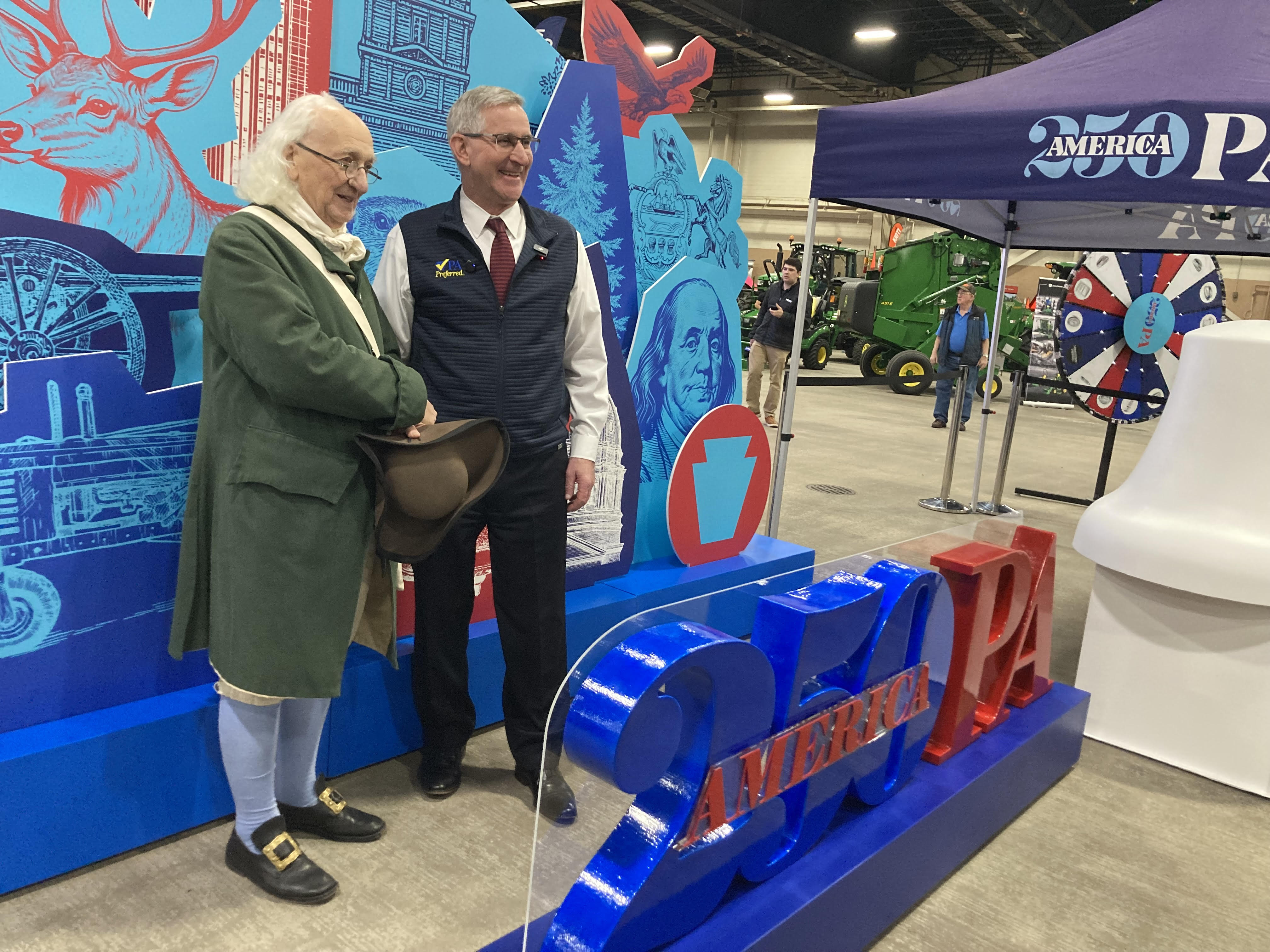
The Declaration of Independence, the Liberty Bell, founding fathers and Betsy Ross are featured in the PA Farm Show’s 2026 butter sculpture.

State officials and dairy industry leaders unveiled the 2026 PA Farm Show’s butter sculpture on Thursday.

The 1,000-pound sculpture shows a scene from 1776 Philadelphia with several founding fathers—including Benjamin Franklin— signing the Declaration of Independence, the Liberty Bell and Betsy Ross holding an American Flag.

The sculpture was created by husband-and-wife team Jim Victor and Marie Pelton of Montgomery County with butter donated by the Land O’Lakes plant in Carlisle. It celebrates the Farm Show’s 2026 theme, “Growing a Nation,” which honors the Keystone State’s influence on the United States.

“Philadelphia was at the very, very center of our national interest in science and agriculture,” Department of Agriculture secretary Russell Redding explained Thursday. “Our farms led the cities and sustained the Continental Army, powered the industry and built the strong rural communities that continue to anchor our economy.”

The Farm Show theme frames Pennsylvania as an agricultural powerhouse, tracing its legacy back to the nation’s founding.

The PA Farm Show, which runs from Jan. 10 to 17, will also serve as the official kickoff event of America250PA, which counts down to the 250th birthday of the United States on July 4, 2026.

In honor of America250PA, the PA Dairymen’s Association will offer red, white and blue milkshake flights in strawberry, vanilla and blue raspberry flavors. The Farm Show food court will be open to the public on Friday, Jan. 9 from noon to 3 p.m., ahead of the weeklong event.

The Farm Show is the nation’s largest indoor agricultural exposition. It spans 1 million square feet, hosts 6,000 animals and boasts more than 12,000 competitive and 250 commercial exhibits.

“It invites every visitor to connect more people with the products and the places that make agriculture thrive,” said Redding.

Department of Agriculture secretary Russell Redding with a Benjamin Franklin reenactor.

To learn more about the PA Farm Show, visit this website

If you like what we do, please support our work. Become a Friend of TheBurg!

Continue Reading

Which Pro Sports Teams in Philadelphia Have the Best Chance of Winning Pennsylvania’s Next Championships?

The Philadelphia Eagles will enter the 2025 NFL regular season as the defending Super Bowl champs. But are they the pro sports team in Pennsylvania most likely to win the state’s next coveted title?

This is a question we have endeavored to answer. And we will be using odds from the best Pennsylvania sports betting apps to rank the championship chances of the state’s five main pro teams: The Eagles (NFL), Philadelphia Phillies (MLB), Philadelphia 76ers (NBA), Philadelphia Flyers (NHL) and the Philadelphia Union (MLS)

For reference, we will be working with the lines for the currently ongoing seasons in Major League Soccer and Major League Baseball. Meanwhile, for the Eagles, Sixers and Flyers, we will be using the odds to win it all for the upcoming regular seasons, which will tip off in September (Eagles) and October (Sixers, Flyers) of this year. 


Philadelphia Eagles (+750)

Given the parity in the NFL, this is actually an impressive feat by the Eagles. They are not the team most favored to win the Super Bowl. That honor belongs to the Baltimore Ravens (+650). But they remain the favorites to emerge from a wildly shallow NFC conference, and they are also the third-most favored team overall, trailing only Baltimore and the Buffalo Bills (+700).

Of course, while Philly benefits from playing in the NFL’s weaker conference, this isn’t the only reason the reigning champs are receiving so much public action. They also happen to be just flat-out great.

In fact, ESPN’s NFL staff writers recently ranked the Eagles as having the second-best rotation in the entire league. Their case is rather obvious, too.

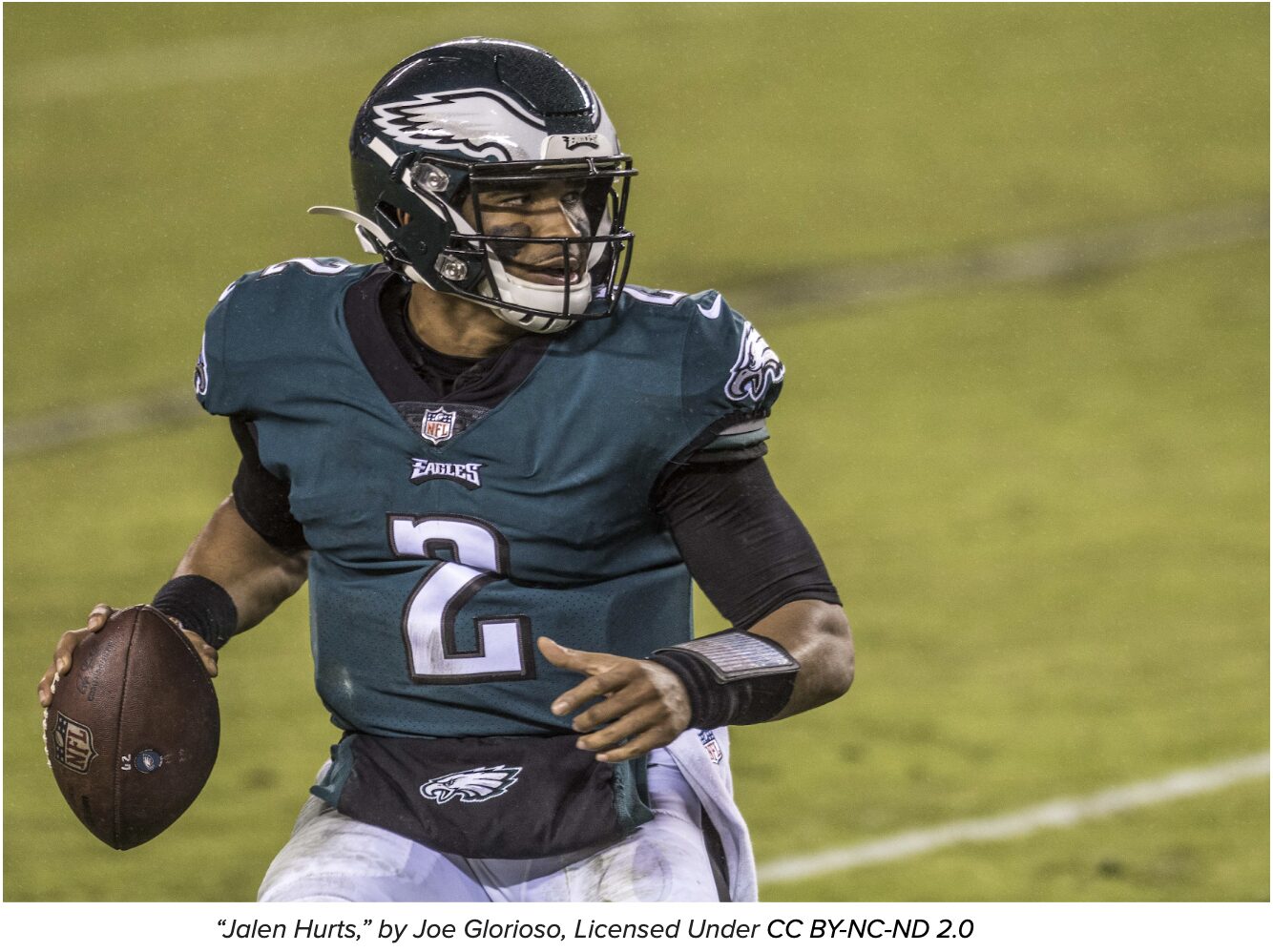
Philadelphia is returning a lion’s share of their most important defenders, continue to have Jalen Hurts to soak up QB1 duties and still employ an offensive tackle carousel that’s the envy of the rest of the planet. 

It is nevertheless a little shocking to see them with such a comfortable lead on the top spot among Philly’s pro sports squads. Then again, this is the type of bump you get when you have made three Super Bowls, winning two of them, in the span of less than a decade.

  • Philadelphia Union (+850)

Though the Philadelphia Union are among the pro franchises to have never won an MLS Cup, that could change in the near term.

Sure, oddsmakers continue to give advantages to Inter Miami CF (+410) and FC Cincinnati (+700), but the Union are right there. Entering August, in fact, they have Major League Soccer’s largest goal differential, thanks in large part to the scoring exploits of Tai Baribo and an otherwise evenly distributed offensive attack. 

It does appear that the lack of a second go-to goal-getter holds them back in the championship pecking order, but despite what the odds might say about Inter Miami CF, it’s tough to find a squad more equipped to win The Cup, aside from perhaps FC Cincinnati.

  • Philadelphia Phillies (+950)

A third straight 90-win regular season appears to be in the cards for the Phillies. And with it will come their fourth consecutive cameo in the MLB playoffs, giving this era ownership over the second-longest postseason streak in franchise history.

While many have expressed concern over some of the Phillies’ offensive vitals, they have the fourth highest on-base percentage in all of baseball. Plus, when you have a pitching rotation as dominant as theirs from start to finish, you don’t need to overwhelm the competition from the more glamorous side of the plate. 

The proof is MLB’s World Series odds. A 9.5-to-1 shot at bagging the title may not seem like much, but as things currently stand, the New York Mets (+900) and Los Angeles Dodgers (+220) are the only clubs laying better odds to win it all.

  • Philadelphia 76ers (+3600)

Depending on how healthy they are, the Sixers can look like the absolute favorites to win an NBA title—not to mention the next pro sports championship for the state of Pennsylvania. The problem is, they’re seldom healthy.

Superstar Joel Embiid is among the biggest question marks in NBA history. A recent profile shed light into his on- and off-court struggles, but it did little to assuage fears that he’ll never be healthy for a full-tilt playoff run.

Even so, the upside here is obvious. Embiid already has an MVP award and is one of the most dominant per-minute players in league history. If the supporting cast of Tyrese Maxey, V.J. Edgecombe, Paul George, Kelly Oubre Jr., Quentin Grimes (assuming he re-signs) and Jared McCain are both healthy and playing at the peak of their powers, you’d be hard-pressed to find more than one or two teams in the entire NBA more likely to win the next title.

And yet, because of injuries, the Sixers find themselves with the 13th-best NBA Finals odds overall, and in second-to-last place on the “Who will win Pennsylvania’s next pro title?” scale.  

  • Philadelphia Flyers (+12000)

The Flyers comfortably settle into last place for this exercise. Five consecutive seasons finishing under .500 have clearly taken their toll. 

It isn’t clear whether the Flyers have added enough talent coming off a nondescript 33-39 season in 2024-25 to rework perception of their product. Bringing in Trevor Zegras and Christian Dvorak will be a spark to the top and middle of the rotation, but this team badly needed a goaltending upgrade, and landing on Dan Vladar is not the type of answer that inspires many feel-good vibes.

If everything breaks right for the Flyers, they could win 10 more games than this past year. Yet, that’s not nearly enough to give them much Stanley Cup equity. 

Sponsored Content

Continue Reading

Chestnut Hill Charm: Take a weekend to explore Philly’s hidden gem

Chestnut Hill Hotel

Nestled on the northwestern edge of Philadelphia, Chestnut Hill offers a respite from the everyday hustle and bustle. With its cobblestone streets, cozy cafes, lush gardens, bountiful boutiques and burgeoning arts scene, this walkable neighborhood is tailor made for a weekend getaway from the Harrisburg area.

Germantown Bound

To explore the area on foot, Germantown Avenue is the place to start. The Chestnut Hill Hotel, located at 8229 Germantown Ave., offers a central location and the convenience of a large, free parking lot. It’s an ideal basecamp for daily strolls to the many shops and restaurants in the area.

 The Woodmere Art Museum is also on Germantown Avenue. Housed in a historic building that once belonged to avid art collector and founder Charles Knox Smith, the museum touts some 8,000 works, showcasing the talents of the many artists who call Philadelphia home. A highlight with ties to Harrisburg is an exhibit by Violet Oakley, who is known for her 43 murals that festoon the walls of the state Capitol.

Outdoors, visitors can explore the museum’s growing sculpture collection known collectively as Woodmere’s Outdoor Wonder (WOW). Guests can scan QR codes to learn more about each piece.

The Woodmere is among the elite 3% of U.S. museums accredited by the American Alliance of Museums, a recognition of its commitment to excellence. Recently, it announced the acquisition of a nearby building and four additional acres for expanded gallery space and outdoor exhibits with a projected opening by October/November.


Flora & Fauna

Nature lovers will love the Morris Arboretum and Gardens, a 92-acre oasis that’s part of the University of Pennsylvania. The private estate of siblings John and Lydia Morris, the property was transformed from desolate land in the late 1800s into a verdant landscape with plants from around the world. It became a public arboretum in 1933 after Lydia’s passing.

Home to 17 “champion” trees—recognized as outstanding specimens in Pennsylvania—the grounds include a rare katsura tree and a grove of dawn redwoods once thought extinct.

Designed with inspiration from English parks and Japanese gardens, the arboretum features a lovely swan pond and scenic overlooks. Morris also hosts educational programs for kids and adults on art, wellness, botany, birding and more.

Another natural retreat is Wissahickon Valley Park, located at 120 Northwestern Ave. With 50 miles of trails, the 1,800-acre park is perfect for picnicking, walking, biking and wildlife watching.  On any given day, one is likely to see wildflowers, deer and perhaps the occasional fox.


Shop Talk

Germantown Avenue is home to many boutique shops, each offering something unique.

At the Antique Gallery at 8523 Germantown Ave., you’re likely to meet Gerald Schultz, a man with a passion for the decorative arts. Schultz established the business in the 1980s and enjoys offering information about his many interesting and beautiful pieces. During my visit, he introduced me to a striking, Art Deco-style Longwy service in earthenware cloisonné enamel. I learned that Longwy is a French town known for its enameling techniques.

Art enthusiasts will also enjoy browsing the street’s many galleries—there are at least seven along the avenue. A few works that caught my eye were pieces by Peter Max and Romero Britto displayed at Moondance Farm Studios.


Food & Drink

No trip to Chestnut Hill is complete without a visit to McNally’s Tavern at 8634 Germantown Ave. McNally’s is an institution in the area, dating back to 1921 when Rose O’Brien McNally, wife of a trolley conductor, opened “McNally’s Quick Lunch” in a small steel building across from its current location. It was a respite for Philadelphia Rapid Transit workers and local laborers.

In 1927, the tavern expanded to where it is today, serving spirits and beer after the repeal of Prohibition. The landmark, now run by Anne and Meg McNally, is a testament to their great-grandmother’s legacy.  McNally’s is known for its signature Schmitter sandwich made with steak, cheese, fried onions, tomatoes, cooked salami and “Schmitter sauce,” served on a kaiser roll.

Adelinas Restaurant & Bar is another standout located on Germantown Avenue. The Italian eatery opened in 2022 by brothers Antonio and Giuliano Presta and is named after their grandmother. The menu features traditional Italian fare made with locally sourced ingredients. Popular dishes include stuffed focaccia, chicken parmesan and a porterhouse topped with black truffle butter.

After dinner, visitors can enjoy a nightcap at Char & Stave, located at 8441 Germantown Ave. The coffeehouse/cocktail bar hybrid was founded by Jared Adkins, who applied his whisky-making talent to the art of coffee roasting.

Then there’s Wednesday night trivia at the Chestnut Hill Brewing Co. Held in the beer garden, the game allows customers to engage in a friendly competition for a chance to win a gift card.

For breakfast, head to Cake, a place so popular that people queue up early to wait in line for employees to open the place. The bright, airy eatery housed in a converted Victorian greenhouse is known for its baked goods and its brioche French toast with honey butter and spiced pecans. Hearty lunch options include options like Philly cheesesteak marsala.

Whether you’re wandering through fragrant gardens, admiring local art, savoring a Schmitter at a historic tavern or browsing boutique shops, Chestnut Hill offers a blend of culture, history and natural beauty. You may find it to be the perfect weekend escape.

If you like what we do, please support our work. Become a Friend of TheBurg!  

Continue Reading

Mural Mecca: How Philadelphia became “mural capital of the world.”

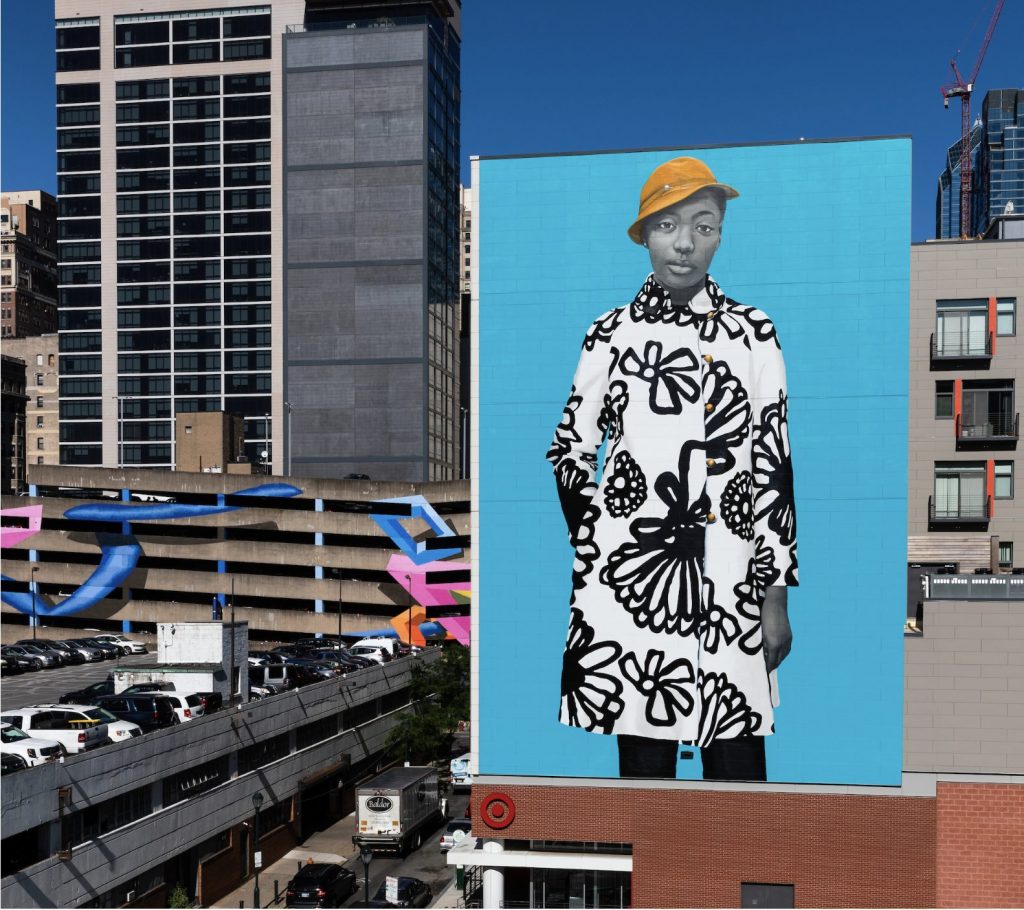
“Untitled” by Amy Sherald. Image courtesy of Mural Arts Philadelphia.

Chances are, when you think about Philadelphia, certain icons come to mind: Independence Hall and the Liberty Bell, soft pretzels and cheesesteaks. You may even hear a strain of the theme song from “Rocky.”

But there’s one more colorful symbol to add to the list: murals. The organization Mural Arts Philadelphia is considered the nation’s largest public art program, credited with creating the world’s biggest outdoor art gallery—with a tally over 4,000.

“It’s a visual treat to come into the city and see the diversity of the City of Brotherly Love reflected back,” said Chad Eric Smith, Mural Arts’ director of communications.

Just 100 miles from Harrisburg, Philly’s murals brighten every corner of the city, ranging from beautiful butterflies, scattered alphabet letters for children to discover, tributes to Philly’s sports teams and stunning abstract murals. In Center City, a soaring 22-story mural by the artist MOMO showcases his methodology for creating abstract design, using practical geometry.


Murals with a Message

There are even murals in nontraditional or unexpected places.

“A Love Letter for You: Brick Valentines on the Philly Skyline” is a series of 50 rooftop murals best seen by elevated train. Created as a collective, giant love letter, the murals’ words are not only from a guy to a girl, but from an artist to his beloved hometown. That artist is Philadelphia native Steve Powers, who also created one of Harrisburg’s murals.

Many murals honor famous Philadelphians: Julius “Dr. J” Irving, Smokin’ Joe Frazier, John Coltrane, Kevin Hart, Frankie Avalon, The Roots. Others are dedicated to causes: veterans’ issues, the impact of incarceration, the vital nursing profession and the soaring youth suicide rate.

Smith led me to a Center City underpass where two “Point of Triangulation” murals depict nine previously incarcerated people. To our right, under the words, “Once Stigmatized,” men and women are painted in plain prison garb. To our left, under the words, “Always Resilient,” the same people—returning citizens in colorful clothing—appear transformed.

“It asks the observer to question their own perspective on how people look,” said Smith. “While that can be a topic that’s deep, it allows for you to have a very visual and not antagonistic experience. Seen through art, what does it mean to you?”

And that’s been a primary tenet of Mural Arts Philadelphia since its 1984 founding—to use the power of art to inspire change in people and places.

“When a person is moved from the inside out, it’s more transformative,” Smith said.


Power in the Paint

Philly’s Mural Arts movement was birthed out of anti-graffiti efforts, “transferring the energies and talents of artists who were tagging, into public participatory artwork,” Smith said. Jane Golden is the organization’s first and only executive director—a position she continues to hold today, as the nonprofit, partially supported by the city, creates between 100 and 150 murals annually.

One of the city’s newest murals, dedicated in May, covers a long wall at Yards Brewery. The innovative “Electric Philadelphia” murals integrate colorful tubes of light into underpass art. “Cecil B. Moore Freedom Fighters” honors young Philadelphians who successfully desegregated Girard College in 1965. Currently, the Climate Justice Initiative is creating murals about climate change in the Lenapehoking neighborhood, originally Native American Lenape land.

“There are people whose lives have changed as a result of the artwork,” Smith said.

And he’s not just talking about you and me, visitors and residents. He’s talking about the artists and apprentices, many of whom express their life situations—maintaining sobriety, overcoming homelessness, being marginalized—through brushstrokes.

Taking the time to understand the complexities, issues and people behind the paint on the surface of each wall reveals deeper context.


Murals Are a Draw

Guided weekend mural tours along nine routes, on foot and via trolley, tell the stories behind murals in Center City, historic Germantown, South and West Philly. A self-guided tour puts mural stories in the palm of visitors’ hands, via smartphones.

“It’s empowering for people to choose murals at their own pace and have access,” Smith said.

Just text the word, “mural,” to 215-608-1866 to book a guided tour or access the GPS-driven self-guided tour.

“Visitors are often surprised at the number of murals we have, and knowing their stories adds to our arts and culture,” said Rachel Ferguson of the city’s tourism organization Visit Philadelphia.

While the depth and breadth of Mural Arts Philadelphia is staggering (more than 50 full-time employees; an annual budget of $13 million; 131 artists employed; 24,000 participants—all in fiscal year 2020), the city’s murals have far-reaching impact well beyond Pennsylvania’s largest city.

“We think cities all over the country can use it as a model, can see the power of the arts,” said Smith, who notes the organization has shared its artistic wisdom with city leaders nationwide.

Why have murals been so successful in Philadelphia?

“Jane Golden is probably one of the most tenacious people I’ve met, as far as holding firm to the belief that art ignites change,” Smith said. “Being the visionary she is, understanding murals’ value as not superficial but impactful.”

In a city known as the birthplace of America, freedom and independence, it makes sense that Philadelphia also birthed America’s artistic mural culture and expression.

“Public art can move the needle in our hearts and minds, and expand our thinking about the world. I tend to think the arts can foster empathy, which is sometimes deficient in our culture,” Smith said. “Jane Golden once said, ‘Art is like oxygen—it should be everywhere and available to everyone.’ And that has stuck with me.”

For more information on Mural Arts Philadelphia, see muralarts.org.

If you like what we do, please support our work. Become a Friend of TheBurg!

Continue Reading

Lincoln’s Last Journey: Stone Gables Estate hosts funeral train re-enactment

Gettysburg isn’t the only local burg with a claim to important Civil War-era events.

President Abraham Lincoln’s funeral train chugged through southcentral Pennsylvania on April 22, 1865, making stops in Harrisburg and Elizabethtown. Now 155 years later, Elizabethtown’s role in the well documented funeral train procession is re-enacted at Stone Gables Estate, site of the Star Barn.

Re-enactors at the upcoming two-day event aimed to make the event’s elements historically accurate, with only few variances.

According to records, the locomotive pulled in to Elizabethtown at 12:15 p.m. for a quick, 15-minute stop to refuel, using the wood and water from the “tender” car. Onlookers swarmed the platform to get a better view of the benediction, speakers and ceremonies. Then the train headed to Philadelphia for another casket viewing, stopping every 20 miles to refuel.

The “United States” was Lincoln’s private presidential train car, later carrying his casket. Unfortunately, the train was destroyed by fire in 1911, forever lost to history.

According to Shannon Brown, event coordinator, only two existing structures at Stone Gables Estate were around when the original train came through.

“Whoever lived in the old stone house on the knoll could have watched the funeral train from 400 yards away,” she said. “That, and a retaining wall.”

Brown served on the 30-person team that brought the replica train to life. David Kloke spearheaded the effort as an educational outreach. He spent 3½ years building it from scratch in his workshop in Illinois. Weighing 67,000 pounds and measuring 9-feet wide, 13-feet tall and 48-feet long, the replica can chug easily over U.S. standard rails that didn’t exist in 1865.

Of everything offered at the re-enactment, “the ambience of that car has the biggest wow factor,” Brown said. “It feels very period, which was the intention. It sets the mood. It sets the stage for what happens next.”

Quite Powerful

The passenger car smacks of opulence and attention to detail germane to yesteryear craftsmen unconcerned with schedules or cost.

Curtains, carpets and interior crimson silk fabrics were specially designed and hand-rendered. Painters matched the original paint colors, hand-lettering and drawing embellishments from photographs. Blacksmiths hand-forged the railings, and woodworkers carved countless details. Decorators hung period paintings and sconces resembling oil lamps on the walls.

“Walking through the Pioneer Coach passenger car, there are walkover seats flipped so you can ride in either direction,” Brown said. “When people get to the funeral car, the coffin is the last thing they see. It’s quite powerful—draped in mourning, black crepe, flowers. It’s incredible to see people’s reactions, wiping away tears.”

You’ll also find period artisans at the event, like a lady making lye soap, another making Victorian hair jewelry, and a metalworker forging all kinds of metal wares.

The second oldest municipal band in the nation, the New Holland Band, will play period music. The band can trace its history back to 1829 to a fife and drum corps for the 51st Regiment, Pennsylvania State Militia.

“In all the records I’ve seen, there was some type of music at the train stops,” Brown said. “Bands played dirges, and, if they didn’t have instruments, people sang hymns.”

Re-enactors and lecturers will roam the grounds, giving demos, giving wagon rides, doing drills in the encampments, and demonstrating what life was like in 1865. Some play a simultaneous role of re-enactor and lecturer.

“At the inaugural event, a gentleman who looks like General Grant was on horseback giving people a tour,” Brown said.

No Civil War re-enactment would be complete without a military presence. To keep the ranks well rounded, there’s a nice mix of infantry, artillery, dismounted cavalry, civilians and sutlers. Jeffrey Cohen, commander of the 6th New York Independent Battery, will return with his co-ed unit of 35 to demonstrate the drill, military protocol of that time, campsite cooking, how to use small arms, and even an authentic cannon that fires.

The cannon is an original model 1857 bronze Napoleon, weighing over a ton, with cannonballs the size of shot puts. Cohen recruits kids from the audience to put on uniforms, and he puts them in a popular scenario of the day, such as a 16-year-old running away to enlist. Observing all safety measures, the re-enactors encourage the kids to perform soldiers’ tasks: pulling the cannon by the rope, operating the sponge rammers, or throwing the cannonballs.

“You really get to teach the public. People are coming to see us, so you want people to see an accurate picture of everything,” Cohen said. “It’s been alleged that we hijacked the train. There were no photos, so it’s a lie.”

The Lincoln Funeral Train Commemoration takes place April 23 and 24 at Stone Gables Estate, 1 Hollinger Lane, Elizabethtown. For more information, visit www.stonegablesestate.com.

Support quality local journalism. Become a Friend of TheBurg!

Continue Reading

Novelist Liz Moore slated to return to Harrisburg for book talk, signing

Author Liz Moore

Kensington, Philadelphia: a place that straddles the line between the Lower Northeast and North Philly.

It’s the home to a large black, Hispanic and Polish American population and, more recently, an area marked by gentrification. Kensington is also one of the neighborhoods within Philadelphia that was hit hardest by America’s opioid epidemic.

This Friday, for 3rd in the Burg, Liz Moore returns to Midtown Scholar’s stage to read from her latest novel, “Long Bright River,” which dives into both the opioid epidemic and its effect on Kensington.

The book tells a fictional account of sisters Michaela “Mickey” and Kacey Fitzpatrick. The two are inseparable, almost like one another’s shadows, but they eventually become estranged due to one sister’s addiction. Mickey becomes a police officer who patrols Kensington, the same neighborhood where her sister works in the sex trade to fuel her addiction.

Kacey goes missing around the same time that women in the area are being murdered. So, Mickey takes it upon herself to solve the murders and find her sister.

“Most of the research [for the book] was organic,” Moore said. “I was there anyway, in the neighborhood for other reasons and other projects. So, a lot of it was just absorbing what was going on around me.”

Moore lived in Philly for a decade, and, in 2009, started a photojournalism project in Kensington, which turned into a long period visiting the area and writing nonfiction and fiction pieces about the area. She got to know more people in the community through volunteering, teaching a free writing workshop at a day shelter and just talking to people.

“As a writer of fiction, I often draw from my own life to a certain extent, but I’m also very aware of my outsider status in Kensington, which is important to point out,” she said. “I’m not from there, I didn’t grow up there. I think it’s more of, I found it an interesting place.”

Most of the research for her book came through absorbing her surroundings in Kensington. However, she also interviewed addiction counselors and people who suffered from addiction and spoke with family members of people with addiction, police officers and other people in the community. Almost everyone she talked to had some sort of connection to the opioid epidemic, whether they themselves had an addiction or had an addicted family or friend.

“My hope is that [this book] allows readers to be all the characters—characters who are suffering from addiction, characters who have lost someone from addiction,” Moore said. “Both are very very difficult positions to be in. I hope this book puts a face on something that we read a lot about in the news.”

This is Moore’s third time visiting Midtown Scholar. In 2017, she read from her then-latest novel “The Unseen World” and, in 2019, returned to moderate an event with novelist Téa Obreht.

On Friday, Moore will share a bit about her inspiration behind “Long Bright River,” do a reading and hold a Q&A session, as well as sign copies of her book.

“We’re thrilled to welcome Liz Moore back to the Scholar. She already has many devoted fans and readers here in Harrisburg. So, it’s especially exciting when she comes out with a new book,” said Alex Brubaker, manager at Midtown Scholar. “‘Long Bright River’ has so much anticipatory buzz behind it from booksellers, book clubs and reviewers that’s so well deserved. It truly is one of the must-read crime novels of the year.”

See Liz Moore this Friday, Jan. 17, at 7 p.m. at Midtown Scholar Bookstore, 1302 N. 3rd St., Harrisburg. For more information visit www.midtownscholar.com/featured-events. For more information on Moore, check out her website at https://www.lizmoore.net.

Continue Reading

The Painted Word: From the Schuylkill to the Allegheny, art festivals abound this summer.

Samantha Sanders. Photo by Landon Wise.

Going, going, gone.

Those three words may be best associated with baseball’s “boys of summer,” but they could equally apply to my favorite summertime pursuit—art festivals in Pennsylvania. As in, “I’m going to an art festival,” and “I’ve gone to an art festival.”

Art’s summer season recognizes many stages: the studio, the gallery, the museum and even the floorboards where the lights go up. So, in this season of the great outdoors stage, look for inspiration wherever your travels take you.

But, first, this commercial interruption.

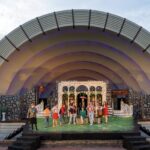
This edition of “The Painted Word” is brought to you by the 26th year of free “Shakespeare in the Park” under the band shell at Reservoir Park in Harrisburg with “Much Ado About Nothing.” Now that is something! This year, the Gamut Theatre Group production runs May 31 to June 15—let’s all hope for good (dry) weather!


Trendy

It’s good to be a little nosy. In Pittsburgh, nosy people are known as nebbers, as in, “I was nebbing in on the conversation, and I found stuff I shouldn’t have” (thanks Urban Dictionary). During the 10-day span of June 6 to 16, make certain you neb around the Three Rivers Art Festival, which takes place in downtown’s Point State Park, 101 Commonwealth Pl., noon to 8 p.m. daily, featuring some 300 exhibitors.

Over the following weekend, June 22 and 23, head the other way on the Turnpike to the Manayunk Arts Festival, which features 300 exhibitors in this trendy part of Philadelphia. Hours are Saturday 11 a.m. to 6 p.m. and Sunday 11 a.m. to 5 p.m. Manayunk is known as a hipster hangout, offering a welcome change of pace from the hustle and bustle of Center City. Manayunk translates from the Lenape, “It’s where we go to drink,” and, appropriately, there are plenty of great watering holes and restaurants along Main Street.

Next, we take you out of the city for the rustic vibe at the Kutztown Folk Festival, which runs from June 29 to July 7 at the Kutztown Fairgrounds in Berks County. There, you’ll discover more than 200 crafts people and folk artists, along with plenty of good, old-fashioned Pennsylvania Dutch food. Be sure to not “throw the cow over the fence.”

Heading west again, the 53rd edition of the Central Pennsylvania Festival of the Arts beckons, with the street fair spanning the avenues of State College and on the campus of Penn State. Dates this summer run from July 10 to July 14. A sidewalk art sale takes place concurrently on the streets of State College. For more details, visit www.arts-festival.com.

Looking for something out of the ordinary? An oozing monster just might do the trick. The 19th Annual Blob Fest takes place in Phoenixville. Yes, actor Steve McQueen’s career was launched in the 1958 cult classic, “The Blob,” partially filmed in Phoenixville in the Colonial Theater, which is central to the three-day horror film festival, which runs July 12 to July 14. Join the madness being re-enacted as participants scream and run out of the theater. Saddle shoes and poodle skirts are optional.


Explore, Enjoy

Closer to home, it wouldn’t be summer without the 45th Annual Mt. Gretna Outdoor Art Show over the weekend of Aug. 17 to 18, held under the oaks of the Chautauqua section of Mt. Gretna at Rt. 117 and Pennsylvania Avenue. Hours are Saturday, 9 a.m. to 6 p.m., and Sunday, 9 a.m. to 5 p.m., with 250 to 300 exhibitors and an admission fee of $8.

Several other central PA festivals close out our summer of art.

The Long’s Park Festival in Lancaster takes place over Labor Day weekend, Friday, Aug. 30, to Sunday, Aug. 31, in its 41st offering. Expect to share the experience with more than 10,000 spectators over the three-day event. Ranked as one of the top-50 fine art festivals in America, all proceeds from ticket sales benefit the foundation’s free summer music series.

If underground art is more your thing, drive down to historic Gettysburg over Labor Day weekend for Creature Feature Weekend. This independent film festival/horror convention features a lineup of dark and bizarre movies, along with celebrity guests, Q&A’s, vendors and food trucks. And, while in Gettysburg, it’s requisite to hop on a ghost and/or film location tour. More information can be found at www.creaturefeatureweekend.com.

Finally, circle back home for the 2019 Harrisburg Mural Festival. Over 10 days, starting on Aug. 30, watch as world-class muralists bring to life grand outdoor paintings around the city. The festival will include numerous public and participation events, capped off with a block party downtown to coincide with the Art Association’s annual Gallery Walk on Sept. 8. For all the details, visit the Sprocket Mural Works website: www.sprocketmuralworks.com.

Given the gamut of festival fare listed, it is certain that summer is a state of mind. So get outdoors, explore and enjoy the beautiful weather, with art acting as a perfect complement.

Continue Reading

A Rebel Walks into a Bar: Rum, revolt in Pennsylvania history.

Editor’s Note: Midtown Scholar Bookstore will host “An Afternoon with Diane McCormick” this Saturday, Feb. 2, 4 to 6 p.m. Therefore, we’re re-featuring our interview with Diane from our November issue. Drop by to hear Diane speak about the rich history of rebellious behavior in Pennsylvania bars and taverns. Midtown Scholar is located at 1302 N. 3rd St., Harrisburg.

Good plots are often hatched in bars.

Those plots may be of the subversive type, or they may be of the book type.

Harrisburg author Diane McCormick discovered both in a tour of some of Pennsylvania’s most notorious watering holes, a journey she relates in her new book, “Well Behaved Taverns Seldom Make History: Pennsylvania Pubs Where Rabble-Rousers and Rum Runners Stirred up Revolutions.”

I recently sat down with McCormick, who told me how history often has been made when a dose of grievance met a dose of alcohol.


TheBurg: What was the origin of your idea?

McCormick: It came to me at Jean Bonnet Tavern in Bedford, Pa. My husband has family up there. So, we frequently travel up there and always make the stop at the Jean Bonnet, which has Whiskey Rebellion ties. Probably 2½ years ago, I was sitting there one day in this awesome tavern at the bar drinking a Sly Fox O’Reilly’s Stout and eating a grilled ham-and-cheese thing. I looked around, and I thought, “You know, a lot of pubs probably have rebellious ties. A lot of rebellions have pubs at their heart.” I just thought about it for quite some time, kept it to myself. Then, in the summer of 2017, around May, I started looking at my schedule, and I thought, “I might have some time to put into this, this summer.” I carefully walked up to my husband. He’s an excellent judge of topics and content. I said, “Well, what do you think of this idea?” He said, “I love it. It’s great. It could work.”


TheBurg: The topic of this book suits Pennsylvania very well. We’re pretty much synonymous with revolution and rebellion and drinking.

McCormick: Exactly. I said—Pennsylvania has pubs. Pennsylvania is famous for rebellions. You bring people with gripes to a public gathering place. You have some rum or beer or Madeira or applejack, and the flame torch is lit. So, people grab a pitchfork and go marching.

When I sat down and thought about my criteria, it came down to any sort of era in American history where people defied authority in some sort of way. So, yes, you had the American Revolution, but I also kind of skipped through eras. The last one I had was Prohibition because what’s more iconoclastic than a speakeasy? So, I ended up with the American Revolution, Whiskey Rebellion, a rebellion called Fries’s Rebellion, which is an absolute hoot, the canal-building era, the Battle of Gettysburg, the Molly Maguires and Prohibition. There are 12 pubs total. So, it was any time that Americans said, “We don’t like this law. So, we’re either going to ignore it or we’re going to defy it.”


TheBurg: So, you cut it off before the Harrisburg incinerator forensic audit?

McCormick: Yeah, that’ll be next [laughter]. If I could find a bar related to it.

TheBurg: I think all the planning went on in McGrath’s [laughter].

McCormick: I tried as much as I could to go with places where the ties are authentic. For instance, there is a bar called the Molly Maguires in Jim Thorpe. But it’s a tribute bar. So, I tried to avoid that. I went to places that definitely had clear ties to these events.

For instance, the Dobbin House in Gettysburg. It’s very hard to prove underground railroad tales, but the gentleman who built the Dobbin House as his home in 1776 was a minister. They were very abolitionist. His son was a known abolitionist. When the son became an elderly gentleman, he passed on the mantle of the underground railroad to a young man, who then wrote in 1911 his recollections. So, that’s pretty good documentary evidence. It’s not proof, but he did build a second floor with a space about 3½ feet high between them with a sliding panel. Why else would you do that? So, yes, I tried to go with places that have a direct connection and have that authentic piece of history involved.


TheBurg: What did you consider to be the most interesting place you visited?

McCormick: There were different aspects to each that were fascinating. City Tavern in Philly, even though it is a re-creation because the original was torn down in 1850-something, it is as meticulous a reproduction as the National Park Service could create, even down to the fact that City Tavern had this marvelous bell system that was very technologically advanced for its day, which was just bells with wires going through walls. If you were in the basement, and Gen. Washington’s oyster stew was ready, you would ring the bell and somebody would come down. The bell would be on the second floor, and it would ring up there, and they’d come down and get it. Plus, the food was tremendous there. I also loved the speakeasies. They were fun just because there was so much lurking underneath the surface.


TheBurg: Where were they?

McCormick: The Horse Inn in Lancaster. That is a must-go place. It actually has been in operation since it was a speakeasy. It’s called the Horse Inn because it was a loft to a horse stable.

In Easton, a speakeasy is now Two Rivers Brewing Co. That’s only been around a few years, but they bought this decrepit building at sheriff’s sale. The owner had to break into his own building. But the bar is still there that was put in during the ‘20s. Like in the middle of Prohibition, people just ordered bars from Sears and put in the bar. Easton was sin city. It was famous because people leaving the fights at Madison Square Garden would hear barkers say, “Going to Easton. Going to Easton.” And you would get in a car or a bus and go to Easton—and prostitution, gambling, booze, anything you wanted. There’s this whole alley that was nothing but brothels.


TheBurg: It makes it seem like we live in very tame times.

McCormick: Exactly. I think that, sometimes, we think of the past as this upright time of probity, and everyone was so genteel and dancing the minuet. George Washington chose his table at City Tavern so that he could see anyone coming into the room or into the building. An assassin could come after him at any time. So, he sat where he could see anything.


TheBurg: So much of civic life used to happen in taverns. People even voted in taverns.

McCormick: Taverns were the public gathering places—taverns and churches. In churches, you weren’t going to patronize prostitutes or drink or fight someone or debate politics. So, you went to your local pub for that. Pubs were also places of trials. With Jean Bonnet, I get into that. At the Jean Bonnet, there’s a longstanding story about a hanging right inside the tavern. It was a place where there were trials. There are several versions of that story, but one I heard was that a man burst into the tavern. He’s a white man, a local. He says, “The Indians are after me.” Of course, all the patrons are up in arms. They’re ready to fight. The Native Americans arrive and they say, “Yeah, we’re chasing the guy. He stole our horses!” So, they held a trial right there—guilty. Hanged from the stairwell.


TheBurg: Swift and unfair.

McCormick: Yes. There also was a legend that a body was found in the basement with a bullet hole in the head at the Jean Bonnet. Yeah, they were gathering places, and, sure, the fact that there was liquor there would make people get even more heated up about whatever their gripes might be.

Now Fries’s Rebellion was a doozy. At the time, there was a house tax imposed by the federal government to pay for defense. And these Pennsylvania German farmers who had fought in the Revolution said, “Wait, I thought we were fighting against unjust taxes.” So, they started protesting. Things reached a point where these guys one day just got totally drunk, took several of the tax collectors hostage.

First, they were at a pub called McCoole’s in Quakertown that I was in. Then they went into another pub, where they found out that some of their compatriots were being held at a pub in Bethlehem. That’s only about 15 miles away. So, totally drunk, they started marching toward Bethlehem. Well, lo and behold, it’s the Sun Inn, which is a famous inn with revolutionary ties, because all the founding fathers stopped there, because it was basically the only nice inn between Philadelphia and New York.

So, this drunken mob—100 people, 400 people, accounts differ—were on the march, but the marshal holding the place only had 15 or so men. So, he didn’t have much choice. My favorite part was when this mob was marching into Bethlehem. They got to a toll bridge, and the marshal told them, “Stop right there. We’re not gonna let you come in.” They said, “We’re coming in. We’re gonna take our friends. We’re gonna take these prisoners away from you, no matter what.” So, he paid the toll and crossed the bridge into the inn. So, I read that and said to myself, “He paid the toll?” But that made sense. That was a tax that made sense. It paid for the road that you used—a road farmers used to take their goods to market. So, they paid the toll to get across the bridge to continue the rebellion.

It was important to me to find standing taverns, standing bars. I didn’t want this to be a guide to places you could drive past and go, “Oh, that happened there.” So, I wanted to be sure that you could go there, eat the burger, drink the beer, drink the special drinks. So, I get into that in each chapter, as well. I talk about what they might specialize in, what their specialty drinks are and tell people what I tried. At Two Rivers Brewing Co., I had a peanut butter bacon cheeseburger. They said, “Best in the Valley.” And, sure enough, Lehigh Valley Live voted it their best burger, and it was the type that you had to hold the whole time with both hands, and it’s just dripping down your hands. They had an awesome burger. The Horse Inn in Lancaster had an awesome burger. The food everywhere I went was just great.


TheBurg: What was the most distant place you went to from here?

McCormick: Probably the Black Bass Hotel. That was one with ties to the canal-building era. It was a morgue for dead canal workers. They were dying, dropping like flies, mostly Irish, keeling over from malaria and typhoid and such. They needed a nice, cool, stone-walled building to keep the bodies. So, that’s literally on the Delaware River looking out over New Jersey on the other side. That was a fun place because I got into the canal era, the reputations of the canal-builders, a lot of workers’ rights issues came up, the exploitation of these workers. And they had a reputation for being such rowdy, dirty drunks. But they worked from sunup to sundown. There was a saying that went, “It’s easy to build a canal. All you need is a pick, a shovel, a wheelbarrow and an Irishman.”


TheBurg: And I’m sure the owners valued the pick and the shovel more than the Irishman.

McCormick: Very likely. There’s one thing I want to bring up, and it came up quite clearly at the Black Bass. The manager who showed me around, a Scottish man named Grant Ross, was very careful to make it clear that there is legend and there’s more legend. And he was not about to prove or disprove anything. I tried in the writing of this to make clear when I knew something was fact and something was legend.


TheBurg: But legends are fun, especially if you’re in a bar.

McCormick: What else are bars for, except to give birth to legends? So, I just tried to make it clear when I was getting into legendary territory, but those were the fun stories to tell. Sometimes, the factual story wasn’t as fun. But I would share that, OK, here’s what some people say really happened, but here’s the legend, because it’s a lot of fun.


“Well Behaved Taverns Seldom Make History: Pennsylvania Pubs Where Rabble-Rousers and Rum Runners Stirred Up Revolutions,” by M. Diane McCormick (Sunbury Press) can be found online and in select bookstores.

This interview was edited for length and clarity.

Disclosure: Diane McCormick is a freelance writer for TheBurg.

Continue Reading

Revolution in Care: Harrisburg native pens book on founding father, Benjamin Rush.

Illustration by Ryan Spahr.

From supermodels to rabbis, the subjects of award-winning investigative journalist Stephen Fried’s six books have been nothing if not diverse.

Now, with “Rush: Revolution, Madness and the Visionary Doctor Who Became a Founding Father,” this Harrisburg native has entered the territory of writers like David McCullough to produce a comprehensive biography of Benjamin Rush, a major figure in American history whose legacy has slipped, unfairly, into the shadows.

Signer of the Declaration of Independence, member of the Constitutional Convention, pioneer in the humane treatment of mental illness, vigorous advocate for racial, religious and gender equality and founder of Dickinson College, lifelong Philadelphian Rush had a unique vantage point from which to observe the birth of the American nation and the growing pains of its early years.

In an interview from his Philadelphia home, “down the street from the American Revolution,” as he describes it, Fried, who teaches journalism at both the University of Pennsylvania and the Columbia University Graduate School of Journalism, explained that he was drawn to Rush as a subject because the story allowed him to marry his interest in the problem of mental illness (he co-authored a 2015 book on the subject with former Rep. Patrick Kennedy) to an account of the American Revolution.

Rush, who was born in 1745 and died in 1813, offered the added benefit to a historian of a life that spanned a profoundly significant era. He was a “very political doctor trying to do important work in Philadelphia, who’s a wide-eyed revolutionary when the big guys come to town and, within two years, he’s one of them,” Fried remarked.

Rush had been engaged prominently in political activity as far back as 1773, when he co-wrote the anti-tax broadside that led to the Boston Tea Party and helped usher Thomas Paine’s pamphlet “Common Sense” into print.

Returning to Philadelphia after his participation in the Revolutionary War, in which he served as surgeon general to Washington’s troops in some of the bleakest days of the conflict, Rush resumed his medical practice, and by the mid-1780s, entered into a period of intense public engagement that included a major address to the American Philosophical Society in 1786. In that talk, Fried explained, Rush “lays down the framework for seeing addiction and mental illness as diseases and not failures of will or religious faith, which is how they were viewed at the time.”

Along with Benjamin Franklin, Rush worked to revive the Pennsylvania Abolition Society. A man of strong Christian faith (in contrast to many of the Deist founders), Rush was someone who, as Fried described it, “believed that religious liberty was bigger than organized religion,” opposing a religious test for public office in the proposed Pennsylvania constitution, as merely one illustration of his broadminded views.

Rush carried on an extensive correspondence with John Adams and was responsible for reconciling Adams and Thomas Jefferson a dozen years after the bitter election battle of 1800. The desire of Rush’s family and these ex-presidents to suppress this intensely personal correspondence, Fried argues, was one of the reasons he’s fallen into relative obscurity.

In letters like these, and a profusion of other writings, from which Fried quotes extensively in his book, Rush passionately articulated, in eloquent, but accessible prose, his vision of equality and liberty for the nascent American society.

“What I love about Rush,” Fried said, his enthusiasm for his subject evident in his voice, “is that the minute there is America, he starts realizing what the challenges will be. He doesn’t write about them as if he’s fixing them or that they will be easily fixed. He lays down the challenges: the challenge between science and religion; the challenge between liberty and good government.”

Central to Rush’s importance, he continued, is “how correctly he identified the main friction points dividing America and how reasonable his approaches to these things are. They still have great value today because he wrestles with them; he’s candid about the need to wrestle with them. The American experiment is that we’re going to wrestle with this. It’s always the best we can do. We wrestle with them and we ask: ‘How is America going to be different than other countries?’”

Fried is excited about returning to his hometown to discuss his book.

“Harrisburg is the greatest place to be from in the world,” he said, noting his many friendships here and the warm support he’s received from the local community for his previous work.

Asked to offer some final thoughts on Rush’s legacy and its contemporary relevance, Fried was emphatic about his enduring importance in American history.

“The message Rush spent most of his career trying to convince people of—of equality, of racial, religious, gender equality—I wish we could say that we had made more progress in these areas, but we haven’t made enough. Rush would probably say he didn’t expect us to, but that he always expected the challenge would be one that we would be open about and try to do better. We didn’t invent a country to have a perfect union. We invented a country to have an increasingly more perfect union. Rush really understood that.”

Stephen Fried will be at Beth El Temple, 2637 N. Front St., Harrisburg, on Oct. 21, at 7 p.m. for a presentation and book signing. General admission tickets are $25 ($20 for students) and include a dessert reception. For more information, email [email protected] or call the office at 717-232-0556. To learn more about Fried and his work, visit stephenfried.com.

Continue Reading

Art for All: A venerable Lancaster gallery has new owners, a new look and a new focus.

Dreya Moore

A memorable experience at a young age sometimes can lead to a changed career path later in life. Dreya Moore, the new owner of The Artist Studio and Gallery @ Annex 24 in Lancaster, recounted her earliest memory.

“When I was about 5 years old, my mom opened her first art gallery in the world-famous Italian Market in South Philly,” she said. “I remember standing on a milk crate and ringing up sales at the register. I used to build forts and dollhouses for my dolls out of stacks of art prints and framing supplies.”

Moore and her co-owner, Jackie Moore-Ballard, who also happens to be her mother, reopened The Artist Studio and Gallery @ Annex 24 early last year. Before taking over this adventure as gallery owners, they had exhibited in the space. Moore is a mixed media artist who specializes in found objects, up-cycling and recycling.

“Since I’m a tactile person, each piece ‘tells’ me what it wants to become,” she said. “I describe it as a collaborative relationship between me and the piece. I’ve created small-scale wire sculpture as well as a 6-foot-tall mixed-media piece using only vintage jewelry, recycled paper and plaster.”

The previous owners, Ken and Vanessa Reisig, approached the mother/daughter team with the idea of selling the business. It turned out that Moore was ready for a change. She had enjoyed her decade-long job as a chemist, but her life changed two years ago when her daughter was born.

“I had been with the company for a number of years and had advanced to the management level, so more responsibility meant less time for home,” she said.

When she returned to work after three months of maternity leave, she realized how much it bothered her to be away from her daughter.

“She rolled over, crawled and said her first words while I was in a meeting with some client,” she said. “It was heartbreaking and not worth it to me. So, I quit with zero plan, except that I was going to be a good mom.”

Immediately after that, her mother came to her with a business proposal—it seemed like kismet.

“Women are a force to be reckoned with,” Moore said. “Women business owners are just as capable as men, but I personally believe women are a bit more empathetic in their practices, which gives them a boost.”

What advice would she give to other women starting their own business?

“For the love of all things—do it,” she said.

Moore’s goal for the first year at The Artist Studio was to honor the original message of Annex 24, which was to give all artists a voice and a chance.

“I wish I was cool enough, talented enough to call myself an outsider artist, but I’m good with just being the chick who respects outsiders and is willing to take a chance on good, interesting, evolving, emerging, proven, developed, kick-ass art,” Moore said.

The Artist Studio uses theme exhibits, which are curated by Moore with help from her mother. For instance, one exhibit last year was themed “#BlackGirlMagic” and featured works by African-American female artists.

“I love being able to take a self-guided tour, so I tried to implement this type-A personality quirk into my exhibition planning, hence having themes,” she said. “A theme creates an experience for the viewer, either by telling a story or invoking a feeling.”

For this year, some of the themes include cityscapes/countryscapes, pop culture and “LatinX,” which will focus on Latin and Hispanic artists. In July, an exhibit will open entitled “Hex,” which, Moore said, will be a “love letter to Lancaster.” This exhibit will focus on area folk art with works from Amish artists, fiber arts, wood creations and a new spin on Lancaster County hex signs.

As artists themselves and community advocates, Moore and Moore-Ballard want to offer art classes to underprivileged residents. Many hardworking locals raising a family couldn’t afford things like art classes, Moore said. So, The Artist Studio decided to offer free paint classes, as well as other classes at varying price points, to accommodate everyone. Proceeds from raffles and silent auctions and donations of supplies help offset the costs of free classes, she said. Many artists also volunteer to help out.

From that small girl helping her mom at her first art gallery, Moore has come full circle. And Moore-Ballard, who had to leave her first gallery to focus on her young family, has returned home.

The Artist Studio and Gallery @ Annex 24 is located at 24 W. Walnut St., Lancaster. For more information, visit www.annex24gallery.com.

Continue Reading