Tag Archives: Lower Paxton Township

Coffee & Creations: Our writer takes an excursion to Linglestown

Students at Mud Queen Pottery

“Good vibes only,” says a sign greeting pottery-studio students. “PEACE4LIFE,” proclaims a café blackboard. A shop owner selling mystical wonders hopes her customers find peace.

Has quaint Linglestown, Pa., found the secret to lasting peace? Well, I had a fun Saturday exploring its favorite haunts and hidden gems with a friend. I most certainly contributed to the Linglestown economy. I plan to keep going back.

Is this peace? Let’s call it contentment from a charming village getaway—a daytrip 10 minutes from home.

In 1765, first-generation German-American Thomas Lingle laid out 80 lots and called it the Town of St. Thomas. Locals called it Lingle’s town. The name stuck.

This was my chance to walk a village in Lower Paxton Township that is, in the parlance of real estate agents, “not a drive-by.” The street refresh and construction of roundabouts in 2015 were painful, but they preserved the hamlet’s cherished history and walkability, said Andrew Enders, president and general counsel of Enders, the family insurance business that has made Linglestown its home since 1979.

“We’ve often wondered how we can continue to improve Linglestown and grow organically and highlight what we have that is so special,” Enders said.

Starting the Day

So, there we are—me and Gina Napoli—sitting on the St. Thomas Roasters sofa, like Monica and Rachel at Central Perk but without the perfect hair. There’s only one place to start your Linglestown excursion. St. Thomas Roasters has been a Linglestown landmark since 2000, the granddaddy of local coffee shops, serving fresh roasts amid eclectic décor.

The history of Linglestown is hanging on the walls. Linglestown’s shop owners love displaying framed sepia photos of their buildings when they were the general stores, barbershops and pharmacies of a rural crossroads, reached by trolley or horse cart.

Gina was my local guide, just as funny and insightful a companion as she is a theater reviewer for TheBurg. On this blistering day, being the smart one, she ordered iced coffee. I drank regular coffee and will be sure to return when I run out of my favorite whole beans at home—the rich, medium-bodied yirgacheffe, roasted in St. Thomas Roasters’ famous Diedrich roaster that serves as décor and fills this bustling shop with enticing aromas.

St. Thomas tempts coffee-drinking customers with quiches and baked goods, but we had other breakfast choices. My husband and I are partial to St. Thomas Restaurant for its homey atmosphere, and oh, that baked oatmeal. But I had never been to Mellow Minded Café, where its mission of “PEACE4LIFE” is written into a giant tree chalked on the blackboard wall.

Founded in 2015, Mellow Minded is the rustic-glam spot for healthy, satisfying breakfast and lunch. Gina was good and got the avocado toast. I got egg and provolone on an everything bagel. Did I want bacon with that? Oh, what the heck. Eat your heart out, McDonald’s bacon, egg and cheese sandwich.

Families filled the tables, from grandparents to babies. At a table near us, Jennifer and Antonio were there with their kids, 1-year-old Dominic and 3-year-old Sophia, who were patiently waiting for their quinoa pancakes.

Jennifer said that they often do exactly what we were doing—coffee at St. Thomas Roasters, followed by a meal at Mellow Minded Café. Linglestown, she said, “is welcoming. It’s quiet. It’s friendly. There are a lot of cute shops here.”

She added that she moved to the Harrisburg area from New York City.

“I love it here,” she said. “It’s different from the raucous, crazy atmosphere there.”

Heart & Soul Books

Shop On

When it comes to shopping and dining, Linglestown offers quality over quantity, said Enders.

“I will speak for the entirety of our team at Enders that we love having a collection of restaurants and shops in walking distance,” he said. “I take as many meetings at St. Thomas Roasters as I do at the office.”

With coffee and breakfast, I had already boosted the Linglestown economy with some of my big bucks earned from TheBurg. Time to do more.

Outside Treasures from Home, a sandwich board proclaimed, “Purses are like chips. You can’t have just one.” That’s a hint to the finds inside this selective consignment shop. Two new blouses found their way into my wardrobe from the wide selection of meticulous, brand-name clothes.

And then there are the designer bags. Louis Vuitton. Kate Spade. Coach. Hardly a sign of wear, and all carefully inspected for authenticity.

Of course, every consignment shop has its, shall we say, quirky items.

“Is that a belt or a corset?” Gina suddenly asked, holding up a wide, black elastic belt that I would have rocked in the ‘90s. “That’s a sin. It’s a cry for help.”

Down the street, The Edit HBG boutique and gift shop was closed for the July 4 holiday. Bummer. Instead, we dropped into its sister business, Unveiled Bridal and Formal. Earlier this year, I had wandered into its discreet doorway almost by accident, and the friendly ladies helped me find the ideal dress just in time for a formal wedding.

On this day, we weren’t there for bridal wear, but all that satin, lace, and beading makes the head whirl like Cinderella before the clock strikes midnight.

“It’s nice to dream,” Gina said.


Wheel of Fortune

Mud Queen Pottery was on our must-see list. Alas, it was closed.

The vicissitudes of small business. When the owner has car trouble, the door is locked. But with the pottery and jewels we spied through the window, we pledged to return.

Instead, we wandered down to the 19th-century barn—one of many remnants of Linglestown’s rural past, including an outhouse I once spotted—that houses the studio. There, we found three pottery-class students practicing on the wheels.

With pottery, “you definitely have to be adaptable,” said Jared Covalt of nearby West Hanover Township. “It doesn’t matter what you want. It’s what you end up with.”

 He pointed ruefully to the vase forming on his wheel.

“It’s supposed to be a bowl,” he said.

Frustrating, yes, said Emma Gottschall, of Midtown Harrisburg, but also “meditative. It’s something you do with your hands.”

And, added Jared’s wife, Sena Covalt, “When you get something back from the kiln, that’s very exciting.”

At Mud Queen, we learned about The Magic Is in You, a gemstone shop tucked inside a distinctive 18th-century stone cabin. We entered a side door into a mystical wonderland.

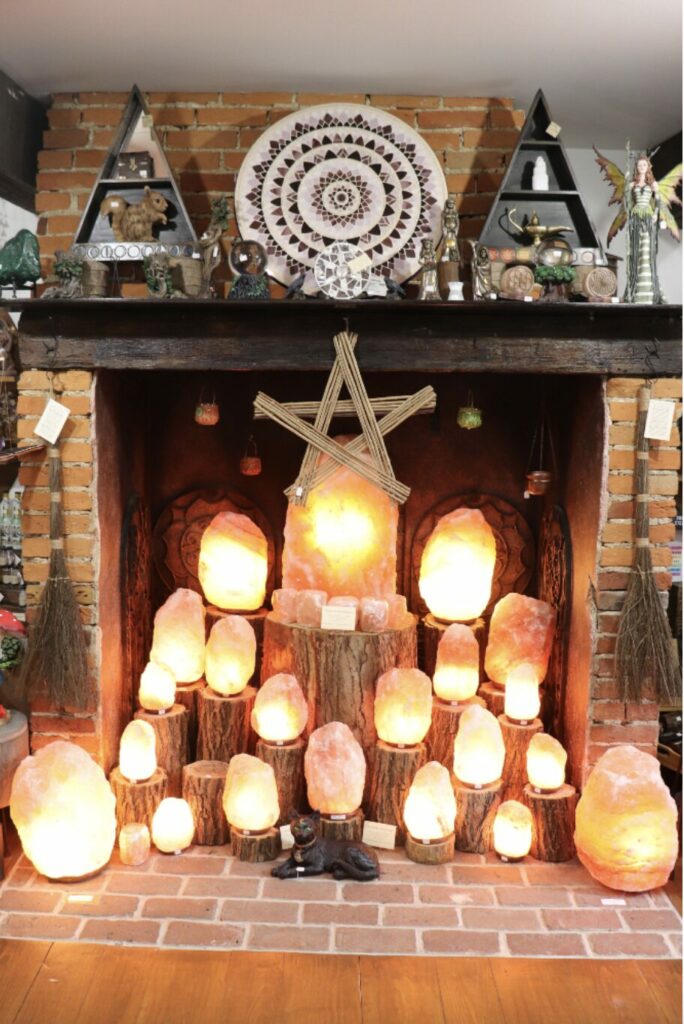
With wide plank floors beneath and heavy beams overhead, we had stepped into Linglestown’s origins, rejuvenated for the present. Salt lamps filled a tall brick fireplace. Bins overflowed with smoothly tumbled stones such as sardonyx and coral. A soothing bracelet of green prehnite beads, “a stone of protection & unconditional love,” now has a place in my jewelry collection.

Owner Stacy Swartz had been in business for 20 years when this evocative space became available in 2019.

“It got into my head, and I couldn’t let it go,” she said. “Things are showing me it’s meant to be.”

And, she added, “I love Linglestown. A lot of cute stuff has popped up.”

This is where I asked what she hopes her customers experience.

“Peace,” she said.

The Magic Is In You

  Plot Points

Chef Tony’s Bistro and the Eagle Hotel Restaurant and Bar weren’t open yet, so before Gina and I ventured out for lunch with drinks, we made Heart & Soul Books our last stop.

“Books changed my life,” owner Ashley Bailey told us. Her story begins in a juvenile detention center, when reading was therapy. She shares new and used books that represent the scope of humanity. Free book clubs and story times attract readers of all types.

Titles in the children’s section included “Be an Eco-activist” and “A Guide for Young Truth Seekers.” Gina drew my attention to “My Little Golden Book About Frida Kahlo.” That’s one for my new great-niece, since I am, after all, the aunt who gives books.

I am so coming back, for books and blouses and bags. Here’s my plan. When I come to St. Thomas Roasters for my next pound of yirgacheffe, I’ll add time to keep exploring and doing my part for the Linglestown economy.

“Come and stay,” Geof Smith said. “You might surprise yourself.”

If you like what we do, please support our work. Become a Friend of TheBurg! 

Continue Reading

Art, on the Mark: Maureen Marks teaches children, families to create, enjoy art.

Maureen Marks

At Maureen Marks Arts in Lower Paxton Township, students aren’t expected to create art perfectly.

Instead, owner Maureen Marks encourages her classes to create.

“Art is important to kids because it’s one of the few subjects that has no right or wrong answers,” she said. “Kids need to have that creative part during their development. You need to know there are possibilities.”

After years of teaching art in area public schools, Marks started teaching in her home, then in West Hanover Township. Four years ago, she renovated her current spacious, bright studio on Sunset Avenue in Lower Paxton from a building that once housed offices.

“I’ve been involved with doing art pretty much since birth,” Marks recalled. “My dad wanted me to be an English teacher, but I couldn’t stop making things.”

Maureen Marks Arts offers a wide variety of fall and spring classes each year for ages 3 to adult. Fall sessions usually attract a total of 120 students in all age groups with a “90% to 95% return rate,” she said.

Media instruction ranges from drawing, painting, clay, printmaking, pastel and crafts such as jewelry making.

The facility also offers a variety of public or private art parties and events, as well as several youth camps and “pop-up” events each year. Family paint nights held there are open to ages 8 and up.

Like many area venues, COVID-19 and the state’s pandemic orders have been a major challenge. Last year, the business was forced to close entirely from March through June. When it reopened, class sizes were reduced to meet state social distancing mandates. Masks were required, as well, and parents of students could no longer enter the building.

To further adhere to social distancing mandates, Marks split her 2020 summer art camps into two sessions each. Today, she still conducts classes “doing individual everything” with art supplies. “I’m still trying to separate things,” she said.

Marks also posted instructional project videos online during the pandemic.

“With COVID, everyone turned to art,” she said. “The soul needs this.”


Fun, Carefree

The Hamiltons are one of many families that have joined together for various activities at Maureen Marks Arts.

“Everyone in our family has been involved there at one time or another,” said Elizabeth “Liz” Hamilton, mother of Brooke, 14, Audrey, 10, and Landon, 6. The Lower Paxton Township family started going there in 2016 after a friend recommended it for Brooke’s birthday party.

Elizabeth Hamilton said she often participates in “pop-up classes” with friends or family at Marks Arts, such as holiday painting or watercolor events. Her favorite projects include a Christmas card with a pickup truck illustration, a Valentine gnome and wooden pumpkins made with her children.

“I never really thought of myself as an artist, but Maureen offers so many different materials to work with, and she explains it so well,” Elizabeth said. “I learned to have fun with it and not stress out about making it perfect. It’s fun to remember who we were with for each of the classes. Maureen is a great teacher. It’s been great seeing her giving the kids her knowledge.”

Brooke Hamilton has regularly attended sessions at Marks Arts since her initial birthday party there five years ago. From there, she was inspired to begin crafting her own jewelry at home, according to her mother.

“I’m really glad that Brooke found a craft there that she could take home and run with,” Elizabeth said. “When she’s not reading, she’s downstairs at her art table.”

Brooke, a freshman at Central Dauphin High School, said that she hopes someday to land a job “that has something to do with art.” Her favorite project done with Marks was a tree collage set on canvas using a variety of different materials.

“I liked crafting on my own before this, but she made it really fun and carefree,” Brooke said. “I have two really good friends who go there with me, and you have a lot of time to do things there, like around hour or an hour and a half for each one.”

In turn, Marks said she “loves going to work every day.”

“No two days are the same,” she added.

She also said that she enjoys watching her students grow both in art skills and in life skills.

“Part of kids learning to have self-esteem is working through your mistakes,” she said. “In art, it’s OK to make mistakes.”


Maureen Marks Arts is located at 103 Sunset Ave., Harrisburg. For information, call 717-545-5815 or visit
www.maureenmarksarts.com.

If you like what we do, please support our work. Become a Friend of TheBurg!

Continue Reading

Houses & Home: Twila Glenn warmly embraces the term “realtor mom.”

Twila Glenn

Twila Glenn is chatting easily on her cell phone in her expansive home in Lower Paxton Township while her 5-year-old son plays video games beside her and she puts last-minute touches on a sleepover party for her daughter—all while working to top last year’s $8 million in real estate sales.

She wouldn’t have it any other way.

“I wanted a career that allowed me to be present in the lives of my kids and to make good money doing something I loved,” she said.

Glenn is part of a group she lovingly calls “The Realtor Moms,” leading the powerhouse team under Joy Daniels Real Estate.

After graduating from Messiah College with a degree in international business 14 years ago, Glenn embarked upon a career in banking as a portfolio manager. She rapidly realized that sitting in front of a computer all day, managing trades, was not her passion.

At that time, many of her friends were buying their first houses and were asking her to come to showings with them, knowing she had always embraced architecture and interior design. It was her husband Ryan who suggested she consider getting her real estate license.

She decided to cross that threshold, working full-time at the bank by day and then attending four-hour classes at night. While most trainees find the classes to be dull, she loved them.

Taking a leap of faith, she quit her day job, opting for a commission-based lifestyle. She started working for Century 21, and after three years, moved to RE/MAX for eight years.

Throughout, she knew she wanted to assemble her own team. Two years ago, award-winning realtor Joy Daniels reached out to her.

Under a new arrangement, agents now work for Daniels’ company, not directly for her. It allowed Glenn to do all she did before, and more.

“The Realtor Moms” are governed by the philosophy, “The relationship is more important than the transaction.” That mindset is working, because referrals have been pouring in, Glenn said.

Her relationship-builder acumen also has earned her a spot on the board of Harristown Development Corp. and drawn offers to join several other boards. She is also a Sunday school teacher at the Harrisburg Brethren in Christ Church.

It’s the icing on the cake for a woman who used to play “office” as a child and is a DIY home decorator.

She mentors other realtor “moms,” who often think they have to wait until their children are in school to sell real estate. “You can do this too,” she urges them.

Recently, she earned her designation as a “senior real estate specialist.” While many of her older clients have moved into assisted-living communities and will probably never move again, she still remains in touch, and the referrals still come.

She has succeeded, in part, because she communicates with her clients constantly, and in the form her clients prefer. She knows most of her older clients don’t want emails and texts. She often visits them personally and calls them often.

“The more you stay in touch, the better the entire transaction and their entire relationship is,” she said.

“What sets our team apart is we know our strengths, and we try to bring in team members to supplement our weaknesses,” she said. “As a team, we are strong.”

Glenn estimates that 95 percent of her marketing is event-based, not calendars and magnets. She and her mom-realtors throw “client appreciation parties,” offering, for example, a free showing of “Aladdin” and free concessions, for recent and long-ago clients.

They give away pie at the holidays, do a free “Coffee on Us,” and host housewarming parties for buyers for up to a year.

They now attract four to five referrals a week. Her goal this year is to give out three times as many referrals as they receive and to hit $13 million in inventory.

Personally, she wants to travel more and take her family on a Disney cruise. Her daughter is a fan of “Moana,” and her son is into all things “Star Wars.” Although she admits to some workaholic tendencies, she will readily turn off her phone and be the “force” her kids and husband need.

“At the end of your life, it’s not about the number of transactions you did,” she said. “It’s about the people we impacted and the memories we made.”

For more information on the Twila Glenn Group, call 717-695-3177 or visit www.glenngrouprealty.com.

Continue Reading

Harrisburg Ascending: Central PA’s rock climbing community is on the rise.

When Shea McGill started her sport more than a decade ago, she wasn’t the confident climber she is today. She was afraid and intimidated.

Some of that came from frequently being the only woman in a group of men. A common misconception about the sport is that it requires a tremendous amount of arm strength—not exactly what women are stereotyped as having. Also, climbing up a rock face with nothing but a harness or rope to secure you isn’t exactly our natural state.

McGill definitely conquered her fear.

She became so skilled that she coached the rock-climbing team at Climbnasium, a popular Mechanicsburg climbing gym, for eight years. She enthusiastically repeated the pep talk she frequently gave her athletes.

“Listen, how many rock climbers do you know? None. How many people do you know who ride their bike or play basketball?” she said. “It’s not a new sport, but it is just so hard. It’s hard for a 6-foot-tall male to succeed let alone a 5-foot-nothing girl who can’t do a pull up.”

While coaching and traveling to climbing spots across the country, McGill has seen the central Pennsylvania climbing community grow, welcoming experienced and novice climbers alike.

“It’s crazy because you wouldn’t think that central Pennsylvania would have such a strong climbing community,” McGill said. “But because it is so small and it is such a niche activity, it draws people who are really unique—young, old, the most interesting people I have ever met.”

For those who haven’t tried to make it up a wall or boulder, climbing may seem straightforward—you climb up the wall using the available mounts and holds around you.

That’s true in a way, but a big challenge of climbing is following the set course. Color-coded markers typically lead the way to the end of the path. It’s like the yellow brick road, just vertical. Unlike the one-foot-in-front-of-the-other approach we’re all familiar with, you may find yourself gripping a hold while ever so gracefully adjusting the position of your feet to make the next move doable.

Problem-solving and critical thinking are core to the sport. You may see climbers staring at the wall making mental notes and envisioning each move before they begin their journey. Or, you may spot a climber holding on to the wall as they calculate their position and how to move to the next hold. It’s this mental workout that is just as much a test of endurance as the physical exercise is.

“You’re not losing that much strength day-to-day but, depending on where you are mentally, you are going to perform completely different,” McGill said.

The mental challenge is what brings James Emery, a frequent climber at The Cave in New Cumberland, coming back for more.

“It’s a mix of athletic exercise and mental problem solving,” Emery said. “It’s a nice foundation.”


Superhero

Evan Bates, owner of The Cave, opened the gym after experiencing climbing with his young nieces and nephews.

“My niece was very much here and there—a classic toddler,” Bates said with a smile. “Her climbing on the rocks really gave her perspective and the ability to get some of that energy out. It really helped with her coordination, which was important for her mom and dad. She became really confident in herself, and now that she has a wall at her school, she’s the superhero.”

Bates partially attributes some of the rise in the sport’s popularity to climbing’s grand reveal in the 2020 Summer Olympics in Tokyo, Japan. In addition to adult athletes like Emery, The Cave welcomes many parents who identify climbing as a sport their kids can progress in. So, it’s just not a weekend hobby.

“People are really wanting to climb,” Bates said. “There’s even more of a customer base and more of a community.”

The Friendship Center opened a climbing wall in January 2018 after a survey found that Lower Paxton Township residents wanted to have a local option.

Rachelle Scott, director of the Friendship Center, sees the wall as another activity that families can do with their children. The wall at the Friendship Center is also the only one that is fully accessible. So, it is accommodating for all levels, as well as for adaptive climbing.

Devon Linville, rock climbing team lead there, has seen a variety of ages and backgrounds take to the wall.

“A lot of people never thought about rock climbing before as an accessible thing they can do,” Linville said. “Now they’ve come here and other places and have really gotten into it.”


Where to Climb

Central Pennsylvania has a growing number of locations for those interested in giving rock climbing a try. Here are the locations mentioned in this story.

The Cave Indoor Rock Climbing
400 Bridge St., New Cumberland
717-774-2468
www.thecaverockclimbing.com

Climbnasium
339 N. Locust Point, Mechanicsburg
717-795-9580
www.climbnasium.net/home.html

The Friendship Center
5000 Commons Dr., Harrisburg (Lower Paxton Township)
717-657-5635
www.lowerpaxton-pa.gov/friendship-center

Continue Reading

D&H Distributing plans move from Harrisburg to Lower Paxton Township

D&H will be headquartered in this building in Lower Paxton Township.

One of the region’s largest companies is moving out of Harrisburg, as D&H Distributing has purchased a 50-acre parcel of land in the nearby suburbs.

D&H expects to make the move later this year, relocating from its longtime Harrisburg headquarters to 100 and 200 Amp Dr. in Lower Paxton Township, near I-81, according to the company.

Co-President Dan Schwab said that a need for more space led to the move. With 244,512 square feet of office space between two main buildings, the new headquarters will be about twice as large as the current location on the 2500-block of N. 7th Street in Harrisburg, he said.

“The AMP Drive campus provides adequate space for continued expansion, future-proofing the D&H corporate headquarters for decades to come,” he said.

The new office will offer the company other amenities, such as easy highway access, a larger cafe, a full-service cafeteria, a state-of-the-art data center and a 900-space parking lot, according to D&H.

D&H bought the property for $8.2 million from TE Connectivity Corp., which will continue to occupy a portion of the campus. D&H will either sell or lease its current Harrisburg headquarters, Schwab said.

Founded in Williamsport as Economy Tire and Rubber, D&H last year marked its 100th anniversary. Over the years, it evolved from a tire seller to become one of the country’s largest distributors of IT and electronics. It’s been at its current Harrisburg address since 1952.

Last year, Forbes magazine ranked D&H as No. 109 among the largest private companies in the United States. The company stated that it expects to add 30 jobs just this year.

“We’re loyal to Harrisburg,” said Co-President Michael Schwab. “The staff has admirably embraced this region over the years, and vice versa, including through local charity activities and community events. We wanted that relationship to continue well into the future, while providing a satisfying and effective work environment for our co-owners, even as we proceed on a rapid growth trajectory.”

This story has been updated to include additional information and comments from D&H Distributing.

Continue Reading

Taste Times Two: Koda, Newfangled offer a flavorsome collaboration.

Photo by Dani Fresh.

Those of us who grew up with Italian grandmothers know what it’s like to live in an environment where food is an expression of love.

We’ve seen firsthand the smiles a good meal elicits. So, it’s no surprise that, as adults, we, too, are interested in creating a similar mood.

As a child, Christian DeLutis observed his grandmother creating praiseworthy meals from simple ingredients and soon learned that he was happiest behind a stove. His passion led him to the Pittsburgh Culinary Institute and, upon completion of the program, to top kitchens in Baltimore, Washington, D.C., and Ireland.

After spending years away from home, DeLutis decided that it was time to return to the area.

“Family is here,” he said. “I missed home, and I wanted to bring here what I learned over the years.”

Arriving back in central PA, he soon went to work with Tröegs Brewery in Hershey to develop their “snack bar.” The project was so successful that it created a national buzz, with magazines like “All About Beer” singing its praises, using words like “adventurous, forward thinking and experimental.” After five years at Tröegs, DeLutis decided that it was time to move on, to take his career to the next level and become his own boss.


Shared & Loved

Owning his own restaurant was a long-held dream for DeLutis, and he felt that the best way to execute his vision was to start from scratch.

He worked with locally based Yingst Homes to build his restaurant in an emerging planned community located just off Nyes Road between Locust Lane and Union Deposit Road in the Union Station development.

“We chose this area because it is not as tucked away as some planned communities,” he said. “We are convenient to most locations on the East Shore, and there is a parking lot out back that accommodates 100 cars.”

In a nod to his mother’s pet name for him, DeLutis chose the Native American word, “Koda,” for his eatery, which means ‘little bear.’

Upon walking into Koda, the dining room immediately stands out or, in current parlance, is “Instagram worthy.”

An enormous, blue neon sign hangs over the open kitchen spelling out the restaurant name and its founding year in Roman numerals. The space, with its high ceiling and unfinished wainscoting, has an industrial vibe, with elements of Americana pulled from various decades.

Hobnail drinking glasses hail from the 1930s, and tufted booths evoke the steakhouses of the 1950s. One can almost picture the British model Twiggy perched on any one of the mod, white plastic chairs that complement rectangular tables of the same color.

As for the food, DeLutis describes it as “nostalgic” and explains that he considers it “vintage cuisine viewed beneath a modern lens.” The made-from-scratch, Americana-inspired dishes include creative takes on comfort foods like Swedish meatballs (venison, currants, egg noodles, gravy), gnocchi (scallop, lobster, fennel cream) and crispy duck leg (baked beans, barley, bacon, molasses).

Last month, Brenden Orth was one of the first customers to visit the restaurant, just days after it opened. He left praising the homemade pretzel rolls that arrived hot at the table topped with honey butter and the pork tenderloin served with bacon, red cabbage and dumplings.

“Everything was delicious and seasoned perfectly, and my wife thought her salmon was the best she’s ever had,” he said.

The couple made a point to save room for dessert, ordering apple pie and baked Alaska.

“We shared and loved both,” Orth said.

DeLutis attributes the early praise to a well-choreographed team.

“I make no decision without the other three chefs: the chef de cuisine, the pastry chef and the lead cook,” he said. “We all have to nod in agreement when making decisions.”

Through experience, he’s learned that a positive, supportive work environment is key to maintaining top-notch employees.

“I believe that will result in good food and good service,” he said. “We’re not trying to be pretentious here.”


Fun, Approachable

But good food isn’t the only reason to venture out to Koda. In a trend that’s becoming increasingly popular, the restaurant is partnering with a new brewery, which is located under the same roof.

Newfangled Brew Works opened just before Koda, but the timing worked out well. The two operations share about 12,000 square feet of space, but they’re technically separate. So, you can enjoy a craft beer in the casual brewery or slip into Koda for a great meal and cocktail.

Run by brew master Adam Cole, Newfangled prides itself on serving crisp, American-style beers. So, while you’ll find a solid IPA and wheat beer, you probably won’t be faced with anything on the bleeding edge of hoppy or sour.

Cole earned his beer bona fides at well-known breweries like Harrisburg-based Appalachian Brewing Co. and Victory Brewing Co. in Downingtown. He said that his degree in biotechnology has translated well into brewing, too. Then there was his experience as a bomb technician in the Air Force, which, he said, has helped him enter the tough world of business ownership.

“I learned not to sweat the small stuff,” he said, with a laugh.

For now, Cole anticipates turning out between 700 and 1,000 barrels annually, offering four standard beers, along with seasonal brews. Wines and spirits will also be available, as will casual fare like tacos, chicharrones and pork carnitas served from an on-site taco truck.

The brewery, which accommodates about 100 patrons, is meant to be an easygoing, fun experience, marked by live music and even party games like Jenga, Connect4 and Ping Pong.

The partnership between Koda and Newfangled enables patrons to enjoy a beer, cocktail or glass of wine at either one place or the other, or both. Even though Cole and DeLutis are running each business separately, both are united in one goal: to foster socialization by creating a fun, approachable destination where everyone feels welcome.

Koda and Newfangled Brew Works are located at 8001 Union Station Blvd., Harrisburg (Lower Paxton Township). For more information, visit www.kodahbg.com and www.newfangledbrew.com.

Continue Reading

Walk This Way: Harrisburg’s streets are unusually dangerous for pedestrians. What can be done?

Illustration by Jonathan Bean.

Evelyn Hunt pointed to the street map sprawling across long tables.

Post-it notes in pink or blue were scrawled with such phrases as “Heavy foot traffic” and “Raised intersection?” Hunt put her finger on the north side of 19th and State streets.

“For some reason, more of the accidents happen on this side versus the other,” she said.

Immediately, a consultant slid a pack of pink Post-its toward her. Wordlessly, he was inviting her to add her observation to the comments accumulating on the map.

In an effort impressive for its swiftness, a phalanx of municipal, regional and state officials is examining how to make Harrisburg-area roads safe for all users. Starting with a particularly deadly stretch from Camp Hill to Harrisburg, the push is on to help motorists, pedestrians and bicyclists move in harmony.


To Zero

The cliché about dangerous roadways is that somebody has to die before government finally steps in.

Maybe five deaths since 2017 along one speedway of a Harrisburg road inspired a shared epiphany. Maybe the senseless death of Cynthia Wilson, apparently crossing State Street for a quick trip to the store, was the last straw. Amid the outcry, the city turned to a Vision Zero Action Plan, vowing for zero roadway fatalities by 2030.

Traditional transportation planning incorporates the three elements of mobility, accessibility and safety, said Harrisburg’s city Engineer Wayne Martin. But safety has taken the proverbial back seat.

“There’s now a national and international shift toward safety being the number-one priority,” he said.

Which explains the sudden elevation of State Street, and hazards citywide, in the public policy agenda.

“Believe me when I say the statistics on State Street should be enough to get past any concerns for travel-time delays and things like that,” Martin said.


Process & Plan

Urban traffic deaths might seem anomalous—after all, city streets aren’t beltways—but the killer component is speed differential, said Martin. Today’s cars are increasingly safe for occupants, but the more drivers exceed speed limits—which peaks on State Street at the close of the work day, according to a Vision Zero finding—the higher the speed difference between the vehicle and the unfortunate walker or bicyclist.

“We know that the auto industry is going to be more advanced,” Martin said. “So, we need to focus on these other road users, because they’re more susceptible.”

Enter Vision Zero. It’s a process and action plan in one. Officials scrutinize crash data and anecdotal evidence to uncover the problem spots. Vision Zero task force meetings attract the full array of agencies responsible for and using city streets: city administration, police, engineering, Capital Area Transit, Harrisburg school district. Because the state owns many of the roadways under scrutiny, including State Street and Front Street, PennDOT is at the table.

“The challenge is, we’re trying to move large volumes of traffic, especially the commuters coming in during the morning,” said PennDOT spokesperson Greg Penny. “How do you balance the interest of moving large volumes of traffic with the interest of providing safety to bicyclists and pedestrians?”

Vision Zero’s rapid response component targets the most troublesome areas first. Road data provide hard evidence, while input from residents, motorists and pedestrians offers real-life perspective. Hence, surveys conducted during rush hours, and community input meetings with maps and Post-it notes, like the one attended by Evelyn Hunt.

“We can look at all the statistics we want about crashes and timing of signals and vehicle volumes and speeds, but that’s not going to pick up a near-miss,” said Martin. “That’s not going to pick up aggressive behaviors. You’re really going to get that from community members.”

Initial solutions are inexpensive and quick to implement, especially compared to pricey, drawn-out construction projects. Upgrades such as line painting “can be done cheaply,” Martin said. State Street’s center lane is a legacy of streetcar days, and its luxurious, 12-foot lanes inspire drivers to put pedal to metal.

“Those lanes don’t have to be 12 feet,” said Martin. “We can definitely get away with 11 or 10. You start narrowing those lanes, it’s a shorter distance for pedestrians to cross, and it slows vehicles down.”

For pedestrians, quick fixes can include uniform lighting to eliminate dark spots, crossing signals flashing countdowns instead of those ambiguous hands and time-delayed signals that provide pedestrians a few seconds to step into crosswalks and be visible to left-turning motorists.

And because pedestrians sometimes—make that often—need encouragement to use crosswalks instead of jaywalking their way through live-action Frogger games, medians can be planted with prickly rose bushes.


Camp to Allison Hill

When it comes to traffic corridors, motorists and pedestrians don’t care who’s responsible for maintenance and safety. The Tri-County Regional Planning Commission is a regional coordinator dispersing federal transportation dollars, and its Harrisburg Area Transportation Study, or HATS, formulates transportation plans for Cumberland, Dauphin and Perry counties.

A HATS study that now includes Forster Street through State and 15th streets actually started life as a look at the Camp Hill bypass—officially, Cumberland Boulevard. Residents unnerved by the December 2016 death of their friend Diana Davidson, killed by a speeding drunken driver, discovered an alarming string of crash data and asked HATS for a review.

“There are not sidewalks the entire length of our walking community,” said Brett Miller, a Camp Hill resident who, with resident Sherry Bowman, created the Camp Hill Cumberland Boulevard Task Force. With Davidson in mind, the group vows to “make sure this never, ever happens to anybody else,” Miller said.

Harrisburg then asked that the study extend through Forster Street and State Street, with an eye on projects that could alter traffic patterns and deter collisions, whether car-on-car or car-on-pedestrian.

Expected to wrap up in late 2018, the study “will include some medium- and longer-term things to be looking at,” including the “road diets” that slim down wide lanes, said TCRPC Executive Director Steve Deck.

“Some of the ideas we’re proposing are things tried out in other areas and found to be effective. Not perfect, but effective,” he said. “I think people will see some significant improvements even with some short-term stuff that’s happening this year.”

The study earmarks about $300,000 for traffic safety improvements, Deck said. Collaboration among municipalities and agencies is inspired by safety concerns—a “no brainer,” he said. “While there’s some competition in what to do next, typically these organizations want to work together to improve safety.”

Miller speaks highly of the local, regional and state officials involved.

“I applaud the officials who stood up and took notice and did something, because they’re trying to be proactive instead of reactive,” she said. “We’ve talked to people in this field who say they’ve never seen anything move so quickly.”


Enforcement & Education

Nationwide, 49 states allow local police to enforce speed limits using radar. The outlier? Pennsylvania. A bill to put Pennsylvania in step with the other 49 passed the state Senate in November 2017 but, so far, has stalled in the House of Representatives.

Its passage into law is a Vision Zero goal. The topic is “a sore subject with most municipal police offices,” said Harrisburg Police Bureau spokesperson Capt. Gabriel Olivera. The department uses other enforcement methods, including timing devices and speedometers, but personnel shortages mean that officers are stretched too thinly for regular traffic stops.

“We are responding to many, many calls throughout the day,” said Olivera. “Because we’re responding to all the calls, it doesn’t allow us the ability to stay in one location to enforce traffic.”

Miller would appreciate a stronger dose of education about motorist, pedestrian and bicyclist safety—in homes, schools and municipalities. Common sense helps, too, she said.

“Until the experts figure out exactly what can be done to make the road and safety better, please adhere to the crossing signals, the crosswalks and the underpasses because it really does make a difference,” she said.

Indeed, both motorists and pedestrians would do well to reacquaint themselves with the rules of the road, according to numerous people interviewed for this story. After all, anyone who’s spent time in Harrisburg likely has noticed infractions by all parties, with epidemics of both speeding and jaywalking.

Front Street has become a particular focus of concern since PennDOT made changes to that state-owned road a couple of years ago. Crosswalks were added at more intersections, but that seems to have caused greater confusion than actual safety improvements. After all, what happens when you add multiple crossing points to a street that many drivers still treat as a high-speed corridor—a highway—into the city?

To wit, a few months back, a security video went viral that showed a woman being hit and thrown by an SUV at Front and Herr streets as one lane of traffic stopped to allow her to cross at an intersection, but the other lane did not.

Lower Paxton Township resident John Norton has been on the other side of that problem.

He got caught in a five-car pileup this spring, caused by a motorist stopping to allow a pedestrian to cross Front Street. He has also seen near-misses, whether between cars and pedestrians or fender-benders. Few people, he said, understand that state law requires pedestrians to actually occupy a crosswalk before motorists must yield.

“All we did back in the day was pretty simple,” said Norton, who long lived in a Front Street apartment and walked his dog in Riverfront Park nearly every day. “We stood by the side of the road until it was safe to cross, and then we’d cross. During rush hour, we sometimes had to wait five or 10 minutes. What’s the tragedy in that?”

Continue Reading

May News Digest

Sanitation Changes Weighed

Harrisburg’s existing rules governing trash collection may soon get canned.

City Council is considering a new, more comprehensive sanitation ordinance that would usher in stronger enforcement tools and more efficient billing for its trash collection services and lay out clearer rules for city recycling programs, Mayor Eric Papenfuse announced last month.

It would also waive annual trash fees for the owners of vacant lots and properties, eliminating an unpopular provision of the current ordinance, Papenfuse said.

The revised sanitation code aims to curb the city’s perennial problems of illegal dumping and excessive trash accumulation. It would grant the city stronger enforcement powers by creating two categories of offenses and a new fine structure.

Under the proposed ordinance, serious offenses—including illegal dumping, accumulation of trash exceeding 1,000 pounds, improper waste disposal and failure to register as a private trash hauler—would be considered category 1 violations punishable by a $1,000 fine or up to 90 days in jail.

Category 2 violations are more minor acts that are likely to recur without deterrence, Papenfuse said. These violations, which include failure to bag waste, obstruction of streets and sidewalks or interference with enforcement, would be met with fines starting at $100. Fines would increase up to $500 for each subsequent offense.

The ordinance would also permit the Public Works Department to designate enforcement officers to patrol public streets for violations. It also would authorize police officers to issue citations and enforce the ordinance.

Papenfuse said that the new legislation also would codify the city’s free and mandatory recycling services, including its new glass recycling program.

“This will bring us into the new century in regard to recycling,” Papenfuse said. “We’ve more than tripled recycling in the last few years but very little is laid out in existing code.”

One of the most significant changes would be an annual billing structure designed to save money for the city and its residents.

Harrisburg residents currently make monthly payments for trash services. Under the new ordinance, the city treasurer’s office would include trash fees in property tax bills. The separate charges would appear on the same invoice and would be subject to the same due date and discount period.

Residents may opt out of yearly billing in favor of monthly direct deposit payments. However, those who pay their trash fees within 60 days of billing would receive a 2-percent discount.

City Treasurer Dan Miller said that streamlined bills would save the city $100,000 in mailing and labor costs each year. He also hopes it will increase the city’s collection rate and improve early-year cash flow.

Miller said that the city has a 98-percent collection rate for its real estate tax, with 70 percent of that revenue coming in during the 60-day discount period.

“We assume trash will be the same, which would increase cash flow and generate more interest for us throughout the year,” he said.


Staff Cuts, Tax Hikes in School Budget

Kindergarten cuts might not be coming to Harrisburg after all.

Members of the Harrisburg School District administration unveiled a new budget proposal last month that would preserve the full-day kindergarten program in favor of cutting 31 district employees. The proposal calls for eliminating nine administrators, 11 teachers, and 11 AFSCME union members for a total of $2.132 million in savings, which would narrow the district’s deficit to $4 million.

The budget still calls for maximum tax hikes for the next three years.

District Business Manager Bilal Hasan said that over-hiring has contributed to the district’s annual deficits, which are projected to deplete the district’s fund balance by 2020. Thirty-seven teachers who have been hired since 2016 took positions that were not in the district budget, Hasan said.

Interim CFO Jim Snell explained that salaries alone don’t account for the district’s high expenses. Costs like healthcare benefits and pension payments only emerged in long-term budgeting projections, he said.

“When you start to look at the reality of recurring costs over multiple years, that’s when you appreciate the true consequence of those decisions,” Snell said. “Some of those consequences are starting to get in the way and cause financial challenges for us.”

Budget and finance chair Ellis Roy was incredulous when Hasan confirmed the extent of the over-hiring.

“You’re telling me we hired 37 people we had no money to pay for?” Roy said. “We’re self-destructing here.”

Hasan said that the district has not had a position control mechanism in place to monitor its total number of staff positions and vacancies. The administration has implemented a new policy so that no position can be added to the payroll unless it is approved and included in the budget, he said.

Hasan and Snell said that developing a position control program is a lengthy and tedious process that requires collaboration between the district’s human resources, IT and business departments. Employees must code each permanent position with a unique identification number, which can be difficult in a large organization with high turnover, Snell said.

“At any point in time, there are staff coming and going, so there was a never a snapshot that said ‘at this moment in time, these are all our positions,’” he said.

The district’s mistake, Snell explained, was anticipating expenditures in line with previous years without accounting for vacant positions that the district wanted to fill. When the administration ramped up its recruiting efforts and hired dozens of new teachers at the beginning of this school year, it unwittingly took on employees that were not included in the budget.

The implementation of a position control system was one of the initiatives outlined in the district’s state-mandated recovery plan, which it adopted in 2013. The task ultimately fell to Hasan, who began developing the program in August 2017 and oversaw its implementation earlier this year.

“This will provide structure and order, and that was not always the case when we were hiring,” Snell said.

School Board Votes to Retain Knight-Burney

Sybil Knight-Burney will remain the superintendent of the Harrisburg school district for at least three more years, the city’s school board decided last month.

After almost an hour of public comment during which district residents overwhelmingly called for Knight-Burney to be replaced, the board rejected a motion that would have hired a search firm to find a new superintendent and passed another measure to retain her for a term of three to five years.

Frustrated residents began jeering the board before its members could vote on the second motion.

“You don’t care!” one resident yelled. “This is insanity, clear as day. You don’t care.”

“This is ridiculous!” Gerald Welch yelled, before chanting “Shame!” as he and two-dozen other exasperated residents left the gymnasium.

Yanna Kent, a Harrisburg High School alumnae, said she did not want to see the district put in state receivership, which is one possibility facing it when its five-year recovery plan expires in June.

“We need to do a better job,” Kent said, addressing the board and the administration. “We put you here to work for us and, if you don’t want your job, leave.”

Other residents pointed to the fact that state test score and graduation rates have remained stagnant or declined under Knight-Burney’s leadership. Some called out the administration for not yet completing the initiatives outlined in the district’s five-year recovery plan.

Almost 70 percent of the initiatives have been fully completed as of February 2018, according to the most recent report available from the state’s chief recovery officer.

“If I only complete at 70 percent of what my job had asked me to do, would I be able to continue, especially when other people are willing to go 100 percent?” said Carmen Dones. “It’s time to say thank you, but I think it’s time that we say goodbye.”

Board President Judd Pittman, who voted against retaining Knight-Burney, pointed to other sobering facts from the past two years: $180,000 in district funds were embezzled by an employee, 70 teachers were hired at the wrong pay step, and the district revealed two years of over-hiring by its business office.

Those factors have contributed to an $8 million budget deficit this year, as well as a structural deficit that threatens to eat up the district’s general fund by 2021.

Pittman cited these incidents as evidence that the district has not implemented strong accountability systems during Knight-Burney’s tenure.

“In 11 years, if you have not had time to put systems in place it’s time to come to the table with [solutions], or it’s time for us to look at other opportunities to put systems in place,” Pittman said before the board voted on the superintendent’s contract.

Pittman has been advocating since December for the board to launch a superintendent search. The board passed a motion to do that in March and then tried to rescind that action in April.

Board director Tyrell Spradley raised the motion to rescind in April, after voting in March to consider new candidates for Knight-Burney’s post. Spradley voted to retain the superintendent, along with board directors Ellis Roy, Lionel Gonzalez, Melvin Wilson and vice president Danielle Robinson.

Board directors Brian Carter, Carrie Fowler and Percel Eiland joined Pittman in the minority.


Substation Cost Rises

The Harrisburg Police Bureau last month made a plea for an additional $165,000 to construct a substation on S. 15th Street.

That sum represents a 13-percent increase over the project’s $817,000 budget.

City engineer Wayne Martin said that bids for the project came in above early estimates and insisted that the added cost was “not an unusual” margin for error in publicly bid projects.

Several council members lamented the fact that the project’s timeline has lagged as its costs increased.

“Three years ago, we planned a $300,000 precinct with a turnaround of three to six months,” Councilman Cornelius Johnson said. “Now, it’s more expensive, and it’s only a substation.”

Public Safety Commissioner Thomas Carter said that early plans to retrofit a facility at S. 15th Street became impossible once it was found to be structurally unsound. That structure was razed in December to make way for a new modular building.

Police officials say they don’t have enough manpower to staff a full-time precinct, but they still think a substation would benefit officers and residents. Carter reported that increased police presence in South Allison Hill has helped drive down homicides there this year.

“The cost is what it is, but I know that, since we’ve been concentrating on that area, we have not had homicides,” Carter said.

Tough Road for CAT

Harrisburg’s public transit network has a bleak road ahead of it.

Capital Area Transit (CAT) will end the year with a $700,000 deficit, but new Executive Director Richard Farr can’t explain why.

“It’s like an archeological dig trying to figure out how we got this far in the red with no foreseeable way out,” Farr told Harrisburg City Council last month.

Farr said that CAT’s “worst case scenario” would be to reduce service to narrow the deficit. Administrator salaries have been cut to the furthest possible extent, he said, which leaves the company eyeing its other major expenditures—insurance and maintenance—as possible areas to shave costs.

CAT has the highest maintenance costs in the state, Farr said, outpacing major public transit authorities like Philadelphia’s SEPTA system. It also has the third-highest labor costs.

And yet, CAT buses leave customers stranded every day due to driver shortages, Farr said.

CAT executives hope to join an insurance network to help mitigate some of its maintenance costs. But the source of the high labor expenditures remains hazy, especially since the agency has slashed administrator salaries in recent years by leaving high-level positions vacant.

Like most public transit authorities, CAT derives little revenue from fares and other consumer sources. State and federal dollars constitute the bulk of its funding, which make its annual revenues relatively stable and predictable.

“This isn’t a revenue problem, it’s an expenditure problem,” Farr said. “Some of these costs are legacy… but we have a big hurdle we need to work through.”

Farr hopes to avoid service reductions and said he has already averted driver layoffs once since taking the helm of CAT earlier this year.

Even if service reductions are avoided this year, they may be inevitable, said Harrisburg Mayor Eric Papenfuse.

“Eventually, they’ll have to cut service because they’ll have to use next year’s funding to pay this year’s line of credit,” Papenfuse explained.


HACC to Vacate Midtown Building

HACC plans to vacate one of its Midtown Harrisburg buildings after its lease expires in four years, the college said last month.

HACC, a community college with campuses in Harrisburg, Gettysburg, Lancaster, York and Lebanon, announced plans to leave Midtown 2, the former Evangelical Press Building, moving its trade and technology programs out of the building between mid-2019 and June 2022, with the expiration of its 15-year lease.

“No programs are being cut, and the transition will occur at times that have the least impact on classes,” said college President John J. “Ski” Sygielski. “Requirements to complete these programs will remain unchanged.”

HACC leases the building from GreenWorks Development, which fully renovated the landmark, century-old building at N. 3rd and Reily streets starting in 2006. HACC moved into the 80,000-square-foot building a year later, signing a long-term lease.

Soon after, HACC also moved much of its administrative staff across the street to GreenWorks’ newly built Campus Square Building, but returned these employees to the main campus at Wildwood several years ago. It plans to continue to occupy a third building, called Midtown 1 at N. 4th and Reily streets, which houses its workforce development, continuing education and welding programs, according to the college.

The move from Midtown 2 will save the college about $1.9 million in annual rent, maintenance and expenses, according to HACC. A portion of the savings initially will be used to renovate spaces for the relocated programs, HACC said.

So Noted

Capital Region Water has received the Award in Excellence for Sustainability from the American Planning Association, Sustainable Communities Division. CRW received the award in the Sustainable Green Infrastructure Project category for its “Community Greening Plan: A Green Stormwater Infrastructure Plan for Harrisburg.”

Chad Dion Lassiter was named the new executive director of the Pennsylvania Human Rights Commission last month. Lassiter has more than 20 years of experience in the fields of race relations, conflict resolution, mediation, teaching, counseling, policy and prison reform.

George Scott captured the Democratic nomination last month for U.S. Congress, besting a field of four candidates. He will face Republican incumbent Scott Perry in the November general election.

Harry Young has been named the new executive director of the Central Pennsylvania Gay and Lesbian Chamber of Commerce. In this role, Young will serve as the organization’s voice to build business, promote economic development and fulfill its mission to foster LGBT business equality and inclusion in central Pennsylvania.

Kathryn Aumiller announced her retirement last month as executive director of the Pennsylvania Regional Ballet. This summer, Aumiller will retire after 25 years leading the organization, which is searching for a new director.

S&T Bank has announced Shannon Golden as vice president, business banker, serving the Harrisburg market. In this role, she is responsible for fostering and strengthening business relationships in the region.

Stosh Snyder last month was named the new executive director for Theatre Harrisburg, responsible for the organization’s overall operations. A Harrisburg area native and actor, Snyder replaced Allison Hays, who served in the post about one year.

William B. Hawk, Lower Paxton Township supervisor, has been elected to a one-year term as president of the Pennsylvania State Association of Township Supervisors. The association represents the commonwealth’s 1,454 townships of the second class.

Zembo Shrine is back on the market after its proposed sale fell through. Arkansas-based Beaty Capital Group had the iconic, Moorish-style Shriners building in Uptown Harrisburg under contract, but backed out of the purchase after further examination of the mid-Atlantic area’s entertainment market, according to the company.

In Memoriam

Samuel Sloan Auchincloss died on April 27 after a brief illness. Born in New York, he was the long-time co-owner with his wife Susan of Auchincloss & Auchincloss, a Harrisburg-based marketing communications firm. Over the years, Sloan was active in many organizations, including Historic Harrisburg Association, Harrisburg Rotary, Harrisburg Lions Club, St. Stephen’s Episcopal School, Susquehanna Art Museum, the Rockhill Trolley Museum and the Harrisburg Chapter National Railway Historical Society, among others. Sloan also was a great friend, mentor and supporter of TheBurg. He is survived by his wife Susan, son Lloyd Brian Auchincloss, daughter Elizabeth Auchincloss Strickler, stepdaughter Leah Peak, their spouses and three grandchildren.

Changing Hands

Adrian St., 2436: S. Stroyan to PA Deals LLC, $30,000

Allison St., 1502: SWM Properties LLC to T. Mullally, $53,400

Barkley Lane, 2502: S. Vetock to J. Guerrero, $68,000

Berryhill St., 1101: Biks Auto Collision LLC to J. Garcia, $185,000

Bigelow Dr., 39: R. Johnson to J. Mayweather, $52,900

Briggs St., 211 & 213: Rockville Enterprises LLC to Grey Rex LLC, $230,000

Calder St., 105: A. Brett & K. Magagna to K. & G. Tennis, $150,000

Cameron St., 620: L. Aronson Family Trust & R. Aronson to Gini LLC & J. Pal, $225,000

Chestnut St., 2035: T. Coley to W. Seago, $62,500

Conoy St., 104: E. & K. Eckman to D. Wolf, $142,500

Croyden Rd., 2832: D. & B. Ratcliffe to J. Core, $51,000

Green St., 810: M. Hillman to S. & J. McGrath, $145,000

Green St., 1318: R. Bullock to G. & E. Gibeau, $93,500

Green St., 1802: BM Investment Group LLC to Asprodites Simpson Trust, $183,500

Green St., 2428: S. Tagle to T. & N. Blank, $137,500

Kensington St., 2223: PA Deals LLC to A. Womer, $64,900

Kensington St., 2326: E. McCloskey to I. Chatman, $69,900

Kensington St., 2431: Wells Fargo Bank to T. Dieu, $31,500

Lexington St., 2632: D. Grossman to A. Memic, $63,500

Luce St., 2306: T. & T. Parson to P. Almodovar, $69,900

Market St., 1025A: J. Lamb Sr. to J. Colron, $45,000

Market St., 2468: C. Jackson to S. Green & J. Burnett, $122,600

Mulberry St., 1845: V. Rivas to F. & R. Garcia, $70,000

North St., 1616: B. Davenport to C. Brooks, $39,000

N. 2nd St., 1937: US Bank National Association to M. Horgan, $92,000

N. 2nd St., 2053: 7 Eleven Inc. & Sunoco Retail LLC to Realty Income Trust 6, $3,221,477

N. 2nd St., 2538: T. & L. Magaro to M. Parsley, $110,000

N. 2nd St., 3033: A. Myers to D. Madsen, $100,000

N. 3rd St., 1014: 1014 N. 3rd St. LLC to O’Sullivan Realty, $660,000

N. 3rd St., 1231: E. Gabler to N. Wahby, $107,450

N. 3rd St., 1824: B. Strike to T. Miller & L. Wood, $79,900

N. 3rd St., 2329: CPenn Properties Old Uptown LLC to M. Mtere & F. Laoukili, $50,000

N. 6th St., 2407: Hobbeze Inc. to Elliots Enterprises LLC, $34,000

N. 6th St., 2528: Premier Property Solutions LLC to H. Foka, $31,000

N. 6th St., 2933: P. & E. Devenshire to C. Wise, $62,000

Paxton St., 1619: JC Hunt Management LLC to NAR Investments LLC, $110,000

Peffer St., 269: G. Neff & M. Baltozer to Heinly Homes LLC, $101,000

Penn St., 1925: WCI Partners LP to G. & K. Capoferri, $135,000

Race St., 566: I. & S. Milnes to B. Shisler, $119,000

Rudy Rd., 1919: M. O’Neill to A. Ross, $74,900

Rumson Dr., 298: Secretary of Housing & Urban Development to J. & J. Avila, $41,000

S. 17th St., 1040: Wells Fargo Bank NA to B. Nguyen, $40,000

S. 20th St., 12: Secretary of Housing & Urban Development and Information Systems & Networks Corp. to D. & L. Romero, $30,010

S. 25th St., 701: O. Huynh to G. Coppersmith, $69,900

State St., 1323: J. Ward to A. & S. Shelly, $71,000

State St., 1325: J. Ward to A. & S. Shelly, $71,000

Susquehanna St., 2112: E. Reichert to T. Hage, $45,000

Swatara St., 2158: Reverse Mortgage Solutions Inc. to D&F Realty Holdings LP, $30,500

Valley Rd., 2407: D. Loughery & J. Levine to E. Mena, $249,900

Verbeke St., 124: R. and M. Gordon to Kyzer Rentals LLC, $105,000

Continue Reading

Houses & Horses: Preserving history in Lower Paxton Township.

The new Lower Paxton Township Historical Commission is on the hunt for horses. Well, not just any horses, but old, handcrafted ones that some township residents may remember fondly.

There was, for instance, the old Inn 22 horse that long graced the grounds of the restaurant located five miles east of Harrisburg on Route 22.

“We’re still looking for that horse,” said Lower Paxton Township Historical Commission Chairman Joe Murphy.

Then there were the carousel horses you once could find on a farm owned by Judy Miller Klinefelter’s family. For years, the Linglestown Fair operated on the land, near what is now the Blue Moose Bar & Grille.

“We held an annual fair here,” said Klinefelter. “State government officials would come out to visit, and we’d have cows, pigs, sheep and other animals, along with cake judging and so forth—sort of like a precursor to our modern-day farm show.”

One of the highlights of the fair was a carousel. According to Klinefelter, when the fair closed down for good, her grandfather received an urgent telephone call from a friend who said, “You’d better get down here, every car that is going through town has one of your horses on it.”

Her grandfather arrived on site to discover one lone horse remaining, and today it’s stabled in Klinefelter’s living room.

“You know there are a lot of things kids don’t want these days, but both my daughters want that horse,” says Klinefelter with a laugh.

As for the remaining horses, she still holds out hope that others might show up someday.
Sharing History

It’s stories like these that bring history to life, Murphy believes.

His wife, Polly, through her work with both the Linglestown and the Lower Paxton 250th anniversary celebrations, learned many more. As the tales unfolded, it became clear that something should be done, and this led to the creation of the Lower Paxton Historical Commission in February.

According to Murphy, the commission’s mission is to identify, preserve, promote and protect the historical heritage of the township. The commission held its first meeting in March and now is conducting monthly history presentations.

“We will also be sharing the history with local students and teachers,” he said.

Preservation serves many purposes, according to the National Trust for Historic Preservation. For instance, old structures exist as a reminder of a city’s culture and complexity. The trust stresses the fact that once an historic structure is torn down, there’s no way to bring it back.

And the Linglestown area is rich with old structures.

For instance, the building that houses St. Thomas Roasters, near Linglestown Square, once operated as a pharmacy and dates back to the 1800s. One of the oldest structures in the area, the Gilchrist House, was built in 1794. The home is located near Arooga’s in Linglestown and is one of the original homes built in Lower Paxton Township.

“We think it’s built around a log cabin and are hoping to get into it with a building inspector,” said Murphy, adding that the home has been vacant for 30 years. “The woman who owns it had no idea until we contacted her.”

And then there’s Thomas Lingle’s house, which still exists on Parkway West, just a few blocks west of Linglestown Square.

David Doyle, who serves as the commission’s vice chair, mentioned long-gone businesses that are fondly remembered and posted by the commission on Facebook. For instance, he said, Moulin Rouge was known for its steaks, Maurice Acri’s served Italian food and Gino’s cooked up locally famous burgers and fried chicken.

When the commission posted a picture of the old Dutch Pantry, which was located on the corner of Allentown Boulevard and Mountain Road, the “likes” skyrocketed, Doyle said. And, of course, the Eagle Hotel, located on Linglestown Square, remains popular to this day.

“As a pre-Civil War structure, it’s one of the oldest taverns in Lower Paxton Township,” Murphy said.

In 1919, the American Legion was formed on the third floor, where they also held auctions for livestock.

“The barn located behind what is now Mud Queen Pottery was where the animals were, and they marched them right over,” Murphy said. “At the time there were two entrances—one for men and one for women.”

Not all preservation projects are focused on structures. Murphy remarked on a 400-year-old tree located off Linglestown Road.

“The John Goodway sycamore is named after the last Indian in the area,” he said. “He’s buried 10 feet north of that tree.”

And speaking of gravesites, Murphy speculated on a tragic loss that may not have occurred had the historical commission existed in the 1950s.

“Around 1956, I-83 was cut onto Route 22,” he said. “This affected approximately 300 graves, most of which were marked and contained many veterans from the French and Indian War up to World War I. They were dumped into one big, mass grave, and they were able to do it because the deceased’s relatives were gone. It was the oldest part of the cemetery. This is what we are going to work on preventing in the future.”


Past Is Future

History, of course, isn’t just physical objects. It also includes memories and stories.

At a recent monthly presentation, the commission shared the story of a B-26 bomber that crashed into Blue Mountain in 1951 due to fog and radio problems. Plans are in the works to honor the crewmen with a memorial service.

“The three crewmen were National Guardsmen from the 202nd Squadron,” Doyle said. “We reached out to the unit to see if they can be of any help with our service.”

Looking ahead, the commission plans to work with Lower Paxton Township to set up markers to designate historical structures. Since the commission operates without taxpayer money, it is gearing up to learn more about grant writing and fundraising to achieve its future goals, including a permanent building to store, display and create an official township historical collection of artifacts and ephemera.

Committee members are optimistic that, as the word spreads, more people will want to learn about the rich history of the township and may consider joining in the important mission of preserving the past for the benefit of the future.


To learn more about the Lower Paxton Township Historical Commission, visit www.lowerpaxton-pa.gov or the Facebook page: Lower Paxton Historical Commission.

Continue Reading

She Builds: A social champion is in the house.

Crystal Brown

“I remember standing on the corner watching my house burn in my ‘New Kids on the Block’ nightie.”

That memory is one of Crystal Brown’s earliest and most formative ones, as a 5-year-old living in Ohio, forced to face a hate crime sparked by her parents’ interracial marriage.

“We were very fortunate that we were able to stay with family until my parents were able to find another home,” Brown recalled. “Actually, a person from the community let us stay with them since all of our family was in Pennsylvania.”

Thus, Brown understood from a young age that having a support system is important to maintaining stability.

“If it would not have been for family and those kind neighbors, we would have been homeless,” she said. “That is why I believe in the work we do at BHA.”

BHA stands for Brethren Housing Association, a nonprofit, interdenominational organization that owns more than 10 properties in South Allison Hill, serving about 85 adults and children a year. Their red-doored headquarters is situated in the shadow of the Capitol, on Hummel Street, across from the Mulberry Street Bridge.

Named executive director in 2011, Brown helps Harrisburg residents obtain housing and the skills they need to keep that housing. BHA is probably best known for its “Transitions” program, in which women with children who are homeless are given transitional housing. Families live in BHA-owned housing, obtaining their own apartment without being forced to share common spaces. BHA also works to secure permanent housing for people with disabilities and offers an aftercare program for families once served by their programs.

Brown said she and her staff give clients both “encouragement and accountability.” Many came to BHA from an emergency shelter or were couch-surfing, she explained, “doubling up” with another family temporarily.

The reasons for homelessness vary, she said.

“Every family is different, but there is usually the need to supplement their income,” she said.

Most are in need of a job, an education, and, often, basic money management skills.

“They need skills to keep their apartment neat, pay their bills on time, live successfully with their neighbors,” she said.


Love and Support

A 2004 graduate of Susquehanna Township High School, Brown began volunteering at the Interfaith Shelter, which operates under the auspices of Catholic Charities in Lower Paxton Township, while earning a degree in social work from West Chester University. The Shelter offered her a job soon after, and she went on to earn a master’s degree from Temple-Harrisburg.

The desire to serve families in need is in her genes. Her father, the Rev. Wayne Baxter, served a congregation in Edgemont, and her grandfather also was a minister.

Brown said that, unlike the Interfaith Shelter, where families usually stay only 30 days, her goal is about permanence, opportunity and access. Families can stay as long as two years. With more time, she can better help clients acquire the skills they need and connect them with more resources for long-term stability.

“I feel like housing is a right,” she said. “People deserve to have a roof over their head.”

That sentiment is reflected in many of the plaques bearing motivational quotes in her busy first-floor office, which straddles a large open meeting room where clients gather. One of them reads: “You have to be taught to be second class. You’re not born that way.”

She notes that homelessness is part of a larger problem. Low-cost housing leads to housing segregation, which leads to educational segregation—which “leads to a perfect storm, and our families live with the aftermath,” she said. She pointed out that rent for a two-bedroom apartment in Dauphin County costs about $886.

“I can’t change federal policies, but I can give love and support and encouragement,” she said.


Tag Out

Brown sees a lack of affordable housing as a serious problem in every American city, but especially Harrisburg.

So many restrictions are often imposed upon prospective tenants, such as criminal background checks and credit checks. The homeless with criminal records often can’t get housing, which leads to not just homelessness, but hopelessness. Many have paid their debt to society, but cannot break out of homelessness because of their past.

“People make mistakes,” Brown said matter-of-factly.

Although memories of her childhood house fire remain, other, more recent memories lift her spirits. She recalls a single mother, frazzled after dealing with a boisterous 3-year-old all day, with no one around to give her a break. Brown came home with the mom and calmed the child by singing “Itsy Bitsy Spider.” That child is now 6 and doing well in school.

“I got to be that tag out” for that mom, Brown said.

The community is a vital partner in BHA’s efforts. One of their most popular programs is “Adopt an Apartment.” Caring donors can buy pots, pans, lamps and more for a family moving into a new apartment. She said UPMC Pinnacle and its employees are frequent sponsors.

She is often asked if she ever feels afraid, working where she does. She replies that she is no more scared than she would be in a parking lot at Wal-Mart or camping.

And, while she may have little experience camping or living in a rustic environment, she clearly knows what she is doing in an urban setting.

“I have a healthy level of fear,” she said.


Such Transformation

One of Brown’s mentors is Lisa Peck, program director at Interfaith Shelter. Peck returns the respect.

“Crystal is very open, very honest, and she very much believes in her work,” Peck said.

Peck and Brown often brainstorm about how they can make things better for others.

“She is very, very dynamic,” Peck said. “She does everything with enthusiasm and nothing is too small to take on. She is always up to challenges and will stop at nothing to help the less fortunate.”

When families arrive, Brown is “always warm and welcoming,” Peck said.

“I really enjoy working with the women,” Brown said. “Every day, I learn and grow. It continues to humble me. It is a constant reminder to not pass judgement.”

Still, amidst the triumphs are tragedies. One of BHA’s most ardent supporters, Ray Diener, was brutally murdered several years ago, and one of the rehabbed houses on Hummel Street was named in his honor.

That experience forces a reflection on another plaque on her wall: “Pray about everything. Worry about nothing.”

“We are here to serve—to love God and love our neighbor,” Brown said.

One of Brown’s greatest sources of pride is that they are a “trauma-informed organization.”

Many homeless people are victims of physical and sexual abuse, she explained, and that trauma hinders their growth and stability. Homelessness then becomes an additional trauma. BHA partners with Pressley Ridge to offer counseling.

“Instead of asking, ‘Why did you spend that $100 on that?’ we try to understand their story and put it in context,” she said.

BHA also works with Dauphin County’s Office of Children and Youth, since many of the children in the child welfare system are there due to homelessness.

In the mid-winter cold, Brown gave a short tour of snow-topped Hummel Street. The townhouses across the street from her office are new construction. BHA demolished old buildings and built new with the help of UPMC Pinnacle. A playground, pavilion and garden are also part of the tidy block. A state grant helped with streetscaping.

“There is such transformation on this block,” she said.

The growth in their properties is among the accomplishments she is most proud of.

She lists many other housing construction and renovation projects going up around her, including 50 affordable housing units slated for 13th and Mulberry and Crescent and Mulberry, in conjunction with the Harrisburg Housing Authority.

Her end goal is more housing, less hate.

“We just need to be nice to each other and share in our abundance,” she said.

The mean-spiritedness she witnesses is rooted in fear, she believes. People are afraid that, if someone else gets an opportunity, it subtracts opportunity from them.

But she knows it is not a zero-sum game.

She pointed to her favorite quote on her wall, uttered by Frederick Douglass: “It is easier to build strong children than to repair broken men.” And so she builds.


Brethren Housing Association is located at 219 Hummel St., Harrisburg. For more information, call 717-233-6016 or visit www.bha-pa.org.


Continue Reading