Tag Archives: Lower Paxton Township

Campus Debate: Eastern U makes pitch to locate inside city hall.

Part of the basement of Harrisburg city hall, where Eastern University wants to establish a satellite campus.

There’s no denying that the proposal from a faith-based university to renovate and rent space in Harrisburg city hall is an unusual one. But just how unconventional is it in the realm of public-private partnerships?

“We’re out on the edge here,” said city Solicitor Neil Grover on Wednesday night, as City Council debated a proposed agreement with Eastern University, a Christian college based in St. Davids, Pa.

Council devoted its entire workshop session tonight to discussing the proposal from Eastern, which wishes to move a satellite campus from Lower Paxton Township to the basement of city hall. University officials are offering to foot $600,000 in renovation costs to make the vacant space functional.

The arrangement would net the city a new press room and emergency operations center, two amenities it can’t afford to build itself. City hall employees also would be permitted use of Eastern’s lounge area and bathrooms. Since the university would only offer classes in city hall from 6 to 10 p.m., there would be little overlap between students and city employees.

Eastern would pay a nominal fee for a 10-year lease, since the value of the rental agreement would come from the cost of renovations.

Council members expressed skepticism about the arrangement at the July 6 meeting where the proposal was first considered. Namely, some worried that a faith-based institution operating within city property would render that space exclusionary, particularly for members of the city’s LGBT population. That concern was reprised tonight, along with questions about parking and tuition discounts.

Councilman Ben Allatt pressed Eastern University representatives on their commitment to Harrisburg’s non-discrimination ordinance, which prohibits discrimination against LGBT people in areas of employment, housing and public accommodations. Allatt wanted confirmation that these protections, which are not codified at a state level, would be upheld in Eastern’s hiring and admissions practices.

“I can assure you that Eastern University is committed to standing against discrimination,” said Provost Kenton Sparks. “You can trust Eastern University to protect the dignity of every single student.”

Allatt asked the Eastern officials if they would affirm their values of inclusivity in writing. Grover, however, pointed out that there are limits to what a government can demand in a contract with a private entity.

Councilwoman Shamaine Daniels asked city officials why they were not letting other organizations compete for a partnership with the city. She said that the city should request proposals from other businesses that may be open to a renovations-for-rent agreement. Grover and Mayor Eric Papenfuse demurred, saying that nobody else had approached the city with a proposal and that the city has no plans to solicit any.

Councilman Cornelius Johnson pointed out that the cost of Eastern’s renovations would not come close to the value of fair market rent. He said that even if the city charged just $5 per square foot for the space, Eastern’s rent payments would total more than $1 million for a 10-year lease.

“We’ll still be subsidizing the cost of them being in city hall,” Johnson said.

Eastern has offered to give Harrisburg residents a 25 percent tuition discount as a term of their agreement with the city. Johnson asked them to consider increasing the discount to 35 percent.

Eastern officials agreed to reconsider the tuition discount before council’s Oct. 10 legislative session, when the resolution will come up for debate and a vote. They also said that they would come to that meeting with more detailed plans for student parking and a response to council’s concerns about the city non-discrimination ordinance.

Continue Reading

Gone to the Dogs: An abandoned block of Harrisburg gets a new leash on life.

Illustration by Rich Hauck

Ginger and Matt Coleman are the happy parents of a 3-year-old boxer rescue named Apollo.

“He’s very, very active,” said Ginger, who lives on N. 3rd Street in Midtown Harrisburg. “So, he really needs a dog park.”

I walked with Ginger recently to a very green, very empty plot of ground at the corner of N. 7th and Granite streets, a dogleg-shaped parcel (natch!) that, if Friends of Midtown has its way, will be Harrisburg’s first dedicated, off-leash dog park.

“We’ve gone to the one on Union Deposit Road,” said Ginger, referring to Kohl Memorial Park in Lower Paxton Township. “But it would be nice to have one closer to home.”

After searching for several years, Friends of Midtown decided upon this three-quarter-acre patch of grass as the best option for pooches to get their run and sniff on. It even comes with some of Fido’s favorite playthings already in place: squirrels, groundhogs and rabbits, which, at least for now, run around unimpeded, blissfully ignorant of what may be in their future.

Ginger and I visited on a cool evening, a little before dusk, along with several other dog-lovers. The group reviewed the details—the timeframe (early 2018), how much money Friends of Midtown needs to raise ($18,000) and the design (separate areas for large and small dogs). Vartan Group, which owns the land, is letting them have it for the next two years.

A few people chose to walk the grounds, picturing, I’m certain, their own dogs jumping and frolicking and playing in the grass. As a student of this city, I saw things a little differently. I perceived emptiness and eerie quiet, and I began to wonder what had happened to this long-abandoned city block so that a dog park now constituted, to put this in economic terms, a higher and better use.

The story of the 1700-block of N. 7th Street actually tells a story shared by other parts of once-industrial Harrisburg. By the mid-19th century, one large family, Dr. Luther Reily and his children, owned the entire area—what would become 96 city blocks. Over the decades, pieces were sold off and subdivided so that, by 1889, there were eight landowners on this block and, by 1901, 14, with the Reily heirs still claiming several parcels, according to city maps.

The 1932 Polk city directory showed the block to be fully developed with dozens of small, attached houses, many likely occupied by the working-class, railroading families that populated the area. By the 1958 directory, the block had become almost completely industrial, home to small warehouses, paint shops and junkyards, with some houses remaining, mostly up Kelker Street.

The ensuing years were not kind to this now-gritty block of scrap-metal salvagers and junk dealers. As the city de-industrialized, businesses closed, owners died and properties sold for taxes. Investors and speculators moved in, renting out increasingly dilapidated houses to poor families. In some cases, the city became an owner of last resort. The Vartan Group has been buying up land there for some 20 years, knocking down whatever structures remained, so that it now owns nearly the entire city block.

On that cool, cloudy early evening, as I stood scanning the grassy field, I felt a bit like the character of the time traveler from H.G. Wells’ “The Time Machine,” a man who, from his machine, witnesses a block of London rise and fall and rise again, ever changing, over the course of many years.

I suspect that Vartan eventually will find a use for the land and develop it. It may be many years away, but the seeds of the neighborhood’s redevelopment—the pending state Archives and U.S. courthouse buildings—are being planted right now nearby on 6th Street. Some day, new construction will overrun this block, too, putting the fallow property back into productive use, returning it to the city’s built environment, a contributing part of its urban density.

Until then, at least for a few years, the block seems destined to have happy hounds and terriers, spaniels and shepherds, romp and yelp, scamper and play. This will be the first, small step back for a forsaken, forgotten piece of Harrisburg at 7th and Granite streets.

Lawrance Binda is editor-in-chief of TheBurg.

Friends of Midtown continues to collect money for the creation of a dog park at N. 7th and Granite streets. If you would like to contribute, please donate by visiting www.friendsofmidtown.org or mail a check, indicating “dog park” in the memo line, to Friends of Midtown, P.O. Box 5291, Harrisburg, Pa., 17110.

Author: Lawrance Binda

Continue Reading

Out of the [Home] Office: Can’t work from home? Sick of Starbucks? There’s a better option.

 Sometimes, working from home isn’t all it’s cracked up to be.

Oh sure, it may be cozy to peck away at your home computer in slippers and sweats, but there’s more to it than that. Often, it’s about working around household noise that can drive even the most dedicated worker to distraction.

Just ask Jon Nixon, principal and creative director of Nixonmedia and father of three young children, about the trials and tribulations of running a home business.

“The garage door is right across from my home office,” said Nixon of Lower Paxton Township. “The bathroom is right there, too. When my children are home, I hear them going in and out all the time while I’m trying to work.”

Fortunately, there’s now a quiet haven for professionals like Nixon in the Harrisburg suburbs. In March, Coworking at The Park, a new venue offering professional office space for rent, opened in Swatara Township.

The Park rents co-working space to professionals, small business owners, entrepreneurs, sales agents and freelancers, allowing them to work, collaborate and make their professional enterprise flourish, according to company president Jaime Novinger-Toigo. The business offers day passes, private desks or private offices, plus a conference room that seats up to 65 for training, events or product pitches.

“It’s a perfect fit for me,” said Nixon, who uses a rented office at The Park three days a week. “I like that I can have a quiet space to work anytime. I like that it’s open on weekends. It looks professional when I have clients come in.”

Novinger-Toigo actually came about opening her new business in an indirect way. When relocating her other business, Service 1st Restoration & Remodeling, from Lower Swatara Township last October, she realized that the new building on East Park Drive had much more space than she needed.

“We had 20,000 square feet of storage areas,” Novinger-Toigo explained. “When we saw this, that’s when the concept of Coworking in The Park came to fruition.”

Over the next several months, workers gutted the much of the building’s interior to create six private offices, private desk areas, conference and training rooms and a working kitchen, all meticulously detailed. Walls are painted with handcrafted notations such as, “Great things never come from the comfort zone.” Even the restrooms are uniquely hued with shiny aquatic blue floors in recognition of Novinger-Toigo’s fire and restoration business next door.

After all the preparation, Novinger-Toigo said the hard work is starting to pay off. Business at Coworking at The Park is growing quickly.

“A janitorial business came in over the weekend and used the training room,” she said. “It was really cool. A marketing business is coming in today. A lawyer came in here, too, to meet with his client.”

Networking is another of Coworking in The Park’s benefits. When professionals using the facility meet and socialize, opportunities often blossom.

“Jaime and I believe we’re going to attract people who want to grow personally and professionally,” said office coordinator Emily Gilroy. “I believe it will be people who are driven and want to make a better community for themselves and their families,”

As a self-employed journalist, I can personally vouch for the serene refuge of Coworking at The Park as I’ve used it myself recently after writing from my home on a freelance basis for 22 years over the clamor of four children, a television perpetually set to Nickelodeon or MTV and cats taking territory on my papers.

Three of my four children are grown now, but they’ve since been replaced by a retired husband with his own television agenda and kitchen activities. At times, phone interviews are suddenly ruined by a lawnmower’s roar or the fire horn’s call, causing me to leap from my chair and close windows and doors. All this while maintaining a coherent phone conversation, of course.

Therefore, I felt quite tranquil while sitting undisturbed on a recent morning at Coworking at The Park, my trusty laptop and iPad in tow at one of the facility’s spacious desks. As a gentle spring breeze floated through the window, I inwardly relaxed, realizing that nobody there cared what I was making for dinner that night. Instead, Novinger-Toigo and office coordinator Emily Gilroy asked if there was anything that I needed.

“No,” I replied. “I already have everything I need right here.”

Coworking at the Park is located at 330 East Park Dr., Harrisburg (Swatara Township). For more information, visit www.theparkcoworking.com or call 717-232-5444.

Author: Phyllis Zimmerman

Continue Reading

New Land, New Lives: Despite the political environment, refugees continue to come to Harrisburg—and Catholic Charities is here to help.

Photo by Dani Fresh

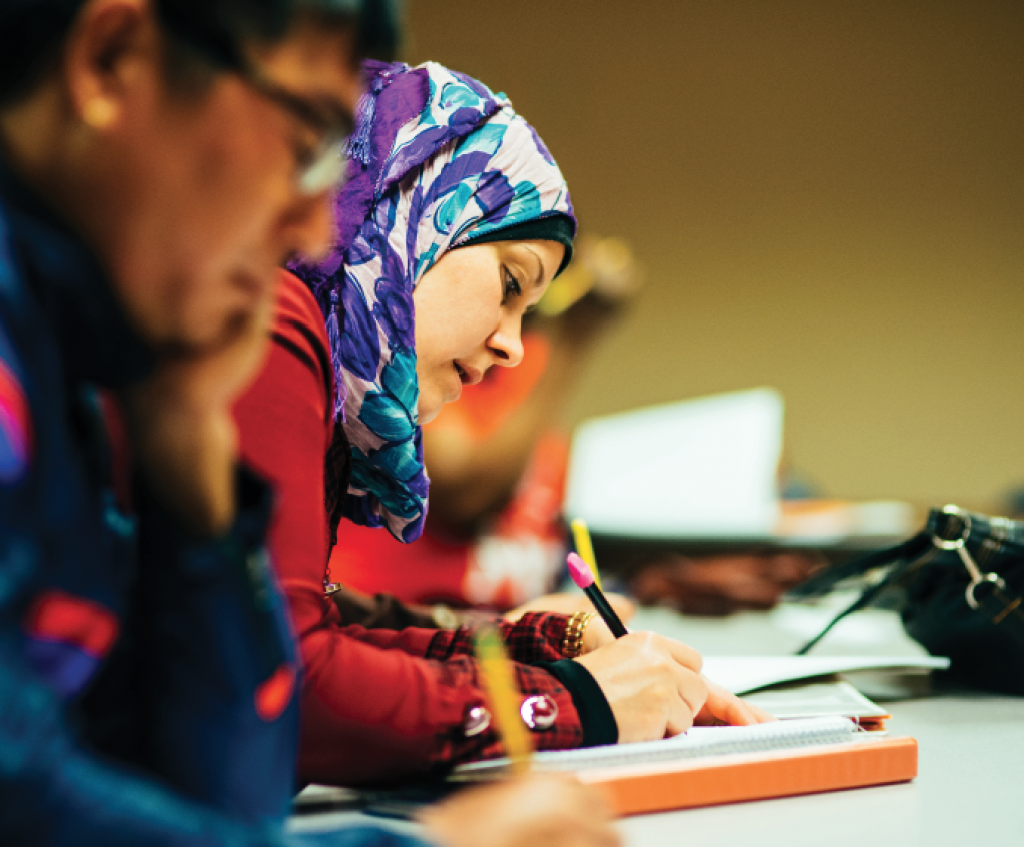
On a clear, cloudless morning in suburban Harrisburg, nine colorfully clad men and women work at tables in uninterrupted silence as teacher Charity Stowell exits the classroom briefly.

Their stillness is not merely a product of studiousness.

The students do not speak English fluently, and most do not speak the same language as the person seated to their right or left.  

All are attending a free English as a Second Language (ESL) class, held from 9 a.m. to noon Monday through Thursday each week.

Sponsored by Catholic Charities’ Refugee Resettlement Program under the auspices of the Diocese of Harrisburg, the classes unfold in the basement of a nondescript office building in Lower Paxton Township. About half the learners are from Bhutan and Nepal. Others hail from the Congo, Sudan, Pakistan, China, Syria and South Korea.

Interpreter Shira Adhikari, 30, and a young, bespectacled interpreter who speaks Arabic, are close at hand to help.

Adhikari was born in Bhutan, a landlocked country flanked by India to the south and China to the north. He and tens of thousands of other Nepali-speaking Bhutanese were raised in cramped, primitive refugee camps in the shadow of the Himalayas, as the nation’s leaders embarked upon a systematic ethnic cleansing campaign designed to build a homogenous race.  

Adhikari’s cell phone still holds photographs of the thatch-roofed huts in leafy villages that were home to refugees living a life “more miserable than you can imagine.”

ESL services Manager Sarah Beck said that many Americans conflate immigrants with refugees, but these terms should not be used interchangeably. The refugees now living in Harrisburg had no choice but to flee their country of birth. They are carefully vetted and came to America to save their families from persecution, as any parent would do.

Adhikari holds a master’s degree in physics. He relates the tale of his own parents, who have been in this country for four years. Their apartment is surrounded by refugees from other countries. Despite the language barrier, the children all play together, the adults all wave to each other, and neighbors shovel each others’ walks, clearing away the pure, powdery snow that most have seen for the first time.

When their neighbors speak kind words in a language that is foreign to them, the Adhikaris’ response is automatic. They smile, deliver two thumbs-up and say, “Everything is good.”

That sentence encapsulates how they have found every detail in America—the lights that always work; the clean, clear water that runs hot and cold, night and day; the dwelling space that is cavernous compared to their closet-sized huts; the drawers that are stuffed with clothes; and the grocery store shelves that are dense with a dizzying variety of cartons and cans, fresh fruits and vegetables.

It is a far cry from Bhutan, where rain streamed in like a garden hose through the roof during storms and food was so scarce it was rationed. Clothing was extremely limited. Fires were frequent. When one hut burned, they all went up in black smoke.

“We could see the moon from our bed,” Adhikari said. ”The roof blew off often.”

Today, in Stowell’s classroom, the young Messiah College graduate is teaching the refugees how to ride a bus. Few have their driver’s license, but as soon as they receive their Social Security card, they will try to get jobs.

The classroom’s whiteboard bears these words, written in magic marker: “Stay in your seats. Listen to your music with headphones.”

One refugee was called to the center of the “U” to assume the role of bus driver.

Stowell gently corrected a student who had written that pets were allowed on the bus. Paying the fare and watching your young children were also part of the lesson.

“The class is like a one-room schoolhouse,” Stowell said.  

Some students have never been to school, never learned how to write their names. Others have advanced degrees in their native countries. Volunteers help to personalize the instruction.

Like the turmoil in the world, “the class is constantly rotating,” Stowell said. When Cuba was in political crisis, Cuban refugees populated the class.  

Colleen Wisor Patterson, a young student support specialist with the migrant program, which works closely with Catholic Charities, helps the children of refugees cope with the trauma of life in Bhutan and then the double-trauma of leaving it all behind. She is keenly aware of the politically charged climate in which they are aiding refugees. She said many Americans choose to either demonize refugees or glorify them.

She recalls one citizen who whipped out his cellphone when he saw the hijab on a woman, ready to call 9-1-1 or record events.

“We see a lot of snap judgments, based on appearances,” she said.

She emphasized that the refugees are just regular people, wanting to be accepted and trying to make a better life for their families.

Sunita Rai is a 20-year-old refugee, a small-boned woman in Stowell’s class who was born and raised in a refugee camp in Nepal. Her parents are Bhutanese. Her mom is here in America. Her father passed away.

“America is very nice,” she said in English.  

Her favorite new word: “OK.”

For her, Harrisburg’s vast array of flowers—and elevators—were among her most dazzling discoveries here.

Beck said that, since 2008, some 8,000 Bhutanese and Nepali refugees, rejected by their government, have been resettled in the Harrisburg area. Adhikari said the program resettled about 300 refugees last year, with the majority hailing from Bhutan. The refugees receive help with life skills, language, housing and jobs.   

How to use a debit card, write a check, follow directions on a pill bottle, and ask for directions are some of the first skills taught.

Beck noted that only about 1 percent of the world’s refugees are resettled. With more than 21.5 million people considered to be refugees worldwide, each country picks the numbers they can take. In the past, the United States agreed to take about 80,000.

Many refugees are settled together in apartments on Green Street, which can be challenging when families are large and multi-generational. The program’s goal is independence within three months.  

Many refugees find jobs in the midstate’s vibrant warehouse, packaging and health care industries. Many enroll at HACC. Often, they work two and three jobs, double shifts, Patterson said, and are “extremely entrepreneurial.”

Stowell quotes one refugee as he adjusted to America: “I had to be like a baby again.”

As they cope in this brave new world, “Mostly they just need a friend,” said Patterson, someone to visit, to take them to appointments.

She finds that most refugee children suffer from severe loneliness, trying to transition from the trauma in their native land to the trauma of separation and a strange new land.

One bond the class all seems to share—how laughably bad Google Translate is, Stowell said.

But everything else—all good.  

“They love the house, the food, the clothes,” said Adhikari. “There is fresh air. There is peace in America. There is no one knocking at their door at midnight. In America, they can sleep here fearlessly.”

He is eager for the day he can take the formal oath as an American citizen.  

“We can work independently,” he said. “We can live independently. We can live our own life. This is the dream place for people all over the world.”

One hand signal they all seem to know transcends the barriers of language and culture.

When asked where they would be without the refugee program, they all speak in their native tongue in a verbal deluge of gratitude, and then, reflexively, they touch their heart.

June 20 is World Refugee Awareness Day. For more information about Catholic Charities, Diocese of Harrisburg, including immigration and refugee services, visit www.cchbg.org.

Author: Diane McNaughton

Continue Reading

Be Alert, Save a Life: 8-year old’s family honors his memory by raising awareness of distracted driving.

Screenshot 2016-06-23 14.42.47Owen Cole Brezitski would have turned 13 this year.
A polite, curious kid with a contagious smile, you never had to remind Owen to say “please” and “thank you.” He was a leader in his classroom, a skilled soccer and baseball player and, more than anything, loved his parents and sisters, Makenna and Kyla.

On March 17, 2011, Owen was taken from this world far too soon—the victim of a distracted, 17-year-old driver. Owen, a second-grader at Holy Name of Jesus School, was struck in a marked crosswalk as he and his family left the former Bishop McDevitt High School on Market Street. They were on their way to McDonald’s for Shamrock Shakes after watching the girls perform at a school concert.

It’s been five years since the tragedy, and Owen’s mother, Karen Brezitski, often wonders what her son would be like today. She sees the hurt in her husband Mark’s eyes when spring rolls around, knowing he would love to have just one more baseball catch with his boy.

“I miss the lost potential,” Karen says. “What could have been, what should have been— that’s the heartbreaking thing.”

The tragedy that turned the Brezitski family’s lives upside down in a matter of seconds is an all-too-familiar story.

The AAA Foundation for Traffic Safety recently released a study on distracted driving. It found that 60 percent of teen crashes involve distracted driving. The summer months are the worst. According to AAA, in the past five years, more than 5,000 people have been killed in crashes involving teen drivers during what it calls the “100 Deadliest Days.” This is the period starting Memorial Day through the end of the summer.

It’s not just cell phone use that causes distractions. The study found the biggest distraction is other passengers in the vehicle. Texting or operating a cell phone and attending to something inside the vehicle are the other top distractions.

There are many ways a driver can be distracted. How often do you notice another driver on their phone, head lowered, while dangerously operating a two-ton vehicle? Maybe you do it yourself.

Whatever it is, it can wait. The motto of Owen’s Foundation is as simple as it is powerful: “Slow Down, Be Alert and Save a Life!”

There are days Karen says she has difficulty getting out of bed. But her mission to save lives through sharing her story is part of what keeps her going.

“I want to help make sure no other family suffers a loss like ours,” she says. “No one is 100-percent distraction free, but examine your own behavior and, if what you’re doing is risky, maybe it’s time to change to protect your loved ones.”

In telling her story, there are moments when Karen is close to tears. She, along with her husband and daughters, are incredibly strong and courageous people. Just after Owen’s funeral, Makenna and Kyla knew they had to honor their brother.

The girls—now 19 and 16—decided to make orange wristbands since orange was Owen’s favorite color. The wristbands grew into a foundation, and, when the foundation became too large for Karen and Mark, they brought in The Foundation for Enhancing Communities (TFEC) to help.

Through it all, thousands of dollars raised and awareness spread, Karen’s orange band remains permanently affixed to her wrist. Starting to fade, it’s a stinging but motivating reminder of what she now believes she was put on earth to do.

In addition to spreading awareness, tangible results in improving driver and pedestrian safety, along with community improvements and opportunities, have emerged from Owen’s Foundation.

The foundation purchased and installed solar LED crosswalk signs at the former Bishop McDevitt High School. They have since been transferred to the entrance of the new campus in Lower Paxton Township.

The foundation donated money to South Central EMS for new cardiac monitors. It also purchased new helmets and catcher’s equipment for Owen’s baseball association, PHR, and painted, furnished and decorated a new bedroom at the new Silence of Mary Home on Market Street in Harrisburg.  Silence of Mary is a home for the poor, sick and dying.

It also set up the Owen Cole Brezitski Memorial Scholarship for a graduating Bishop McDevitt student attending any form of higher education.

Karen says her family’s ultimate goal is to pass legislation to change the rules for drivers approaching pedestrians in crosswalks. By law, drivers only need to yield. She wants drivers to be required to come to a complete stop at marked crosswalks. If they don’t, stiff penalties would apply, especially in school zones.

They are also working to offer free online driver’s education courses and behind the wheel training to novice drivers.

“Everything I do is always out of honor and memory of Owen,” Karen says. “Whatever I can do now helps me move on and feel better as a mom.”

Capital BlueCross has partnered with Owen’s Foundation in the annual “Orange Out” campaign to raise awareness of distracted driving dangers.

Matt Kemeny is a senior communications specialist at Capital BlueCross, one of TheBurg’s community publishers.

Owen’s Foundation is a charitable fund of The Foundation for Enhancing Communities (TFEC). Orange 4 Owen is a project of TFEC, fiscal sponsor. The official registration and financial information of TFEC may be obtained from the PA Department of State or by calling toll-free, within PA, 1-800-732-0999. Registration does not imply endorsement.


Continue Reading

House Hunters Harrisburg: As amenities, confidence grow, so does interest in living in the city.

Screenshot 2016-02-26 16.41.00A year ago, Jared Blouch packed up his belongings and did something that, until recently, would have seemed decidedly backwards.

He sold his house in Mechanicsburg and moved into Harrisburg.

He was tired of the commute and traffic into the city each day, he said. So, he found a beautiful, historic house that he also thought was very affordable and started a new way of life that included—egads—walking.

“I like that everything is so close, and I don’t have to drive far,” said Blouch, who purchased on Green Street. “I can get everything I want right there.”

Blouch became so enamored with his new neighborhood that he quickly became an activist for it, joining the board of Friends of Midtown and serving as president of the Olde Uptown Neighborhood Association.

Blouch’s introduction to Midtown Harrisburg could hardly be more different than that experienced by Ray Davis, who moved there in 1986.

“I bought my house on Green Street, and I drove my mother by and she looked at me, and she looked back at the house and said, ‘Are you serious?’” he said.

Davis, a familiar licensed real estate agent in central PA, and particularly in Harrisburg, laughed as he recalled the memory.

“She had no experience with city living,” he said. “So, she put her hand on my knee and said, ‘Is it safe?’”

In those three decades in Harrisburg, Davis has seen many changes—from the transition of the plasma center on Reily Street to the current Midtown Cinema; from rows of empty buildings to the recent surge of new businesses in Midtown.

“We didn’t have anything—anything!” he stressed. “It was so different than it is now.”

Today, Midtown residents have numerous restaurants, nightspots and even a brewery among a long list of amenities just a short stroll away. In part, that’s what may be driving new interest in living in the heart of the city, said Davis.

“Comparing 2011 to 2015, there were literally twice as many sales,” he said.

In 2011, the data (price range of $50,000 to $250,000) showed that 49 houses were sold in the 17102 zip code, which includes North Street to Maclay Street and Front Street to N. 7th Street. In 2015, the same zip code totaled 99 units sold. Even more encouraging, the average time on the market for those 99 units was 87 days, just below the average of 90 days in the surrounding suburbs.


Faring Better

Wendell Hoover, Harrisburg’s other go-to agent, looked past the borders of the 17102 zip code to find that the dips and peaks of the average sales price over a six-year period told the same story.

Including data from downtown, Midtown and Uptown, the average sales price was $97,241 in 2010. In 2011, the average sales price dropped drastically to $85,339 then dropped further in 2013 to $75,058. The last two years have seen a reversal. The 2015 figures show a 22 percent increase since 2013 to an average price of $91,600.

The low numbers in 2011 were not unique to Harrisburg as the country experienced a bursting of the housing bubble. Harrisburg, however, was experiencing other challenges, financially and politically, over those years. Now, the opinion of the city has changed, said Hoover, who credited this improved perception as the main factor behind the current upswing.

“There were just so many negative things, and there were very few positive things before, so that’s the biggest trend—people have changed their viewpoint,” he said. “Whether they’re first-time homeowners or they’re investors, you need to have that confidence in the immediate market, and now a lot of people do.”


More Attractive

Hoover has been a realtor in central PA for six years and, during that time, he, too, has observed many of the changes in the city and optimistically foresees continued growth.

“Interest rates, although they might inch up, will remain relatively low, and the economy, although not good for everyone, has incrementally improved,” he said. “I don’t see much to stop this positive momentum, particularly as we get more things in Midtown.”

Hoover cited the opening of the Millworks and the expansion of the Harrisburg Midtown Arts Center as two important recent projects that have made the neighborhood more attractive to buyers.

“There are different venues I could point to, but it doesn’t necessarily have to be restaurants,” he said. “It’s just things that people can walk to.”

The desire to live in a walkable city is something that both Davis and Hoover have noticed from clients such as young professionals, first-time homebuyers and empty-nesters looking to downsize.

“I can’t put a particular amount of weight on it, but I believe the trend going forward is people wanting a house in a walkable community, and Harrisburg is definitely that,” Hoover said. “Some areas more than others, but that’s the biggest demand, particularly in Midtown. That’s a trend that I’ve seen for several years, but I’ve seen it grow in the last year or two years.”

The city’s walkability is not only attractive to potential homebuyers, but also to renters. The rental market is another facet of Harrisburg’s housing market that’s been trending up.

“The rental market was always good and remained good,” Hoover said. “Even during the time when people didn’t have the confidence in the overall market, they were at least willing to rent. They wanted to be in Midtown, they wanted to be in Uptown, but they weren’t convinced that maybe the market wasn’t going to get worse.”

And, in fact, developers have been responding to the growth in rental demand, with many new apartment buildings—particularly high-end renovations of historic buildings—coming on the market over the past couple of years. LUX, Walnut Court and COBA are a few examples of recently renovated multi-dwelling buildings. This year, both Harristown Enterprises and WCI Partners will add significant new rental inventory to downtown and Midtown.

Some of those renters eventually turn into homeowners.

“Renters who are renting upper-end properties, if they decide to stay, or when they decide to stay here, they turn into really good buyers,” Davis said. “They’re having a good experience in the city, and they want to stay.”

Both realtors also have had a growing number of clients moving to the city from larger metropolitan areas. These buyers, or renters, are attracted to Harrisburg because of the amount of space they can get for their hard-earned money compared to the cities they came from, the realtors said.

“Folks coming from those areas really help our values because they see value where natives don’t,” Davis said. “But do I see a big trend of that? I don’t know if it’s a huge trend, but it’s happening.”

What do the next five years hold? If demand continues, perhaps developers will begin to build single-family homes. The city’s new construction market—unlike the growing multi-family segment—has seen little action for many years.

“The city isn’t like Lower Paxton Township or Silver Spring Township, where they’re building new stuff all of the time,” said Davis. “[Zip code] 17102 doesn’t really have anywhere to go other than a few townhomes up at the [Broad Street] market.”

So far, Blouch appears happy with his choice to ditch “the boonies” for city life. Not only is he within blocks of places like Little Amps Coffee Roasters, Alvaro Bakery and Zeroday Brewing Co., but he’s met “tons” of people in his first year in Harrisburg.

“This works for me because I’m very social,” he said. “I’m more of a city person. I like being around other people.”


Continue Reading

Livin’ the Cream: Pastries rise to the top at Brew Crumberland’s Best.

Screenshot 2014-11-25 17.16.45Laurel Weiser never wanted to work for someone else.

After finishing school and moving back to her hometown of Grantville, the pastry chef took jobs as a baker, first at the Hilton Harrisburg and later at the Hershey Hotel.

While she enjoyed the work, she dreamed of creating her own recipes and running her own business. Just when she felt she might be stuck as someone else’s employee, a speck of hope appeared at the end of her rolling pin.

Weiser’s aunt, Vicky, wanted to retire from Bridge Street Coffee Shop, the New Cumberland fixture she owned for about 15 years. Weiser decided it would be the perfect time for her to make a jump. After working alongside her aunt for several weeks, she officially took over the shop on Sept. 1.

“It suddenly felt like everything I had worked for would be worth it,” she said.

Weiser’s family helped her put her own touches on the shop décor, and she renamed it Brew Crumberland’s Best (pun totally intended). But new paint on the walls and a different furniture arrangement was just an aesthetic change. Bigger things were going on inside the kitchen.

A new espresso grinder and fresh roasted coffee beans delivered each week from Mosaic Coffee Company in Shippensburg were one part of a two-part menu redesign Weiser had in mind.

“A lot of places can offer you just one thing—either great tasting coffee or a great tasting pastry,” Weiser said. “They specialize in one thing, but I want to make sure we’re the best of both.”

When Weiser isn’t out front making specialty coffee drinks for regular customers, she’s back in the kitchen. It’s there that she finds the freedom to explore recipes she never had the chance to tackle when she worked in other places.

Her daily baked scones and muffins, most recently created with fall flavors apple cider and pumpkin roll, are her biggest sellers. Brownies and peanut butter pie are close seconds, but she soon hopes to break into more sweet breads, as well as cinnamon rolls, cheesecake and other desserts.

“I can do whatever I’m in the mood to do,” Weiser said of her creations. “The special thing to me is being able to see people’s reactions when they eat my food. I was always stuck in the back of a kitchen, making the same recipes every day. There’s something very unique to getting immediate feedback from people who eat what you create.”

The young business owner has big plans for her new endeavor. She hopes to eventually offer live music and have local art displayed on the walls.

“I really want to immerse myself in this community,” she said.

Meredith Brewster, who stopped into the coffee shop recently, said she happened to be passing through and needed something to get her through the rest of her day.

The Lower Paxton Township woman munched on a panini and snuck a scone into her purse for later.

“I never go to the big name coffee shops,” she said. “For me, the great thing about this area is that there are so many independent businesses. I always try to help them—especially when they make stuff as delicious as this.”

Jeremy Lewis of Harrisburg was on his way between business meetings when he decided to use the drive-thru for a late lunch the same day.

“I’ve come here a few times, always for the coffee,” he said. “When I find a place that makes a good cup, it becomes a regular stop for me.”

The comments of happily fed customers keep Weiser inspired. She’s always looking for something new to create, something else she can improve and another customer she can please.

“I’m exhausted every day, but I don’t think I’ve ever been so happy,” she said. “I’m learning a lot, and I have a lot of areas to grow in, but I’m happy to be on this path. I think great things are going to happen.”

Brew Crumberland’s Best is at 1903 Bridge St. in New Cumberland. Hours are Monday to Friday, 6 a.m. to 3 p.m., and Saturday, 7 a.m. to 2 p.m. For more information, call 717-774-6511 or search for “Brew Crumberland’s Best” on Facebook.


Continue Reading

A Community Is Built: Mr. Hodge and his vision of a neighborhood for all.

Rev. Susan Ashe (Hodge)

Rev. Susan Ashe (Hodge)

In the mid-1950s, a man named Elmo Hodge had a vision to develop a community of custom-built homes marketed to upwardly mobile blacks, a notion then unique in the region.

As a young girl, I recall my mother pointing toward a particular home and saying, “That’s Mr. Hodge’s house!” So, who was this Mr. Hodge and why should I care that it was his house? I wondered.

I would like to share a portion of his vision and journey, one that culminated with the creation of the Lower Paxton Township community of Hodges Heights.

For Everyone

Elmo Hodge was a pig farmer and trash collector who lived in Edgemont with his wife Sibbie and their eight children. His daughter, the Rev. Susan Ashe (Hodge), reminisced with me about growing up in Edgemont with her parents, four sisters and four brothers.

“Daddy raised pigs that were fed from the food scraps he picked up on his trash route in Camp Hill,” she said. “Some of his Camp Hill customers liked daddy so much that they would separate the food scraps for the pigs, and he sold his meat to the Swift Packing House.”

Her husband Charles told me how the Edgemont community would close down 25th Street each Labor Day. Mr. Hodge, an avid hunter, and other neighborhood men would cook wild meat and roast a whole pig. The women would prepare all the side dishes, and the entire community would have a feast.

In April 1945, Elmo Hodge decided to look beyond Edgemont, purchasing 137 acres of farmland in the southeastern section of Lower Paxton Township (near the new Bishop McDevitt campus) from the Anderson family, which caused a stir among the neighbors.

“These neighbors just couldn’t understand why Mr. Anderson would sell his farm to a black man,” said Rev. Ashe.

Mr. Hodge farmed for about a decade when a real estate agency offered him $175,000 for the land. At settlement, he found out that the developers were going to sell lots and houses to whites only, which meant even he wouldn’t be able to live there. Without a second thought, he turned down the money and walked out of the courthouse.

He farmed the land for several more years before deciding to develop the property himself, in the way he wanted. He became even more determined after people from the adjacent area signed petitions to keep him from developing it.

“Daddy dreamed of a community where people of all colors would be able to live together in peace and harmony,” said Rev. Ashe. “He then knew that the success or failure of this business venture to personally develop the property depended upon the availability of blacks to buy lots and build homes.”

Dream Realized

The Hodges Heights project began with 97 one-quarter acre lots. The parcels originally sold for $900 and eventually for as much as $2,000 per lot.

Elmo Hodge had a vision of a community of single-family homes, custom-designed with specific parameters. To provide a sense of those expectations, the following paragraphs were taken directly from a deed of sale dated Jan. 24, 1959.

“No permanent structure to be erected nearer than twenty-five (25) feet of the aside property lines, no house to cost less than fourteen thousand-five hundred ($14,500.00) Dollars, no tannery, piggeries, etc. No gasoline service station, taproom, hotel, nor any materials which are inherently dangerous, and neither garages for occupancy, nor dog kennels or chicken farms.”

For perspective, $14,500 in 1959 had the same buying power as $116,927 does today.

According to Rev. Ashe, her father originally brought a developer to the farm to discuss building homes and selling them.

“Daddy couldn’t get financed by the banks, so their deal never got off the ground,” she said. “His alternative plan was to sell the lots directly to prospective home owners, and they would secure the financing to build their custom homes.”

The plan worked.

Among the buyers were doctors, dentists, teachers, mid-level managers in the private sector and auditors. Many were proud graduates of HBCUs—historically black colleges and universities. The community was never a blacks-only endeavor, though the “original” residents of Hodges Heights were all black folks.

It is worth mentioning that the some of the children of these original families today are surgeons, dentists, a neonatologist, a Rhodes scholar, an investment banker (whom I babysat), tenured university professors, a truck driver, a professional sports figure, a colonel and federal government employees. What’s also noteworthy is that almost none returned to the Harrisburg area to build their careers.

Pride in Ownership

I sat down with my childhood dentist, Dr. Thaddeus Phillips, and his wife Marge. In 1968, they built their family home, where they raised five daughters and one son. They still live in that house today.

Dr. Phillips told me about the formation of the Hodges Heights Men’s Club, which functioned somewhat like a current-day homeowners association. There were annual dues, and one of the primary functions was to ensure property was properly maintained at all times—pride in ownership was the expectation.

Today, the club is called the Hodges Heights Neighborhood Civic Club.

“Dues are still paid and the club function has expanded to include providing gestures of comfort for those who may be ill around the holidays, giving gifts to high school and college graduates, having a Christmas luncheon and sometimes a bit of community activism,” said Marge Phillips. “Many of us petitioned to close a nearby landfill when radon was found in some of our homes, and we won.”

A resident who built in the 1950s added, “It was exciting to be able to build the home that you wanted and to know it was the first in the area to be an all-black, custom-built community.”

Elmo Hodge’s vision and dream has come to be. Today, Hodges Heights is a community that still boasts pride in ownership, and people of all stripes exist in harmony.

Wendy Jackson-Dowe can be reached at [email protected]. She would like to thank the Ashe family for sharing this important piece of history and pride for the greater Harrisburg region.

Continue Reading