Tag Archives: Ken Frew

Making a Home: Harrisburg couple’s historic house renovation documented by local filmmaker for national television

The Burchfields

At around 8 p.m. one night, Eva Burchfield called her husband Bruce to check in. Dinner was ready, and Bruce was still not home.

“She’s like, ‘where are you guys? Dinner’s ready and you’re late,’” Bruce said. “I was like, ‘we’re holding up the front of the house, not now.’”

He meant that literally. The front of the Burchfield’s fixer-upper was actually leaning. Water had crept in between the bricks and the turret window and froze, popping it off the house. Bruce was holding it up, desperately trying to save the structure.

“Those were the moments where I’m like, ‘what did we do?’” Bruce said.

In 2022, the Harrisburg couple embarked on a year-and-a-half-long renovation project at the dilapidated corner house on Kelker Street that would become their home. The project was more of an undertaking than the couple ever thought, even testing the perseverance of Bruce, a professional architect.

However, the Burchfields needed more space for themselves and their two young kids and wanted a home that would keep them in their tight-knit community. They were also suckers for a good historic property and saw renovating a blighted building as a way to make a positive impact on their neighborhood.

When the couple saw the chance to take a crack at the 1900-era house just down the block from the small home that they shared with Eva’s parents, they took it. They just didn’t realize quite how much work they were in for. They needed to gut the house if they ever wanted to restore it to its former glory.

“Next thing you know, all the walls were pulled off, windows were literally just hanging and swinging,” Bruce said. “I started taking them out one by one, and I remember Eva came up to the top of the steps and started looking around and was like, ‘all there is, is holes in this house.’”

Eva admitted, while she was excited about the renovation, she just couldn’t see Bruce’s vision at first.

“I couldn’t imagine it becoming a home because it was just bare walls with holes,” Eva said. “What did we do and how did we end up in this situation? I couldn’t see it.”

But eventually she did see it, and others caught the vision as well.

Harrisburg resident Adrian Selkowitz was out and about in the neighborhood with his son when he stumbled across the work on the Kelker Street house, a project already several months in.

It just so happened that Selkowitz’s film production company, Cowboy Bear Ninja, was on the hunt for a historic renovation project to document for an episode of the television show, “In With the Old,” which is broadcast through the Magnolia Network.

Bruce and Eva considered and decided it would be the perfect way to showcase the city they love, while also showing people—you can do this too.

The next day, Selkowitz was there with his team and cameras to follow the process.

They filmed for much of the year that the reconstruction project took to complete, delivered the episode to the Magnolia Network in the spring of 2024, and the episode aired on television earlier this year.

“It was challenging, but totally worth it, to give a full image on what really happened and to show Harrisburg was just totally worth it,” Eva said.

Same Canvas, New Story

The project was a whirlwind and a team effort, and, from Bruce’s point of view, it required spreadsheets. From the contractors to the film crew to the trips to Philly to source historic doors and trips to Amish country for woodwork, everything had to be coordinated.

“Bruce, probably because he’s an architect, already had a pretty detailed schedule,” Selkowitz said. “We created a shared spreadsheet and came up with a color-coding system. And then, you know, schedules are always shifting.”

But there were also the quieter moments, like when Eva’s father dedicatedly scraped the fireplace and mantel, chipping away for hours, then days, at years of paint that concealed beautiful wood, or when the couple worked with an architectural conservator to clean the unique tile entryway.

While much of the interior of the house needed to be demolished, there were also many gems that remained as “the jewelry of the house,” as Bruce described them. There were the original front doors and hinges, upstairs stair railings and flooring. Other elements were lost or worn from time, but the Burchfields recreated them to match up—like the downstairs stair railing, the baseboards and newel posts.

“That idea of the stories that are layered over, but it’s still the same canvas, really resonated when we were renovating this because we kept thinking of all the previous families and stories that were in these walls, but we were going to write our own story,” Bruce said. “That’s what gave us hope. We could still use the canvas, which was the shell of the house, but our goal was to make this home ours so that we could write our own story on it. But the cool thing is you still see the little traces of the old.”

The couple also met with local historian Ken Frew, who uncovered stories from the house’s past. The stories of former occupants holding parties in the house, from excerpts printed in the newspaper, stood out to the couple, as they also love to host.

“Looking at the history and now looking at it here, that’s exactly what we wanted to do, we wanted to host people,” Eva said. “We wanted it to be open and welcoming for everybody that we know and love.”

Getting to that point certainly wasn’t easy, as there were scorching hot summer days, plumbing snafus and lots of busy weeknights and weekends. Bruce still worked a full-time job throughout the project, and Eva ran her Broad Street Market stand, Evanilla Donut Shop, until the market fire forced her to close in July 2023.

“It was grueling,” Bruce said. “It really was nonstop.”

However, both Bruce and Eva agreed that it was worth it. All the work left them with a light and airy primary suite, beautiful kitchen with custom cabinetry and personalized rooms for the kids.

In the episode of “In With the Old,” viewers can see the full transformation, from a gutted property, to a bright, clean, yet homey space. They can also hear from Bruce and Eva on the highs and lows of the process and see them discuss and make design decisions.

“It’s a lot to let a film crew into your life,” Selkowitz said. “There’s that extra layer that it adds of stress, and those two handled it with so much grace.”

For Selkowitz, who had filmed another episode of the show previously, working with the Burchfields was a treat, as he got to grow closer to his neighbors and friends through the process. He was also happy for the chance to give his hometown some national attention.

“When you live here and you do love your community and you know all the treasures, you know all the great things that are happening, you know all the amazing people, you do want to share that,” Selkowitz said.

Eva caught the home renovation bug and has already been nudging Bruce, trying to get him on board with another project. Bruce, on the other hand, is enjoying the less-chaotic life, for now, although he’s open to the idea in the future.

Both really want the best for their community and see the need for more houses in Harrisburg, like theirs, to be restored to their former glory.

“It’s heart-wrenching to see those beautiful homes gone or demolished or deserted. They’re irreplaceable. That’s what makes them unique,” Eva said. “We’re hoping to leave [our home] for a hundred more years for somebody else to enjoy.”

“Old Uptown Revival: The Heart of Harrisburg,” season six, episode seven of “In With the Old,” is available to watch on the Magnolia Network and can be found on several streaming platforms.

If you like what we do, please support our work. Become a Friend of TheBurg!   

Continue Reading

The Gift of HBG: Our writer digs deep to craft a hyper-local gift guide

ModSew Designs

Deck the Burg with boughs of holly. If you’re looking for holiday presents that are uniquely Harrisburg, our exclusive gift guide takes you on a culinary, artistic and heartwarming tour of the region.


Fa-la-la-la-la

Did someone say, “Give the gift of music”?

Timeless tradition: Hard to believe, but Stuart Malina has been music director of the Harrisburg Symphony Orchestra since 2000. So, it’s the perfect time to make 2025 concerts part of your giving. Celebrations for this 25th season include Malina Madness 2.0, when the maestro himself conducts and plays the ever-popular “Rhapsody in Blue,” May 17 and 18. Christmas stockings around town are already pre-stuffed with tickets for the dazzling acrobatics of “Cirque Goes Broadway!” on May 3 and 4. www.harrisburgsymphony.org

Bearing gifts: Give your clubbing friend tix to H*MAC’s lineup of electronic dance music masters, including Bear Grillz (early Christmas present, Dec. 6) and HE$H (Jan. 18), a rising star in dubstep (yeah, I had to look it up. It’s a type of EDM.) www.harrisburgarts.com

Joyful sounds: Since 2019, proceeds from sales of “Joy to the Burg” CDs have had a real impact in sheltering and supporting the homeless of Harrisburg. The 2024 compilation brims with local musicians delivering the sacred and the silly. No Last Call marches to “The Dreidel Song.” Stars in Sapphire sings a haunting “Coventry Carol.” And Rick Pawelski and the Flying Matlocks strike a very Burg-y note with Pawelski’s “Party with Santa,” as he sings, “From the north to the south, the 717 is ready to party with Santa. We’re gonna give it our best on the east and the west shores of the Susquehanna.” The song evokes seeing old friends for the holidays, Pawelski told me. Plus, he said, “Once I figured out that Santa sorta rhymes with Susquehanna, I had something to work with.” www.joytotheburg.com

Star bright: Sankofa African American Theatre Co. presents “Black Nativity,” Langston Hughes’ retelling of the Nativity story through gospel arrangements of traditional carols and spirituals. Directed by the remarkable Sharia Benn, with music directed and arranged by Brian McGrady, “Black Nativity” shines new light on an ancient story, Dec. 6, 7 and 8. www.sankofatheatrehbg.com


Bless the Poor

Honor a loved one with a gift that makes a difference in your community.

To market, to market: With support of the community, the fire-damaged Broad Street Market hasn’t broken its streak as the nation’s oldest continuously operating farmers’ market. Gift a loved one with a Friends of the Broad Street Market membership, for early-bird access, discounts for BSM events such as the popular Paint & Sip, and, of course, a tote for filling with market produce, pretzels, deli meats, candy and doggie treats. www.broadstreetmarket.org/friends

All is calm: A gift to the YWCA Greater Harrisburg transforms lives. Maybe it’s the 4,100 women, children and families who receive crisis services each year, or the 1,000 individuals and veterans who get residential support. For the holidays, generous donors fill the YW wish list with linens and activities for kids, while they step up with gift cards for gas and groceries that go directly to YWCA clients working their way out of domestic violence and homelessness. www.ywcahbg.org

Tzedakah: With its move to the Alexander Grass Campus for Jewish Life, the Jewish Federation of Greater Harrisburg reaffirmed its commitment to uplifting every member of the community. Donations, naming opportunities and legacy-giving help sustain the federation and its showcase campus as sources of learning, health and culture for children, adults and senior citizens. www.jewishharrisburg.org


Five Gold Rings

Help a loved one wear a bit of the Burg—and TheBurg.

Don we now our Stay Apparel: Here’s wearable Harrisburg history, with Stay Apparel’s USA-made T-shirts, hats and accessories adorned with logos and ads from the 20th-century bars, breweries and teams of Harrisburg and central PA. I like the art deco “Refresh with Graupner’s Silver Stock Lager Beer” tee, recalling the legendary Harrisburg brewery that was run, for a time, by the founder’s indomitable widow. www.stayapparel.com

Gear up: Show off your Burg-er pride with TheBurg’s black unisex sweatshirt, women’s white cropped sweatshirt and black or white Walnut Street Bridge tee. They’re the perfect gift for a post-feast walk along the river. www.theburgnews.com/burg-gear

O PA tree: Your hiker friend needs a bit of the trail to take along everywhere she goes. Richelle Dourte of Boiling Springs-based Metalledwith hikes the woods of Pennsylvania every spring and forages for new growth on native PA trees. Then she casts her minuscule, three-day-old leaves in resin and handcrafted metalwork to create delicate necklaces and earrings. www.metalledwith.com, www.villageartisansgallery.com


Deck the Halls

The holidays last a few weeks, but art abides.

Junkster’s paradise: From the Williams Grove flea market to summer yard sales, Jason Lyons finds trash that he turns into treasure. The Harrisburg-based repurposing sculptor transforms saddles into armadillos and typewriters into fish. www.jasonlyonsarts.com

The river rocks: From the Rockville Bridge at sunset to a morning glow on the water, the Susquehanna River inspires artists to capture its mystery. Find local scenes from local artists, including Jonathan Frazier, Carrie Wissler-Thomas and Susan Benigni Landis, at The Smith Gallery & Fine Custom Framing, New Cumberland www.fineart2u.com. Other places to nab art locally include the Art Association of Harrisburg (www.artassocofhbg.com), the Millworks (www.millworksharrisburg.com) and almost any other area gallery.


Reindeer Games

Time out! Take a play break.

Put me in, coach: During the winter solstice, we light candles to chase away the darkness. Or, we can conjure sunny summer days by putting a baseball under the tree, wrapped in Harrisburg Senators season tickets. www.milb.com/harrisburg

Ice, ice baby: The scrape of the skates. The swish of the sticks. The whirr of the Zamboni. Sounds like the AHL Hershey Bears are back with world-class hockey. I must check out the Dec. 22 Berks Holiday Ham Shoot. No, you don’t shoot hams. You shoot pucks for a chance to win a ham. www.hersheybears.com

Run, run Rudolph: Lace up the sneakers and fulfill your New Year’s resolution to train for 2025 YMCA-sponsored races, which will include a half marathon, the always-fun HBG Mile and, of course, the venerable HBG Marathon, among other races. In just a few months, you’ll be in good enough shape to compete with the field. www.hbgyrun.org

Cuddle up: ModSew Designs from New Cumberland’s Rebecca Adey offers stuffed toys with Midcentury Modern flair. Whimsical deer, elephants and octopi just beg to be loved. Millworks Studio #322, www.millworksharrisburg.com/artist/modsew-designs


Beautiful Sight

That Dr. Who TARDIS ornament isn’t an actual time machine. Give the gift of genuine time travel with a piece of Harrisburg history.

Snow scene: When I worked in the Pa. Capitol and had a window looking up at the dome, I felt like I was in a snow globe every time it flurried. The 2024 Capitol Preservation Committee ornament evokes that feeling with its depiction of the Capitol on a winter’s day. www.store.cpc.state.pa.us.

Laying the foundation: Every building in Harrisburg tells a story, and intrepid historian Ken Frew uncovers their tales, from 1719 to 1941, in “Building Harrisburg.” Frew’s monumental compendium brings to life Harrisburg’s architects and the landmark buildings they created amid controversies, confabs and clashes. www.Dauphincountyhistory.org/gift-shop

Traverse afar: “Along the Bethel Trail: The Journey of An African American Faith Community” focuses on the history of the Bethel African Methodist Episcopal Church to distill the story of Harrisburg’s Black community in all its resilience, faith and fight. www.amazon.com, www.dauphincountyhistory.org/gift-shop


Local Flavor

I don’t know what figgy pudding is, either. Let’s try these Harrisburg tastes, instead.

Visions of sugarplums: The legacy of Matangos Candies founder Christoforos “Pop” Matangos lives on in the sweets he first learned to make in Istanbul. You’ll still find them, including the impossibly thin and irresistible Venetian mints, in the shop he founded in Harrisburg’s Allison Hill. www.Matangoscandies.com

Cookie monster: You know what’s better than a gift card? Cookies, especially if they come in a gift basket bursting with flavors of your choice, plus three gaily decorated sugar cookies and two gingerbread men. Cece’s Cake Shop has been delighting Harrisburg-area sweet tooths since 2020. Gift a holiday-themed cookie platter, cake pop bouquet, or gingerbread house kit, and grab a few limited-edition cakes and cookies in cranberry almond and eggnog flavors for yourself. www.cecescakeshop.com

Hopping mad: This elf doesn’t stay on the shelf for long. Mad Elf from Troegs Independent Brewing is a seasonal staple, in all its 11% ABV glory. Taste the holidays in every sip made with cherries, Pennsylvania wildflower honey and winter spices. www.troegs.com/bee/mad-elf

Yuletide spirits: Midstate Distillery is the hometown go-to for craft spirits and fun events. Gift an unexpected infusion (Fruity Pebbles, anyone?), meticulously crafted classic such as the nine-botanicals gin (my fave), or a Pennsyltucky bourbon made with PA grains. Crack open the Scratch Batch Cinnamon Vanilla Vodka, and stir up Midstate’s recipe for the winter’s apple cocktail. www.midstatedistillery.com

If you like what we do, please support our work. Become a Friend of TheBurg! 

Continue Reading

A Statue Story: After stumbling on an old family photo, a Harrisburg woman goes on the hunt for a missing elk.

Crystal Skotedis atop the elk at the scrapyard.

“We’re driving down some side streets, and I see it in a junkyard.”

Yes, a majestic statue of an elk would stand out. Crystal Skotedis thought her search for a forgotten piece of Harrisburg history—ostensibly what this story is about—had hit a dead end. Suddenly, there it was, as if the call of the elk had lured her to this spot.

Where to start? With the well-traveled statue, or with Skotedis’ sleuthing that led to new connections in family and Harrisburg history? Let’s begin with Skotedis.


The Photo

Visiting her grandmother in North Carolina, Crystal Skotedis was poring through family photo albums. A sepia picture of her great-grandmother and an unknown woman sitting on a bronze elk seemed jarringly whimsical.

“These people were from Lewistown,” Skotedis told me. “They never, ever traveled. They were farmers. For her to go to a destination and climb on top of a bronze statue, it was kind of surprising.”

She turned over the photo. “Harrisburg, Penna,” it said.

“What are the chances of that?” Skotedis marveled. “That’s where I live, and I have never seen this elk in my life.”

So many questions. Who was that other woman? Why had Skotedis never seen this elk? Where was it now?

An internet search revealed a PennLive story on Harrisburg’s monuments, and there it was—an elk erected in Reservoir Park by Elks Lodge #12, Harrisburg, PA.


An Elk Rises

In 1896 and 1897, Harrisburg attorney Meade D. Detweiler served as Grand Exalted Ruler of Benevolent and Protective Order of Elks of the USA for an unheard-of two terms. In that age of joining, he was renowned for his oratory and as the only person with “nerve sufficient,” in the words of one newspaper, to mediate disputes among warring Elks factions.

After the national Elks disbanded Harrisburg’s first Elks lodge, Detweiler recruited leading lights for a new lodge and, with his national clout, fought off other lodges for a coveted low number that had become available. In June 1904, just as national officers were arriving in Harrisburg to celebrate initiation of B.P.O. Elks Lodge #12, Detweiler fell ill and died, age around 38.

In October 1906, Reservoir Park resounded with speeches, poetry and music. Hundreds gathered for a ceremony dedicating Lodge 12’s Detweiler memorial, a $10,000 edifice of towering column, Detweiler bust and statue of an elk.

The work would “forever stand as an emblem to those beautiful, ennobling, uplifting, humanitarian principles of your order: Charity, justice, fidelity and brotherly love,” said Charles A. Disbrow, then-president of the city parks board. “In accepting the care of this handsome monument, which you have so generously presented to the city as an adornment of this park, the Park Commission promises you to cherish and preserve it in its present artistic beauty.”

By “forever,” Disbrow apparently meant about six decades. Someone broke off a tip of the horns that, in Elks lore, represent the spreading antlers of protection. Around 1966, Lodge #12 moved the statue—first, to its lodge in downtown Harrisburg, and then to guard its new lodge on Woodlawn Street, near the city line with Paxtang borough.

In those intervening generations, the statue became a destination. Locals and visitors would trek to Reservoir Park and hoist themselves on the back of the elk. Someone would pull out a Kodak Brownie and snap a pic.

Dauphin County Historical Society archivist Ken Frew helped Skotedis unearth the statue’s history.

“I’m pretty sure I have a photograph of me sitting on it or beside it when I was little,” he said. “It was a favorite spot for parents to take their children to get their picture taken.”


The Great Find

Jenny. That was the other woman on the elk, the sister of Skotedis’ great-grandmother. Skotedis learned this when her grandmother suggested that she connect with the daughter of her great-great-grandfather’s brother—still in Lewistown and a keeper of “generations of old family photo books.”

“She let me borrow her life’s work to take home and enjoy,” Skotedis said. “At this point, I’m anxious to see if I can find this statue. Maybe I can sit on it and re-create the photo.”

Skotedis dragged her husband to the Elks lodge, but the building recently had been sold. Her next thought—drive to Reservoir Park and take a photo at the statue’s pedestal, standing in the footsteps of her great-grandmother, named Zelda Irene Harshbarger.

That was when they passed that scrapyard. The gate was open. No one answered at the office. Skotedis hopped on the elk, her husband snapped a photo, and they darted away.

Worried that this “relic of the history of Harrisburg” would be melted down, Skotedis contacted Elks Lodge #12 and got a return call from Exalted Ruler Robert “Bullit” Martindill.

“He was wonderful,” she said. “He was as robust an Elk as you’d want someone to be.”

Sigh of relief there. The elk will not be melted down. The scrapyard belongs to a lodge member who accepted the statue for safekeeping after the Woodlawn Street building sold. It might even move temporarily to West Shore Lodge #2257 until Lodge #12 finds its new home.

Lodge #12 is devoted to community service, sponsoring youth events, supporting veterans and presenting drug awareness programs, said Martindill.

“That elk shows that we’re there for the community, and we’re here to spread goodwill and do what we can to help out,” said Martindill. “That’s why it’s important to keep the elk intact and have it displayed in front of our Elks building or any Elks building at this time.”


City Beautifying

So, they erected a monument in 1906. What else was going on in Harrisburg back then?

Oh, just construction of a water treatment system to eradicate the scourge of typhoid. And the paving of impassable dirt streets. And creation of a parks system that sparkles to this day. And the dedication of a grandiose state Capitol building.

Embracing the City Beautiful movement, Harrisburg was transforming from a swampy, disease-ridden backwater to a capital city.

“Statuary was a big part of it,” said Frew. “I’m sure that the Elks monument was part and parcel of that movement.”

With a career in public accounting, Skotedis is a principal with Boyer and Ritter LLC and a Harrisburg resident since 2003. She feels “appreciation and gratitude” for those City Beautiful pioneers and, following in their footsteps, serves on the Capital Region Water board.

“You can kind of transport yourself into that timeline and get energized by the passion of those people who were establishing a community,” she said.

Skotedis texted relatives with the play-by-play of her elk hunt, including the discoveries in their own heritage. There was the ninth great-grandfather who was the first Amish bishop to settle in Pennsylvania. An uncle helped test the first space shuttle and joined investigations into the Apollo I fire.

Mostly, Skotedis gifted her beloved grandmother, Doris Reed, with stories that brought young Zelda to life. As a businesswoman with a positive spirit, Reed was “my living, breathing example of a woman in business who was really assertive and really empowered,” Skotedis said. “I know 1,000% that’s one of the reasons I knew I could go into public accounting in a still very male-dominated field.”

Martindill, of Hummelstown, is a retired police officer still living with injuries sustained while rescuing inhabitants from a burning house that exploded around him. While other civic organizations bleed membership, he is busy initiating new members eager to serve.

“The young people mingle with the older crowd, and they’re respectful and they learn things,” he said. “In order to go forward in life, you need to understand what all us old farts have gone through to give you some direction.”

Skotedis sees that commitment to service in her search. She met people passionate about the community. She uncovered a quirk of Harrisburg history that draws others into its orbit. She found a statue and, she hopes, will follow its journey, wherever it leads.

All from a sepia photo marked “Harrisburg, Penna.”

“If you peel back a couple of layers, you’re not that far unrelated from people who walk down the street,” said Skotedis. “Holy cats. The elk really unified our family in a whole new way.”

For more information on Harrisburg Elks Lodge #12, visit https://bpoe12hbg.wixsite.com/website or their Facebook page.

If you like what we do, please support our work. Become a Friend of TheBurg!

Continue Reading

Toil & Service: On a search for the origins of the Irish in Harrisburg

Michael Burke. Photo courtesy of the Historical Society of Dauphin County.


Dennis Dougherty. Tillie and Patrick Conway. Timothy P. O’Leary.

If you’re looking for Irish Harrisburg, look under your feet. Actually, look six feet under at Mount Calvary Cemetery. It’s the compact graveyard at 13th and Berryhill streets that you’ve probably passed without noticing (I know I have). The grounds are neat, but the last plot sold here was in 1920, making the cemetery feel—forgive me—not lived-in.

Harrisburg’s Irish history is well hidden, but you can find pieces of it here at Mount Cavalry, in stories of heroism, humanity and hope.

Forgotten Man

Lynch. O’Sullivan. Here’s a Reagan. There’s a Kennedy.

No doubt about it. Mount Calvary was the last stop for Harrisburg’s 19th- and early 20th-century Irish community. There are three bishops here, as well as an Irish-born physician buried under a grandiose Celtic cross and America’s first Irish-born Medal of Honor winner (more on him later). The Patriot-News once called the site a “who’s who of prominent Catholics of yesteryear.”

But I was there on a search for the forgotten man. Some of the bodies here made a second journey after their first burials. They were originally interred at the graveyard of the first St. Patrick’s Church on State Street. Many came from the Irish community nestled in the vicinity. During church rebuilds in 1902 and possibly earlier, around 1868 (there’s a bit of confusion here), the dead were reinterred in this little country graveyard high atop Allison Hill. More may have been moved in 1902, with construction of today’s St. Pat’s. Today, trucks rumble past on I-83.

Hard to say where these reinterments are, exactly. I couldn’t find anything like a mass reburial or ancient markers, so I spent my time communing with the Gilmers and Clancys and McGraths. And Hugo Schutzenbach and Joseph Aiello. No ethnic discrimination here, but non-Irish are definitely in the minority.

Michael Madden was not hard to find. Maybe 20 feet beyond the main entrance stands a stone—hefty but nothing elaborate, proclaiming, “MADDEN,” for eternity. A wreath obscured the name of beloved wife Annie, but there is Michael J. Madden, 1841-1920.

Born in Limerick, Ireland, Madden immigrated to the United States in 1855, hard up on the Great Famine that brought waves of Irish to this country. On Sept. 3, 1861, the strapping, blonde, hazel-eyed Madden was serving with the 42nd New York Infantry, known as the Tammany Regiment (“cannon fodder,” Ancient Order of Hibernians historian Michael Edmiston told me). On a reconnaissance mission, Madden and two comrades drew fire. One of them, John Coffey, was hit and couldn’t walk.

“If I left him lay,” Madden said for posterity, “he would have probably bled to death or starved in their Rebel dungeons.”

With bullets flying, Coffey rallied, and Madden walk-carried him to the water’s edge. From an island in the river, Madden’s company provided cover. The Confederates returned fire. Amid bullets zinging into the water, Madden put Coffey on his back and swam to safety.

The fresh wreath hanging on Madden’s Mount Calvary grave—honestly, one of the few signs of remembrance in these grounds that probably haven’t seen a burial in decades—is a “Wreaths Across America” recognition from the Cumberland County-based Ancient Order of Hibernians, Michael Collins Div. 1.

Madden would be wounded twice in 1862, at Glendale and at Antietam. In 1863, he fought at Gettysburg. In 1864, he was mustered out of the Union Army—and reenlisted.

“He didn’t get wounded enough,” surmised Edmiston.

Finally out with the war’s end, Madden came to the bustling railroad town of Harrisburg. While serving as a railcar inspector, he and his brother-in-law got a patent for a railcar brake. He was, said Edmiston, “a pretty interesting character.”

“If you have any doubt that there has been a substantial presence of Irish-born or Irish descent in this area, that cemetery is loaded with names that smack of the Old Sod,” Edmiston said.

First Cluster

In 1850 Harrisburg, the largest foreign-born group of residents was the Irish—421 people in a town of 7,834. Many didn’t stay long, perhaps moving north with railroad construction jobs.

But one group had been in Harrisburg and stayed, all the way to Mount Calvary. They were fairly well tolerated in the Know-Nothings age of rabid anti-immigration fervor. Funny little historical footnote: One exception to the area’s tolerance for Irish Catholics was a Harrisburg Telegraph and Morning Herald editor who relentlessly denounced the Irish as paupers filling the jails, living off taxpayers, and blindly obeying the pope. His name was Stephen Miller—just like former President Trump’s anti-immigrant immigration adviser.

Back to that first cluster of Harrisburg’s Irish. They came here in the 1820s to build the Pennsylvania Canal. The remnants of their labors are still visible in the filled-in canal beds behind the Glass Lounge and the Harris switch tower near the Forum, and in that watery trench fronting the Steelton steel plants.

A small Catholic mission had been located on Sylvan Heights since around 1810 but, according to Ken Frew’s “Building Harrisburg,” never got much traction. Canal construction provided a “ready congregation” of Irish Catholic immigrants, so the tiny church’s leaders moved to the riverfront where they lived. On a plot on State Street, the cornerstone for the first St. Patrick’s church was laid in 1826. Those canal workers built the church, named—it’s said—in honor of their national patron saint.

That humble building’s 1873 replacement gave way to the permanent St. Patrick’s Cathedral, dedicated in 1907. Tap on the floor somewhere in the St. Patrick’s sacristy, and the Irish-born canal and railroad contractor Michael Burke might tap back to say hello.

The entrepreneurial, civic-minded Burke made his way from Tipperary to Harrisburg. The outsider made his fortune working with the area’s native-born elites—many of them Scotch-Irish, which is a whole other story—to transform a sleepy community into a factory town, according to Gerald G. Eggert’s “Harrisburg Industrializes.”

Burke died in 1860 in a tale worthy of an Irish pub song, the victim of a freak accident involving a railway crossing, a carriage, a horse and a train cowcatcher. The horse was not injured. Burke was buried in the old St. Pat’s churchyard and, it appears, never re-interred to Mount Cavalry.

Burke is “buried under the floor under the present St. Patrick’s,” Frew told me. “The nearest we can figure, he’s still encapsulated there.”

Sisterhood

Around 1869, Harrisburg’s first bishop, Jeremiah Shanahan, wrote to his aunts, who were Sisters of Mercy in Chicago. Their order, founded in Dublin in 1831, had been sending women from Ireland to the United States since 1843 to serve the sick and the poor. Now, Shanahan needed nuns to serve his newly designated diocese.

On Sept. 1, 1869, six Sisters of Mercy boarded a train in Chicago and journeyed to Harrisburg, according to a 2020 story by Sister Regina Werntz in the newspaper, the Catholic Witness. For a time, their motherhouse was the Sylvan Heights home—later an orphanage that these sisters would run, and today, the landmark home of the YWCA of Greater Harrisburg.

The order’s Mother Clare bought a $10,000 property for the sisters on Maclay Street “with only $10 in the bank,” recalled one of the sisters. “There they prayed for coal and food, especially bread. The tombstones bearing the ages of young Sisters who died of tuberculosis . . . is proof of the poverty they suffered.”

The Sisters of Mercy went house to house, visiting the sick and braving open ridicule on the streets. They didn’t charge for their ministry, but lived on fees charged for music lessons and the tiny schools that they ran. Over the next decades, the sisters operated an infirmary in Harrisburg and a government school for Native Americans in Carlisle. They taught at Bishop McDevitt, Trinity and Delone high schools. In Lancaster in 1975, the order learned Spanish so that they could teach the children of Latino families. That same year, they aided refugees arriving at Indiantown Gap from Vietnam.

As I walked up the sloping hill of Mount Calvary Cemetery, I gasped at a striking sight—two long, back-to-back rows of tiny Celtic crosses. They are engraved only with names and dates. Sister Mary Francis Donovan, 1845-1918. Sister Agatha Horn, 1850-1921. Here is one who died young, Mother Carmalita Brady, 1884-1909. The Sisters of Mercy came to Harrisburg from Ireland to minister and educate. Here, they remain.

Support quality local journalism. Become a Friend of TheBurg!


Continue Reading

House Call: One of Harrisburg’s oldest buildings undergoes “paneful” examination

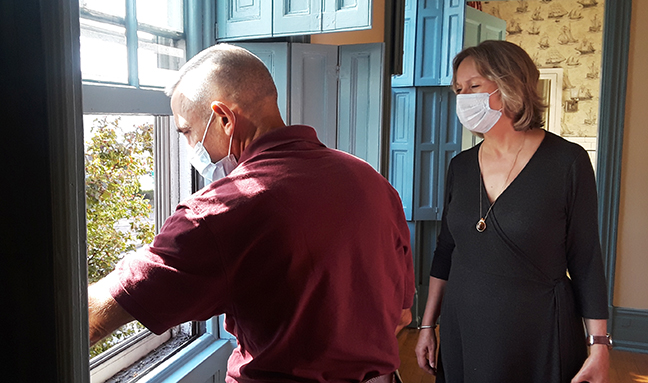
Restoration expert John Lindtner examines a window in the Haldeman Haly House as Karen Cullings, executive director of the Dauphin County Library System, looks on.

John Lindtner raised the question: Does it make sense to replace a window that has survived 200 years with one that might last 30?

“They say, in my world, that the greenest window is the window that’s already built,” he said as he diagnosed the health of a 200-year-old window. “It doesn’t make sense to fill up the landfill with these windows.”

The window restoration expert did, though, have a word about the storm windows that appeared to be approaching the half-century mark.

“You have my blessing to replace the storm windows, because I believe the storm windows can be improved,” he said.

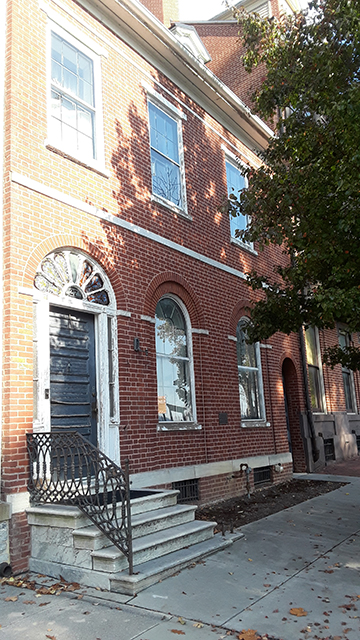
Lindtner was inside the library of the Haldeman Haly House (pictured), the Governor’s Row home called by architectural historian Ken Frew one of Harrisburg’s top-five most historic buildings.

Lindtner’s visit on Wednesday was a “house call” sponsored by Historic Harrisburg Association, funded with a gift from the Auchincloss Family Fund. He was there to advise Dauphin County Library System on the feasibility of restoring the windows of the circa-1812 home that the library acquired in 2019 to expand its programming, community, and administrative space.

The 5,458-square-foot house at 27 N. Front Street was built by Stephen Hills, architect of the first Pennsylvania State Capitol, and was home to Sara Haldeman Haly, whose bequest in 1896 seeded the Dauphin County Library System. The library system is running a capital campaign to raise $3.5 million to renovate and link the building to its McCormick Riverfront branch next door–the original branch built on the site of Sara Haldeman Haly’s garden.

“This building came to us like manna from heaven in a lot of ways because not only is this, obviously, right next to our library, but there’s a really important shared history here,” said Dauphin County Library System Executive Director Karen Cullings.

The Haldeman Haly House’s soaring, arched front windows face the Susquehanna River, Market Street Bridge and City Island. The north-facing side windows overlook the library roof, buildings along and behind Walnut Street, and–peeking above it all–the dome of the state’s 1906 Capitol, the second replacement of Hills’ creation, burned in an 1897 fire.

With the exception of a north-side sill rotted by water damage from broken spouting, the windows definitely merit restoration, said Lindtner, founder of Chester County-based Building Preservation Services.

“There’s absolutely nothing wrong with this window,” he said. “There’s just a lot of paint on it from close to 200 years.”

With weather stripping and good storm windows, which can be custom-made to fit unique shapes such as the Haldeman Haly House’s arches, a restored window can achieve respectable energy efficiency, he said.

Historic windows endure because they were built with old-growth timber, he added. “To replace these windows would be very much a mortal sin.”

The library has been advised to cover the windows for the winter, said Cullings. Lindtner concurred–with one caveat. Don’t seal too tightly.

“You want to have some opportunity for it to vent in the event it gets wet,” he said. “If it gets wet and can’t dry out, you’re creating a bigger headache.”

When panes need to be replaced, the “wavy glass” of the handmade age can be replaced with salvaged historic glass or even glass new-made with characteristically wavy touches. As Lindtner and Cullings investigated a top-floor room under the home’s dormered windows, Lindtner decided not to try to open one that housed a wasp nest.

“See what you inherited?” he asked Cullings.

“I know,” she said. “It’s lovely.”

Historic Harrisburg Association Executive Director David Morrison called the Haldeman Haly House the most historic house on Governor’s Row for its history across multiple centuries.

Cullings declared the building in “not that bad” shape, in need of cosmetic work but otherwise stable. She promised to “make it beautiful again,” like the historic library next door. Restoring the windows suits that theme.

“We definitely want to be able to preserve as much of it as we can,” she said. “Obviously, we have to deal with budgets, and we’re a nonprofit, but we’re hoping we’ll be able to preserve all of it, if we can. I like to feel like I’m honoring the heritage of it. I don’t want to be doing things to it that are going to make it look asymmetric and out of whack with what the original designers had in mind.”

The Harrisburg Architectural Review Board will Zoom-meet at 6 p.m. Nov. 2 to consider the library’s request to remove some non-original additions and build a connector between the Haldeman Haly House and the McCormick Riverfront branch library.

Support quality community journalism. Become a Friend of TheBurg!

Continue Reading

Landmark building in Camp Curtin has a new owner–and a new plan

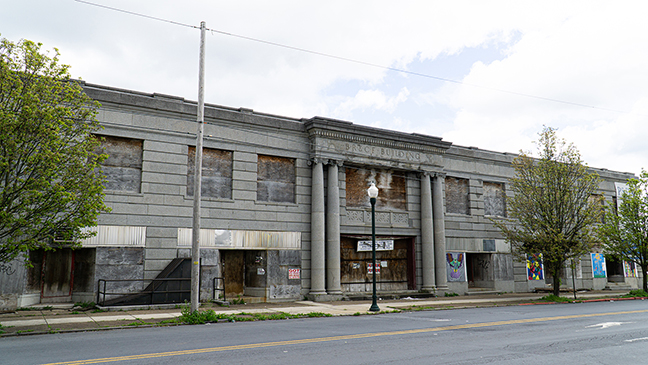
The Hudson building in Uptown Harrisburg

Originally, it was supposed to be a high-rise apartment building—with a huge convention hall, to boot. It was supposed to be 10 to 12 stories tall.

That never happened.

Instead, over the years, the cavernous Hudson building has been everything from a bank to a church to a series of small shops. And, for almost 20 years, it’s simply sat empty and falling apart.

Now, the building, at N. 6th and Maclay streets in Uptown Harrisburg, has a new owner and a new plan, one that includes something city residents have long said they wanted—a grocery store.

“Harrisburg is a food desert, so we plan to have a grocery component,” said new owner Adam Maust, who purchased the property through his company, Mighty Group Holdings LLC. “That’s one of the things that I’m most excited about.”

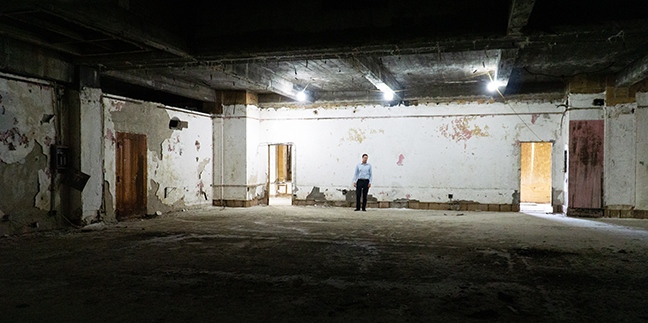
Owner Adam Maust stands in the huge, dilapidated interior of the building.

According to Dauphin County, Maust bought the 50,000-square-foot building and surrounding lots late last month for $425,000 from Philadelphia Suburban Development Corp., a King of Prussia-based commercial real estate development firm. That company bought it in 2004 and never redeveloped it.

The neglect is quite apparent, as the building has deteriorated significantly since that time.

Maust said that he’s putting together a plan for the complete rehabilitation of the structure, with architecture by Camp Hill-based By Design Consultants.

First off, the structure needs to be gutted, as little of the damaged interior is salvageable. He wants demolition to begin next month.

He then plans to ask the Camp Curtin community what it would like to see in the space. He wants to hold community meetings to get the feedback and buy-in of people who live in the neighborhood.

He’s pretty sure that the area needs a grocery store, so that’s high on his agenda. He also plans to move his own Harrisburg-based marketing company, A Mighty Group, into a small portion of the structure. He thinks that a brewery and art studios could be good fits, maybe a restaurant or a coffee shop.

The property includes a parking lot and several empty lots, which he wants to turn into community green space.

“I’m open to any idea,” he said. “It’s really talking to the community to see what makes sense.”

This image shows the interior’s extensive damage.

The building began to take shape in 1923 as the Brotherhood Relief & Compensation Fund Building, a railroad workers’ relief fund. It was to include a bank, a convention hall and numerous floors of apartments.

The project, though, soon halted mid-construction and didn’t restart until 1931, eventually finished in its current, two-story form, according to historian Ken Frew’s book, “Building Harrisburg.”

Through the years, the local Hudson family purchased the building, which was divided into a series of storefronts for small shops, all eventually closed. Maust is rebranding the building as “The Atlas.”

Maust said that he wanted to purchase the building for several reasons. First of all, he’s from the area and, he said, loves Harrisburg, so wanted to make a contribution. Secondly, he thinks that the 6th Street corridor is ripe for redevelopment with such projects as the new federal courthouse and the planned state archives up the street.

“I saw this as an exciting opportunity to change Harrisburg for the better,” he said. “I hope this will be an anchor that we can build on.”

He also likes the proximity to the state Farm Show Complex, which is just across the Maclay Street bridge. He said that he easily could see the building serving as an adjunct for large events there, with event and meeting space.

Since the building is so large, there are many possible uses, he said. And, if his project is successful, he might even consider building up, since the stone and steel bottom floors were built to support a 12-story structure.

“This building is an anchor for the entire corridor,” he said. “It will be one of the very best buildings in Harrisburg.”

Continue Reading

History Keeper: As Harrisburg changes, Calobe Jackson Jr. tells the stories of what came before.

LeRon McCoy, Calobe Jackson and Ryan Sanders.

Calobe Jackson nimbly treads a narrow path behind his childhood home. He plants a hand on a low concrete wall.

“My dad had this wall put in, probably around 1937 or 1938,” he said.

Jackson’s memories are modest. Sweeping barbershop floors. Pears growing on backyard trees. But when Harrisburg’s history-keepers talk about Jackson, they pull out the superlatives. “Living treasure.” “Walking encyclopedia.” “Historian’s historian.”

Calobe Jackson, Jr., turned 90 in April. With his steel-trap memory and will-do attitude, he has spent decades in community service. His contributions have broadened the scope of Harrisburg’s past, even as he steps into the future as a muse for revitalization of a key piece of African-American entrepreneurial history.


Stories They Told

In 1934, World War I veteran Calobe Jackson, Sr., relocated his barbershop and his family, including 4-year-old Calobe, Jr., from Strawberry Alley to N. 6th Street.

In a mixed-race neighborhood, “Jack’s Barbershop” joined a thriving African-American business scene. German Jackson (no relation) ran the Green Book-listed Jackson House rooming house and restaurant next door. A beauty school was on the other side. At the funeral home on the corner, morticians would embalm bodies in the basement and carry them upstairs via a stairwell leading to the sidewalk.

These are the stories Jackson shares as he walks around his old neighborhood.

“You had the major African-American businesses right together, and that is very symbolic,” he said. “They were prosperous during segregation, and they’re still the most popular businesses. Most African Americans go to the African-American barbers or beauticians, the undertakers and the restaurants.”

As young Calobe worked around the barbershop, he heard the tales of old-time Harrisburg from the doctors, lawyers and politicians in the chairs.

“I was fascinated by the stories they told,” he said.

He especially loved stories of the Old 8th Ward, where a thriving, diverse neighborhood had given way to expansion of the Capitol grounds.

His step-grandfather would take Calobe to Negro League baseball games.

“All these great stars—(Josh) Gibson and (Satchel) Paige,” he said. “I saw them play.”

Jackson graduated from William Penn High School, where he ran track. He attended Lincoln University until being drafted into the Army, where his proclivity for math landed him a spot as a surveyor. His unit—possibly one of the last all-black units before President Harry Truman desegregated the armed forces—stayed stateside during the Korean War.

After military service, Jackson worked his way up to post office superintendent, a problem-solving role that energized his puzzle-loving brain. He married Betty Canady in 1957. They raised two sons and a daughter. Betty died in 1976.

Jackson served on the Harrisburg school district’s elected school board and appointed board of control. He never feared the future, from childhood days building crystal radios to his years leading establishment of the school district’s Marshall Math Science Academy and the Harrisburg High School SciTech Campus. From 2005 to 2010, he served on the board of the fledgling Harrisburg University of Science and Technology.

“Harrisburg University has some very innovative courses,” Jackson said. “These things they’re into with the (esports) gaming—that’s part of the future.”


A Toast

After retiring in 1990, Jackson started tracking down details on all the stories he had heard over the years. He and fellow historians bonded over their hours spent in the Pennsylvania State Library’s microfilm section.

He has contributed memories and meticulous research to a long string of projects—creating African-American history trails, commemorating U.S. Colored Troops, celebrating Harrisburg’s sesquicentennial, preserving cemeteries, exploring jazz and the Negro Leagues, researching Old 8th Ward residents for the Commonwealth Monument Project.

Ken Frew, librarian for the Historical Society of Dauphin County, remembers when Jackson asked for an obituary that wasn’t in the society’s files. Visiting the State Library the next day, Frew asked for two rolls of microfilm that might yield the obit, but they were loaned out. Frew went into the microfilm room, “and there’s Calobe with the two rolls.”

“When he has a lead on something, he follows through on it,” Frew said.

With Jackson’s contributions of informational gems from his own collection, Frew expanded the Historical Society’s file of African-American history from a small file to one now outgrowing a drawer.

Fellow historians marvel at Jackson’s accuracy and his generosity in sharing his knowledge.

“He’s sort of like a living Wikipedia,” said Historic Harrisburg Association Executive Director David Morrison.

HHA’s 2020 Preservation Celebration—postponed to Sept. 20 because of the pandemic—features “A Toast to Calobe Jackson.”

For HHA, Jackson worked with historian Jeb Stuart to create an African-American history route for the YWCA of Greater Harrisburg’s Race Against Racism. He also helped HHA intern Kristian Carter write about African-American businesses and, said Morrison, “the subtle segregation in that these black-owned businesses existed and thrived because people couldn’t go downtown and shop.”

“He was one of several people, and certainly the dean of African-American historians, who have helped to integrate African-American history into general history, locally and beyond,” said Morrison.

Jackson’s accuracy derives from his talent for matching memories “with actual documentation,” said Stuart. “He’s unbelievable. He’s sharp.”

Jackson provides context that makes pictures emerge from the scattered puzzle pieces of history, said arts activist Lenwood Sloan—even if it means, as in one case, sharing a racist account of a visit by 19th-century abolitionist and journalist Martin Delaney.

“You’re creating fact-based history and not legend and mythology,” Sloan said. “Memory tends to gild things. Some of the things that Calobe turns up are not that pretty.”


A Pillar

Post-World War II, most of the 6th Street African-American business corridor gave way to Capitol Complex expansion and urban renewal. One stretch survived—the historic buildings of Jackson House, Jack’s Barbershop and the corner funeral home that was originally the Ridge Avenue UMC parsonage, later known as the Swallow Mansion.

“They’re the only thing left from that time,” said Jackson.

Through late historian Hari Jones, Jackson connected with Ryan Sanders, a partner in Vice Capital with NFL veterans LeRon and LeSean McCoy. The team is revitalizing Jackson House and the former funeral home to create Jackson Square, transforming the dilapidated buildings into apartments and retail.

Jackson’s firsthand knowledge of the site helped forge a narrative of African-American entrepreneurship and its role in overall Harrisburg history, said Sanders.

“He is absolutely a pillar of this project,” he said. “Accuracy is very, very important here. As we’re telling the narrative and the storyline, we’re setting the groundwork for future endeavors on this property.”

Jackson’s memories helped give momentum to reinvigorating “an important anchor to the community,” added LeRon McCoy. “Hearing those original stories and what these buildings meant, it only cemented the idea that we wanted to rebuild them.”

As the new federal courthouse drives revitalization of N. 6th Street, noted Morrison, Jackson is enhancing the effort by helping restore the corridor as “a special boulevard of African-American heritage.”


Keeps Him Young

In every conversation about Calobe Jackson, someone references the man himself.

“He’s one of my favorite historians,” said Frew. “One of my favorite people, even if he wasn’t a historian. He’s just a good guy.”

“He’s just a heck of a nice guy,” seconded Morrison

Added Sloan: “He is a gentle man and a gentleman.”

But make no mistake, Sloan said. Jackson’s work counterbalances Harrisburg’s culture of “perpetually emerging” but largely peripatetic African-American organizations that have no place to call home—no black bookstore or art gallery or theater group with a sign out front and its own door to walk through, Sloan said. In a heritage marked by displacement, people such as Jackson are “temples of memory” pointing toward permanence.

“If it wasn’t for people like Calobe who remind us that we were here and that we thrived and survived for a time, we would be forgotten, or worse than forgotten, discounted,” Sloan said. “Calobe reminds us that we count.”

Jackson says simply that his work keeps him young.

“It keeps your mind flowing,” he said. “I’m in good health to be 90. A couple of ailments like some people get. The way my mind works, the idea of having this thirst for history, this thirst for knowledge, keeps you going.”

“A Tribute to Calobe Jackson and Harrisburg’s African-American Heritage,” will be live-streamed on Sunday, Sept. 20, starting at 5 p.m. Click here for more information and to view the event.

Support quality local journalism. Become a Friend of TheBurg!

Continue Reading

September News Digest


Stop Signs, Charging Stations for 3rd Street

Harrisburg will retain two of four stop signs on N. 3rd Street that were threatened with removal until City Council can make a final decision on their fate.

Mayor Eric Papenfuse said last month that his administration has decided to retain the stop signs at Emerald and Kelker streets, but remove them at Harris and Boyd streets.

These are temporary measures until the 3rd Street corridor project is complete, Papenfuse said. At that time, council will have the option of making a final decision on the signs by changing the city’s traffic control map.

“The traffic control map will come to City Council for approval once the project is done,” Papenfuse said.

In early August, residents along the corridor were surprised to learn that the city planned to remove stop signs on N. 3rd Street at those four intersections. Soon after, numerous residents appeared at a council meeting to protest the removal.

At the Harris and Boyd street intersections, the stop signs will be replaced with yield signs. A pedestrian crosswalk also will be added at Harris Street.

“I agree with Boyd,” said Councilman Westburn Majors. “I’m concerned about Harris Street because there’s the senior living building there.”

Papenfuse added that the 3rd Street project unexpectedly will extend into next year for the downtown area south of Forster Street for two principal reasons.

First, Harrisburg University has requested a work stoppage at S. 3rd and Chestnut streets until it removes its heavy equipment from the immediate area as part of the construction of its 17-story academic tower and hotel.

Secondly, the city has received a $40,000 state Department of Environmental Protection grant to install eight electric vehicle charging stations in front of the State Museum. The installation of the electrical infrastructure will delay completion of the project in that area, Papenfuse said.

Moreover, the city plans to complete the sidewalk-widening project around the state Capitol. About eight years ago, the sidewalk around the Capitol on Walnut Street and most of N. 3rd Street was widened. However, the project wasn’t completed, leaving the original, narrow concrete strip in place from North to State streets. That sidewalk now will be widened, as well, finishing the walkway.


Harrisburg Adopts Artsfest

When Jump Street announced it was shutting down, many Harrisburg residents wondered who would run the city’s beloved Artsfest celebration.

Now we know, as the city has opted to take the event in-house.

For 2020, Megan Roby, the city’s director of special events, will take the lead in organizing Artsfest, the long-running, three-day, arts-focused celebration along the city waterfront, said Mayor Eric Papenfuse.

“The city is taking on Artsfest for next year because no one else has stepped up,” he said.

Artsfest takes place in Riverfront Park each Memorial Day weekend, attracting more than 200 art exhibitors and vendors, as well as thousands of visitors. Several years ago, the nonprofit arts group, Jump Street, took over the event from long-time organizer, the Greater Harrisburg Arts Council. However, Jump Street now is dissolving.

Papenfuse said that adopting Artsfest, in its 53rd year, wasn’t his preferred option, but that he feared that the event wouldn’t happen otherwise.

“We can’t let Artsfest disappear,” he said. “It’s too valuable to the city.”

For one year, the city hopes to hire Melissa Snyder, the long-time executive director of Jump Street, as a consultant. To that end, City Council introduced a resolution last month that, if approved, would pay Snyder $10,000 to help transition the event from Jump Street to the city.

Papenfuse estimates the total cost of Artsfest to be about $100,000. In the end, he expects the city to break even from sponsorships and other event revenue.

The city already organizes the two other big summer events in Riverfront Park—the July 4 Food Truck Festival & Fireworks and the three-day Kipona festival over Labor Day. It also puts on such events as the Fire & Ice Festival in March, the holiday parade in November and the downtown New Year’s Eve celebration.


Ribbon Cut on River Walk

Harrisburg’s deteriorating river walk has been repaved, as the city last month unveiled a ribbon of new concrete running about two miles.

The $1.6 million project laid new concrete along much of the 10,275-linear-foot walk from Shipoke to Maclay Street, though, in a few places, old walk was repaired, not replaced, due to funding restrictions.

The project only replaced the river walk itself, not the stairs leading to the Susquehanna River. Fixing the steps, city Engineer Wayne Martin said, is a massively expensive project, though the city might be able to patch some areas.

The work was funded by a $1.5 million federal Transportation Alternative Program grant, with the city kicking in about $160,000.

At the ribbon-cutting, city officials were joined by a group of bicyclists who took a ceremonial first ride on the newly laid white concrete.

Bike Harrisburg’s Dick Norford explained that the river walk and steps were part of Harrisburg’s City Beautiful movement of the early 20th century, which gave the city numerous parks, as well as paved roads and a functioning sewer system.

In fact, the walk itself came into existence to shield a sewer interceptor, which runs beneath it.

“This is such a vital link because the Greenbelt is not just a beautiful recreational trail,” Norford said. “When a city is more inviting to walking and biking, it’s a better place to work, a better place to live and a better place to play.”

The project actually began several years ago, when the walk along the Shipoke waterfront—badly damaged from the 2011 flood—was replaced. Work kicked in again last fall, took a break for the winter, and started up again in spring.


Superintendent Condemns Voucher Proposal

A top official of the Harrisburg school district has come out strongly against a proposal that would allow city students to use public money to attend private schools.

Last month, the district’s acting superintendent, Dr. John George, called a proposed bill by House Speaker Mike Turzai (R-Allegheny) “ill-timed” and said it would “harm the majority of children in the Harrisburg school district.”

Turzai currently is seeking co-sponsors for a proposed bill that would establish a “pilot voucher program” specifically targeted at the Harrisburg school district. It would award “scholarships” of $4,100, which city children could use to attend private or other public schools.

The proposal also calls on the state to contribute another $3,000 in a “tuition grant,” bringing the total to $7,100 per student.

“Speaker Turzai’s proposal is ill-timed and undermines the Financial Recovery Act of 2012, the very legislation for which he advocated,” George said, in a statement. “By removing additional monies from the school district that is already financially distressed, the proposal seriously disrupts the recovery process and wrecks additional havoc, virtually guaranteeing that the district will forever remain in financial distress.”

George further stated that Turzai’s proposal “requires parents to pay a portion of the tuition,” which “may help a few, but it comes at the expense of harming the vast majority.”

“It also only further widens the economic disparity between those who can afford to pay tuition and the poorest of the poor,” he stated.

Turzai began circulating his proposal among lawmakers soon after the school year began in the 6,700-student district. He said that such action was needed given the poor performance among students on state test scores and the fourth-lowest high school graduation rate in the state.

“By allowing Harrisburg families to choose the right education environment for each student, we can finally resolve the decades-long failure to provide an adequate education to Harrisburg children,” Turzai wrote in his memorandum to House members seeking co-sponsors.


Sewer Project Resumes

Capital Region Water is giving its Front Street interceptor project another go, closing a part of Riverfront Park in Uptown Harrisburg until early November.

CRW last month closed the park between Shamokin and Emerald streets until Nov. 9 to install 1,765 feet of new pipe liner, called “cured in place” pipe, which helps prevent failure, sinkholes and leakage.

“We appreciate everyone’s patience during construction as we address our critical and aging infrastructure,” said CEO Charlotte Katzenmoyer in a statement.

The park needs to be shut down in the area due to construction and because aboveground pipes have been installed in the park to bypass water flows during the installation, CRW said.

Last year, CRW closed down the park for several months as it attempted the same project. However, the city utility authority was unable to complete it due to worse-than-expected deterioration of the 105-year-old Front Street interceptor, as well as unexpected utility conflicts, CRW has said.

The 30-inch diameter interceptor carries about 2.3 million gallons of wastewater every day from Harrisburg and Susquehanna Township to the Front Street pump station.

The project will not lead to full road closures on Front Street, but park pedestrians will be detoured across the street until completion.


Commonwealth to Build on D&H Site

When D&H Distributing announced its departure from Harrisburg, many city residents wondered what would replace the company at its longstanding Uptown headquarters.

Now we know.

Last month, the state Department of General Services announced that the commonwealth plans to build a three-story, 120,000-square-foot building to house hundreds of workers displaced from the former Harrisburg State Hospital grounds in Susquehanna Township.

“We are glad to be able to announce the award of this lease that will put nearly 900 employees into a physically and technologically advanced workspace,” said DGS Secretary Curt Topper, in a statement.

In January, D&H announced that it would move to a new office campus in Lower Paxton Township after almost seven decades on the 2500-block of N. 7th Street.

DGS said that the new office building will house employees from the Office of Administration’s Office of Information Technology and the Department of Human Services, including staff from offices of its medical assistance programs, income maintenance, administration, youth and families and its 24/7 ChildLine operations.

Most workers will be relocated from buildings at the former State Hospital, which the state is trying to sell. Some also will relocate from an office building on Herr Street and the Office of Medical Assistance Programs space in Camp Hill.

According to DGS, the state is entering into a build-to-suit lease with Hudson Asset Advisors, which will demolish the low-slung, sprawling D&H building. On the site, it then will build a 120,000-square-foot building with 1,000 parking spaces.

DGS expects to break ground in early 2020, with the first workers moving in during the first quarter of 2021.

DGS did not reveal financial terms, but said that it would once the pricing and terms of the lease are finalized.


Library Buys Historic House, Will Expand

For many years, two prominent parcels on N. Front Street in Harrisburg had common ownership and a shared history.

More than a century ago, those parcels separated, and the building’s side yard became the site of the McCormick Riverfront Library.

Now, those two properties are linked again.

In a recent ceremony, Dauphin County Library System (DCLS) officials announced that they had purchased the original, two-century-old house next door to the McCormick Library, with plans to renovate and turn it into administrative offices.

“This project lets us restore and preserve this historic structure,” said DCLS Executive Director Karen Cullings. “It is one of the oldest buildings in the city.”

Ken Frew, the long-time librarian for the Dauphin County Historical Society, affirmed the historic credentials of the building at 27 N. Front St.

Frew said that Stephen Hills, who came to Harrisburg to construct the original state Capitol, built the Georgian-style house for his own home around 1812. He owned the building for many years, eventually renting it out to Gov. John Schulze, one of a group of houses now known as “Governor’s Row.”

“If I had to compile a list of the top-10 most-historic houses in Harrisburg, this house would be in the top five,” Frew said.

In July, DCLS bought the 5,458-square-foot house for $295,000 from long-time owner, attorney William Balaban.

The library itself sits on land that originally was the side yard to the building, bequeathed by a later owner, Sara Haldeman Haly, who had a garden on the property.

“I am truly honored that we were able to acquire the property that was Sara’s home,” Cullings said.

Cullings said that DCLS was “in the formative stages of the project,” as it still needs to raise money for the substantial renovation.

Once the renovation is done, DCLS plans to move its administrative staff into the house. That will free up space in the library for more family and children’s activities, including STEM and arts-related programming, Cullings said.

Next door, DCLS plans to renovate the house’s first floor for community meetings and events and also will allow public access to the courtyard in the back, she said.

DCLS board President Andrew Enders wrapped up the brief ceremony with a pitch to the community to help the project come to fruition.

“It’s time for the Dauphin County Library System to continue to make our mark on this community,” he said. “But we need your support. Whether it’s your time or your money, we’ll take it.”


Urban Meadow Extension Proposed

Harrisburg hopes to extend an existing walkway by two blocks, offering a landscaped pedestrian link between the new federal courthouse and the heart of Midtown Harrisburg.

The city has applied for a $75,430 grant to PA WalkWorks, a state Department of Health program, to extend the “urban meadow” to N. 6th Street from its current terminus at Fulton Street.

“With the courthouse being built, we would like to see this extension,” confirmed Mayor Eric Papenfuse.

About a decade ago, three blocks of Boyd Street, from N. 3rd to Fulton streets, were transformed from a street alley into a pleasant walkway and bike path with the installation of pavers and native plants.

The project was part of a larger master plan to revitalize the area. In the early 2000s, the city acquired and cleared several blocks of blighted houses and commercial buildings along the 300- and 400-blocks of Reily Street.

The Harrisburg Redevelopment Authority eventually sold these blocks to GreenWorks Development and HACC, and they’re now surface parking lots. Recently, GreenWorks received a $2 million state grant to help fund a $26 million, 135-unit apartment and retail building planned for the 300-block of Reily.

The current urban meadow runs in back of these parcels.

If received, the grant would pay for design work for the two-block extension up Boyd Street to N. 6th Street, making the walkway nearly ¼-mile in total. Papenfuse said the city also is applying for a Dauphin County gaming grant, which would help fund the remainder of the project, including construction.

City Council must ratify the application to PA WalkWorks, though the city has already submitted the application in order to meet an Aug. 30 deadline.


Home Sales, Prices Climb

Both home sales and prices swung up in August in the Harrisburg area, largely due to falling interest rates.

The Greater Harrisburg Association of Realtors credited declining mortgage rates for sales that rose 5.3 percent to 720 units compared to the year-ago period. Median sales prices increased by 10.5 percent to $199,500 over the same period, GHAR said.

In Dauphin County, sales totaled 346 units, an increase of 16 units, while the median sales price rose 12.1 percent to $184,900 compared to August 2018, according to GHAR. Cumberland County saw sales go up by 9.7 percent to 350 units, with the median price up by 9.3 percent to $218,500.

Perry County had a decrease in volume, with sales down by 11 units to 24 units compared to the year-ago period, GHAR said. The median sales price also dropped, down 9.5 percent to $153,750.


So Noted

Jason Isbell has put Harrisburg on his upcoming concert tour, scoring a date at the Forum. The Grammy Award-winning Americana/roots icon will play on Dec. 20 as part of the Harrisburg University concert series.

Open Stage of Harrisburg announced last month that it was rebranding simply as “Open Stage” and changed its logo. The changes were made in anticipation of opening its expanded and renovated theater in downtown Harrisburg.

Recycle Bicycle last month moved out of its home of the last four years, the Atlas Street Warehouse in Uptown Harrisburg. The nonprofit wants to purchase a new, permanent home, preferably on Allison Hill, and hopes to make an announcement soon.

Salman Rushdie is returning to Harrisburg in December, with an appearance at Midtown Scholar Bookstore. The world-famous author will speak and sign books to promote his newest novel, “Quichotte.”

Shady McGrady’s is up for sale, joining a number of other long-established bars and restaurants to hit the market in the Harrisburg area. The owners are asking $650,000 for two buildings, plus the liquor license and fixtures. In recent months, several other local institutions have been listed for sale, including the FireHouse Restaurant in Harrisburg and the Glass Lounge in Susquehanna Township.

Two Poodles debuted in the Broad Street Market, selling scratch-made bagels from its stand in the brick building. Owners Bill Weber and Shea Mascia, who reside in Elizabethtown, also sell bagels in York Central Market.

Whitaker Center is turning 20-year-old classroom space into a new, 3,000-square-foot STEM Design Studios in the Harsco Science Center. Très Bonne Année, an annual, wine-focused fundraiser, is underwriting much of the $450,000 cost of the new STEM center.


Changing Hands

Benton St., 512: J. Eldred to V. Doan, $103,000

Briggs St., 1836: BSR Rental Trust to J. Cruz & C. Soto, $69,000

Chestnut St., 2123: T. Barton to T. Allen, $200,000

Cumberland St., 119: S. Pritchard to J. & L. Weigle, $129,000

Delaware St., 262: WCI Partners to A. Hanlon, $114,000

Derry St., 2414: U.S. Bank NA to HT Properties LLC, $36,400

Green St., 1100: B. Smith to D. & K. Rosemarino, $169,900

Green St., 1430: B. Rice to K. Roberts, $148,000

Green St., 1612: B. Brubaker to G. Hoffner, $150,000

Green St., 1710: Federal National Mortgage Association to M. Della Porta, $120,000

Green St., 1920: WCI Partners LP to A. Hanlon, $123,000

Green St., 1935: R. Holder to T. Holder, $200,000

Green St., 2320: M. Chajai to M. Sadi, $31,000

Hale Ave., 444: P. Huynh to MRG Homes LLC, $55,000

Harris St., 414: J. Underhill to Z. Jackson, $107,000

Herr St., 415 & 426 Snipe Al.: J. Foreman to K. Baran & R. Gillis, $62,500

Holly St., 1937: T. Hardison to CR Property LLC, $30,000

Hudson St., 1131: T. Smarsh to M. Hester, $104,000

Hudson St., 1257: R. Madara to R. & N. Purdy, $125,000

Hummel St., 210: Justgeoff Partners LLC to Ice Properties LLC, $51,000

Kensington St., 2142: C. Smith to D. Anderson, $75,000

Lexington St., 2615: A. Oglesby to S. Das, $59,900

N. 2nd St., 402: North Front Associates to N&R Group, $200,000

N. 2nd St., 509: 509 Partners LLC to Pennsylvania School Boards Association Insurance, $335,000

N. 2nd St., 1519: H. Task to T. Kunkle, $224,900

N. 2nd St., 1821: W&P Real Estate Investments to R. Rammouni, $56,000

N. 2nd St., 3115: G. Fiaschetti to C. & C. Harris, $77,900

N. 3rd St., 2331: F. Laoukili & M. Mtere to S. Morton & R. Bushner, $970,000

N. 4th St., 2434: PA Deals to L. & C. Lautsbaugh, $70,000

N. 4th St., 3309: D. Wright to K. Dierolf, $121,000

N. 5th St., 2326: L. Palmer to S. Wolfe, $87,000

N. 5th St., 2558: V. Rivas to R. Morel, $65,000

N. 5th St., 2731: PA Deals LLC to R. Narinesingh, $79,900

N. 6th St., 2646: Preferred Trust Company Custodian & D. Clements to Builders Property Management & Marketing Group LLC, $42,000

N. 12th St., 1002: Cameron St. Body Shop Inc. & Aumiller’s Auto Parts Inc. to DF Herr LP, $750,000

N. 15th St., 1419: 1900 Capital Trust II to S. Jumaevo & A. Ruziev, $33,000

N. 16th St., 716: H. Lowery to J. Vazquez, $135,000

N. 16th St., 1223: KDR Investments LLP to W. West, $79,000

N., 17th St., 117: Justgeoff Partners LLC to Ice Properties LLC, $40,000

N. 18th St., 706: C. Harper to T. Mulally, $55,550

N. Cameron St., 33: Musalair Trust to 27 33 N. Cameron St. LLC, $5,264,000

N. Front St., 1525, Unit 303: A. Cahall & M. Brenner to R. & S. Cuyjet, $127,000

Peffer St., 329: Secretary of Housing & Urban Development information Systems & Networks to J. Secrest, $34,500

Penn St., 1931: R. & B. Precourt to Z. Ashley & A. Garman, $150,000

Pennwood Rd., 3127: J. Bell to N. Lilla, $125,000

Rolleston St., 1411 & 1315: Keystone RH LLC to JWM Associates, $1,360,000

Rumson Dr., 331: D. Burns to T. Ait, $85,000

S. 14th St., 47: Redevelopment Authority City of Harrisburg to Capital Region Economic Development Corporation, $115,000

State St., 131: Grandtree Farms Incorporated to WCI Partners LP, $150,000

State St., 1406: JRC Properties LLC to AISH Partners LLC, $80,500

State St., 1726: K. Fearnbaugh to Three Bridges Holdings LLC, $69,500

Verbeke St., 222: E. Dean to S. Price & D. Lyons Jr., $157,500

Walnut St., 1818: J. Monroe Trust to F. Counts, $33,000

Woodlawn St., 2259: D. Enders to HL Bowman Building LLC, $199,963

Woodlawn St., 2323: Brothers & Sister Food Service Inc. to Indigo Foods USA, $680,000

Harrisburg property sales for August 2019, greater than $30,000. Source: Dauphin County. Data is assumed to be accurate.

Continue Reading

Together Again: Library purchases historic Harrisburg building next door, will expand services

Karen Cullings, executive director of the Dauphin County Library System, spoke today in front of the newly acquired Haldeman Haly house.

For many years, two prominent parcels on N. Front Street in Harrisburg had common ownership and a shared history.

More than a century ago, those parcels separated, and the building’s side yard became the site of the McCormick Riverfront Library.

Now, those two properties are linked again.

In a ceremony today, Dauphin County Library System (DCLS) officials announced that they had purchased the original, two-century-old house next door to the McCormick Library, with plans to renovate and turn it into administrative offices.

“This project let us restore and preserve this historic structure,” said DCLS Executive Director Karen Cullings. “It is one of the oldest buildings in the city.”

Ken Frew, the long-time librarian for the Dauphin County Historical Society, affirmed the historic credentials of the building at 27 N. Front St.

Frew said that Stephen Hills, who came to Harrisburg to construct the original state Capitol, built the Georgian-style house for his own home around 1812. He owned the building for many years, eventually renting it out to Gov. John Schulze, one of a group of houses now known as “Governor’s Row.”

“If I had to compile a list of the top-10 most-historic houses in Harrisburg, this house would be in the top five,” Frew said.

In July, DCLS bought the 5,458-square-foot house for $295,000 from long-time owner, attorney William Balaban.

The library itself sits on land that originally was the side yard to the building, bequeathed by a later owner, Sara Haldeman Haly, who had a beautiful garden on the property.

“I am truly honored that we were able to acquire the property that was Sara’s home,” Cullings said.

Cullings said that DCLS was still “in the formative stages of the project,” as it still needs to raise money for the substantial renovation.

Once the renovation is done, DCLS plans to move its administrative staff into the house. That will free up space in the library for more family and children’s activities, including STEM and arts-related programming, Cullings said.

Next door, DCLS plans to renovate the house’s first floor for community meetings and events and also will allow public access to the courtyard in the back, she said.

“This expansion will not only provide additional space for children’s and family activities but also will preserve a historic landmark in perpetuity,” said Dauphin County Commissioner George Hartwick, who also spoke.

DCLS board President Andrew Enders wrapped up the brief ceremony with a pitch to the community to help the project come to fruition.

“It’s time for the Dauphin County Library System to continue to make our mark on this community,” he said. “But we need your support. Whether it’s your time or your money, we’ll take it.”

For more information about the Dauphin County Library System and to make a donation, visit the website.

Continue Reading

My City Was Gone: How redlining helped segregate, blight Harrisburg.

Growing up on Harrisburg’s 6th Street in the 1930s and ‘40s, Calobe Jackson Jr.’s favorite sandwich was capicola on rye bread. He’d procure the meat, a spicy, cured pork sausage, from Nick’s Italian American store on 6th and Herr—just a block from his family home on Cumberland. The bread came from Strohman’s Jewish Deli, just a block north.

“It was a busy, multi-ethnic neighborhood,” said Jackson, an African-American man who was born in 1930. Though he was a child of the Great Depression, Jackson recalls a neighborhood bustling with small businesses, including Jack’s Hotel, which his father, Calobe Jackson Sr., opened in 1946.

Today, the blocks of 6th Street where Jackson grew up show little of the vibrancy he knew as a boy. Only one neighborhood institution, Jackson House restaurant, still stands. City directories show that businesses started closing in the 1950s, and the number of vacant storefronts and housing units rose steadily through the 1970s and ‘80s. The neighborhood’s proximity to the Capitol Complex and the Broad Street Market likely saved it from the same fate as the northern stretch of 6th Street, where entire blocks languish as patches of grass and concrete.

Ken Frew, a lifelong Harrisburg resident and local historian, grew up hearing stories of 6th Street from his mother. He summarized the changing fortunes of Harrisburg’s longest corridor.

“It was a jumping place,” he said. “Now, it’s been decimated.”

Many factors contributed to divestment in Harrisburg and the flight of wealth to the suburbs after World War II. Among them was a federal effort that segregated neighborhoods in the name of rebuilding the national housing market. Engineered by the federal government and enforced by local realtors, banks and government officials, these policies cut urban neighborhoods off from access to capital, initiating a cycle of divestment and decay that remains visible to this day.

Today, the practice of government agencies denying service to certain neighborhoods is called redlining—a term first coined by community groups in Chicago, referring literally to the red lines that lenders and insurance providers drew around areas they would not service. Redlined neighborhoods—those occupied by African Americans or by integrated, multi-ethnic populations—became unsuitable sites for home loans or business financing. Residents who could afford to leave these areas often did; those who stayed saw once-thriving areas falter around them. According to the National Community Reinvestment Coalition, 74 percent of neighborhoods that were redlined eight decades ago are considered low-to-moderate income today.

The 6th Street corridor from Forster to Maclay streets, which was redlined by appraisers in the 1930s, is a prime example. Jackson’s father was denied a mortgage there in 1945 for Jack’s Hotel, even though he already owned a home and a small business. The neighborhood today has a 33-percent poverty rate, according to census data. Almost half its families make less than $35,000 per year.


Best to Worst

The federal agency that pioneered redlining was the Home Owners Loan Corporation (HOLC), one of the dozens of “alphabet soup” organizations created under President Franklin D. Roosevelt’s New Deal program. When HOLC was founded in 1933, the country was facing unprecedented levels of home foreclosures on top of a paltry homeownership rate. A previous federal campaign, begun almost two decades earlier to promote home buying among the working and middle class, had accomplished little by the time Roosevelt took office. Few families could scrape together the 50-percent down payment required on most homes or commit to the standard five- to seven-year loan repayment schedule.

The nation’s housing crisis worsened during the Great Depression. Many families that owned property could no longer make loan payments, and those that aspired to homeownership now had fewer assets. It was in this climate that the federal government created HOLC, which aimed to stabilize the nation’s housing market by issuing low-interest, long-term loans to homeowners in danger of defaulting. At the same time, the Federal Housing Agency (FHA), another New Deal organization, began granting loans to first-time homebuyers.

The FHA adopted lending guidelines that were explicitly racist. Its appraisal standards included a white-only requirement, and its 1935 “Underwriting Manual” warned that allowing races to mix in neighborhoods led to “instability and a reduction in home value.” But the most infamous relics of racial home policy we have today come from HOLC, which created America’s first formal system for assessing lending risk.

With help from local real estate agents and insurance brokers, HOLC representatives dispersed across the country to rank neighborhoods on a scale of best to worst. Their “City Survey” program produced detailed reports for 239 American cities, along with security maps that assigned each neighborhood a grade on a four-letter scale. Neighborhoods that had high concentrations of African Americans were deemed “hazardous” lending zones and got a “D” rating. On security maps, these neighborhoods were colored red. “Definitely declining” neighborhoods got a “C” grade and were shaded yellow; “static,” B-rate neighborhoods were colored blue, and the “best,” A-grade areas, were colored green. The resulting maps are a striking, visual manifestation of a racist national policy agenda.

Legal historian Richard Rothstein writes in his book, “The Color of Law,” that risk designations had nothing to do with social class or credit-worthiness and everything to do with segregation. A neighborhood with African-American residents, for instance, couldn’t escape redlining “even if it was a solid, middle-class neighborhood of single-family homes.” But they weren’t the only ones who suffered under HOLC’s appraisals. Since the federal government hoped to jumpstart the construction industry with new homebuilding, neighborhoods with old, densely zoned housing also got “hazardous” ratings. Areas with multi-ethnic populations—like the one where Jackson grew up—or large numbers of recent immigrants, particularly European Jews, were also redlined.

Redlining maps have resurfaced in recent years as scholars, urban planners and policy makers place new scrutiny on segregation patterns in American cities. More than 100 HOLC maps, including those for Philadelphia and Pittsburgh, are available in an online database hosted by the University of Richmond. Last year, Bernardo Michael, a professor of history at Messiah College, set out to find one for Harrisburg.

An Old Suspicion

Michael, whose scholarship centers on South Asian history, developed an interest in American social history while leading a civil rights tour for Messiah’s Office of Diversity Affairs. The project made Michael wonder about the more prosaic, lived realities of minority communities in central Pennsylvania. With help from Messiah students, he began plumbing local archives to learn how segregation limited mobility and residential choices for people of color.

“One of the things that became clear to me talking to residents in Harrisburg was that racial segregation was very strong and communities were divided on the grounds of color,” Michael said. “Communities of color lived in anxiety-ridden environments and were anxious about many things—where would they eat as they traveled, what neighborhoods were welcoming and open.”

Michael knew that the nation’s redlining practices must have left an imprint in Harrisburg. Unable to find a HOLC security map for the city, he made an inquiry at the National Archives in College Park, Md. It yielded a scan of a 1930s-era map of Harrisburg, rendered in a patchwork of green, blue, red and yellow.

According to Michael, the map “was confirming an old suspicion.”

“Local authorities and the federal government were heavily involved in setting up structures that limited the movements of communities of color,” he said.

He added that, as a result, people of color “found themselves confined to what we now call the inner city not by choice, but by circumstance.”

One crucial circumstance was the inability of black homebuyers to secure FHA mortgages in highly rated suburban areas. The exclusion of African Americans from the national housing market was a frequent topic of derision in the black press. No digital archives of Harrisburg’s historic black papers exist, but a 1954 wire report from the Pittsburgh Courier illustrates the injustice of “the serious housing problem confronting American Negroes which, in effect, hems them into the least desirable areas of our cities.” Lamenting increased congestion and crime in many cities, the writer contends that “white people seeking to escape such an environment find few obstacles and desert such areas in large numbers, leaving them to those unable to escape: Negroes, Mexicans, Puerto Ricans and the like, who would in equal proportion prefer to move, if they could rent or buy in the new FHA-financed suburban settlements.” The FHA did not reform its racist lending policies until passage of the Fair Housing Act in 1968.

Urban renewal movements that began in the 1970s and intensified in the 2000s did save some redlined neighborhoods from abject ruin. Harrisburg’s downtown business district was redlined in the 1930s, but now boasts restaurants, retail and a growing number of new, upscale apartments. HOLC appraisers warned that Front Street was “definitely declining;” recent years have seen new commercial and residential tenants move into many of its historic mansions. Shipoke, which got a “D” rating from HOLC, today is home to some of Harrisburg’s most expensive, historic properties.

But the same housing policies that devalued cities across the country insulated Harrisburg from meaningful investment for decades. Only two areas in the whole city—Bellevue Park and Riverside, an Uptown neighborhood bordering Susquehanna Township—were considered a lender’s “best” bet for investments. Every other corner of the city was deemed stagnant, declining or outright dangerous territory for those in the mortgage business.

Today, Harrisburg has a 31-percent poverty rate, and some neighborhoods with the highest rates of poverty—Uptown north of Maclay, South Allison Hill and the corner of Harrisburg south of 1-83—were all redlined starting in the 1930s. When the federal government announced, in 2017, a new program to spur development in low-income census tracts, it anointed six tracts in Harrisburg as “qualified opportunity zones.” They align almost perfectly with neighborhoods that were redlined by HOLC.

As many scholars have pointed out, these D-rated areas also became convenient locations for the infrastructure that suburban, white homeowners didn’t want in their own backyards. Harrisburg’s low-income and public housing complexes, including Hall Manor and the Howard Day Homes, sit today in areas that were redlined. The Harrisburg incinerator, once a major emitter of pollutants, found its home in a “hazardous” neighborhood in 1969.

Long, Hard Look

Even though the federal government didn’t have a hand in every home loan that was made in Harrisburg, their segregationist policies shaped the national lending economy. According to Frew and Jackson, the risk assessments in Harrisburg reflect a long-term, local planning agenda that sought to accelerate movement into suburbs.

Take, for instance, HOLC’s redlining of many of Harrisburg’s commercial corridors. In addition to 6th Street, which was a bustling business district, Derry Street and Market Street in Allison Hill were outlined in red on HOLC’s security map, even though Derry Street cuts through desirable neighborhoods shaded in blue. The area between South and Chestnut streets—what is now the downtown business district—is striped red and yellow. These business areas buzzed with grocers, record stores, tailors and laundromats in the 1930s, but they represented a model of commercial retail that was on the decline across America.

Starting in the 1950s, American retail shifted from downtown streets to suburban malls. Harrisburg’s first mall, Kline Village, was built in 1951. As Jackson said, the appraisers drawing Harrisburg’s security map “probably anticipated the fact that people were going to stop shopping downtown.”

Compounding the retail migration to the suburbs was the movement, starting in the 1950s, to reroute major city streets with one-way traffic patterns. Under the pressure of political boss Harvey Taylor, city officials launched an all-out war on traffic congestion. They reduced parking lanes and converted 2nd and Front streets to one-way, multilane thoroughfares. It became easier than ever for drivers to pass through Harrisburg without ever exiting their automobiles.

“The plan was to get people out of the city as quickly as possible,” Jackson said. “When people got off from work, they went out of the city, stopped shopping. When they made Market Street one way, that was the end of downtown. The one-way streets made it difficult for people to maneuver.”

Reading the map as a portend of urban planning trends that came to pass in Harrisburg shows how government policy directly influenced local development, subsidizing suburbs at the expense of city neighborhoods and the people who inhabited them.

Another project looming over Harrisburg at that time was the Capitol Complex expansion. This began in the 1900s with the demolition of the Old Eighth Ward, an African-American and immigrant neighborhood that came to be known as Harrisburg’s “tenderloin” district. The Capitol Complex expansion continued into the 1930s and ‘40s, consuming even more property along Forster and 7th streets.

HOLC redlined those areas, possibly because local leaders had already earmarked them for a state expansion, Frew and Jackson said. It’s just one example of how appraisers with colored pencils helped ensure the planning agendas of Harrisburg’s political class.

“The people who made this had to look far ahead to see what’s going on,” Frew said. “It’s like somebody looked into the future at the city of Harrisburg and came up with these areas because they knew they would have a Capitol expansion, and they knew the downtown area was going to change because of street patterns and malls.”

Today, urban renewal efforts aim to redress some of the deprivations in Harrisburg’s most struggling neighborhoods. City Council doubled Harrisburg’s budget to demolish blighted buildings this year. Vacant storefronts in Allison Hill, Midtown and downtown Harrisburg are finding new lives as brewpubs, retail outlets and restaurants. Some redlined neighborhoods, such as the MulDer Square improvement district in South Allison Hill, are the site of targeted, city-led revitalization efforts.

But there’s work yet to be done. And Michael, the professor, thinks it should start with a long, hard look at Harrisburg’s history. The research project at Messiah called “Spaces of Fear” led to a partnership with Harrisburg University. Their collaborative project, “Digital Harrisburg,” aims to digitize historical census data and create interactive, historical maps of the city. Student researchers also continue to find prime materials, such as racially restrictive covenants, that testify to the history of discriminatory housing in the region. The goal, Michael said, is to create an archival database with policy implications.

“Most of the planning by my generation was clueless about the past,” Michael said. “We are not just going to the past for the past itself, but for how the past informs the present and tells us what we need to do to think about the future. And equality and inclusion are going to play an important role in that.”

Explore more about redlining in Harrisburg and other online historical resources at www.digitalharrisburg.com.

Continue Reading