Tag Archives: harrisburg

The Week that Was: News and features around Harrisburg

Bethesda Mission distributed these coffee cup sleeves this week.

What happens when a major holiday lands in the middle of a workweek? For us, it means a slower news cycle, for a second straight week. Nonetheless, we found plenty of news to report, with our coverage recapped below.

Bethesda Mission launched its #iheartHBG campaign this past week, distributing coffee cup sleeves to shops and cafes around central PA. Find out the meaning behind the initiative in our online story.

Harrisburg is always a vibrant news town, and 2019 was no exception. What were the most significant news stories for the year just past? TheBurg’s editor comes at you with his annual top-10 list.

The music scene continues to be diverse and vibrant around central PA as we head into a new year. Our music columnist tells you what she’s most looking forward to this month.

PA Farm Show kicks off this weekend, showing off the bounty of the commonwealth’s agricultural industry. There’s no snow this year, but plenty of animals, competitions, food, fun and a whimsical butter sculpture. We have the skinny.

Qualified Opportunity Zones were a key federal initiative meant to drive investment into poorer communities. Much of Harrisburg has been dubbed an opportunity zone, but has that made any difference? Our feature story has some answers.

Sankofa Film Festival brought great films, a few celebrities and several important issues to Harrisburg last week. We have a recap from central PA’s first African American film festival.

Sara Bozich has her recommendations for getting out and about during the first weekend of the year. If you’re not all partied out from the holidays, you’ll find plenty on her to-do list.

TheBurg published hundreds of stories in 2019, but what were the most popular? We give you the top-10 most-read online stories last year, as judged by your page views. Check it out!

TheBurg’s January issue hit the streets this past week, packed with a vibrant mix of city news, community features, columns and events, in addition to a special section devoted to health and fitness. Pick up the hard copy at more than 500 distribution locations or read it online here.

Do you receive TheBurg Daily, our daily news digest delivered straight to your email inbox? If not, subscribe here!

Continue Reading

The Week that Was: News and events around Harrisburg

Elementary Coffee Co. debuted its shop this week.

The local news was as variable as the weather this past week: calm one minute, stormy the next. We have the news portion wrapped up for you below, in case you missed a story while dodging the trick-or-treat monsoon.

Art Association of Harrisburg is featuring two new exhibits, which both touch on important social issues. Check out what our fine arts columnist had to say about the installations.

Elementary Coffee Co. debuted its standalone shop at North and Susquehanna streets in Harrisburg following a lengthy build-out. We were delighted to capture the soft opening of this long-anticipated project. Check out our online story.

Harrisburg has proposed implementing an innovative business parking permit program, but the ordinance quickly met pushback last week from City Council members. Click here to find out what the proposal is all about.

Harrisburg Mural Fest may be past, but we showcased the stunning works of art in our October issue. As a bonus, one delayed mural was just completed, and you can see that for yourself at a prominent corner–N. 3rd and Cumberland streets–in Midtown Harrisburg.

Harrisburg’s federal courthouse is rising quickly at N. 6th and Reily streets, though without nearly enough parking to accommodate all the staff, jurors and visitors. In his monthly column, our editor weighs in with his thoughts on the coming Midtown parking clash.

Harrisburg’s music scene steps up to a new level this month as several major acts visit the capital city. Our music writer lets us know who’s coming to town over the 30 days of November.

The Marine Corps Marathon was last weekend, and a Camp Hill doctor ran it to raise money to help injured veterans. Read about this man and his commitment to this important cause in our online feature.

A medical marijuana company expects to build a dispensary in Allison Hill, but first must have its building plan approved by City Council. Council listened for two hours last week as the company explained the plan for its Allison Hill facility. Read the details here.

Sara Bozich summarizes the final batch of the season’s Halloween-related events, which take place this weekend, and has another 100 or so other things for you to do. Take a gander at her long list of activities here.

TheBurg released our November issue, chock-a-block with stories about local businesses in anticipation of the busy holiday shopping season. You’ll also find many stories about Harrisburg-area people, organizations, cultural activities, events and more. You can pick up the hard copy in 500-plus locations in central PA or click here to read the online version.

Whitaker Center is launching its “Thursday Afternoon” music series next week. So, this coming Thursday, pack a lunch and bring it to downtown Harrisburg’s arts and science complex for some great live sounds while you eat. Read the details here.

Do you receive TheBurg Daily, our digest of news and events emailed right to your inbox six days a week? If not, subscribe here!

Continue Reading

Harrisburg to continue, accelerate lead abatement program with new federal grant

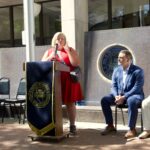
Uptown Harrisburg resident Joanne Chisolm spoke at a press conference today on lead abatement funding.

Harrisburg’s lead abatement efforts got a huge boost today, as the city announced a major federal grant.

In a press conference at city hall, federal, state and local officials joined together to announce that Harrisburg will receive $5 million from the federal Department of Housing and Urban Development’s Lead Based Paint Hazard Reduction grant program and $600,000 from its Healthy Homes Supplemental program.

“With the aging housing stock we have in Harrisburg, we have a lot of lead paint,” said Mayor Eric Papenfuse. “But now with the assistance of HUD, we’ll be able to move our lead abatement efforts forward for years to come.”

The funding covers five years of lead paint analysis and removal throughout the city, Papenfuse said.

The city’s program is open to residents who meet certain conditions, including income requirements. It’s been show that children who eat chipped, lead-based paint can experience learning disabilities and behavioral problems.

HUD’s Joe DeFelice, Harrisburg Building and Housing Director Franchon Dickinson and Harrisburg Mayor Eric Papenfuse pose with a ceremonial check.

HUD recently announced $319 million in funding throughout the country for its Lead Based Paint Hazard Reduction grant program and supplemental program, including $22 million for six jurisdictions throughout Pennsylvania.

Locally, besides Harrisburg’s funding, Lancaster is receiving $9.1 million through the grant program and another $600,000 through the supplemental program.

The grant marks the return of federal funds for lead abatement in Harrisburg. The city’s previous federal grant of $3.7 million expired last December. This year, Harrisburg has continued its program though a one-year, $986,245 state grant.

“The funding will enable professionals to evaluate the living conditions in the house and then address the lead hazards found there,” said Joe DeFelice, HUD’s Mid-Atlantic regional administrator.

Speaking at the event, city resident Joanne Chisolm said that Harrisburg’s program has allowed lead to be removed from her Uptown house, where she also runs a part-time daycare center.

She said that her house first was analyzed for lead and that, when it was discovered, she was put up in a hotel for 1½ weeks while the remediation took place, all at no cost to her.

“It was a wonderful experience,” she said. “The work was professionally done.”

Click here for more information on Harrisburg’s Lead Hazard Reduction Program.

Continue Reading

What’s Up with That? Piece by piece, a city rebuilds.

When I arrived in Harrisburg some 11 years ago, I had quite a few “what’s up with that?” moments.

For instance, a large, boarded-up stone building at 3rd and Boas streets that clearly had once been a stunner—what’s up with that? Ditto, the tall, majestic building a few blocks away, blighted and deteriorating, and the abandoned brick pile on Verbeke Street that had a few fading Art Deco flourishes.

What was up with all of these—and many others?

As a new resident, I wanted to know how they had reached their lowly states, especially since they all were located so close to the Capitol complex, home to thousands of state workers daily.

Perhaps my greatest “what’s up with that?” came the first time that I saw the 1000-block of N. 6th Street. Here was an entire block of blight, with one major exception, the popular lunchtime spot, the Jackson House.

Every day, hundreds of state employees breezed right by these ruins to grab a legendary Jackson House burger or sub. Logically, you’d think that someone would see a business opportunity to re-develop this area. But no.

So, how did this happen?

It’s actually a complex story and one that, in the ensuing years, TheBurg would return to again and again. I can’t tell it all in this space, but it shares two elements common to most blight stories in Harrisburg—and in other once-thriving industrial cities across the United States.

Element #1: Flight. Starting in the 1950s, industry closed, and people began leaving the city for the suburbs, commuting in for, increasingly, service-sector jobs, which, in Harrisburg’s case, mostly meant state government. The 1972 flood was the nail in the coffin here, as residents took their federal flood money—and the few pennies that opportunistic slumlords gave them for the properties—and fled in a second huge wave.

Element #2: Disinvestment. Property owners stopped maintaining their buildings. Typically, they rented them out, for increasingly less money, until they became utterly uninhabitable. Then, instead of fixing them up, they boarded them up, and the dilapidation continued. Some fell apart slowly, others collapsed suddenly. Some sold for taxes, some landed with the Redevelopment Authority, others were flipped to speculators who let them rot further.

All of this happened to the 1000-block of N. 6th Street.

Of the six properties on the west side of the street, one caught fire, one collapsed in a

storm, one pancaked in, one was boarded up and the other should have been. Only the Jackson House, smack-dab in the middle of the street, remained truly sound.

And that, in a nutshell, was what was up with that.

Also, the blight fed on itself so that, for more than 50 years, few imagined that any of the old commercial streets of Midtown Harrisburg could be any different.

But then they were.

Fortunately, it turned out that the opposite also could happen. Just as blight can spread, so can redevelopment, and that’s where we are now in this story.

Over the past decade, nearly every one of the blighted, boarded-up buildings I saw on my first walk through Midtown has been renovated and redeveloped.

One is now StartUp. One is H*MAC. One is the Millworks, and another is the Coba apartment building. There’s Midtown Scholar and the Susquehanna Art Museum and ModernRugs and Campus Square and numerous smaller shops and restaurants like Yellow Bird Café, Pastorante and Urban Churn. One is even TheBurg.

Redevelopment has become such a powerful force that it’s now rolled over even the most desperate of streets—the 1000-block of N. 6th.

Currently, three of the buildings are being redeveloped as a mix of apartments and retail. Brothers LeSean and LeRon McCoy, Harrisburg natives and professional football players, are investing in the block, undertaking two cellar-to-roof renovations. They also hope to buy and build new on the vacant corner parcel, where the former Bethel AME Church burned down in 1995.

This street has a great deal of meaning to Harrisburg. It is one of notable history, the last remaining block of what was once an extensive African-American commercial enclave—a street of barbers, rooming houses, hotels, groceries and other businesses that catered largely to a black clientele in segregated Harrisburg, and it was almost lost. Well, unfortunately, some of it indeed was lost, but some now will be saved, so that life will return again to the street—that is, for more than a quick bite at lunchtime.

I find that, in Harrisburg (maybe everywhere), there are the glass-half-full and the glass-half-empty people. The latter might say—well, that’s fine for Midtown, but what about the rest of the city?

I try to be an optimist, but understand their point, too. Heck, on my block, two small apartment buildings have been condemned this year alone. There are still far too many old-time property owners who regard Harrisburg as only a place to extract money from, not invest in, seemingly believing that even simple building maintenance is a dollar out of their pocket.

But I’m not going to begrudge redevelopment where it happens. A revived 6th Street is good for the city, especially because it links up with other progress nearby, creating a critical mass to attract people and motivate further investment. It’s gotten to the point that, walking around the city, I still have my “what’s up with that?” moments. However, when I do, it’s because I see the boards coming off and construction signs going up.

Lawrance Binda is editor-in-chief of TheBurg.

Continue Reading

Renewed hope for Harrisburg’s MarketPlace neighborhood as city buys back dozens of empty lots

An S&A sign still stands near N. 6th and Reily streets despite the recent sale to the Harrisburg Redevelopment Authority.

A stalled building project may have a new lease on life, as the Harrisburg Redevelopment Authority has bought back dozens of undeveloped lots in the city’s MarketPlace Townhomes neighborhood.

In late June, the authority purchased 58 lots from S&A Homes for $128,672, re-acquiring the Midtown properties it had given to the State College-based developer almost 14 years before.

“The Redevelopment Authority had to take back the properties because S&A was not going to develop them,” said Mayor Eric Papenfuse. “The Redevelopment Authority is now looking for a [development] partner for those lots.”

In the 1970s, the authority began acquiring parcels just south of N. 6th and Reily streets, which eventually included the Zommit Cleaners site, an industrial property that required soil decontamination.

By 1998, 38 single-family homes had been built in the MarketPlace neighborhood, named for its proximity to the Broad Street Market. In late 2005, the authority sold most of its remaining inventory—71 lots—to S&A for $1 apiece in an area bounded by N. 6th, James, Reily and Sayford streets.

Over the next three years, S&A built 13 houses, but stopped when the financial crisis hit in 2008. No homes have been constructed since, leaving numerous grassy, overgrown lots, many set off by white wooden fences that are now falling down.

A group of townhouses in the MarketPlace neighborhood.

Papenfuse said that he regards the re-acquisition as a first step in getting the project back on track. The authority is eager to receive proposals from qualified developers, he said.

“By taking them back, HRA can find a new development partner,” he said.

Bonnie Rhoads, board president of the MarketPlace Home Owners Association, said that she welcomed news that the city had taken back the lots. Residents, she said, long have wondered about the future of their neighborhood, since S&A seemed uninterested in resuming the project.

A few years ago, the company installed utilities for several lots at N. 6th and Reily but no development followed.

“We’d love to see something done with these lots,” she said. “I’m open to listening to whatever the mayor or the Redevelopment Authority wants to do.”

Many of the former S&A lots look like this.

Papenfuse said that he believed the area now may be desirable for home buyers given the construction of the U.S. courthouse nearby. He said that the city would welcome development proposals that included novel ideas, such as greater density and mixed-use developments, possibly with affordable housing,  even if it required rezoning.

“We’re taking pitches,” he said. “If people have a plan, they should bring it to the city.”

Related: In his column, our editor this month offers ideas for affordable housing in Harrisburg, and, in it, he even mentions the S&A lots as an area begging for redevelopment.

Continue Reading

Harrisburg writer educates children on “Where I Live.”

Debra Hervitz (and her book) in front of the state Capitol building.

While working as a teacher and reading specialist in the Harrisburg school district, Debra Hervitz discovered that many children didn’t know where they lived.

When she asked the kids if they knew their addresses, some only knew the street name, others didn’t know anything at all.

“A lot of teachers are trying to hold on to [teaching basic knowledge],” she said. “But because of the state testing and everything, they’re so worried. So, basic types of things like their home address [aren’t taught.]”

Without the district on her side, Hervitz decided to take matters into her own hands. Hervitz, nicknamed “Ms. Read,” is now the author of the “Where I Live,” a series of books that teaches Pennsylvania students about where they live. To date, Hervitz has published two versions of the book: “Where I Live: Harrisburg, Pennsylvania” and “Where I Live: Pennsylvania.”

Both books start out with the solar system, outlining the names of the nine planets plus the sun. They then zero in on our planet, Earth, and its features such as the oceans, continents and countries.

The books then travel down to Pennsylvania. Hervitz describes the municipalities and counties that are in Pennsylvania. In her Harrisburg book, she goes more in-depth with some of the staples of the city such as the Capitol building and the State Museum.

“[Education] is something I am passionate about,” she said. “ It’s not like I’m an expert on geography. It’s just that I know that children need this.”

The first draft of “Where I Live” was actually created in 1998 by Hervitz and her daughter. At the time, Hervitz was teaching first grade English at Silver Academy and her daughter happened to be in the class. Hervitz wanted to incorporate geography into her curriculum, so she had her students create a “Where I Live” book for them to take home and read to their families. Since Hervitz taught her daughter, she was able to keep her book.

Nearly two decades later, Hervitz published her new version of “Where I Live,” with the help of the American Literacy Corp., local literary activist Floyd Stokes and illustrator Sheena Hisiro. 

Since then, the retired teacher has read her book in classrooms across Harrisburg. She even had students set up a “geography bee,” with groups of teachers asking students geography questions based on her book.

Both books also have interactive sections for the kids to draw their neighborhood, sing a song, learn fun facts about Pennsylvania and more.

Hervitz hopes her books not only educate students on where they live but encourage teachers to teach students basic knowledge, such as their addresses.

“There are still a lot of good [teachers] out there,” she said. “When I walk into a classroom, and I see a globe by a teacher’s desk and not up on the shelf, I know it is a good teacher because they’re reading, their writing, their talking, and they’re pointing to that globe.”

To purchase your copy of “Where I Live,” visit elearningsource.com or contact Hervitz at [email protected].

Continue Reading

The Week that Was: A summary of news and features around Harrisburg

Harrisburg school district Receiver Janet Samuels speaks to the press.

The weekend is upon us once again, but it can’t start until we sum up another heavy workweek of news around Harrisburg.

“Art of the State” opened at the State Museum of Pennsylvania, giving our art reviewer a chance to check out the annual juried exhibit dedicated to PA artists. Also, find out who won the awards.

Bethesda Mission received Harrisburg City Council approval for its proposal to demolish the historic Shamrock Fire Station and build a new addition to its community center on Herr Street. Click here for the details.

Capital Region Water unveiled its plan to begin imposing a stormwater fee for system upgrades and greening initiatives. CRW officials stressed its necessity, but not everyone was happy about it. For all the details, click here and here.

D&H Distributing is making a major commitment to help out our region’s children. Find out what this company, one of our area’s largest yet little known, is up to. Click here for the details.

Harrisburg swore in nine new police officers and gave commendations for bravery to both officers and civilians. Separately, a city hall ceremony honored Capt. Gabriel Olivera, a long-time officer who is retiring from the force.

Harrisburg School District again offered a bounty of news, as the district’s new court-appointed receiver cleaned house of the old administration, including the embattled superintendent, and announced that she would bring in a new team. Our editor added his own commentary.

Harrisburg University has attracted students from all over the world to attend its annual AI Bootcamp. Click here for the details.

July 4 Food Truck Festival and Fireworks will return for another year on Thursday. We have all the patriotic details from the mayor’s announcement.

Keyzus was our featured musician for the week as we wrapped up our series in honor of African American Music Appreciation Month.

Lt. Gov. John Fetterman opened the pool at his Fort Indiantown Gap mansion to groups and organizations, and Harrisburg schoolchildren were the first ones to make use of it.

Rockhill Trolley Museum is a nice day trip to view (and ride in) historic trolleys from around central PA, says our writer.

Rock climbing has become a popular sport in recent years, and there are numerous walls to scale around the Harrisburg area. Click here to read our feature story.

Sara Bozich punches your ticket for a fun weekend with her weekly roundup of things to do around the Harrisburg area.

TheBurg distributed our July issue to more than 500 locations in seven counties around central PA and posted all the content to our website. This month, we have a focus on pets, in addition to our usual wealth of community news and features.

U.S. Environmental Protection Agency has awarded Harrisburg a $300,000 grant to help clean up old, polluted industrial sites known as brownfields. Click here for the details.

Do you receive TheBurg Daily, our daily digest of news and events? If not, subscribe here!

Continue Reading

City Inspired: Jelani Splawn helps Harrisburg see itself in a fresh light.

It’s hard to pin down exactly what makes Jelani Splawn so likable.

It had been years since I was in the same room with the now-24-year-old (we both attended SciTech High School, though he was a year above me). But the instant he sat across from me in Midtown Scholar, I felt like I was just chatting with a friend.

He immediately apologized for running late and pulled me into a sideways hug. He asked me how I was, which made me chuckle, not because the question is comical but because here he is, out of breath, coming off an eight-hour shift at IGI Global in Hershey, and he’s wondering how I am.

It’s easy to see how Splawn gets people to open up, even when he has a camera in front of their faces.

For years, the Harrisburg-based photographer has captured hundreds of photos that could make even long-time residents see the city in a new light.

There’s no one way to categorize his photos.

There is the playful “Blooming” series, where different models are placed in front of a colorful background with flowers blooming from their hair. Then, there are more haunting black-and-white photos. There is one with a woman on her knees, hands stretched to the heavens. Another of the late Mary Ellen, who lived outside of the old Rite Aid on Market Street, hunched over her ever-present crossword puzzle. The only color in the photo was a golden halo around her face.

“A lot of people ask me what do I do, what type of photography I work on,” he said. “The best way for me to describe it is, I [wing] it. Whatever captures my eye, I usually just pursue that.”

There’s an old saying: “A picture is worth 1,000 words.” Well, lately for Splawn, that is not enough.

For his newest venture called “Beauty in My Street,” a “Humans of New York”-style project, Splawn interviews local artists about how art impacts their community. The project started as just photographs on Splawn’s Instagram then developed into a YouTube vlog series. In his first episode, which aired May 31, Splawn, along with his long-time friend and frequent model Michael Jensen, interviewed local musician and visual artist Tishon Jones.

“I found so many intriguing people in my own backyard,” he said. “All these folks come from different [places] with hopes, dreams and a willingness to take life as it is—an experience.”


It Was Perfect

Though his grandfather was a photographer, Splawn didn’t care too much for being behind the camera until he was in college.

He started out with a lot of standard photography: flowers, murals and photos of the Capitol. About three years ago, things started to change.

In 2015, he heard that his college’s Black Student Union was searching for a photographer. He joined the club and pitched the idea of a photoshoot highlighting black hair. The idea was inspired by Ebony magazine’s 1970s-era shoot called “Rows. Fros. Everything Goes.”

“I figured, since this is more of a pro-black situation, we can do something based off of a photoshoot with the hair of African Americans who are a part of the Black Student Union,” he said.

They got a huge lineup of people wanting to be involved in the shoot, which shocked Splawn.

“I was not expecting that,” he said. “I was expecting it to crash, or only have five people show up. Everyone was very receptive of it, and it was very welcoming. Everyone had their own style, and everyone goofed off, and it was perfect.”

Splawn dealt with more advanced editing and models during this shoot. For the first time, he felt like a real photographer. This was his calling.

“It was such a huge moment for me because I didn’t think I could make it that far as a photographer,” he said. “But, when I looked at my art and saw what I can do, it was all the motivation I needed to pursue it more.”

Since then, Splawn has done shoots for Artcan, a local art collective, and inside La Cultura, the Verbeke Street pop-up shop building. Still, some of Splawn’s favorite photos come from just roaming around the city with his camera.

One of his favorite photos is an image of a vagabond named Brandon back in 2017.

Brandon, who was in his early 20s at the time, told Splawn and his friends that he was inspired by his grandfather to roam around different cities and states. He started in California and somehow landed in Harrisburg.

“We just sat down and talked, shot the breeze, and then he was sitting down playing with his harmonica,” Splawn said. “From that, I got a really nice shot and, since then, I have fallen in love with it. I think that was one of my favorite shoots, not because it was so good in my opinion, but because it was so raw. It was human.”

Currently, Splawn is focusing on reaching out and discovering more artists for his “Beauty in My Street” project. His goal is to take the project beyond Harrisburg, to different cities and states.

“I’m not a big-time photographer on social media,” he said. “I only have about 700 followers, but, when I think about it, it doesn’t really matter. I learn how to hone my own craft, and I learn a little bit about myself and my photography every day.”

He has no big lineup of gallery showings or events currently. Instead, any free time he has he’ll spend in Harrisburg with his headphones on and camera around his neck. So, next time you see a tall, dread-headed guy with a camera in front of his face, say cheese.

You can view Jelani Splawn’s photography on his Instagram account @ jelly_the_photographer.

Continue Reading

Capital Region Water proposes new stormwater fee for system upgrades; Harrisburg mayor “strongly” objects to plan

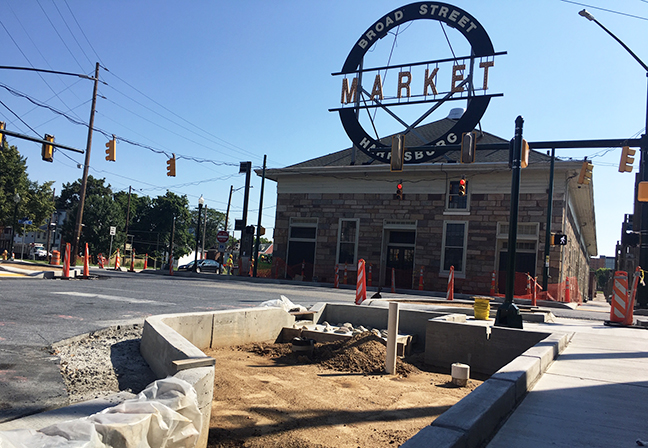
Capital Region Water is adding greening features to reduce stormwater runoff, including this bump-out, as part of the city’s 3rd Street multimodal project.

Capital Region Water is set to propose a new stormwater fee, as it seeks to better distribute the cost of some $100 million in infrastructure improvements and greening projects over the next 20 years.

Under the plan, cost impacts will range from modest to substantial, depending on the type of customer and the amount of hard, impervious surfaces on a property.

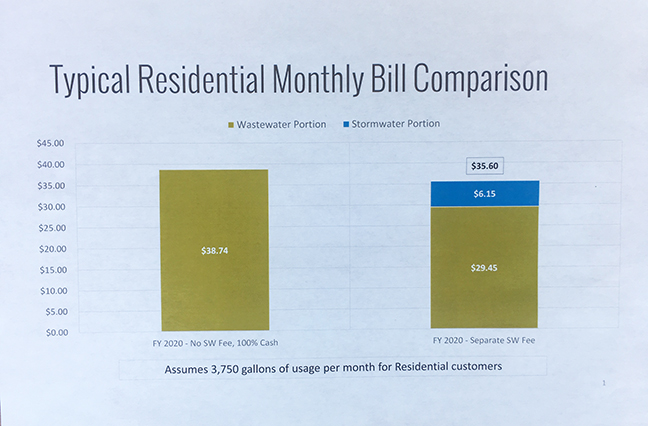
Most residential customers would see an additional stormwater fee of $74 per year, spread out in payments of $6.15 per month, starting in January, according to CRW. That cost would be offset somewhat by reduced increases in wastewater fees, CRW officials said.

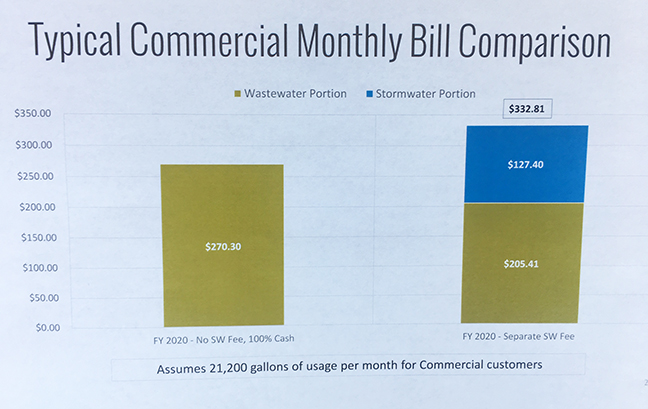
Commercial and government customers, however, could experience much greater increases, as CRW will base the new stormwater fee on the total amount of impervious surface owned by an entity.

“We’re at the point where we have to start rolling this out because we have to start making the improvements,” said CRW board Chairman Marc Kurowski. “It’s also commensurate with our mission. We’re supposed to be treating sewer water. It’s part of what we’re supposed to do.”

In addition to Harrisburg, CRW serves several surrounding municipalities, including Penbrook, Paxtang and Steelton and parts of Susquehanna, Swatara and Lower Paxton townships.

At its meeting tonight, the CRW board is slated to introduce the plan, setting in motion a 90-day comment period. Comments received may guide changes to the plan before the expected Jan. 1 implementation, Kurowski said.

Harrisburg, like many old cities, has a combined sewer system, meaning that wastewater and sewer water flow through the same pipes to CRW’s treatment plant. When rain falls, the amount of water flowing in often overwhelms the system, leading to untreated sewer and wastewater discharge into streams, the Susquehanna River and, ultimately, the Chesapeake Bay.

CRW’s existing system captures and treats only 53 percent of the 1.6 billion gallons of combined wastewater volume, discharging some 796 million gallons directly into local waterways each year.

Five years ago, CRW entered into a “partial consent decree” with the federal Environmental Protection Agency (EPA) to significantly reduce the discharge of raw pollutants into the river.

“We just didn’t volunteer to boost rates,” Kurowski said. “It’s a compendium of things, but this is another unfunded mandate that comes down from the feds to us, and we have to figure out how to deal with it.”

In recent years, CRW has been boosting sewer rates significantly, in part to pay for greening projects, pipe replacement and other measures intended to help remedy the situation. With $5 million a year generated from the new fee, a separate stormwater fund would be set up to pay for those improvements.

If the fee is implemented, customers would have three parts to their monthly CRW bill starting next year: for drinking water, wastewater and stormwater. Currently, stormwater and wastewater are charged in a single fee.

Charlotte Katzenmoyer, CRW’s new CEO, described the proposed stormwater fee as “more equitable” than the current system of boosting wastewater rates to pay for stormwater projects. That’s because, she said, the new fee would be based on the total square footage of impervious surface, so that property owners that contribute more to the problem, such as large commercial customers, would pay more.

In fact, some property owners, such as those that own large surface parking lots, currently may pay no sewer fee at all, but contribute greatly to the problem of stormwater runoff and water pollution.

“It was determined that the best method of dealing with that affordability issue is to shift some of the burden of those wastewater rate increases from the residential customers to the property owners who generate the most stormwater and, therefore, create the most burden on our combined sewer system,” she said.

CRW, she said, used several mapping technologies, including the Lidar (light detection and ranging) 3-D surveying method, to aerially determine all of the hard surfaces in their service area. It then cross-referenced those with Dauphin County property records.

The stormwater fee takes into account nearly all impervious surfaces, with the exception of public roads.

Katzenmoyer added that, while most residential customers will pay a new, $74 yearly stormwater fee, they should see slower growth in the wastewater fee.

For example, CRW’s 2019 wastewater rate increased by 9.4 percent over the 2018 rate for the average residential customer. However, that rate is expected to increase by a much lesser amount, 3.7 percent, for 2020, according to CRW.

According to CRW, a typical monthly residential bill for 2020 would actually be lower with the separate stormwater fee than it would have been if no change were made—$35.60 versus $38.74. However, the typical commercial bill would rise significantly—from $270.30 to $332.81 a month (see graphics).
That argument, however, has not persuaded Harrisburg Mayor Eric Papenfuse, who said he vigorously objects to the stormwater fee.

In 2020, the city would pay an annual stormwater fee of $163,880, he said. In fact, the city is one of the “top 15” most-impacted customers, according to CRW.

However, Papenfuse said he is most concerned with the fee’s impact on the city’s poorer residents. He believes that landlords and entities like the Harrisburg school district and Standard Parking would simply pass on the fee, multiplying the cost to residents and users.

“I am strongly opposed to the stormwater fee,” he said. “I am concerned it is shifting the burden to poor communities that can least afford it.”

Papenfuse said he is also concerned that the fee would deter business investment and development in Harrisburg. He said that he sees the fee as working against his goal of creating a “positive economic climate for growth” in the city.

Several neighboring municipalities have already enacted the fee, which was enabled by a recent amendment to the Pennsylvania’s Municipal Authorities Act.

Coincidentally, the commonwealth would have the second-highest stormwater fee among CRW’s customers. Norfolk Southern Railway owns the most impervious surface in the service area, so would pay the most, Katzenmoyer said.

Papenfuse added that he was concerned that the commonwealth and Dauphin County would both oppose the fee. Katzenmoyer said that they’ve held discussions with both and, overall, described news of the fee among the “top 15” customers as “mixed.”

“Some of them get it,” she said. “The county commissioners have property in some of these other townships. So, they’ve already seen a fee from some of these other townships, where they have property. So, it wasn’t a surprise to them.”

She added that CRW is starting to set up meetings with the “top 50” most-impacted users.

“On the commercial side . . . without the stormwater fee, they’re not paying their fair share, because the stormwater fee is the major component that overburdens our system,” she said. “So, they should be paying more, because they’re generating most stormwater, not the residential customer. So, that’s why this is more equitable.”

Capital Region Water is slated to introduce the proposed stormwater fee tonight at its board meeting, which is scheduled to start at 6 p.m., at its offices at 212 Locust St., Harrisburg.

Continue Reading

Harrisburg officially picks up Steelton as new trash customer

Harrisburg Mayor Eric Papenfuse, surrounded by city and Steelton officials, announced a new intergovernmental agreement on Wednesday.

Usually, Harrisburg’s mayor doesn’t intentionally stand in front of trash trucks for photo ops, but this day was different.

Both Harrisburg and Steelton officials gathered at the city’s Public Works building late on Wednesday to officially announce their new intergovernmental sanitation agreement.

Last night, Harrisburg City Council voted unanimously to allow the city to begin collecting Steelton’s residential trash and recycling starting the week of July 1.

“This was an opportunity we were really pleased to grab hold of and work together on,” Mayor Eric Papenfuse said.

Steelton Council President Brian Proctor said that he was the first to approach Harrisburg officials with the idea of joining forces after borough residents voiced complaints about the service provided by their long-time hauler, Republic Services. They also were staring at a significant price increase from $24.45 to as high as $39.45 per month for trash collection.

“The borough of Steelton listened to its residents—and we listened to our residents,” Papenfuse said.

Steelton residents will now pay $25 a month for trash pickup compared to the $32.34 Harrisburg city residents pay.

Papenfuse explained that this discrepancy is due to the much higher “tipping fee” that Harrisburg pays for refuse disposal at the Lancaster County Solid Waste Management Authority (LCSWMA) facility in south Harrisburg.

Public Works Director Aaron Johnson emphasized that the new agreement will not cause a shortage of employees in Harrisburg.

“It’s my belief that we can do this better than anyone,” added Deputy Director David West.

Local officials from both municipalities said they were pleased at how quickly the agreement came together since the process began less than a month ago.

“To get two municipal councils to work together in a few weeks is remarkable,” Papenfuse said.

Steelton residents can expect welcome letters, and an initial quarterly bill, to be sent out in July, along with the dimensions and models of their new trashcans, Papenfuse said.

Steelton Planning Commission Chairman Dennis Heefner summed up the end result in a simple way–better service for borough residents.

“I’m just happy they will take their time and empty the trash,” he said.

Continue Reading