Tag Archives: harrisburg

Burg View: Worn-Out Welcome

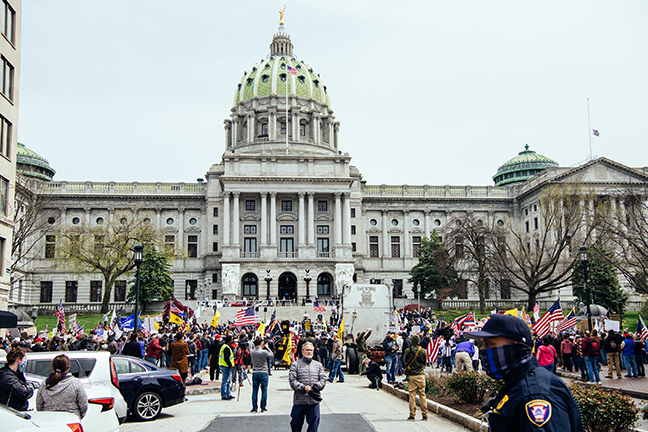
A man carries an American flag with “Trump: Making America Great Again” along N. 3rd Street during the April 20 “Reopen PA” rally in Harrisburg

So, here we go again.

On Friday, “Reopen PA” says they’ll be back in town, at the state Capitol, to protest the commonwealth’s lockdown orders and business restrictions, with no doubt the usual abundance of MAGA hats, pro-Trump flags and vendors hawking Trump/Pence 2020 T-shirts.

And, on its face, that’s perfectly fine.

They have a right, as do you and I, to protest and ask the government for a redress of grievances.

But here’s what they don’t have a right to do. They have no right to terrorize the residents of the capital city.

Nearly a month ago, during the first Reopen PA/Trump rally, protesters jumped off the back of a military-style vehicle, dressed in combat gear and began unloading guns off the rear of the truck.

They circled the Capitol building for hours in their cars and trucks, gridlocking several major streets, preventing us, as well as emergency vehicles, from being able to go anywhere.

They leaned on their horns all morning and all afternoon, creating unceasing, ear-splitting cacophony in our neighborhoods.

They open-carried enormous weapons through our quiet residential streets.

And the authorities just let it roll.

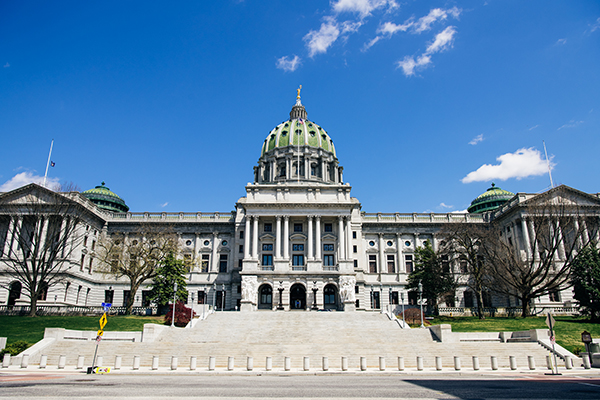
The Capitol and state police, of course, were vigilant in protecting the big, empty white building with the green dome.

As I covered the event, police shouted at me when they thought I had encroached too far from the sidewalk onto 3rd Street—just as some guy waving an enormous American flag, which he had desecrated by writing, in giant letters, the word “Trump” on it, conspicuously marched down the middle of the road (pictured above).

That day, the residents of downtown and Midtown Harrisburg felt like sitting ducks, with little visible law enforcement—local, state, whatever—standing between us and some very angry, very well-armed people.

The irony was that then, presumably like this Friday, the subjects of the protest–the governor, the health secretary and most legislators–weren’t even in the capital city. The only people here were the residents, and we bore the brunt of the hate, anger and aggressiveness aimed at other people.

By choosing to live in Harrisburg, we know that sometimes we’ll be inconvenienced by this or that protest or demonstration. And that’s fine. That’s democracy.

However, we shouldn’t have to fear for our safety, either.

So, to the protesters—welcome to Harrisburg. Please respect our city, our regulations and the people who live here. And please limit your protest to the immediate area around the Capitol building. The “Golden Rule” applies. I’m pretty sure that you also don’t want eight hours of horns blaring, gridlocked streets and scary-looking dudes armed to the teeth wandering around your street or cul de sac.

And to our elected and law enforcement officials—you have a duty not only to protect the guys in the gray suits but to protect us. We have ordinances about noise, traffic, public disturbances, etc., in our neighborhoods. Please enforce them.

Lawrance Binda is co-publisher/editor-in-chief of TheBurg.

Continue Reading

The Week that Was: News and features around Harrisburg

The PA state Capitol. Photo by Dani Fresh

The coronavirus pandemic continues to dominate our lives, two months after the first case was diagnosed in Pennsylvania. Similarly, it again dominated the news, with basically all of our stories somehow tied to it. If you missed any of our coverage from the past week, we have it all listed and linked below.

COVID-19 pandemic appeared to ease a bit in Pennsylvania this past week, as most days had new cases below 1,000. However, the state twice raised the fatality rate significantly. We had an update each day, and here’s the latest.

Coronavirus pandemic has nearly everyone down, anxious and wondering what comes next. Our contributor, Karen Hendricks, shared her thoughts in a beautifully written blog post that surely reflects how others are feeling during this time.

Dauphin County reported 13 positive COVID-19 cases after a facility-wide testing of the county prison. More than 1,000 inmates and staff were tested, with a small percentage testing positive. Check out our online story for the details.

Harrisburg and Impact Harrisburg expect to more than double the grant money available through the Neighborhood Business Stabilization Program. The initial $1 million pot of money has already been exhausted, with much need left in the community. We covered the issue in an online story.

Harrisburg area likely will remain in the “red” category for at least another month. Gov. Tom Wolf revealed that the next counties to enter the “yellow” category of reopening would be in the southwest part of the state, as he extended his “stay-at-home” order for all red areas. We had the blow-by-blow in our online stories.

Healthy Steps Diaper Bank is teaming with Hamilton Health for a drive-through diaper distribution this weekend. Like many essentials, diapers are in great demand and low supply. Read our online story to find out the details and to make a donation.

Midtown Scholar Bookstore hosted a very timely book talk, featuring Catharine Arnold, author of “Pandemic 1918.” We sat in on the virtual event, seeing comparisons between the two pandemics, a century apart.

Nora Carreras is the newest member of the Harrisburg school board. Receiver Janet Samuels made the decision to fill the open seat following the recent death of board Director Gerald Welch. Find out more in our online story.

Nursing home residents constitute a huge number of positive COVID-19 cases, as well as the far majority of fatalities in PA. In an editorial, our editor questions why nursing home data is being lumped in with the general population data as the commonwealth makes decisions about re-openings.

Polling stations will change for several wards in Dauphin County for the June 2 primary, due to the pandemic. Our online story has the details on which ones will be affected.

Sara Bozich sometimes stares out the window and sometimes stares at her computer. In her weekly blog post, she has some great ideas for your own computer staring with virtual events and delicious takeout ideas.

TheBurg editor has some somber impressions of his empty city, as well as a few “wishes” for the Harrisburg area as we come out of the pandemic. This past week, we published his magazine column for our online readers.

TheBurg Podcast dropped on Friday, going into greater depth on stories from our May issue. Host Karen Hendricks interviews writers of several feature stories, including photographer Dani Fresh, whose photo story is certainly a highlight. You can subscribe to TheBurg Podcast or link to it here.

Wolf administration is planning a “Commonwealth Civilian Coronavirus Corps,” a workforce that would be deployed throughout PA to conduct testing and contact tracing. Read more in our online story.

Do you receive TheBurg Daily, our daily digest of news and events delivered right to your email inbox? If not, subscribe here!

Are you a member of our new membership program, Friends of TheBurg? Please join and become part of TheBurg family!

Continue Reading

TheBurg Podcast: The Antidote, May 2020

Overwhelmed by pandemic news? This month’s podcast provides the antidote—we talk around “it” without focusing on “it.” Allow us to elaborate:

Behind the lens: Harrisburg-based photographer Dani Fresh shares her insights, from her photo essay of street scenes, “Silent City.”

Missing sports? Culture? Alice Anne Schwab of the Susquehanna Art Museum goes to bat for you, explaining how you can still catch the museum’s current exhibit “Separate and Unequaled” detailed in “Diamonds are Forever: SAM exhibit honors Negro Leagues centennial.”

Cat chat: Writer Diane McCormick expands upon her story “Pets & Pandemic” to share timely information for animal lovers.

And running along the Susquehanna River sparked the idea for editor Lawrance Binda’s monthly TMHT, “the most Harrisburg thing.”

Meet some of the Harrisburg area’s most fascinating people, and hear their own authentic stories, straight from every month’s issue—with a different twist—on TheBurg Podcast. Because there’s always “more to the story.” Hosted by Karen Hendricks. TheBurg is a monthly community magazine based in Harrisburg, Pa.; Lawrance Binda, co-publisher/editor.

Interested in sponsoring TheBurg Podcast? Contact Lauren ([email protected])

Karen Hendricks is a lifelong journalist; visit her website here.

Continue Reading

Wishing Well: Thoughts from an empty city.

Illustration by Rich Hauck.

Some 35 years ago, a Don Henley song called “Boys of Summer” was an inescapable earworm on top-40 radio. Part of the song goes:

“Empty lake
Empty streets,
The sun goes down alone”

Walking around eerily quiet Harrisburg over the past month-plus, those lyrics have become fixed in my brain. I’ve thought of them maybe a hundred times jogging around Italian Lake, strolling through the downtown.

I sometimes wonder what I’ll remember most from this bizarre period in our shared history. More than anything, I may recall a feeling of isolation mixed with a sense of helplessness.

It’s like that with memories—you often feel them more than truly remember them.

As I run around the empty lake and stroll the empty streets, I wonder what Harrisburg will look like at the end of this.

Will my sick, elderly friend survive the pandemic? Will the local diner still be around? Will my neighbors be able to keep their restaurant going? Will TheBurg make it? Right now, I can’t guarantee any of these.

A few years ago, I wrote a column that I called, “FutureBurg,” in which I imagined a prosperous future for this little city on the river. That vision now seems as distant to me as what we once called “normal” life—the one in which we didn’t wonder about the health of the person who just passed us on the street or about what lays, unseen, on the countertop or currency we touched.

It’s certainly possible that, six months from now, we’ll return to our routines. The streets will get crowded again, the bars busy with customers, folks out of their houses, enjoying each other’s company. But it seems equally likely that this won’t happen at all. Even after the contagion eases and the “stay-at-home” orders are lifted, I fear that people will be slow to engage publicly again.

Will we become a nation of glove- and mask-wearers? Will we see danger on every door handle and drinking glass? And, if we do, you can be certain that the usual collection of crass capitalists and amoral politicians will be right there to exploit our fears, further dividing us for power and profit.

Recently, someone asked me if I thought society would change at all from this experience—and, by that, I think she meant change for the better. Clearly, I have my doubts about this. But to cheer myself up (because I obviously need cheering), I made a wish list.

So, here’s what I wish for, collectively, for the Harrisburg area. I don’t actually expect these things to happen, but, hey, I’ve had a lot of alone time to ponder the meaning of life.

I wish we could heal the east/west, city/suburb rift. Believe it or not, there are plenty of wonderful, well-intentioned people on both sides of the great, fake divide.

I wish that the zero-sum, us vs. them mentality would end. I believe this mindset holds us back from imagining and realizing a better, more prosperous future.

I wish the commonwealth would take greater responsibility for its overwhelming presence here, becoming an active partner with the city for the benefit of all.

I wish we would become less reliant on cars. Slimming down Forster and State streets and putting in bike lanes and bump-outs would be a great start.

I wish that people with means—money, time, whatever resource you have in abundance—would make a greater commitment to helping their community.

I also wish for such things as less poverty, crime and racism, but that applies throughout our entire society, challenges certainly not unique to the Harrisburg area.

I suppose that all of these fall under the umbrella of being nicer to one another—kinder, more patient, more understanding, more giving, less willing to jump to conclusions, expect ill intent or demonize one another.

I do have one solid idea that goes beyond just a wish.

Last month, I wrote a blog post in which I implored people—those who can—to dedicate half of their federal stimulus checks to local businesses and organizations. So, I would like to repeat that suggestion here.

Of course, I realize that many people need every cent to pay their rent or purchase food and other essentials. But, if you’re fortunate enough to have resources to spare, please don’t lock them all away—spread them around to others.

Do you have a favorite restaurant, shop, sandwich joint, nonprofit or arts group? Spend it there: donate, buy a gift card, tip generously, make a purchase. These pillars of our community need our help now, and we desperately need them to remain here with and for us.

One day, this crisis will be over. Countering Henley’s lyrics, the streets won’t be empty, nor will the lake. People will gather again to watch the sun go down over the Susquehanna. And then someone will say, “Hey, let’s meet up for a burger and a beer,” and perhaps we’ll think for a moment about how lucky we are to be doing something so simple.

Lawrance Binda is co-publisher/editor-in-chief of TheBurg.

Continue Reading

Silent City: A Photostory

This story feels like a melancholy flaneur.

I found myself photographing a lot of what’s not there—no people in the restaurants or coffee shops or churches. There are no politicians, staffers, state workers or tours at the Capitol building, no children on the playgrounds. There are no folks gathered at the market. The city is eerily quiet.

But we’re still here. We’re just tucked into our respective homes, trying to stay safe.

The rest of these images are portraits. They’re snippets of how our lives have changed over the last few weeks during the COVID-19 pandemic. They display our resilience, our worries and anxiety, the ways in which we’re filling our time, trying to stay afloat, and the ways we’re attempting to check on and care for our neighbors and families in unprecedented times.

I hope you are being gentle with yourself. I hope you and your family are safe and healthy. And I hope to see you on the other side of these COVID-19 times, whenever that may be.

www.danifresh.com

——–

Qui Qui Musarra, chef and an owner at Rubicon, Mangia Qui, & Suba, was taking a quick break. It was almost a completely familiar scene, seeing Qui out in front of the restaurant with her chef coat and apron on, but today she is wearing a mask to prepare Easter dinner for about 200 take out covers.

The Broad Street Market on a Saturday afternoon is usually busy and filled with folks socializing with friends and neighbors, but today it’s silent.

Hair salons and barbershops are closed so Hanniel Sindelar gave their partner, Lindsay Kirkwood, a haircut on the back porch of their house in Midtown. “It’s been a long time since you’ve had to cut my hair. Makes me think of our first apartment together,” Lindsay says to them.

Amine “Mo” Amamli has been laid off from his position at Habitat for Humanity so he’s been spending his time doing a ton of yard work and helping out with deliveries at Rubicon where his partner, Ashlyn, works.

Lauren Duff & Lissa Richards make sure to sit at least six feet apart on Lissa’s front porch. They’re catching up and checking in with each other. It’s Lauren’s first time out of the house in a few weeks.

Signs in the windows of this Penn Street house read, “WE WILL GET THROUGH” with brightly colored hearts.

Bri Rhoad works at PHEAA and does some freelance marketing work for the Governor but she’s more worried about her mom who has asthma. Bri goes to the store for her so she doesn’t have to leave the house.

Playgrounds all over the city are vacant and quiet.

A rainbow displayed in the window of a house in Midtown is part of a scavenger hunt that has spread throughout multiple towns and cities. It’s an activity for parents and children that they can do outside while still maintaining social distancing guidelines. There’s also a sign that reads, “Be gentle with yourself. This is new to all of us. Smile.”

Pat & Alan Edwards are playing rummy and having beers outside their house in Midtown. “What else are we going to do?” Pat laughs. They’re doing fine but they’re especially worried about friends who work in the service industry. Pat works from home. Alan has had a busy couple of weeks traveling to take care of a family member and goes to work during the week. He has a manufacturing job that is considered essential.

Carey Campbell and Diane Farrell Walker are out walking their dogs along the riverfront. They just walked to a friend’s house to wave at them from the sidewalk for their birthday since they can’t spend time together.

Shatara Parsons and Madison Hatcher were out for a bike ride down at the riverfront. Madison works at Foose Elementary and Shatara is a teacher at the Nativity School in Harrisburg. She says she misses the kids, they’re usually the liveliest part of her days.

Leah Mull sips wine on her front stoop while her husband, Steve, draws decorative eggs on the sidewalk for a social distancing friendly kids’ Easter egg hunt the next day. He says a lot of folks decided to put them in their windows, but this seems like more fun.

Loretta Barbee-Dare already works from home, so the stay at home order hasn’t affected her work. She’s worried about her neighbors though, most of whom are older folks at higher risk. She took boxes of food to some of them a little over a week ago and tries to check in often. And she’s irritated that the liquor stores are closed.

The sign in the window of Christ Lutheran Church on 13th street says, “All church services & meetings canceled until further notice. May God bless you,” and “We’re sorry. No dental services until further notice. Lo sentimos. No hay servicios dentales.”

Rikkie Shellhamer came out on her balcony. It feels a little safer talking with folks down in the courtyard behind her apartment from up there. She is laid off, but says she’s doing okay–some good days and some bad. She’s doing a lot of reading and recording music with her partner, Andy.

Self portrait in the window by Harrisburg University. It was my first day out of the house in eleven days. I have one mask and two bandanas for the days I go out to shoot, taking care to wash them after each use and I have strange new rituals for when I get home from shooting. I keep tripping over my feet.

The only somewhat busy spot on Second Street is Hornungs True Value. They have shelves of spring flowers and hanging baskets lining the street along with the usual sidewalk wares. A man loads his vehicle with a box of purchases from the store.

Lewis Walker is getting fresh air outside where he lives at the Presbyterian Apartments on Second Street. His building is all older folks in closely adjacent apartments. They’re worried that if one person gets sick, it will spread easily to other residents in the building.


Continue Reading

Burg Guest Blog: Reflections Amid the Pandemic

An image from Monday’s “Reopen PA” rally at the PA state Capitol. Photo: Dani Fresh

You know the saying, “Truth is stranger than fiction?” It rings true as we live through this pandemic. Nothing feels “normal” although plenty of us are referring to our new daily routines as our “new normal.”

Like last week’s trip to the grocery store—ordinarily a pretty routine task. But I don’t usually feel dread in the pit of my stomach or have to mentally prepare myself before the normally-mundane grocery trip. Maybe it was because I equipped myself with everything short of a plastic bubble—hand sanitizer, gloves, and bandana-turned-facemask. Taped arrows on the store’s floors pointed the way. I found myself involuntarily smiling at grocery store employees as they greeted me—from a safe distance of six feet away—but my smile froze under my mask as I remembered that: a) they couldn’t see it and b) the conditions didn’t really lend themselves toward being friendly. Neither one of which should be normal.

I tried following the arrows, and I tried not to judge other shoppers who weren’t arrow-followers. It was hard. I just wanted to zig-zag my way through the store, snagging the 15-or-so items on my list and get the heck out of there. One-way aisles with arrows threw a few curveballs into my plan. So did some of the eerily empty shelves.

I also tried avoiding people, which felt unnatural and wrong. Most shoppers had masks on like myself, which was honestly a bit scary. It felt like a crazy dream with a bizarre storyline about caricatured bank robbers. But then I spotted a few shoppers without masks. I didn’t know whether to feel mad or sad. But I definitely wanted to avoid them. What if they had COVID-19? It felt like fear and anxiety were lurking around every corner, every thought. And that shouldn’t be normal. I really wished it was all a bad dream from which I could wake up and shake off. None of us like living like this.

But this virus has taken hold of our lives, our routines, our culture and our country. No one is immune from being affected—the least of which are the thousands of people who have contracted COVID-19 and died as a result. I know I should feel lucky to be healthy, to be able to work from home, to have a home. We use the phrase “during these challenging times” a lot. Most of the time, I’m up for the challenge and I can keep a healthy and positive perspective, based on the facts and news, with a  healthy respect for those in our leadership and governmental roles. But sometimes the challenge and situation feels overwhelming. It hurts to see people hurting.

As a society, we Americans don’t like being told what to do. Our “normal” human habits and paths are being rerouted, detoured and cut off. The American dream is at stake for small business owners forced to close for this time of social distancing. My heart goes out to all of them, and as much as I want to encourage them to keep the faith, the likelihood is that they can’t all survive.

We also cherish our freedom in America. Freedom of religion is alive and well, as most churches creatively and ingeniously take services online. Freedom of speech is also alive—although many are questioning whether it is “well.”

Yesterday, hundreds of people rallied at our state capitol in Harrisburg. These pandemic protesters waved American flags, held handmade signs, many stood shoulder-to-shoulder, and only a few wore masks. Basically, these protesters exercised their freedom of speech. In a nutshell, drawing from the media reports, they were protesting “the new normal” and they want life to go back to “normal”—to their jobs and workplaces.

Those are all facts. But the judgments were levied on social media. And that’s when it hit me in the gut: This pandemic, for a little while, halted us in our tracks and therefore halted a lot of the hate—especially political partisanship and the great divides in American opinion. It was pushed to the background, where it’s been simmering on the proverbial backburner. We all had bigger fish to fry for a few weeks. But with weekend protests in other states, and then our own Pennsylvania protest yesterday, it feels like “the great divides” are boiling once again.

You could feel the hate, anger, frustration and anxiety through social media comments, in response to yesterday’s rally. Insults were hurled at the protesters from all directions—for their lack of social distancing, for the grammatical errors on their signs, for their “stupidity,” and there were those who said they hoped all the protesters came down with the virus. There was even one rogue comment, containing a grammatical error itself, that attacked the media for “framing” the story because the headline, “Hundreds rally at state Capitol to protest shutdown, to ‘reopen PA,’” didn’t say the opposite—that most Pennsylvanians stayed home.

Good journalism summarizes a story in the headline and tells the story in the paragraphs to follow (and the story I’m referring to, did this). Good journalism also reveals new perspectives—ones we may not have considered before—and attempts to uncover motivations. So what motivated people to rally? For many, it appeared to be loss of a job, loss of a way of life, and fear. For others, it appeared to be a black and white case of support of our president and hatred of our governor’s political party—especially his ability to affect change over our way of life. A politicization of the pandemic.

We are living in a gray area that a lot of us are calling “unprecedented.” Most of us are muddling through as best we can. I think one conclusion we can draw is that we’re all mourning the loss of control over our lives. It’s just that we’re expressing that loss in different ways.

At one end of the spectrum are those who are expressing hatred, attacking others and twisting facts and current events to suit their agendas. When people lash out, attack or insult, those actions made under stress reveal their motivation and true character.

At the other end of the spectrum, we have those being lauded by many as heroes—healthcare workers, emergency responders, grocery store workers, medical and scientific researchers, and lots of people doing good. My neighbor is one of these people—she’s baking cookies today and delivering them in cheer packages. Another friend donated dozens of pizzas to a hospital. A teacher friend is uploading daily French and Spanish Facebook lessons. Lots of friends are sewing and donating facemasks, calling and zooming to check on friends and family. These are “the helpers,” as Mr. Rogers called them. Their actions, to bridge gaps and divides, to heal and help—to reach through this time of social distancing with a human touch—reveal their motivation and true character as well.

Karen Hendricks is president of Hendricks Communications, a frequent Burg contributor and host of TheBurg Podcast.

Continue Reading

Burg Blog: The Last Man

The streets were empty, as usual, on a recent beautiful spring day in Harrisburg.

Like many of you, I’ve been watching more Netflix than usual lately.

Searching for something new, I actually clicked on something old—very old—the original “Twilight Zone” TV series. I hadn’t seen an episode in a gazillion years and wondered what I would think now, at this age. Would it be as good as I vaguely remembered, or would it seem hokey and dated?

Turns out—it was even better than my recollection.

I started, logically, with episode one, from 1959, titled, “Where Is Everybody?”

The scene opens with a young man walking down a road alone. He comes upon a town and, hungry, goes into a diner looking for something to eat. He calls out for service, but no one is there. Then, increasingly agitated, he ventures from building to building, only to find more of the same. The infrastructure is all in place—the streets, the sidewalks, the school, the theater, the pharmacy—but not a soul is to be found.

And that’s when it hit me: Harrisburg.

Over the past month, I’ve ventured from one empty place to the next, and my thought has been exactly that: “Where is everybody?” In my case, that’s a rhetorical question, since I know where everyone is. They’re at home, awaiting the day when this affliction passes us, because, someday, presumably, it will.

And when that day blissfully arrives, what will Harrisburg look like? When we all emerge from our houses, step into the fresh air and shield our eyes from the blinding sun, will we still have the theater and the diner and the restaurant?

I’m not sure we will. And that’s why I offer a bold suggestion.

This week, people have begun receiving their federal stimulus money, which, for most adults, amounts to $1,200. Now, many people need these funds desperately. It’s a lifeline for them and will help pay for the basics of life: rent, mortgage, food, utilities, etc. And, unfortunately, it won’t last long either.

But others may not need it at all. Maybe they’ve been able to retain well-paying jobs, or perhaps they’re financially comfortable.

Therefore, I would like to suggest that those who can commit half of their stimulus checks to making sure that, after this crisis is over, Harrisburg no longer looks like, as the old saying goes, “something out of ‘The Twilight Zone.’”

Buy a gift card, a membership, some delicious takeout. Donate to your favorite nonprofit or arts group. Purchase something online from a local shop. Spread the wealth around to the extent you can. And, after you’re done, heck, you’ll still have another $600 in the bank.

According to Gov. Tom Wolf, the state is beginning to think about how we’re going to emerge from this thing. They’re pondering how and when can we open again as a society and as an economy.

When we do, we have to ensure that it’s not already too late. We need to be able to turn the key and put our streets, our sidewalks, our markets, our restaurants, our shops back into motion.

In the “Twilight Zone” episode I watched, the character, at one point, enters an empty pharmacy and spies a bookrack, but every book only has one title, “The Last Man on Earth.” At times, wandering around this city, doing my “essential” job, that’s exactly how I’ve felt–like the last man in a city, isolated, helpless.

Certainly, I hope that my own contribution will help our community awaken from its months-long slumber. But I expect it’ll also help me personally–empowered, no longer helpless, able to contribute.

If you can, I hope you’ll also see the value in ensuring that, when we come back, there’s a place to come back to, buildings no longer empty and dormant but filled with people, food, drink, art, activity and delight.

As “Twilight Zone” creator Rod Serling himself might say, emerging from the shadows and looking directly into the eye of the camera: “The cause? Our shared fate.”

Continue Reading

A Star Is Born: PA Capital-Star journalists reflect on their first year, ponder what lies ahead.

John Micek

About a year ago, a new type of journalism splashed down in Harrisburg.

The Pennsylvania Capital-Star was one of three nonprofit newsrooms that launched within months of each other, all dedicated to covering state news.

Recently, we sat down with the Capital-Star’s four journalists—Editor-in-Chief John Micek, Associate Editor Cassie Miller and reporters Stephen Caruso and Elizabeth Hardison—to find out how the first year has gone. In the process, we also touched on such topics as nonprofit news and the often-dysfunctional relationship between Harrisburg the city and Harrisburg the capital.

Excerpts from our interview follow, edited for clarity and length.


TheBurg: How did the Pennsylvania Capital-Star get its start?

Micek: I was at PennLive in 2018. I was approached by an organization called the States Newsroom Project, which said they were opening up this new outlet in Pennsylvania, and would I be interested? After a couple of conversations back and forth, I decided that, yes, this was worthwhile.


TheBurg. What attracted you to it?

Micek: First and foremost was the idea of building something new from the ground up. At that point, PA Post was here; Spotlight PA had not yet launched. And I put in 20 years of my working life to covering Pennsylvania state government. It was the idea of creating a new voice within that, to help add to coverage because, at that point, the Capitol pressroom was fairly depleted. It’s wonderful to see so many new faces up there now working away and to have so many eyes on state government. But, at that point, it wasn’t really like that.

The really great thing about the States Newsroom Project was the idea that we could give voice to under-heard voices in the public dialogue, those who don’t always make it into the committee hearings, those who don’t make it into the hallways of power. So, now you see a lot of focus—through Lizzy’s work on criminal justice reform, for instance—on people who often have the whole system weighted against them. Stephen does outstanding work on climate. So, we tried to find the places that we thought weren’t receiving as much coverage or weren’t being paid attention to in the way that they probably should have been and trying to really build the coverage there, trying to elevate those voices.


TheBurg: Tell me about the foundation that supports you.

Micek: We are organized as a 501(c)3 nonprofit. The nearest analog I can draw is that we are funded in much the same way that NPR is funded, a mix of individual and foundation donors. The States Newsroom Project is based in Raleigh, and we’re right now in 15 states, with the goal of having 20 by year’s end. It’s a very aggressive model.


TheBurg. Tell me about your reporting beats.

Stephen Caruso

Caruso: I cover the PA House. I cover environmental issues, specifically focused on climate, and I cover labor. Those are the three areas. The House brags about being the “people’s house,” so it’s important that the people have free and fair access to information about it. That’s what I try to do in my beat.

I would say, for how I do my job, it’s a pretty long leash. On a session day, I’m up in the Capitol, and I just run around until I find people who I know will talk to me, and I do the best I can to get the information we need. I think that ideally is what statehouse reporting should be doing, and that’s what I strive for, to be focused on what is happening and what needs to be explained to people, because a lot of this is not readily evident. We need to try to explain why Harrisburg matters and explain what’s happening.

Hardison: I cover criminal justice and education. There’s a lot of interesting bipartisan convergence in Harrisburg right now about what people call criminal justice reform. It’s not all as sweeping and consequential as people want it to be, and there are so many giant, unaddressed, unchallenged practices in our criminal justice system that need reform that politically have been non-starters for people, like sentencing reform. I also cover the state Senate. So, that’s kind of where I started day one—I was assigned to the state Senate, and then we really just defined beats over time based on what we were interested in. Stephen and I had very different interests, so we were able to just define what we wanted without stepping on each other’s toes.

Cassie Miller

Miller: I’ve only been here since November. So, I have not really established beats the way that Stephen and Lizzy have. I’ve been more filling in as needed, bouncing around in a broad range of things. So, I’ve done things like census stuff, trying to explain the census and how it works and the potential impact. Right now, I’m working more on an understanding of the budget. So, I can fill in when these two are busy with the Senate and the House, and I can jump around where needed. I also do a lot of multimedia stuff, a lot of photo stories and videos. I’m also John’s right-hand. So, whenever anything in the office needs to be addressed, or any administrative stuff, I can pitch in there.


TheBurg. What is one of the more surprising things you’ve found about how the state works?

Hardison: One of things that surprised me is how non-essential the city of Harrisburg is to the state. When I was covering the city (at TheBurg), I remember that Act 47 reform was passing, and that was hugely consequential for the city. It was a pocketbook issue because there was the specter of really big tax increases for the city residents if the state didn’t move on some kind of Act 47 reform. It was like all anyone in Harrisburg could think about for a month. Then we go into the Capitol to cover it, and the scale of perceived importance was a lot different. It was just kind of another item. It passed in the Senate, which was its last stop, without any debate or anything. It was just one of many votes they took that day. It was sobering or surprising to me that something could seem so important in a community, but then the scale just changes on the state level. I thought there would be more interplay, but [Harrisburg] really is just a sound stage for the state government.

Micek: Honestly, one of the reasons I looked to Lizzy as a potential staff member when we started was because she had that knowledge, so she could serve as that bridge between city issues and state issues. The city matters to me. We put the office in downtown for that very reason. We have a really wonderful columnist named Anwar Curtis who tells the stories of the people of the city. That was a very conscious decision to make sure that the people on the Hill knew that their actions did not exist in a vacuum, that the state Capitol was not some island floating on a hill, but, in fact, they had this entire city all around it.


TheBurg: This happens not only on a legislative level but on a departmental level. It seems to me that the state hardly recognizes the city of Harrisburg at all, except as a place to transit through to get to and from work.

Elizabeth Hardison

Hardison: The city is kind of a case study: How do you fund and keep these small cities in Pennsylvania financially solvent? No one has a good answer. We are in one right now, a third-class city that struggles for various reasons—a big swath of non-taxable property, depopulation, people fleeing for the suburbs. It’s just really hard to fund services. You could cut lawmakers the benefit of the doubt and say, well, if you’re from rural Pennsylvania or the suburbs of Philadelphia, you’re not really familiar with the problems of third-class cities. But you come in and work here every single day. There’s a reason that the roads you take in to get to your place of work are filled with potholes. It’s because of decisions that people make.

We had a school district that was failing by every single measure in the city. There were reasons for that to do with leadership. But it’s also a funding problem, the way our schools are funded. You can see the inequities in schools, between here and Camp Hill. So, it kind of heightens the irony, the fact that Harrisburg can languish because of choices that people make. It need not be this way.

Micek: As someone who’s watched state government for a long time, one of the things that I find encouraging is the infusion of younger lawmakers, newer members who are coming into the House and the Senate who look at this and are not content to let things roll along the way they are. A lot of people come in, and they’re full of wide-eyed idealism, and they’re sucked into the vortex, and they become this sort of stereotypical state lawmaker. My hope is that there are enough people who exist outside of that. You know, it’s going to take forever, but at least there may be some incremental progress.


TheBurg: After a year, what have you learned, what changes do you feel you need to make?

Micek: The one thing that has been most gratifying is that people have been telling me that we’re everywhere, which is fantastic. They quite literally see Stephen running up the stairs to get to somebody or that Lizzy has turned around a really quality story on schools or criminal justice. Out of the gate, the goal was to establish us as a legitimate and respected news organization, and the only way to do that was to flood the zone with coverage. People say that they come to us now for their state government news. That’s been the most gratifying thing by far.

We moved into larger public service projects. We have the #PennForward project that we launched in September, which looks for evidence-based solutions to big public policy problems confronting the commonwealth. We spent four months doing nothing but looking at the issue of gun violence from every angle and trying to find solutions, hopefully passing those along so that they could become part of the dialogue. We’re now moving on to climate and fossil fuels.

We just launched the Purple State Project, which is a four-state project across the States Newsroom network. We’ll be sharing stories across the four properties throughout 2020, hopefully, calling attention to issues that are relevant to voters in all four of those states, making a difference in the dialogue there.


TheBurg: How are you preparing for the election?

Micek: Frantically. It’s beyond a cliché. Pennsylvania will be hugely important in 2020, and we want to play a role in vigorously covering that campaign, recognizing that Lizzy and Stephen, their first priority is covering the General Assembly. We will need to have bodies on the ground across the state to help us with our coverage. The goal of the Purple State Project is the same thing—it’s the economy of scale across the four properties. I would be remiss if I didn’t point out the fact that we have the largest Washington bureau of any Pennsylvania news organization. We have three people in D.C. who work across the sites, who work across the network.


TheBurg: Do you believe that the nonprofit model is viable across other types of journalism?

Micek: Being a journalist is all I ever wanted to do, and I hope it’s all I hope to do until I can’t do it anymore. And that means finding a way to keep doing it, because, obviously, the old model doesn’t work anymore. If that means finding large donors who believe in the importance of journalism as a civic mission, I’m OK with that. It’s a way to hold power accountable. It’s a way to tell the stories of the people who need to have their stories told.

The best thing about it is that nobody tells us what to do. All of our calls are made in house. There are no ads, there’s no paywall. We don’t share people’s personal information. So, to me, there’s more of a purity about the model in a lot of ways.

You hear these stories across the country about these local papers shutting down, creating these news deserts in these small towns. I think that’s where the nonprofit model could do the most good. Some of those billionaires should take their money into Youngstown, Ohio, and find a way to revive the Vindicator as a nonprofit. Put their billions there. When you take journalists away at the local level and elected officials feel that nobody is watching them, the accountability and that watchdog function goes out the window. I’m glad we’re here, but it’s even more critical in these tiny towns across the country.

You can find the Pennsylvania Capital-Star at www.penncapital-star.com.

Disclosure: Elizabeth Hardison is a former reporter for TheBurg.

Continue Reading

Harrisburg mayor issues video message to reassure on city services, food availability

A screen shot from Mayor Eric Papenfuse’s video message

Harrisburg’s mayor issued a message to residents today with reassurance that vital city services are continuing, while debunking several “rumors.”

In a video message, Mayor Eric Papenfuse said that city employees are still working and that essential services are being delivered.

“All essential city services are continuing uninterrupted,” said Papenfuse, who added that the Fire Bureau fought a fire on Locust Street just this morning. “At this time, all of our employees in the city are healthy, and they are eager to serve you.”

The city’s MLK Jr. Government Center is closed to the public, but municipal employees are still at work, either on site in city hall or at their homes, the city has said previously.

Papenfuse spent much of his short, two-minute-plus address debunking “two rumors that we’re hearing in the community.”

The first, he said, was if residents were allowed to go outside. The answer, he said, was “most assuredly yes.”

“Go outside, go for a run, walk your dog, go to the pharmacy, go to the grocery store, take out your trash—engage in these types of outdoors activities,” he said. “Just, when you do so, stay away from gathering in large groups, practice sensible social distancing, maybe stay six feet apart from others, and wash your hands and practice good hygiene both before and after you go outside.”

Residents also are calling city hall to ask if grocery stores will close or will be depleted, Papenfuse said.

“I want to assure you that grocery stories will remain open, and they will not run out of food,” he said.

Grocery stores, he said, are not subject to Gov. Tom Wolf’s order to shut down most business locations and will remain open. And this includes not just major supermarkets but other stores that carry food such as Wal-Mart, Dollar General and Target.

“There is absolutely no need to hoard any types of groceries or stockpile them,” he said. “Grocery stores will remain open.”

Lastly, he appealed for calm and a continuing sense of community.

“Remember, Harrisburg, we are all in this together,” he said. “Stay calm, stay positive, be patient, be kind to one another, and this, too, shall pass.”

Click here to watch the full video.

Continue Reading

Harrisburg declares emergency, shuts public access to city government buildings due to epidemic

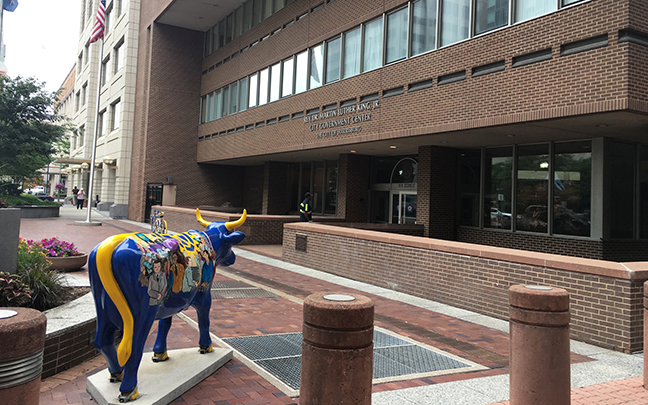
Harrisburg’s MLK Jr. Government Center

Harrisburg has issued an emergency declaration and will shut down city government buildings to the public until further notice.

Effective on Tuesday, all official city buildings will close to the public, including the MLK Jr. Government Center, the Public Works building and the Reservoir Park Mansion.

The city will continue to provide all essential functions and services, according to Mayor Eric Papenfuse.

“We are all in this together,” Papenfuse said, in a statement. “I encourage the community to adhere to Gov. Wolf’s directives and use precautions to prevent the spread of the coronavirus.”

Most city workers will continue to work, some remotely, Papenfuse said. The public can use the drop box at the rear of the building to pay bills, submit forms and drop off other items, he said.

Because of the closure, Tuesday’s City Council work session has been cancelled, and the deadline for residential parking permits has been extended through the end of April.

For inquiries, residents are encouraged to fill out the city’s online support form at www.harrisburg.gov/support, email [email protected] or call the city’s 311 help desk, which will continue to operate.

Likewise, Dauphin County late on Monday declared a disaster emergency and will close county government offices to the public until further notice, effective end-of-day on Tuesday. All events and activities at county facilities have also been cancelled.

County residents who want to pay a tax bill or drop off a voter registration form or absentee/mail-in ballot can deposit items in a locked box near the entrance of the Dauphin County Administration Building on 2nd Street in Harrisburg, according to the county. The Dauphin County Courthouse will also have a secure box near the entrance on Market Street where documents can be dropped off, the county stated in a release.

At this time, there are no known confirmed cases of coronavirus within Dauphin County, according to the state Department of Health.

Earlier on Monday, Gov. Tom Wolf ordered all “non-essential stores” to be closed throughout the commonwealth, including bars, restaurants, gyms, retail outlets and salons, though restaurants can sell through delivery and takeout. The shutdown is expected to last “at least two weeks.” Essential businesses to remain open include grocery stores, gas stations and pharmacies.

Also, all Fine Wine & Good Spirit stores will close at the end of business on Tuesday until further notice.

Statewide, the department on Tuesday reported 96 confirmed cases, including 10 in Cumberland County, though none yet in Dauphin County.

“Our top priority is the health and safety of our residents, especially the elderly and most vulnerable,” Papenfuse said. “We appreciate everyone’s patience and understanding during this disaster emergency.”

For more information, visit the city’s website.

This story has been updated to include information from the commonwealth and the emergency declaration from Dauphin County.

Continue Reading