Tag Archives: Hall Manor pool

Harrisburg’s Jackson Lick Pool to reopen for the summer next week, with some updates

Jackson Lick pool. File photo.

Three, two, one, cannonball!

Harrisburg’s Jackson Lick Pool on N. 6th Street will reopen for the summer season on Wednesday, June 12, after receiving some much needed TLC.

The city recently completed patching and repairing the aging pool using $55,000 that City Council allocated in April for the updates. At the time, Harrisburg officials said that the updates were necessary to be able to open for the summer.

In addition to the repairs, the Public Works Department is currently putting the final touches on painting the bathhouses.

The pool will be open throughout the summer on Tuesdays through Sundays from noon to 6 p.m. each day. Admission costs $4 for adults and $2 for children.

Harrisburg’s second public pool in Hall Manor has been closed for several years, but is slated to be replaced and reopened in the coming years. In April, council approved using $8 million in federal American Rescue Plan Act (ARPA) funds to construct a new pool in Hall Manor, which would likely take over two years to complete, city officials shared.

For more information, visit Harrisburg’s website.

If you like what we do, please support our work. Become a Friend of TheBurg! 

Continue Reading

City Council questions selection of Broad Street Market construction manager, allots money for pools

The Broad Street Market brick building after a July fire.

Harrisburg officials have identified their choice of a company to coordinate and manage the Broad Street Market rebuild, though City Council isn’t so sure. 

At a special legislative session on Wednesday, council weighed hiring Harrisburg-based Alexander Building Construction Co. as the construction manager for the market brick building rebuild, but members had numerous concerns about the city’s selection process. 

The proposed agreement would pay the company, which has experience in fire restoration projects, $914,371 to provide pre-construction and construction management services for the project.  

Council was originally slated to discuss and vote on the proposal on Wednesday, but ended up tabling the matter due to concerns about the city’s RFP and selection process. 

Council members asked questions about the RFP scoring template, how the evaluation team was chosen, and why Alexander scored the highest and was chosen, despite costing the city more than some other applicants. Council President Danielle Bowers also questioned why the city’s Chief Equity and Compliance Officer Karl Singleton was not on the scoring team. 

“I’m not sure how equitable this process was,” Bowers said. 

According to city Facilities Director Dave Baker, Alexander was selected based on factors such as its extensive experience in construction management, its fire restoration experience, and its ability to have daily on-site supervision of the project. When it came to the price tag, Baker said the city seeks the most “responsible bidder to get the most bang for our buck.” 

Other RFP submissions that were evaluated for the market project came from Philadelphia-based Alexander Perry Inc., Camp Hill-based JEM Group and Wormleysburg-based Steel Works Construction.  

In March, Alexander Building Co. also was selected by the city to serve as construction manager for a project to upgrade the city-owned FNB Field on City Island, at a cost of $712,888.  

“So the concern is, no disrespect to your company, but when you keep seeing the same people getting these projects, I got to start thinking about why are they the only ones getting them,” council member Lamont Jones said. “Our job is to stand vanguard for this community to make sure local vendors and businesses are included in the economic growth of the city of Harrisburg.” 

Council members said that they would like to review the RFPs and the grading system before making a decision on the construction manager hiring. The resolution will remain tabled until council decides to bring it forward again for discussion. 

“We are committed to working with City Council to address any questions and concerns they have about our independently scored selection of Alexander as a qualified company to oversee the rebuild of the Broad Street Market,” Matt Maisel, city communications director, told TheBurg.

Also on Wednesday, Harrisburg got the go-ahead to begin to spend money on restoring and replacing its two city pools. 

Harrisburg City Council approved an $8 million allocation of federal American Rescue Plan Act (ARPA) funding to go towards replacing the closed Hall Manor pool. 

The city will begin with the $2 million phase one of the project first, which includes site inspection and prep work. The remaining $6 million will fund construction of the new pool, which would likely take over two years to complete, according to city officials. 

Additionally, council approved the reallocation of $55,000 from its capital projects fund for street and road projects to instead go towards patching and repairing the Jackson Lick pool. According to the city, the repairs are needed to be able to open the pool for this summer.  

At a meeting on Tuesday, city administration presented a plan that would have drawn from ARPA money for the Jackson Lick repairs. However, council pushed back against the proposal, many members saying that they preferred to only spend the federal funds on projects that they already specified. The resolution was amended at Wednesday night’s meeting to fund Jackson Lick through other city funds.  

Additionally, a proposal to bring new green space to Allison Hill will continue to move forward. 

Council voted to allow a park project planned for S. 15th and Swatara streets to continue on, approving the city’s application for state funding for the park.  

The project will be organized and completed by local climate change activist Char Magaro and a group of volunteers who plan to transform the currently vacant lot into a neighborhood park. The group said that they would create the park and coordinate maintenance for several years, with the city eventually taking ownership. 

If you like what we do, please support our work. Become a Friend of TheBurg!     


Continue Reading

Harrisburg City Council weighs senior apartment project, park development, pool repair

The site of a proposed apartment project on N. 4th Street.

An apartment project proposed for Harrisburg is moving closer to completing the city approval process. 

At a meeting on Tuesday, City Council weighed a proposal from Harrisburg-based Midtown Redevelopment LLC to construct a four-story, 36-unit senior apartment building on a vacant lot at 1610 N. 4th St. 

In February, the Harrisburg Planning Commission voted in favor of the project, which includes consolidating 19 lots and vacating several grocer’s alleys on the project site. The proposal also received relief from the Zoning Hearing Board in 2022. 

The proposal also includes first-floor commercial space, 30 first-floor interior parking spaces and 12 outdoor, on-site parking spots.  

Council members asked questions about whether the developer would include minority- and women-owned businesses in the contracting process. According to Matt Long, with Harrisburg Commercial Interiors, the general contractor for the project, at least 20% of their contractors will fall under that criteria. Additionally, he said they often host community meetings with city-based contractors on the bidding process.

“I appreciate you doing that,” said council member Lamont Jones. “A lot of people are building in this community, and there are some jobs needed around here. So, we would love to help our community share in the growth of the city.”

Long also noted that this proposal is part of the second phase of a series of housing and commercial projects that the developer has planned for Midtown.

Council is slated to vote on the project at a May 14 meeting. Additionally, council will still need to hear and vote on the street vacation portion of the proposal. 

In other news, local climate change activist Char Magaro presented her plan to transform a vacant lot on S. 15th and Swatara streets into a neighborhood park. Magaro and a group of community volunteers said that they would work to develop the park and coordinate maintenance for several years, with the city eventually taking ownership of the park.  

At the meeting, the city asked council to ratify its submission of a grant application to the Department of Conservation and Natural Resources (DCNR) for funding for the park.  

The proposal for the Swatara Street Park includes planting trees, shrubs and pollinator plants and eventually adding recreational elements.

While most council members said they were in favor of the project, a few had concerns about the potential impact on the neighborhood and the cost of future maintenance to the city.

“I think the project is beautiful, but I’m worried about gentrifying this neighborhood,” Jones said. “This looks like a beautiful project, but I think with a housing shortage, these are parcels we could build some more properties for people to live in.”

Several community members attended Tuesday’s meeting to show support for the park project.

“That is in my backyard. That’s something I walk out and see every single day. That is an area that I see people dumping every day,” said one resident. “Our youth is crying. We have got to have something.”

Also on Tuesday, council discussed allocating $8 million in American Rescue Plan Act (ARPA) funds to replace the city’s Hall Manor pool, with a small allotment going toward repairing the Jackson Lick pool.

In July 2023, council voted to move $31.4 million in ARPA funds into the city’s general fund as revenue replacement, but specified certain projects that the money would fund. In March, council approved the city to start using that money for some of those designated projects. The resolution discussed on Tuesday would approve the use of a portion of the money for another specified project–the pool.

Initially, $1.9 million of the $8 million for pool projects was to be used for preliminary site inspections and prep work at the Hall Manor pool, which is closed. The additional $6 million was to be earmarked for construction in a second phase of the project.

The total project is estimated to take over two years, according to city Facilities Director Dave Baker.

Out of the total $8 million, $55,000 would support pool patching and temporary repairs at Jackson Lick to allow the city to keep it open this summer. In 2022, the city was awarded $5 million in state COVID-relief funding to renovate the pool. However, according to city officials, the city cannot spend the grant money until a legal tie-up around the pool’s ownership is resolved with the Harrisburg School District, which owns the property.

“We need to utilize the funds so we can keep it up and running,” Baker said of the ARPA money. “At this point, in the condition that it’s in, it wouldn’t be feasible to allow the public in the pool.”

However several council members expressed opposition to using ARPA funds on Jackson Lick–a project that council did not originally designate the funds for–and taking them away from the Hall Manor project.

“I don’t know why we don’t just eliminate that pool and just have the pool that is out in the south [Hall Manor],” council member Jocelyn Rawls said. “It’s almost as if we’re throwing money away instead of using it for a single pool. I just don’t understand throwing out $55,000 for it to get through one summer and then not really knowing where it goes from there. I want to make sure we are doing the best possible with our ARPA money.”

Other council members said that they would like to find money from elsewhere in the city’s budget for the Jackson Lick repairs.

“I’m not taking the $55,000 out of the general budget when I have to be very careful about my spending,” said Mayor Wanda Williams, who appeared at the end of council’s meeting. “We need to open a pool this summer. Right now, our kids do not have a pool at all.”

Council is slated to vote on the resolution at an April 17 meeting.  

This story has been updated with the correct photo of the proposed site of a senior apartment building on N. 4th Street.

If you like what we do, please support our work. Become a Friend of TheBurg!     


Continue Reading

Harrisburg mayor proposes using federal funds on new pools; council members ask to be included in planning

Mayor Eric Papenfuse held a press conference at the Hall Manor pool on Thursday.

As Harrisburg finds itself swimming in federal COVID relief money, the mayor has some plans for how to use it.

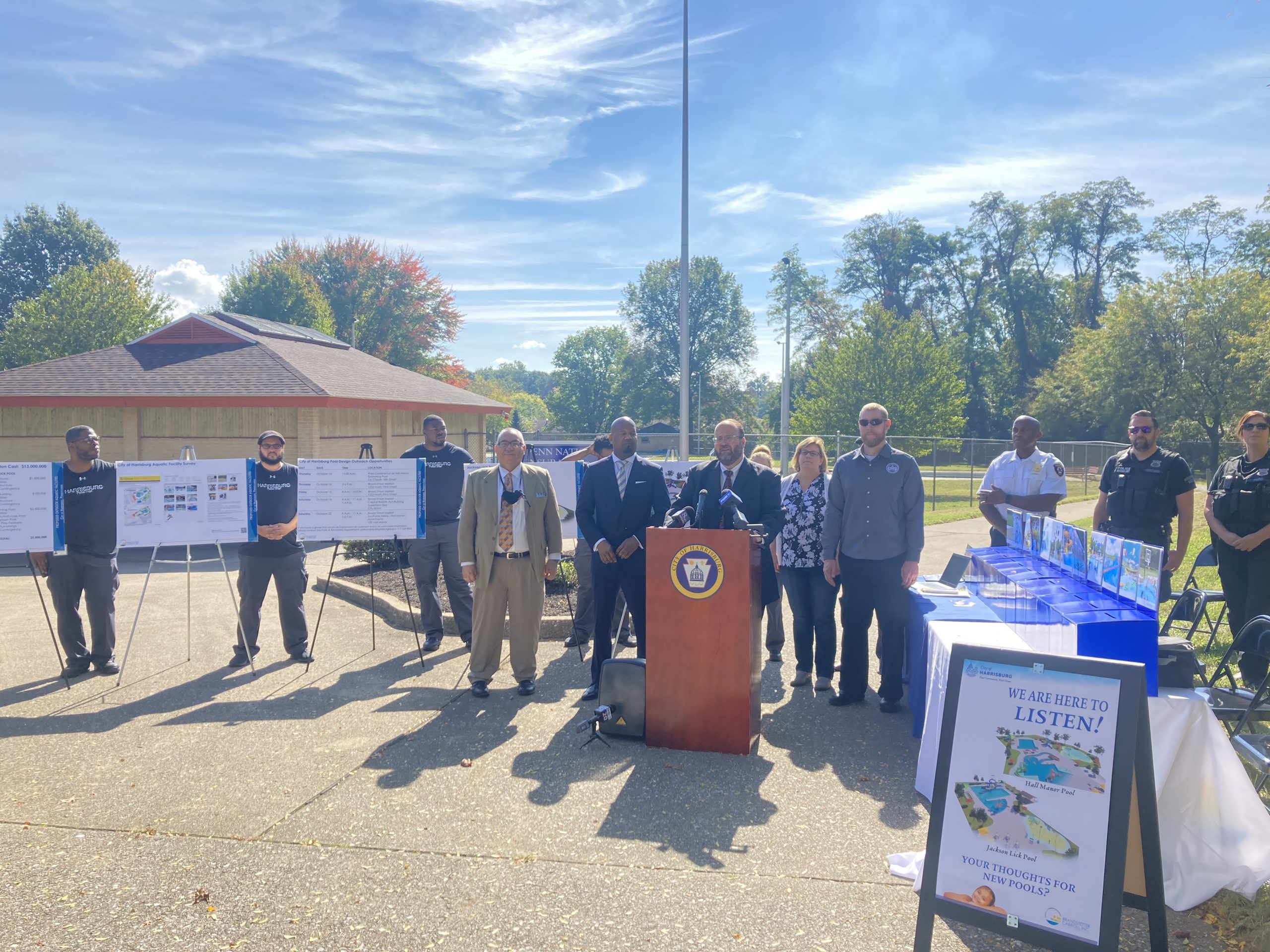
At a press conference on Thursday at the Hall Manor Pool, Mayor Eric Papenfuse announced his proposal to use a portion of the city’s allocated American Rescue Plan money to rebuild Harrisburg’s two public pools.

“Those pools have served the city well for five decades, but they are now officially beyond their useful life,” Papenfuse said. “The American Rescue plan funds […] are designed to help people who need help the most. This is the perfect use for those funds.”

Papenfuse said that he intends to use $13 million of the city’s rescue plan funds to renovate both the Hall Manor and Jackson Lick pools, which are both over 50 years old.

In total, Harrisburg is set to receive $48.8 million in American Rescue Plan funds. The city has received half of the total funds already and expects to receive the rest next year.

Papenfuse said that rebuilding the pools will provide a form of safe recreation for children and families in Harrisburg.

The city is currently soliciting feedback from residents on what they would like to see incorporated into the designs of the pools, however, Papenfuse already has some ideas.

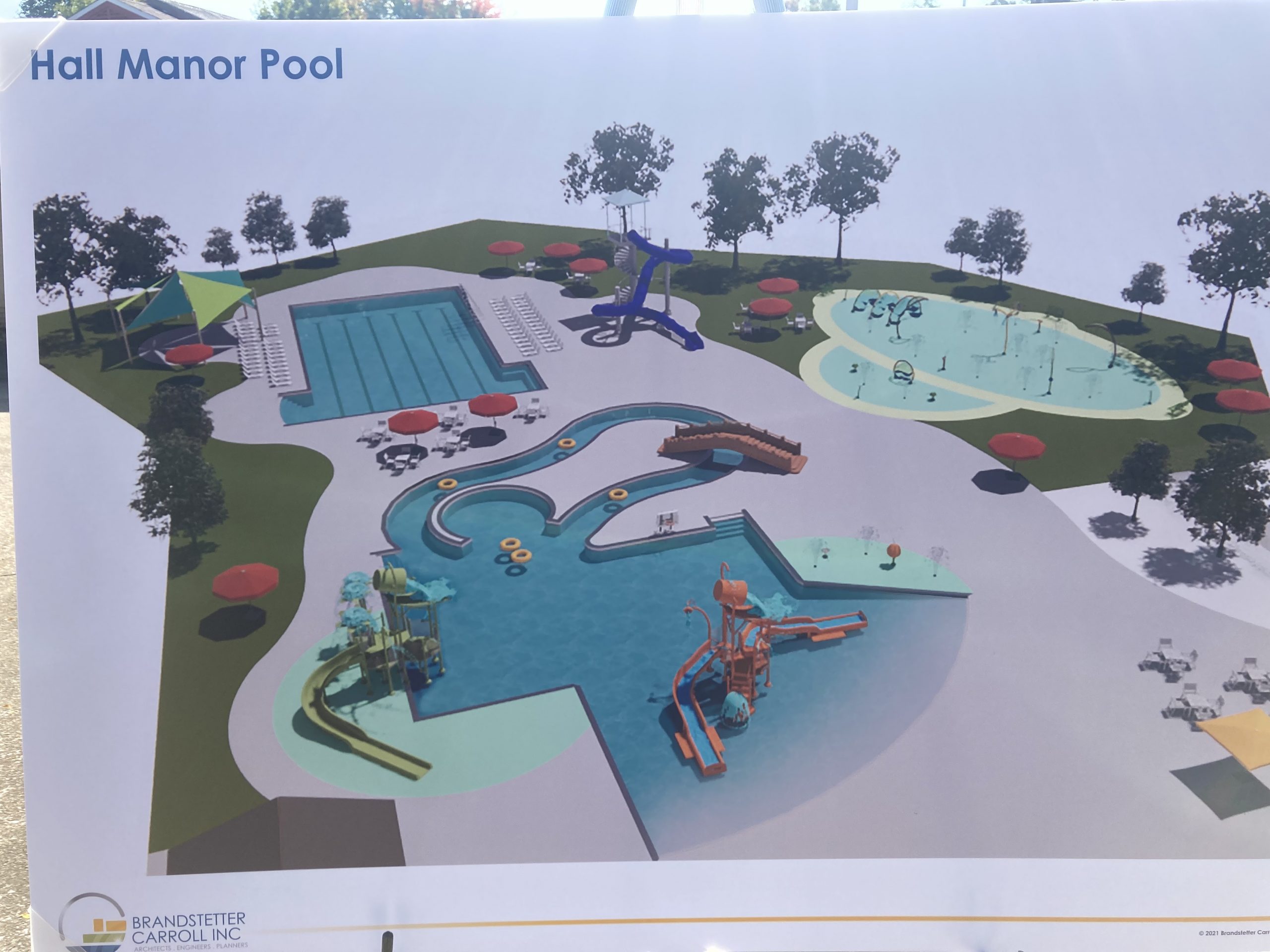
Proposed plans for the Hall Manor pool

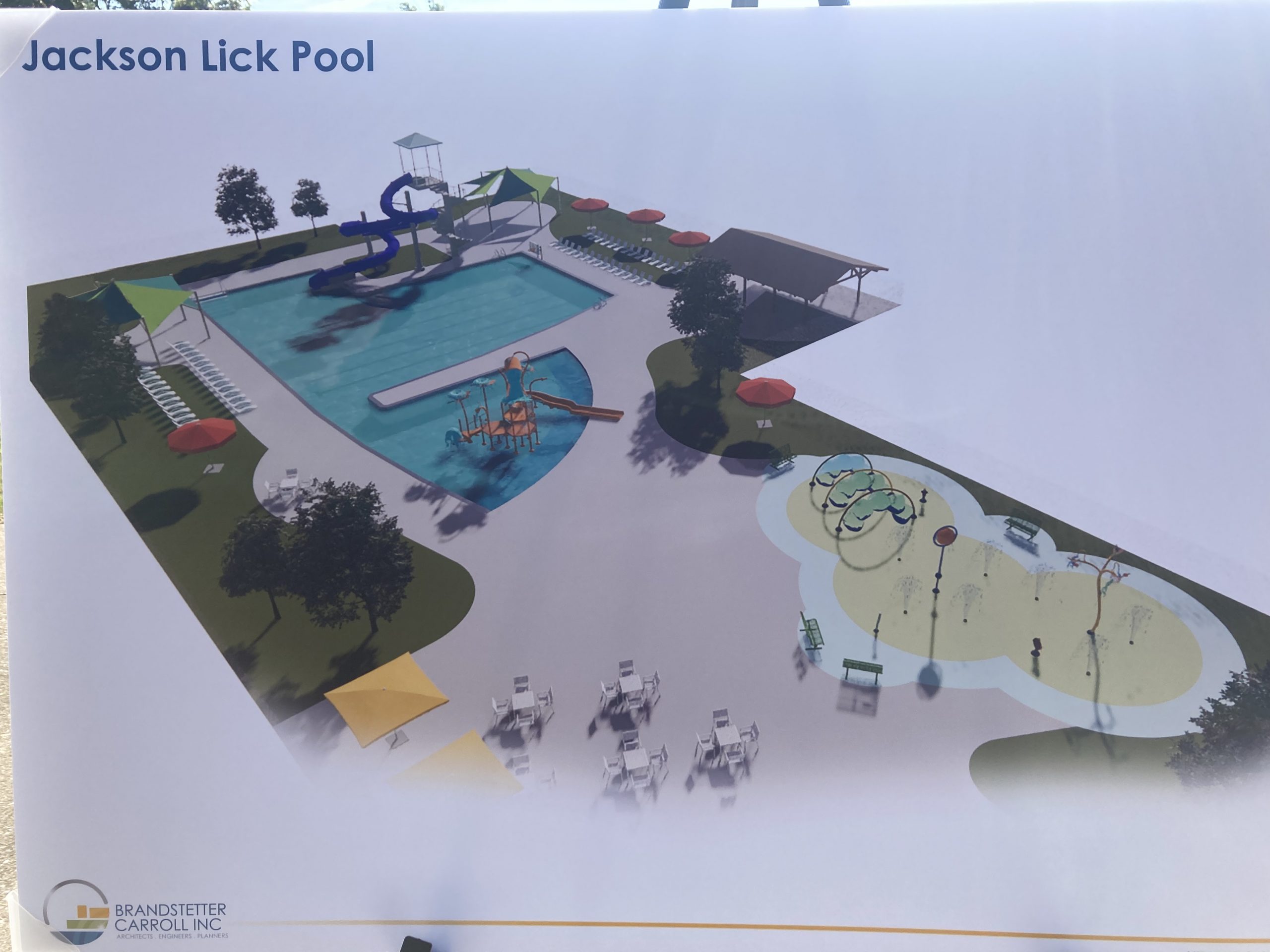
Proposed plans for the Jackson Lick pool

Harrisburg has worked with engineering firm Brandstetter Carroll Inc. to draw up plans for the pools that include water slides, splash pads, lazy rivers, picnic pavilions and lap pools, among other features. Pool houses will be reconstructed, as well.

“The constant feedback from the community has been just how important the pools are to our civic life,” Papenfuse said. “The community would like to see these pools reinvigorated for the next generation.”

He added that, for the past eight years, the city has conducted various studies on the pools. While there has been demand for the pools, the city has never had the funds to reconstruct them, but rather, patched and repaired wherever they could over the years, Papenfuse said.

Both pools have been closed for the majority of the past two years due to COVID. The Jackson Lick pool only opening briefly this past August, after facing a shortage of lifeguards. Parks and Recreation Manager Kevin Sanders said that he thinks finding staff will continue to be an issue even after the reconstruction.

Papenfuse said that the construction would take about three years to complete and that they would stagger work on the pools so that one is always open.

Admission to the pools would be free during construction and for at least a year after, Papenfuse said.

The new pools, Papenfuse said, would last for years to come.

Under the rescue plan fund guidelines, there are rules for how the money can be used. Papenfuse said that this project complies.

“The pools are going to benefit some of the folks who were affected by COVID the most,” he said. “It’s about racial equity; it’s about social justice.”

Harrisburg’s City Council would need to approve the plan, which Papenfuse said he will propose as part of the 2022 budget. He said that he has spoken with members of council about his plan.

“I think they will be very supportive,” he said.

City Council member Westburn Majors said that he had a brief conversation with Papenfuse last week, but that overall, communication with the administration has been lacking.

“It’s extremely frustrating that the first time we formally hear about the plans, it’s at a press conference,” Majors said when reached by phone. “Since the rescue plan money got passed, I have repeatedly asked for the administration to have a conversation with council.”

Majors said that, historically, council has been supportive of renovating and keeping the pools, even when the administration has pushed replacing the pools with splash pads.

“I don’t think anyone is opposed to looking at pools as an option,” he said. “But I want to have a larger conversation. Everyone should have a stake in how this is spent.”

Several other council members have voiced concern about the lack of communication, as well. Most recently, council member Danielle Bowers publicly shared her sentiments towards Papenfuse at a legislative session on Tuesday.

“We are ready and waiting to meet with you to discuss a spending plan for the American Rescue Plan funding that makes sense for the longevity of the city,” she said. “My colleagues have politely inquired about the mayor’s absence and have received radio silence.”

In addition to the pool proposal, Papenfuse has also discussed using about $12 million more in the federal funding to create a guaranteed income program. Under that initiative, the city would provide monthly payments to possibly thousands of qualifying low-income families for a multi-year period, he said.

In addition to the online survey, residents can comment on the pool proposal at various outreach opportunities throughout the city.

The dates for outreach pop-ups are listed below:

  • Oct. 14, from 2 to 6 p.m. at the Broad Street Market
  • Oct. 15, from 8 a.m. to 12 p.m. at the Broad Street Market
  • Oct. 16, from 8 to 11 a.m. at the Broad Street Market and from 1 to 4 p.m. at Capital Rebirth’s Superhero Day on City Island
  • Oct. 23, from 8 to 11 a.m. at the Broad Street Market and from 1 to 5 p.m. at Southside Fiesta-Hall Manor Apartments

To complete the pool survey, click here.

Support quality local journalism. Become a Friend of TheBurg!


Continue Reading

Harrisburg plans to open Hall Manor, Jackson Lick pools in late June

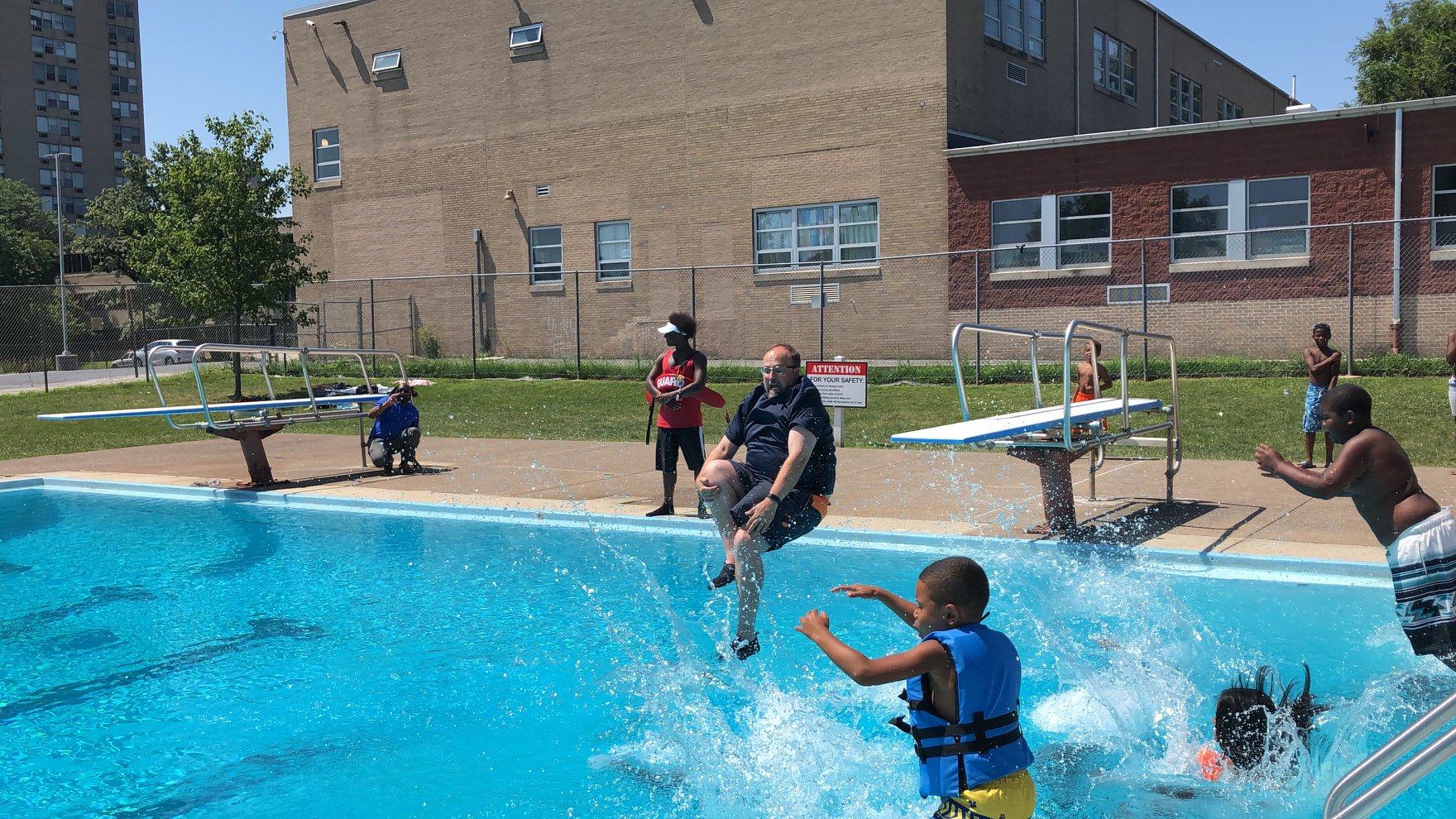
Harrisburg Mayor Eric Papenfuse celebrated a day of free swimming at the Jackson Lick pool in July 2019.

Harrisburg expects to open both its municipal pools next month in a step towards a post-COVID summer.

According to the city, the public pools at the Jackson Lick and Hall Manor housing complexes will likely open for swimming by late June.

“The city is looking forward to opening both pools this year for residents to enjoy,” said Dave Baker, the city’s parks and facilities director.

The two pools were closed for the 2020 season, due to the pandemic.

In previous years, the city has wrestled with how to keep the 53-year-old pools up and running. In recent years, both have been repeatedly patched and repaired, leading to delays and closures.  Harrisburg has considered completely renovating both pools, but decided the multi-million-dollar price tag was too high.

Harrisburg has explored more affordable options, such as replacing the pools with spray park/splash pad installations.

Nonetheless, the pools will open for the 2021 season, according to the city, which is now testing the pool facilities and training staff.

When the pools do open, COVID-19 safety guidelines and protocols will be followed, Baker said.

The Jackson Lick pool is located at 1205 N. 6th St., Harrisburg and the Hall Manor pool is located at 1413 South 18th St., Harrisburg. For more information, visit the city’s website.

Support quality local journalism. Become a Friend of TheBurg!

Continue Reading

Fieldwork

On Monday, around lunchtime, the reporter left the Harrisburg Hilton and started walking towards the Hall Manor pool.

He had no idea how long it would take to walk there. The farthest he’d gone south on foot from city hall was to a fire at Paxton and Cameron. On the map, which he poached via the Hilton’s Wi-Fi, it looked pretty far.

He passed the historical society and the shuttered Paxton fire station. At the I-83 off-ramp, he headed left over the railroad tracks, which for the moment carried no trains.

He was surprised at how accommodating the route was to pedestrians. Everything in sight seemed designed for cars: used car lots, a gas station, the wide-laned roads. It was a car’s, car’s, car’s world, as some Paul Simon-James Brown hybrid might have sung.

And yet the paint was bright on the crosswalks, and drivers respected the walk signal. At 13th, where the overpass crosses the highway, a dump truck with a sputtering diesel engine stopped dead on the ramp, yielding the right of way.

Why was he walking to the Hall Manor pool? Because the new mayor was going to get wet there. Who doesn’t want to see the new mayor get wet?

The pool had been closed for several years. It was leaking. Earlier that summer, though, the mayor scraped together money from a federal grant program for repairs. The pool was supposed to open in August, and the city put out feelers for contractors, but nobody bid. The opening was delayed.

The reporter was not good at predicting these things. In July, he wrote a story about how the pool would soon be open. To help tell the story, he went to the other city pool, east of the Broad Street Market. He drifted through the empty bathhouse, bought a sno-cone, and stood around the perimeter, creeping people out.

The reporter crossed over the highway and was very suddenly on unfamiliar ground. To his right was a grid of barracks-like apartments, connected by pale tributaries of sidewalk. Clotheslines were strung up between them. In the middle distance, a woman swept her stoop. To his left was a school.

He headed up Hanover Street into Hall Manor proper. More barracks, more hanging clothes. He walked up a vein of gold dirt, worn down by people cutting over the grass to save time. The grass was strewn with hundreds of empty potato chip bags, glittering like candy.

At last, he arrived at the pool, where news crews were setting up cameras. He wasn’t sure how, but he planned to record video on his phone, take photos and take notes in his notebook. He hoped he had enough attention left over to actually experience what was going on.

Soon the mayor arrived, in gym shorts and a T-shirt. The T-shirt, not really surprising, was still a relief. A shirtless mayor could be traumatizing.

The mayor and a member of his cabinet, similarly attired, chatted warmly with the gathered officials and members of the media. Two buckets were filled with water, then with ice, and left to chill. Everyone gave speeches, about the buckets and about the pool. Then the council president climbed a ladder.

“Eenie, meenie, miney, moe,” the council president said. She dumped one bucket on the cabinet member, whose note to himself seemed to be, A man shows no emotion. Then she dumped a bucket on the mayor, whose note was, It’s OK to scream.

They jumped in the pool. They toweled off. The mood was festive. The pool would reopen officially next year.

The reporter wanted to go back by a different route. He headed north to Sycamore, finding himself all at once in a lovely, tree-lined neighborhood. He came upon a corner bar, neon beer signs in the window of a brick-colored, split-block façade.

He went inside. Three ladies at the bar, nursing Miller High Lifes, looked him over. He took a stool and ordered a lager. One of the ladies suggested he was FBI.

He was not FBI, he said. He was a reporter. He was up here for the event at the pool. Where the mayor was getting wet—

They were not concerned about the wetness of the mayor. They were concerned about the pool. Kids had drowned in that pool, they insisted. The fence was too low.

“Drain that motherfucker. Drain it,” one of the ladies said.

The bartender did not think the city should drain it. He thought it should put barbed wire on the fences and a tarp over the water, or else it would freeze in the winter and kids would sneak in and break through the ice and drown.

The woman nearest the reporter, who wore a leather jacket and glasses, said she used to put a pool out in front of her Hall Manor apartment, even though it wasn’t allowed. “You’d think I had the Hall Manor pool,” she said. “Kids would come from all around.”

On the wall of the bar was a list of barred people. PINEAPPLE JUICE FOR MIX DRINKS ONLY, a sign underneath the list said.

The bartender began to reconsider his position. Perhaps a tarp would not be so good, he reasoned. Kids could walk out on it, get tangled up, and drown. “Yep, a tarp is more of a problem,” he concluded. “But that’s just one man’s opinion.”

What was the reporter trying to achieve here, crouched with his preposterous notebook in the middle of the afternoon in a corner bar? He thought about it and couldn’t come up with an answer. He settled up, stepped out into the sunshine, and headed down the hill.

Continue Reading

Swimming Lesson: A brief history of Harrisburg’s public pools.


Screenshot 2014-07-30 21.14.24“My hungry body’s burning for a swim,” the Jamaican-born Harlem Renaissance poet Claude McKay wrote in his poem “Thirst,” from his 1922 collection “Harlem Shadows.” For city dwellers in the midst of a hot summer, there’s no relief quite as sweet as jumping into a pool. And yet, for the past few summers, Harrisburg residents have had only one city pool in which to swim.

That’s expected to change this month, as the city plans to reopen the pool at Hall Manor after making some short-term repairs. The Hall Manor pool, at the end of S. 18th Street in south Harrisburg, was closed in 2012 due to leaks, and, according to city engineer Wayne Martin, it will also require extensive concrete work and a new paint job before it can be used. The necessary repairs, which began in July, represent part of an estimated $210,000 in renovations to both pools planned over the next year, to be paid for out of federal community development funds.

The administration of Mayor Eric Papenfuse announced the renovations in late June, shortly after the launch of its “Summer in the City” promotional campaign. “We chose the pools because we consider them critical to our public safety strategy as well as our summer enrichment strategy,” Papenfuse said, when asked about the project at a press conference in July. “We need two pools just to handle the demand. But also, we want to give kids and families something productive and happy to do.”

The other city pool is on N. 6th Street in Midtown, located behind the Jackson Lick public housing apartment towers and the Ben Franklin School. Both pools were substantially renovated in the late ‘90s. The initial investment will yield scant returns this year, as the Hall Manor opening, expected to be around Aug. 15, will only provide for two weeks of swimming before the summer ends. But, according to Martin, the repairs planned over the next year should extend the pools’ useful life by between 10 and 15 years.

“The Hall Manor pool has been closed for years, just neglected and forgotten about, and we said, ‘No, we’re gonna make fixing it a real priority.’ And it looks like we’re going to be able to get it up and running,” Papenfuse said. “We think that’s a wise investment of city dollars.”


Harrisburg undertook the construction of its two pools in the spring of 1968, under Republican Mayor Albert Straub.

“Big Al” Straub, whom the journalist Paul Beers, in a column in the Patriot-News, once described as “a senior-citizen sex symbol with a square jaw and a silver mane,” had taken office that January. Not unlike the current mayor’s initiative, the Straub administration’s efforts formed part of a citywide investment in recreation. Over the next year, the city would pledge more than $1 million—including $150,000 from a private donor—towards constructing the pools and developing playgrounds at seven city locations.

The recreation project came at a time of change and unrest. The city itself was shrinking: the U.S. census reported a loss of nearly 10,000 residents in the 1950s, and another 11,000 in the 1960s. On April 4, three months into Straub’s term, Martin Luther King, Jr., was assassinated. That summer, the school district, having been cited for “racial imbalance” by the state Human Relations Commission, drafted a plan to bus black students into three predominantly white schools. Less than a year later, pupils at John Harris High would boycott an afternoon assembly on the basis of, as Beers later wrote, “inadequate recognition of the recent Black History Week.” Harrisburg’s race riot flared only a few months afterwards.

The Hall Manor pool’s construction was delayed one year, but the Jackson Lick pool opened on Aug. 9, 1968, a Friday morning. At the time, the Jackson Lick apartment towers housed families with children, and in the days leading up to the opening, a residents’ association had raised safety questions in connection with the pool’s chain link fences, which some parents worried could be hopped by children. The association was also irked over a “complete lack of communication between the city and the tenants,” according to its president, Helen Moore. By opening day, the city had assuaged Moore by promising to post a night watchman at the pool and by inviting association leaders to sit with other city officials on opening day.

According to a report the next day in the Patriot, Straub led a 20-minute ceremony under a “hot noonday sun.” Perhaps in apology for construction delays, he announced that the public could use the pool free of charge for the remainder of the season. (Full admission prices would take effect the following summer—25 cents per visitor, or $8 for a family season pass.) While the mayor spoke, “kids and some parents stood impatiently by in swimming togs waiting for the program to end.” When it did, the report adds, “approximately 300 children entered the pool in 10 minutes.” Moore, of the residents’ association, remarked that she’d “never seen a happier bunch of children.”


On a recent weekday, during a few days’ break from summer temperatures, the men’s locker room at the Jackson Lick pool was empty. An inch-deep pool of standing water sat at the feet of a row of stalls. Outside, on the walk to the pool, a man named Andre sold sno-cones and candy out of a small garage. Andre owns a furniture store on S. Cameron Street, one of several businesses displaced by the massive fire at a nearby vehicle salvage business in May. At the snack stand, he said, he was merely standing in for the head of the operation—his 10-year-old daughter.

The Jackson Lick pool sits on a sloping rectangle of scrabbly grass in the shadow of the tinted-glass PHEEA building. On the other side is the Ben Franklin School, whose windows face directly onto the pool. In May, you would think this would prove a form of torture for the middle-school students, except that the pool isn’t filled until the school year ends. (Maybe it’s a form of torture anyway.) A pair of managers watched from under a sun umbrella, while perhaps 20 or 30 children, many from a nearby daycare, splashed around, tossed Nerf footballs, or dove from the boards. Behind them, a smaller, circular wading pool, filled, but with a broken pump, sat unused, its floor growing a brown-green fuzz.

It was a peaceful day, with lifeguards lazing at their posts and objects on the periphery—a crumpled stretch of fence, a dusty picnic table—looking quaintly timeworn. Nonetheless, the pool has seen its share of excitement over the years. Across the street, Keith Myers, a maintenance supervisor for the Harrisburg Housing Authority, reminisced about some of the wilder times. “Kids would sneak in at midnight, throw their towels over the fence,” he said. He recalled the discovery, several years back, of large bags of marijuana in the attic of the bathhouse, a gun battle that left bullets in the side of one of the apartment towers, and, most peculiarly, a deer bolting out from what used to be a woodsy patch adjacent to the parking lot.

Myers started with the housing authority in 1982. A year or two before, the organization had removed families from the southern tower, named for Alton W. Lick, and converted the building into apartments for people over 55. Before then, the tower had attracted gang activity. “Mayor Reed was calling us ‘Hall Manor in the sky,’” Myers said. The northern tower, named for C. Sylvester Jackson, was vacated in 2004 and is currently under renovation. Both of the buildings have 13 floors, which, in defiance of the superstition, are labeled 1 through 13 in the elevators. For the convenience of residents, many of whom are disabled, a wheelchair ramp was added to the Jackson Lick pool during a renovation in the 1990s.

In 1998, the city introduced a pool program that had nothing to do with swimming. Called the “Get Hooked on Fishing Derby,” it involved filling the pool with striped bass after it had closed for the season in September. In 2006, according to a press release from the office of former Mayor Stephen Reed, the city dumped in 1,100 12-inch stripers, 30 of which had been tagged with the names of various city celebrities. Anglers who hooked them would receive a special prize.

Bob Herman, the president of Capital City Bassmasters, the local BassPro Shop’s house fishing club, recalled that his members would team up with the city to help young fishermen manage their rods. “It was a mess,” he said. “You can imagine, kids around a swimming pool…we’d have, like, 20 kids at a time all tangled up.” The event was abandoned in later years, as the city’s deepening fiscal crisis led to a budgetary clampdown.

The present-day pool prices—$5 per visitor, $150 for a family of six—can make the city pools’ early years seem like ancient history. And, as far as I know, Harrisburg has no imminent plans to fill the Jackson Lick pool with stripers. But, for the first summer in a while, if only for a few weeks, it should once again have a second pool.


Continue Reading