
Tag Archives: Erika Eberly

Burg Review: Buckle up for a night of throwback romance at Gamut’s “Pride & Prejudice”

Serendipitously timed with spring flowers bursting forth from the ground, Gamut Theatre brings us the 18th century romantic comedy soap opera “Pride & Prejudice” by Kate Hamill, based on the novel by Jane Austen.

The classic story is couched within the bygone era when women dropped their handkerchiefs, required chaperones when traveling, and courting was a relentlessly pursued business. Back then, being an accomplished woman meant excelling in embroidery, music and languages. Although societally weakened during that time period, addressing their husbands formally as “Mr. So-and-So,” strong women characters emerge throughout the play. And while the romantic costumes and setting hint at a cozy kind of love about to bloom, the courtships instead seem rushed and desperate.

Although not the protagonist, the main character responsible for setting the mood is Mrs. Bennet (Amber Mann), as “ma-mah” a high-strung, overdramatic, “vulgar country mother.” While obsessively matchmaking, she reduces her five daughters to their attributes, as one would do when selling a horse, jewelry, or any other commodity. In contrast, her husband, Mr. Bennet (Jason Samarin), purposefully back-seats his involvement. They are the epitome of a mismatched pair, shipped hurriedly, long ago. Throughout the play, ma-mah push-push-pushes toward repeating the pattern five more times. Mann creates a powerful matronly figure who takes over the stage whenever she steps on it.

The lone daughter who mostly resists the idea of matrimony is Lizzy (Grace Hoover). While she plays the sensible sister, Lizzy doth protest too much, until the formulaic “will they or won’t they” of rom coms inevitably gives in to “they will.” And she does, with the disagreeable, perfectionistic Mr. Darcy (Sean Adams), whose character develops as broodingly heated in that taciturn manner of the “strong but silent” archetype. Bluntly honest, Mr. Darcy’s words dig into Lizzy’s skin until they hit the bone. (His backhanded proposal reminds me of my beloved husband, Mr. Kopp. There’s something so hot about the unattainable and emotionally unavailable, no?) While all others are hurriedly pairing off, Mr. Darcy is the lone one wondering, “How does one ever know if they’ve made the right match?”

The obvious onstage chemistry between Hoover and Adams progresses, with telling body language that pauses a little to gather momentum, building each time they interact, then finally spilling over at the end.

But I’m getting ahead of myself – putting the wedding before the “I love you,” as it were, much like the characters in Austen’s world.

Although you may need a dance card to track who’s who within the large-ish ensemble cast, all the actors performed well, and those who twirl through the choreographed ballroom dancing in frilly costumes (Jen Kilander) score extra points with me. If you listen closely to the notes of the ballad, you may recognize a contemporary hit or two. If I’m honest, (and I am), I would have traded several scenes of the giggly gaggle of squabbling Bennet girls to see more of that elegant dancing. When together, the girls sounded shrill and chaotic, like a pre-teen girls’ sleepover. It’s no wonder Mr. Bennet relegated himself to reading his paper.

In lively sub-plots, Mrs. Bennet engages in a constant rotation of schemes to marry off her five girls. Erin Shellenberger plays the diffident Jane as a steady character, trying to win the affections of the wealthy Mr. Bingley (Kevin Willis). A constant target of her mother, Mary (Maggie Haynes) reminds me of Ally Sheedy in “The Breakfast Club,” bringing a grunting, off-putting intensity that keeps other people at bay. She stands out from her younger sisters Kitty (Allie Willhouse) and Lydia (Alexandra Fazzolari), the latter of whom plays a convincing alcoholic.

To add to the sisterly commotion, Mrs. Bennet needs one of the sisters to marry their cousin, Mr. Collins (Matthew Hogan), an eloquent preacher who knows his way around a thesaurus. Lt. Wickham (Dom Hernandez) appears as a charming and attainable option for the Bennet sisters. I think Lizzy might have considered him if Mr. Darcy hadn’t kept showing up every few scenes to annoy her.

The Bennet sisters aren’t the only choices for the suitors of the day. Charlotte Lucas (Abby Carroll) presents a weird rivalry as all the girls assume their marital places. I admit, it threw me off when Mrs. Bennet called her “horse faced.” Ms. Carroll is quite lovely, and I had trouble picking her out of the lineup.

Although Lady Catherine (Gabriella DeCarli) has a small role, she makes her presence big as the most objectionably wicked of all the cast members. DeCarli infuses her character with enough haughtiness to make me want to reach down from my seat in the balcony and smack her makeup off her face. In the same vein, Miss Bingley (Erika Eberly), more subtle in her nastiness, made my plus-one wonder aloud, “Who does she think she is?”

Some soap operas span over years, but this play only lasts a little over two hours. During your theater immersion, make time to read the director’s note in the program. Francesca Amendolia penned a thoughtfully written essay about perfection and love – not love as a complete ideal, or even an aspirational goal, but as a forgiving verb. Take those paragraphs home with you, and allow the timeless theme that is love to penetrate your senses. Never thee mind if your head’s senses don’t quite align with your heart’s sensibilities.

P.S. If you go, Gamut Theatre has a small request of you. Because one of the cast members has severe allergies, they request that you please leave any items containing mint, menthol or lavender at home. This may include perfumes, cough drops, tiger balm and chewing gum.

“Pride & Prejudice” runs March 9 to 24 at Gamut Theatre, 15 N. 4th St., Harrisburg. Find more information at https://www.gamuttheatre.org/pride-and-prejudice.

If you like what we do, please support our work. Become a Friend of TheBurg!

Continue Reading

Burg Review: Narcisse Theatre makes a deal with the devil in splendidly gloomy “Dr. Faustus”

When my family visited Germany several decades ago, our hosts took us to several medieval torture museums, castles with dungeons and chains, and a tour of the concentration camp remains in Dachau. The itinerary of our so-called relaxation time raised the question, “Is this really how we wanted to spend our family vacation?”

That same ilk of gloomy question hangs over Christopher Marlowe’s tragic play “Dr. Faustus,” set in late 16th century Germany, except that the protagonist asks, “Is Hell really where I want to spend my eternity?”

All jokes about my hellish vacation to Germany aside, Director FL Henley and Narҫisse Theatre Company deliver us an appropriately evil show full of gloom and serious questions to grapple with.

Although Doctor John Faustus (Chris Gibson) is already professionally accomplished, he longs for more in terms of material wealth and power. With a waxy necromantic spell book in hand and a pentagram chalked onto the floor, he conjures the devil to make a deal: to have Mephistopheles (Erika Eberly) do his bidding for 24 years, at the conclusion of which he will trade his soul.

Gibson delivers the audience an exceptional Dr. Faustus, with inner dialogue exploding onstage in strings of soliloquies, with some of them in Latin. Gibson infuses his character with a brash sense of pride, making him unlikeable and unsympathetic. Then later, his vulnerability and desperation make him only slightly less so.

In contrast, the dark energy Eberly brings to Mephistopheles is more of a slow burn. Until it isn’t. Aloof and cunning, she bides her time, playing along with Dr. Faustus, accommodating his every whim. Until she doesn’t. Often, it’s the deliberate mannerisms and gestures that Eberly gives her character that say even more than her dialogue.

There are but a few lightning bolts of comedy in “Dr. Faustus,” although they are straight from the gallows. Benvolio (Daniel Hutchins) is a boorish drunk who trades vengeful barbs and jabs with Dr. Faustus. Throughout all Benvolio’s antics, Hutchins nails this character with self-righteous indignation as his leading emotion.

In a spirit of mentoring, learning and community building, this play features a cast of enthusiastic novice actors amongst the more seasoned, with a few actors even making their theater debuts. Particularly excellent was the convincing (and sometimes intentionally slow-motion) stage combat, as well as the portrayals of the Seven Deadly Sins (Tai Allen, Aaron Bomar, Daniel Hutchins, Kamden Fowler, Eric Richardson, Linde Stern and Benjamin Wesley) shown in the shadows of demonic orange light.

It would be simple for any of us to remain on the outside of Dr. Faustus’ experience and judge it. We may vow that we would never strike a deal with the devil. Why would anyone trade 24 years of pleasure for a lifetime of torture? But Henley reminds us that a devilish deal need not be made officially. If we step inside Faustus’ character and think about the time and other parts of ourselves we trade for the material wealth we accumulate on earth, we might dig deeper to find compassion for Dr. Faustus’ sin of pride.

This legend/play brings forth other serious questions about grave topics: morality, repentance, personal fulfillment, desire, choices. Those are for you and your plus-one to pore over during the “third act,” complete with poured coffee and your choice of angel food cake or devil’s food cake.

“Dr. Faustus” is Narҫisse Theatre Company’s first production in their new space. The outdoor courtyard setting lends additional spookiness, especially when combined with the macabre castle setting and being surrounded by things that go bump in the night. May you all make it home from the theater a half hour before the devil knows you’re dead.

“Dr. Faustus” runs Sept.1-3, 6-9 at Narcisse Theatre Company, 312 Chestnut St., Harrisburg, in the theater’s new courtyard. Find more information at www.narcissetheatre.org.

If you like what we do, please support our work. Become a Friend of TheBurg!

Continue Reading

Burg Review: Raise a glass to the gloomy, thoughtful “Thistle & Salt”

J. Clark Nicholson, Michael Bush & Ryan Hicks. Photo by John Bivins Photography.

In stark contrast to the rollicking, Kelly green, American version of Ireland that comes alive this time of year for St. Patrick’s Day, Gamut Theatre and Narҫisse Theatre partner to present a grimmer slice of Ireland from the turn of the 20th century.

“Thistle & Salt: The Ireland of J.M. Synge,” is formatted as two one-act plays: “Riders to the Sea” and “In the Shadow of the Glen.”

While the Gaelic language is itself lyrical and lovely to the ears, and Synge carefully composes his characters’ dialogue like a song, the themes and plots of his stories were surely written with ink distilled from the muck at the bottom of Galway Bay. The drips and drabs of humor that peek out from the covers is so dark, it’s dank.

We don’t meet the Irish literary renaissance poet John Millington Synge, but his contemporary, William Butler Yeats (Clark Nicholson), narrates Synge’s 37 short years. Yeats relays the story that executors found Synge’s papers. Of great concern to Synge himself: He did not want “good things destroyed or bad things published in haste.”

Both plays move slightly slowly, but you’ll need that built-in lag time for your brain to process the dialogue, which is thick at times. For being of a gentler pace, Synge’s works are not cozy. His sets his glum characters in circumstances both morose and sparsely mundane.

“In the Shadow of the Glen” is a tale of physical survival amidst mental anguish. Nora Burke (Erika Eberly) is stuck in a loveless marriage to a cantankerous old man. She is equal parts “afeared,” lonely for affection, and entrenched in resentment while doing all the chores. When it appears as if the husband is freshly dead and laid out in the parlor, Nora has a suitor already lined up. Then A Tramp (Ryan Hicks) knocks on her door one stormy evening.

Eberly and Hicks display a perfect amount of foreshadowing, subtle chemistry and trust between strangers. And Daniel Burke (Michael J. Bush) is darkly funny as the maniacal husband who is so bored that he cruelly pretends to be dead just to amuse himself.

“Riders to the Sea” is a dramatic, suspenseful story about succumbing to nature. Grieving mother Maurya (Susan Banks) is riddled with fear about losing more sons to an ocean that has already claimed four of them, her husband, and her father-in-law. Banks, along with daughters Cathleen (Madison Eppley) and Nora (Abby Carroll) reach deep into their innards to portray the torment of fresh grief that simultaneously rips scabs off old wounds of loss.

The gutting action in this play spares no feelings, showing the raw materials for a coffin propped against the chimney, as well as fresh contents for that coffin. Bravo to Bartley (Matthew Hogan) for lying absolutely still, and brava to Kim Greenawalt and Eberly for their keening (mournful wailing) skills.

Sláinte to all the actors for preserving the intent of the Gaelic language while still modernizing it to help the audience follow along. The Gaelic brogue is inherently a bit mumbled and slurred no matter the amount of alcohol the characters consume, so check your program’s glossary when you need subtitles. The language is poetry, but it demands your attention to fully absorb it.

The plays double down on the depression all the way through to their gloomy endings. Because these plays do not end happily, and they further leave the audience wondering how the characters’ lives unfold after the proverbial curtain falls, these one-acts were natural choices for Director FL Henley and his penchant for presenting plays with “no happy endings, and sometimes no endings.”

Both Gamut Theatre and Narҫisse Theatre take risks in the assortment of theater they produce, diving into obscure and/or difficult material, as well as thoughtful experimentation. In this partnership, both companies push the boundaries to deliver us something authentic – an un-sanitized, un-romanticized Ireland, un-celebrated with a parade or green beer.

“Thistle & Salt: The Ireland of J.M. Synge” runs until March 19 at Gamut Theatre. Find more information at www.gamuttheatre.org/ and on Facebook.

If you like what we do, please support our work. Become a Friend of TheBurg!

 

Continue Reading

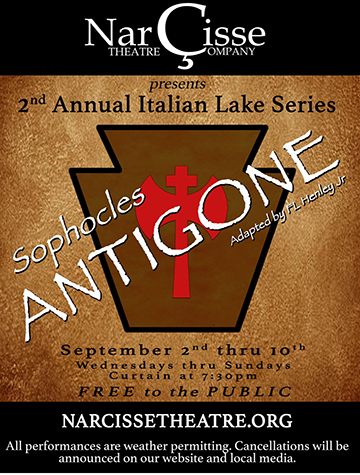
Burg Review: With “Antigone,” Narcisse Theatre presents ancient drama for modern times

Narcisse Theatre kicks off its theater season old school (read: ancient school) with a classic tragic play from Sophocles circa 441 B.C.

The story of “Antigone,” adapted by Artistic Director FL Henley, Jr., is an overt commentary on contemporary politics, a political manifesto urging theater-goers to the polls.

I won’t lie. The play made me mad. Discomfited. Pained in places.

And that’s exactly what the play is designed to do.

With a play as old as “Antigone,” its themes are as relevant today as they were 2,400 years ago: absolute power corrupting absolutely, the danger of pride upheld above all other values, man’s laws vs. God’s (or gods’) laws, and ethical questions in handling unjust laws.

While Sophocles wrote his characters to the issues of his day, and even threw in a plague for good measure, centuries’ worth of audience viewers can easily call to mind their own examples of unjust laws, tyrannical rulers, and “what would you do” ethical situations. (As a Catholic school veteran and a mostly functioning member of a dysfunctional family, the allegorical lines don’t even need be political.)

Speaking of dysfunctional families, we find our tragic anti-heroes in the aftermath of a civil war. Remember Oedipus from Freud’s theory? This play is about his children, who are also technically his nieces and nephews. Although Oedipus’ daughter Antigone (Erika Eberly) acknowledges her grafted family tree as part of her internal struggle, more pressing is her determination to bury her brother Polynices properly, and she wants her sister Ismene (Caitlyn Davis) to help her.

The new ruler, Kreon (Marc Lubbers), has proclaimed Polynices to be a traitor, that he should remain unburied and un-mourned. With Antigone set to marry Kreon’s son, Haemon (Stiles Everett), the conflict layers itself. Even Kreon’s Senators (Joel Colvin, Chris Krahulec, James Mitchell, Adam Bateman, Sara Foster, Sarah Vermeulen, Caitlyn Davis, Daniel Hutchins, and Stiles Everett) and Kreon’s own wife Eurydice (also Chris Krahulec) point out that the law is unjust, and seems to be aimed at Antigone.

Eberly and Lubbers are standouts in passionate character interpretation, complete with well-timed, red-faced, sputtering line delivery. Evenly matched and motivated by their conflicting convictions, neither backs down from the other, feeding off each other’s heated dynamics.

In the wake of the main conflict, the play’s soap opera style then yields room for more restrained roles. Davis plays Ismene as a hesitant, frightened woman firmly set on playing by the rules, even if unjust. Stiles also finds themselves among the high drama, although they display their fury through the process of character development, a volcano erupting at just the right time.

Although Narcisse’s “Antigone” is purposefully timed with the upcoming November elections, it feels as if political platforming through the theater medium has more bluntly saturated year-round plays that used to be solely entertainment, to the point where audience viewers receive an almost constant stream of entertainers’ political agendas. Henley isn’t trying to be sneaky about it, or even slightly subtle. He is in your lap (in the program, that is), telling you who not to vote for and why.

You can get riled up like I did, for any combination of characters’ actions or inactions, your personal political stances on any point of the spectrum, or a memory triggered of an elementary school principal who gloated about filling your young life with rules that still make no earthly or heavenly sense. The fact is that there are no easy resolutions in the themes “Antigone” surfaces. I imagine what’s hard to do is watch this play and feel any semblance of contentment.

“Antigone” makes good on Henley’s promise of all Narcisse productions: “There are no happy endings. We want you to leave with uncomfortable questions. We don’t put a bow on it for you.”

“Antigone” runs Sept. 2, 3, 4, 7, 8, 9, and 10 at Italian Lake Park, with shows starting at 7:30 p.m. Admission is free, with donation suggested. Bench seating is available, and you can bring your own lawn chair. (Bring insect repellant, too.) Find more information at www.narcissetheatre.org and on Facebook.

If you like what we do, please support our work. Become a Friend of TheBurg!

Continue Reading

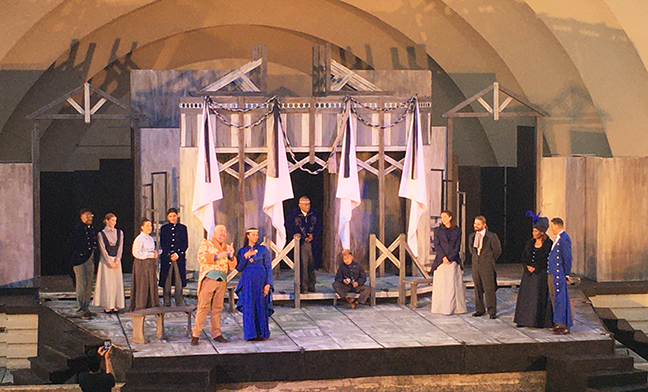
Burg Review: Gamut, Narcisse offer a fresh, fascinating take on Shakespeare’s “The Winter’s Tale”

Free Shakespeare in the Park returns with “The Winter’s Tale” at the band shell in Reservoir Park.

In its 29th year of presenting Free Shakespeare in the Park, Gamut Theatre has partnered with Narcisse Theatre Co. to present the experimental, “The Winter’s Tale.”

This tragicomedy has little to do with cold weather and everything to do with changing seasons – a metaphor Director Clark Nicholson attributes to the sometimes unexpected and abrupt shifts we encounter in day-to-day life.

Presenting “The Winter’s Tale” outdoors amidst smells of sunscreen and insect repellant is intentional comedic irony from Gamut, in stark contrast with the play’s heavy beginning. The only cold things you’ll find then are the icy relationship between Sicilia’s King Leontes (FL Henley, Jr.) and his very pregnant wife Queen Hermione (Erika Eberly), and the cold-blooded murder and intrigue that ensues.

As soon as the heavenly intro music ends, plucking at your mood like sad violins, the conflict smacks you straight away. Leontes sees Hermione giving King of Bohemia Polixenes (Michael James Kacey) extra attention. At first, Leontes delivers veiled, passive-aggressive subtext to his wife. It escalates quickly into aggressive-aggressive. Blinded by rage, Leontes accuses Queen Hermione’s unborn child of being a bastard, physically attacks Hermione during her trial, and then orders the Queen and her accused lover Polixenes murdered. Their son, Prince Mamillius (Zahar Georgievskiy), is killed in the crossfire, and Leontes exiles the newborn to be consumed by the elements.

Even if the iambic pentameter dialogue format confuseth thee, you can easily pick up what Henley is laying down in his body language, voice tone, facial expressions, and interactions with the other characters. You can see the scorn steaming off his scalp. His dialogue is filled with Elizabethan-era words we need to bring back, such as hobby horse, bedswerver and cuckold. The first two are Leontes’ fancy way of saying that his wife is, well, promiscuous. The final word refers to his shame about it.

Leontes’ court advisors recognize he is abusing his power. Paulina (Jenni Chavis) brings a strong presence to the impassioned court physician and advisor to King Leontes. She chastises him for his vengeful behavior, especially his decision to reject the newborn princess. Camillo (Christopher Ellis), who was supposed to be the cupbearer carrying out the murder of King Polixenes, warns him instead.

The very tail end of Act 1 is when the comedy kicks in, and it carries through Act 2. Its comic relief helps us recover from that grim Act 1. Fast-forward 16 years, and the banished princess is all grown up. She has lived as a normal person among Bohemians in colorfully mismatched costumes, like a neon patchwork of humble folks who have a knack for fashioning something happy and useful out of very little.

The lighter mood shift is our reassurance that Princess Perdita (Sydney Crutcher) has led a good life, and we learn she’s found love with Florizel (Jimmy Kohlmann), Prince of Bohemia. Their marriage ceremony flows seamlessly with Bohemia’s sheep shearing party. Almost all loose ends are tied up at the end, with the plot mystically and beautifully foraying into the spiritual realm. (We inwardly hope that King Leontes, despite his treachery, is Perdita’s father. Otherwise, that family tree just became a wreath.)

Although Gamut Theatre remains committed to incorporating Shakespeare’s original verbiage, the actors do take some liberties in interpreting their characters, a choice that Gamut’s Executive Director Melissa Nicholson supports. It’s a reminder that The Bard’s dialogue isn’t only for the erudite.

For example, the Shepherd (Jeff Wasileski) and the Clown (Josh Miccio) could have been acting their scenes at a hillbilly camp somewhere in the deep South. And Autolycus (Joel Colvin) has an overpowering Bronx accent. The Shepherd breaks character to deliver funny, tension-easing, contemporary one-liners.

Part of the romance of sitting outside to absorb live theater is the Reservoir Park venue, complete with a fresh coat of paint on the band shell, the familiar cracks and crumbles a blight of the past. Whenever the lighting (Tristan Stasiulis) shifts within the band shell, the set, props and even the flooring change color. With no lighting, the stage looks chalky and distressed. But the right lighting gives it an iridescent quality, like a mysterious crystal pirate ship sailing off and landing in an enchanted forest. The lighting in the spiritual realm is particularly inspired.

Nearing the end of his life, the Bard likely wrote the end of “The Winter’s Tale” with a kinder quill than perhaps the corners of the love triangle deserved. The themes find timeless relevance and resonance within humanity of any era: love and revenge, redemption and reconciliation, mistakes you can’t undo, and leaders coming to terms with accountability. Those who abuse their power will eventually have to answer for their actions, even if their consequences aren’t immediate.

If you go, bring a lawn chair, umbrella, lawn blanket, sunscreen, insect repellant and your flexibility. Weather may foil the plot, but the interloping background noises become part of the three-hour experience.


Gamut Theatre’s Free Shakespeare in the Park, “The Winter’s Tale,” runs June 3 through 18, Wednesdays through Saturdays, in Reservoir Park, 100 Concert Dr., Harrisburg. Admission is free. To really get your Shakespeare on, Gamut will present “A Midsummer Night’s Dream” on June 22 through 24, and Narcisse Theatre will perform “Antigone” on Sept. 2 through 10 at Italian Lake, Harrisburg.

If you like what we do, please support our work. Become a Friend of TheBurg!

Continue Reading

Poetry in HBG: Local poets heal, find meaning through putting pen to paper

Erika Eberly

Picture this. A poet finishes reading her newest work in a dimly lit basement. The audience doesn’t snap, as is customary for these kinds of gatherings, but just claps. Revolutionary. It’s almost poetic in itself.

The not snapping, the plastic-cup-of-alcohol drinking, the incense burning—it all sets the scene for Thursday nights at H*MAC in Midtown Harrisburg.

On my right sits a guy in a hoodie and trucker hat, on the left, a young woman in a cheetah print dress and cheetah print jacket, and across the room, an older man in a matching set—fur hat, fur coat and fur leg warmers.

Amy Trout

The self-professed “leader of this ragtag group,” Amy Trout, steps onto the stage in her pink beret hat. She recites a poem that starts out about men bothering women at a bar and ends with the scathing realities of sexual assault and its victims who aren’t always believed. She speaks intentionally fast and passionately. And then, ding. She taps the bell on the string-of-lights-wrapped podium, signifying the end of the poem.

Ringing the bell is one of only two rules of the poetry-reading group. The other is that you can’t apologize. Throughout the night, only one person slips up on that rule, and the group catches it. Lastly, the readings are uncensored—a fact that the group seems to take pride in, that you can get on stage and say whatever you want. You have a captive audience.

These are the Blacklisted Poets of Harrisburg, a group that Trout formed as a continuation of the former Almost Uptown Poetry Cartel, which ended in 2021 when its organizer retired.

One thing I learned from the Thursday night reading was that poetry takes many forms and is very diverse in its expression. That’s something you’ll see evidenced in the Harrisburg poets featured in this story. However, poetry seems to serve mostly the same purpose for writers—it’s therapy. And after the past few years that we’ve had, who couldn’t use a little therapy?

 Cathartic

Thursday night’s poetry reading covered every topic—the backstabbing ex, the loss of a loved one, the love affair and entitled men. Ding. Also mental health, science, pregnancy and God. Ding. Then some that either I wasn’t artsy enough to comprehend or just didn’t quite make sense. Ding.

Anthony Honorowski, aka hoodie guy, was the third to step on stage after science poems guy.

“When you come here, you can let it out and express anything you want,” Honorowski told me earlier that night.

That hasn’t always been his experience, he explained, especially during his time in the military.

“It’s very ‘grin and bear it,’” he said. “A lot of stuff gets bottled up.”

At the reading, he shared a poem about a girl who he met in a psych ward.

Honorowski, now an EMT, has seen how the pandemic has affected mental health—it’s affected his own. What was already an issue for him, caused him to spiral during COVID. But through the poetry group, he found release.

“It was a very liberating experience,” he said of his first time reading in front of the audience.

Erika Eberly has had a similar experience. She’s been part of the poetry group since 2017, when it was still the Almost Uptown Poetry Cartel, although she’s been writing since she was 7.

“Poetry has always been a way of getting something out there,” she said. “It’s cathartic, releasing and healing.”

Eberly is also a local actress and has performed with Harrisburg’s Narçisse Theatre Company. But there’s something about the vulnerability of poetry that allows her to fully express herself, she said.

“I always tried to put on a happy face,” she said. “But it’s good to lay yourself down naked sometimes.”


Juelz teaching poetry classes.

Literary Legacy

As opposed to the Blacklisted Poets, oftentimes, Harrisburg-native Julian “Juelz” Davenport’s one rule is to censor when reading poetry. It makes sense since he’s regularly reading to young, impressionable minds at local schools.

Davenport has published several poetry books that share his experiences growing up in poverty, witnessing violence and spending time in prison, among other things. He writes to heal himself, but also to help those in the same situations that he once was in.

“I don’t want the kids to go through what I once went through,” he said. “I wish I knew then what I know now.”

Davenport has taught poetry workshops at several area elementary, middle and high schools, including the recently opened STEAM Academy charter school in Harrisburg and Milton Hershey School. He has also visited several juvenile detention centers and youth programs.

“What I’m teaching them is to take what’s inside them and to bring it out,” he said. “I didn’t know how to place my feelings when I was younger. A lot of them are experiencing the same things.”

Davenport even wrote a poetry book specifically for children that encourages kids to have dreams, to stand up to bullies, and accept their peers despite differences.

Davenport has big plans for his poetry and brand, IME Vision, with new books on the way and plans to continue teaching poetry classes to adults and students.

But it all started when he first put pen to paper, as a young man writing letters to his father in prison.

Basil “BooBee” Talib had a similar experience of writing to incarcerated family members.

The Brooklyn, N.Y., native had a rough childhood, he said. His mother died when he was 5, and he never really knew his father.

Talib’s “Aunt Easy” raised him, cared for him, and taught him how to face his fears, he said. She also taught him street smarts: never touch someone’s food, money or girl. Those come in handy, he said.

In his youth, Talib fell in love with the works of writers like Langston Hughes and Malcolm X. They sparked something in him, and he began to write poetry himself.

“I felt like that was the only person that listened to me—that paper,” he said.

When Talib was incarcerated, he continued to write, sharing spoken word poems with other inmates and writing for the prison newsletter.

“In my poems, I share things that I would’ve never shared,” he said. “Without poetry, I would be a ball of rage.”

These days, Talib is a single dad of two sons and coaches their basketball team at the Camp Curtin YMCA in Harrisburg. He has written eight poetry books and speaks at churches, retirement homes and nonprofits, among other places. He has also participated in the American Literacy Corp.’s “500 Men Reading” event. And if you ever ride the public bus in Harrisburg, you might find one of Talib’s poems resting on a seat. He tends to do that, his son Zahkee told me—carry a bunch of print-outs around in his backpack, leaving one here or there for someone to find. Talib just wants to inspire.

“I’ve done so much negative in my life, but why can’t my legacy be positivity?” he said. “When I talk to people, I want to make a lasting impact.”


Gardens

Back at H*MAC, the bell dings again. One poet leaves the stage, making room for Taylor Lagyak. When she first joined the group, she had just given birth to her first child and needed a creative outlet. The first time she read a poem, she spoke fast—she was nervous. During a critique group, the other poets advised her to slow down, that they couldn’t understand what she was saying.

But she’s come a long way. On Thursday night, she recites her poem, “I Don’t Need No Hype Man.” It’s all about confidence.

American poet Marianne Moore once said that “poetry is the art of creating imaginary gardens with real toads.” What has inspired a lot of the Blacklisted Poets, as well as Davenport and Talib, is real pain, mistakes and trauma. It’s even what brought most of them to poetry in the first place. But through poetry, on their terms, they’ve turned those toads into gardens.

A selection from Davenport’s poem, “Young Entrepreneur,” exemplifies this:

Something in us sets us apart from the rest.

Ambition is key to the ignition for what beats in your chest.

Failure is just a fuel for actions or just a tool to build every vision that’s been

thought up by you.

I dropped this little note to keep you on your path.

Go get it!

Be persistent, create your own thing and make it last!

Ding.

For more about Julian “Juelz” Davenport and to purchase his books, visit www.iamjuelz.com. To contact or book Basil “Boobee” Talib or purchase his books, email him at [email protected]. For more information on the Blacklisted Poets of Harrisburg, find them on Facebook.


If you like what we do, please support our work. Become a Friend of TheBurg!

Continue Reading

Burg Review: Playwright Paul Hood bares his painful youth in Narcisse’s raw family drama, “Kill Keller”

Brave is the writer who rips open his painful life story to expose all the scars, to re-open all the old wounds.

Local playwright Paul Hood shares his own R-rated teenage years with Narcisse Theatre audiences in “Kill Keller,” his graphic memoir of growing up in Allison Hill in the 1990s with his abusive stepfather Keller (Aaron Bomar).

H*MAC’s snug, basement-level performance space offers the perfect setting for the play, as audiences symbolically enter Hood’s cramped childhood home, complete with decades-old salvaged furniture, a leather whoopin’ strap hanging on the wall, and a velvet Jesus portrait.

Although the vibrant colors of the huge portrait occupy a lot of wall space, Keller’s constant rants and harsh demonstrations of control reflect his rejection of any power higher than himself. Keller humiliates, manipulates, criticizes and beats his stepsons Naudain (Isaiah Brown) and Maclay (Stiles Everett) over their every action and non-action. This sets up a family dynamic in which the boys can’t win. And they weren’t meant to.

Keller is unlikeable in every way, leaving the audience wondering if there is redemption for him. Keller’s only hope for mustering any sort of sympathy is his vulnerability from poor health, and if you have a soft spot for caustic people who suffer from addiction.

Hood’s life story is told through everyday family life situations that are purposefully repetitive, exposing damaged relationships between all the family members. I lost count of the number of times Keller sent Naudain to the store to buy cigarettes, how many times Mom (Erika Eberly) told Naudain to wash the dishes while his older brother Maclay sat on the couch, how many times Mom prioritized her need for affection over her sons’ safety. A silent character is the boys’ biological father, a military man who abandoned the family and whose toxic presence is frequently mentioned.

The turning point in the story comes when Maclay joins the Marines, and Keller’s health problems escalate. This shifts the underlying forces between all the characters, including Reverend Niel (James Mitchell) whose presence only seems to amplify the brokenness. Every scene is weighty with fight-or-flight decisions.

The actors’ body language and repellent reactions toward each other reveal a blended family unsuccessful in bonding together, tromping through metaphorical eggshells all over the stage floor, with any love they might feel shown in a selfish or guarded way. The play is disturbing all the way through to its unsettling end.

Director FL Henley said of Narcisse plays, “No happy endings. And sometimes no endings. We want you to leave with uncomfortable questions. We don’t want to put a bow on it for you.”

Henley assured the audience that, in real life, actor Bomar is one of the nicest people we could ever meet, and he really wanted to play a baddie. Bomar played his role so well that I will probably cross to the other side of the street if I see him around town.

Hood, who felt afraid at first to put something so emotionally raw into the universe, experienced catharsis in writing the play. He said, “I needed to work through stuff that happened with my stepfather. Writing helped me move past the trauma. Even if I almost gave up on the play, even if we almost never performed it, writing it was my therapy.”

I had the privilege of sitting next to Hood during Act I of the play. In way too many scenes, I felt like bending his 6-foot-plus frame down and resting his bald head on my heart. I wanted to re-mother him properly–to hug his inner child hard, to build living room forts with him, and to give him a dog he could keep.

During the final round of applause, I felt my entire body unclench, and I started to fully breathe again. I didn’t realize how tense the atmosphere felt until that moment.

You will want to stay for the talkback after the show. That will give you the opportunity to find some necessary comic relief in the loving and respectful interplay between the actors, to hear their individual and collective journeys (one of which was a significant death in the family that unfortunately delayed the play’s premiere this past November), and to discover the supportive family that is Narcisse Theatre.

“Kill Keller” runs Jan. 14, 15, 21, and 22 at 7 p.m., and Jan. 16, 23, and 30 at 2 p.m. in the Harrisburg Midtown Arts Center (H*MAC). Find more information at https://www.narcissetheatre.org/ and on Facebook.

Continue Reading

Burg Review: Deep truths, deeper questions probed in Narçisse’s reality-bending “Rashōmon”

A scene from Narçisse Theatre Co.’s “Rashōmon,” playing at Italian Lake Park

I could point to any number of issues that people disagree vehemently about.

Whether it’s the latest conspiracy theory or debating the color of a dress with strangers over the internet, everyone brings their unique perceptions and levels of argumentative passion. With most issues, you can agree to disagree at the point of impasse, and then move on with your life.

But when four unreliable witnesses give drastically different first-hand accounts of a rape and murder, and someone may be put to death over the crime, that’s not a debate easily shrugged off. We have to dig into motivations behind those alternative realities and the unfortunate mutability of truth, or “truth.”

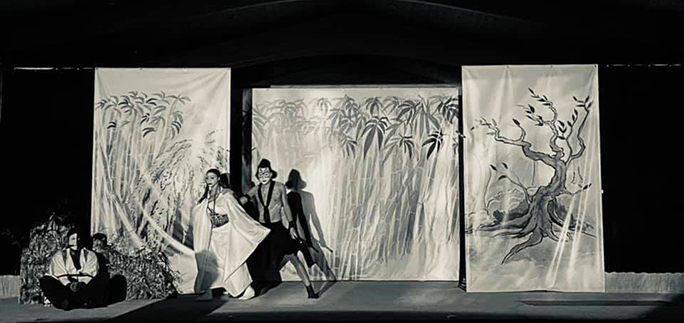
Different versions of the “truth” spin like ancient fake news in Narçisse Theatre’s season opener, “Rashōmon,” a psychological thriller from a 1950 film set in 8th-century Japan. Told through traditional kabuki theater style, four eyewitnesses describe a rape and murder scene from four drastically different points of view. One character even comes back from the dead through an African tribal dance to give their account.

Before we meet any of our eyewitnesses, we first meet the three people waiting at the gate of Rashōmon: the Priest (Samuel Eisenmuth), the Wigmaker (James Mitchell) and the Woodcutter (Aaron Bomar). Think of these three as the talking heads of the day, both narrating and analyzing the story and all its points of view. They serve as the fact-checkers of their day, intermingling their own biases. Like sinister magpies perched on a clothesline, their gossip and judgments continuously oscillate the truth along a spectrum.

Our four eyewitnesses/participants in the crime scene very capably demonstrate their talents for high drama, especially in the stage combat scenes. Tajomaru (the bandit, played by Stiles Everett), Kimune (the wife, played by Erika Eberly), Takehiko (the samurai, played by Paul Hood) and the Woodcutter (Bomar), all convincingly pull distinctive elements into each version of the story to alter it enough, yet still make each somehow believable.

Along with the ever-shifting truth is audience sympathy that head-hops depending on who the perceived victim is, and which truth presents as stronger. In discerning the truth, it’s important to note the cultural norms of the day regarding suicide, honor and the lack of a #metoo movement. Our own lenses do not necessarily bring the picture of 8th-century Japan into sharp focus.

The somber lighting and shadows on-set are symbolic of the hazy understanding intended for “Rashōmon.” The monochromatic visual elements of the settings and costumes hit notes of an incredibly elegant KISS concert with much more intentional choreography (Yuko Hamada and Dena McKell) and traditional, sometimes discordant Japanese music by Jonathan Frazier. Within a world we wish could be all black and white, we see smatterings of gray thrown in, intentionally symbolizing subjective reality.

Artistic director and founder of Narçisse Theatre Company, FL Henley, chose this play “in response to what I saw when looking at society during the lockdown… a society split between those living in an objective, unpleasant reality and those choosing to live in an alternate reality comprised of a blending of tribalism, demagoguery and personal belief.”

The play’s Wigmaker said, “Let’s not argue about right and wrong while we are hanging in here.” But it’s not so easy for the rest of us to agree to disagree. One of Henley’s goals is to make audiences “feel challenged, uncomfortable, walking away with the types of questions that cause psychological distress.”

Mission accomplished on making the audience think about deeper existential questions, and well done to all the performers for translating a difficult concept into something tangible for the audience. My plus-one and I are still spelunking deeper implications of truth v. perception via our longest text thread ever, and our list of questions is growing faster than any forthcoming answers. This play will undoubtedly leave its mark on you, too.

P.S. The story left an impression on the psychological community when it first aired in 1950. After the film, the phrase “Rashōmon Effect” entered our cultural lexicon, describing an instance when the same event is described in significantly different (often contradictory) ways by different people who were involved. The more you know.

“Rashōmon” runs Sept. 10 and 11, each evening at 7:30 p.m., Italian Lake Park, Harrisburg. Don’t forget to bring lawn chairs, insect repellant and a little something for the donation bucket. No ticket or reservation needed. Find more information at https://www.narcissetheatre.org/ and on Facebook.

If you like what we do, please support our work. Become a Friend of TheBurg!
Continue Reading